An exploration of Dialectical Behaviour Therapy-informed occupational therapy in mental health, in South Africa
Abstract
BACKGROUND: There is an increasing trend of occupational therapists incorporating Dialectical Behaviour Therapy (DBT) in their interventions for Mental Health Care Users (MHCUs). Despite its growing popularity, there is a paucity of literature describing how DBT is used within occupational therapy practice PURPOSE: The study aimed to describe the current use of DBT-informed occupational therapy by South African occupational therapists working with clients with mental disorders METHOD: Using a qualitative design descriptive, 17 semi-structured interviews were conducted with South African occupational therapists using the DBT approach in mental health practice. An inductive thematic analysis of the qualitative information generated in the interviews took place FINDINGS: Three themes emerged from the data analysis: (a) Potential challenges, (b) Why DBT? (c) Training influences practice CONCLUSION: The themes identified in the study highlight both the potential and challenges of incorporating DBT-informed approaches within occupational therapy, emphasising the need for further research in this area Implications for practice • It is recommended that occupational therapists who want to use DBT to inform their practice obtain a post-graduate DBT qualification. • To remain within the scope of occupational therapy, the occupational therapist should focus their treatment plan on specific skills that the MHCUs need to participate in occupations that are meaningful to them. • It is also very important that the occupational therapist communicate their treatment focus to other team members, to avoid confusion or overlap. • The occupational therapist who implements the DBT approach should clinically reason from an occupational science approach. This would mean designing a client-centred treatment plan in a manner which is accessible to the MHCU, enabling specific skills that will meet the MHCU's occupational needs. • Further research in the use of DBT in occupational therapy is necessary.
training influence; DBT-informed approach; good health and well-being; psychologically compromised; psychological treatment approaches; third-wave psychotherapeutic techniques
INTRODUCTION
According to the World Health Organization, mental illness is one of the leading causes of disability1. When psychologically compromised, as is the case with mental disorders, intrinsic emotional factors such as emotional regulation may prevent an individual from effectively engaging in meaningful occupations or doing2-5. Therefore, to optimise the occupational well-being of mental healthcare users (MHCUs) affected by mental disorders, it becomes important for an occupational therapist to focus on the client factors, such as emotional regulation, that are inhibited by illness as part of a holistic intervention programme.
Various psychotherapy treatment modalities for mental disorders have been researched and developed over time, ranging from psychoanalysis to behaviourism6. Dialectical Behaviour Therapy (DBT) forms part of relatively new collection of psychological treatment approaches termed third-wave psychotherapeutic techniques, which all primarily focus on a person's relationship to their thoughts and emotions7.
The first author has experienced that occupational therapists in South Africa are adapting and using the traditional DBT programme in practice, although the details of this integration remain unknown. More specifically, there is no published research on DBT-informed occupational therapy within South Africa. It is not understood how and why DBT is being used in South Africa by occupational therapists in mental health. This indicates that any iteration of DBT-informed occupational therapy lacks a foundation in evidence-based practice and may instead be considered practice-based and evidence-informed. This also indicates a lack of uniformity in the DBT-informed occupational therapy interventions presented, which may lead to confusion among MHCUs and medical aid funders. Thus, the question arose: how is the DBT approach being used to inform occupational therapy working in mental health in South Africa?
To begin answering this question this article aims to describe the integration of this approach within occupational therapy and the current utilisation of DBT-informed occupational therapy by South African occupational therapists to facilitate occupational engagement in clients with mental disorders. This is achieved by describing the knowledge, attitudes, and practices of occupational therapists working within the South African mental health field.
The symptoms of mental disorders are experienced by individuals as primarily negative and distressing, described in more severe cases as having a tyrannical power over life0. These symptoms influence client factors and act as a barrier to participation in activities of daily living (ADL), instrumental activities of daily living (IADL), health management, rest and sleep, education, work, play, leisure, and social participation10. Conversely, occupational engagement supports health and wellness2,9. Both notions substantiate the link between emotional factors and performance patterns, performance skills, and, ultimately, functional domains10.
To address the occupational performance challenges MHCUs face, occupational therapy is provided to individuals, groups and populations. Occupational therapy group techniques have therapeutic value for MHCUs11. An occupational therapist's skill to facilitate group dynamics to enable recovery of the MHCU can be described as an art in its own right12. In South Africa, common outcomes addressed by occupational therapists in groups include, amongst others, improved role performance, social interaction, and life skills13. A study by Soeker et al14 highlighted the value of occupational therapy groups for enabling workplace integration of forensic MHCUs.
However, despite the value of occupational therapy, some MHCUs, due to the chronic nature of their condition, experience severe symptoms that negatively impact their occupational performance15. These MHCUs are not able to perform meaningful occupations nor able to perform them to their satisfaction. Their opportunity to do (actively engage), to be (discover), to become (all that they want to be) and to belong (connect to others) is disrupted16.
The influence of the symptoms of mental disorders on occupational participation warrants the need to invest in evidence-based, client-centred, and occupation-centred mental health interventions1719. Dialectical Behaviour Therapy is a third-wave psychotherapeutic approach that teaches specific Zen-related techniques aimed at enhancing emotional and behavioural regulation20. Although initially designed for the treatment of MHCUs with suicidal thoughts or ideation, DBT has been successfully incorporated across a range of mental health settings21-23. In a quasi-experimental study with a pre-test post-test design, group-based DBT showed a significant reduction of depressive symptoms in a female substance use population24. An 18-month DBT program was effective in reducing anger and violence in a forensic population25. Dialectical Behaviour Therapy combined with trauma-focused interventions showed a reduction in Post-Traumatic Stress Disorder symptoms26. A qualitative analysis of a DBT skills training programme offered to teachers suggested that DBT may be useful in equipping individuals with social-emotional competencies, even outside of clinical pathology27. Dialectical Behaviour Therapy skills also instilled confidence in teachers fighting racism28. A 2021 study found that a shortened version of DBT successfully improved the emotional regulation of adults with Autism Spectrum Disorder, with no intellectual disability29. Although some adaptations were recommended, DBT was viewed as a feasible approach when working to improve the mental health of transgender youth30 Best practice guidelines are also available to practitioners wishing to adapt DBT for various cultures and ethnicities31. These are just a few examples of numerous studies on the DBT approach that underscore its value across various contexts and among different populations.
Literature on the adaptation and use of DBT concepts in psychology is available. However, none of these studies are embedded in occupational therapy. Thus, this study explored South African occupational therapists' knowledge, attitudes, and practices possibly using DBT in mental health practice.
METHOD
A qualitative descriptive research design with a postpositivist stance was used to gain insights into DBT used within occupational therapy in mental health in South Africa. The postpositivist perspective allows for a more balanced approach to understanding the phenomenon of DBT in occupational therapy, acknowledging the influence of both objective realities of the technique and the subjective experiences of the occupational therapists while recognising that knowledge is imperfect and evolving32. This design suited the need for an initial landscape description, asking How? before exploring specific hypotheses32. The first author conducted one-on-one, semi-structured, online interviews to gather individual perspectives and practices regarding the DBT approach of occupational therapists. The data generated was then organised into themes and used to inductively build an understanding of the current implementation of DBT-informed occupational therapy in South Africa32,33. There were no initial restrictions placed on the types of mental disorders and types of clinical settings included in this study. In intending to seek maximum variation, occupational therapists from diverse contexts of all ages, genders, cultures, fields of expertise, and years of experience were included in the study population. A strength of the inductive analysis is that it allowed for revision and redirection as the themes in this study emerged and provided a more in-depth understanding of the technique under investigation34.
Sampling method
Purposive sampling, a non-probability sampling technique, was employed by inviting all occupational therapists known to the authors who work in the mental health field to participate in the study through an email invitation32. The non-probability snowball sampling, or chain referral method, was subsequently utilised by encouraging initial participants to refer additional colleagues for an interview. This was done by asking them to resend the invitation email, ensuring that the contact details of potential participants were not shared with the research team 32,3S.
Inclusion criteria:
Occupational therapists registered with the Health Professions Council of South Africa (HPCSA) working in the mental health sector in South Africa with knowledge of the DBT approach. Occupational therapists working in the public and private mental health sector, regardless of years of experience. Occupational therapists who have access to the Internet and can receive emails and do online interviews.
Exclusion criteria:
Community service occupational therapists
Data generation methods
The authors developed an interview schedule with open-ended and detail-oriented probes to guide, rather than dictate, the interviews, ensuring flexibility in exploring participants' experiences, allowing for in-depth discussions and a richer understanding of the phenomenon32,36. Two of the authors hold a master's degree in occupational therapy with a specialisation in mental health. The primary author, a qualified female occupational therapist working in the mental health field and trained in the DBT approach, conducted the interviews.
The interview questions were arranged from simple to complex in a logical order32. A knowledge, attitude, and practice survey guideline was also consulted in preparing the interview schedule, as these three themes are relevant to answering research question37. The primary questions were direct questions regarding knowledge of, attitude towards, and practice using DBT. The probing questions were designed based on themes relevant to this study, such as training and occupational participation. Open-ended interview questions are recommended as multiple-choice answers may lead to correct guessing by participants37. If not addressed in the open-ended answers, more direct questions were asked. The primary open-ended questions referred to below were asked, with each primary question also having several optional probing questions.
Keeping the primary questions open-ended allowed for depth and allowed the participant the freedom to disclose as much or as little information regarding their methods as they desired. This is important when considering the participants' right to intellectual property in programme design. The sessions were concluded with an ethically obliged debriefing question to clarify any concerns or unpleasant experiences during the research participation process32. Participants brought forward no concerns.
Data management
The interviews were conducted in English, using Microsoft Teams software. This software also allowed for automatic transcribing and manually storing recorded interviews. Recordings were stored on the principal investigator's password-protected OneDrive account for 12 months. The average time of completion was 30 minutes per interview. No additional interviews were scheduled once data saturation was achieved, and no follow-up interviews were conducted.
Interview schedule
1. Can you describe what you know and understand about the Dialectical Behaviour Therapy (DBT) approach?
2. Could you kindly share your attitude towards the use of DBT by occupational therapists to enable occupational performance in patients with mental disorders?
3. Please explain how you make use of the DBT approach or selected DBT themes in practice?
4. Please explain why you have chosen to use DBT in the manner?
Data analysis
Creswell's six-step theory for qualitative data analysis was used as a guideline for analysing the information gathered via interviews32,33. This method of data analysis is true to the inductive design of the study, working from the ground up in this previously unexplored field. Data analysis was completed by the principal investigator using NVivo software and reviewed by the study supervisors.
Quality criteria (trustworthiness)
This research was designed to meet the four pillars of trustworthiness, credibility, transferability, dependability and confirmability38. Credibility was achieved via investigator triangulation. All the authors were involved in decision-making regarding coding and data analysis. Transferability was enhanced by describing the context in which the research occurred, to augment the descriptions of behaviour and experiences38. By maintaining the research path throughout the study and basing the analysis process on a common and tested theory described in literature, dependability and confirmability were possible33,38. The interpretation of data was approached with efforts to minimise researcher bias, supported by a documented trail of notes maintained throughout the analysis process to enhance transparency and reflexivity38. The researcher tried not to digress too much from the original message conveyed in the interviews by using quotations as far as possible.
Ethical clearance
This study was approved by the Health Sciences Research Ethics Committee of the University of the Free State (HSREC #: UFS-HSD2022/0937/2908). Before the interview, an informed consent form was distributed to potential participants as part of the invitation email. It was indicated on the form, as well as at the beginning of the interview, that participation in the interview is viewed as understanding and providing informed consent. Identifying information was excluded from the data analysis and participation was voluntary.
FINDINGS
Sampled population
A total of 17 (n=17) semi-structured interviews were conducted with occupational therapists working in mental health. Seven (n=7) of these occupational therapists interviewed have been working in the mental health field for five years or less; four (n=4) for a period between five to ten years); five (n=5) for 10 to 15 years; and one (n=1) for longer than fifteen years. Fifteen (n=15) of the participants were working in private practice, one (n=1) in the public sector, and one (n=1) at a nongovernment organisation. Ten (n=10) of the participants worked with in-patients, six (n=6) without-patients and one (n=1) with both. The study participants treated a broad range of mental disorders. Of the participants, 59% (n=10) had received formal DBT training. Participants were relatively evenly spread out across three South African provinces: the Eastern Cape, Gauteng, and the Western Cape.
Some of the participants had completed formal DBT training in the form of courses of a few weeks or days (n=11). Six participants completed basic training through the DBT Institute of South Africa (n=6).

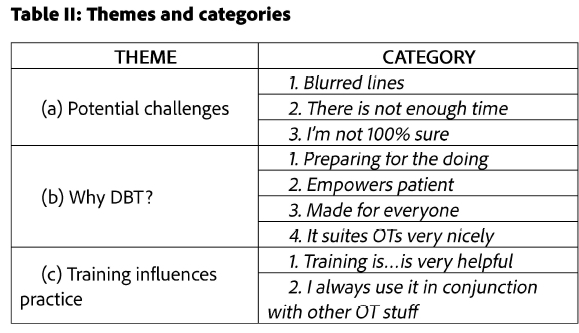
Three themes emerged from the study: (a) Potential challenges, (b) Why DBT? and (c) Training Influences Practice (Table II, below).
THEME A: Potential challenges
This theme discusses the challenging aspects of incorporating the DBT approach into practice as experienced by the study participants. Three categories are discussed. The first relates to uncertainty regarding the role of the occupational therapist. The second category is related to the large amount of content in the traditional DBT programme. The third potential challenge is the limited in-depth knowledge of the traditional DBT programme.
Category 1: Blurred lines
A key concern of participants was the differing role of occupational therapists versus other multi-disciplinary team members (MDT) and how each uses DBT to inform their practice. One participant expressed that psychologists do not understand this differentiation clearly, stating: "that's them not understanding the professional scope of practice" (Ρ1Ο).
This was seconded by another participant who stated: "they will not understand our role that we will play using it' (P5). It was recommended by one participant to: "find the line where is OTand where is psych because I often want to dive into psych" (P2); as well as by another: "don't try to take over the role of the psychologist.... focus on occupational performance areas" (P13).
This blurred line between professions was seconded by a participant who stated: "I found that I was very often grappling outside my zone of expertise" (ΡΊ7). These sentiments all surround the importance of communicating differences among the MDT Still, with MHCUs, "we just need to be careful about really being intentional about remaining in our scope and yeah, and setting those boundaries with our clients as well" (ΡΊ5). Six participants reported that or encouraged their MHCU to see another member of the MDT at the same time as they are attending occupational therapy. There was consensus among some participants that the same type of lingo or consistency with wording and practice should be used by the MDT incorporating DBT into their practice. One participant shared: "efficacy of DBT in someone's therapeutic process can be enhanced when the whole team is speaking the same language" (P9).
Category 2: There is not enough time
A second primary potential risk/challenge identified by study participants was doubt about the applicability of the DBT approach in short-term or acute settings. This doubt is two-fold. Firstly, there is much content in the original DBT handbook. Possibly too much to be utilized in a brief period. Participants stated: "it's too much information" (P17); "I question how realistic it is to expect patients to remember" (P14); "it's more practical over three four months, if not longer" (P10) and that time limits lead to "possibly not spending enough time practicing it' (P16). The second cause of doubt was that the participants reported concern over the mental status of MHCUs admitted in an acute setting and how this matches the demands of DBT. For example: "patients were actually still a little bit psychotic and then nothing works DBT wise" (P11).
Category 3: I'm not 100% sure
Most of the participants interviewed could name the four main DBT themes. Just under half of the participants spontaneously mentioned the original target population that DBT was designed for, namely borderline personality disorder. Seven participants spontaneously mentioned the creator of DBT, Marsha Linehan. All these facts are in line with DBT literature.
However, there was also some uncertainty among the population surrounding DBT background and research. This was suggested by some participants with phrases such as: "I'm not 100% sure" (P14); "DBT stands for dialectical behavioural, neh?' (P5) and "there's a bit of a lack of knowledge with regards to DBT' (P7). There was also a belief among five participants that DBT was intertwined with Cognitive Behavioural Therapy, as some participants stated: "it's a derivative of Cognitive Behaviour Therapy (ΡΊ5) and "it's based on Cognitive Behaviour Therapy (P11). Outside of knowledge of the basic premises of DBT, limited in-depth knowledge or expertise on the approach came to the fore for most participants.
THEME B: Why DBT?
All the study participants displayed a positive attitude towards using DBT to inform occupational therapy practice. There were multiple reasons for this enthusiasm.
Category 1. Preparing for the doing
The belief that DBT-informed occupational therapy enhances occupational performance was strongly conveyed by most study participants. DBT-informed occupational therapy was seen as allowing MHCUs to cope or function better when the DBT skills are applied. One participant stated that DBT helps to "improve being able to make decisions, being able to do higher order executive skills, being able to problem solve within a work environment, things like that' (ΡΊΟ), and another "their ability to perform their occupations is enhanced' (P9).
Distress tolerance and emotional regulation skills were identified as two skills well-matched to the "preparing for the doing" (ΡΊ5).
Category 2: Empowers patients
Five participants expressed motivation to utilise the DBT approach to inform their practice, as they perceived it to be empowering for the MHCUs. As stated by participants: "give patients some confidence and make them feel that they are able to tackle distressing situations" (P14); also, DBT is " bringing people back to their... inner strength" (P17); and "it really empowers patients to kind of take their own responsibility (P2). Furthermore, some participants reported observing the positive effects of the approach on the functioning of the MHCUs. One participant stated: "I've seen the effectiveness of it' (P3).
Category 3: Made for everyone
Thirteen of the seventeen participants interviewed reported that the DBT approach can be adapted and successfully incorporated for a wide range of MHCU populations. This was noted in comments such as: "I think it can be used with all mental health diagnoses" (P14); "they (the DBT skills) really are made for everyone" (P12). One participant stated that DBT is "really something that you can adapt to a population easily" (P4). This was viewed as true even for more challenging groups: "a lot of my patients aren't really receptive to other kind of skills" (P7). A range of populations with which this approach was successfully incorporated included: "substance dependency, depression, personality disorders, schizophrenia and anxiety' (P3).
Category 4: It suites OTs very nicely
Another benefit and motivator for participants using DBT was that the handbook, including handouts and activities, was seen as an "amazing tool" (P4). Participants described the approach as: "practical, it's tangible" (P15), structured and well-packaged.
Dialectical Behaviour Therapy was seen by participants as aligned with the premises of occupational therapy and falling within the occupational therapy scope of practice. One participant stated: "I feel it's very much in our scope of practice" (ΡΊ5). This was seconded by six other participants with statements such as "it suites us OTs very nicely" (P12); and "it's very OT based' (P10).
THEME C: Training influences practice
The general idea conveyed with theme C is that each study participant used the traditional DBT approach differently to inform their practice.
Category 1: Training is...is very helpful
Your training as a therapist will influence how you use a specific approach because of your level of expertise therein. Twelve participants in the study believe that additional DBT training is necessary before an occupational therapist can effectively incorporate the DBT approach. One participant stated: "some sort of training is, is very helpful.... to understand the whole picture and to really give an effective service" (P13). Another participant stated: "so there is a risk, because it is not going to be not effective, but it is not going to be as effective as it can be if someone just uses the skills in a by the way kind of manner" (PI). On the other hand, some participants did not believe that training is vital and that learning about an approach through reading and observing is possible given an occupational therapy background.
Category 2:1 always use it in conjunction with other OT stuff
The original DBT programme is not being used as-is by study participants but rather adapted according to the needs and wants of the MHCUs that they work with. This was derived from statements such as: "it's very much based on their needs" (P15) and we "need to look at what's important meaningful to the client' (ΡΊ). Adaptation is done according to grading, as one participant mentioned: "we must always do our grading when it comes to our activity choices and our presentation choices and our structuring" (P13).
The original programme is also being adapted based on the time available. For majority of the participants interviewed, this was a short period falling between a few days to 12 weeks. Therefore, condensation of the approach becomes a must. Frequently, sessions are also presented by the participants in groups.
The majority of the participants reported only using components of the theory by bringing in aspects of it or teaching certain skills as they become necessary. This was corroborated by statements such as: "I love that I can use aspects ofiL.as you go along, the opportunity will arise" (P8); and "I always use it in conjunction with other OT stuff' (P6). This is different to four of the participants interviewed who use DBT as the primary or most influential approach informing their practice, stating: "we work through the different components" (P7); "the bulk of what I use currently is DBT skills" (P1) and "DBT is one of the bigger, bigger components" -(P16).
Five of the seventeen study participants reported applying the DBT themes in a practical manner by teaching specific skills. As stated by one participant: "we will lookatmore of the functional practical implications of it in your context' (P6) and another "we don't like to just talk about it. We actually do the things" (P15). Five participants reported utilising handouts and/or worksheets when presenting DBT themes. When occupational therapists employ DBT, it is often perceived as a skills training approach, with minimal emphasis placed on the processing of emotions. As stated by one occupational therapist: "occupational therapists' role is very much in the skills training" (P17).
Some participants reported primarily utilising discussion-based groups centred on the DBT themes. As explained further by one participant: "sometimes the skills coaching, and the teaching might be the activity (PI).
DISCUSSION
The current study aimed to explore occupational therapists' knowledge, attitudes, and practices in using DBT to inform clinical practice within the South African context. These three themes are integrated into a comprehensive discussion of the key findings that emerged from the study. The information gathered during the interviews provided above provides insight into the current DBT approach within South Africa.
Potential challenges with using DBT in occupational therapy practice
Some of the challenges identified by the participants using DBT within occupational therapy practice include uncertainty regarding DBT theory and whether DBT is part of or separate from Cognitive Behaviour Therapy (CBT). In literature, DBT is described as a theoretical construct with a unique set of skills taught that differ from CBT39. However, in some published sources, DBT is viewed as a form of CBT40. DBT is distinguished from CBT in that its core focus is on the development of stress coping skills and there is radical acceptance of the MHCU which is about fully embracing painful emotions and situations without judgment, as part of balancing acceptance with change. In CBT, acceptance involves recognising and reframing maladaptive thoughts to change behaviours41. These contradictions found in literature, combined with limited research, may be a source of confusion for occupational therapists using DBT and may lead to discrepancies in practice and inconsistent MHCU care.
The attitudes of study participants highlighted several potential challenges related to the use of DBT by various members of the MDT A key concern involved the risk of miscommunication and conflict among professionals when DBT is integrated into occupational therapy practice. This underscores the critical need for clear communication from the occupational therapist about how DBT will inform their practice, specifically emphasising the differences between the adapted version of DBT and the traditional model. Additionally, these discussions should also involve the MHCU, as the relevance of occupational therapy interventions can be better understood within a client-centred discussion. Literature supports the importance of such communication, noting that involving the MHCU and MDT in conversations about DBT's role can enhance the treatment process42. For instance, explaining DBT's role, its adaptation for occupational therapy, and its benefits, such as improving interpersonal and psychosocial functioning through meaningful activities can help to align client-centred therapeutic goals across the team and with the client43.
Ideally, a collaborative approach between the psychologist and the occupational therapist will help reap the DBT approach's full benefit. An MHCU should be seeing a psychologist who processes emotions more than would be done in skills training by an occupational therapist40. This was the practice of the majority of the participants as well. Collaborating with a psychologist could prevent the need to grapple outside the scope of occupational therapy while moving through the DBT process. Although this risk is important to recognise, there might also be an opportunity when an occupational therapist uses DBT. Staying within the scope of occupational therapy, focusing on activity and occupational performance rooted in occupational science, may reveal aspects of DBT not explored by other professions43.
A second branch of the potential challenges expressed by participants was related to the length and content of the original DBT approach. According to the experiences of two participants, the acute symptoms of mental health disorders in MHCUs pose a barrier to the learning of cognitively demanding or abstract Dialectical Behaviour Therapy (DBT) concepts. This observation suggests that the cognitive and emotional challenges these individuals face during acute episodes may hinder their ability to engage with complex therapeutic content, potentially limiting the effectiveness of such interventions in this context. This finding is substantiated in the literature, which states that engaging an acutely ill MHCU in occupational therapy is challenging, particularly when it comes to appreciating the full professional potential of an intervention42. Furthermore, it has been described that establishing a life worth living (a crucial aim of DBT) would require more intensive work on behalf of the service provider in an in-patient setting44.
Given the concerns regarding the extent of content included in the original DBT design, research investigating the efficacy of condensed versions of DBT-informed occupational therapy would contribute to a better understanding of the mechanisms underlying more concise interpretations of the approach.
The benefits/motivators of DBT-informed occupational therapy for the therapist and user.
Despite the potential challenges expressed by the participants, the overarching attitude of participants surrounding DBT-informed occupational therapy was positive. The substantiation of the alignment of DBT with occupational therapy theory is built up and supported in the introduction of this article. Using the OTPF as a frame of reference, the occupational therapist can address emotional factors that may interfere with functionality10. The focus of DBT-informed occupational therapy is not psychotherapy or psychoeducation but equipping an MHCU with the necessary skills needed to return to their daily life45.
A benefit of using DBT in practice was the flexibility of the approach and its broad applicability. The promising notion that DBT can have a beneficial outcome for varying populations is supported by literature25,26,46. There is positive research in the fields of DBT for depressive symptoms, Post-Traumatic Stress Disorder, people with no diagnosed mental disorder, and the forensic population, among others25'26'30,39. The founder of DBT has also identified the potential usefulness of DBT in ever-evolving and adapted clinical settings. However, Linehan also states that further research is required to explain how DBT works in these evolving clinical setups23. It is also important to recognise that the research with successful DBT outcomes was within the psychology profession and not in occupational therapy. The lack of research on Dialectical Behaviour Therapy (DBT) within occupational therapy may hinder its understanding and application in practice. This highlights the need for DBT-focused research within the profession to support evidence-based practice and improve its integration into occupational therapy interventions.
Most of the participants reported the use of DBT in groups. The potential therapeutic value of groups has long been established. At least 175 curative factors present in therapeutic groups were empirically identified before the year 195511. Yalom identified twelve popular curative factors unique to group therapy that are still fundamental to clinical practice52. The traditional DBT skills training also takes place in groups (in conjunction with individual therapy), recognising the potential value of the group dynamics27. However, there is no literature supporting DBT-informed occupational therapy groups currently.
It would be important for the occupational therapist to consider published research suggesting that didactic teaching alone (as reported by some participants) is not effective in ensuring mental wellness long-term48. The fundamental occupational therapy therapeutic medium and outcome of meaningful activity should always be a central construct in practice. Furthermore, it will be important to investigate further how DBT relates to occupational therapy principles and what a DBT-informed occupational therapy group could look like in comparison to the standard DBT skills training group before the efficacy of such can be determined.
Variation in how DBT is being used by occupational therapists in practice
The findings of this study suggest that every participant was interpreting and using DBT differently. These differences in practice make it complicated to define what DBT-informed occupational therapy approach entails. This would be a valuable question to ground further research and discussions.
The participants reported mostly translating the original DBT approach into skills training in a group setting. This differs from the traditional DBT programme, which has additional components such as telephone contact and one-on-one therapy with a psychologist. In a study by Flynn et al46, it was reported that DBT skills training offered over 24 weeks by a multi-disciplinary team was effective in reducing binge drinking and drug use, as well as improving emotional regulation and mindfulness practice. Thus, there is a degree of support for implementing an adapted DBT program for MHCUs with dual diagnoses, which also validates the clinical reasoning of the participants in this study.
The selection and presentation of skills were not uniform among participants. Grading of the intervention was recommended. Grading by an occupational therapist is a fundamental occupational therapy technique or art that should not be lost regardless of the structure of an approach chosen47 48. It is also important to recognise that all approaches the occupational therapist incorporates in treatment are underpinned by occupational therapy or occupational science principles. One of which, recognised by participants in the study, is the occupational therapy art of grading and making theory practical and applicable to the MHCU's unique context. In all instances, the occupational therapist aims to build their intervention with and for a specific MHCU49. Considering the culture of the MHCU is crucial in the multi-cultural South Africa before applying an approach designed in the global-north3150.
If one adheres to the principle of designing an intervention plan to meet the specific needs of Mental Health Care Users (MHCUs), then a "one-size-fits-all" program, such as traditional DBT group training, would be inappropriate. A crucial requirement in designing the most effective intervention for a MHCU is the application of clinical reasoning grounded in critical thinking51. If DBT is selected by occupational therapists as the treatment approach of choice simply because it is popular or advised by an institution, this way of working could pose a risk to clinical reasoning and best outcomes for the MHCU.
Looking through the occupation-centred lens, it is possible that all four DBT themes hold relevance for the MHCU and their occupational needs and wants18. However, in situations where the DBT content as is seems not to match the client factors, it becomes all the more important for the occupational therapist to use techniques such as grading, therapeutic use of self, and clinical reasoning in order to make the intervention client-centred again19. This may mean choosing not to use DBT or choosing to use only certain techniques.
DBT is a structured therapeutic approach. Consequently, it is limited to how much it can be adapted before it deviates from its traditional form. If selected as the primary therapeutic approach, it is essential that the therapist is proficient in DBT rather than simply having a general understanding of its foundational elements. Moreover, it is crucial to acknowledge that using isolated components of DBT does not allow a therapist to claim their practice is supported by the empirical evidence typically associated with comprehensive DBT interventions. Nevertheless, the therapist could utilise frameworks such as the OTPF and principles of occupational science to substantiate the empirical integration of DBT components within their practice.
Limitations
A limitation of this study's findings is that no exact, detailed explanations were provided on how DBT is specifically used in practice. While intellectual property rights limited the access to information on specific techniques, it was still possible to describe how DBT fits within the occupational therapy framework and the general principles that guide its application. Future research may seek the connection between occupational performance and DBT-informed occupational therapy practice. Another limitation of the study was that the sample was not representative of all provinces in South Africa. This can be mitigated by employing stratified sampling to ensure that participants from each province are proportionally represented and reflect the diverse population of South Africa.
CONCLUSION
In conclusion, this study underscores the necessity for further research into occupational therapy-informed DBT and the development of a comprehensive guideline for therapists seeking to implement the DBT approach. Such a guideline should balance structure and flexibility, allowing for clinical reasoning and alignment with the principles of occupational science. Overall, the study participants who utilised DBT to inform their practice possessed a foundational knowledge of the basic DBT concepts. However, there were varying levels of expertise in the field of DBT among the participants. Many study participants recommended additional training in DBT to ensure skilled application. The prevailing attitude among participants in this study was positive regarding the integration of DBT-informed occupational therapy in South Africa. Nonetheless, some concerns were expressed regarding the challenges of multi-disciplinary collaboration.
DBT-informed occupational therapy primarily differs from traditional DBT in that it focuses exclusively on practical skills training. Participants who employed this approach reported positive outcomes while working with various MHCUs in different settings. However, within this study, participants utilised DBT in diverse ways to inform their practice, resulting in variations in intervention time frames and the balance between discussion groups and practical application sessions. These differences in practice may reflect the occupational therapist's commitment to client-centred practice. However, significant variations in practice could lead to critical challenges that would need to be addressed by occupational therapists seeking to implement this approach effectively.
Author Contributions
Mrs Itumeleng Tsatsi and Mrs Monique Strauss were involved with the following:
Conceptualization: The initial idea or design of the study.
Methodology: The development or design of the methods used in the research.
Writing: Writing the original draft and revising or editing the manuscript.
Supervision: Overseeing the study or managing the research team.
Mrs Kristy Frances Ward was involved with the following:
Conceptualization: The initial idea or design of the study.
Methodology: The development or design of the methods used in the research.
Investigation: Conducting the research or gathering of data.
Writing: Writing the original draft and revising or editing the manuscript.
Funding acquisition: Securing financial support for the research.
Visualization: Preparing figures, graphs, or illustrations for the research.
Conflict of interest
No conflict of interest was reported by the authors.
REFERENCES
Acknowledgements
The author thanks the Crouch Bursary Fund for funding this research.
LITERATURE REVIEW
-
1. World Health Organization. Mental health overview [Internet]. 2023 [cited 2023, May 17]. Available from https://www.who.int/health-topics/mental-health#tab=tab1
» https://www.who.int/health-topics/mental-health#tab=tab1 -
2. American Occupational Therapy Association. Occupational therapy practice framework: domain and process. American Journal of Occupational Therapy [Internet]. 2014;68. Available from: https://doi.org/10.5014/ajot.2014.682006
» https://doi.org/10.5014/ajot.2014.682006 -
3. Backenstrass M, Frank A, Joest K, Hingmann S, Mündt C, Kronmqller K-T. A comparative study of nonspecific depressive symptoms and minor depression regarding functional impairment and associated characteristics in primary care B. Compr Psychiatry [Internet]. 2006 [cited 2020 May 4];47:35. Available from: https://doi.org/10.1186/s41155-018-0094-z
» https://doi.org/10.1186/s41155-018-0094-z -
4. Kearns Murphy C, Shiel A. Evaluation of an intensive occupational therapy intervention to facilitate independent living and improve occupational performance and participation. Results of a longitudinal case study design. Occup Ther Ment Heal [Internet]. 2020 [cited 2021 Mar 11];15. Available from: https://doi.org/10.1080/0164212x.2020.1852149
» https://doi.org/10.1080/0164212x.2020.1852149 -
5. Christie L, Inman J, Davys D, Cook PA. A systematic review into the effectiveness of occupational therapy for improving function and participation in activities of everyday life in adults with a diagnosis of depression. J Affect Disord [Internet]. 2021 Mar 1 [cited 2021 Apr 14];282:962-73. Available from: https://doi.Org/10.1016/j.jad.2020.12.080
» https://doi.Org/10.1016/j.jad.2020.12.080 - 6. Austin Τ, Bezuidenhout C, Botha K, Du Plessis E, Du Plessis L, Jordaan E, et al. Abnormal psychology a south african perspective. Second. Burk A, editor. Oxford University Press; 2012.5-36 p.
-
7. Hayes SC, Hofmann SG. The third wave of cognitive behavioral therapy and the rise of process-based care [Internet]. Vol. 16, World Psychiatry. Blackwell Publishing Ltd; 2017 [cited 2021 Mar 10]. p. 245-6. Available from: https://doi.org/10.1002/wps.20442
» https://doi.org/10.1002/wps.20442 -
8. Connell J, Brazier J, O'Cathain A, Lloyd-Jones M, Paisley S. Quality of life of people with mental health problems: a synthesis of qualitative researc. Health Qual Life Outcomes [Internet]. 2012,-(10):7. Available from: https://doi.org/10.1186/1477-7525-10-138
» https://doi.org/10.1186/1477-7525-10-138 -
9. Wasmuth S, Mokol E, Szymaszek K, Gaerke KJ, Manspeaker T, Lysaker P. Intersections of occupational participation and borderline personality disorder: A grounded theory approach. Cogent Psychol [Internet]. 2020 Jan 1 [cited 2021 Mar 11];7(1):2. Available from: https://doi.org/10.1080/23311908.2020.1803580
» https://doi.org/10.1080/23311908.2020.1803580 -
10. Boop C, Cahill SM, Davis C, Dorsey J, Gibbs V, Herr B, et al. Occupational therapy practice framework: Domain and process fourth edition. Am J Occup Ther [Internet]. 2020;74(August):1-87 Available from: https://doi.org/10.5014/ajot.2020.74s2001
» https://doi.org/10.5014/ajot.2020.74s2001 -
11. Sherry P, Hurley J. Curative factors in psychotherapeutic and growth groups. J Clin Psychol [Internet]. 1976;34(2):835-7. Available from: https://doi.org/10.1002/1097-4679(197610)32:4%3C835::aid-jclp2270320423%3E3.0.co:2-#
» https://doi.org/10.1002/1097-4679(197610)32:4%3C835::aid-jclp2270320423%3E3.0.co:2-# - 12. Dsouza SA, Galvaan R, Ramungondo E. Concepts in occupational therapy- Understanding southern perspectives. 2017.270; 275; 277 p.
- 13. Meyer A. Trends in activity participation of mental health care users with major depressive disorder attending occupational therapy groups. University of the Witwatersrand; 2020.
-
14. Soeker MS, Hare S, Mall S, Van Der Berg J. The value of occupational therapy intervention for the worker roles of forensic mental healthcare users in Cape Town, South Africa. Work [Internet]. 2021 [cited 2023 Jun 22];68(2):399-414. Available from: https://doi.org/10.3233/wor-203381
» https://doi.org/10.3233/wor-203381 -
15. Fonseca Barbosa J, Gama Marques J. The revolving door phenomenon in severe psychiatric disorders: A systematic review. Int J Soc Psychiatry [Internet]. 2023 Aug 1 [cited 2023 Oct 19];69(5):1075-89. Available from: https://journals.sagepub.com/doi/full/10.1177/00207640221143282
» https://journals.sagepub.com/doi/full/10.1177/00207640221143282 -
16. Wilcock AA. Reflections on doing, being and becoming. Aust Occup Ther J [Internet]. 1999;46:1-11. Available from: https://doi.Org/10.1046/j.1440-1630.1999.00174.x
» https://doi.Org/10.1046/j.1440-1630.1999.00174.x -
17. Lau AS, Lind Τ, Crawley M, Rodriguez A, Smith A, Brookman-Frazee L. When do therapists stop using evidence-based practices? Findings from a mixed method study on system-driven implementation of multiple EBPs for children. Adm Policy Ment Heal Ment Heal Serv Res [Internet]. 2020 Mar 1 [cited 2020 Apr 25];47(2):329. Available from: https://doi.org/10.1007/s10488-019-00987-2
» https://doi.org/10.1007/s10488-019-00987-2 -
18. Fisher AG. Occupation-centred, occupation-based, occupation-focused: Same, same or different? Scand J Occup Ther [Internet]. 2013;20:162-73. Available from: https://doi.org/10.3109/11038128.2012.754492
» https://doi.org/10.3109/11038128.2012.754492 -
19. Carroll E. Towards client-centred practice within an occupational therapy group life skill prgram: An action research journey [Internet]. 2015 [cited 2020 Feb 14]. Available from: https://ezproxy.ufs.ac.za:8381/ehost/detail/detail?vid=12&sid=8c349ad9-a910-4a54-ae54-1c44e50fedeb%40pdc-v-sessmgr05&bdata=JnNpdGU9ZWhvc3QtbGl2ZSZzY29wZT1zaXRl#AN=ufs.11660.2300&db=ir00890a
» https://ezproxy.ufs.ac.za:8381/ehost/detail/detail?vid=12& sid=8c349ad9-a910-4a54-ae54-1c44e50fedeb%40pdc-v-sessmgr05& bdata=JnNpdGU9ZWhvc3QtbGl2ZSZzY29wZT1zaXRl#AN=ufs.11660.2300& db=ir00890a -
20. Swales M, Heard H. Dialectical behaviour therapy: distinctive features [Internet]. Second. Routledge; 2017. 6;7. Available from: https://doi.org/10.4324/9781315544540
» https://doi.org/10.4324/9781315544540 -
21. May JM, Richardi TM, Barth KS. Dialectical behavior therapy as treatment for borderline personality disorder. Ment Heal Clin [Internet]. 2016 Mar [cited 2020 Mar 11];6(2):62-9. Available from: https://doi.org/10.9740/mhc.2016.03.62
» https://doi.org/10.9740/mhc.2016.03.62 -
22. Linehan M. DBT skills training manual [Internet]. Second. Guilford Press; 2015.129;419. Available from: https://doi.org/10.1097/nmd.0000000000000387
» https://doi.org/10.1097/nmd.0000000000000387 -
23. Linehan MM, Wilks CR. The course and evolution of dialectical behavior therapy. Am J Psychother [Internet]. 2015 [cited 2020 Mar 28];69(2):97-110. Available from: https://doi.Org/10.1176/appi.psychotherapy.2015.69.2.97
» https://doi.Org/10.1176/appi.psychotherapy.2015.69.2.97 -
24. Sahranavard S, Miri MR. A comparative study of the effectiveness of group-based cognitive behavioral therapy and dialectical behavioral therapy in reducing depressive symptoms in Iranian women substance abusers. Psicol Reflexão e Critica [Internet]. 2018 Dec 25 [cited 2020 Feb 20];31(1):15. Available from: https://doi.org/10.1186/s41155-018-0094-z
» https://doi.org/10.1186/s41155-018-0094-z -
25. Evershed S, Tennant A, Boomer D, Rees A, Barkham M, Watson A. Practice-based outcomes of dialectical behaviour therapy (DBT) targeting anger and violence, with male forensic patients: a pragmatic and non-contemporaneous comparison. Crim Behav Ment Heal [Internet]. 2003 Sep 1 [cited 2020 Mar 28];13(3):198-213. Available from: http://doi.wilev.com/10.1002/cbm.542
» http://doi.wilev.com/10.1002/cbm.542 -
26. Bohus M, Dyer AS, Priebe K, Krüger A, Kleindienst Ν, Schmahl C, et al. Dialectical Behaviour Therapy for Post-traumatic Stress Disorder after childhood sexual abuse in patients with and without Borderline Personality Disorder: A randomised controlled trial. Psychother Psychosom [Internet]. 2013 [cited 2020 Mar 28];82(4):221-33. Available from: https://doi.org/10.1159/000348451
» https://doi.org/10.1159/000348451 -
27. Justo AR, Andretta I, Abs D. Dialectical behavioral therapy skills training as a social-emotional development program for teachers. Pract Innov [Internet]. 2018 Sep [cited 2020 Mar 28];3(3):168-81. Available from: https://doi.org/10.1037/pri0000071
» https://doi.org/10.1037/pri0000071 -
28. Yang Ρ, Crous Y, Balli-Borrero NA, Scott BL, Trujillo AM, Choi BY, et al. Antiracism work in schools: Using Dialectical Behavior Therapy skills to empower south Texas educators. J Am Acad Child Adolesc Psychiatry [Internet]. 2022 [cited 2022 Dec 16];61(10):1296. Available from: https://doi.Org/10.1016/j.jaac.2022.03.031
» https://doi.Org/10.1016/j.jaac.2022.03.031 -
29. Bemmouna D, Coutelle R, Weibel S, Weiner L. Feasibility, Acceptability and Preliminary Efficacy of Dialectical Behavior Therapy for Autistic Adults without Intellectual Disability: A Mixed Methods Study. J Autism Dev Disord [Internet]. 2022 [cited 2022 Dec 16];52. Available from: https://doi.org/10.1007/s10803-021-05317-w
» https://doi.org/10.1007/s10803-021-05317-w -
30. Tilley JL, Molina L, Luo X, Natarajan A, Casolaro L, Gonzalez A, et al. Dialectical behaviour therapy (DBT) for high-risk transgender and gender diverse (TGD) youth: A qualitative study of youth and mental health providers' perspectives on intervention relevance. Psychol Psychother [Internet]. 2022 Dec 1 [cited 2022 Dec 16];95(4):1056-70. Available from: https://doi.org/10.1111/papt.12418
» https://doi.org/10.1111/papt.12418 -
31. Haft SL, O'Grady SM, Shaller EAL, Liu NH. Cultural adaptations of Dialectical Behavior Therapy: A systematic review. J Consult Clin Psychol [Internet]. 2022 Oct [cited 2022 Dec 16];90(10):787. Available from: https://doi.org/10.1037/ccp0000730
» https://doi.org/10.1037/ccp0000730 - 32. de Vos A, Strydom H, Fouche C, Delport C. Research at grass roots for the social sciences and human service professions. 5th ed. Van Schaik Publishers; 2021.
-
33. Creswell JW. Research design: qualitative, quantitative, and mixed methods [Internet], third. SAGE Publications Inc.; 2009. Available from: https://doi.org/10.1002/nha3.20258
» https://doi.org/10.1002/nha3.20258 -
34. Anderson C. Presenting and evaluating qualitative research. 2010 [cited 2023 Mar 27];74(8). Available from: https://doi.org/10.5688/aj7408141
» https://doi.org/10.5688/aj7408141 -
35. Naderifar M, Goli H, Ghaljaie F. Snowball sampling: A purposeful method of sampling in qualitative research. Strides Dev Med Educ [Internet]. 2017 Sep 30 [cited 2021 Dec 16];14(3):1-6. Available from: https://doi.org/10.5812/sdme.67670
» https://doi.org/10.5812/sdme.67670 -
36. Adams WC. Conducting semi-structured interviews. Handb Pract Progr Eval Fourth Ed [Internet]. 2015 Oct 14 [cited 2022 Mar 28];492-505. Available from: https://doi.org/10.1002/9781119171386.ch19
» https://doi.org/10.1002/9781119171386.ch19 -
37. Andrade C, Menon V, Ameen S, Praharaj SK. Designing and conducting knowledge, attitude, and practice surveys in psychiatry: practical guidance. Indian J Psychol Med [Internet]. 2020;42(5):478-81. Available from: https://doi.org/10.1177/0253717620946111
» https://doi.org/10.1177/0253717620946111 -
38. Korstjens I, Moser A. Practical guidance to qualitative research. Part 4: Trustworthiness and publishing. Eur J Gen Pract [Internet]. 2018 [cited 2022 Apr 15];24(1):120-4. Available from: https://doi.org/10.1080/13814788.2017.1375092
» https://doi.org/10.1080/13814788.2017.1375092 -
39. Webb CA, Beard C, Kertz SJ, Hsu KJ, Björgvinsson T. Differential role of CBT skills, DBT skills and psychological flexibility in predicting depressive versus anxiety symptom improvement. Behav Res Ther [Internet]. 2016 Jun 1 [cited 2023 Feb 3];81:12-20. Available from: https://doi.org/10.1016/j.brat.2016.03.006
» https://doi.org/10.1016/j.brat.2016.03.006 -
40. Rizvi SL, Steffel LM, Carson-Wong A. An overview of dialectical behavior therapy for professional psychologists. Prof Psychol Res Pract [Internet]. 2013 [cited 2023 Feb 3];44(2):73-80. Available from: https://doi.org/10.1037/a0029808
» https://doi.org/10.1037/a0029808 -
41. Bass C, van Nevel J, Swart J. A comparison between dialectical behavior therapy, mode deactivation therapy, cognitive behavioral therapy, and acceptance and commitment therapy in the treatment of adolescents. Int J Behav Consult Ther [Internet]. 2014 [cited 2023 May 27];9(2):4. Available from: https://doi.org/10.1037/h0100991
» https://doi.org/10.1037/h0100991 -
42. Crouch R, Alers V. Occupational therapy in psychiatry and mental health [Internet]. 5th ed. Wiley Blackwell; 2014. 17;34;37;39;40;69;115;116;118;120. Available from: https://doi.org/10.1002/9781118913536
» https://doi.org/10.1002/9781118913536 -
43. Department of Health. Regulations defining the scope of the profession of occupational therapy [Internet]. Government Gazette. 2023. p. 39-41. Available from: https://www.gov.za/sites/default/files/gcisdocument/202303/48158rg11551gon3101pdf.pdf
» https://www.gov.za/sites/default/files/gcisdocument/202303/48158rg11551gon3101pdf.pdf -
44. Fox E. Delivering DBT in an inpatient setting. In: The Oxford Handbook of Dialectical Behaviour Therapy [Internet]. 2018. p. 1-30. Available from: https://doi.org/10.1093/oxfordhb/9780198758723.013.20
» https://doi.org/10.1093/oxfordhb/9780198758723.013.20 -
45. Νott A. Understanding and treating people with personality disorders in occupational therapy. In: Alers V, Crouch R, editors. Occupational therapy in psychiatry and mental health [Internet]. Fourth. Wiley Blackwell; 2014. p. 480-506. Available from: https://doi.org/10.1002/9781118913536
» https://doi.org/10.1002/9781118913536 -
46. Flynn D, Joyce M, Spillane A, Wrigley C, Corcoran Ρ, Hayes A, et al. Does an adapted Dialectical Behaviour Therapy skills training programme result in positive outcomes for participants with a dual diagnosis? A mixed methods study. Addict Sei Clin Pract [Internet]. 2019 Aug 15 [cited 2023 Feb 4];14(1):28. Available from: https://doi.org/10.1186/s13722-019-0156-2
» https://doi.org/10.1186/s13722-019-0156-2 -
47. Rebeiro KL, PolgarJM. Enabling occupational performance: Optimal experiences in therapy. Can J Occup Ther [Internet]. 1999 Feb [cited 2020 Mar 9];66(1). Available from: https://doi.org/10.1177/000841749906600102
» https://doi.org/10.1177/000841749906600102 -
48. Andonian L, Cara E, Macrae A. Psychological theories and their treatment methods in mental health practice. In: Cara E, Macrae A, editors. Psychosocial occupational therapy: An evolving practice [Internet]. Third. Cengage Learning; 2013. p. 128-64. Available from: https://doi.org/10.1080/0164212x.2020.1752881
» https://doi.org/10.1080/0164212x.2020.1752881 -
49. Townsend Ε, Wilcock A. Occupational justice and client-centred practice: a dialogue in practice. Can J Occup Ther [Internet]. 2004,71(2):78. Available from: https://doi.org/10.1177/000841740407100203
» https://doi.org/10.1177/000841740407100203 -
50. Daniels AL, Isaacs D. Cultural constructions of the mentally ill in South Africa: A discourse analysis, part 1. Cult Psychol [Internet]. 2023,-29(1):45-66. Available from: https://doi.org/10.1177/1354067X221131998
» https://doi.org/10.1177/1354067X221131998 -
51. Alers V. Clinical reasoning in psychiatric occupational therapy. In: Alers V, Crouch R, editors. Occupational therapy in psychiatry and mental health [Internet]. Fourth. Wiley Blackwell; 2014. p. 74-91. Available from: https://doi.org/10.1002/9781118913536
» https://doi.org/10.1002/9781118913536 -
52. Yalom ID. The theory and practice of group psychotherapy [Internet]. New York: Basic Books; 1970. Available from: https://doi.org/10.1177/105960117600100117
» https://doi.org/10.1177/105960117600100117
Reviewed: 9 September 2024
Revised: 14 November 2024
Accepted: 14 November 2024
EDITOR
Pamela Gretschel https://orcid.org/0000-0002-7890-3635
FUNDING
The research received the Crouch Bursary Fund
* Master's student at the University of the Free State at the time of the study.