Occupational therapy in adult palliative care. A rapid review
Abstract
INTRODUCTION: The Occupational Therapy Association of South Africa commissioned a task team to gather evidence that would inform the upcoming National Health Insurance policies on the role and practice of occupational therapists. This rapid review aimed to identify level 1 and 2 peer-reviewed published evidence that describes occupational therapists' practice and intervention in adult palliative care. METHOD: Systematic reviews and randomised control trials were searched for through the Stellenbosch University library. CINAHL (EBSCO), MEDLINE (EBSCO), the Cochrane Library (Wiley) and OTSeeker databases were used and hand searching of references in selected articles was done. Rayyan.ai was used forthe screening and selection of articles. The CASP appraisal tool was used for quality assessment of the selected articles. Data was captured in Excel and Word and analysed and synthesised in Excel and Taguette. RESULTS: 15 articles were identified for data extraction in this rapid review. The CASP quality appraisal showed a good rating. Occupational therapists working in palliative care were reported to address: Functionality, activity participation and quality of life, symptom management related to disease and the treatment thereof, environmental modification and adaption, assistive devices and equipment, education and caregiver support and education, lifestyle adaptation, return to work or higher education/training. CONCLUSION: South Africa has a unique palliative burden of care due to diseases that shorten life expectancy. Due to the unique and varied beliefs held by South Africans about illness and end of life, evidence from high income countries needs to be supplemented with local knowledge to frame the role and intervention of occupational therapists in palliative care. Evidence to support and define the role of occupational therapists claims this needs to be a matter of priority. IMPLICATIONS FOR PRACTICE • Contextually relevant palliative care intervention needs to be included in the undergraduate curriculum for occupational therapists and once they go to community service, they need to be supported in this. • Development and upskilling of occupational therapy clinicians in contextually relevant palliative practice at all levels of care need to be an available and accessible continuous professional development (CPD) activity. • Occupational therapy clinicians working on the frontlines of palliative care need to be encouraged and supported to collect and present evidence for their practices in formats and at forums where it can be used to shape policies that affect palliative adult care locally and globally.
life-limiting illness; terminal illness; end-of-life care; palliative intervention; ADL and ¡ADL; cancer; quality of life; interprofessional team; symptom management; assistive devices
INTRODUCTION
Palliative care, as defined by the World Health Organisation (WHO), is an approach aimed at enhancing the quality of life for individuals with life-limiting diseases and their families. This definition encompasses early identification, assessment, and intervention to address the physical, psychosocial, and spiritual needs of those in palliative care123
The World Federation of Occupational Therapy (WFOT) notes that occupational therapists are globally recognised as valuable members of interprofessional care teams who focus on palliative intervention. The WFOT position statement456,7. Hammell et al.8focusing on life and preparing for death.
The Constitution of the Republic of South Africa, No. 108 of 1996, upholds the fundamental rights to life and human dignity for all who live in South Africa910,4. In the introduction of this framework, Motsoaledi1010
Palliative care is not confined to healthcare facilities but is delivered across all levels of the healthcare system and beyond. It encompasses an interprofessional approach aimed at providing care and support to individuals with life-threatening illnesses and their families. Its goal is to enhance the quality of life and uphold the dignity, starting from the moment of diagnosis and continuing throughout the entire journey until the end of life101112
The rapid review methodology was selected to produce timely evidence for decision-making purposes and to address urgent and emergent health issues and questions deemed to be of high priority. Garritty et al.13141516
The aim for this rapid review was to conduct a review of interventions that occupational therapists provided in adult palliative care reported as evidence in level 1 and 2 peer reviewed journal articles.
METHOD
The OTASA rapid review task team consisted of four occupational therapists (the authors) who met online regularly. They used the South African Department of Health method guide and template for rapid reviews1713
Search strategy
Step1: Topic and review refinement
The review question was: What is occupational therapy's role and intervention in palliative care with adults? Eligibility criteria for inclusion of articles were defined according to the population, intervention, context and outcome (PICO) elements.
Population: Adult human beings, 18+years, no upper cut-off age was specified, all gender-, and cultural groups, with life-limiting illnesses.
Intervention: Any form of occupational therapy as per the World Federation of Occupational Therapy definition.
Context: All settings where palliative care is offered.
Outcomes: Occupational therapy intervention in palliative care of terminal adults, from the point of diagnosis to end of life.
Only evidence of population groups 18 years and older with no upper cut-off age and/or with no prescribed proportion of age groups were considered. Articles that focused specifically on paediatric palliative care or specifically on older adults or geriatric end-of-life care were excluded. The reasoning behind this is that in occupational therapy, paediatric and geriatric interventions are recognised and well-published fields of practice18,19 and have age-specific interventions that differ from the occupational realities of the population group identified for this review. However, if an article reported - younger than 18-year-olds and older adults - as part of a larger and general research population, such articles were included.
All forms of occupational therapy intervention were considered. Considering palliative care from the point of diagnosis to end-of-life suggests various contexts for intervention. From acute specialised hospital settings to hospice long-term care and even private homes. The outcome of interest was occupational therapy intervention that involved the acknowledgement of the inevitability of death, loss of function, and the aim to be as active as possible for as long as possible.
Step2: Strategy and search
Evidence considered for this review was systematic reviews and randomised control trials that were written in English, published in peer-reviewed journals between January 2013 and June 2023 for which full texts were available to the OTASA rapid review taskteam. The date range was decided on by the OTASA rapid review team through an iterative decision-making process The review team had access to Stellenbosch University Library where the following data bases were searched: CINAHL (EBSCO), MEDLINE (EBSCO), the Cochrane Library (Wiley) and OTSeeker. In addition, the first author did a hand search of the references of articles that
RESULTS
were selected after screening, including articles that were not found in the original search.
Step 3: Study Screening and Selection
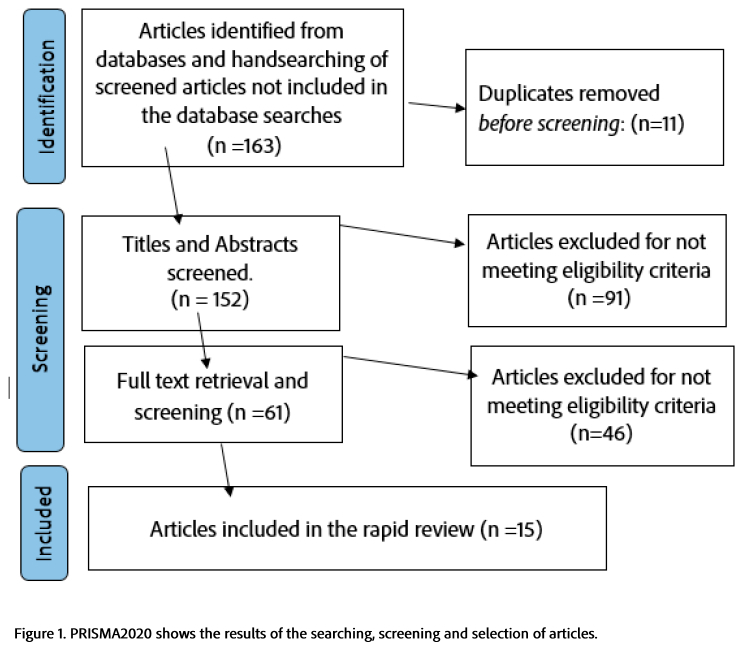
Rayyan20Figure 1, adjacent). Two of the authors did the screening using the software's blinded setting. Conflicts were resolved by discussion and consensus. Figure 1 (adjacent) shows the results of this screening and selection.
Step 4: Quality appraisal and data extraction
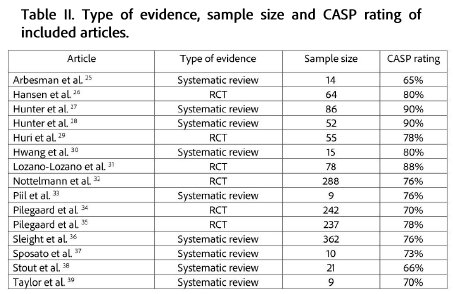
The first author created quantitative and qualitative data extraction templates in Excel and Word. The Critical Appraisal Skills Programme (CASP)21,22 which offers the healthcare professional with various checklists to check the quality of articles, was used. The CASP Systematic Review2122Table II (adjacent) was devised by allocating scores to the three answer options: Yes = 2, Can't tell = 1, and No = 0. The higher the rating percentage the greater the quality of the research. Comments noted during the appraisal were considered in the discussion section of this article.
Step 5: Evidence Synthesis
Quantitative data were analysed in Excel predominantly with frequencies/percentages. The qualitative data were analysed using Taguette23
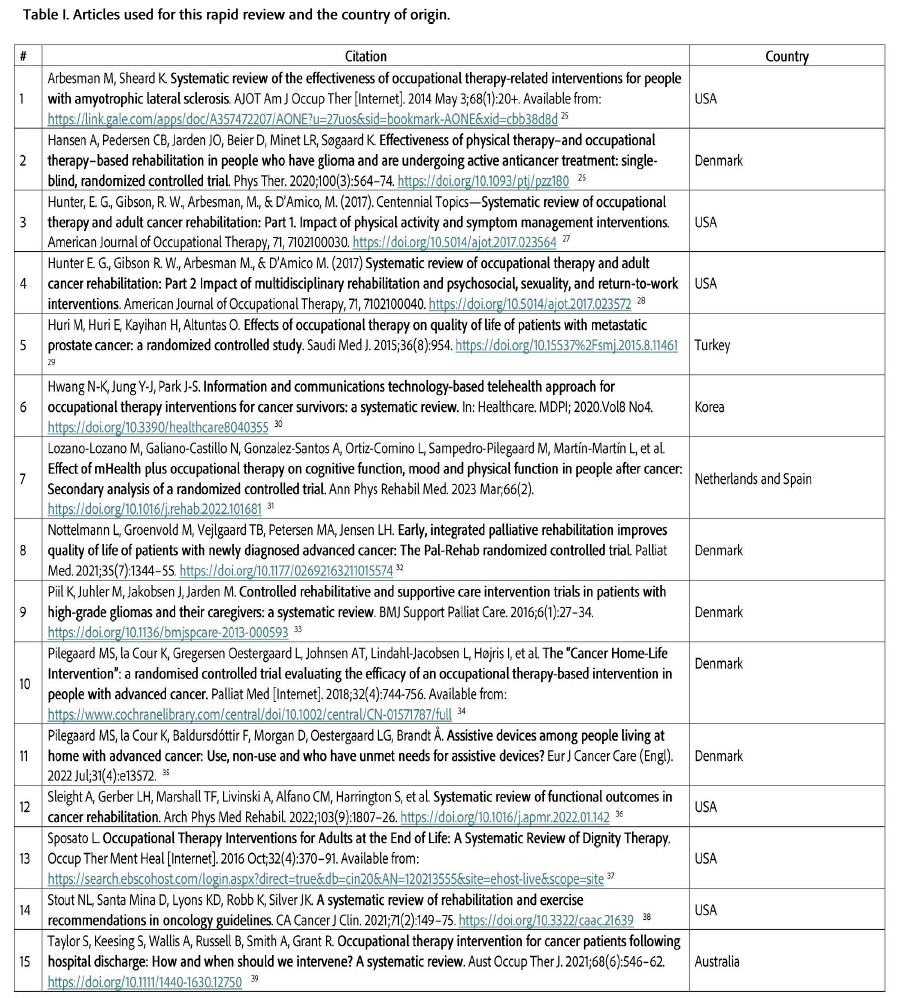
Step 6: Reporting and dissemination of results The results of the rapid review were presented in the form of a report to the OTASA Council and submitted to the South African Journal of Occupational Therapy for peer review and publication. The PRISMA 2020 diagram24Figure 1 (adjacent), shows the results Table I (below) lists the 15 included articles, in alphabetical order of first author's surname. There were six randomised control trials (RCTs) and nine systematic reviews. All RCTs were done in the European Union: four were conducted in Denmark, one in Turkey and one from a Netherlands-Spain collaboration. The six systematic reviews were predominantly executed by USA authors, with one from Australia, one from Denmark and one from Korea. There were no articles from Africa.

Quality appraisal
Two of the CASP (Critical Appraisal Skills Programme) checklists were used to assess the quality of articles identified for this rapid review: Randomised Controlled Trial Standard checklist2221Table II (page 5). The'sample size' of each article depicts the number of participants in an RCTand the number of articles included in a systematic review.
The palliative condition addressed in 14 out of the 15 articles was cancer and one was a motor neuron disease (amyotrophic lateral sclerosis or ALS). The settings which the occupational therapy intervention took place were not reported by all the articles. Settings that were reported ranged from inpatient and outpatient hospital care26,36,39, hospice and palliative care36,37,39,25, private homes/domiciliary and community settings25,29,31,32,34,35,36,39,
education and work settings273425,27,28,31,32,33,39. Arbesman and Sheardl25 25,32. Referring specifically to ALS, Arbesman et al.25
Occupational therapy interventions reported in the selected articles
Interventions that occupational therapists were involved in were grouped into five themes: 1) Functionality, activity participation and quality of life, 2) Symptom management related to disease and the treatment thereof, 3) Environmental modification and adaptation, assistive devices and equipment, 4) Education and caregiver support, and 5) Lifestyle adaptation, return to work or higher education/training. These are reported below in order of frequency as they were mentioned in the articles.
Functionality, activity participation and quality of life
All the articles referred to occupational therapists' involvement with functionality, activity participation and quality of life and this was the most frequently reported role and intervention. In many cases, specific actions within these concepts were not expanded on. The general impression was that occupational therapists aimed at keeping persons with life-threatening illnesses as functional as possible doing activities of importance to them for as long as possible. Sposato et al.3783829
Several articles noted that the occupational therapists addressed the activity participation needs25,26,27,28,30,32,39 of adults faced with life-limiting illness, listing the following: activities of daily living (ADL) and instrumental activities of daily living (¡ADL), work, leisure, hobbies, community mobility, social participation, and rest and sleep. Sleight et al.3627,28 reviews concluded that occupational therapy practitioners are well suited to investigate occupational performance, occupation-based strategies, quality of life, and participation status to support client-centred interventions before, during and after treatment of cancer.
Symptom management related to disease and the treatment thereof
Fatigue, loss of energy, disrupted sleeping and rest are common problems reported by persons with cancer4026 303132253041,27,37.
Huri et al.293027,28,33,36,38.
Pain symptom management is an important aspect of end-of-life care3727,28 reported pain management to be the most common occupational therapy focused on symptom intervention reported in their two systematic reviews. Two of the RCTs noted the occupational therapy intervention they studied effectively reduced pain31,29. The management of pain in cancer palliative care was often linked to fatigue interventions30,31,39.
Three of the articles reported occupational therapy intervention focused on lymphedema management27,38,39. Hunter et al.2738
Environmental modification and adaption, assistive devices and equipment
Assistive devices facilitate the performance of everyday activities and the conservation of energy. An occupational therapist often recommends assistive devices to enable activity participation and improve the quality of life for their clients37,38,39. An RCT of the Cancer Home-Life Intervention3435
Education and caregiver support
Lifestyle adaptation, return to work or higher education/training Five studies reported occupational therapists involved in assisting persons with cancer to return to work and vocational rehabilitation27,28,29,30,36,. Occupational therapists assisted clients in applying ergonomics and energy-saving techniques at home and work, allowing them longer and pain-free participation in activities at home, workplace and community25,37. These included task adaptations such as sitting versus standing, taking regular rest breaks, and using adaptive tools and assistive devices 25,37.
Ethical considerations
Ethical clearance was not required forthis review as no primary data collection was done. The quality and bias of selected articles were tested to ensure quality results to inform the question of this review.
DISCUSSION
The World Health Organization (WHO) advocates for the enhancement of palliative care as an integral part of comprehensive healthcare42105,4, books43
In their review, Hunter et al.273925,26,27,28,32,33,35,36,38. Arbesman et al.25 33
The South African National Policy Framework and Strategy on Palliative Care (NPFSPC)1042
Limitations of the study
None of the articles' address or consider persons living with HIV and Aids. HIV being one of the leading causes of death in South Africa44
Except for Turkey, which hasan upper-middle-income economy, all the evidence in this rapid review was from high-income countries. There were no systematic reviews or RCT articles on adult palliative care from Africa, or Low- and Middle-Income Countries (LMIC) such as South Africa. In the book Occupational Therapy: An African Perspective, Matovu45.255 concludes her chapter on occupational therapy in palliative care in an African setting stating that in Africa, with its unique and varied cultural and religious beliefs around illness, death and dying occupational therapists cannot 'extrapolate western biomedical approach' to palliative care.
Future research and other recommendations
MotsoaledMO notes that in Africa, the burden of palliative care is focused on dealing with death arising from HIV. The absence of level 1 and 2 evidence on the occupational therapist's role within this context needs to be addressed as a priority. Occupational therapy training and education in contextually relevant palliative care is essential. This should be at the undergraduate and post-graduate levels as well as continuous professional development activities for clinical occupational therapists. Responsibility for the support, mentoring and equipping of community service occupational therapists and therapists responsible for taking palliative occupational therapy services to populations with the greatest health needs46
CONCLUSION
In South Africa, the palliative care burden is predominantly carried by family and communities and occupational therapists are actively engaged in primary healthcare and community environments, making them well-suited to meet the requirements of individuals who need palliative care and their families or communities. The aim of this review was to gather global level 1 and 2 evidence published in peer reviewed journals of interventions that occupational therapists provided in adult palliative care. The results showed that occupational therapy practices transcend the healthcare sector and extend the role of the profession to schools and education facilities, the labour market, the life insurance industry, religious institutions, hospices, family homes and community settings. Occupational therapy practitioners worked with various types of life-limiting illnesses and at different stages of palliative care and that they provided intervention for Rehabilitation (Activity and Participation), Symptom management (Body Structures and Function) and Environmental modifications ICF domains. They were active in within interprofessional programs and teams bringing a client-centred and occupation-based perspective to the team.
None of the articles reported evidence from Africa. Due to South Africans' varied and unique beliefs concerning end-of-life, first-world evidence cannot be used to frame the role and intervention of occupational therapists within adult palliative care. South African policymakers, and future research need to prioritise the generation of contextually relevant and high-level research evidence to support and define the role of occupational therapists in Africa. In addition to evidence, the skilling, training and support for occupational therapists offering palliative intervention need to be recognised by South African occupational therapists representing professional bodies, healthcare policymakers and training institutions.
Conflicts of Interest and other declarations.
The authors declare they received remuneration from the Occupational Therapy Association of South Africa (OTASA) for this review. They declare that this did not affect their decision making in the review and results were not skewed to provide the outcome OTASA wanted to have. They have no bias to declare.
The Large Language Model (LLM), ChatGPT, was used to assist with the language editing and paraphrasing of the final article.
Author contribution
All authors planned and participated in review. They all took part in the writing and revising after two reviews of the article. Shaheed M. Soeker initiated and supervised the review. Hester van Biljon spearheaded the review, drafted, saw to completion and submitted the article.
Acknowledgements
Stellenbosch University (SU), the SU library and SU occupational therapy departments who assisted, encouraged and enabled the access to evidence.
REFERENCES
-
1. World Health Organisation. Palliative care. Health Topics. Epub ahead of print 2015. DOI: https://www.who.int/health-topics/palliative-care
» https://www.who.int/health-topics/palliative-care - 2. Giardini A, Ferrari P, Negri EM, et al. The positive role of caregivers in terminal cancer patients' abilities: usefulness of the ICF framework. Eur J Phys Rehabil Med 2016; 52: 214-222
-
3. Maritz R, Baptiste S, Darzins SW, Magasi S, Weleschuk C, Prodinger B. Linking occupational therapy models and assessments to the ICF to enable standardized documentation of functioning. Canadian Journal of Occupational Therapy. 2018, 85(4):330-341. DOI https://doi.org/10.1177/0008417418797146
» https://doi.org/10.1177/0008417418797146 -
4. World Federation of Occupational Therapy (WFOT). Position Statement. Occupational Therapy in End-of-Life Care. 2016. DOI https://wfot.org/resources/occupational-therapy-in-end-of-life-care
» https://wfot.org/resources/occupational-therapy-in-end-of-life-care -
5. Occupational Therapy Australia. Position Paper: Occupational therapy in palliative care. Fitzray VIC, 2015. https://otaus.com.au/publicassets/6d5829df-2503-e911-a2c2-b75c2fd918c5/Occupational%20Therapy%20and%20Palliative%20C are%20(August%202015).pdf http://www.otaus.com.au/
» https://otaus.com.au/publicassets/6d5829df-2503-e911-a2c2-b75c2fd918c5/Occupational%20Therapy%20and%20Palliative%20C are%20(August%202015).pdf http://www.otaus.com.au/ - 6. Burkhardt A, Ivy M, Kannenberg K, et al. The Role of Occupational Therapy in End-of-Life Care. Am J Occup Ther 2011; Vol 65.lss 6:66-75.
- 7. Pickens N, Chow JK, McKay H. Role of occupational therapy in end-of-life care. AJOT: American Journal of Occupational Therapy. 2016 Nov1;70(S2).
-
8. Hammiii K, Bye R, Cook C. Occupational Therapy for People Living with a Life-Limiting Illness: A Thematic Review. British Journal of Occupational Therapy. 2014;77(11):582-589. https://doi.org/10.4276/030802214X14151078348594
» https://doi.org/10.4276/030802214X14151078348594 -
9. South African Government. Constitution of the Republic of South Africa. The Bill of Rights, Republic of South Africa. 1996. https://www.gov.za/documents/constitution/chapter-2-bill-rights
» https://www.gov.za/documents/constitution/chapter-2-bill-rights -
10. Department of Health RSA. National Policy Framework and Strategy on Palliative Care 2017-2022. Pretoria, 2016. https://www.heaIth.gov.za/wp-content/uploads/2020/11/NationalPolicyFrameworkandStrategyonPalliativeCare20172022.pdf
» https://www.heaIth.gov.za/wp-content/uploads/2020/11/NationalPolicyFrameworkandStrategyonPalliativeCare20172022.pdf -
11. Pereira RB. Towards inclusive occupational therapy: Introducing the CORE approach for inclusive and occupation-focused practice. Aust Occup Ther J 2017; 64: 429-435. https://doi.org/10.1111/1440-1630.12394
» https://doi.org/10.1111/1440-1630.12394 -
12. WFOT. WFOT Definition of Occupational Therapy, (2012) https://wfot.org/resources/definitions-of-occupational-therapy-from-member-organisations
» https://wfot.org/resources/definitions-of-occupational-therapy-from-member-organisations - 13. Garritty C, Gartlehner G, Kamel C, King VJ, Nussbaumer-Streit B, Stevens A, Hamel C AL. Cochrane Rapid Reviews. Interim Guidance from the Cochrane Rapid Reviews Methods Group. 2020.
- 14. Forrest JL, Miller SA. Translating Evidence-Based Decision Making into Practice: EBDM Concepts and Finding the Evidence. J Evid Based Dent Pract 2009; 9: 59-72.
- 15. Burns PB, Rohrich RJ, Chung KC. The levels of evidence and their role in evidence-based medicine. Plast Reconstr Surg 2011; 128: 305-310.
-
16. South African Government. Old Age Pension. Older Person's Grant. South African Social Security Agency 2021; www.gov.za
» www.gov.za -
17. South Africa Department of Health. METHODS GUIDE FOR RAPID REVIEWS FOR COVID-19 MEDICINE REVIEWS. 2021. https://www.heaIth.gov.za/covid-19-rapid-reviews/
» https://www.heaIth.gov.za/covid-19-rapid-reviews/ -
18. Cuevas-Lara C, Izquierdo M, Gutiérrez-Valencia M, et al. Effectiveness of occupational therapy interventions in acute geriatric wards: A systematic review. Maturitas 2019; 127: 43-50. https://doi.Org/10.1016/j.maturitas.2019.06.005
» https://doi.Org/10.1016/j.maturitas.2019.06.005 -
19. Graff MJL, Vernooij-Dassen MJM, Thijssen M, et al. Community based occupational therapy for patients with dementia and their care givers: randomised controlled trial. BMJ 2006; 333:1196. https://doi.org/10.1136/bmj.39001.688843.BE
» https://doi.org/10.1136/bmj.39001.688843.BE -
20. Rayyan Sytems I. Rayyan Intelligent Systematic Review. Rayyan https://rayyan.qcri.org/.
» https://rayyan.qcri.org/ -
21. Critical Appraisal Skills Programme. CASP Systematic Review, (2018).http://creativecommons.org/licenses/by-nc-sa/3.0 www.casp-uk.net
» http://creativecommons.org/licenses/by-nc-sa/3.0 www.casp-uk.net -
22. Critical Appraisal Skills Programme. CASP Randomised Control Trial, (2021). http://creativecommons.Org/licenses/by-nc-sa/3.0/ www.casp-uk.net
» http://creativecommons.Org/licenses/by-nc-sa/3.0/ - 23. Rampin R, Rampin V, DeMott S. Taguette Version 0.10.1. hiptaguette.org 2020; BSD-3-Clause license,
-
©.
» https://doi.org/10.3390/healthcare8040355 -
24. Page M, McKenzie J, Bossuyt P, et al. The PRISMA 2020 statement: an updated guideline for reporting systematic reviews. BMJ Open; 372. Epub ahead of print 2021. DOI. https://doi.org/10.1136/bmj.n71
» https://doi.org/10.1136/bmj.n71 -
25. Arbesman M, Sheard K. Systematic review of the effectiveness of occupational therapy-related interventions for people with amyotrophic lateral sclerosis. AJOT Am J Occup Ther 2014; 68: 20+. https://doi.org/10.5014/ajot.2014.008649
» https://doi.org/10.5014/ajot.2014.008649 -
26. Hansen A, Pedersen CB, Jarden JO, et al. Effectiveness of physical therapy-and occupational therapy-based rehabilitation in people who have glioma and are undergoing active anticancer treatment: single-blind, randomized controlled trial. Phys Ther 2020; 100: 564-574. https://doi.org/10.1093/ptj/pzz180
» https://doi.org/10.1093/ptj/pzz180 -
27. Hunter EG, Gibson RW, Arbesman M, et al. Systematic review of occupational therapy and adult cancer rehabilitation: Part 1. Impact of physical activity and symptom management interventions. Am J Occup Ther 2017; 71: 7102100030p1-7102100030p11. https://doi.org/10.5014/ajot.2017.023564
» https://doi.org/10.5014/ajot.2017.023564 -
28. Hunter EG, Gibson RW, Arbesman M, et al. Systematic review of occupational therapy and adult cancer rehabilitation: Part 2. Impact of multidisciplinary rehabilitation and psychosocial, sexuality, and return-to-work interventions. Am J Occup Ther 2017; 71: 7102100040p1 -7102100040p8. https://doi.org/10.5014/ajot.2017.023572
» https://doi.org/10.5014/ajot.2017.023572 -
29. Huri M, Huri E, Kayihan H, et al. Effects of occupational therapy on quality of life of patients with metastatic prostate cancer: a randomized controlled study. Saudi Med J 2015; 36: 954. https://doi.org/10.15537/smj.2015.8.11461
» https://doi.org/10.15537/smj.2015.8.11461 -
31. Lozano-Lozano M, Galiano-Castillo N, Gonzalez-Santos A, et al. Effect of mHealth plus occupational therapy on cognitive function, mood and physical function in people after cancer: Secondary analysis of a randomized controlled trial. Ann Phys Rehabil Med 2023; 66:101681. https://doi.org/10.1016/j.rehab.2022.101681
» https://doi.org/10.1016/j.rehab.2022.101681 -
32. Nottelmann L, Groenvold M, Vejlgaard TB, et al. Early, integrated palliative rehabilitation improves quality of life of patients with newly diagnosed advanced cancer: The Pal-Rehab randomized controlled trial. Palliat Med 2021; 35:1344-1355. https://doi.org/10.1177/02692163211015574
» https://doi.org/10.1177/02692163211015574 -
33. Piil K, Juhler M, Jakobsen J, et al. Controlled rehabilitative and supportive care intervention trials in patients with high-grade gliomas and their caregivers: a systematic review. BMJ Support Palliat Care 2016; 6: 27-34. https://doi.org/10.1136/bmjspcare-2013-000593
» https://doi.org/10.1136/bmjspcare-2013-000593 -
34. Pilegaard MS, la Cour K, Gregersen Oestergaard L, et al. The 'Cancer Home-Life Intervention': a randomised controlled trial evaluating the efficacy of an occupational therapy-based intervention in people with advanced cancer. Palliat Med 2018; 32: 744-756. https://doi.org/10.1177/0269216317747199
» https://doi.org/10.1177/0269216317747199 -
35. Pilegaard MS, la Cour K, Baldursdóttir F, et al. Assistive devices among people living at home with advanced cancer: Use, non-use and who have unmet needs for assistive devices? Eur J Cancer Care (Engl) 2022; 31: e13572. https://doi.org/10.1111%2Fecc.13572
» https://doi.org/10.1111%2Fecc.13572 -
36. Sleight A, Gerber LH, Marshall TF, et al. Systematic review of functional outcomes in cancer rehabilitation. Arch Phys Med Rehabil 2022; 103:1807-1826. https://doi.org/10.1016/j.apmr.2022.01.142
» https://doi.org/10.1016/j.apmr.2022.01.142 -
37. Sposato L. Occupational Therapy Interventions for Adults at the End of Life: A Systematic Review of Dignity Therapy. Occup Ther Ment Heal 2016; 32: 370-391. http://dx.doi.org/10.1080/0164212X.2016.1146930
» http://dx.doi.org/10.1080/0164212X.2016.1146930 -
38. Stout NL, Santa Mina D, Lyons KD, et al. A systematic review of rehabilitation and exercise recommendations in oncology guidelines. CA Cancer J Clin 2021; 71:149-175. https://doi.org/10.3322/caac.21639
» https://doi.org/10.3322/caac.21639 -
39. Taylor S, Keesing S, Wallis A, et al. Occupational therapy intervention for cancer patients following hospital discharge: How and when should we intervene? A systematic review. Aust Occup Ther J 2021; 68: 546-562. https://doi.org/10.1111/1440-1630.12750
» https://doi.org/10.1111/1440-1630.12750 -
40. Schroder J, Mackenzie L. The impact of non-pharmacological cancer-related fatigue interventions on activity performance and participation outcomes in adult cancer survivors: A systematic review. Epub ahead of print 2019. DOI: http://hdl.handle.net/2123/21105.
» http://hdl.handle.net/2123/21105 -
41. Arbesman M, Sheard K, Auais M, et al. Comparison of posthospitalization function and community mobility in hospital mobility program and usual care patients: a randomized clinical trial. Int J Environ Res Public Health 2017; 68:216-228. http://dx.doi.org/10.1001/jamainternmed.2016.1870
» http://dx.doi.org/10.1001/jamainternmed.2016.1870 - 42. World Health Organisation. Assessing the development of palliative care worldwide: a set of actionable indicators, isbn: 9789240033351 (2021).
- 43. Cooper J. Occupational Therapy in Oncology and Palliative Care. 2nd ed. London: John Wiley& Sons, 2013.
- 44. Statistics South Africa. Mortality and causes of death in South Africa, 2016: Findings from death notification. Pretoria, 2018.
- 45. Alers V, Crouch R. Occupational Therapy: An African Perspective. Sarah Shorten Publishers, 2010.
-
46. Struwig N, van Stormbroek K Support, supervision, and job satisfaction: Promising directions for preventing burnout in community service occupational therapists. South African J Occup Ther 2023; 53: 67-80. http://orcid.org/0000-0003-4890-5063
» http://orcid.org/0000-0003-4890-5063
Reviewed 1st round: May 2024
Reviewed 2nd round: June 2024
Final revision: July 2024
Accepted: July 2024
Data availability: Upon reasonable request, from corresponding author
Funding: Authors were remunerated by The Occupational Therapy Association of South Africa (OTASA) who requested the review