Appropriateness of the standard manual wheelchair for occupational performance by wheelchair users in the Thulamela Municipality of the Vhembe District, Limpopo, South Africa
Abstract
BACKGROUND: There was a need to investigate the appropriateness of the standard manual wheelchairfor occupational performance in Thulamela Municipality Vhembe District, Limpopo. METHODS: An observational cross-sectional descriptive design using simple random sampling was used to select n=60 wheelchair users who were issued with standard manual wheelchairs between 2014 and 2018. The Wheelchair Outcome Measure was used to investigate the participants' level of satisfaction in engagement in ADL and IADL and the suitability of the wheelchair in terms of the user's comfort and satisfaction with positioning and prevention of skin breakdown. Descriptive statistics were used to analyse the data. RESULTS: The wheelchair users viewed activity participation in the home as important and were generally satisfied with their standard manual wheelchairs while performing occupational activities at home and outside the home. A total of (n=46; 78%) of the participants felt comfortable in their wheelchair. CONCLUSIONS: Wheelchair prescription should take into consideration the occupational choices of the user. Further qualitative studies to explore the factors that determined the participants' choices for their activity participation goals should be undertaken. IMPLICATIONS FOR PRACTICE • Training of new occupational therapy staff in each facility in the Thulamela district to equip them with the skills to prescribe wheelchairs is necessary. • The level of importance that wheelchair participants attached to level of importance of activity participation inside and outside the home was high therefore there is a need to consider the client's occupational choices when prescribing wheelchairs. • The wheelchair needs to facilitate participation in a wide range of occupational choices ranging from self-care activities and watching TV in the home to visiting friends and family and attending events outside the home.
wheelchair prescription; occupational choices; activity participation; Wheelchair Outcome Measure (WhOM); ADL and ¡ADL; good health and wellbeing
INTRODUCTION
According to the World Health Organisation (WHO) report on disability, more than a billion people, that is 15% of the world's population, live with some form of disability1234
The Framework and Strategy for Disability and Rehabilitation Services (FSDRS)56768
South Africa ratified and signed the UNCRPD94,10,11,12. The South African NRP guides general rehabilitation services in South Africa, whilst the South African National Guidelines on Provision of ADs stipulate the essential responsibilities and requirements regarding the provision of ADs in the public health sector in South Africa781013
This study investigated the appropriateness of the standard manual wheelchair for occupational performance in various occupational and community settings in the Thulamela Municipality of Vhembe District of Limpopo province in South Africa. It was essential to understand wheelchair user needs and the appropriateness of the prescribed wheelchair. The objectives of the study were to (i) compile a demographic profile of the standard wheelchair users in Thulamela Municipality Vhembe District, (ii) assess the level of importance and wheelchair user satisfaction in the performance of activities of daily living (ADL) and instrumental activities of daily living (IADL) when using the standard manual wheelchairs at home and outside the home; (iii) assess the level of satisfaction of the wheelchair user on their body position when using the standard wheelchair and determine the level of comfort experienced by wheelchair users when using the prescribed standard wheelchairs.
Disability is contextual; the experience of disability differs between various individuals due to the nature of the impairment. People use wheelchairs because of their limitations in mobility. Wheelchair users are people with various musculoskeletal and neurological impairments, lifestyles, life roles and socio-economic status living in different environments, including rural, semi-urban and urban. PWDs represent a wide range of mobility needs, according to the guidelines on the provision of manual wheelchairs in less resourced settings2,11,13.
When selecting a wheelchair, factors to ensure that the wheelchair contributes to the quality of life of the wheelchair user should be considered. The diversity of wheelchair users and the different contexts in which occupations are performed emphasises creates the need for different designs of wheelchairs 2,7,1°. No single wheelchair can meet the needs of all wheelchair users. The function of the wheelchair can be affected by different wheelchair design features, including overall length, wheelbase, frame type, rear wheels and front castors, transportability, and stability versus mobility setting8,10,13.
South Africa has experienced a complex health transition in the past few decades. The Department of Health ensures that the necessary polices are available to guide the various provinces in South Africa. The department of Health in Limpopo is responsible for the rendered provision of ADs, including wheelchairs6,7. According to the FSDRS5
The South African national guideline on ADs includes specific protocols on key service steps in the provision of wheelchairs and other ADs, such as hearing aids, spectacles and walking aids799813
In 2012, Statistics South Africa121415
The prescription should detail the type and size of the wheelchair, additional components needed, including customised components and the information the client needs to have before leaving the prescribing institution. An estimate of when the wheelchair will be ready should be given to the client10,13. The RT233-2023 tender document governs purchasing of wheelchairs in South Africa; this tender document has a comprehensive range of wheelchair options.
However, financial constraints appear to lead institutions into procuring only one type of wheelchair as the price, rather than the quality, is often the deciding factor when wheelchairs are procured. Budgetary challenges negatively impact the ability of occupational therapists to provide a service per policy and guidelines. According to Visagie et al.131416
Several factors can negatively affect wheelchair prescription. This includes funding, the ability to assess the need for and order wheelchairs accurately and the extent of training of occupational therapists during their undergraduate course12,14. This may pose a challenge to the occupational therapists offering wheelchair services and may create a situation where an inappropriate wheelchair is prescribed, which will, in turn, affect product preparation, fitting user training and function15,16.
METHODS
Design
An observational cross-sectional descriptive design was used to achieve the aims of this study. Data were collected from every participant who required a standard wheelchair to mobilise in a defined area at the time of the study17
Study Location
The study was conducted in the Thulamela Municipality region in Vhembe District, Limpopo. Thulamela municipality has a population density of people 497237 181811
Recruitment and Sampling
Simple random sampling was used to select 60 wheelchair users who were issued with standard manual wheelchairs and discharged from which hospital between 2014 and 2018. Simple random sampling was selected because it would bean equal chance of each participant being selected, thus eliminating any sampling bias19
Data Collection Instrument
The Wheelchair Outcome Measure (WhOM) was used in this study202020,21.
Data Collection
Data were collected on the descriptive components from wheelchair users over a three weeks period in August 2018. The survey was completed at the participants' homesteads by the first author. The demographic section comprised three subsections namely, client identifying data; lifestyle and environment; and medical diagnoses. Data on participants' opinion of importance, satisfaction, and comfort with the standard manual wheelchair during occupational performance inside the home and outside the environment were collected under the descriptive component using Part II (Importance and participation) of the WhOM Questionnaire. The WhOM is designed to assist wheelchair users identify and evaluate the impact of wheelchair interventions on participation level outcomes20,21.
Data Analysis
Descriptive data were recorded using Microsoft excel and then analysed and coded using the Statistical Package for Social Sciences (SPSS-2) programme (IBM, 2021). Descriptive statistics were used to analyse frequencies on dependent and independent variables for Part I, II, and III. The dependent variables for this study were the standard manual wheelchairs prescribed for various disabilities. The independent variables for this study were wheelchair user levels of satisfaction and comfort with the appropriateness of the standard manual wheelchairs during occupational performance and sitting, respectively. To ensure content validity in this study, items included for investigation were based on the WhOM manual. In this study, the interpretation of results considered the participants' diverse disability needs for wheelchair users to ensure consequential and external validity.
Ethical considerations
Although the data collection method for this study did not involve any known risk, during data collection, all efforts were made to ensure the safety and welfare of the participants. Participation in the study was voluntary. Written informed consent was obtained from each participant. All information was treated as confidential. The names of the clients or any information directly identifying the client are not included in the research report or any other form of publication of this study. Any other patient-identifying data required for data analysis is kept confidential and used only for analysis purposes. All completed questionnaires are kept in lockable storage, which is only accessible to the authors. The questionnaires will be disposed of through shredding after five years.
Relevant ethical considerations were adhered to. Ethical clearance was obtained from the University of KwaZulu Natal Biomedical Research Ethics Committee (BREC Ref No.: BE411/17). Gatekeeper permission was sought from the Limpopo Department of Health and Thulamela Municipality Vhembe district Department of Health and Tshilidzini Regional Hospital, responsible for wheelchair management for the Thulamela Municipality Vhembe district.
RESULTS
The results of the study collected through the use of the WhOM Questionnaire are highlighted. The demographic profile of the standard manual wheelchair users and their activity participation goals are presented followed by the results on participants' level of satisfaction and comfort during occupational performance inside the home and outside environment are illustrated. The results level of comfort experienced by the participants when sitting in standard manual wheelchairs is presented.
Demographic Profile of Participants in this Study
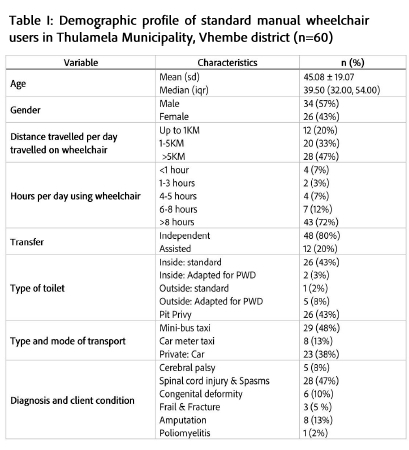
This study involved 60 participants who use a wheelchair for mobility; ages ranging between 18 to 93 years; mean of 45.08 (± 19.07). The sample comprised both males and females. The majority of the participants were males (n=34; 57%). Distances travelled ranged between less than 1 and over 5km. the participants travelled in their wheelchairs was over 5km (n=28; 47%), with the least distance being up to 1km (n=12; 20%). Most participants (n=43; 72%) spent over eight hours a day in their wheelchair, with (n=2; 3%) spending 1-3 hours a day in the wheelchair. A large proportion of the participants (n=48; 80%) were independent in wheelchair transfers. Most of the participants used inside toilets (n=26; 43%), or pit privy toilets (n=26; 43%), whilst PWDs (n=2; 3%). had access to an inside wheelchair adapted toilet Almost half of the participants relied on minibus taxis as a mode of transport (n=29; 48%), a fair amount relied on private cars (n=23; 38%). The most common diagnosis reported was spinal cord injuries (n=28; 47%), with the least prominent diagnosis being poliomyelitis (n=1; 2%). (Table I, page 71).
Activity Participation Goals
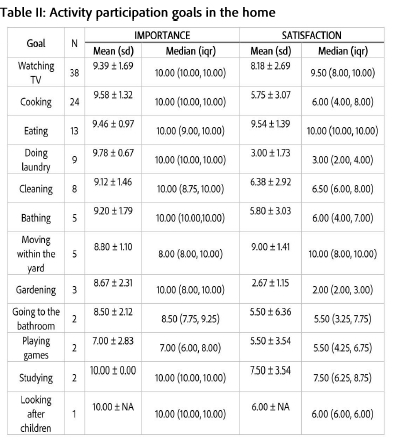
The activity participation goals of the participants at home and outside the home are presented in Tables II and III (adjacent). Participants were asked to provide activity participation goals that they performed inside the home and outside the home. Each activity participation goal given by the participants was recorded. Each activity participation goal provided by the participant was rated from 0 to 10 by the participant for level of not therapist satisfied at and 10 meaning extremely satisfied. Table II (adjacent) presents a summary of the participants' activity participation goals in the home, including mean and median satisfaction and importance scores per activity participation goal. The table is ordered according to the activity participation goal with the most to least number of respondents.
The most common activities performed at home that the participants identified were watching television (TV), cooking, eating doing laundry, cleaning bathing and moving around the yard. The least common activities performed at home were looking after children, studying playing games, going to the bathroom and gardening.
Watching television was the most common activity that the participants participated in at home (n=38; 63%). A high level of importance (mean of 9.39± 1.69) on a scale of 0 -10 and satisfaction (mean 8.18± 2.69) was noted. Cooking was the second most prominent activity participation goal amongst the participants (n=24; 40%), with a high level of importance (mean of 9.58± 1.32) and overall average satisfaction (mean of 5.75± 3.07). Looking after children was the least prominent (n=1; 2%). Overall, the wheelchair participants rated the level of importance of activity participation in the home as high (mean 9.36 ± 1.46), with an average level of satisfaction (mean 6.93 ± 3.18).
The participants' activity goals outside the home varied. Visiting friends was the most reported by participants (n=14; 23%), with an average importance (mean 9.86 ± 0.53), and a high level of satisfaction (mean 8.43 ± 2.28). Travelling to town, moving around the workplace and going to the hair salon were the least common activity goals amongst the participants (n=1;2%). Travelling to learnership (n=7;12%) was ranked as highly important (mean=10) and average for level of satisfaction (mean 6.71± 3.15). Table III (below) presents a summary of activity participation goals outside the home by the participants. Overall, the wheelchair participants ranked the level of importance of activity participation outside the home as high (mean 9.28 ± 1.38) with an average level of satisfaction (mean 6.72 ± 3.11).

Level of Comfort, Pressure Sores and Body Position experienced by Wheelchair Users
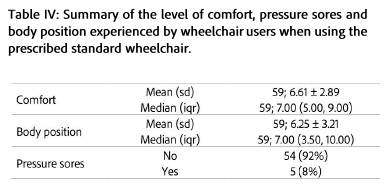
Table IV (below) highlights the self-reported scores of how the participants rated the level of satisfaction related to comfort and body position while sitting in the wheelchair. The participants were given a scale from 0 to 10 to their level of satisfaction related to comfort and body position while in a wheelchair. A value of 0 means that the participant is not at all comfortable/not satisfied at all, whereas a value of 10 means that the participant is extremely comfortable/ extremely satisfied with the comfort and body position when they are using their wheelchair. A mean score of 6.61 ± 2.89 was rated for the level of comfort, and a mean score of 6.25 ± 3.21 was also rated for body position. The majority of the participants (n=54; 92%) had not experienced pressure sores on their buttocks six months prior to data collection whereas five of the participants (8%) had experienced pressure sores in the prior six months.
DISCUSSION
This study investigated the appropriateness of the standard manual wheelchair for occupational performance in various occupational settings and community settings in the Thulamela Municipality, Vhembe District of Limpopo province in South Africa. Determining the level of importance and wheelchair user satisfaction is an essential aspect of assessing the appropriateness of the standard manual wheelchair in occupational performance. The results illustrated that wheelchair users in the Thulamela Municipality Vhembe district view activity participation in the home as very important and are generally satisfied with their standard manual wheelchair while performing occupational activities at home. Moreover, the study revealed that there is significant participation by wheelchair users in occupational activities outside the outside the home in the Thulamela Municipality, Vhembe district. Wheelchair users have a high level of satisfaction with their standard manual wheelchairs while performing occupational activities outside the home. There was a wide range of activities that the participants engaged in while outside the home which is an encouraging finding since the literature indicates that individuals who are "healthy" are those who are engaged in meaningful occupations22
The diagnosis of spinal cord injuries (SCI) was prominent amongst the participants in this study (47%). In South Africa, the main cause of SCI in was found to be assault, which accounted for approximately 60% of all cases23 followed by transport related causes and falls. The majority of the participants (72%) spent over eight hours a day in their wheelchairs. A large proportion of the participants (80%) were independent with wheelchair transfers. Though a significant number of participants were independent in wheelchair transfers, the age range of the participants ranged between 18 to 93 which could have an impact on the participants' independence in wheelchair transfers as older participants could have had difficulties with independent transfers due to their frailty. As pointed out earlier this is in view of the total age of the participants averaging 45.08 ± 19.07 therefore, the age range is wide. Injuries that led to the participants using a wheelchair for mobility ranged from motor vehicle accidents to violence, neurological disorders and genetic disorders.
Almost half of the participants relied on minibus taxis as a mode of transport (48%). It is possible that the design of the standard manual wheelchair, which is small with a foldable design and therefore and takes up less space inside taxis242525262726,27. The factors that hindered accessing transport were not explored in this study.
The participants were from rural, peri-urban and urban areas where different types of toilets are available. The pit privy toilets, also referred to as 'latrines', are used for onsite waste management. They consist of a hole in the ground, which may be unlined or lined, with a reinforcing material to contain human excreta and the standard inside toilets is the most common in these areas.
The level of importance attached to being able to perform occupational activities in the home was reported as high however, participants' level of satisfaction with their performance was not substantial. The participants could have viewed the activities as very important however they may have not been satisfied with the extent to which wheelchair use enhanced their participation in activities in the home. The choice in the type of the wheelchair as well as the adjustments made to the wheelchair must be individualised to enhance satisfaction and usability28
Overall, the wheelchair participants attached a high level of importance to activity participation outside the home but the participants' level of satisfaction was not substantial. Bergström and Samuelsson2929
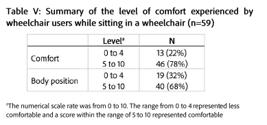
A total of (n=46; 78%) of the participants felt comfortable in their wheelchair, and 22% (n=13) felt less comfortable in their wheelchair. Most of the time they will be sitting. In a study by Visagie et al.27272927
The participant who received 16 wheelchairs in five years is a 53-year-old female with a diagnosis of spinal cord injury, residing in a rural area who spends more than eight hours a day in a wheelchair. In this case, the unsuitability of the type of wheelchair on the terrain might be contributing to frequent breaks and the need for frequent wheelchair replacements. The National Guidelines on Provision of Assistive Devices73030,7. The aforementioned guidelines however highlight that there should be no limits on the replacement of an assistive device unless it is not needed anymore, or there is evidence of poor maintenance or abuse. Given the overall high satisfaction scores in the study, one could therefore question whether the participants were more likely to report participation outcomes with which they were satisfied rather than those which they were not satisfied with.
CONCLUSION
The study found that level of importance that wheelchair participants attached to level of importance of activity participation inside and outside the home was high. Overall, the participants felt comfortable while sitting in their wheelchair and also felt that their body was positioned well. Most of the participants had not experienced pressure sores on their buttocks in the prior six months. There was participation in a wide range of occupational choices ranging from self-care activities and watching television in the home to visiting friends and family and attending events outside the home. This highlighted the need to consider the wheelchair users occupational choices and the context when prescribing a wheelchair. This also implies a need to ensure training of new occupational therapy staff in each facility in the Thulamela district to equip them with the skills to prescribe wheelchairs. A qualitative study is recommended to explore the different aspects that determined the participants' choices for the activity participation goals, how they determined the importance of those participation goals, their level of community participation and socialization. This would allow occupational therapists to gain better insight into the use of their client's wheelchairs both in the home and outside the home and assist in identifying the facilitating factors and barriers to using the standard manual wheelchair.
Competing interests
No completing interest to declare
Author contributions
Khumbelo Nethathe and Helga Lister conceptualised the study. Khumbelo Nethathe conducted the data collection and initial data analysis. Pragashnie Govender and Helga Lister assisted in the data analysis. Helga Lister, Pragashnie Govender and Deshini Naidoo assisted in the interpretation of the data. Khumbelo Nethathe, Helga Lister, Pragashnie Govender and Deshini Naidoo drafted the manuscript. Pragashnie Govender and Deshini Naidoo assisted in the critical review of the manuscript and revisions.
REFERENCES
Acknowledgements
The authors acknowledge the study participants for their willingness to participate in the study and Mr SM Phehlukwayo for his contributions in guidance in early stages of this study.
LITERATURE REVIEW
-
1. World Health Organization.2011. United States Agency for International Development. Joint Position Paper on the Provision of mobility devices in less resourced settings. Implementation of the Convention for Persons with Disabilities (CRPD) related to personal disability. Geneva: World Health Organization. Available from: https://www.who.int/publications/i/item/9789241502887
» https://www.who.int/publications/i/item/9789241502887 -
2. World Health Organization. Guidelines on the provision of manual wheelchairs in less resourced settings. World Health Organization; 2008. Available from: https://www.who.int/publications-detail-redirect/9789241547482
» https://www.who.int/publications-detail-redirect/9789241547482 -
3. Statistics South Africa. Census. 2012. Profile of persons with disabilities in South Africa Report No. 03-01-59. Pretoria: Statistics South Africa. Available from: https://www.statssa.gov.za/?p=3180
» https://www.statssa.gov.za/?p=3180 -
4. Ndlovu N, Gray A, Mkhabela B, Myende N, Day C. Health and related indicators 2022. South African Health Review [Internet]. 2023 Aug 24;25. DOI: http://dx.doi.org/10.61473/001c.82026
» http://dx.doi.org/10.61473/001c.82026 - 5. Department of Health. 2015. Framework and strategy for disability and rehabilitation services in South Africa. Pretoria: Department of health.
- 6. Department of Health, 2000a. National Rehabilitation Policy. Pretoria.
- 7. Department of Health, 2003. Standardization of provision of mobility devices in South Africa. Pretoria: Department of Health, Pretoria
-
8. World Health Organization. 2008. International Society for Prosthetics and Orthotics (ISPO) Guidelines on the provision of manual wheelchairs in less resourced settings. Geneva: World Health Organization. Available from: https://apps.who.int/iris/handle/10665/43960
» https://apps.who.int/iris/handle/10665/43960 -
9. United Nations (UN).2006. Convention on the rights of persons with disabilities; Article 20: United Nations. Available from: https://www.un.org/disabilities/documents/convention/conventionaccessiblepdf.pdf
» https://www.un.org/disabilities/documents/convention/conventionaccessiblepdf.pdf -
10. Bateman C. 'One size fits all' health policies crippling rural rehab: therapists. SAMJ: South African Medical Journal. 2012 Apr;102(4):200-8. Available from: http://www.scielo.org.za/scielo.php?script=sci_arttext&pid=S0256-95742012000400006&lng=en.
» http://www.scielo.org.za/scielo.php?script=sci_arttext&pid=S0256-95742012000400006&lng=en -
11. Borg J, Lindström A, Larsson S. Assistive technology in developing countries: national and international responsibilities to implement the Convention on the Rights of Persons with Disabilities. The Lancet. 2009 Nov;374(9704):1863-5. DOI: http://dx.doi.org/10.1016/s0140-6736(09)61872-9
» http://dx.doi.org/10.1016/s0140-6736(09)61872-9 - 12. Statistics South Africa. Census. 2012. Profile of persons with disabilities in South Africa Report No. 03-01-59. Pretoria: Statistics South Africa.
-
13. Visagie, S., Scheffler, E. & Schneider, M., 2013. 'Policy implementation in wheelchair service delivery in a rural South African setting', African Journal of Disability 2(1), Art.#63, 9 pages. DOI: http://dx.doi.org/10.4102/ajod.v2i1.63.
» http://dx.doi.org/10.4102/ajod.v2i1.63 -
14. Shore S. The long-term impact of wheelchair delivery on the lives of people with disabilities in three countries of the world. African Journal of Disability [Internet]. 2017 Sep 8;6. DOI: http://dx.doi.org/10.4102/ajod.v6i0.344
» http://dx.doi.org/10.4102/ajod.v6i0.344 - 15. McAdam, J.C. & Casteleijn, D. 2005. Wheelchair dexterity and repair skills of wheelchair users living in a developing community.SA Journal of Occupational Therapy, 35(3).8-13.
-
16. Greer N, Brasure M, Wilt TJ. Wheeled Mobility (Wheelchair) Service Delivery: Scope of the Evidence. Annals of Internal Medicine. 2012 Jan 17;156(2):141. DOI: http://dx.doi.org/10.7326/0003-4819-156-2-201201170-00010
» http://dx.doi.org/10.7326/0003-4819-156-2-201201170-00010 - 17. Carter RE, Lubinsky J, Domholdt E. Selection and assignment of participants. Rehabilitation research: Principles and applications. 2016:98-9. Elsevier Saunders, St. Louis. ISBN 13 978-1455759798
-
18. Department of cooperative Government and Traditional Affairs. Vhembe District Municipality 2020/21 IDP Review. 2021. Available at https://www.cogta.gov.za/cgta_2016/wp-content/uploads/2020/12/VHEMBE-DISTRICT-MUNICIPALITY-2020-21-IDP-REVIEW.pdf
» https://www.cogta.gov.za/cgta_2016/wp-content/uploads/2020/12/VHEMBE-DISTRICT-MUNICIPALITY-2020-21-IDP-REVIEW.pdf - 19. Creswell, J. W. 2014. Educational research: Planning, conducting and evaluating quantitative and qualitative research (4th ed., pg. 142-163 & 368-369). Harlow, Essex: Pearson.
-
20. Mortenson WB, Miller WC, Miller-Pogar J. Measuring wheelchair intervention outcomes: development of the wheelchair outcome measure. Disability and Rehabilitation: Assistive Technology. 2007 Jan 1;2(5):275-85. DOI: 10.1080/17483100701475863
» https://doi.org/10.1080/17483100701475863 -
21. Miller WC, Garden J, Mortenson WB. Measurement properties of the wheelchair outcome measure in individuals with spinal cord injury. Spinal cord. 2011 Sep;49(9):995-1000. https://www.nature.com/articles/sc201145
» https://www.nature.com/articles/sc201145 -
22. Ekelman B, Bazyk S, Bazyk J. The relationship between occupational engagement and well-being from the perspective of university students with disabilities. Journal of Occupational Science. 2013 Aug 1;20(3):236-52. https://www.tandfonline.com/doi/abs/10.1080/14427591.2012.716360
» https://www.tandfonline.com/doi/abs/10.1080/14427591.2012.716360 -
23. Joseph C, Scriba E, Wilson V, Mothabeng J, Theron F. People with Spinal Cord Injury in Republic of South Africa. American Journal of Physical Medicine & Rehabilitation. 2017 Feb;96(2):S109-11. DOI: http://dx.doi.org/10.1097/phm.0000000000000594
» http://dx.doi.org/10.1097/phm.0000000000000594 -
24. Medola FO, Elui VMC, Santana C da S, Fortulan CA. Aspects of Manual Wheelchair Configuration Affecting Mobility: A Review. Journal of Physical Therapy Science [Internet]. 2014;26(2):313-8. DOI: http://dx.doi.org/10.1589/jpts.26.313
» http://dx.doi.org/10.1589/jpts.26.313 -
25. Chakwizira J, Nhemachena C, Mashiri M. Connecting transport, agriculture and rural development: experiences from Mhlontlo Local municipality integrated infrastructure atlas. Available from: http://hdl.handle.net/10204/4400
» http://hdl.handle.net/10204/4400 -
26. Lister HE, Dhunpath R. The taxi industry and transportation for people with disabilities: implications for universal access in a metropolitan municipality. Transformation: Critical Perspectives on Southern Africa. 2016;90(1):28-48. DOI: http://dx.doi.org/10.1353/trn.2016.0009
» http://dx.doi.org/10.1353/trn.2016.0009 -
27. Visagie S, Mlambo T, Van der Veen J, Nhunzvi C, Tigere D, Scheffler E. Is any wheelchair better than no wheelchair? A Zimbabwean perspective. African Journal of Disability [Internet]. 2015 Nov 20;4(1). DOI: http://dx.doi.org/10.4102/ajod.v4i1.201
» http://dx.doi.org/10.4102/ajod.v4i1.20 -
28. Marchiori C, Bensmail D, Gagnon D, Pradon D. Manual wheelchair satisfaction among long-term users and caregivers: A French study. Journal of Rehabilitation Research and Development.2015;52(2):181-92. DOI: http://dx.doi.org/10.1682/jrrd.2014.04.0092
» http://dx.doi.org/10.1682/jrrd.2014.04.0092 -
29. Bergström AL, Samuelsson K. Evaluation of manual wheelchairs by individuals with spinal cord injuries. Disability and Rehabilitation: Assistive Technology. 2006 Jan 1,1(3):175-82. DOI: http://dx.doi.org/10.1080/17483100600573230
» http://dx.doi.org/10.1080/17483100600573230 - 30. Provincial Government of the Western Cape: Department of Health (PGWC DoH), 2010. Core package of care and standard operating procedures for wheelchair seating services, PGWC DoH; Cape Town.
Reviewed: 10 February 2024
Revised: 25 April 2024
Accepted: 2 May 2024
Data availabiity: Data can be made available by the corresponding author on request
Funding: No funding was received for this research