Older adults' adaptiveness to disruptions during South Africa's COVID-19 lockdown: Keep your head up and continue breathing
Abstract
INTRODUCTION: Adaptiveness fosters resilience through increasing capacity to transcend barriers in individuals, their environment and occupational engagement. The COVID-19 pandemic and lockdown may have decreased adaptiveness in older adults by disrupting occupational engagement, thus negatively influencing health and well-being METHODS: A qualitative, meta-analytic design was used to explore the adaptiveness of older adults to disruptions experienced during South Africa's COVID-19 lockdown. Four student researchers' primary studies were reviewed and findings synthesised for this paper. Individual, semi-structured interviews were conducted with 16 participants during April and May 2020. The transcripts were analysed thematically and reported in the primary studies. The authors conducted thematic analysis across all four primary studies to develop themes for this paper FINDINGS: Three dominant themes emerged: (1) COVID-19 as an illness, (2) occupational disruptions experienced by older adults, and (3) developing a state of adaptiveness. Older adults developed adaptiveness through changing perspective, adapting to new environments, learning to use technology, expanding roles and routines, and strengthening the spiritual self through engagement in eudemonic occupations CONCLUSIONS: The study provides insights into challenges and adaptiveness of older adults during the COVID-19 lockdown. Findings inform interventions with older adults presenting with reduced adaptiveness Implications for practice This study is valuable as it provides occupational therapists with a deeper understanding of older adults' experiences and challenges during the COVID-19 lockdown, thus, laying the potential for strengthening client-therapist interpersonal relationships. Although the sample observed in this study was older adults, the findings can be considered among other vulnerable clients such as individuals with disease, illness and/or disability. Additionally, these findings may provide occupational therapists with insights that can assist in framing intervention strategies for clients with a decreased state of adaptiveness. This is significant as adaptation requires reasonable social, emotional, and cognitive processes. Lastly, this study aimed to contribute to a wealth of research exploring adaptiveness, rooted in the reality that change is inexorable; however, how we respond to change can be transformative for individual and population well-being.
adaptiveness; occupational engagement; COVID-19 pandemic and lockdown; occupational disruption; state of well-being; older adults
INTRODUCTION
At the core of the human experience is an overwhelming desire to be engaged in meaningful and purposeful occupations, and this is integrated with the process of striving for, and achieving, mastery in said occupations. Schultz and Schkade12,3,4. An increased state of adaptiveness empowers persons to engage in diverse and meaningful occupations, which in turn has the potential to promote a holistic state of well-being2,3,5,6. The advent of the COVID-19 pandemic and consequent restrictions resulting in lockdowns in South Africa may have decreased levels of adaptiveness in more vulnerable populations, such as older adults, who were identified as a higher risk population for the development of moderate-severe COVID-19 complications with a higher mortality incidence. O'Leary78
Previous studies such as those by Blacker456 9
COVID-19 in South Africa
In December 2019, a novel, acute respiratory syndrome SARS-CoV-2 appeared in Wuhan, China101112131414,15. Older adults' risk was exponentially increased through the prevalence of comorbidities such as hypertension, diabetes mellitus, obesity, chronic obstructive pulmonary disease or any other respiratory illness16,17. The Centers for Disease Control and Prevention18
The implications of the COVID-19 lockdown on South Africans
To safeguard vulnerable populations such as older adults, the South African government followed international trends and declared a National State of Disaster. South Africa was placed on lockdown alert level 5 effective from 26 March 2020 in an attempt to flatten the first wave of COVID-19 infections. The lockdown highlighted disparities amongst South Africans when considering the argument of equality versus equity as a determinant of privilege19202021222324252627
These efforts, however, were minimal in addressing the grave inequalities rooted in disadvantaged communities.
Occupational justice perspective
Durocher describes occupational justices as the promotion of fairness, equity, and empowerment that enables opportunities for participation in occupations for the purposes of health and well-being28293029,30. The South African lockdown highlighted numerous occupational injustices more rampant in lower-middle class individuals. These injustices stem from the residual remnants of occupational apartheid that saw the unequal distribution of occupational opportunities in accordance with a system of racial classification3132 3329,30.Transcending the barriers of class and privilege, the lockdown resulted in widespread occupational alienation3234
Occupational disruptions
Nizzero describes occupational disruption as a temporary disturbance in an individual's typical pattern of participation34357873634371,3.
Occupational adaptation
Occupational adaptation is described by Schkade and Schultz1138393140,41.
Eudemonic occupations
Eudaimonia infers a state or condition of existing in good spirits which can commonly be translated to one's state of happiness or well-being40,41. Eudemonic occupations can be observed as those going beyond the mere utility of survival and, instead, nurture the essence of who we are as beings whilst reflecting our hearts, dreams and purpose. Fulfilment of eudemonic occupations fosters eudemonic well-being described by Ryan424344454645,46 are those in which we experience belonging to others and to life through connecting online or in person, giving back to the community and interconnect-edness to pets and nature. Centring occupations45,46 foster awareness, presence, and calm through meditation, walks in nature, repetitive activities such as knitting or grooming a pet. Creative occupations45,46 aim to meet the human need to explore, create and play without judgment or the need to develop product or skill mastery. Contemplative occu-pations45,46 are those that induce awe of life by focusing on the bigger picture through prayer, journaling, or reflective walks in nature. Contributing occupations45,46 allow us to give back within the communities that support and nurture us. Engagement in eudemonic occupations has the potential to provide predictability, structure and routine; belonging and connectedness; and a sense of hope for the future45
In summary, the review of literature revealed some evidence that the COVID-19 lockdown affected the occupational engagement of individuals through disruptions experienced in meaningful occupations. Disruptions further highlighted grave societal inequalities through the widespread incidence of occupational injustice. These occupational injustices simmered back down to the persisting argument of equality versus equity as rooted in South Africa's complex history regarding racial classification. Not all participants were provided with equitable opportunities for holistic engagement during the lockdown, thus, laying the potential for a decreased state of health and well-being. To foster occupational engagement for improved health and well-being, literature suggests a need to develop resilience to disruptions through an increased state of adaptiveness. It is possible that engagement in eudemonic occupations has the potential to facilitate resilience in individuals and enable them to adapt to challenging situations. However, there is limited research exploring the adaptiveness of older adults in South Africa within the context of a pandemic or lockdown.
METHOD
This study aimed to explore the adaptiveness of older adults to disruptions experienced during South Africa's COVID-19 lockdown. The research design for this study was qualitative meta-analysis, which is a method for reviewing qualitative studies that entails a rigorous secondary qualitative analysis of primary qualitative findings4747
Primary qualitative studies
Four primary qualitative studies conducted by student occupational therapy researchers under the supervision of two of the authors were reviewed for this paper. This allowed researchers to gain an in-depth and contextually rich understanding of the process by which older adults have developed adaptiveness to disruptions experienced during the South African lockdown48,49. The student researchers voluntarily consented for their studies to form part of the meta-analysis. According to the method outlined by Timulak4747
Study selection and participant selection
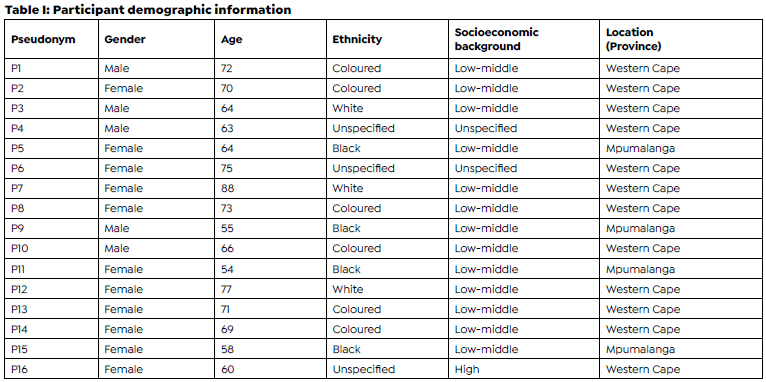
All four primary studies utilised purposive5051Table I, page 58).
Data collection
Data for the four primary studies were collected in May 2020 through face-to-face contact or using technological platforms such as: telephone calls, WhatsApp Messenger, and email. Researchers utilised individual interviews guided by semi-structured and open-ended questions to facilitate discussions. The key questions focused on older adults' experiences of the influence of COVID-19 and the South African lockdown, how this influenced their occupational engagement, and how they adapted. Telephone calls were recorded and voice notes were saved and transcribed verbatim, whilst written responses were saved. These transcripts were then analysed separately for each primary study and the findings were written up as chapters of the four research reports. The four research reports, with a focus on the findings chapters, comprised the data sources for the qualitative meta-analysis presented in this paper.
Data analysis
Relevant information from the primary studies was mapped onto a data extraction spreadsheet, and included title, research question, study aim and objectives, theoretical framework, methodology, research setting, findings, discussion, and recommendations. Subsequently, all data extraction spreadsheets (transcripts) were imported to generate one master transcript, and organised using a coding framework to be analysed thematically52
The first author utilised Braun and Clarke's six steps of thematic analysis to guide data analysis through the process of familiarisations and noticing similarities and patterns53
Trustworthiness
Trustworthiness was ensured by means of the above-mentioned critical appraisal of the primary studies4754554756
Ethics
Ethics approval was obtained from the University's Biomedical Research Ethics Committee (BM20/9/3). All participants in the four primary studies and the meta-analysis study took part voluntarily, provided informed consent and were aware of their right to withdraw from the study at any stage without concern of repercussions. All health and safety protocols to prevent the transmission of COVID-19 were strictly adhered to throughout the study. Participant confidentiality and privacy was maintained throughout. Participants were assigned pseudonyms and all data were stored on password-protected devices only accessible to persons directly involved in the study.
FINDINGS
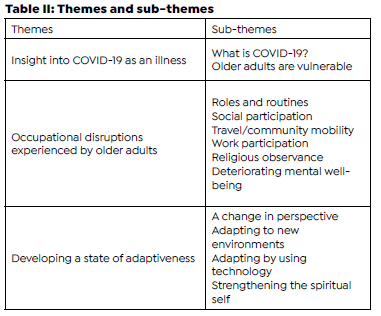
Data analysis yielded three dominant themes: (1) Insight into COVID-19 as an illness, (2) occupational disruptions experienced by older adults, and (3) developing a state of adaptiveness. These themes comprised twelve sub-themes and are supported by data extracts (Table II adjacent).
Theme One: Insight into COVID-19 as an illness
The first theme deals with the older adults' insight into COVID-19 as an illness, which highlights their understanding of the pandemic. This theme further captures the awareness about the vulnerability of older adults in developing moderate-severe health outcomes.
What is COVID-19
Participants perceived COVID-19 as a novel virus similar to the common cold or flu in its presentation of a dry cough, fever, tiredness and fatigue, however, emphasised its severity in likening it to a terrible virus grave enough to cause death.
"My understanding is that it is a terrible virus and people have died from it." (P1)
"Somebody that I knew died, she was a nurse." (P2)
Older adults are vulnerable.
It was determined that the risk of developing moderate-to-severe COVID-19 health outcomes was more prevalent in older adults due to their progressing age. This risk was exponentially increased by the prevalence of comorbidities such as diabetes mellitus and other immunocompromising conditions such as HIV/AIDS. Participants positioned older adults living with comorbidities as the most vulnerable South African population.
"COVID-19 affects us in old age because we have a lot of underlying medical problems. I have diabetes and I take ARV [antiretroviral] pills, so this puts you at risk. We are vulnerable." (P3)
Theme Two: Occupational disruptions experienced by older adults.
The second theme focuses on the occupational disruptions experienced by the older adults that influenced their occupational engagement during South Africa's COVID-19 lockdown.
Roles and routines
Participants reported that the abrupt enforcement of the South African COVID-19 lockdown during the COVID-19 pandemic caused significant disruptions in occupational engagement through the immediate suspension of previously held roles and routines. Previously engaged in roles and routines that provided participants with structure, predictability, autonomy through decision-making abilities, and the power to select meaningful or purposeful tasks or activities that filled up the day, were no longer possible during the lockdown.
"The lockdown has caused so much change and without warning. It really has a big impact on my ability to fulfil my daily routines. I don't know what to do anymore." (P4)
The lack of engagement in meaningful roles and routines caused confusion, frustration, uncertainty and led to participants questioning who they were and what they were doing with their time.
"My roles have changed overnight. Sometimes I don't know what to do because who I was, I can't be anymore." (P5)
Social participation
COVID-19 can largely be considered a social spreader in that the virus spreads more rapidly through social contact with infected persons or contaminated surfaces. The South African government, thus, more stringently regulated occupational engagement in social activities. Participants reported how vastly these restrictions negatively influenced their social and family roles resulting in loneliness, isolation, and disconnectedness.
"I used to visit friends and have them visit me three or four times a week and now we cannot do that. I feel alone." (P6)
"I used to see my family a lot. Now I only get to see my family once a week when they drop off my shopping, but they always say, 'Ma I'm staying in the car.' I wish they stayed longer." (P7)
Travel/community mobility
Participants highlighted restrictions on travel and community mobility as being instrumental in hindering their social participation and the fulfilment of family roles. This significantly affected participants as travel and community mobility was fundamental in aiding their connections to others.
"My children can't visit even though I live close-by. People are not allowed to travel." (P6)
"I used to visit my family but now I can't drive anywhere so I don't see them." (P8)
Travel, community mobility and social activities were closely monitored by the South African Police Service and National Defence Force through constant community surveillance and the implementation of a national curfew. Participants reported feeling anxious and fearful when leaving their homes out of concern that they could be arrested.
"I like being able to walk around my area but now I am worried I will get arrested." (P7)
Work participation
The South African COVID-19 lockdown called for the immediate closure of all business sectors, which fundamentally impacted upon participants' ability to engage in work. This is significant, as participants reported that the fulfilment of their worker role provided structure, predictability, meaning-fulness, purpose and financial means. Without some form of income, participants feared that they or their families would struggle to meet basic needs such as food.
"Lockdown prohibits me from doing my work." (P4)
"It [lockdown] has a great impact on my ability to fulfil my role as breadwinner. My ability to provide has been reduced to almost zero and it's concerning because my family will go hungry." (P8)
One participant reported drawing money from his unemployment fund to cover basic expenses however, that this was insufficient and that the amount became less each time.
"I am getting money from the UIF [Unemployment Fund], but it's not the same. It's not enough to cover all my expenses and it gets less every month." (P15)
Another participant highlighted that community soup kitchens were closed under the lockdown restrictions which further reduced opportunities for hunger relief for persons with financial challenges.
" I am involved in a church community soup kitchen, but it's closed, and the people don't have food around here." (P1)
As findings from the medical and science communities emerged and the lockdown alert levels were eased to facilitate the increased but still regulated movement of individuals, participants highlighted still being unable to work due to their age and the presence of chronic illnesses.
" I am not able to work because I am 55 and have a chronic sickness." (P9)
Religious observance
The South African COVID-19 lockdown caused the immediate closure of places of worship, resulting in disruptions in religious observance. Participants reported being unable to attend church and elucidated a longing for connectedness through a shared religious experience. Participants further positioned the social self as being interlinked with the religious self.
"I can't go to church. The fact that you can't see your friends by the services in church is something I miss a lot." (P6)
Several worship facilities adjusted their approach to religious observance as the lockdown alert levels eased through the use of technology and implementation of government recommended precautionary measures. Participants, however, reported still being unable to participate due to their progressed age and lack of technological proficiency.
"The staff and I collect for the church charity project; I can't get it to the people anymore because of my age and that's frustrating for me." (P2)
"I am an esteemed member of my congregation and not being there for meetings is affecting me. Other members continue with meetings on their phones, I don't know how to do that and I am an old man, I don't want to be a burden to anyone." (P3)
Deteriorating mental well-being
Disruptions in the occupational engagement of participants caused deterioration in mental well-being. Participants reported feeling sad, miserable, empty, helpless, burdensome, neglected and forgotten.
"I have been feeling miserable. I feel as if something has been taken away from me. Like the rug has been pulled from under me." (P10)
"I have to sit at home and feel helpless." (P8)
"I feel empty inside." (P1)
Disruptions exacerbated symptomology in participants diagnosed with depression.
"I have a history of depression. My daily routine helps me get my mind off things. Now I feel trapped in the house." (P11)
Theme Three: Developing a state of adaptiveness.
The third theme highlights how participants developed a state of adaptiveness to disruptions experienced in their occupational engagement. This was achieved through (a) a change in perspective, (b) adapting to new environments, (c) adapting by using technology, and (d) strengthening the spiritual self.
A change in perspective
Participants believed that the first stage to developing adaptiveness is through a change in perspective of oneself in relation to the various environments. With time, introspection and critical reflection, participants were able to accept the unpredictability of their environment, develop hope that COVID-19 and the lockdown were temporary and were optimistic that the opportunity to reintegrate, re-engage and reconnect would come soon.
"I know that this lockdown isn't going to last forever, and I know that I will be with my family and friends again. I just need to stay positive." (P7)
"I have learnt that I would rather miss my family for a little bit now and know that they are safe, than miss them forever if they died." (P12)
Adapting to new environments
Participants adapted to their new environments by establishing a state of peace with external circumstances and by implementing changes that fostered re-engagement. Participants reported readying their homes for re-engagement in social participation through the implementation of a designated area for visitors to practice good hand hygiene through hand-washing and/or sanitizing.
"I have sanitiser at the door and a bucket of water if you want to wash your hands." (P13)
Participants further reported overcoming barriers in their environment by designating a relative to fulfil high risk occupations such as shopping. Additionally, participants reported adjusting their times of engagement. This allowed participants to regulate their contact with others, thus reducing risk of potential COVID-19 infection.
"My daughter does my shopping for me now." (P8)
"I can only go early in the morning to the shop because then its empty and nobody is gonna [sic] bump into me". (P12)
Adapting by using technology
Technological tools such as a cell phone, laptop, tablet, and radio have been instrumental in facilitating re-engagement. One of the most noteworthy applications utilised by participants was WhatsApp messenger as it allowed participants to connect with family and friends through instant messaging, voice notes, sharing multimedia and voice and video calling.
"WhatsApp and social media help a lot because you still have access to others." (P2)
"I can talk to all of my friends at the same time now, not just one at a time. Yesterday I video-called with 4 friends on WhatsApp." (P8)
"I use WhatsApp to talk to my church friends and Father sends his sermon as a voice-note to us now. I listen to that every Sunday." (P12)
Strengthening the spiritual self
The South African COVID-19 lockdown was perceived as an enabler that facilitated participants to engage in occupations that strengthened the spiritual self. Participants reported that families now had the time to come together, pray and perform acts of worship. This allowed participants to focus on life's bigger picture.
"Families are spending lots of time together performing these acts of worship together. In this way this lockdown has been a blessing." (P14)
Participants used their abilities to engage in crafts such as knitting that occupied their time and calmed their mind through repetitive work activities. The knitted products motivated the participants to engage in occupations that fulfilled the purpose of giving back and being supportive to the communities.
"I knit bed socks and beanies [caps] for my family and the people in the road." (P7)
Participants experienced a sense of belongingness because they were able to engage in occupations that facilitated caring for others as part of intergenerational relations and occupational legacy. It was noted that the participants achieved a sense of meaning and purpose because they gave back to their families in need of care.
"Just before the lockdown my grandson was detoxing from his drugs at my house. This was difficult for him, and he needed me to look after him. I like that I am able to be here for him all the time and we are always together, so he doesn't feel alone during this difficult time." (P12)
"My mother has been very sick for some time, and I was only able to visit her at most once in a month. I can at least take care of her now since I am not going to work during this time. She will now definitely get better, I'm sure of that." (P15)
Participants engaged in occupations that encouraged a strengthened connection to the self, nature, and pets.
"I spend more time working in the garden and with my pets." (P4)
Participants engaged in occupations that fostered improved awareness, presence and calm through exercise, yoga, meditation, mindfulness and rest.
"I used to go to the gym before all of this started, that used to relax and help me. Now I do things like home exercises and yoga to help me." (P15)
"I have started meditating and reading the bible more."
(P11)
"I feel like my mind is resting. I can connect with myself."
(P11)
DISCUSSION
This study provided an insight into older adults' adaptiveness through the occupational disruptions that emanated from the eruption of the COVID-19 pandemic. Overall, the findings accentuated that there were vulnerabilities for older adults, as highlighted in the first theme (Insight into COVID-19 as an illness). The findings are congruent with Kaseje14155716,17. In the findings, participants reflected on themselves as the vulnerable population due to their progressed age. Participants 3, 9 and 11 further identified their vulnerability by indicating that they were living with comorbidities. This vulnerability was compounded when considering that South Africa has a weakened healthcare system that's efforts have been prioritised to mitigate a high population incidence of HIV/AIDS, tuberculosis, malnutrition, and lifestyle diseases1457
The findings in the second theme Occupational disruptions experienced by older adults underscored that the measures implemented to mitigate the influence of the pandemic and consequent lockdown, such as confinement, community restrictions, stay-at-home and social distancing, resulted in social isolation and loneliness among older adults. These findings indicated that the older adults were occupationally alienated because they experienced prolonged disruption, which is resonant with Townsend and Wilcock29,30. It can be argued that all populations experienced a degree of occupational alienation during the COVID-19 lockdown as marked by social isolation and loneliness; however, the findings indicate a clear discourse in terms of reduced freedom of opportunity owing to age. Additionally, the disruptions of the older adults' routines made them experience emptiness and a sense of meaningless, which affected their sense of identity. The results of the synthesis revealed that older adults' rights to exert individual autonomy and benefit from fair privileges seemed to have been infringed because they were occupationally marginalised and imbalanced29,30. This is supported by the extracts in the subtheme Roles and routines, which indicated that older adults experienced a sense of idleness, as they did not know what to do anymore.
In the subtheme Social participation, it was evident that the older adults experienced a sense of disconnectedness as they were unable to spend meaningful time with relatives, friends, and families. Furthermore, in the subtheme Travel/ community mobility, the findings reinforced Maldonado-Torres' assertion that the structures of coloniality of power have emerged during South Africa's COVID-19 lockdown and restrictions, as the government-controlled people's movements5858Work participation. This is resonant with Manahan59
The findings emerging from the third theme Developing a state of adaptiveness indicated that the South African COVID-19 lockdown-related occupational disruptions were powerful events that facilitated the process of occupational adaptation among older adults. These findings reverberated Grajo's explanations of occupational adaptations as a product of engagement in occupations; process that emerges during transaction with the environment; manner of responding to change and life transitions; and process to form a desired sense of self60A change in perspective, the findings indicated that the South African COVID-19 lockdown provided many older adults with the opportunity to engage in a gratitude exercise, as a flourishing activity that facilitated critical reflection and positivity6160
In responding to change and life transitions, the findings from the present meta-synthesis indicated that older adults experienced occupational adaptation because they altered the situation by reclaiming their roles and participating in alternate occupations to address the occupational challenge. This kind of adaptive gestalt response supported the older adults to configure their sensorimotor, cognitive, and psychosocial involvement in dealing with the occupational disruptions. It was evident that the older adults' occupational responses reflected a relative mastery, as they adapted their environment to achieve role expectations. This corroborates Schkade and Schultz's assumption that relative mastery is achieved when the person experiences the occupational response as efficient (use of time and energy), effective (production of desired result) and satisfying to self and society1
The older adults' state of occupational functioning was changed due to the South African COVID-19 lockdown restrictions and subsequent disruptions in occupational engagement. However, the findings indicated that the older adults strived for normality as far as possible, such as using technology to compensate for the loss of connection with others, which reinforced occupational adaptation. The findings are in agreement with recent studies that supported the use of technology to enhance the relatedness, mental and psychological needs of well-being6260,63,64,65. This process of dynamic occupational adaptation by the older adults speaks to a higher degree of resilience to environmental barriers.
It was evident in the sub-theme, Strengthening the spiritual self that the older adults strived to address the occupational disruptions, and occupational injustices emanating from the South African COVID-19 lockdown related restrictions that resulted in coloniality of being. Therefore, the findings validated that engagement in eudemonic occupations appeared as adaptive strategies that sustained older adults' adaptiveness so that they may pursue their purpose in life as valuable contributors to society59
Engagement in centering45,46 occupations such as meditation, attending online church and reading bible appeared as religious and spiritual activities that enabled the older adults to experience occupational adaptation, which supported their occupational identity. It is noted that the centring occupations45,46 was related to human flourishing including happiness and life satisfaction, mental and physical health, meaning and purpose, and close social relationships61
CONCLUSION
This study explored the adaptiveness of older adults to disruptions experienced during the South African COVID-19 lockdown. Evidence illustrated that older adults experienced disruptions in roles, routines, social participation, travel and community mobility, work participation and occupations linked to religious observance. These disruptions arose secondary to the South African government's top-down approach in the implementation of lockdown restrictions that, most significantly, stripped citizens of autonomy and resulted in the experience of powerlessness. The disruptions led to the deterioration of individual and population well-being as indicated by sadness, emptiness, helplessness, powerlessness, feeling neglected, forgotten, and burdensome. To surmount their deteriorating mental well-being consequent to disruptions in occupational engagement, older adults improved their state of adaptiveness through (a) a change in perspective; (b) adapting to new environments; (c) adapting by using technology; (d) expanding roles and routines; and (e) strengthening the spiritual self. Most noteworthy, participants reflected on strengthening the spiritual self through engagement in eudemonic occupations, which included the occupational gifts; contemplative, contributing, connecting, and centring occupations. This promoted a reconnection to the self, the community, and a greater life purpose, thus, encouraging and improving resilience to negotiate barriers.
The COVID-19 lockdown was monumental in highlighting the degree of socio-political change that is needed to transform many of the persisting fragments pertaining to society when considering privilege. The South African population should be commended for their increased resilience to transcend many complex barriers and adapt. This continual state of adaptation against environmental barriers however, should not become customary as it has the potential for individuals to neglect their own occupational desire, needs and wants thus laying the potential for a disconnection from one's occupational identity. Future research can look at this relationship or could explore health outcomes of persons unable to develop a state of adaptiveness to overcome disruptions in occupational engagement.
Declaration of Conflicts of Interest
The authors declare no conflicts of interest.
Author contributions
Aaqil de Vries was involved in the literature review and data analysis and took the lead in writing the manuscript.
Thuli Godfrey Mthembu supervised some of the student research projects which were part of the meta-analysis; and contributed to the conceptualisation of the study, development of the research proposal, literature review, data analysis and writing the manuscript. Lisa Wegner supervised some of the student research projects which were part of the meta-analysis; lead the conceptualisation of the study, development of the research proposal and data analysis; and contributed to writing the manuscript.
REFERENCES
Acknowledgements
The authors acknowledge and thank the four students who conducted the studies and the 16 participants for their participation.
Literature review
-
1. Schultz S, Schkade J. Occupational adaptation: Toward a holistic approach for contemporary practice, Part 2. The American Journal of Occupational Therapy. 1992;46(10):917-925. https://doi.org/10.5014/ajot.46.10.917
» https://doi.org/10.5014/ajot.46.10.917 -
2. Law M, Cooper B, Strong S, Stewart D, Rigby P, Letts L. The person-environment-occupation model: A transactive approach to occupational performance. Canadian Journal of Occupational Therapy. 1996;63(1):9-23. https://doi.org/10.1177%2F000841749606300103
» https://doi.org/10.1177%2F000841749606300103 - 3. Kielhofner G, Forsyth K, Barrett L. The model of human occupation. In Crepeau EB, Cohn ES, Schell BAB, Willard & Spackman's occupational therapy, editors. 10th ed. Lippin-cott Williams & Wilkins; 2003. p. 212-219.
-
4. Blacker D, Broadhurst L, Teixeira L. The role of occupational therapy in leisure adaptation with complex neurological disability: A discussion using two case study examples. NeuroRehabilitation. 2008;23(4):313-319. https://doi..org/10.3233/NRE-2008-23404
» https://doi..org/10.3233/NRE-2008-23404 -
5. Lexell E, Iwarsson S, Lund M. Occupational adaptation in people with multiple sclerosis. OTJR: Occupation, Participation and Health. 2010;31(3):127-134. https://doi.org/10.3928/15394492-20101025-01
» https://doi.org/10.3928/15394492-20101025-01 -
6. Cahill M, Connolly D, Stapleton T. Exploring occupational adaptation through the lives of women with multiple sclerosis. British Journal of Occupational Therapy. 2010;73(3):106-115. https://doi.org/10.4276/030802210X12682330090415
» https://doi.org/10.4276/030802210X12682330090415 -
7. O'Leary L. Minding our mental health as our routines adjust to the coronavirus outbreak [Internet]. St Patrick's Mental Health Services. 2020 [cited 8 July 2021]. Available from: https://www.stpatricks.ie/media-centre/blogs-articles/2020/march/new-routine
» https://www.stpatricks.ie/media-centre/blogs-articles/2020/march/new-routine - 8. Cloete L, Mthembu T, Christopher C, Gretschel P. Beating COVID-19 by going back to the basics at home. Parliamentary Newsletter. 2020;2(4), 7.
-
9. Johansson A, Mishina E, Ivanov A, Björklund A. Activities of daily living among St Petersburg women after mild stroke. Occupational Therapy International. 2007;14(3):170-182. https://doi.org/10.1002/oti.232
» https://doi.org/10.1002/oti.232 -
10. Du Toit A. Outbreak of a novel coronavirus. Nature Reviews Microbiology. 2020;18(3):123-123. https://doi.org/10.1038/s41579-020-0332-0
» https://doi.org/10.1038/s41579-020-0332-0 -
11. Zhu N, Zhang D, Wang W, Li X, Yang B, Song J et al. A novel coronavirus from patients with pneumonia in China, 2019. New England Journal of Medicine. 2020;382(8):727-733. https://doi.org/10.1056/NEJMoa2001017
» https://doi.org/10.1056/NEJMoa2001017 -
12. Sohrabi C, Alsafi Z, O'Neill N, Khan M, Kerwan A, Al-Jabir A et al. World Health Organization declares global emergency: A review of the 2019 novel coronavirus (COVID-19). International Journal of Surgery. 2020; 76:71-76. https://doi.org/10.1016/j.ijsu.2020.02.034
» https://doi.org/10.1016/j.ijsu.2020.02.034 -
13. Kim A, Nyengerai T, Mendenhall E. Evaluating the mental health impacts of the COVID-19 pandemic: perceived risk of COVID-19 infection and childhood trauma predict adult depressive symptoms in urban South Africa. Psychological Medicine. 2020;1-13. https://doi.org/10.1017/S0033291720003414
» https://doi.org/10.1017/S0033291720003414 -
14. Kaseje N. Why Sub-Saharan Africa needs a unique response to COVID-19 [Internet]. World Economic Forum. 2020 [cited 22 June 2021]. Available from: https://www.weforum.org/agenda/2020/03/why-sub-saharan-africa-needs-a-unique-response-to-COVID-19/
» https://www.weforum.org/agenda/2020/03/why-sub-saharan-africa-needs-a-unique-response-to-COVID-19/ -
15. Adhikari S, Meng S, Wu Y, Mao Y, Ye R, Wang Q et al. Epidemiology, causes, clinical manifestation and diagnosis, prevention, and control of coronavirus disease (COVID-19) during the early outbreak period: a scoping review. Infectious Diseases of Poverty. 2020;9(1):29. https://doi.org/10.1186/s40249-020-00646-x
» https://doi.org/10.1186/s40249-020-00646-x -
16. Ostchega Y, Hughes J, Zhang G, Nwankwo T, Graber J, Nguyen D. Differences in hypertension prevalence and hypertension control by urbanization among adults in the United States, 2013-2018. American Journal of Hypertension. 2021; 35(1): 31-41. https://doi.org/10.1093/ajh/hpab067
» https://doi.org/10.1093/ajh/hpab067 -
17. Shahid Z, Kalayanamitra R, McClafferty B, Kepko D, Ramgobin D, Patel R et al. COVID-19 and older adults: What we know. Journal of the American Geriatrics Society. 2020;68(5):926-929. https://doi.org/10.1111/jgs.16472
» https://doi.org/10.1111/jgs.16472 -
18. Centers for Disease Control and Prevention. Covid-19. 2022 [cited 24 July 2022]. Available from: https://www.cdc.gov/coronavirus/2019-ncov/need-extra-precautions/people-with-medical-conditions.html
» https://www.cdc.gov/coronavirus/2019-ncov/need-extra-precautions/people-with-medical-conditions.html -
19. Nwosu C, Oyenubi A. Income-related health inequalities associated with the coronavirus pandemic in South Africa: A decomposition analysis. International Journal for Equity in Health. 2021;20(1). https://doi.org/10.1186/s12939-020-01361-7
» https://doi.org/10.1186/s12939-020-01361-7 -
20. Stiegler N, Bouchard J. South Africa: Challenges and successes of the COVID-19 lockdown. Annales Médico-Psychologiques, Revue Psychiatrique. 2020;178(7):695-698. https://doi.org/10.1016/j.amp.2020.05.006
» https://doi.org/10.1016/j.amp.2020.05.006 -
21. Niehaus I. From AIDS to Covid-19 in South Africa: Thoughts from an Uxbridge Apartment. African Arguments. 2020 [cited 24 July 2022]. Available from: https://africanarguments.org/2020/04/from-aids-to-covid-19-in-south-africa-thoughts-from-an-uxbridge-apartment/
» https://africanarguments.org/2020/04/from-aids-to-covid-19-in-south-africa-thoughts-from-an-uxbridge-apartment/ -
22. Hara M, Ncube B, Sibanda D. Water and sanitation in the face of COVID-19 in Cape Town's townships and informal settlements. PLAAS. 2020 [cited 24 July 2022]. Available from: https://www.researchgate.net/publication/343588510_Water_and_sanitation_in_the_face_of_Covid-19_in_Cape_Town's_townships_and_informal_settlements
» https://www.researchgate.net/publication/343588510_Water_and_sanitation_in_the_face_of_Covid-19_in_Cape_Town's_townships_and_informal_settlements -
23. Gumede W. Latest - SA faces food riots and breakouts from the lockdown - Wits University. The University of the Witwa-tersrand, Johannesburg. 2020 [cited 24 July 2022]. Available from: https://www.wits.ac.za/covid19/covid19-news/latest/sa-faces-food-riots-and-breakouts-from-the-lockdown.html
» https://www.wits.ac.za/covid19/covid19-news/latest/sa-faces-food-riots-and-breakouts-from-the-lockdown.html -
24. Evans J. 'The gun was directly in my face' - multiple shops looted in Manenberg. News24. 2022 [cited 24 July 2022]. Available from: https://www.news24.com/news24/SouthAfrica/News/the-gun-was-directly-in-my-face-multiple-shops-looted-in-manenberg-20200414
» https://www.news24.com/news24/SouthAfrica/News/the-gun-was-directly-in-my-face-multiple-shops-looted-in-manenberg-20200414 -
25. Hungry South Africans clash with police amid Co-vid-19 lockdown. New Straits Times. 2020 [cited 24 July 2022]. Available from: https://www.nst.com.my/world/world/2020/04/584442/hungry-south-africans-clash-police-amid-covid-19-lockdown
» https://www.nst.com.my/world/world/2020/04/584442/hungry-south-africans-clash-police-amid-covid-19-lockdown -
26. Chabalala J. Police brutality under lockdown: Public has 'no faith' in cops. News24. 2020 [cited 24 July 2022]. Available from: https://www.news24.com/news24/southafrica/news/police-brutality-under-lockdown-members-of-public-have-no-faith-in-cops-20200812
» https://www.news24.com/news24/southafrica/news/police-brutality-under-lockdown-members-of-public-have-no-faith-in-cops-20200812 -
27. Bhorat H, Köhler T. Lockdown economics in South Africa: Social assistance and the Ramaphosa stimulus package. Brookings. 2020 [cited 24 July 2022]. Available from: https://www.brookings.edu/blog/africa-in-focus/2020/11/20/lockdown-economics-in-south-africa-social-assistance-and-the-ramaphosa-stimulus-package/
» https://www.brookings.edu/blog/africa-in-focus/2020/11/20/lockdown-economics-in-south-africa-social-assistance-and-the-ramaphosa-stimulus-package/ -
28. Durocher E, Gibson B, Rappolt S. Occupational justice: A conceptual review. Journal of Occupational Science. 2013;21(4):418-430. https://doi.org/10.1080/14427591.2013.775692
» https://doi.org/10.1080/14427591.2013.775692 -
29. Townsend E, Wilcock A. Occupational justice and client-centred practice: A dialogue in progress. Canadian Journal of Occupational Therapy. 2004;71(2):75-87. https://doi.org/10.1177/000841740407100203
» https://doi.org/10.1177/000841740407100203 - 30. Wilcock A. An occupational perspective of health. Slack Incorporated; 2006.
- 31. Kronenberg F, Pollard N. Overcoming occupational apartheid: A preliminary exploration of the political nature of occupational therapy. Occupational therapy without borders: Learning from the spirit of survivors. 2005;1:58-86.
-
32. Whiteford G. Occupational deprivation: Global challenge in the new millennium. British Journal of Occupational Therapy. 2000;63(5):200-204. https://doi.org/10.1177/2F030802260006300503
» https://doi.org/10.1177/2F030802260006300503 -
33. Galvaan R. The contextually situated nature of occupational choice: Marginalised young adolescents' experiences in South Africa. Journal of Occupational Science. 2014;22(1):39-53. https://doi:10.1080/14427591.2014.912124
» https://doi:10.1080/14427591.2014.912124 -
34. Nizzero A, Cote P, Cramm H. Occupational disruption: A scoping review. Journal of Occupational Science. 2017;24(2):114-127. https://doi.org/10.1080/14427591.2017.1306791
» https://doi.org/10.1080/14427591.2017.1306791 -
35. Klinger L. Occupational adaptation: Perspectives of people with traumatic brain injury. Journal of Occupational Science. 2005;12(1):9-16. https://doi.org/10.1080/14427591.2005.9686543
» https://doi.org/10.1080/14427591.2005.9686543 -
36. Eklund M, Orban K, Argentzell E, Bejerholm U, Tjörnstrand C, Erlandsson L et al. The linkage between patterns of daily occupations and occupational balance: Applications within occupational science and occupational therapy practice. Scandinavian Journal of Occupational Therapy. 2016;24(1):41-56. https://doi.org/10.1080/11038128.2016.1224271
» https://doi.org/10.1080/11038128.2016.1224271 -
37. Doroud N, Fossey E, Fortune T. Recovery as an occupational journey: A scoping review exploring the links between occupational engagement and recovery for people with enduring mental health issues. Australian Occupational Therapy Journal. 2015;62(6):378-392. https://doi.org/10.1111/1440-1630.12238
» https://doi.org/10.1111/1440-1630.12238 -
38. Nelson D. Why the profession of occupational therapy will flourish in the 21st Century. The American Journal of Occupational Therapy. 1997;51(1):11-24. https://doi:10.5014/ajot.51.1.11
» https://doi:10.5014/ajot.51.1.11 - 39. Nelson DL, Jepson-Thomas J. Occupational form, occupational performance, and a conceptual framework for therapeutic occupation. Perspectives in human occupation: Participation in life. 2003:87-155.
-
40. Deci E, Ryan R. Hedonia, eudaimonia, and well-being: an introduction. Journal of Happiness Studies. 2006;9(1):1-11. https://dx.doi.org/10.1007/s10902-006-9018-1
» https://dx.doi.org/10.1007/s10902-006-9018-1 -
41. Huta V, Waterman A. Eudaimonia, and its distinction from hedonia: Developing a classification and terminology for understanding conceptual and operational definitions. Journal of Happiness Studies. 2013;15(6):1425-1456. https://doi.org/10.1007/s10902-013-9485-0
» https://doi.org/10.1007/s10902-013-9485-0 -
42. Ryan R, Deci E. On happiness and human potentials: A review of research on hedonic and eudaimonic well-being. Annual Review of Psychology. 2001;52(1):141-166. https://doi.org/10.1146/annurev.psych.52.1.141
» https://doi.org/10.1146/annurev.psych.52.1.141 -
43. Waterman A, Schwartz S, Conti R. The implications of two conceptions of happiness (Hedonic Enjoyment and Eudaimonia) for the understanding of intrinsic motivation. Journal of Happiness Studies. 2006;9(1):41-79. https://doi.org/10.1007/s10902-006-9020-7
» https://doi.org/10.1007/s10902-006-9020-7 -
44. Hayward C, Taylor J. Eudaimonic Well-being: Its Importance and Relevance to Occupational Therapy for Humanity. Occupational Therapy International. 2011;18(3):133-141. https://doi.org/10.1002/oti.316
» https://doi.org/10.1002/oti.316 - 45. Thibeault R. Occupational gifts. In McColl M, editor. Spirituality and occupational therapy. 2nd ed. CAOT-ACE; 2011. p.111-120.
-
46. Zafran H. Occupational Gifts in the Time of a Pandemic. 2020. Available from: https://www.mcgill.ca/spot/article/occupational-gifts-time-pandemic
» https://www.mcgill.ca/spot/article/occupational-gifts-time-pandemic -
47. Timulak L. Meta-analysis of qualitative studies: A tool for reviewing qualitative research findings in psychotherapy. Psychotherapy Research. 2009;19(4-5):591-600. https://doi.org/10.1080/10503300802477989
» https://doi.org/10.1080/10503300802477989 - 48. Hall HR, Roussel LA. Evidence-Based Practice: An integrative approach to research, administration, and practice. Burlington, MA: Jones & Barlett Learning; 2014.
-
49. Allmark P. Should research samples reflect the diversity of the population? Journal of Medical Ethics. 2004;30(2):185-189. https://doi.org/10.1136/jme.2003.004374
» https://doi.org/10.1136/jme.2003.004374 - 50. Patton MQ. Qualitative research and evaluation methods. 3rd ed. Thousand Oaks, CA: Sage Publications; 2002.
-
51. Goodman L. Comment: On respondent-driven sampling and snowball sampling in hard-to-reach populations and snowball sampling not in hard-to-reach populations. Sociological Methodology. 2011;41(1):347-353. https://doi.org/10.1111/j.1467-9531.2011.01242.x
» https://doi.org/10.1111/j.1467-9531.2011.01242.x -
52. Braun V, Clarke V. Using thematic analysis in psychology. Qualitative Research in Psychology. 2006; 3(2): 77-101. https://doi.org/10.1191/1478088706qp063oa
» https://doi.org/10.1191/1478088706qp063oa -
53. Krefting L. Rigor in qualitative research: The assessment of trustworthiness. American Journal of Occupational Therapy. 1991; 45(3): 214-222. https://doi.org/10.5014/ajot.45.3.214
» https://doi.org/10.5014/ajot.45.3.214 - 54. Guba E, Lincoln Y. Competing paradigms in qualitative research. Thousand Oaks, Ca: Sage; 1994.
-
55. Carter N, Bryant-Lukosius D, DiCenso A, Blythe J, Neville A. The Use of Triangulation in Qualitative Research. Oncology Nursing Forum. 2014;41(5):545-547. https://doi.org/10.1188/14.ONF.545-547
» https://doi.org/10.1188/14.ONF.545-547 -
56. Korstjens I, Moser A. Series: Practical guidance to qualitative research. Part 4: Trustworthiness and publishing. European Journal of General Practice. 2017;24(1):120-124. https://doi.org/10.1080/13814788.2017.1375092
» https://doi.org/10.1080/13814788.2017.1375092 -
57. Chen J. Daily social life of older adults and vulnerabilities during the covid-19 pandemic. Frontiers in Public Health. 2021;9: 637008. https://doi.org/10.3389/fpubh.2021.637008
» https://doi.org/10.3389/fpubh.2021.637008 -
58. Maldonado-Torres N. ON THE COLONIALITY OF BEING. Cultural Studies. 2007;21(2-3):240-270. https://doi.org/10.1080/09502380601162548.
» https://doi.org/10.1080/09502380601162548 -
59. Monahan C, Macdonald J, Lytle A, Apriceno M, Levy S. CO-VID-19 and ageism: How positive and negative responses impact older adults and society. American Psychologist. 2020;75(7):887-896. https://doi.org/10.1037/amp0000699
» https://doi.org/10.1037/amp0000699 -
60. Grajo L, Boisselle A, DaLomba E. Occupational adaptation as a construct: A scoping review of literature. The Open Journal of Occupational Therapy. 2018;6(1):6. https://doi.org/10.15453/2168-6408.1400
» https://doi.org/10.15453/2168-6408.1400 -
61. van der Weele T. Religious communities and human flourishing. Current Directions in Psychological Science. 2017;26(5):476-481. https://doi.org/10.1177/2F0963721417721526
» https://doi.org/10.1177/2F0963721417721526 -
62. Goldschmidt K. The COVID-19 Pandemic: Technology use to Support the Wellbeing of Children. Journal of Pediatric Nursing. 2020;53:88-90. https://doi.org/10.1016/j.pedn.2020.04.013
» https://doi.org/10.1016/j.pedn.2020.04.013 -
63. Palma Candia O, HuesoMontoro C, Martí-García C, Fernandez-Alcantara M, Campos-Calderón C, Montoya Juárez R. Understanding the occupational adaptation process and well-being of older adults in Magallanes (Chile): A Qualitative Study. International Journal of Environmental Research and Public Health. 2019; 16(19):3640. https://doi.org/10.3390/ijerph16193640
» https://doi.org/10.3390/ijerph16193640 -
64. Mthembu TG, Wegner L, Roman N V. Spirituality in the occupational therapy community fieldwork process: A qualitative study in the South African context. South Africa Journal of Occupational Therapy. 2017; 47(1):16-23. http://dx.doi.org/10.17159/2310-3833/2016/v46n3a4.
» http://dx.doi.org/10.17159/2310-3833/2016/v46n3a4 -
65. Firfirey N, Hess-April L. A study to explore the occupational adaptation of adults with MDR-TB who undergo long-term hospitalisation. South African Journal of Occupational Therapy. 2014; 44(3):18-24. Available from: http://www.scielo.org.za/scielo.php?script=sci_arttext&pid=S2310-38332014000300006&lng=en.
» http://www.scielo.org.za/scielo.php?script=sci_arttext&pid=S2310-38332014000300006&lng=en

Peer review: July2022
Revised: August 2022
Accepted: September 2022
Published: April 2023
Funding: The authors would like to thank the University of the Western Cape for funding the study.