Rehabilitation and work reintegration within the disability claims management process: A South African Private Insurer Perspective
Abstract
BACKGROUND: Maintaining or promoting employment in the presence of disability or reducing the impact of disability on employability should be the adopted focus to decrease the negative impact that disability has on the economy and just as important on the livelihood and well-being of exposed insured individuals. Group risk disability insurance protects an employee's income when illness or injury result in work disability. To achieve this, factors that promote the success of rehabilitation and support for return-to-work of employees following illness and injury need to be understood from an insurance perspective. OBJECTIVES: To explore principles of disability claims management during the rehabilitation and work reintegration stage using a multi-stakeholder approach for the purpose of successful return to work. METHODS: An exploratory qualitative design was used to collect data via semi-structured interviews with 26 purposively selected participants. Interviews were audio-recorded, data were transcribed and analysed thematically. Qualitative research was used to understand the necessary role players in the work reintegration process, factors that hinder and promote work reintegration and best practice principles for Disability Claims Management (DCM). RESULTS: Three themes emerged from the study; (i) role players and their functions with collaboration is integral to disability claims management, (ii) various factors promote and restrict return-to-work planning, and (iii) best practice principles in the DCM pathway that promote return-to-work. These principles include behavioural economics as the central principle, with resource identification and competency, governance, role engagement and education and awareness as supporting principles. CONCLUSION: Collaborative and integrated approaches by role players within a workers' family unit, health system, employer structure and insurance compensation are required for positive return-to-work outcomes. The various role players are responsible for creating policies, structures, intervention strategies, and environments that foster return-to-work. IMPLICATIONS FOR PRACTICE • An integrated approach is required for optimal RTW outcomes as employers' policies restrict work integration. • A collaborative approach by all role players involved in DCM, focusing on positive RTW outcomes is required in the RTW process • Occupational therapists can influence employer incapacity and disability policies in order to keep people employed and productive in the presence of medical conditions with the application of reasonable accommodations where necessary. • Occupational therapists are suitably positioned to outline workplace environment and other supports required to guide and support employees through rehabilitation and RTW and in ensuring that employees who can remain at work while on a partial or fully insured benefit, can engage optimally in aspects of work function.
vocational rehabilitation; work function; disability claims management; behavioural economics; work disability; role-player collaboration; return-to-work
INTRODUCTION
Work disability most often refers to the permanent inability to work, but it can also include temporary inability to work, sick leave, or reduced work hours12345
In terms of disability claims management, employers provide group risk disability insurance to their employees as part of the employer's risk management strategy to provide income to employees if health or injury impacts workability. Based on the first author's background in the insurance industry, it seems evident that the responsibility for managing employees after illness or injury is a shared effort between the insurer and the employer. Consequently, Disability Claims Management - when an insured benefit is in effect - can be seen as a collaborative intervention approach between the employer and the insurer. Disability Management is also viewed as Disability Claims Management and is not limited to claims processing under the specific disability benefits plans, but includes the active management of claims. Disability Management is proactive and aimed at recovery and work reintegration, including the employer, the worker, private or state insurers, and healthcare professionals3,6.
Role players in Disability Management (DM)
Teamwork, establishing expert interactions within a multidisciplinary team (MDT) including the employer, employee or employee's representative, and Disability Management (DM) rehabilitation service providers are essential for DM738489
It has become common for insurers in South Africa to employ occupational therapists as claims assessors to ensure robust assessments considering the occupational impact of medical diagnoses1010
In 2012, Reinsurance Group of America (RGA) conducted a survey which cited that 43% of South African insurers did not employ rehabilitation services to manage disability claims. This was in marked contrast to the other regions surveyed (Australia, North America, and the UK). Over 80% in each market reported using rehabilitation services to manage disability claims107,11.
Essential DM concepts and strategies
DM programmes that include a blended approach, that is, between organisations with proactive RTW interventions and individuals, limit the incidence of disability12813
Factors that impact Disability Management
Employers who assume ownership and responsibility for injured worker reintegration and worksite accommodations frequently use Disability Management (DM) programmes that include components for optimal disability management884141091415, including stigma from claims processes, colleagues, professional service providers and employers2
Injured persons who continue engaging in work activities have better outcomes than those off work144161417 101899
To consolidate an effective disability claims management pathway, we need to understand the factors that impact rehabilitation and work reintegration for injured and ill employees. Dermody and colleagues1919
METHODS
Study design
The methodology for this study referenced the Consolidated Criteria for Reporting Qualitative Studies (COREQ) according to the 32 items on the checklist, which is recommended for comprehensive reporting of qualitative studies20
Reflexivity and research team
The primary author is a qualified female occupational therapist with ten years' clinical experience spanning private and public healthcare and a further 13 years' experience in corporate insurance, focusing on disability benefits and case management to facilitate RTW. Data collection was completed with the assistance of a co-facilitator. The co-facilitator was a qualified female occupational therapist with four years' clinical experience and corporate insurance experience. The co-facilitator, a disability assessor within an insurance company at the time of the study, was chosen as she had insight into the selection of questions and interview probing due to her familiarity with the study aims, peer debriefing and data triangulation. In a professional capacity, several of the study participants knew the primary author. As a result, the researcher's positionality was made overt through a series of reflective statements and exercises that indicated practical knowledge of the subject of study, allowing for the suspension of judgments as needed and reducing researcher bias. The researcher analysed her goals and how her roles and identities influenced the study techniques.
Study population and sampling strategy
The study focused on a sample of 40 identified stakeholders engaged in the management of private insurance disability claims in South Africa, selected through purposive sampling that aimed for maximum variation. Participants were chosen based on their expertise in ill-health intervention and disability insurance. The first author had professional interactions with several stakeholders. The study purposively sampled its target population from diverse sources such as companies, broker houses, insurance groups, reinsurance groups, and occupational therapy practices. The participants encompassed CM and vocational occupational therapists, Employee Wellness Practitioners (EWP), group insurance disability claims managers, Health Risk Managers (HRM), Human Resources (HR) professionals, insurance brokers, and an Occupational Medical Practitioner (OMP). Individuals were selected based on their knowledge, interest, and experience in the field. To initiate engagement, an expression of interest e-mail was dispatched to five stakeholders within each group, totalling 40 stakeholders. From these, 26 stakeholders responded, representing various roles, including human resource managers (n=4), employee wellness specialists (n=3), occupational health medical practitioners (n=4), group insurance disability claims brokers (n=3), health risk managers (HRM) (n=3), group insurance disability claims assessors (n=3), vocational/case management occupational therapists (n=3), and group insurance reinsurance disability claims managers (n=3). All respondents were subsequently included in the study for interview purposes.
Data collection
Semi-structured interviews were used in this study as this method facilitated in-depth data collection using open-ended and probing questions21,22. The development of questions was guided by the literature reviewed and the authors' practical experience of RTW. Each interview was conducted in English with the primary author and a co-facilitator to gather the relevant data comprehensively. All participants communicated in English within their respective roles. Interviews were completed after receiving informed consent from the participant. Twenty-six, 60-minute semi-structured interviews were conducted. The interviews were conducted individually to allow the participants to express their personal experiences without influencing other role players.
The interviews occurred online and were audio-recorded and transcribed verbatim using the Microsoft Teams platform. The researcher then checked the relevant transcripts against the audio recordings multiple times to ensure the integrity and amended any incongruences in the data during analysis, thereby providing a basis for trustworthiness23
Data analysis and rigour
The data were analysed using thematic analysis, which entailed reading and re-reading the transcripts to identify themes within the data2425
Ethical Considerations
Ethics approval was provided by the Human and Social Sciences Ethics Research Committee (HSSREC/00002870/2021) of the University of KwaZulu Natal. The participants were contacted via e-mail to explain the study's aim, purpose, and process. The details about the study, the biographical details request, and consent were sent via e-mail for acknowledgement and signature. The right to withdraw from the research process at any point, research content, and anonymity of data were iterated in the consent and at the start of the interview. All participants provided written consent to participation and publication of data in the study. Confidentiality was maintained by de-identification of participants and the pooling and synthesis of the data sets.
RESULTS
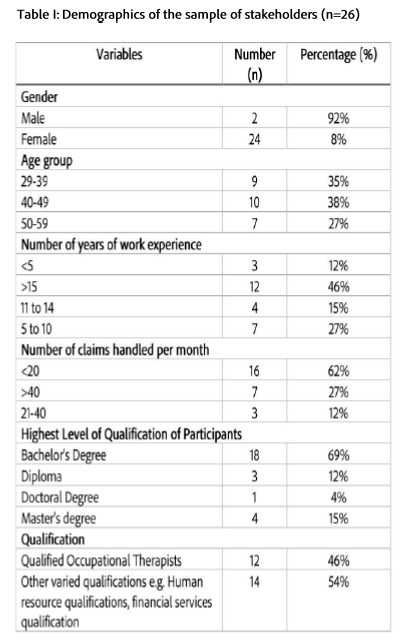
Twenty-six individuals volunteered to participate in the study; and included CM/vocational occupational therapists (n=3), EWP (n=3), group insurance disability manager (n=6), HRM (n=3), HR (n=4), OMP (n=4), insurance disability claims broker (n=3). A total of 46% of the stakeholders held an Occupational Therapy qualification, albeit performing different roles in the disability claims management process. All participants who met the inclusion criteria were included in the study. Stakeholders without exposure to disability in the workplace and disability benefits were excluded from the study (Table I below).
Three themes emerged from the data analysis and reflect the study's aims.
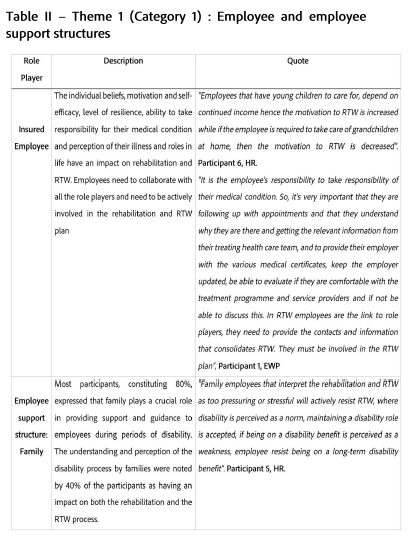
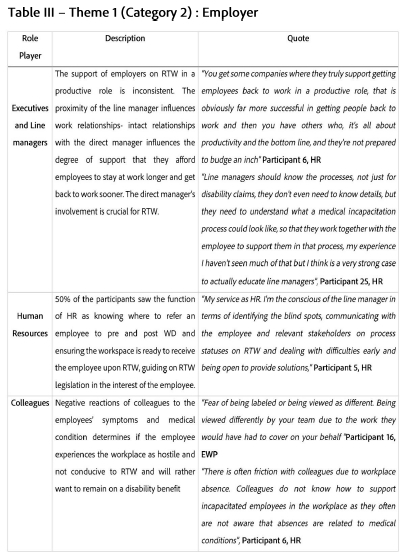
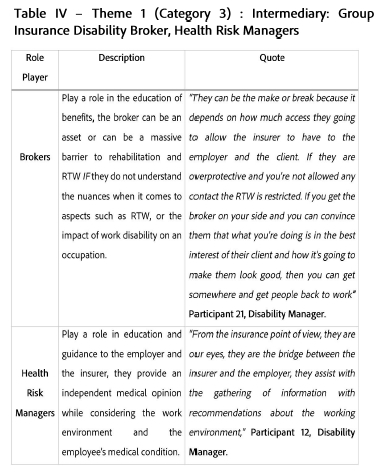
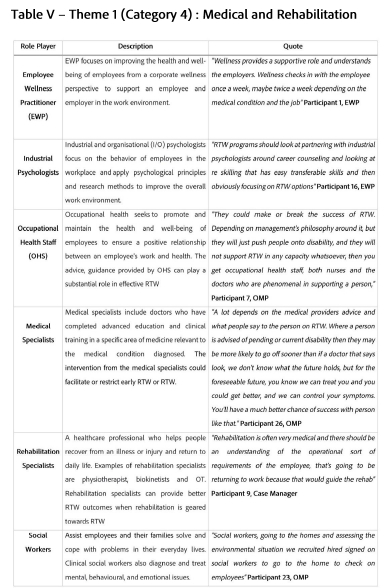
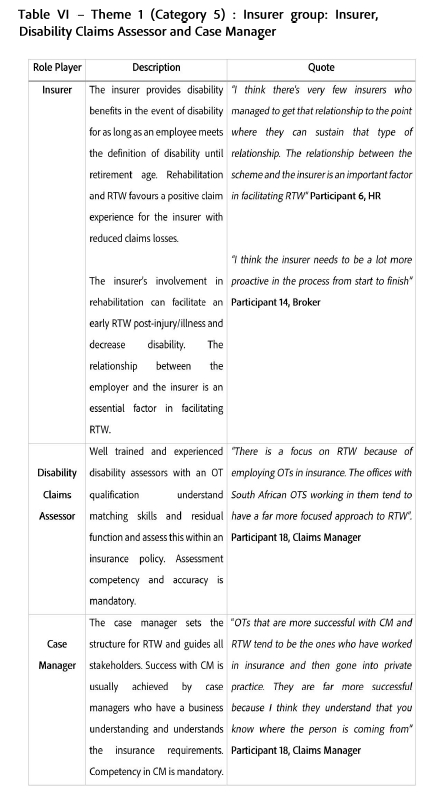
Theme 1: Role Players and their Functions in DCM-Rehabilitation and RTW (Tables II-VI)
This theme identified the role players in the DCM pathway and described their function in the rehabilitation and RTW stage. Five role-player categories were consolidated: (1) employee and employee support structures, (2) employer, (3) intermediary group, (4) medical and rehabilitation, and (5) insurer group. The following tables These are illustrated in tables with verbatim quotes highlighting the participants' voices.
The feedback, level of intervention from the medical providers and how the medical condition is explained impact RTW. The medical team is described in Table V (below).
Theme 2: Factors that facilitate and restrict rehabilitation and RTW based on the opinions of the participant group
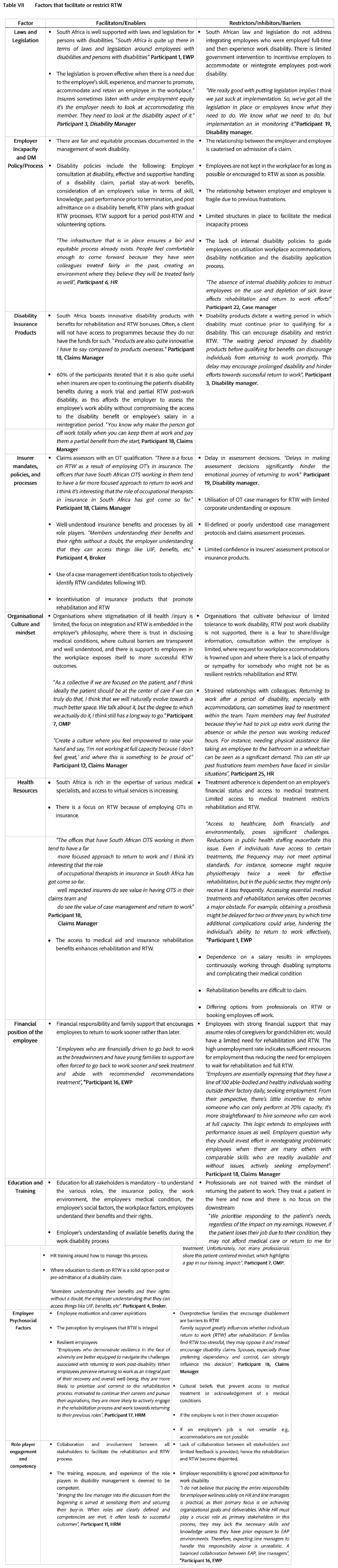
Several factors posed as facilitators and or barriers to rehabilitation and RTW implementation. The factors listed in Table VII (page 59) have been grouped into the following categories: Laws and Legislation, Employer Incapacity and DM policy/Process, Disability Insurance Products, Insurer mandates, policies and processes, Organisational Culture and mindset, Health Resources, Financial position of the employee and Education training.
Theme 3 - Best Practice Principles
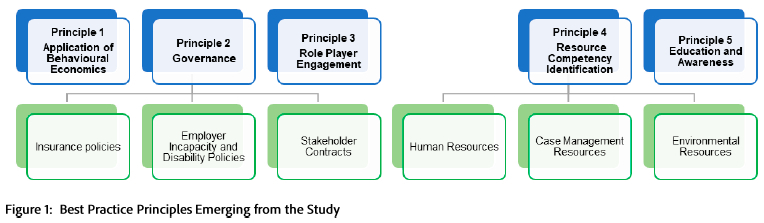
Figure 1 (below) illustrates the five best practice principles that emerged from the study
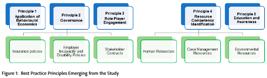


Principle 1: Application of Behavioural Economics
Behavioural economics is a field of study that combines insights from psychology and economics to understand how individuals make economic decisions. It examines the psychological factors, cognitive biases, and social influences that impact people's choices in economic situations29
The approach and resultant behaviour of how role players approach disability claims management and manage RTW must be structured to adopt the approach/ attitude that the employee's RTW is integral in promoting quality of life and claims management. Recommendations around access to healthcare must be intentional, realistic, and aligned to the collaborative goals of all role players to support claims management and RTW. Adopting a claims management "philosophy" was recommended.
"Eat, live, breathe claims management because, client management for me is everything we, we can't put things into little pockets. We need to have a very clearly defined philosophy. If you don't have that, it's not going to work,"
Participant 20, Disability Manager
"As a collective if we are focused on the patient, and I think ideally the patient should be at the centre of care if we can truly do that, we will naturally evolve towards a much better space. We talk about it, but the degree to which we actually do it, I think still has a long way to go," Participant 7, OMP.
Principle 2:
GovernanceThe governance framework needs to exist to ensure that the correct policies are in place, so the proper procedures can be followed. These frameworks are fundamental for fairness in the process for all stakeholders.
The following governance frameworks were noted from the respondents:
• Insurance policies must support rehabilitation and RTW through policy wording and benefits, including the employee's role and responsibility in disability claims management. This was highlighted as follows:
"Insurers involvement in rehabilitation can facilitate an early RTW post injury/illness and decrease disability if the financial support and guidance is part of the insurance policy", Participant 18, Claims Manager
• Employer Incapacity and Disability policies should focus on keeping people employed and productive in the presence of medical conditions and applying reasonable accommodations where necessary. The policies should define the processes to be followed in case of loss of productivity due to medical reasons, and stakeholders should be consulted. The policy must outline the workplace environment and people support required to guide and support employees through rehabilitation and RTW. If employees can remain at work while on a partial or fully insured benefit should be considered in the workplace to keep an employee semi or fully engaged in aspects of work function.
Family support greatly influences whether individuals return to work (RTW) after rehabilitation", Participant 18, Claims Manager
"Allowing the employer to remove the employee from payroll reduces the chances of them returning to work. We should push for ongoing payment during this period. If the employer continues to handle the employee's salary, they might be motivated to help them return to work. However, if the employer stops managing the salary and removes the employee from payroll, it damages the relationship between the employer and the employee, discouraging the employer from making efforts to bring them back to work",
Participant 4, Broker
Stakeholder contracts are crucial to clarify roles, comply with requirements, and acknowledgement of roles in the rehabilitation and RTW process. Contracts must ensure that the appropriately qualified stakeholders are sourced to achieve RTW success. Informal contracting with family employees and support structures are also included in this principle. Participant 5, Broker, noted:
"Contracting the right skill for the role and contracting the responsibilities or all parties involved is crucial for accountability and positive outcomes"
Principle 3: Role Player Engagement
The purpose of the key role players identified in Theme One, including the employee, must be maintained throughout the process. The motivation and incentive of the employee to participate meaningfully in treatment and RTW integration must be monitored. Direct contact or communication between the employees and the identified role players is required for successful outcomes.
"Direct contact with employees either in person or telephonically. Are you seeing this person picking up the phone and calling them and saying this is who I am? This is what I'm asking you? Do you have a minute?" Participant 19, Disability manager.
"Having a well-coordinated team is the best way to manage RTW. That has been the biggest differentiator in terms of how well people RTW, or whether they even stay within the workplace" Participant 21, Disability manager
Rehabilitation and RTW planning must be consolidated with all the relevant role players. The plan must ensure that there is understanding, transparency and communication. Feedback loops must be established to adjust plans to achieve the return-to-work goals.
Engagement between stakeholders must allow for a level of flexibility and agility. This includes both proactive and reactive management from the insurer. The insurers' contribution to early identification and management of claims, including financial support for rehabilitation, must be discussed as part of the engagement. Role players engage in the workplace, family environment and medical treatment. Role players must engage with the various treatment pathways for a positive outcome.
"Make sure all parties are talking to each other "
Participant 13, HRM
Principle 4:
Resource Identification and CompetencyWe have outlined the role players that play a critical role in positive RTW outcomes. However, the competency of these role players plays a crucial role in the DCM process and RTW.
• Human Resources
"I think that we need to upskill our managers and our HR in terms of how we integrate and what can be done in the integration period because I think sometimes our managers and our HRBP's are not patient and understanding enough",
Participant 24, HR
• Disability Assessors: There is a focus on RTW because of employing occupational therapists as claims assessors in insurance. The South African occupational therapists working at the insurance companies bring that skill level. Medical background knowledge is integral in claims assessment and is challenging to teach when compared to technical terms and policy conditions and how they are applied
"Understanding medical knowledge and how it relates to function is essential - occupational therapists are probably the best equipped", Participant 21, Disability Manager.
CM Resources in the insurance context must include suitably qualified case managers.
"Case managers with exposure in the corporate and clinical settings have better RTW outcomes based on their practical knowledge in the workplace and exposure to work environments", Participant 20,
Disability Manager
• Environmental Resources should be focused on creating a conducive RTW environment; this is achieved by addressing any previous frustrations between colleagues and educating the employer on stigma and what to expect from the employee upon RTW.
"Ensure that the employee has the tools and, workspace, and access rights that are necessary when they RTW "
Participant 13, H RM
Principle 5:
Education and Awareness• "Ensuring adequate education and awareness is the responsibility of all role players", participant 1 EWP. Medical role players must ensure that the employee understands his medical condition and what interventions are required for RTW.
"The employer has a role in raising awareness of RTW options with colleagues and line managers and workplace sensitisation participant "Participant 16, EWP
• All role players need to understand the product details, the definition of disability, the purpose of the benefit, and how the policy/ product is practically applied at the claim stage. Increased understanding of active participation by employees must occur while they receive disability payment to facilitate RTW. Employees and line managers must understand and be orientated to these key facts from when the product is sold.
"All role players must be educated on the disability benefit when a claim is admitted, including the potential for RTW and termination options for the benefit" Participant 9, Case Manager
DISCUSSION
This study confirmed that an integrated stakeholder approach is required to succeed with rehabilitation and work reintegration goals. NIDMAR733,26. This study found that co-operation must include transparent communication on intervention, prognosis, and alignment of rehabilitation and RTW goals. Streamlining and co-ordinating the functions of each role player is crucial, with active involvement of the employee in goal setting for the return-to-work process. This is essential to prevent fragmented rehabilitation and RTW efforts. The competence of each role player holds significance, and regular monitoring of the RTW plan and the functions of all involved parties must be conducted at agreed-upon intervals.
Ensuring accurate assessments and anticipated outcomes from medical and rehabilitation providers is essential to manage expectations right from the outset of the process effectively. The employee is the key stakeholder who strongly influences RTW outcomes depending on their, level of motivation to engage in the interventions to RTW. The employee's motivation is influenced by various factors, including the work environment, relationship with the employer (including managers and colleagues), family support, cultural beliefs and whether the employee is resilient or not271011
One of the participants' significant reasons for limited success is the lack of general training in South Africa. A study concluded in 2018 noted that training in CM at undergraduate and postgraduate levels of occupational therapy is required1110
The financial support for rehabilitation in insurance products promotes rehabilitation. However, participants expressed that the insurer restricts access to disability products as goals to RTW may not be well understood or agreed on. The disability-waiting period in insurance policy dictates that disability must be evident for a specific period prior to an employee accessing the disability product. The nature of the waiting period could be seen as restricting early intervention and delaying treatment that could result in RTW. Wells & Barrett10
Zooming out of the governance concept and into the environmental space of the employee, the organisational mindset can either promote or restrict RTW reintegration. Participants perceived a general lack of trust in the South African context around medical diagnoses, influencing disclosure by employees due to the stigma related to diagnoses. Organisations that foster stigmatism and reduced disability tolerance tend to restrict RTW. In contrast, organisations where RTW is embedded in the employer's philosophy and disability processes and is well understood, will support RTW. The support provided by line managers and colleagues and their awareness and understanding of the RTW process can either enhance the RTW environment or place stress and anxiety on all role players. Participants agreed that the employee /claimant is the centre of care, and the organisation will naturally evolve to a better RTW space as a collective. This concept is echoed by Dekkers-Sánchez30
Financial and environmental access to medical treatment, adherence to treatment, and access to skilled specialists positively influence rehabilitation and RTW. The lack thereof is the opposite of not getting a confirmed diagnosis and adequate treatment. The delay in treatment has a dual impact on RTW; the delay in medical treatment complicates recovery and delays the assessment for potential benefits and interventions that could result in RTW. The state of finances of the employee either encourages or restricts RTW depending on the life roles being assumed by the employee.
Participants divulged that some employees would continue to work amidst symptoms and to the detriment of their health due to not getting time off work for treatment or for fear of being placed on disability. When this individual may not work further, rehabilitation and RTW may not be an option, as a WD may appear permanent. There are also instances where employees are driven to RTW post injury and illness, as maintaining their worker role is the only option.
Education and training of all role players is seen as a decisive factor in determining RTW. In circumstances where all stakeholders are well informed on employer processes, insurer processes, reasons for claims decisions and CM, thorough and informed decisions lead to the correct employees engaging in RTW and reintegration with more significant positive RTW outcomes. Awareness and knowledge are crucial to ensuring engagement in the RTW process. Coupled with this are the education and training qualifications of the injured or ill employee. Where opportunities are limited due to educational level and experience, the need for RTW to work may be more significant, and the opportunity to cross-skill the same employee to RTW may be reduced.
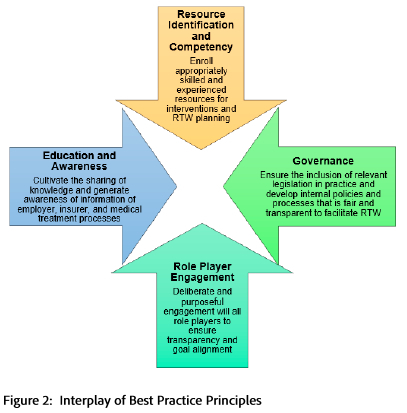
Best practice principles have emerged from the findings (as illustrated in Theme 3). Figure 2 (below) summarises how these best practice principles may work from a behavioural economics perspective.
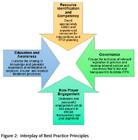
The concept that role-players need an integrated approach in the environmental and health context is integraI for successful RTW and illuminates the principle of resource identification and competency. The collaboration of these stakeholders in drafting and planning a RTW strategy, facilitating a RTW environment, and contributing to encouraging RTW speaks to a principle of role player engagement. Ensuring sufficient knowledge is disseminated, RTW policies, health conditions, insurance processes, and policies highlight the principle of education and awareness. Ensuring alignment to South African legislation, employer DM policies and insurance policies to promote RTW brings in the principle of governance. All these principles stem from the core concept of the employee being the focus in DCM's rehabilitation and RTW phases. Implementing a biopsychosocial approach and behavioural economics to ensure that all factors are considered around facilitating RTW post-work disability are highlighted as the study's fundamental principle.
CONCLUSION
The study has cemented that a collaborative and integrated approach by role-players within an employee's family unit, health system, employer structure and insurance compensation is required for positive RTW to work outcomes. The various role players are responsible for creating policies, structures, intervention strategies, and environments that foster RTW.
The profound impact of rapidly escalating workers' claims costs will be experienced worldwide by businesses and industries throughout the next decade because of reduced strained economies, reduced healthcare options and insurance benefits that provide a source of income. As this crisis challenges the insurance industry, RTW interventions create an opportunity. South Africa is faring well in having conversations around illness and injury and RTW, and employees can access care from an insurer perspective where RTW is possible. A more integrated approach could augment RTW options and give more structure and governance within the DM process to enhance RTW post-injury and illness.
Declaration of conflict of interest
The authors declare no conflict of interest
Author contributions
Dineshree Reddy completed this study towards a Masters in Occupational Therapy degree and was responsible for the conceptualisation of the study, data collection, analysis and drafting of the original manuscript. Pragashnie Govender and Deshini Naidoo were supervisors of the study and guided the process from conceptualisation and design of the study to drafting and revision of the manuscript. All authors read and approved the final manuscript.
REFERENCES
-
1. Isabelle J.C Thibau, Edward Yelin, Michael M. Ward, 61 -Socioeconomic and Disability Aspect, Dubois' Lupus Erythematosus and Related Syndromes (Ninth Edition). 2019,759-769 https://doi.org/10.1016/B978-0-323-47927-1.00061-X
» https://doi.org/10.1016/B978-0-323-47927-1.00061-X -
2. Young, A, Viikari-Juntura, E, Boot, C, Gimeno Ruiz de Porras, D, Linton, S. Workplace outcomes in work-disability prevention research: a review with recommendations for future research. Journal of Occupational Rehabilitation. 2016,1(1): 434-447. https://doi.org/10.1007/s10926-016-9675-9
» https://doi.org/10.1007/s10926-016-9675-9 -
3. Dunstan, D, MacEachern, E. Bearing the Brunt: Co-workers' Experiences of Work. Journal of Occupational Rehabilitation. 2012;1(1): 44-54. https://doi.org/10.1007/s10926-012-9380-2
» https://doi.org/10.1007/s10926-012-9380-2 -
4. Gowan, N. Gowan Health - Managing Disability in the Workplace: Everything You Need to Know. [Online]. Available from: https://gowanhealth.com/managing-disability-in-the-workplace-everything-you-need-to-know/
» https://gowanhealth.com/managing-disability-in-the-workplace-everything-you-need-to-know/ -
5. Reinsurance Group of America. Global claims views: Return-to-work in the context of COVID-19. [Internet]. Australia; May 2020. Available from: https://www.rgare.com/docs/default-source/marketing/rtw-in-the-context-of-covid-19-a-guidance-note global-claims-views final.pdf
» https://www.rgare.com/docs/default-source/marketing/rtw-in-the-context-of-covid-19-a-guidance-note global-claims-views final.pdf -
6. Doricic, D. Disability Management Best Practice VRA Canada Conference -Workplace Health and Safety. [Online]. Available from: https://www.slideshare.net/DarleneDoricic/disability-management-best-practices [Accessed 29 December 2020].
» https://www.slideshare.net/DarleneDoricic/disability-management-best-practices -
7. NIDMAR. (2003). Disability Management in the Workplace: A Guide to Establishing a Joint Workplace Program. Port Alberni, BC. http://www.re-integrate.eu/resources/001_rtwbook_e.pdf
» http://www.re-integrate.eu/resources/001_rtwbook_e.pdf -
8. ILO Content Manager. (2011). Disability Management at the Workplace: Overview and Future Trends. https://www.iloencyclopaedia.org/part-iii-48230/disability-and-work/item/179-disability-management-at-the-workplace-overview-and-future-trends
» https://www.iloencyclopaedia.org/part-iii-48230/disability-and-work/item/179-disability-management-at-the-workplace-overview-and-future-trends -
9. Govender R, Govender P, Naidoo D. Disability management in a public-private health care facility in South Africa: an organisational perspective. African Health Sciences [Internet]. African Journals Online (AJOL); 2021 Sep 27;21 (3):1440-50. Available from: http://dx.doi.org/10.4314/ahs.v21i3.55
» http://dx.doi.org/10.4314/ahs.v21i3.55 -
10. 9. Wells L, Barret P. Disability income: What can we learn from other markets? [Internet]. Reinsurance Group of America: South Africa; 2013 [updated 2013; cited 2021 November 12]. Available from: http://www.africanagenda.com/convention2013registration/papers/42-7f37a2a802344242b0059edb114ef263.pdf
» http://www.africanagenda.com/convention2013registration/papers/42-7f37a2a802344242b0059edb114ef263.pdf -
11. Govender, K, Christopher, C, Lingah, T. The role of the occupational therapist in case management in South Africa. South African Journal of Occupational Therapy. 2018;48(2): 18-19. http://dx.doi.org/10.17159/23103833/2018/vol48n2a3
» http://dx.doi.org/10.17159/23103833/2018/vol48n2a3 -
12. Rosenthal DA, Hursh N, Lui J, Isom R, Sasson J. A Survey of Current Disability Management Practice. Rehabilitation Counseling Bulletin [Internet]. SAGE Publications; 2007 Jan;50(2):76-86. Available from: http://dx.doi.org/10.1177/00343552070500020601
» http://dx.doi.org/10.1177/00343552070500020601 - 13. Kanhai, R. Life Claims Management- Insights from General Insurance. Finity ANZIIF Journal. 2014;37(4): 25.
-
14. Trippolini, M, Young, A, Pransky, G, Elbers, N, Lockwood, K, Cameron I. Beyond symptom resolution: insurance case managers perspective on predicting recovery after motor vehicle crash. Disability and Rehabilitation. 2019;1(1): 1-7 https://doi.org/10.1080/09638288.2019.1630857
» https://doi.org/10.1080/09638288.2019.1630857 -
15. Maja, P., Mann, W., Sing, S., Steyn, A, & Naidoo, P. Employing people with disabilities in South Africa. South African Journal of Occupational Therapy. 2011; 41(1):24-32. Available from: https://www.researchgate.net/publication/237188507_Employing_people_with_disabilities_in_South Africa
» https://www.researchgate.net/publication/237188507_Employing_people_with_disabilities_in_South Africa -
16. Collie A, Sheehan L, Lane TJ, Gray S, Grant G. Injured worker experiences of insurance claim processes and return to work: a national, cross-sectional study. BMC Public Health [Internet]. Springer Science and Business Media LLC; 2019 Jul 10;19(1). Available from: http://dx.doi.org/10.1186/s12889-019-7251-x
» http://dx.doi.org/10.1186/s12889-019-7251-x -
17. Pasanen, J, Luoma, A. How can social insurers promote return to work in occupational rehabilitation? A quantitative, cross-sectional study. BMC Public Health. [Online] 2021,-21(1): 1687. https://dx.doi.org/10.1186%2Fs12889-021-11758-w
» https://dx.doi.org/10.1186%2Fs12889-021-11758-w -
18. Cullen KL, Irvin E, Collie A, Clay F, Gensby U, Jennings PA, et al. Effectiveness of Workplace Interventions in Return-to-Work for Musculoskeletal, Pain-Related and Mental Health Conditions: An Update of the Evidence and Messages for Practitioners. Journal of Occupational Rehabilitation [Internet]. Springer Science and Business Media LLC; 2017 Feb 21;28(1):1-15. Available from: http://dx.doi.org/10.1007/s10926-016-9690-x
» http://dx.doi.org/10.1007/s10926-016-9690-x -
19. Dermody, M, Martin, J, Reid, S, Corbett, P, Ward, K. Balancing the challenges of Mental Health Claims in Insurance. Actuaries Institute. 2017,-1(1). Available from: https://www.actuaries.asn.au/Librarv/Events/SUM/2017/SUM17MartinEtAlPaper.pdf
» https://www.actuaries.asn.au/Librarv/Events/SUM/2017/SUM17MartinEtAlPaper.pdf -
20. Tong A, Sainsbury P, Craig J. Consolidated criteria for reporting qualitative research (COREQ): a 32-item checklist for interviews and focus groups. International Journal for Quality in Health Care [Internet]. Oxford University Press (OUP); 2007 Sep 16;19(6):349-57. Available from: https://dx.doi.org/10.1093/intqhc/mzm042
» https://dx.doi.org/10.1093/intqhc/mzm042 - 21. Flick, U, Von Kardorff, E. A Companion to Qualitative Research.: Sage Publications; 2004.
-
22. Jamshed S. Qualitative research method-interviewing and observation. Journal of Basic and Clinical Pharmacy [Internet]. Medknow; 2014;5(4):87. Available from: http://dx.doi.org/10.4103/0976-0105.141942
» http://dx.doi.org/10.4103/0976-0105.141942 -
23. Harrell M, Bradley M. Data collection methods: semi-structured interviews and focus groups. RAND: National Defense Research Insitute. [Internet]. Santa Monica: RAND Corporation; 2009 [updated 2009; cited 2021 November 12]. Available from: https://www.rand.org/content/dam/rand/pubs/technical_reports/2009/RANDTR718.pdf
» https://www.rand.org/content/dam/rand/pubs/technical_reports/2009/RANDTR718.pdf -
24. Al-Yateem N. The effect of interview recording on quality of data obtained: a methodological reflection. Nurse Researcher [Internet]. RCN Publishing Ltd.; 2012 Jul 19,-19(4):31-5. Available from: http://dx.doi.org/107748/nr2012.07.19.4.31.c9222
» http://dx.doi.org/107748/nr2012.07.19.4.31.c9222 -
25. Fereday J, Muir-Cochrane E. Demonstrating Rigor Using Thematic Analysis: A Hybrid Approach of Inductive and Deductive Coding and Theme Development. International Journal of Qualitative Methods [Internet]. SAGE Publications; 2006 Mar;5(1):80-92. Available from: http://dx.doi.org/10.1177/160940690600500107
» http://dx.doi.org/10.1177/160940690600500107 -
26. Govender, R, Naidoo, A, Govender, P. Return to Work following III Health or Disability in a Public-Private Health Care Facility: A Study in South Africa. Global Journal of Health Science. 2019;11(9): 171-179. https://doi.org/10.5539/gjhs.v11n9p170.
» https://doi.org/10.5539/gjhs.v11n9p170 -
27. Zhenjing G, Chupradit S, Ku KY, Nassani AA, Haffar M. Impact of Employees' Workplace Environment on Employees' Performance: A Multi-Mediation Model. Front Public Health. 2022 May 13,10:890400. Doi: 10.3389/fpubh.2022.890400. PMID: 35646787: PMCID: PMC9136218
» https://doi.org/10.3389/fpubh.2022.890400 -
28. Knauf, M, Schultz, I. Current conceptual models of Return to work. In: Schultz, I, Gatchel, R (eds.) Handbook on Return to work. New York: Springer; 2016. p. 27-51 Available from: http://dx.doi.org/10.1007/978-1-4899-7627-7 2
» http://dx.doi.org/10.1007/978-1-4899-7627-7 2 -
29. Heukelom, Floris. (2007). Kahneman and Tversky and the Origin of Behavioral Economics. SSRN Electronic Journal. 10.2139/ssrn.956887.
» https://doi.org/10.2139/ssrn.956887 -
30. Dekkers-Sánchez, P. M., Wind, H., Sluiter, J. K, & Frings-Dresen, M. H. (2011). What promotes sustained return to work of employees on long-term sick leave? Perspectives of vocational rehabilitation professionals. Scandinavian Journal of Work, Environment & Health, 37(6), 481-493. http://www.jstor.org/stable/23064883
» http://www.jstor.org/stable/23064883
Reviewed: 30 November 2023
Revised: 21 January 2024
Accepted: 21 January 2024
Data availability: All transcripts and raw data are available upon reasonable requests from the corresponding author.
Funding: The University of KwaZulu-Natal is acknowledged for tuition remission for the first author towards a Master's Degree, from which this paper emanates.