Support, supervision, and job satisfaction: Promising directions for preventing burnout in South African community service occupational therapists
Abstract
BACKGROUND: Community service occupational therapists may be especially vulnerable to experiencing burnout. This study sought to determine the levels of burnout experienced by this population and to investigate the relationship between reported burnout and various contextual, personal, and demographic factors METHODS: A quantitative, descriptive, cross-sectional survey design was used. The online questionnaire included contextual information of the participants and the Maslach Burnout Inventory. Data were analysed using Statistica 13.5. The effect of contextual, personal and demographic variables on burnout was tested using Kruskal-Wallis tests RESULTS: All community service occupational therapists were invited to participate in the study. A response rate of 31.92% was achieved (n=75). High levels of emotional exhaustion were reported by 55% (n=41) of participants. 'Strong' and 'adequate' support systems were associated to a greater sense of personal accomplishment (p=0.02) and 'minimal' social support was associated to increased emotional exhaustion (p=0.01). Dissatisfaction with supervision was associated to increased emotional exhaustion (p=0.017). Job satisfaction was associated to a greater sense of personal accomplishment (p=0.0002). Job dissatisfaction was associated to depersonalisation (p=0.047) and emotional exhaustion (p=0.006 CONCLUSION: Support systems, supervision and job satisfaction showed significant association to burnout. Interventions to address these factors, and research that further investigates the impact of contextual factors on burnout is recommended. This is imperative if South African occupational therapy is to take seriously its responsibility to the therapists responsible for taking services to populations with the greatest health needs Implications for practice • Opportunities for occupational therapists to develop professional resilience to prevent burnout should be offered across the lifelong learning continuum. • Strengthening supervision capacity and implementing mentoring and supervision strategies that provide mutual reward for both parties are needed. • The responsibility for promoting the vitality and job satisfaction of COSTs should be taken seriously by the Department of Health as CSOTs continue the vital work of taking rehabilitation to South Africa's populations with the greatest health needs.
Maslach Burnout Inventory Human Services Survey; contextual factors; job satisfaction; personal factors; demographic factors
INTRODUCTION
There is increasing concern around the experience of burnout amongst occupational therapists in South Africa and particularly among community service occupational therapists (CSOTs)123
Compulsory community service (CS) was legislated two decades ago to increase access to services for rural and underserved populations245562, 7
A proportion of CSOTs (44.7% in 20133839
The CSOTs who work in rural areas and on the PHC platform have limited access to physical resources such as specialised occupational therapy equipment, appropriate therapy areas to see clients in, and no specific occupational therapy budget allocation. A long turnover time to receive ordered equipment also poses a problem to access of physical resources3, 103,10. Access to supervision and mentorship is often limited along with restricted opportunity to observe other occupational therapists treating and interacting with clients 3,10 which may be due to a lack of staffing in the PHC system. Research has suggested that access to these resources is important to provide support in the transition from being a new graduate to a novice therapist 11
Many CSOTs often work with clients that do not speak the same language as they do and clients often come from different cultural and religious backgrounds, which makes delivery of accessible and appropriate services a challenge3, 101212, 13
In responding to the aforementioned challenges, many CSOTs have reported frustration around limited or absent budgets, inadequate resources141414141415 16
If burnout is prevalent amongst CSOTs, it is necessary to determine what intrinsic and extrinsic factors are associated with this experience in order for prevention and remediation strategies to be explored1171
Understanding burnout
Burnout was first described in the 1970s by Herbert Freud-enberger, an American psychologist, to report the consequence of extreme stress experienced by people working in helping professions. Individuals who were burned out lacked energy and could not cope with work demands18
"... a syndrome... resulting from chronic workplace stress that has not been successfully managed. It is characterised by three dimensions: feelings of energy depletion or exhaustion; increased mental distance from one's job, or feelings of negativism or cynicism related to one's job; and reduced professional efficacy. Burn-out refers specifically to phenomena in the occupational context and should not be applied to describe experiences in other areas of life16 1st paragraph."
Typical symptoms in burnout are, emotional exhaustion, depersonalisation, and reduced personal accomplishment that can occur among individuals who do 'people work' of some kind 19p. 32020202122
Burnout in health professionals and occupational therapists
Burnout can be related to factors such as expanding workloads and impractical requests from clients, families, and employers232323241325
In a 2020 study, occupational therapists in Texas were found to have greater levels of job satisfaction and lower levels of burnout as compared to other healthcare workers such as nurses. This was attributed to strict qualification criteria, and experience in different areas of practice with different populations, making occupational therapists an adaptable workforce, lessening feelings of frustration and despair in the workplace which may protect against burnout26
Similarly, a 2021 study found that Greek occupational therapists who were found to be more resilient (resilience measured using the Connor-Davidson Resilience Scale) had a greater sense of personal accomplishment and lower risk for experiencing burnout. Participants with less resilience were at greater risk for experiencing burnout2728
South African occupational therapists and burnout
A shortage of occupational therapists in South Africa exists, with 0.9 occupational therapists for every 10 000 people residing in South Africa529
The need to investigate burnout in the CSOT population
While there are studies on burnout in new graduate occupational therapists internationally, no study exploring burnout in South African CSOTs specifically could be found in the literature. Thus, it is uncertain if patterns of burnout reported in newly graduated therapists in other countries30
It is imperative that stakeholders (CSOTs, CSOTs' employers and the occupational therapy profession as a whole) understand CSOTs' the experiences of burnout and that this is addressed appropriately. Addressing the causes of high burnout rates may contribute towards developing an insightful, resourceful and resilient CSOT workforce. This research is thus positioned to describe burnout in CSOTs and investigating the relationship between burnout and relevant contextual, education and demographic factors.
METHOD
Study design
A quantitative, descriptive, cross-sectional survey design was employed. Inductive content analysis31
Study population
The 2019 CSOT population under study consisted of 235 therapists6
Sampling and sample size
Non-probability sampling was used as the details of each member of the population were not available to enable a random sampling approach3233
With a population of 235 a sample size of 147 was required to achieve a 5% margin of error, 95% confidence interval, and 50% response distribution34
Instrumentation and outcome measures
The online survey had two sections: demographic information of the participants and the Maslach Burnout Inventory.
Demographic factors were included in the questionnaire where literature suggested them to be significant to the experience of CSOTs310, 11, 3530
Maslach Burnout Inventory Human Services Survey (MBI-HSS)
The MBI-HSS used for this study, is the first version of the MBI and is most commonly used. It aims to determine how individuals working in helping professions experience burnout in relation to their profession and people who they come into contact with at work36373737
Internal reliability for the MBI was determined by using data from early samples by using Cronbach's coefficient alpha383737
How burnout was measured in the study Conflicting ideas of what constitutes low, moderate or high levels of burnout exist in the literature, challenging the interpretation of results in this study. Cut-off scores for measures are believed to show borders between norms and different clinical ranges39403741
Previous burnout studies involving healthcare professionals have not been overt in reporting cut offs for the three dimensions of burnout. A systematic review of 50 articles focusing on the classification and diagnosis of burnout in doctors and nurses found discrepancies between studies when defining burnout and providing cut-offs for low, moderate and high levels of the three components of burnout4040
The cut-offs chosen for this research were specifically taken from a study done with occupational and physiotherapists by Balogun et al4242
Permission to use the MBI-HSS was granted by MindGarden prior to data collection43
Research procedure
Ethical Considerations
Completion of survey questionnaire constituted consent to participate. Ethical clearance was obtained from the Human Research Ethics Committee (Medical) of the University of the Witwatersrand HREC number: M180719.
Data collection
Completion of the MBI-HSS and demographic questionnaire took approximately 20 minutes. Data were collected between July 2019 and January 2020, allowing for participants to have experienced at least 6 months of clinical work in the Community Service system. Reminders were sent via OTASA and social media during the data collection period. Data were collected and managed using REDCap, an electronic data capture tool hosted by the University of the Witwatersrand44
Data analysis
Questionnaires with missing data were discarded4546
Data were analysed using STATISTICA version 13.54748
Inductive content analysis3149
RESULTS
A total of 105 responses were received (44.68% return rate). Ten responses were incomplete and thus discarded. A further 20 responses were deleted as the MBI-HSS aspect of the questionnaire was not completed. Seventy-five responses were therefore included in analysis, representing 31.92% of the population.
Demographic and work information
Most of the participants (97.33%; n=73) were female (2.67%; n=2 male participants) and a majority (52%; n=39) were 23 years old (age range 22-30 years). Thirty percent of participants (30.67%; n=23) worked in Gauteng. A similar percentage of participants (41.33%; n=31) reported working in rural areas during CS (48%; n=36). One third of participants (33.33%; n=25) provided services at multiple levels of care with 25.33% (n=19) of them providing services at district level. Just over half (54.67%; n=41) of the participants worked at a single service site. Participants treated a median of 80 (Range:15-400).
Social support
A strong support structure and adequate support structure was reported by 49.33% (n=37), and 36% (n=27) of participants respectively. The main source of support reported by participants were significant others (37.33%; n=28) and nuclear family (33.33%; n=25).
Supervision
Most participants (77.33%; n=58) had a supervisor (no supervisor reported by 22.67%; n=17). Most supervisors (69.33%; n=52) were occupational therapists. Dissatisfaction with supervision by the 58 participants who had a supervisor was similar (40%; n=30) to satisfaction (37.33%; n=28).
Of those reporting dissatisfaction, 56.67% (n=17) reported that this was due to supervision that was not optimal or of a good standard. One participant explained,
"No one really checks on me/watches me and guides me". (Participant 53, 24-year-old, female)
Many participants who were dissatisfied with their supervision linked this to unethical practice and poor interpersonal relations with their supervisor (50%; n=15). Two participants explained,
"The supervising therapists do not hold themselves to the [same] standard that they expect the comm serve to adhere to". (Participant 11. 23-year-old, female)
"...develops own rules but doesn't obey them" (Participant 28. 23-year-old, female)
Several participants were not satisfied with their supervision because their supervisor was not an occupational therapist or had limited knowledge in training CSOTs (30%; n=9). Others attributed their dissatisfaction to organisational problems (20%; n=6) or believed their supervisor to have insufficient administrative and leadership skills (10%; n=3).
In contrast, eight (50%) participants who were very satisfied with their supervision, attributed this to available human and non-human resources. One participant explained,
"I am gaining experience in different fields of OT, getting great supervision and have the resources available to treat". (Participant 65, 22-year-old, female)
Job Satisfaction
Just over a third of participants (34.67%; n=26) were partially satisfied with their jobs as CSOTs, with 32% (n=24) of participants reporting being satisfied. Sixteen participants (21.33%) were very satisfied with their jobs and 12% (n=9) of participants were not satisfied with their job as a CSOT.
Twenty-four participants (92.31%) reported that they were only partially satisfied with their jobs as CSOTs due to the lack of human and non-human resources. One participant explained,
"I don't feel as if I am giving a type of service that is of great value, due to having no support, no means of assistance, I'm expected to run an entire OT department seeing in and outpatients both paeds and adults. I am also expected to be accountable for the entire rehab department due to having the highest qualification, which I think is unfair to me". (Participant 13, 26-year-old, female)
Eight (30.77%) participants were partially satisfied with their jobs due to feelings of being stressed, overwhelmed and discouraged. One participant provided the following comment,
"However, I also feel that my responsibilities are substantial, which in turn places an indescribable emotional and physical stress on me. This leads me to often question my happiness with my profession". (Participant 6, 24-year-old, female)
Two participants (7.69%) linked their partial job satisfaction to contextual limitations and eight (30.77%) participants attributed their partial satisfaction to positive experiences in their job.
Of the participants that were very satisfied with their jobs (21.33%, n=16), 62.5% (n=10) reported that they were very satisfied with their job due to the positive experiences of being an occupational therapist,
"...[you] can Anally have continuity of care for the patient throughout the year which means you see progress and feel like you are truly making a difference in someone else's life." (Participant 2, 23-year-old, female)
Of the participants that were not satisfied with their jobs as CSOTs (n=9), 66.67% (n=6) reported that their dissatisfaction was due to a lack of human and non-human resources. The following participant highlighted the absence of human resources,
"I have no support as the sole OT within the remote area, it is continually challenging to communicate with other team members, the understanding of OT in the area is limited despite efforts to change." (Participant 33, 24-year-old, female)
Five participants (55.56%) linked their job dissatisfaction to emotions experienced in the workplace. One therapist described,
"I feel hopeless and useless as I am not rendering a service of good quality." (Participant 25, 23-year-old, female)
Three participants (33.33%) who were not satisfied with their jobs attributed this to client-related frustrations. One participant explained,
"I also at times feel that I struggle to And compassion and sympathy for patients that do not take responsibility for their own health and see the professional as an expert rather than a partner (and patients are often reluctant to engage in goal setting with the therapists to guide their own therapy)." (Participant 9, 23-year-old, female)
Maslach Burnout Inventory Human Services Survey
The three components of the burnout syndrome, as measured by the MBI-HSS37Table I (page 72) and II (page 72). In Table I the mean score of 3.20, SD±1.35 indicates that most of the participants felt emotional exhaustion a few times a month, but not weekly. Table II indicates the level (low, moderate and high levels classified by Balogun et al.42
The mean score of 1.78, SD±1.16 (Table I, 73) indicates that most participants experienced depersonalisation a few times a year or less. Table II (page 73) indicates that 23% (n=17) of the participants reported high levels of depersonalisation at the time of data collection.
Participant's mean score for personal accomplishment was 4.16, SD±0.998 (Table I, page 73) indicating that participants felt a sense of personal accomplishment at least once a week. Table II (page 73) shows that 28% (n=21) of the participants reported high levels of personal accomplishment at the time of data collection. Twenty-five (33%) participants reported low levels of personal accomplishment with lower scores.
Contextual factors affecting perception of burnout
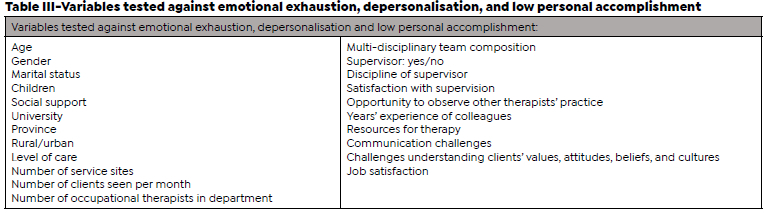
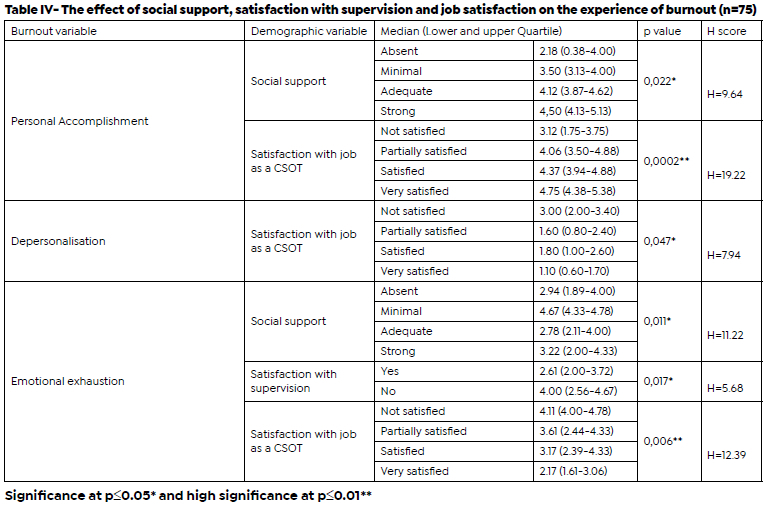
Table III (page 73) shows all the variables that were tested against emotional exhaustion, depersonalisation, and low personal accomplishment. Variables that demonstrated a significant relationship with burnout (p < 0.05, and p < 0.01 and lower for highly significant variables) are highlighted. Only six of the twenty-four variables tested were found to be significant and they all fell into the work demographic category of the demographic questionnaire: The participants' support systems, satisfaction with supervision and job satisfaction which had an effect on their experience of burnout is shown in Table IV (page 74).
The effect of support systems on burnout constructs
Participants with strong (median=4.5, quartile range 4.13-5.13) and adequate (median=4.12, quartile range 3.87-4.62) support systems had a greater sense of personal accomplishment. Kruskal-Wallis results for social support and a sense of personal accomplishment were H=9.64, p=0.022, with a mean rank for personal accomplishment of 14.5 for absent social support, 24.83 for minimal social support, 34.96 for adequate social support and 44.69 for strong social support.
Participants who reported minimal social support (me-dian=4.67, quartile range 4.33-4.78) reported greater levels of emotional exhaustion. Kruskal-Wallis results for social support and emotional exhaustion were H=11.22, p=0.01, with a mean rank of 60.28 for minimal social support.
The effect of satisfaction with supervision on burnout constructs
Participants who were not satisfied with the supervision they received (median=4.00, quartile range 2.56-4.67) reported greater levels of emotional exhaustion. Kruskal-Wallis results for satisfaction with supervision and emotional exhaustion were H=5.68, p=0.02, with a mean rank of 34.60 for not satisfied with supervision.
The effect of job satisfaction on burnout constructs
Participants who were very satisfied (median=4.75, quartile range 4.38-5.38) and satisfied (median=4.37, quartile range 3.94-4.88) with their jobs as CSOTs, had a significantly greater sense of personal accomplishment. Kruskal-Wallis results for job satisfaction and a sense of personal accomplishment were H=19.22, p=0.0002, with a mean rank for personal accomplishment of 14.11 for not satisfied with job, 34.98 for partially satisfied, 40.21 for satisfied with job and 53.03 for very satisfied with job.
Participants who were not satisfied with their CS job (median=3.00, quartile range 2.00-3.40) reported a greater sense of depersonalisation. Kruskal-Wallis results for job satisfaction and depersonalisation, were H=7.94, p=0.05, with a mean rank of 51.89 for not satisfied.
Lastly, participants who were not satisfied with their jobs as CSOTs (median=4.11, quartile range 4.00-4.78) experienced greater levels of emotional exhaustion with a highly significant value. Kruskal-Wallis results for job satisfaction with and emotional exhaustion were H=12.39, p=0.006, with a mean rank of 53.39 for not satisfied with job.
DISCUSSION
Burnout experienced by the participants
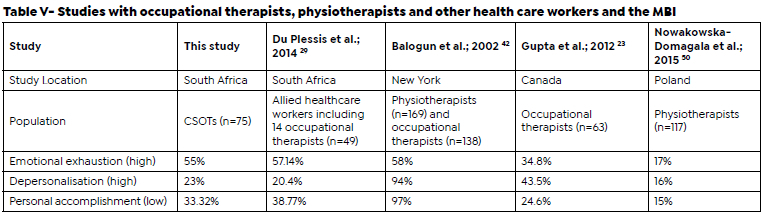
Notwithstanding the challenges around interpretation of MBI-HSS scores, emotional exhaustion was common amongst participants (55%) with smaller, though sizable, groups reporting reduced personal accomplishment (33%) and depersonalisation (23%). These results are similar to levels reported by South African therapists working in private rehabilitation facilities (57,14 %, 38,77% and 20,40% reported for the three components respectively)29Table V (page 75). The results measured for burnout differ for each country. Results for the Balogun et al 42
A well-established link between exhaustion and deper-sonalisation exists in the research as withdrawal is a reaction to exhaustion5152
Hospital and governmental rules may decrease the ability to make independent decisions at work when it comes to time spent in client care, which may increase burnout535353
Burnout influences quality of life, client care, places strain on the economy, and healthcare workers with burnout have been reported to have elevated suicide rates545553, 55541
Approaches for the treatment and prevention of burnout mainly focus on the use of coping mechanisms, fostering resilience, improving the work environment and independence in the work place5615757
The protective role of social support was a significant finding of this study. A positive relationship between social support and personal accomplishment was observed while emotional exhaustion was associated with poor support. A meta-analysis of 144 published articles demonstrated a similar relationship, however, support sources from outside of the workplace were specifically related to greater personal accomplishment. Work-related social support, however, demonstrated a negative association and was found to be closely related to emotional exhaustion58159
Satisfaction with supervision
A number of participants (20%) had no other occupational therapist in their departments or reported being the only allied health professional at their place of work (6.67%), which concurs with older research reporting that CSOTs may be left to run departments in rural practice by themselves with minimal support or supervision1036014
It is important to have a supervisor and enough guidance and support in the transition from being a new graduate to novice practitioner35, 613036135
Thirteen participants were satisfied with their supervision due to the frequency of supervision they received which was expected as the frequency of supervision may decrease from being a student to new practitioner and supervision efficaciousness differs over time62
Supervisor characteristics have been connected to supervision satisfaction in previous studies. Twenty participants were satisfied with their supervision because their supervisor was skilled and knowledgeable, and 14 participants were satisfied with their supervision due to their supervisor's positive characteristics.This concurs with the literature that suggests that there is a definite link between satisfaction with supervision and supervisors skill and experience963
Participants who had a supervisor reported experiencing greater depersonalisation than those who did not have a supervisor (p=0.050) which was unexpected as literature conveys that clinical supervision of a good standard usually results in decreased depersonalisation6464
Job satisfaction
Participants who were satisfied or very satisfied with their jobs as CSOTs had a greater sense of personal accomplishment with a highly significant score (p=0.0002). Participants who were not satisfied with their jobs as CSOTs reported a greater sense of depersonalisation (p=0.047) and experienced greater levels of emotional exhaustion with a highly significant value (p=0.006). This is expected as individuals who experience gratification from working with clients would be thought to have a greater sense of success and competence at work. Work satisfaction may be an indicator of decreased emotional exhaustion and depersonalisation and increased sense of personal accomplishment65
Participants in this study who were not satisfied with their jobs as CSOTs reported unethical staff behaviour (n=7), lack of support, recognition and learning opportunities (n=3), not being confident in their own skills (n=2), stress in workplace affecting emotional and mental wellbeing (n=4), and clients who do not take responsibility for their own health (n=3). These findings were expected, as job-dissatisfaction in occupational therapy is usually related to the work environment, decreased work status and the unspecified role of occupational therapy compared to other health professionals66
Occupational therapists report satisfaction with treating their clients and making a difference in clients' lives. The diverse nature of occupational therapy and the freedom to perform this work coincides with the feeling of satisfaction on the job666714
RECOMMENDATIONSBurnout: prevention is better than cure
CSOTs should have access to learning opportunities that enable them to understand burnout, recognise its symptoms and develop skills that protect against or mitigate its impact. These self-awareness and self-management skills don't develop overnight and need to be supported within the lifelong learning process. This should start with undergraduate students and CSOTs developing various intrinsic strategies to deal with burnout. Learning opportunities could include resilience education and how to foster resilience in preparation for and throughout the CSOT year and developing constructive coping strategies. This training could be offered by universities, OTASA and the employer.
Occupational therapy students can learn the protective value of social support and supervision and be encouraged to develop this throughout their undergraduate and CS years. These topics could be included in the undergraduate curriculum or as part of CPD in the CS year. Learning essential 'soft skills' at an undergraduate level could foster the development of effective self-management and resilience which will assist with navigating through studies, work and life6869
CSOT managers should communicate with CSOTs effectively and involve them in decisions regarding client treatment which gives CSOTs a sense of control in the workplace and decreases feelings of stress and burnout. Older (non-novice) therapists should also develop insight into their own risk for burnout and develop appropriate self-management skills. Modelling these important skills for junior therapists may change the work environment and lessen the risk for experiencing burnout.
Supervision and support in the workplace
Successful opportunities for support, supervision, growth, and development need to be made available to CSOTs by putting meaningful supervision, mentoring and educational programmes into place. Some initiatives which offer mentoring and support have been started70
Opportunities for therapists to grow in support and supervision roles need to be made. Professional organisations such as OTASA and RuReSA (and potentially universities), and the employer could take a more active role in developing good supervisors by providing CPD accredited courses, mentorship programmes, and communities of practice for therapists to develop their knowledge and skill and own sense of satisfaction within supervision, support and mentorship of younger therapists. Recognition for outstanding supervisors in the profession is valuable to promote growth in support and supervision roles. Currently, RuReSA has annual awards for best practicing rural therapists and outstanding supervisors and mentors could be nominated for these awards71
Job satisfaction
CSOTs employers could promote the determinants of job satisfaction highlighted by participants (positive experiences, having learning and growth opportunities, available human and non-human resources, and cohesion with other staff) for CSOTs at the workplace. Support through colleagues can be facilitated by employing CSOTs in pairs or more. Additionally, CSOTs can create their own resources and develop their own resilience by learning how to extract satisfaction from their jobs when determinants for job satisfaction are not available.
CSOTs should be afforded the opportunity to discover fields of preference by being exposed to a variety of placement areas and develop knowledge and skill across multiple areas of practice. This could be done by giving CSOTs the opportunity to rotate to different institutions in one area or seeing a variety of patients in primary care by travelling to different clinics on different days.
Opportunities to learn by means of observation of other occupational therapists' practice and learning about handling techniques with clients should be included in rotations. Transport arrangements by the employer to allow CSOTs to reach urban areas to access practicing occupational therapists would be beneficial. Where real opportunities to watch other occupational therapists' practice aren't possible, virtual opportunities could be explored. Due to the COVID-19 pandemic, telehealth has been approved by the WHO as an acceptable mode for occupational therapy intervention and can be used in training72
Strengths and limitations
This study is the first to document the prevalence of burnout in the CSOT population 17 years after the year of CS was implemented by the National Department of Health. It has expanded on work done by van Strormbroek and Buchanan in 2014, which describes CSOTs experiences and demographic factors35
It is not known if the research questionnaire reached the whole CSOT population and only 75 complete responses were analysed for the study from a total of 105 responses. This could be due to factors such as the participants not having access to social media or technology such as a computer and smartphone with sufficient data to complete the questionnaire. Additionally, some participants could have received the invitation to participate in the survey but did not do so. These factors may have caused an under-coverage bias7374
Data collected in the form of a self-reported questionnaire could create distortion and bias due to the researcher not being able to control situational elements (such as the environmental setting where the participants filled in the questionnaire). Furthermore, the study was a cross sectional study which could create temporal bias as the study was conducted in one point in time75
Pilot testing of the survey questionnaire was not done. This could have been a useful way to identify areas of the survey to improve to ensure a better response rate and to effectively recruit more participants76
CONCLUSION
High levels of emotional exhaustion, as an indicator for burnout, were common in the CSOT participants. Depersonalisa-tion and a reduced sense of personal accomplishment were less common. The relationship between these components and several personal, education and work demographic factors were tested. Significant associations with support, supervision and job satisfaction highlighted these areas as potential target areas to prevent and mitigate burnout symptoms. Roles for the South African occupational therapy profession, the Department of Health and novice clinicians themselves are described.
Author/s contribution
Nadia Struwig was an MSc occupational therapy postgraduate student at the time of the research (graduated in 2020). She was responsible for the conceptualization and execution of the project. She drafted the manuscript and was responsible for subsequent revisions. Kirsty van Stormbroek was the research supervisor of the project. She provided critical reviews, comments, and suggestions for revisions of the manuscript.
Conflicts of interest and bias declaration
The author declared no potential conflicts of interest with respect to the research, authorship, and/or publication of this article.
REFERENCES
Acknowledgements
The Community Service occupational therapists who participated in this study are sincerely thanked for their time and valuable contribution to understanding the research topic within the South African context. Gratitude is extended to Dr Denise Franzsen for her methodological expertise
LITERATURE REVIEW
- 1. Struwig N. The relationship between coping strategies utilised by Community Service occupational therapists and their experience of burnout [Research report]. Johannesburg: University of the Witwatersrand; 2020.
-
2. Reid S. Compulsory Community Service for doctors in South Africa - an evaluation of the first year. South African Medical Journal. 2001;91(4):329-35. Available from: https://www.ajol.info/index.php/samj/article/view/157573.
» https://www.ajol.info/index.php/samj/article/view/157573 -
3. van Stormbroek K, Buchanan H. Novice occupational therapists: Navigating complex practice contexts in South Africa. Australian Occupational Therapy Journal. 2019. Available from: https://onlinelibrary.wiley.com/doi/10.1111/1440-1630.12564.
» https://onlinelibrary.wiley.com/doi/10.1111/1440-1630.12564 - 4. Harrison D. An Overview of Health and Health care in South Africa 1994-2010: Priorities, Progress and Prospects for New Gains. In: Henry J. Kaiser Family Foundation 'to Help Inform the National Health Leaders' Retreat, editor. Muldersdrift2010.
-
5. Ned L, Tiwari R, Buchanan H, van Niekerk L, Sherry K, Chikte U. Changing demographic trends among South African occupational therapists: 2002 to 2018. Human Resources for Health. 2020;18. Available from: https://human-resources-health.biomedcentral.com/articles/10.1186/s12960-020-0464-3.
» https://human-resources-health.biomedcentral.com/articles/10.1186/s12960-020-0464-3 - 6. De Witt P. Statement as the preseident of Occupational Therapy Association of South Africa (OTASA). 2019.
-
7. Rural Health Advocacy Project. Rural Health Fact Sheet 2015 2015 [Available from: http://rhap.org.za/wp-content/uploads/2015/09/RHAP-Rural-Health-Fact-Sheet-2015-web.pdf.
» http://rhap.org.za/wp-content/uploads/2015/09/RHAP-Rural-Health-Fact-Sheet-2015-web.pdf -
8. SAQA. South African Qualifications Authority: Registered Qualification: Bachelor of Science in Occupational Therapy 2020 [Available from: https://allqs.saqa.org.za/showQualification.php?id=3497.
» https://allqs.saqa.org.za/showQualification.php?id=3497 -
9. Toal-Sullivan D. New graduates' experiences of learning to practice occupational therapy. British Journal of Occupational Therapy. 2006;69(11):513-24. Available from: https://journals.sagepub.com/doi/10.1177/030802260606901105.
» https://journals.sagepub.com/doi/10.1177/030802260606901105 -
10. Naidoo D, van Wyk J, Waggie F. Occupational therapy graduates' reflections on their ability to cope with primary healthcare and rural practice during community service. South African Journal of Occupational Therapy. 2017;47(3):39-45. Available from: https://www.sajot.co.za/index.php/sajot/article/view/412/286.
» https://www.sajot.co.za/index.php/sajot/article/view/412/286 -
11. Morley M. Contextual factors that have an impact on the transitional experience of newly qualified occupational therapists. The British Journal of Occupational Therapy. 2009;72(11):507-14. Available from: https://www.deepdyve.com/lp/sage/contextual-factors-that-have-an-impact-on-the-transitional-experience-LDd0baMwj9?key=sage.
» https://www.deepdyve.com/lp/sage/contextual-factors-that-have-an-impact-on-the-transitional-experience-LDd0baMwj9?key=sage - 12. Kautzky K, Tollman SM. A perspective on Primary Health Care in South Africa. South Africa Health Review. South Africa: Health Systems Trust; 2008.
-
13. Schlenz KC, Guthrie MR, Dudgeon B. Burnout in Occupational Therapists and Physical Therapists Working in Head Injury Rehabilitation. The American Journal of Occupational Therapy. 1995;49(10):986-93. Available from: https://research.aota.org/ajot/article-abstract/49/10/986/3829/Burnout-in-Occupational-Therapists-and-Physical?redirectedFrom=PDF.
» https://research.aota.org/ajot/article-abstract/49/10/986/3829/Burnout-in-Occupational-Therapists-and-Physical?redirectedFrom=PDF -
14. van Stormbroek K, Buchanan H. Community Service Occupational Therapists: thriving or just surviving? South African Journal of Occupational Therapy. 2016;46(3):63-72. Available from: https://open.uct.ac.za/handle/11427/30310.
» https://open.uct.ac.za/handle/11427/30310 - 15. Varvogli L, Darviri C. Stress management techniques: Evidence -based procedures that reduce stress and promote health. Health Science Journal. 2011;5:74-89.
-
16. International Classification of Diseases 11th Revision I-. QD 85 Burnout: World Health Organization; 2020 [Available from: https://icd.who.int/browse11/l-m/en#/http:/id.who.int/icd/entity/129180281.
» https://icd.who.int/browse11/l-m/en#/http:/id.who.int/icd/entity/129180281 - 17. Endler NS, Parker JDA. Coping Inventory for Stressful Situations (CISS) Manual. Second ed. United States and Canada: Multi-Health Systems Inc.; 1999.
-
18. Institute for Quality and Efficiency in Health Care. Depression: What is burnout? 2012. Available from: https://www.ncbi.nlm.nih.gov/books/NBK279286/.
» https://www.ncbi.nlm.nih.gov/books/NBK279286/ - 19. Maslach C. Burnout: The cost of caring. NJ: Prentice Hall: Englewood Cliffs; 1982.
- 20. Maslach C. A Multidimensional Theory of Burnout. Cooper CL editor. Oxford: UK: Oxford University Press; 1998.
-
21. Bothma FC, Roodt G. Work-based identity and work engagement as potential antecedants of task performance and turnover intention: unravelling a complex relationship. South African Journal of Industrial Psychology. 2012;38(1):1-17. Available from: https://www.researchgate.net/publication/266607108_BOTHMA_FC_ROODT_G_2012_Work-based_identity_and_work_engagement_as_potential_antecedents_of_task_performance_and_turnover_intention_Unravelling_a_complex_relationship_SA_Journal_of_Industrial_Psycholog.
» https://www.researchgate.net/publication/266607108_BOTHMA_FC_ROODT_G_2012_Work-based_identity_and_work_engagement_as_potential_antecedents_of_task_performance_and_turnover_intention_Unravelling_a_complex_relationship_SA_Journal_of_Industrial_Psycholog -
22. Shin H, Park YM, Ying JY, Kim B, Noh H, Lee SM. Relationships Between Coping Strategies and Burnout Symptoms: A Meta-Analytic Approach. Professional Psychology: Research and Practice. 2014;45(1):44-56. Available from: https://www.researchgate.net/publication/263936204_Relationships_Between_Coping_Strategies_and_Burnout_Symptoms_A_Meta-Analytic_Approach.
» https://www.researchgate.net/publication/263936204_Relationships_Between_Coping_Strategies_and_Burnout_Symptoms_A_Meta-Analytic_Approach -
23. Gupta S, Paterson ML, Lysaght RM, Von Zweck CM. Experiences of burnout and coping strategies utilized by occupational therapists. Canadian Journal of Occupational Therapy. 2012;79(2):86-95. Available from: https://www.researchgate.net/publication/225271324_Experiences_of_Burnout_and_Coping_Strategies_Utilized_by_Occupational_Therapists.
» https://www.researchgate.net/publication/225271324_Experiences_of_Burnout_and_Coping_Strategies_Utilized_by_Occupational_Therapists - 24. Stamm BH. The concise ProQOL manual. 2nd ed. Pocatello 2010.
-
25. Escudero-Escudero A, C., Segura-Fragoso A, Cantero-Garli PA. Burnout Syndrome in Occupational Therapists in Spain: Prevalence and Risk Factors. International Journal of Environmental Research and Public Health. 2020;17(3164). Available from: https://www.ncbi.nlm.nih.gov/pmc/articles/PMC7246504/pdf/ijerph-17-03164.pdf.
» https://www.ncbi.nlm.nih.gov/pmc/articles/PMC7246504/pdf/ijerph-17-03164.pdf -
26. Chen CC. Professional Quality of Life among Occupational Therapy Practitioners: An Exploratory Study of Compassion Fatigue. Occupational Therapy in Mental Health. 2020;36(2):162-75. Available from: https://www.tandfonline.com/doi/abs/10.1080/0164212X.2020.1725713.
» https://www.tandfonline.com/doi/abs/10.1080/0164212X.2020.1725713 -
27. Kyriazos T, Galanakis M, Katsiana A, Saprikis V, Tsiamitros D, Stalikas A. Are Resilient Occupational Therapists at Low Risk of Burnout? A Structural Equation Modeling Approach Combined with Latent Profile Analysis in a Greek Sample. Open Journal of Social Sciences. 2021;9:133-53. Available from: https://www.scirp.org/pdf/jss_2021062114290441.pdf.
» https://www.scirp.org/pdf/jss_2021062114290441.pdf - 28. Zeman E, Harvison N. Burnout, stress and compassion fatigue in occupational therapy practice and education: A call for mindful, self-care protocols. Commentary, National Academy of Medicine; Washington, DC. 2017.
-
29. Du Plessis T, Visagie S, Mji G. The prevalence of burnout amongst therapists working in private physical rehabilitation centers in South Africa: a descriptive study. South African Journal of Occupational Therapy. 2014;44(2):11-6. Available from: http://www.scielo.org.za/scielo.php?script=sci_arttext&pid=S2310-38332014000200004.
» http://www.scielo.org.za/scielo.php?script=sci_arttext&pid=S2310-38332014000200004 -
30. McCombie RP, Antanavage ME. Transitioning From Occupational Therapy Student To Practicing Occupational Therapist: First Year Of Employment. Occupational Therapy In Health Care. 2017;31(2):126-42. Available from: https://www.tandfon-line.com/doi/full/10.1080/07380577.2017.1307480.
» https://www.tandfon-line.com/doi/full/10.1080/07380577.2017.1307480 - 31. Vears DF, Gillam L. Inductive content analysis: A guide for beginning qualitative researchers. Focus on health professional education. 2022;23(1):111-27.
-
32. Glen S. Non-Probability Sampling: Definition, Types 2015 [Available from: https://www.statisticshowto.com/non-prob-ability-sampling/.
» https://www.statisticshowto.com/non-prob-ability-sampling/ -
33. Glen S. Snowball Sampling: Definition, Advantages and Disdvantages 2014 [Available from: https://www.statisticshowto.datasciencecentral.com/snowball-sampling/.
» https://www.statisticshowto.datasciencecentral.com/snowball-sampling/ - 34. Raosoft I. Raosoft Sample Size Calculator. 2004.
- 35. van Stormbroek K. The extent to which Community Service Occupational Therapists are equipped to treat patients with hand injuries and conditions. Cape Town: The University of Cape Town; 2014.
- 36. Maslach C, Jackson SE. MBI-Human Services Survey (MBI-HSS). In: Mind Garden I, editor. 1981.
-
37. Maslach C, Jackson SE, Leiter MP, Schaufeli WB, Schwab RL. Maslach Burnout Inventory Manual. Fourth ed: Mind Garden, Inc. (www.mindgarden.com); 1996-2018.
» www.mindgarden.com -
38. Tavakol M, Dennick R. Making Sense of Cronbach's Alpha. International Journal of Medical Education. 2011(2):53-5. Available from: https://www.researchgate.net/publication/270820426_Making_Sense_of_Cronbach's_Alpha.
» https://www.researchgate.net/publication/270820426_Making_Sense_of_Cronbach's_Alpha -
39. Jacobson NS, Truax P. Clinical significance: A statistical approach to defining meaningful change in psychotherapy research. Journal of Consulting and Clinical Psychology. 1991;59(1):12-9. Available from: https://aliquote.org/pub/JCCP_Jacobson_ClinSIG.pdf.
» https://aliquote.org/pub/JCCP_Jacobson_ClinSIG.pdf -
40. Doulougeri K, Georganta K, Montgomery A. "Diagnosing" burnout among healthcare professionals: Can we find consensus? Cogent Medicine. 2016;3(1):1-10. Available from: https://www.tandfonline.com/doi/full/10.1080/2331205X.2016.1237605.
» https://www.tandfonline.com/doi/full/10.1080/2331205X.2016.1237605 -
41. Leiter MP, Maslach C. Latent burnout profiles: A new approach to understanding the burnout experience. Burnout Research. 2016;3:89-100. Available from: https://reader.elsevier.com/reader/sd/pii/S2213058615300188?token=C28FC-CC7AAB5D055D1834483F14B4F982B4A23AD7272118E0C4E76F6ACC32385F9B2355EFA7AB6A941ED305BE3BE9916&originRegion=eu-west-1&originCreation=20220306143141.
» https://reader.elsevier.com/reader/sd/pii/S2213058615300188?token=C28FC-CC7AAB5D055D1834483F14B4F982B4A23AD7272118E0C4E76F6ACC32385F9B2355EFA7AB6A941ED305BE3BE9916&originRegion=eu-west-1&originCreation=20220306143141 -
42. Balogun JA, Titiloye V, Balogun A, Oyeyemi A, Katz J. Prevalence and Determinants of Burnout Among Physical and Occuapational Therapists. Journal of Allied Health. 2002;31(3):131-9. Available from: https://www.researchgate.net/publication/11162980_Prevalence_and_determinants_of_burnout_among_physical_and_occupational_therapists.
» https://www.researchgate.net/publication/11162980_Prevalence_and_determinants_of_burnout_among_physical_and_occupational_therapists -
43. MindGardenInc. 2018 [Available from: https://www.mindgar-den.com/314-mbi-human-services-survey#horizontalTab2.
» https://www.mindgar-den.com/314-mbi-human-services-survey#horizontalTab2 -
44. Harris PA, Taylor R, Thielke R, Payne J, Gonzalez N, Conde JG. Research electronic data capture (REDCap) - A metadata-driven methodology and workflow process for providing translational research informatics support. J Biomed Inform. 2009 Apr;42(2):377-81. Available from: https://reader.elsevier.com/reader/sd/pii/S1532046408001226?token=F7777448-16FC5E0D5987A2F061A329CFD40E1E71E01BB72545B401DD78AA27EE987F3A3A4505103504CFDC408FDAEA55&originRegion=eu-west-1&originCreation=20220306141753.
» https://reader.elsevier.com/reader/sd/pii/S1532046408001226?token=F7777448-16FC5E0D5987A2F061A329CFD40E1E71E01BB72545B401DD78AA27EE987F3A3A4505103504CFDC408FDAEA55&originRegion=eu-west-1&originCreation=20220306141753 -
45. Mirzaei A, Carter SR, Patanwala AE, Schneider CR. Missing data in surveys: Key concepts, approaches, and applications. Research in Social and Administrative Pharmacy. 2021. Available from: https://www.sciencedirect.com/science/article/abs/pii/S1551741121001157?via%3Dihub.
» https://www.sciencedirect.com/science/article/abs/pii/S1551741121001157?via%3Dihub - 46. Cochran WG. Sampling Techniques.: John Wiley and Sons, Inc.; 1977.
-
47. TIBCO Software Inc. TIBCO Statistica® 13.5.0 November 2018 [Available from: https://docs.tibco.com/products/tibco-statistica-13-5-0.
» https://docs.tibco.com/products/tibco-statistica-13-5-0 -
48. Leard Statistics. Kruskal-Wallis H Test using SPSS Statistics 2020 [Available from: https://statistics.laerd.com/spss-tutorials/kruskal-wallis-h-test-using-spss-statistics.php.
» https://statistics.laerd.com/spss-tutorials/kruskal-wallis-h-test-using-spss-statistics.php -
49. Elo S, Kyngas H. The qualitative content analysis process. Journal of Advanced Nursing. 2008;62:107-15. Available from: https://academic.csuohio.edu/kneuendorf/c63309/Articles-FromClassMembers/Amy.pdf.
» https://academic.csuohio.edu/kneuendorf/c63309/Articles-FromClassMembers/Amy.pdf -
50. Nowakowska-Domagala K, Jablkowska-Gorecka K, Kostrz-anowska-Jarmakowska L, Morton M, Stecz P. The Interrelationships of Coping Styles and Professional Burnout Among Physiotherapists. Medicine. 2015;94(24). Available from: https://www.researchgate.net/publication/278783752_The_Interrelationships_of_Coping_Styles_and_Professional_Burnout_Among_Physiotherapists_A_Cross-Sectional_Study.
» https://www.researchgate.net/publication/278783752_The_Interrelationships_of_Coping_Styles_and_Professional_Burnout_Among_Physiotherapists_A_Cross-Sectional_Study -
51. Maslach C, Schaufeli WB, Leiter MP. Job Burnout. Annu Rev Psychol. 2001;52:397-422. Available from: https://www.wil-marschaufeli.nl/publications/Schaufeli/154.pdf.
» https://www.wil-marschaufeli.nl/publications/Schaufeli/154.pdf -
52. Innstrand ST, Epnes GA, Mykletun R. Burnout among people working with intelectually disabled persons: a theory update and example. Scandanavian Journal of Caring Science. 2002;16:272-9. Available from: https://onlinelibrary.wiley.com/doi/abs/10.1046/j.1471-6712.2002.00084.x?sid=nlm%3Apubmed.
» https://onlinelibrary.wiley.com/doi/abs/10.1046/j.1471-6712.2002.00084.x?sid=nlm%3Apubmed -
53. Fred HL, Scheid MS. Physician burnout: Causes, consequences and cures. Texas Heart Institute Journal. 2018;45(4):198-202. Available from: https://meridian.allenpress.com/thij/article/45/4/198/84952/Physician-Burnout-Causes-Consequences-and-Cures.
» https://meridian.allenpress.com/thij/article/45/4/198/84952/Physician-Burnout-Causes-Consequences-and-Cures -
54. Robertson HD, Elliott AM, Burton C, Iversen L, Murchie P, Porteous T, et al. Resilience of primary healthcare professionals: a systematic review. British Journal of General Practice. 2016:e423-e33. Available from: https://bjgp.org/content/bjgp/66/647/e423.full.pdf.
» https://bjgp.org/content/bjgp/66/647/e423.full.pdf -
55. Maslach C, Leiter MP. Understanding the burnout experience: recent research and its implications for psychiatry. World Psychiatry. 2016;15:103-11. Available from: https://www.ncbi.nlm.nih.gov/pmc/articles/PMC4911781/.
» https://www.ncbi.nlm.nih.gov/pmc/articles/PMC4911781/ - 56. Hardy G. Healthcare burnout - extent and interventions. 70 Arlington Street, Everglen, Cape Town, 7550; 2019.
-
57. Awa WL, Plaumann M, Walter U. Burnout prevention: A review of intervention programs. Patient Education and Counseling. 2010;78:184-90. Available from: https://coek.info/pdf-burnout-prevention-a-review-of-intervention-programs-.html.
» https://coek.info/pdf-burnout-prevention-a-review-of-intervention-programs-.html -
58. Halbesleben JRB. Sources of Social Support and Burnout: A Meta-Analytic Test of the Conservation of Resources Model. Journal of Applied Psychology. 2006;91(5):1134-45. Available from: https://www.researchgate.net/publication/6835943_Sources_of_Social_Support_and_Burnout_A_Meta-Analytic_Test_of_the_Conservation_of_Resources_Model_vol_91_pg_1134_2006.
» https://www.researchgate.net/publication/6835943_Sources_of_Social_Support_and_Burnout_A_Meta-Analytic_Test_of_the_Conservation_of_Resources_Model_vol_91_pg_1134_2006 - 59. Tanner JL. Emerging adulthood. In: Levesque RJR, editor. Encyclopedia of adolescence. New York: Springer; 2011. p. 818-25.
-
60. Rural Health Advocacy Project. Causes, implications and possible responses to the implementation of staffing moratoria in the public health system in South Africa during times of budget austerity 2013 [Available from: http://rhap.org.za/causes-implications-possible-responses-implementation-staffing-moratoria-public-health-system-south-africa-times-budget-austerity/.
» http://rhap.org.za/causes-implications-possible-responses-implementation-staffing-moratoria-public-health-system-south-africa-times-budget-austerity/ -
61. Morley M, Rugg S, Drew J. Before Preceptorship: New Occupational Therapists ' Expectations of Practice and Experience of Supervision. British Journal of Occupational Therapy. 2007;70(June):243-53. Available from: https://www.deepdyve.com/lp/sage/before-preceptorship-new-occupational-therapists-expectations-of-CntqtrIRde.
» https://www.deepdyve.com/lp/sage/before-preceptorship-new-occupational-therapists-expectations-of-CntqtrIRde -
62. Melman S, Ashby SE, James C. Supervision in Practice Education and Transition to Practice: Student and New Graduate Perceptions. The Internet Journal of Allied Health Sciences and Practice. 2016;14(3):Article 1. Available from: https:/www.researchgate.net/publication/309549539_Supervision_in_Practice_Education_and_Transition_to_Practice_Student_and_New_Graduate_Perceptions.
» https:/www.researchgate.net/publication/309549539_Supervision_in_Practice_Education_and_Transition_to_Practice_Student_and_New_Graduate_Perceptions -
63. Steenbergen K, Mackenzie L. Professional support in rural New South Wales: Perceptions of new graduate occupational therapists. The Australian Journal of Rural Health. 2004;12(4):160-5. Available from: https://onlinelibrary.wiley.com/doi/abs/10.1111/j.1440-1854.2004.00590.x?sid=nlm%3Apubmed.
» https://onlinelibrary.wiley.com/doi/abs/10.1111/j.1440-1854.2004.00590.x?sid=nlm%3Apubmed -
64. Edwards D, Burnard P, Hannigan B, Cooper L, Adams J, Juggessur T, et al. Clinical supervision and burnout: the influence of clinical supervision for community mental health nurses. Journal of Clinical Nursing. 2006. Available from: https://doi.org/10.1111/j.1365-2702.2006.01370.x.
» https://doi.org/10.1111/j.1365-2702.2006.01370.x -
65. Adarkwah CC, Hirsch O. The Association of Work Satisfaction and Burnout Risk in Endoscopy Nursing Staff-A Cross-Sectional Study Using Canonical Correlation Analysis. International Journal of Environmental Research and Public Health. 2020;17(2964):1-13. Available from: https://www.researchgate.net/publication/340902824_The_Association_of_Work_Satisfaction_and_Burnout_Risk_in_Endoscopy_Nursing_Staff-A_Cross-Sectional_Study_Using_Canonical_Correlation_Analysis.
» https://www.researchgate.net/publication/340902824_The_Association_of_Work_Satisfaction_and_Burnout_Risk_in_Endoscopy_Nursing_Staff-A_Cross-Sectional_Study_Using_Canonical_Correlation_Analysis -
66. Moore K, Cruickshank M, Haas M. Job satisfaction in occupational therapy: a qualitative investigation in urban Australia. Australian Occupational Therapy Journal. 2006;53:18-26. Available from: https://www.researchgate.net/publication/229897089_Job_satisfaction_in_occupational_therapy_A_qualitative_investigation_in_urban_Australia.
» https://www.researchgate.net/publication/229897089_Job_satisfaction_in_occupational_therapy_A_qualitative_investigation_in_urban_Australia - 67. Swanepoel JM. Job satisfaction of occupational therapists in the public health sector, Free State province. Bloemfontein: University of the Free State; 2010.
- 68. Maleka E. Soft skills training in health sciences students at the University of the Witwatersrand. 2020.
-
69. World Federation of Occupational Therapists. Minimum Standards for the Education of Occupational Therapists: World Federation of Occupational Therapists; 2016 [Available from: https://www.wfot.org/assets/resources/COPY-RIGHTED-World-Federation-of-Occupational-Therapists-Minimum-Standards-for-the-Education-of-Occupational-Therapists-2016a.pdf.
» https://www.wfot.org/assets/resources/COPY-RIGHTED-World-Federation-of-Occupational-Therapists-Minimum-Standards-for-the-Education-of-Occupational-Therapists-2016a.pdf -
70. Community Service Link 2022 [Available from: https://theot-link.com/events/comm-serve-link/.
» https://theot-link.com/events/comm-serve-link/ -
71. RuReSA. RuReSA Award for the Rural Rehab Healthcare Worker of the Year 2022 [Available from: https://www.ruresa.com/about-the-award--award-winners.html.
» https://www.ruresa.com/about-the-award--award-winners.html - 72. Powell K. Students adapt to their own COVID journey challenges. The South African Institute for Sensory Integration; 2020.
-
73. Bhandari P. Sampling bias: What is it and why does it matter? : Scribbr; 2020 [Available from: https://www.scribbr.com/methodology/sampling-bias/#:~:text=Sampling%20bias%20in%20non%2Dprobability%20samples&text=Non%2Dprobability%20sampling%20often%20results,to%20be%20included%20than%20others.&text=Because%20this%20is%20a%20convenience,representative%20of%20your%20target%20population.
» https://www.scribbr.com/methodology/sampling-bias/#:~:text=Sampling%20bias%20in%20non%2Dprobability%20samples&text=Non%2Dprobability%20sampling%20often%20results,to%20be%20included%20than%20others.&text=Because%20this%20is%20a%20convenience,representative%20of%20your%20target%20population -
74. Stockemer D. Quantitative Methods for the Social Sciences: A Practical Introduction with Examples in SPSS and Stata. Switzerland: Springer International Publishing; 2019. Available from: https://doi.org/10.1007/978-3-319-99118-4.
» https://doi.org/10.1007/978-3-319-99118-4 - 75. Thomas G. How to do Your Research Project. 1st ed. London: SAGE Publications Ltd; 2009.
-
76. Hassan ZA, Schattner P, Mazza D. Doing A Pilot Study: Why Is It Essential? Malaysian family physician: the official journal of the Academy of Family Physicians of Malaysia. 2006;1(2-3):70-3. Available from: https://www.ncbi.nlm.nih.gov/pmc/articles/PMC4453116/.
» https://www.ncbi.nlm.nih.gov/pmc/articles/PMC4453116/

Peer reviewed: August 2022
Revised: October 2022
Accepted: November 2022
Published: April 2023
Funding: NS received financial support for this project from the Faculty of Health Sciences Research Office, University of the Witwatersrand and the Occupational Therapy Association of South Africa (OTASA) who awarded NS with the Ruth Watson Research Grant in 2019. KvS is supported by Consortium for Advanced Research Training in Africa (CARTA) which is funded by the Carnegie Corporation of New York (Grant No: B 8606.R02), Sida (Grant No:54100029), and the DELTAS Africa Initiative (Grant No: 107768/Z/15/Z).