Exploring the lived experiences and challenges of informal traders on the Durban beachfront
Abstract
INTRODUCTION: The study explored the lived experiences of informal traders on the Durban beachfront, to understand their challenges and impact on their roles, occupations, and livelihoods. This has important implications for occupational therapy, as it is a work occupation METHODS: The study utilised a qualitative design to explore their lives and working conditions. Purposive and snowball sampling was used to identify 10 participants who completed a demographic questionnaire and were interviewed using a semi-structured interview schedule FINDINGS: The study identified both positive and negative aspects of informal trading. Positive aspects included the financial support from families, and spirituality provided strength and facilitated ubuntu among traders. Negative aspects included crime, adverse weather conditions, poor infrastructure, a lack of basic amenities, and harassment from the police and municipal officials. The occupational imbalance of the traders resulted in difficulties fulfilling their roles. Comorbid health conditions, food insecurity and the aftermath of COVID-19 were other negative aspects CONCLUSION: Informal traders faced financial uncertainty, food insecurity, adverse weather conditions, poor infrastructure, occupational imbalance, crime, deteriorating health, and declining tourism. The positive aspects included developing perseverance, gaining skills and ubuntu among traders. Improving the infrastructure for the traders with increased visible policing may reduce crime and create a safer environment for the traders Implications for Practice • The research identified interventions and policies to improve informal traders' lived experiences and well-being. Training in stress management, ergonomics, and business skills will enhance the traders' coping strategies and financial stability. • Occupational therapists should advocate for policy reforms by amplifying traders' voices on work-related challenges. Addressing these issues will provide broader societal insights and support inclusive policy development. • Informal trading allows greater control over schedules, leisure and self-care, which bolsters mental health and empowerment. • Occupational therapy can address occupational imbalance, fostering identity, purpose and overall well-being of informal traders.
comorbid health conditions; food insecurity; occupational imbalance; Ubuntu; visible policing; good health and well-being; industry; innovation and infrastructure
INTRODUCTION
Many urban workers in developing countries earn their livelihoods through informal street trading12,3. Informal traders are individuals or groups whose businesses are unregistered and run by uninsured entrepreneurs who do not pay taxes456
The difficulty in finding jobs for many people may be due to several factors, including illiteracy and immigration regulations7891011
The literature review presents the reasons and statistics of informal trading, the challenges experienced by informal traders, the effects of the COVID-19 pandemic, weather challenges and the lack of proper infrastructure.
The statistics of informal trading
According to the International Labour Organization1213814Reasons for informal trading
Research findings on inherited businesses in Mexico found that many women used the same practices, techniques, recipes, and skills learned from previous generations to create crafts or goods to sell151617
Ntuli1819 7Challenges experienced by informal traders
Municipal and law enforcement officials harassed street vendors from Barishal City in Bangladesh, as many traders did not have a trader's license2020
The informal trading by-laws within the eThekwini Municipality state that an informal trader's permit may be revoked if illegal items were sold, or any South African laws were infracted. Informal traders are not allowed to sell alcohol or drugs, or cause harm to any person's health2117 19
In the Warwick Market of Durban, the local government made decisions without consulting the traders, which negatively impacted their income, storage, and transportation of goods, as municipality storage rooms were not secure and at risk of theft and vandalism2223,24. Even though the street traders significantly boosted the local economy and community, their living conditions were poor, and they remained economically vulnerable. There is a prominent level of competition between street traders in a designated area within close proximity to each other. This competition added to the mental stress of traders, impacting their overall well-being2519The effect of the COVID-19 pandemic on the informal economy The South African national government only recognised street vendors as essential workers seven days into the lockdown in 2020 due to societal pressures2627
Weather challenges and the lack of proper infrastructure
Adverse weather conditions negatively impact the income of informal traders and exacerbate their comorbid conditions. Adverse weather causes damage to goods, as infrastructure is poor. In the Warwick Market, there needed to be running water and sanitary toilets. Bacterial infections could have resulted from poor sanitation and ingesting unwashed food221928
METHODS
Study design
This study used a qualitative design29
What challenges did the informal traders on the Durban beachfront face, and how did this affect their roles, jobs, and livelihoods?
Ethical clearance
Permission was obtained from the Humanities and Social Science Research Ethics Committee at the University of Kwa-Zulu Natal (HSSREC/00005575/2023). Information sheets and informed consent forms were distributed once individuals had voluntarily agreed to participate. Participants were informed about confidentiality, the use of pseudonyms for privacy, the researchers' ethical responsibilities, and the right to withdraw at any stage during the study. Informed consent for audio recording of the interviews and taking photographs of products were obtained using consent forms.
Research Context
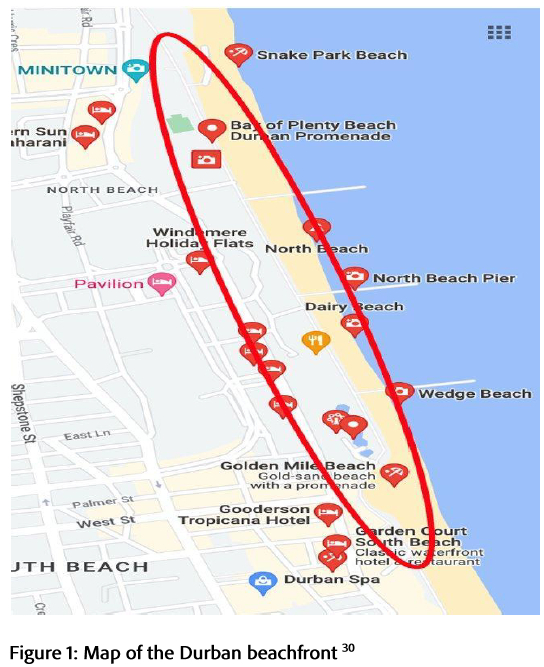
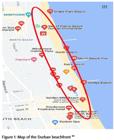
The study was conducted on the Durban beachfront between Snake Park Beach and Golden Mile Beach. The Durban beachfront is the land adjacent to the ocean as depicted in Figure 1 below. This research included informal traders on the promenade, beach, and pavement. Figure 1 depicts the map of the Durban beachfront, with the study context demarcated by a solid elliptical line.
Sampling
Purposeful and snowball sampling was used to identify 10 participants who operated within the study area. The inclusion criteria required participants to be:
■ 18 years or older,
■ able to communicate in English, isiZulu, Siswati or Xhosa,
■ working as a street trader along the beachfront for four years or more, to allow for comparison between pre-covid 19 and current times.
■ trading only along the Durban beachfront.
Data collection
Semi-structured individual interviews and a demographic questionnaire were used as data collection tools. One-on-one interviews allowed researchers to obtain data directly from study participants313233
Data analysis
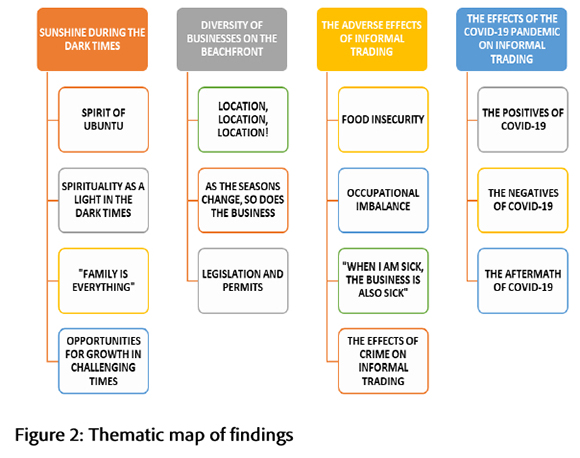
Thematic analysis was used to analyse the data34Sunshine during dark times, the diversity of businesses on the beachfront, The adverse effects of informal trading, and The effects of the COVID-19 pandemic on informal trading. Numerous subthemes emerged under each theme, which will be presented in the Findings section.
Pilot study
A pilot study was conducted with an informal trader before data collection to determine if the semi-structured interview and the demographic questionnaire were easily understood, non-ambiguous, user-friendly, and yielded the information required to answer the research questions. The answers were found to be superficial, and more probing questions were added to allow for more in-depth answers from the participants.
Trustworthiness
Peer debriefing and researcher triangulation were used to ensure credibility. The data's authenticity was confirmed through member checking after preliminary analysis, where themes and subthemes were generated. The thick description of the context ensured transferability to similar contexts. To assure dependability, the researchers generated an audit trail of all processes and decisions. The researchers utilised reflective journaling and debriefing with the supervisor to avoid any potential biases in reporting the data.
FINDINGS
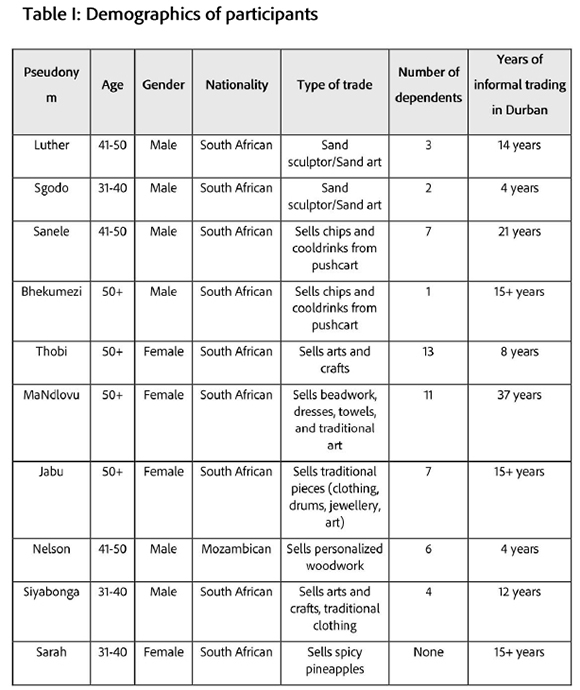
This section will present the themes and subthemes, as well as the participants' demographic information. The demographic information of the participants are presented in Table I (below).
The findings indicated that nine out of the ten participants were South African citizens, and one was an undocumented foreigner. All participants had been in the informal trading industry fora minimum of four years. At least nine of the ten informal traders supported their families with their daily income, having more than two dependents. Six out of the 10 participants were males, with the remaining four being female. Three out of the 10 participants were between 31-40 years of age, three participants were in the 41-50 age range, and four of the participants were over the age of 50 years. Two of the participants were sand artists, two participants sold cold drinks and chips from a pushcart, one participant sold spicy pineapples, four participants sold a range of traditional arts, crafts and beadwork, and one participant sold personalised woodwork trinkets.
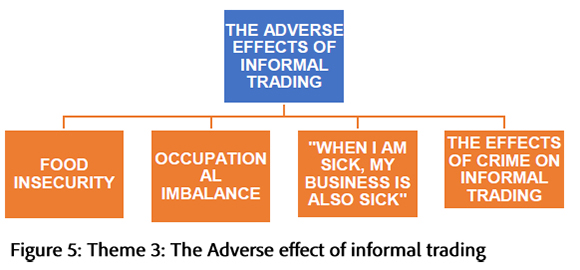
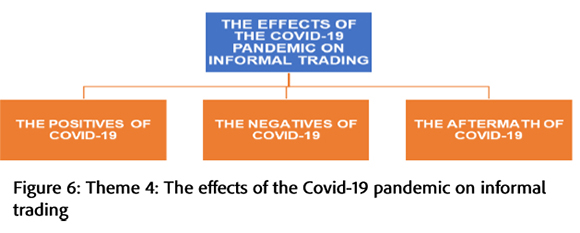
The data coalesced into four major themes. The first theme described the positive aspects of lives through informal trading. The second theme described the diversity of businesses on the beachfront. The third theme explored the adverse effects of informal trading and how it impacted the participants' lives. The fourth theme described the effects of the COVID-19 pandemic on informal trading, and the impact that the pandemic had on the informal traders' roles and livelihoods. The thematic analysis is presented in Figure 2.
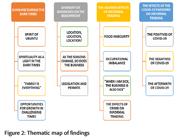
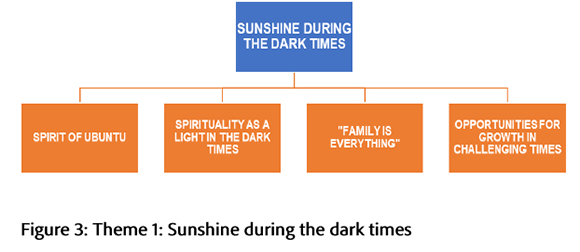
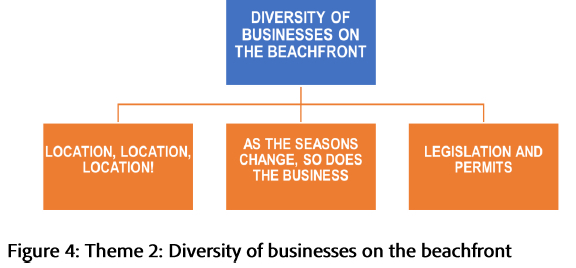
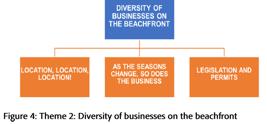
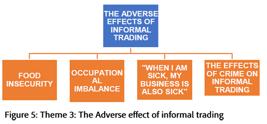
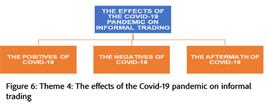
Each theme and subtheme will now be presented, supported by verbatim quotes to illustrate the themes. Pseudonyms were used to protect the identity of the participants. The first theme depicted in Figure 3 embodies the idea that even in difficult moments, hope and positivity can emerge. The second theme under Figure 4 delves into the diverse businesses along the beachfront, examining the effects, both beneficial and detrimental. The third theme under Figure 5 pinpoints the adverse effects of the informal trading whilst the fourth theme under Figure 6 highlights the effects of the Covid-19 pandemic on the informal trading. These are outlined below with direct quotes to support the themes.
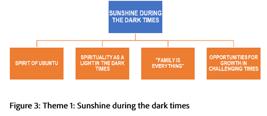
Four subthemes emerged under Theme 1:
Subtheme 1: Spirit of Ubuntu
Most of the participants acknowledged competition amongst the informal traders along the Durban beachfront. However, all the participants also reported experiencing the spirit of Ubuntu, as verbalised in Jabu's narrative, which follows.
"We are sisters, and we help each other... let's say a customer comes and buys from you but they want more goods than you have... you go around and ask who has it, then sell it to the customer and distribute the money that you make." (Jabu)
Jabu expressed how the other ladies were like her sisters, as they tried to help each other sell their products or look after the business in their absence. They all knew how tough the business was, and it was a struggle to provide for their families. They were very empathetic and supportive of each other:
"Yeah, we help each other. That's how we work" (Sgodo) MaNdlovu expressed how she assisted other traders by offering them food, and they reciprocated when she was hungry. "Yes, a lot, like when someone is hungry, I assist them and when I am hungry someone assists me." (MaNdlovu)
Subtheme 2: Spirituality as a light in the dark times
Two participants found light and comfort in their spirituality to help them through difficult times. The participants spoke about their faiths with reverence, as seen in Sarah's and MaNdlovu's quotes. Despite the economic decline, their passion, faith and optimism gave them strength to carry on.
"Like for me I change everything like around my sphere is through religion... but basically that has placed a huge impact on my life." (Sarah)
"I believe God structured me differently, I go home, sleep and tell myself that I will see tomorrow and have hope for the next day... I know that a week won't pass by without making any sales." (MaNdlovu)
MaNdlovu was optimistic and expressed how her faith in God gave her the ability to work hard each day, despite the difficulties, as she believed that her God wouldn't allow her to fail.
Subtheme 3: "Family is everything"
In this in-vivo theme, most of the participants expressed how they were working hard to provide for their families. Apart from the emotional and physical support the participants received from their families, some inherited their businesses from a family member, as was the case with Siyabonga. This helped them to expand their businesses and continue to provide for their dependents.
"Because my mom was an informal trader, so I just inherited it. It's her store..." (Siyabonga)
The support from one's family was a driving force for the traders to continue to work hard even in the face of so many adversities. Siyabonga expressed how he began informal trading as he grew up in the store and took over from his mom. This allowed him a direct access route into the business, and he had someone whom he could rely on to give him advice as well.
"My sister was the one who did trade before me... I am doing this kind of business because of her." (Bhekumuzi)
Continuing the legacy of his sister allowed Bhekumuzi to continue to be able to provide for his family. His sister teaching him the intricacies of business made it easier for him to grow his business.
Subtheme 4: Opportunities for growth in challenging times
Although the participants expressed that they did not often meet their income targets for the day, week, or month, they could still see a future and were optimistic about their businesses.
"When I first came here, I used to work for someone until I was able to start my own." (Sanele)
Sanele expressed how he started informal trading by working for someone else as an assistant. Since then, he had worked his way up to have his own business, emphasising how there was always an opportunity for growth.
"For me, like someone who didn't go to school... I think it is a good business." (Siyabonga)
Siyabonga expressed how starting informal trading was an easier means of employment, especially for those who didn't have a good educational foundation to obtain a job in the formal sector. The informal trading offered those with little formal education to support their families financially.
"You need to know how to make use of your hands and patience as this is a self-made business. I was taught from the time I was a child..." (MaNdlovu)
MaNdlovu expressed that she learned skills as a child which she used to create a business. Although there were opportunities to grow your business in the informal economy, a person needed to persevere and be patient to see the fruits of his or her labour.
THEME 2: Diversity of businesses on the beachfront
Three subthemes emerged from Theme 2 (Fig. 4 page 5):
This theme was used to describe the physical and legal aspects of the working conditions of the traders. This theme was separated into three subthemes: Location, Location, Location! As the seasons change, so do the business, and Legislation and permits.
Subthemel: Location, Location, Location!
Participants at various locations along the beachfront had different concerns about their businesses. The traders on the pavement emphasised that they were disadvantaged being fixed informal traders who had to wait for customers to come to them. Thobi described how the other mobile informal traders could walk to the customers to sell their goods and attract a broader range of customers.
"The disadvantage is that when you stay here, there are people who move up and down, they get more (money) because they move." (Thobi)
However, mobile informal traders faced other challenges. Bhekumuzi, who operated a pushcart, explained how his physical health had deteriorated as he was aging. His business required him to mobilise to different locations on the beachfront to earn a greater income.
"During the year a person is waiting for those events like soccer games...because at the beach it is usually quiet...! no longer have the strength to walk...! am ageing" (Bhekumuzi)
Most informal traders on the beachfront, except for sand artists, did not have the opportunity to work in other locations. This was due to the sand artists' trade, which did not require them to transport goods. Instead, they had to use the sand on the beach. They emphasised how it was better to work in other places due to higher levels of tourism, compared to Durban. However, they required a permit to work at another beach.
"Sometimes I go to the South Coast...some other beaches... it's better than Durban." (Sgodo)
Subtheme 2: As the seasons change, so does the business
Business income fluctuated throughout the year depending on the time of the day, the day of the week, the season, and the weather. Therefore, the daily income generated was not fixed. This is explicated in Bhekumuzi's quote.
"In the morning it is quieter and a bit busier towards the afternoon when people are walking by the beach..." (Bhekumuzi)
All 10 participants stated that January was usually the quietest month. Sales picked up from September to December as the holiday season approached, and there were more tourists. Events like Heritage Day and other sporting events also brought more customers.
"[The] quiet month is January because people take their child to school. Summertime is busy... from Heritage Day to December." (Thobi)
The weather played a significant role in the success of their businesses. Rainy and windy weather affected their earnings due to the damage to goods and a decrease in customers. The sun caused damage to the stock, causing it to discolour, which required them to constantly rotate the stock during the day. Some participants did not work during harsh weather conditions due to inadequate shelter to protect themselves and their goods, while others were forced to work in these circumstances.
When traders attempted to cover the sides of their shelters with sheets due to the sun or rain, the municipality officials instructed them to remove them, due to the unsightly appearance. MaNdlovu's emotive quote illuminates her frustration.
"They are playing with us here. Is there a business like this which is not protected even when it is raining... where your goods get destroyed... and you must start all over again... Where is the profit in that?' (MaNdlovu)
Subtheme 3: Legislation and permits.
Informal traders along the beachfront paid different amounts of money for permits depending on the location and the type of trade. They faced harassment from municipal officials and the police if they could not produce a permit, or if they produced an expired one. Moreover, the sand artists had their art vandalised by the police if they could not produce a permit. Some traders risked getting arrested or having their stock seized, as MaNdlovu's quote illustrates.
"I think it was R500 for some of the goods, and then I haven't gotten them back because I had forgotten my permit. Sometimes you get arrested... and you are unable to pack your things away..." (MaNdlovu)
Four of the participants traded illegally due to them not having a permit. This was due to the lengthy application process required to obtain a permit, as verbalised by Sanele. The foreign participant was hesitant to share his bad experiences with local traders due to the fear of victimization. He stated that due to him being an illegal trader, he was required to avoid the police.
"I don't have access to a permit because they have reached the maximum number of people that are allowed to trade here. I have been on a waiting list, that's why I'm trading without it." (Sanele)
Six participants had shared their grievances with the municipality regarding inadequate shelter and having no access to water or electricity. These matters had not been addressed after numerous complaints. However, the participants had access to a community network, called "business support," which addressed their grievances and protected them against any threats.
"They help us when there are problems, sometimes when people report crimes, or when they have a problem with us on the beachfront they usually take it up with the business support organizations, sometimes it's reported to law enforcement or the beach police. They usually intervene when someone has a problem." (Luther)
THEME 3: The adverse effects of informal trading
This theme explored the negative effects and challenges of being an informal trader. Four subthemes emerged Fig. 5, below), named as Food insecurity, Occupational imbalance, "When I am sick, the business is also sick", and The effects of crime on informal trading.
Subtheme 1: Food insecurity
Street trading is often linked to financial insecurity, which results in food insecurity, as traders
struggle to support themselves and their families. This food insecurity affects their physical health, leading to skipping meals and unhealthy food choices. Some traders like Thobi bought groceries in bulk as she lived with her family. Other traders like Siyabonga, bought a plate of food for himself on most days, and that is where his money was spent.
"If you have a family, they need to eat something, some fruit, or snacks... but you can't buy those things. You buy the big things, samp, mealie meal, rice, meat, it's the only things that we buy." (Thobi)
"Daily we just must buy a plate offood....it is just hand to mouth." (Siyabonga)
When individuals relied solely on street trading as a source of income, they faced challenges in terms of financial insecurity. Moreover, their families faced difficulties meeting their basic needs and experienced heightened levels of food insecurity.
Subtheme 2: Occupational Imbalance
The prolonged working hours of street trading made it difficult for individuals to maintain a healthy work-life balance because they often worked irregular hours. Eight participants worked over eight hours a day, and often late into the night during peak seasons. This increased stress levels, fatigue, and resulted in a lack of time for personal activities, family, leisure and self-care. This occupational imbalance can be seen in the following two quotes.
"I work every day, even if it's raining.seven days per week I will be here." (Thobi)
"Neighbours assist with the small ones when I go to wor/c..."(Sanele)
Street traders often take on multiple life roles simultaneously, exacerbating the imbalance between work and personal life. This caused high levels of stress, which impacted the quality of their lives. Participants like Sanele often had to relinquish parental roles and responsibilities to third parties to earn an income.
Subtheme 3: "When I am sick, the business is also sick." Being an informal trader impacted the traders' health both physically and mentally. This in-vivo quote revealed that some traders experienced physical discomfort while walking around or remaining sedentary for extended periods. The participants experienced deterioration in their mental health due to the financial stresses of their business, the lack of customers and the struggle to support their families. When the traders were ill, they could not trade, resulting in no income earned during this time.
"When I have menstruation pain, I can't open every month... I know there are five days I'm going to be at home." (Thobi)
"I feel like I'm getting old now... To walk every day, just to feel my body feel the pain...but nothing you can do. The children are waiting forme." (Nelson)
It is evident from the preceding quotes that informal traders have no choice but to continue to work despite their health challenges.
Subtheme 4: The effects of crime on informal trade
Crime was a significant challenge faced by the participants, which negatively impacted their businesses. The crime resulted in the beachfront being deemed unsafe, which consequently no longer attracted tourists to the area. Crime also occurred with the theft of goods during busy times when they were not watching over their stock Damage to the infrastructure and vandalization of property, such as the lights of the shelter being stolen, also occurred. Loadshedding also increased crime, as it was dark at closing time, which made the traders easy targets for criminals:
"They are targeting customers...then customers are going to run away from us." (MaNdlovu)
"They rob customers, they steal stock... an informal trader was held at gunpoint... When it is loadshedding we must close early because there is crime when it becomes dark." (Siyabonga)
According to the traders' responses, there were many challenges with crime, and it was experienced at any time, resulting in the negative perception of the area always being unsafe.
THEME 4: The effects of the Covid-19 pandemic on informal trading
Three subthemes emerged under Theme 4:
Subtheme 1: The positives of Covid-19
This subtheme explored the participants' positive experiences during the COVID-19 pandemic, such as additional rest, increased family time and reduced expenses. Most participants worked seven days a week, which minimised time for leisure and rest. Before the lockdown, the participants focused on their work and obtaining an income. The lockdown enforced rest on informal traders, highlighting its importance and how it positively impacted their health and well-being.
"We had to be at home for six months...we had the savings... It's nice as you get family time." (Sarah)
"We were earning free meals... they were letting us sleep for free at the accommodation because they knew we couldn't go to work anywhere." (Sgodo)
Sarah said she had not worked for six months because of the pandemic. However, she had accrued savings, which helped her during this time. She used this time to connect with her family. Most informal traders did not have savings as their expenses exceeded their profits. During the lockdown, Sgodo and other informal traders received free meals and rent exemptions, which were beneficial as they were not earning an income.
Subtheme 2: The negatives of Covid-19
This subtheme explored the negative aspects of the COVID-19 pandemic, such as expired goods, theft, increased expenses and falling into debt.
"The goods that I had expired by the time we were back to selling... and I was in debt because I had to buy new stock... I had no money at that time" (Bhekumuzi)
"Some of it got stolen by the children...no one was guarding the place... that brought our businesses down... we are still trying to bring them up... even now." (MaNdlovu)
The COVID-19 pandemic created additional expenses for the participants. Due to not working during the lockdown period, consumables could not be sold as they had expired, as seen in Bhekimuzi's quote. Stock was also stolen from the beach, and participants fell into debt as they had to borrow money and buy new stock. At the time of data collection in 2023, this was still occurring, as some participants were still trying to pay back money owed, as seen in MaNdlovu's quote.
Subtheme 3: The aftermath of Covid-19
This subtheme explored the consequences of the COVID-19 pandemic for the participants. They continued to experience a depletion in income due to the decreased tourism and increased prices, as well as the looting and flooding, that came after the pandemic.
"Now it's dead, its dead... like before it used to be okay, now it is totally dead. Since post-covid it is dead...." (Siyabonga)
"I think it's changed since the Covid... and everything the looting and, the flooding." (Sarah)
After the COVID-19 pandemic, the participants' businesses suffered, as seen in Siyabonga's quote. The effects of the pandemic exacerbated the participants' challenges, such as needing more money for their living expenses and stock, and a lack of customers. Sarah also commented on other significant events, such as the looting and flooding in Durban. This affected the informal trading businesses, as local crises minimised the number of tourists and holidaymakers to the Durban beachfront.
"The people also don't use the money like before... things in the shops are very expensive..." (Nelson)
Since the pandemic, Nelson described the inflation and economic crises which had resulted in increased living expenses. Moreover, people did not seem to have more disposable income and did not spend money compared to pre-COVID times, which resulted in reduced profits for the traders.
DISCUSSION
The researchers identified that informal traders often entered informal trading to survive and provide necessities for their families despite economic challenges. Inter-generational poverty often impacted participants, who began informal trading to break this cycle due to the fewer barriers to entry, particularly for those from lower-income backgrounds or lower educational achievement351936
The Business Support Unit is the municipal department responsible for issuing permits, establishing laws, certifying traders, and promoting a safe environment for traders and customers373837
Street trading is a demanding occupation, where the strongest and most resourceful traders thrive in a competitive environment with limited space and customers393940,41.
Informal traders' grievances about inadequate amenities and infrastructure still needed to be addressed by the business support unit of the municipal department. Moreover, adverse weather conditions were an ongoing challenge, and they needed access to secure shelters. The poor infrastructure and exposure to adverse weather impacted their well-being negatively and made them susceptible to diseases7,42. Trade was positively influenced by increased sales from September to December, and the holiday season coincided with increased customers and tourists. Mobile traders had an advantage over fixed-location traders because they could take their goods to the customers, whereas fixed traders had to wait for customers to come to them. However, being mobile negatively impacted some traders' health due to carrying goods over long walking distances, which became more challenging as they aged4344
Environmental barriers such as crime were a key challenge impacting the traders' earnings. Despite police being in the vicinity, criminals continued to vandalise infrastructure and caused harm to traders and customers, leading to the beachfront being perceived as unsafe. This resulted in reduced earnings due to there being fewer customers. High crime levels in Durban have led to reduced tourism due to negative perceptions of the city, creating uncertainty among potential tourists45
The COVID-19 pandemic led to a significant reduction in tourism and a decline in the businesses of informal traders. The eThekwini municipality can be commended, as the traders were not obligated to pay permit fees during this period46474748
Implications for Occupational Therapy
Researchers can identify potential risks and challenges faced by individuals working in the informal sector, including job insecurity, low wages, food insecurity, and lack of social protection1919
Understanding the lives of informal traders in Durban can inform occupational therapists about the impact of this trade on individuals, families, and communities in terms of providing contextually relevant interventions. Understanding the balance between occupations is crucial for individuals to maintain daily survival, while fulfilling their occupational life roles and responsibilities. Social connectedness influenced informal traders' actions and goals, aligning with occupational therapy critical practice1949,50. By studying the interplay between social settings and human occupation, researchers can uncover the multifaceted impact that collective participation has on individuals' well-being in the informal sector. The issue of poor working conditions can be utilised as a tool for lobbying for better conditions for informal traders on Durban's beachfront.
This research was crucial for identifying interventions and policies that can enhance the occupational experiences and overall quality of life for individuals engaged in informal trading, which was identified through multiple interactions with the participants and their lived experiences and challenges faced. Occupational therapists should advocate for policy reform and legislation by enabling informal traders to express their opinions on factors affecting their work occupations. This can provide insight into the broader societal implications and offer a more comprehensive approach to addressing the needs of informal traders. Informal traders can enhance their coping skills by learning stress management techniques and ergonomics to minimise physical strain. Trading activities offer individuals greater control over their schedules, leisure, self-care, and empowerment, benefiting their mental health and overall well-being. Occupational therapists can assist informal traders by imparting business skills, including financial management and business planning. Occupational therapy can help address occupational imbalances in leisure, self-care, mental health, and physical well-being, fulfilling roles and enhancing an individual's sense of identity, purpose, and self-worth
Limitations
The study's limitations included the short duration of interviews, as participants were assisting potential customers. This disruption may have impacted the flow and quality of information received from participants. Researchers faced challenges due to weather conditions, as interviews were conducted outdoors, and windy days significantly interfered with audio-recordings. The data collected on challenges faced by foreign traders was limited since only one participant was a foreign national. Most of the data collected was primarily about South African informal traders.
CONCLUSION AND RECOMMENDATIONS
This study explored the lived experiences of the informal traders on the Durban beachfront. The findings confirmed that the challenges outweighed the opportunities of informal trading, which mirrors previous studies51,52. The challenges and occupational imbalance of informal traders negatively affected the mental and physical well-being of the traders. Some challenges were related to harassment, crime, food insecurity, and a lack of basic amenities and infrastructure.
Greater efforts must be implemented by the metropolitan police to ensure the area is safer. Furthermore, the eThekwini Municipality must repair and improve the infrastructure of the traders to provide better protection against inclement weather and vandalism.
Occupational therapy can play a role in developing and uplifting informal traders by creating programmes offered through workshops to upskill the informal traders holistically in all areas of occupation. This would address the challenges being experienced and develop basic entrepreneurial skills such as money management, marketing, and utilising affordable materials to upgrade or create unique products. Community-based occupational therapists can also address the importance of mental and physical health and offer appropriate interventions to mitigate the health challenges of informal traders in Durban and elsewhere in South Africa.
Conflicts of interest
There are no conflicts of interests to declare.
Funding
No funding was obtained for this study.
Author contributions
T-R. van den Bergh, N. Gumede, Z. Obaray, AS Khan, L. Londiwe contributed to the analysis and writing of the manuscript. T. Gurayah conceptualized and supervised the study. She was involved in all phases and contributed to the writing and editing of this article.
REFERENCES
Acknowledgements
The authors of this paper wish to acknowledge the informal traders of the Durban Beachfront for their contribution to this study.
LITERATURE REVIEW
- 1. Tsoriyo W, Ingwani E. Exploring the dynamics of street trading as street spatial (in) justice in Musina Town. Journal of Inclusive Cities and Built Environment. 2022; 2(1): 57-60.
- 2. Mkhize S, Dube G, Skinner, C. Informal Economy Monitoring Study: Street Vendors in Durban, South Africa. Manchester, UK (United Kingdom): WIEGO. 2013
-
3. Zondi S. South Africa in Southern Africa: A perspective. Mozambique: Friedrich-Ebert-Stiftung. 2012. [cited 2022 Sep 30] Available from: https://library.fes.de/pdf-files/bueros/mosambik/09403-no-8.pdf
» https://library.fes.de/pdf-files/bueros/mosambik/09403-no-8.pdf - 4. Mafukat MA, Kancheya G. The Nature of Informal Trade Sector in Zambia and Its Implications for Government's SMEs Regulatory Framework. Handbook of Research on Strategic Developments and Regulatory Practice in Global Finance. 2015; 122-143.
- 5. Hasan M, Alam J. Street garment vendors' contribution to the economy and local community: An empirical study to the street garments vendors in Dhaka City, Bangladesh. International Journal of Management and Business Research, 2015; 5(2): 129-139.
-
6. Siqwana-Ndulo N. The informal sector in South Africa: Women street traders in Durban-Part 1. Polity. 2013.[cited 2023 Feb 20] Available from: https://www.polity.org.za/article/the-informal-sector-in-south-africa-women-street-traders-in-durban-part-1-2013-05-13
» https://www.polity.org.za/article/the-informal-sector-in-south-africa-women-street-traders-in-durban-part-1-2013-05-13 - 7. Gamieldien F, Van Niekerk L. Street vending in South Africa: An entrepreneurial occupation. South African Journal of Occupational Therapy, 2017; 47(1): 24-29.
-
8. Statistics South Africa. Quarterly Labour Force Survey. Statistics South Africa. 2022. [cited 2022 Oct 1] Available from: https://www.statssa.gov.za/7pageid=16408#:~:text=The%20Quarterly%20Labour%20Forc e%20Survey,measures%20of%20employment%20and%20unemployment.
» https://www.statssa.gov.za/7pageid=16408#:~:text=The%20Quarterly%20Labour%20Forc e%20Survey,measures%20of%20employment%20and%20unemployment - 9. Mkhize G, Cele N. The role of women in tourism in KwaZulu-Natal: Case studies from the South Coast of KwaZulu-Natal. Agenda. 2017; 31(1): 128-139.
-
10. Hamilton B. Informal sector in dire situation yet contributes billions to economy. The Citizen.2020 [cited 16 Oct 2022]. Available from: https://www.citizen.co.za/lowvelder/opinion-edition/2020/04/24/informal-sector-in-dire-situation-yet-contributes-billions-to-economy/
» https://www.citizen.co.za/lowvelder/opinion-edition/2020/04/24/informal-sector-in-dire-situation-yet-contributes-billions-to-economy/ -
11. Latimore, M. Rolling Inspiration: Exploring the Durban Promenade. 2021 [cited 2024 Oct 16] Available from: https://www.rollinginspiration.co.za/exploring-the-durban-promenade/
» https://www.rollinginspiration.co.za/exploring-the-durban-promenade/ -
12. International Labour Organization. World Employment and Social Outlook - Trends. 2017 [cited 2022 Oct 10] Available from: https://www.ilo.org/sites/default/files/wcmsp5/groups/public/(a)dgreports /(S)dcomm/(5)publ/documents/publication/wcms 541211.pdf
» https://www.ilo.org/sites/default/files/wcmsp5/groups/public/(a)dgreports /(S)dcomm/(5)publ/documents/publication/wcms 541211.pdf -
13. Gaalen, PV. Thriving township economy vital to SA's economic revival. Investec. 2021 [cited 2023 20 Feb]. Available from: https://www.investec.com/enza/focus/economy/thriving-township-economy-vital-to-sas-economic-revival.html
» https://www.investec.com/enza/focus/economy/thriving-township-economy-vital-to-sas-economic-revival.html -
14. Mntungwa N. Informal traders to engage with eThekwini officials for assistance after July unrest. SABC News. 2021 [cited 2022 Oct 17] Available from: https://www.sabcnews.com/sabcnews/informal-traders-to-engage-with-ethekwini-officials-for-assistance-after-july-unrest/
» https://www.sabcnews.com/sabcnews/informal-traders-to-engage-with-ethekwini-officials-for-assistance-after-july-unrest/ -
15. Banchik AV. "Keeping it in the family": domestic labor, business inheritance, and self-employment among women in Zacatecas, Mexico. (Masters thesis. University of Texas) 2016 [cited 2023 Feb 2]. Available from: https://repositories.lib.utexas.edu/handle/2152/39366
» https://repositories.lib.utexas.edu/handle/2152/39366 - 16. Husain S, Yasmin S, Islam, MS. Assessment of the socioeconomic aspects of street vendors in Dhaka city: evidence from Bangladesh. Asian Social Science. 2015; 11(26):1.
-
17. Sidzatane NJ. African immigrants in Durban: a case study of foreign street traders' contribution to the city (Master's thesis, University of Kwa Zulu Natal). 2011. Available from: https://researchspace.ukzn.ac.za/items/64584919-292e-456c-ac8a-5e9b4fcad9d4
» https://researchspace.ukzn.ac.za/items/64584919-292e-456c-ac8a-5e9b4fcad9d4 -
18. Ntuli I S. Informal trading in post-apartheid South Africa: an examination of the experiences of black African women street traders in Durban (Doctoral dissertation, University of Kwa Zulu Natal). 2020. Available at: https://researchspace.ukzn.ac.za/handle/10413/18851
» https://researchspace.ukzn.ac.za/handle/10413/18851 -
19. Sassen S, Galvaan R, Duncan M. Women's experiences of informal street trading and well-being in Cape Town, South Africa. South African Journal of Occupational Therapy, 2018; 48(1): 28-33. Available from: https://doi.org/10.17159/2310-3833/2018/vol48n1a6
» https://doi.org/10.17159/2310-3833/2018/vol48n1a6 -
20. Ratna FZ. Hawkers in Dhaka: their struggle for livelihoods and functionality of the city. Bangladesh University of Engineering and Technology. 2012 [cited 2022 Oct 21]; Available from: http://lib.buet.ac.bd:8080/xmlui/handle/123456789/3917
» http://lib.buet.ac.bd:8080/xmlui/handle/123456789/3917 -
21. Provincial Gazette of KwaZulu Natal, eThekwini Municipality: Retail market by-law, The provincial gazette of Kwa Zulu Natal. 2014; 8: 47-64. [cited 2023 Feb 24] Available from: https://archive.opengazettes.org.za/archive/ZA-NL/2014/provincial-gazette-ZA-NL-vol-8-no-1173-dated-2014-06-27.pdf
» https://archive.opengazettes.org.za/archive/ZA-NL/2014/provincial-gazette-ZA-NL-vol-8-no-1173-dated-2014-06-27.pdf -
22. Nxumalo M S. Perspectives and experiences of female traders in securing a livelihood in the Warwick Market, Durban (Masters thesis, University of Kwa Zulu Natal). 2018. Available from: https://ukzn-dspace.ukzn.ac.za/handle/10413/17461
» https://ukzn-dspace.ukzn.ac.za/handle/10413/17461 -
23. Haque A. Mental Health Concepts in Southeast Asia: Diagnostic Considerations and Treatment Implications. Psychology, Health & Medicine, 2010;15:127-134. https://doi.org/10.1080/13548501003615266.
» https://doi.org/10.1080/13548501003615266 -
24. Hosen S. Street Vendor's Economic Condition in Bangladesh: Entrepreneurship Development, Employment and Poverty Reduction. Economy and Finance,2018 [cited 2022 Oct 20] Accessed from: https://www.slideshare.net/ShamimHosen5/street-vendors-economic-condition-in-bd
» https://www.slideshare.net/ShamimHosen5/street-vendors-economic-condition-in-bd - 25. Rahman MS. Exploring socio-economic and psychological condition of street vendors of Barishal city: Evidence from Bangladesh. American Journal of Humanities and Social Sciences.2019; 7(2): 1-15.
-
26. Skinner C, Watson V. Planning, and informal food traders under COVID-19: The South African case. Town Planning Review. 2020; 91:1-7. Doi:10.3828/tpr.2020.38
» https://doi.org/10.3828/tpr.2020.38 -
27. PMBEJD - Pietermaritzburg Economic Justice and Dignity. Household affordability index. 2023 [cited 2023 Feb 10] Available from: https://pmbejd.org.za/
» https://pmbejd.org.za/ - 28. Gough, Κ V., Yankson, P., Wilby, R, Amankwaa, E., Abarike, M., Codjoe, S., ... & Nabilse, C. (2019). Vulnerability to extreme weather events in cities: implications for infrastructure and livelihoods.
- 29. Patton, M.Q. Qualitative research and design methods: integrating theory and practice, 4th ed. 2015. Sage Publications, Inc.
-
30. Google maps. Durban beach front. (2019) Available from: https://www.google.com/maps/search/durban+beach+front/(@)-29.834707.30.9682027.10961m/data=!3m2!1e3!4b1?entry=ttu&gep=EgoyMDI0MTAxNC4wlKXMDSoASAFOAw%3D%3D
» https://www.google.com/maps/search/durban+beach+front/(@)-29.834707.30.9682027.10961m/data=!3m2!1e3!4b1?entry=ttu& gep=EgoyMDI0MTAxNC4wlKXMDSoASAFOAw%3D%3D -
31. Showkat N, Parveen H. In-depth Interview. Department of Mass Communication, Aligarh Muslim University, Aligarh. 2017. [cited 2022 Oct 20] Available from: https://www.researchgate.net/publication/319162160In-depth Interview
» https://www.researchgate.net/publication/319162160In-depth Interview -
32. Kakilla C. Strengths and Weaknesses of Semi-Structured Interviews in Qualitative Research: A Critical Essay. Preprints. 2021 .Avaliable from: https://doi.org/10.20944/preprints202106.0491.v1
» https://doi.org/10.20944/preprints202106.0491.v1 -
33. Shakespeare V. A Quick Guide to Semi-Structured Interviews. Fuel cycle. 2019 [cited 2022 Oct 10]. Available from: https://fuelcycle.com/blog/a-quick-guide-to-semi-structured-interviews/
» https://fuelcycle.com/blog/a-quick-guide-to-semi-structured-interviews/ - 34. Braun V, Clarke V. Using thematic analysis in psychology. Qualitative Research in Psychology. 2006 Jan 1; 3(2): 77-101
-
35. Moyo BH. Photo-elicitation and the voiceless: Narrating the "lived experiences" perspective of informal street food vendors in Khayelitsha, Cape Town. World Nutrition Journal. 2021 Sep 30;12(3):91-112.https://doi.org/10.26596/wn.202112391-112
» https://doi.org/10.26596/wn.202112391-112 - 36. Davy J, Rasetsoke D, Todd A, Quazi T, Ndlovu P, Dobson R, Alfers L. Analyses of time use in informal economy workers reveals long work hours, inadequate rest, and time poverty. In Proceedings of the 20th Congress of the International Ergonomics Association (IEA 2018) Volume II: Safety and Health, Slips, Trips and Falls 20 2019 (pp. 415-424). Springer International Publishing.
-
37. Klaudt K. Know your rights: informal trade workers. Foundation of Human Rights and Legal Resources Centre; 2016. [Cited 2023 Oct 6] Available from: https://lrc.org.za/wp-content/uploads/pdf/2016%20Handbook%20on%20The%20Rights%20of%20lnformal%20Traders.pdf?
» https://lrc.org.za/wp-content/uploads/pdf/2016%20Handbook%20on%20The%20Rights%20of%20lnformal%20Traders.pdf? -
38. Masiko-Mpaka N. Xenophobia rears its ugly head in South Africa. Human Rights Watch. 2023. [cited 2023 Oct 5] Available at: https://www.hrw.org/news/2023/09/28/xenophobia-rears-its-ugly-head-south-africa
» https://www.hrw.org/news/2023/09/28/xenophobia-rears-its-ugly-head-south-africa - 39. Kabonga I, Zvokuomba K, Nyagadza B, Dube E. Swimming against the tide: Young informal traders' survival strategies in a competitive business environment in Zimbabwe. Youth & Society. 2023 Mar;55(2):280-99.
-
40. Horwood C, Haskins L, Hinton R, Catherine C, Silondile Luthuli, Rollins N. Addressing the interaction between food insecurity, depression risk and informal work: findings of a cross-sectional survey among informal women workers with young children in South Africa. BMC Women's Health . 2021 Jan 2 [cited 2023 Oct 21];21(1). Available from: https://linkspringer.com/article/10.1186/s12905-020-01147-7
» https://linkspringer.com/article/10.1186/s12905-020-01147-7 -
41. Mafunzwaini MM. Contribution of informal markets to poverty reduction and household food security among street traders in Thulamela local municipality of Vhembe district Limpopo province (Doctoral dissertation, University of Kwa Zulu Natal) 2013. Available from: http://hdl.handle.net/10413/11700
» http://hdl.handle.net/10413/11700 -
42. Mntungwa N. Informal traders to engage with eThekwini officials for assistance after July unrest. SABC News. 2021 [cited 2022 Oct 17] Available from: https://www.sabcnews.com/sabcnews/informal-traders-to-engage-with-ethekwini-officials-for-assistance-after-july-unrest/
» https://www.sabcnews.com/sabcnews/informal-traders-to-engage-with-ethekwini-officials-for-assistance-after-july-unrest/ -
43. Nayam KT. Coping mechanism of informal trading enterprises in adverse situation: A case study of street vendors in the Narayanganj City, Bangladesh (Doctoral dissertation, Brae University) 2021. Available from: https://dspace.bracu.ac.bd/xmlui/handle/10361/15207
» https://dspace.bracu.ac.bd/xmlui/handle/10361/15207 - 44. Akuoko KO, Ofori-Dua K, Forkuo JB. Women making ends meet: Street hawking in Kumasi, challenges, and constraints. Michigan Sociological Review. 2013 Oct 1:25-43.
-
45. Xulu K. Declining tourism in Durban - parties swap blame. 2023. [cited 2023 Oct 8]. Available from: https://www.citizen.co.za/witness/politics/kznmunicipal/declining-tourism-in-durban-parties-swap-blame/
» https://www.citizen.co.za/witness/politics/kznmunicipal/declining-tourism-in-durban-parties-swap-blame/ -
46. Singh K. Ethekwini municipality gives informal traders affected by covid-19, unrest a rental holiday. IOL. 2021. [cited 2023 Oct 8]. Available from: https://www.iol.co.za/mercury/news/ethekwini-municipality-gives-informal-traders-affected-by-covid-19-riots-a-rental-holiday-ada49736-28a5-4bca-afdb-f137fe3184d3
» https://www.iol.co.za/mercury/news/ethekwini-municipality-gives-informal-traders-affected-by-covid-19-riots-a-rental-holiday-ada49736-28a5-4bca-afdb-f137fe3184d3 -
47. Statistics South Africa. SA Tourism shows slight recovery after COVID-19 pandemic. 2023. [cited 2023 Oct 8]. Available from: https://www.statssa.gov.za/?p=16327
» https://www.statssa.gov.za/?p=16327 -
48. National Treasury Government South Africa. Recovery, stability, reform, and growth. 2021 [cited 2023 Oct 7]. Available from: https://www.treasury.gov.za/documents/mtbps/2021/mtbps/Chapter%201.pdf
» https://www.treasury.gov.za/documents/mtbps/2021/mtbps/Chapter%201.pdf - 49. Cutchin MP, Dickie VA. Transactional Perspectives on Occupation: An Introduction and Rationale. In: Cutchin MP, Dickie VA, editors. Transactional Perspectives on Occupation. Dordrecht: Springer Netherlands; 2013:1-10.
-
50. Galvaan R, Peters L. Occupation-based community development framework 2013.https://vula.uctacza
» https://vula.uctacza

1st Round Review: 9 July 2024
Revised: 21 August 2024
2nd Round Review: 7 October 2024
Revised: 28 October 2024
Accepted: 28 October 2024
EDITOR
Adele Ebrahim https://orcid.org/0000-0002-5019-980X
* Undergraduate students at the time of study