The prevalence, associated risk factors and pregnancy-related outcomes of large-for-gestational-age newborns delivered at Chris Hani Baragwanath Academic Hospital
BACKGROUND. Large for gestational age (LGA) refers to a newborn birthweight equal to or greater than the 90th percentile for a given GA. Delivering an LGA newborn poses a high risk of morbidity and mortality for both mother and baby. OBJECTIVES. To describe the prevalence of term LGA newborns and identify the factors and pregnancy-related outcomes associated with delivering term LGA newborns at Chris Hani Baragwanath Academic Hospital (CHBAH), a tertiary hospital in Johannesburg, South Africa. METHODS. We conducted a retrospective, institution-based cross-sectional study from 1 October 2020 to 31 March 2021, in which 275 LGA singleton term deliveries were reviewed. Patient demographics, medical factors and clinical outcomes were recorded and statistically analysed. RESULTS. The prevalence of LGA newborns in singleton-term deliveries at CHBAH was 3.92%. Associated factors included maternal obesity, multiparity, prolonged pregnancy with a GA >40 weeks, previous LGA delivery and (newborn) male gender. Maternal complications included prolonged labour, increased caesarean delivery, postpartum haemorrhage, obstetric anal sphincter injuries and uterine rupture. Fetal and neonatal complications included shoulder dystocia, neonatal hypoglycaemia, and neonatal respiratory distress syndrome. CONCLUSIONS. LGA singleton term deliveries at CHBAH were associated with both maternal and neonatal morbidity. The presence of associated factors should alert maternity caregivers to closely monitor these pregnancies and plan for an appropriate mode of delivery. LGA newborns should be routinely screened and appropriately managed for hypoglycaemia.
large for gestational age (LGA); macrossomia; birthweight; maternal complications; neonatal hypoglycaemia
The prevalence, associated risk factors and pregnancy-related outcomes of large-for-gestational-age newborns delivered at Chris Hani Baragwanath Academic Hospital
N ChibayaI; N OdellII; C GeorgiouII; N FrankIII
IMB BCh; Department of Obstetrics and Gynaecology, School of Clinical Medicine, Faculty of Health Sciences, University of the Witwatersrand, Johannesburg, South Africa
IIMB BCh, FCOG (SA), MMed, Cert Mat Fetal Med; Department of Obstetrics and Gynaecology, School of Clinical Medicine, Faculty of Health Sciences, University of the Witwatersrand, Johannesburg, South Africa
IIIMB ChB, FCOG (SA), MMed, Cert Mat Fetal Med Department of Obstetrics and Gynaecology, School of Clinical Medicine, College of Health Sciences, University of KwaZulu-Natal, Durban, South Africa
BACKGROUND. Large for gestational age (LGA) refers to a newborn birthweight equal to or greater than the 90th percentile for a given GA. Delivering an LGA newborn poses a high risk of morbidity and mortality for both mother and baby.
OBJECTIVES. To describe the prevalence of term LGA newborns and identify the factors and pregnancy-related outcomes associated with delivering term LGA newborns at Chris Hani Baragwanath Academic Hospital (CHBAH), a tertiary hospital in Johannesburg, South Africa.
METHODS. We conducted a retrospective, institution-based cross-sectional study from 1 October 2020 to 31 March 2021, in which 275 LGA singleton term deliveries were reviewed. Patient demographics, medical factors and clinical outcomes were recorded and statistically analysed.
RESULTS. The prevalence of LGA newborns in singleton-term deliveries at CHBAH was 3.92%. Associated factors included maternal obesity, multiparity, prolonged pregnancy with a GA >40 weeks, previous LGA delivery and (newborn) male gender. Maternal complications included prolonged labour, increased caesarean delivery, postpartum haemorrhage, obstetric anal sphincter injuries and uterine rupture. Fetal and neonatal complications included shoulder dystocia, neonatal hypoglycaemia, and neonatal respiratory distress syndrome.
CONCLUSIONS. LGA singleton term deliveries at CHBAH were associated with both maternal and neonatal morbidity. The presence of associated factors should alert maternity caregivers to closely monitor these pregnancies and plan for an appropriate mode of delivery. LGA newborns should be routinely screened and appropriately managed for hypoglycaemia.
Keywords:large for gestational age (LGA); macrossomia; birthweight; maternal complications; neonatal hypoglycaemia.
A baby's birthweight is an important factor which decisively affects and predicts an infant's survival and is also correlated with future health outcomes during adolescence and adulthood.[1] For babies born with larger birthweights, instituting an invariably recognised definition across the world has been difficult.[2] As described by The American College of Obstetricians and Gynaecologists (ACOG), a term that can be used when describing excessive fetal growth is 'large for gestational age'.[2] Large for gestational age (LGA) refers to a birthweight equal to or greater than the 90th percentile for a given GA.[2]
The risk factors for birthing LGA babies can be categorised into maternal and fetal risk factors. Maternal risk factors include diabetes, high maternal pre-pregnancy weight, disproportionate maternal weight gain during pregnancy, advanced maternal age, multiparity, post-term pregnancy, maternal birthweight greater than 4 000g and a previous birth of an LGA newborn. [2·345] Fetal risk factors include familial traits, male gender, and genetic variants and syndromes.[2,4]
Maternal complications of LGA births include protracted labour, need for assisted vaginal delivery, genital tract lacerations, postpartum haemorrhage (PPH), caesarean section delivery and uterine rupture which could lead to both maternal and fetal mortality.[6,7] Fetal complications include shoulder dystocia (SD) resulting in birth traumas such as brachial plexus injuries, fractures or (in the worst case) asphyxia.[4,6,7] In utero, larger babies are at risk of stillbirth and neonatal complications include hypoglycaemia, respiratory problems, polycythaemia and increased frequency of neonatal admission to an intensive care unit.[4,6,8] The most common complications during childhood include obesity, impaired glucose tolerance and metabolic syndromes.[9] In developing countries, there has been an increase in mothers delivering LGA newborns, which is a great public health concern owing to the high risk of morbidity and mortality for both mother and baby.[10] Despite the increase in the incidence of LGA deliveries, there is limited research on the topic in our setting.
Methods
A retrospective, institution-based and cross-sectional observational study was conducted from 1 October 2020 to 31 March 2021 at Chris Hani Baragwanath Academic Hospital's (CHBAH) Department of Obstetrics and Gynaecology. CHBAH is an academic tertiary hospital located in Johannesburg, South Africa.[11] It is the largest hospital in Africa and performs between 20 000 to 25 000 deliveries per annum.[11] All women who delivered an LGA newborn from a singleton term pregnancy at CHBAH during the study period were included. LGA in this study was defined as a birthweight >90th percentile for a given GA, using birthweight percentile references from INTERGROWTH-21st resources, for males and females.[12] A term pregnancy for this study included deliveries occurring from 37+0 weeks of gestation through to 42+0 weeks' gestation. Multiple pregnancies were excluded.
The birth registers were reviewed for all births during the study period. Mothers who delivered LGA newborns from a singleton term pregnancy were identified and their maternity records were assessed. The ACOG GA calculator was used when combining GA assessments from the last normal menstrual period (LNMP) with those extrapolated from ultrasonography to accurately determine the GA. Additionally, the total number of deliveries over the study period was identified, to determine the prevalence of LGA births from singleton-term deliveries. All mothers included in the study were allocated a study identification number, which correlated with the respective hospital numbers found in the birth registers. All the relevant (anonymised) data were recorded on a datasheet in RedCAP by the principal investigator and included participant demographics, obstetric factors, medical factors, maternal and neonate-related factors, as well as pregnancy outcomes.
Frequencies and percentages were used to describe categorical data. The Shapiro-Wilk test was used to test for the normality of continuous variables. Normally distributed data were then presented as mean and standard deviation (SD) whilst non-parametric data were summarised with medians and inter-quartile range (IQR). The main outcome variable of neonatal LGA birthweight was further divided into a dichotomous variable, i.e. 1 = LGA newborns with a birthweight >4 000 g and 0 = LGA newborns with a birthweight <4 000g. ACOG describes a birthweight of >4 000 g as fetal macrosomia.[2] This further analysis was done to assess if the addition of macrosomia to LGA had an impact on maternal and fetal outcomes in our study. Multivariate logistic regression models were computed to estimate the association between various maternal and neonatal factors and those LGA newborns with a birthweight >4 000g. An adjustment was done for risk factors with a p-value of <0.1 at univariate analysis to identify factors independently associated with LGA birthweights of >4 000 g. All data analyses were conducted in STATA version 15 (StataCorp., USA). A p-value <0.05 was considered statistically significant for LGA birthweights of >4 000g.
Ethics
Ethics approval to conduct the present study was obtained from The University of the Witwatersrand Human Research Ethics Committee (ref. no. M2111119). Institutional permission was obtained from the Chief Executive Officer of CHBAH, the medical advisory committee of CHBAH, as well as the Head of the Department of the Obstetrics and Gynaecology at CHBAH.
Results
Participant demographics
A total of 275 study participants were included in our study. The mothers' ages ranged from 14 to 50 years old, with a mean (SD) age of 29.4 (6.1) years. Concerning parity, 54 (19.6%) mothers were primigravida and 221 (80.4%) mothers were pregnant for (at least) the second time during the study period. The average (SD) maternal weight at the first antenatal visit was 83.9 (18.6) kg, with an average maternal body mass index (BMI) at the first visit of 32.7 (7.2) kg/m2[13] Only 36 (13.4%) mothers were of normal weight, and 40 (14.9%) mothers were morbidly obese.[13]
Seven (2.5%) mothers had pre-existing diabetes mellitus and a further 7 (2.5%) had gestational diabetes mellitus. Forty-nine (17.8%) mothers had a history of previously delivering an LGA baby and 8 (2.9%) mothers had previously delivered a stillborn.
Maternal outcomes and complications
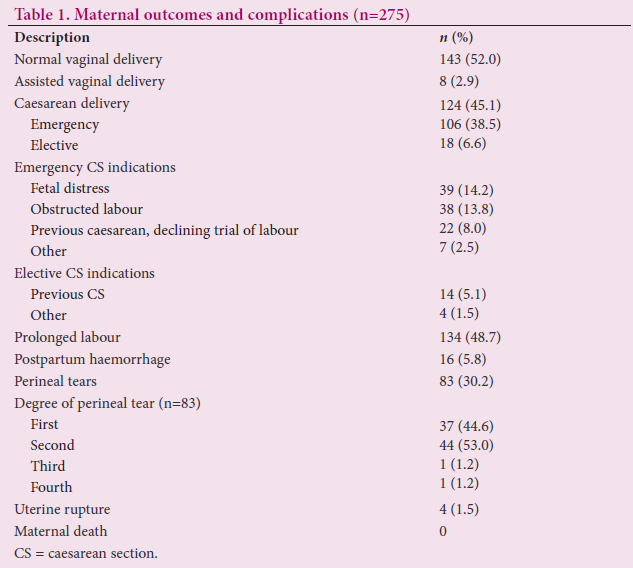
Maternal outcomes and complications are shown in Table 1. The overall caesarean section rate in the group was 45.1%. Almost half (n/N=134/275; 48.7%) of the deliveries were complicated by prolonged labour. Eighty-three (30.2%) mothers suffered obstetric anal sphincter injuries. Four deliveries (1.5%) were complicated by uterine rupture.
Fetal and neonatal outcomes
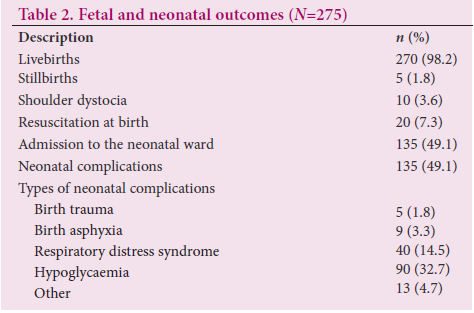
Fetal and neonatal outcomes are shown in Table 2. The majority, 270 (98.2%) babies were born alive and there were 5 stillbirths. Ten (3.7%) deliveries were complicated with SD and 5 of those deliveries were complicated with neonatal birth trauma. Irrespective of the mode of delivery, nearly half (49.1%) of the babies in the study group had complications immediately after birth that required admission. Hypoglycaemia was the most observed neonatal complication (32.7%).
Factors and outcomes associated with LGA birthweights >4 000 g
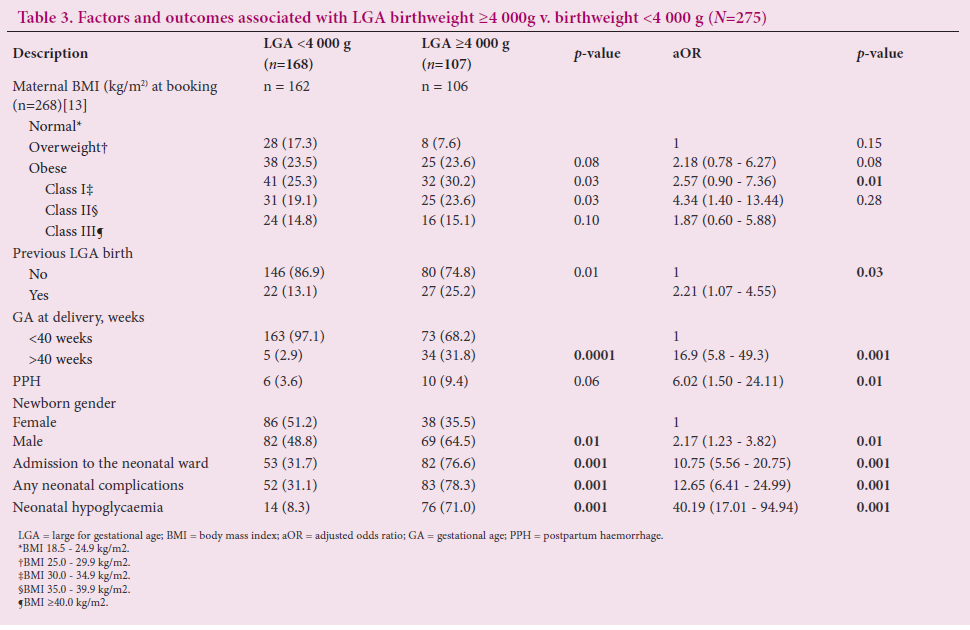
Data analysis revealed highly statistically significant factors and outcomes (p<0.05), associated with LGA newborns with birthweights of 4 000 g or greater in comparison to LGA newborns whose birthweights were less than 4 000 g. These factors included maternal class II obesity (OR 4.34; 95% CI 1.40 - 13.44), a previous birth of an LGA infant (OR 2.21; 95% CI 1.07-4.55), a prolonged pregnancy with a GA >40 weeks (OR 16.9; 95% CI 5.8 - 49.3) and male gender (OR 2.17; 95% CI 1.23 - 3.82).
Significant maternal outcomes included post-partum haemorrhage (OR 6.02; 55% CI (1.50 - 24.11)) and significant neonatal outcomes included immediate neonatal admission after delivery (OR 10.75; 95 % CI 5.56 - 20.76)), and neonatal hypoglycaemia (OR 40.19; 95% CI (17.01 - 94.94) (Table 3).
Discussion
Prevalence
The prevalence of LGA deliveries in singleton-term newborns at CHBAH was 3.92%. This finding was much lower than studies conducted in Italy,[14] Qatar,[15] and other Asian countries,[16] where the prevalence ranged from 10% to 15.6%. It is important to note that our study was conducted in a developing African country, and this discrepancy may be attributed to differences in the characteristics of our study population, including ethnic origins, race, dietary habits, and socioeconomic status. Compared with other studies, our study had a shorter duration, which may have contributed to the lower prevalence of LGA births observed. Furthermore, variations in healthcare service systems could have influenced our findings. Owing to resource limitations, many African countries rely heavily on maternity obstetric units or primary and secondary healthcare facilities for routine childbirth, where fetal weight is estimated clinically rather than through ultrasound. As a result, some mothers carrying LGA infants may be missed and not appropriately referred to tertiary facilities. Consequently, these infants may be born at maternity clinics or at home, leading to underreporting of LGA births outside the tertiary care system and further contributing to the lower prevalence observed.
Associated factors
As the birthweight of LGA newborns increased, we observed a corresponding rise in morbidity for both the mother and the baby. Maternal obesity, a previous LGA birth, prolonged pregnancy, and male gender (especially in newborns weighing >4 000 g) were all significant associations. Historically, irrespective of GA, ACOG describes a birthweight >4 000 g as fetal macrosomia.[2] Maternal diabetes, maternal obesity, and excessive weight gain in pregnancy have been identified as independent predictors of high neonatal birthweight in a study by Alberico et al.,[5] as these conditions encourage a greater nutrient load to the fetus. Approximately nine out of ten (87.9%) of our study participants were overweight at their first antenatal visit, with a mean maternal weight of 83.9 kg. The mean maternal BMI at booking was 32.7kg/m2[13] Nearly all the mothers (97.8%) in our study were overweight at delivery, suggestive of significant weight gain during the pregnancy. Furthermore, our study identified that maternal obesity was a risk factor for birthing a macrosomic LGA newborn, with an odds ratio of 4.34.
Interestingly, our study did not observe a strong relationship between LGA births and the presence of maternal diabetes mellitus, as described by other authors.[2,5] A possible contributing factor is that CHBAH has a highly advanced obstetric diabetic unit, and thus this finding may reflect adequate glycaemic control in their diabetic mothers and consequently, the diabetic mothers were not birthing LGA infants.[17] Additionally, most of our study participants had no record of an oral glucose tolerance test (OGTT) in their maternity records; thus, it is possible that some of the pregnant mothers with abnormalities in glucose tolerance may have been missed, and not recognised as diabetic.
Prolonged pregnancy with a GA >40 weeks, with an OR of 16.9, further increases the chances of delivering an LGA newborns being complicated by macrosomia. The assumption is that prolongation of pregnancy may increase the period of fetal exposure to larger amounts of glucose, insulin, and other maternal nutrients.[181 Thus, the early delivery before 40 weeks of gestation, customarily practised in the care of diabetic mothers may be another contributing factor to the low association of LGA births with diabetic mothers seen in our study.
Multiparity was observed in 80.4 % of mothers who participated in our study. The hypothesis is that with increasing parity, there is a natural increase in maternal age, which in turn is accompanied by a decreased maternal insulin sensitivity, which results in higher glucose levels available for placental glucose transport.[18] Subsequently, the fetus is exposed to higher glucose levels and thus a greater deposition of adipose tissue in the fetus is seen.[18] In our study, mothers with a previous LGA infant were twice as likely to birth a macrosomic LGA newborn (OR 2.21; 95% CI 1.07 - 4.55), which suggests a possible underlying genetic association.[2,4]
Male gender is a well-described fetal risk factor for being LGA.[2,14] In our study, there was no significant difference when comparing the proportions of LGA male births with the proportions of LGA female births, and this could be due to chance. However, the study found that male LGA babies were more than twice as likely to become macrosomic compared to female LGA babies (OR 2.17, 95% CI 1.23, 3.82). This may be attributed to sex-based differences in metabolic hormones, such as insulin, insulin-like growth factors, growth hormone, and inflammatory cytokines, which are typically present at higher levels in male infants and promote greater fetal growth compared to female infants. [18]
Maternal outcomes
The caesarean section rate in our study was 45.1%, which is twice as high as the global caesarean section rate and more than 1.5 times higher than the South African caesarean section rate.[19,20] This puts mothers delivering LGA infants at a greater risk of developing caesarean surgery-related complications.[21] The most common indications for caesarean delivery in our study were fetal distress, obstructed labour and previous caesarean scar. Many of the caesarean deliveries were emergencies, which carries an additional (and greater) risk for complications for both mother and baby when compared with elective caesarean deliveries. This highlights a need for early identification of mothers carrying LGA infants during the antenatal and intrapartum periods, with an appropriate determination of the mode of delivery before labour ensues, thus mitigating delivery complications.
Nearly half (48.7%) of the mothers in our study had prolonged labour[22] and one-third (30.2%) of mothers suffered obstetric anal sphincter injuries during vaginal delivery. These are common complications of delivering larger infants, and similar findings have been described elsewhere.[6,7,23] Our study observed that the larger the birthweight, the greater the risk of PPH, as the mothers who delivered macrosomic LGA newborns had a six times greater risk of complicating with PPH (OR 6.02; 95% CI 1.50 - 24.11).
This increased risk of PPH may be attributed to perineal tears and prolonged labour, resulting in uterine atony.[23] Additionally, four deliveries in our study were complicated by uterine rupture, two of these mothers had a previous caesarean uterine scar and none of these mothers had received therapy for labour induction or augmentation. Therefore, uterine rupture can also be considered a cause of PPH in our study.
Fetal and neonatal outcomes
Ten mothers (3.7%) in our study experienced a delivery complicated by SD, this incidence is higher than the incidence of 0.5 - 1% of SD during vaginal deliveries described by Deneux-Tharaux et al.[24]This in turn highlights the need for midwives and obstetricians facilitating vaginal deliveries in mothers suspected to be birthing LGA newborns to be appropriately trained in the emergency management of SD. Half (49.1%) of the LGA newborns had a neonatal complication that required admission after birth, and the risk of these complications increased as the LGA birthweight increased, as seen with the macrosomic LGA babies (OR 12.65; 95% CI 6.41 - 24.99).
Hypoglycaemia occurred in one-third (32.7%) of newborns, which is almost 3 to 6 times greater than the prevalence of transient hypoglycaemia reported in newborns.[25] Additionally, macrosomic LGA newborns had an OR of 40.19 for hypoglycaemic complications. The proposition is that larger babies have been exposed to higher levels of maternal glucose, which results in fetal hyperinsulinemia, which in turn drastically lowers blood glucose in the newborn once the maternal high glucose levels have been cut off after delivery.[4] With the low prevalence of maternal diabetes mellitus observed in our study, it is worrisome that newborns born to non-diabetic mothers complicated with neonatal hypoglycaemia. This suggests that LGA newborns need close monitoring of their glucose levels regardless of whether the mother is diabetic or not. Respiratory distress syndrome (RDS) was the second most common neonatal complication observed and it is hypothesised that RDS may occur due to the previously described fetal hyperinsulinemia decreasing the production of surfactant in the fetal lungs; thus, pulmonary maturation may falter until later in the pregnancy.[4]
Conclusion
The prevalence of LGA newborns in singleton-term deliveries at CHBAH was found to be 3.92%. The associated factors included maternal obesity, multiparity, prolonged pregnancy with a GA greater than 40 weeks, a mother's history of previously birthing an LGA infant and male newborn gender. The maternal complications observed included prolonged labour, increased caesarean delivery, PPH, obstetric anal sphincter injuries and uterine rupture. The fetal and neonatal complications included SD, neonatal hypoglycaemia, and neonatal respiratory distress syndrome. We recommend mandatory OGTTs for all overweight pregnant mothers and we advise that mothers carrying LGA babies be managed as high-risk during delivery, with a clear plan for mode of delivery and aftercare. Additionally, we advise that LGA newborns should be routinely screened and appropriately managed for neonatal hypoglycaemia. For further study, we recommend a randomised-controlled study in our clinical setting comparing LGA newborn deliveries with appropriate for gestational-age newborn deliveries at CHBAH, and for such a study to be performed over a period of at least 5 years.
Declaration. This manuscript was submitted in partial fulfilment of the requirements for NC's MMed (O&G) at the University of the Witwatersrand.
Acknowledgements. The authors would like to thank Professor Yasmin Adam and the staff at Chris Hani Baragwanath Academic Hospital Obstetric Unit for allowing and facilitating the study.
Author contributions. NC designed the study, prepared the manuscript, collected, and analysed data. NO, CG and NF critically reviewed the study protocol, supervised data collection, and critically reviewed the final manuscript. All authors approved the final manuscript.
Funding. None.
Conflicts of interest. None.
References
-
1. Wilcox AJ. On the importance - and the unimportance - of birthweight. Int J Epidemiol 2001;30(6):1233-1241. https://doi.org/10.1093/ije/30.6.1233
» https://doi.org/10.1093/ije/30.6.1233 -
2. Barth Jr WH, Jackson R. Macrosomia: ACOG Practice Bulletin, Number 216. Obstet Gynecol 2020;135(1):e18-e35. https://doi.org/10.1097/AOG.0000000000003606.
» https://doi.org/10.1097/AOG.0000000000003606 -
3. Black MH, Sacks DA, Xiang AH, Lawrence JM. The relative contribution of pre-pregnancy overweight and obesity, gestational weight gain, and IADPSG-defined gestational diabetes mellitus to fetal overgrowth. Diabetes Care 2013;36(1):56-62. https://doi.org/10.2337/dc12-0741
» https://doi.org/10.2337/dc12-0741 - 4. https://www.msdmanuals.com/professional/pediatrics/perinatal-problems/large-for-gestational-age-lga-infant (accessed 21 June 2024).
-
5. Alberico S, Montico M, Barresi V, et al. The role of gestational diabetes, pre-pregnancy body mass index and gestational weight gain on the risk of newborn macrosomia: results from a prospective multicentre study. BMC Pregnancy Childbirth 2014;14:23. https://doi.org/10.1186/1471-2393-14-23.
» https://doi.org/10.1186/1471-2393-14-23 -
7. Raio L, Ghezzi F, Di Naro E, et al. Perinatal outcome of fetuses with a birth weight greater than 4 500 g An analysis of 3356 cases. Eur J Obstet Gynecol Reprod Biol 2003;109(2):160-165. https://doi.org/10.1016/s0301-2115(03)00045-9
» https://doi.org/10.1016/s0301-2115(03)00045-9 -
8. Das S, Irigoyen M, Patterson MB, Salvador A, Schutzman DL. Neonatal outcomes of macrosomic births in diabetic and non-diabetic women. Arch Dis Child Fetal Neonatal Ed 2009;94(6):F419-F422. https://doi.org/10.1136/adc.2008.156026
» https://doi.org/10.1136/adc.2008.156026 -
9. Beta J, Khan N, Khalil A, Fiolna M, Ramadan G, Akolekar R. Maternal and neonatal complications of fetal macrosomia: Systematic review and meta-analysis. Ultrasound Obstet Gynecol 2019;54(3):308-318. https://doi.org/10.1002/uog.20279
» https://doi.org/10.1002/uog.20279 -
10. Adugna DG, Enyew EF, Jemberie MT. Prevalence and associated factors of macrosomia among newborns delivered in University of Gondar Comprehensive Specialised Hospital, Gondar, Ethiopia: An institution-based cross-sectional study. Pediatric Health Med Ther 2020;11(1):495-503. https://doi.org/10.2147/PHMT.S289218
» https://doi.org/10.2147/PHMT.S289218 -
11. Chris Hani Baragwanath Hospital. Welcome page. https://www.chrishanibaragwanathhospital.co.za/ (accessed 21 June 2024).
» https://www.chrishanibaragwanathhospital.co.za/ -
12. The Global Health Network. The International Fetal and Newborn Growth Consortium for the 21st Century: Standards and Tools. https://intergrowth21.tghn.org/standards-tools/ (accessed 21 June 2024).
» https://intergrowth21.tghn.org/standards-tools/ -
13. World Health Organization. A healthy lifestyle - WHO recommendations. Geneva: WHO, 2010. https://www.who.int/europe/news-room/fact-sheets/item/a-healthy-lifestyle---who-recommendations (accessed 21 June 2024).
» https://www.who.int/europe/news-room/fact-sheets/item/a-healthy-lifestyle---who-recommendations -
14. Chiavaroli V, Castorani V, Guidone P, et al. Incidence of infants born small- and large-for-gestational-age in an Italian cohort over a 20-year period and associated risk factors. Ital J Pediatr 2016;42:42. https://doi.org/10.1186/s13052-016-0254-7
» https://doi.org/10.1186/s13052-016-0254-7 -
15. Younes S, Samara M, Salama N, et al. Incidence, risk factors, and feto-maternal outcomes of inappropriate birth weight for gestational age among singleton live births in Qatar: A population-based study. PLoS OneNE 2021;16(10):e0258967. https://doi.org/10.1371/journal.pone.025896716.
» https://doi.org/10.1371/journal.pone.025896716 -
Harvey L, Van Elburg R, van der Beek EM. Macrosomia and large for gestational age in Asia: One size does not fit all. J Obstet Gynaecol Res 2021;47(6):1929-1945. https://doi.org/10.1111/jog.14787
» https://doi.org/10.1111/jog.14787 - 16. Nchinyani MJ. The effect of maternal weight gain on obstetric outcome. Wits Institutional Repository Environment 2018.
- 17. https://wiredspace.wits.ac.za/server/api/core/bitstreams/d2b59a81-9629-4791-9694-5ff780d5636d/content (accessed 29 March 2025).
-
18. Catalano PM, Drago NM, Amini SB. Factors affecting fetal growth and body composition. Am J Obstet Gynecol 1995;172(5):1459-1463. https://doi.org/10.1016/0002-9378(95)90478-6
» https://doi.org/10.1016/0002-9378(95)90478-6 -
19. Betran AP, Ye J, Moller AB, Souza JP, Zhang J. Trends and projections of caesarean section rates: Global and regional estimate. BMJ Glob Health 2021;6(6):e005671. https://doi.org/10.1136/bmjgh-2021-005671
» https://doi.org/10.1136/bmjgh-2021-005671 -
20. National Department of Health. Saving Mothers Annual Report 2020. Pretoria: NDoH, 2020. https://www.health.gov.za/wp-content/uploads/2023/06/13-10-22-Saving-Mothers-Annual-Report-2020.pdf (accessed 21 June 2024).
» https://www.health.gov.za/wp-content/uploads/2023/06/13-10-22-Saving-Mothers-Annual-Report-2020.pdf -
21. Field A, Haloob R. Complications of caesarean section. Obstet Gynaecol 2016;18(4): 265-272. https://doi.org/10.1111/tog.12280
» https://doi.org/10.1111/tog.12280 - 22. Cronje HS, Lombard HA. Clinical Obstetrics: A South African Perspective. 5th ed. Pretoria: Van Schaik Publishers; 2023:80-90.
-
22. Said AS, Manji KP. Risk factors and outcomes of fetal macrosomia in a tertiary centre in Tanzania: A case-control study. BMC Preg Childbirth 2016;16:243. https://doi.org/10.1186/s12884-016-1044-3
» https://doi.org/10.1186/s12884-016-1044-3 -
23. Deneux-Tharaux C, Delorme P. Epidemiology of shoulder dystocia. J Gynecol Obstet Biol Reprod 2015;44(10):1234-1247. https://doi.org/10.1016/j.jgyn.2015.09.036
» https://doi.org/10.1016/j.jgyn.2015.09.036 -
24. Edwards T, Harding JE. Clinical Aspects of Neonatal Hypoglycemia: A mini review. Front Pediatr 2021;8:562251. https://doi.org/10.3389/fped.2020.562251
» https://doi.org/10.3389/fped.2020.562251

Accepted 29 September 2024