Adaption and reorganisation of academic libraries following the COVID-19 pandemic
Abstract
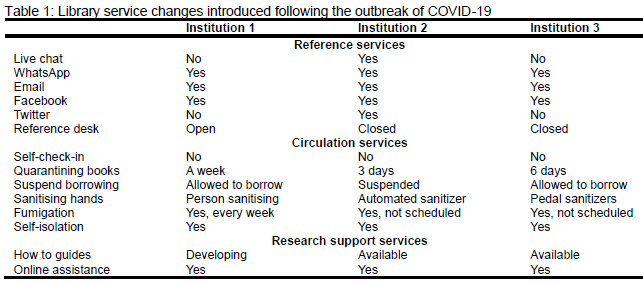
The coronavirus disease-2019 (COVID-19) pandemic significantly impacted the traditional functioning of academic libraries, prompting a critical need to investigate the challenges and opportunities in adapting and reorganising these institutions. This study documents how academic libraries transformed following the outbreak of the COVID-19 pandemic. It identifies how these libraries evolved to meet the changing needs of users in a post-pandemic world. A qualitative study was done using a multi-case study design where three university libraries were purposively selected. Data was collected using semi-structured interviews and participant observation. Fifteen participants were selected using stratified random sampling technique where the strata comprised of library management, technical, reader, circulation, and technology librarians. The data was analysed using thematic content analysis. The findings reveal that libraries were forced to enhance virtual library services to continue serving the library users to meet the needs of hybrid teaching and learning. Online reference services were introduced, and virtual training sessions and meetings were continued after COVID-19. Library services were embedded in the learning management systems. This study assists academic libraries to better handle future disruptions or unforeseen circumstances to improve online resources, enhance remote access, and integrate advanced technologies to enhance the overall user experience.
virtual services; hybrid learning; remote learning; information accessibility; user experience; higher education