Preserving and indigenising chieftainship cultural heritage in Lesotho: the case of Royal Archives and Museum
Abstract
This study explored aims and progress of preserving and indigenising chieftainship and the monarch's cultural heritage, the case of Royal Archives, Museum and Information Centre (RAM) in Lesotho. Evolving in 2006 from the repatriated collection of King Moshoeshoe II, RAM developed into a broad-based facility aimed at indigenising the monarch's cultural heritage. Key terms are conceptualised. The study's areas of indigenising covered RAM's hybridity as a library, archives and museums (LAMs); benchmarking and reciprocity with partners; emphasis of grey literature among LAMs diverse items; rooting the multi-faceted RAM, also as LAMs without walls, within the community of traditional royal village; blending imported methodologies, digitisation and ICTs with indigenous set-up; marketing chieftainship; and a competent home-grown management. Progress is discernible through, inter alia, RAM's visibility locally and globally, increasing patronisation, and resistance to colonial dominance. A case study approach and quantitative desk data methodology were applied, using literature and the researcher's observations and views of relevant contacts. It was concluded that, despite stated challenges, progress is significant in indigenising RAM's chieftainship cultural heritage. Recommendations are advanced, as relevant in 2024 when Lesotho marked the bicentenary of nationhood, a legacy owed particularly to chieftainship that defines the Basotho culture.
chieftainship; cultural-heritage; indigenizing; preservation; Lesotho
1 Introduction and background
It was through the tenacity of its chieftainship that the Basotho nation was born in Lesotho. That nationhood emerged out of the Lifaqane wars that were fought by the Zulu and Ndebele in the Southern African sub-region in the early 19th Century. "Morena", meaning "chief" Moshoeshoe, gathered together remnants of different clans, ethnic groups fleeing the woes of these Lifaqane. Moshoeshoe skilfully led those dispersed, desperate multitudes and groups to hope, oneness, peace and sanctuary of the land that was to be called Lesotho of the Basotho people speaking the Sesotho language and practising the Sesotho culture. Moshoeshoe became the first "Morena e moholo", the Great Chief and the king, the status that to date translates to head of state. Even after triumphs against Chaka of the Zulus, Moshoeshoe still fought battles with the British and the Dutch Boers that saw most of his land conquered. However, Moshoeshoe diplomatically negotiated an alliance with the British through the contingency that had settled in the Cape coast in 1820 (Sanders, 1975). Although Lesotho was by default labelled a protectorate instead of an ally (Matobakele 2023), its administration by the British was apparently not different from that of a colony (Mohapeloa 2002). This indirect rule of Lesotho led to the label Basutoland, the language that suited the ruler. Moshoeshoe died in 1870, having reigned since 1820. His first son, Letsie I, succeeded him and was called the paramount chief. The next paramount chiefs, notably not titled "Kings", were Lerotholi, Letsie II, Griffith, and Seeiso Griffith. Then followed the regency of Chieftainess Mantsebo, who still had to resist much interference and pressure against incorporating Lesotho into the Union of South Africa.
The regent paved the way for the Paramount Chief Bereng Seeiso, who became His Majesty King Moshoeshoe II upon independence in 1966. He graduated from the University of Oxford with a degree in philosophy, politics, economics and law. He was a leader of international stature and a prolific writer and had consequently amassed a remarkable wealth of library resources. His reign coincided with the apogee of apartheid and the oppressive rule in South Africa, the only neighbour of Lesotho. Then, like his grandfather, Moshoeshoe I, Moshoeshoe II was compelled to protect not only his people but also the South African refugees. His grandfather fought Chaka, the Dutch and the British until the size of his country was reduced to the present petite surface area. King Moshoeshoe II and his people continued to suffer atrocities and the wrath of apartheid then. King Moshoeshoe II sadly died in a car accident in 1996. He was posthumously awarded the Order of the Companions of OR Tambo (Mothibe 2006).
The first son of Moshoeshoe II, the current King Letsie III, and his brother Principal Chief Seeiso are learned and modern and have witnessed their father's legacy of scholarship.
Chief Seeiso Seeiso is one of the 22 principal chiefs of Lesotho. Therefore, he also became a member of Senate, the second house of Parliament in the country. The King and Chief Seeiso are hierarchically followed by layers of ward chiefs, area chiefs and headmen who are duly gazetted through the formal structure of governance in Lesotho. One of their statutory duties is to be custodians of the Basotho culture (Chieftainship Act 1968).
The foregoing undoubtedly confirms that the birth of Lesotho and its survival are attributable to the efforts of chiefs and the enduring nature of chieftainship as an indispensable institution for the Basotho.
By 2006, both King Letsie III and Principal Chief Seeiso then authorised and facilitated the safekeeping of their father's collection, in all proper ways, to be decided. Assistance was sought from relevant professionals and volunteers to take inventory of the repatriated nucleus collection. In essence, this gave rise in the first instance to the level of governance called the Board of Trustees; and secondly, to the need to establish and operate RAM.
2. Problem statement
The idea of establishing RAM was, on its own, a well-conceived initiative. But RAM was to become yet another organ and part of the already existing and problematic LAMs operating in the country. According to Coombs (1988:237-250), the emergence of the LAM sector in Lesotho is historically British to such an extent that it culturally reflects foreign interests more than the objective of the locals, hence, seemingly unsustainable. Firstly, the sector is said to have emerged because it was never planned by the indigenous government of the day (National Information Liaison Committee Report 1983). It is confirmed by Coombs (1988) that it was through the British Council's idea and resources that libraries were established in most colonies, dominions and protectorates. Coombs (1988) unpacks initiatives of the British Council whose motive was to promote the English language and culture. Among the British Council's grants that started libraries in the British dominions, colonies and protectorates are the national libraries of Lesotho, Botswana and Swaziland. RAM, on the other hand, has an interest in the self-rule of Lesotho's own chiefs. It is not to promote any foreign language per se nor for political influence. RAM lacked any firm national foundation since the LAM sector in the country remained feeble.
Since its inception in 1976, the Lesotho National Library Service (LNLS) has not been established by law and its existence has been volatile. It lacked financially and in many other respects. It has operated under three different government ministries, such as Education, then Culture, and currently, Information, Communication, Science, Technology and Innovation. The National Archives which were established during the colonial rule, were legalised through the 1967 Act. They, too, have opened and closed at times. Since 2020, the National Archieves were placed under the rehabilitated National Library Service, where progress leaves much to be desired (National Information Liaison Committee Report 1983). Between about 1979 and 1984, they were temporarily housed by the National University of Lesotho library.
Besides their political independence, through the Commonwealth, former British colonies and protectorates still recognise the supremacy of the British. Lesotho is also a member of the Commonwealth, a network of nations that continue cordial relations with their colonial ruler, mainly in terms of culture, language and values (Donaldson 2018). The problem was that despite advantages accruing from the network, seemingly and indirectly the arrangement perpetuates cultural dominance. By observing the colonial master as the head of the Commonwealth, former colonies and protectorates might tend to compromise their own and different culture and values.
These sentiments have recently been corroborated by Segoete (as cited by Monaheng 2025) as she enjoins the campaigns for restitution of cultural material from Britain. She states the following:
"We have lost so much in the name of friendship and protection, and it has subdued us. It has kept us docile in terms of reacting in sharp ways. Reparations are a way of saying: Britain, would you have a British Museum to visit if you didn't have our material culture?" (Monaheng 2025).
Within the context of libraries, the understanding of different cultures is further elucidated by Jimines, Vannini and Cox (2023:30) who caution through a "decolonial lens" about the danger of "privileging written knowledge over other forms of knowing". The culture of English already boasts written knowledge in books, while that of Basotho has used other formats of knowing, such as demonstrating through oral tradition and cumbersome rock painting, which is difficult to preserve. LAMs thus far, thrive in the written knowledge, content of literary works, documents and archives. These are apparently some of the factors that negatively affect LAMs' progress in Lesotho. RAM would instead need to aggressively enhance its strategies to 'make good' its comprehensive collections. Otherwise, it becomes a trap of cultural dominance.
Although chieftainship and kingship in Lesotho have survived a bicentenary, the institution, practice and culture are still prone to criticism. Some critics question whether rulers should be persons who inherit by birth or, rather, those meritoriously and democratically elected. Rosenberg (2008) admits that the practice is the Basotho popular way of governance that binds them together and, as a result, a treasured legacy worth protecting, strengthening and indigenising. Modernising chieftainship is essential. Besides RAM, there is no LAM centre set up with the aim of protecting, modernising or indigenising chieftainship. Neither is there a one-stop information centre focusing on chieftainship and kingship, despite them being a factor in uniting the nation. RAM should fill the gap and indigenise.
The new structure for the National Museum and Art Gallery, located along Lerotholi Street in Maseru, was, by the researcher's observation, completed by May 2024, but it has not yet officially opened even by November 2025. Dlali-Lekhanya (2021) positive attitude towards this museum building is noteworthy. However, the author's crucial concerns are that, as the first museum of its kind in Lesotho, it would be advisable that it should not be a replica of colonial museums. Instead, the Lesotho Museum should be a truly African museum that adequately represents all diversities. Diversities presumably means, inter alia, tangible and intangible items, with the museum conventionally also collecting published and grey literature. Moreover, Dlali-Lekhanya (2021) mentions the likely problem of the colonial ruler versus the ruled, whereby the latter inherits the former's practices. Dlali-Lekhanya (2021:45) finally cites Arinze as follows:
"Considering the baggage carried by contemporary museums in the post-colonial African context, the process of setting up Lesotho's new national museums entail engaging with a range of challenges such as relevant models including funding, expertise, management, etc."
These concerns coincide with ongoing RAM objectives, as this study indicates. Primarily, concerns range from LAMs' challenges that have prevailed for more than a decade and continue unabated. "One weaker side is the fact that the National Archives and the National Museum are poorly organized with no suitable buildings" (Mohai 1990:15). Regardless of the poor state of national institutions, RAM is learning from a few exemplary private and academic services such as the NUL Library, Morija Museum and Archives (MMA), and the Oblates Archives.
In the meantime, as Molapo (2005) stresses, literature and other formats of material on, and owned by, chieftainship and monarchs constitute a rich trove of information. These diverse formats undoubtedly cover more than two centuries. Consequently, the literature is highly demanding in terms of firstly identifying, locating and collecting. Secondly, it is in terms of classifying, indexing appropriately and indigenising. Unfortunately, pockets of the material are scattered throughout all the chief's homes in Lesotho (Nthunya 2011). Similarly, such literature can also be found in the region, in some former British colonial offices, and perhaps also in Canada, France and elsewhere. Segoete (as cited by Monaheng 2025) agrees with this by leading a team of experts making attempts to repatriate items of King Moshoeshoe I as museum pieces from Britain. However, this is a torturous task due to the complex realm of repatriation processes. The topic of repatriation of artefacts and items of cultural heritage
"... also intersects with the rights of indigenous peoples, many of whom seek the return of culturally significant objects taken through various means. Legal frameworks, such as the UNESCO 1970 Convention ... exist to facilitate the repatriation process, but debates persist regarding who is best suited to care for these artifacts. Ultimately, discussions about repatriation reflect broader themes of cultural stewardship, identity, and the lasting impacts of colonialism on global heritage" (Dorau 2021).
The initial collection of RAM has already started with items that belonged to King Moshoeshoe II, as his personal effects from Oxford (Board of Trustees 2006). This shows that the repatriation process will continue, and other centres in Lesotho are seemingly also eager to engage in the exercise. One of the advantages is that wrongful holders of items can be pressurised to return these items. Intricacies might also arise regarding who funds the processes - the rightful owner at the final destination or the information facility? Questions may be asked regarding whether repatriated items will be fully used by the indigenous communities. These likely challenges correspond with widespread problems facing museums in the current era (Burton & Scott 2003), calling for cooperation locally and globally.
Of essence is how RAM maintains its plans to gather widely from within and outside Lesotho, items relating to the cultural heritage of Basotho, Sesotho and Lesotho chieftainship, which is a magnanimous task.
Views from preliminary data are that RAM operates privately, and not necessarily under national LAM institutions that have not yet proven their capability and capacity as demonstrated above. One advantage is that, by developing differently, special disciplines of collections are easily increased and enhanced. While striving to get to such an arrangement, RAM is seemingly still constrained in how to develop financially and progress independently.
Prior to its closure in 1980, however, the national museum displayed indigenous and clearly enviable items comprising the old mohlohlo gun powder rifles, skeletons of some rare animals, namely, thooane, otter - qibi, the skull of a lion; snakes called marabe, qooane, plus two life jackals, as well as pictures of other wild currently rare beasts that previously roamed about in large numbers in Lesotho.
3. RAM's objectives and rationale
From the beginning in 2006, the rationale behind RAM was to safeguard a well-indexed, useable repatriated collection of Moshoeshoe II. From this rationale, the objectives of RAM were then formulated jointly with the Board of Trustees as the authority overseeing governance.
The board provided guidance on how to operate a service of a broad-based, functional, relevant, beneficial library, archives, museum and information centre about chieftainship and kingship, and belonging to the royal family.
Detailed aims, objectives, purpose, including general and specific intentions, have been shaped over time, as described under selected sub-topics below (the Royal Archives 2006):
• RAM's hybridity as a library, archives and museum (LAM)
Hybridity of items repatriated from Oxford, as constituting library materials, archival records and museum objects, determined the formats of RAM.
• Benchmarking and reciprocity with partners
For the benefit of professional standards, partnerships and synergies, RAM aimed to benchmark broadly.
• Emphasis on grey literature among LAMs' diverse items
Despite the collection of diverse formats for RAM, the emphasis was on pro-African grey literature.
• Rooting the multi-faceted RAM, also as LAM without walls, within the community of the traditional royal village (extending to Roma and Thaba Bosiu)
In addition to written, audio, visual and recorded, unpublished materials or grey literature, the objective of RAM was to comprehensively preserve all that relates to royal and chieftainship in Lesotho, both tangible and intangible.
• Blending imported methodologies, digitisation and ICT with the indigenous set-up
The priority was to gather local information, tangible and intangible objects, that are valuable for culturally displaying and conveying the Basotho traditions and values; and to technologically blend, while purposely abandoning foreign dominance.
This tallies with the aim of this study: to determine whether there is progress in rejecting dominance and indigenisation.
• Marketing chieftainship
In order to have a meaningful kingdom, RAM aims to advocate for chieftainship and duly market it. Subjecting RAM to the public eye may also facilitate constructive comments on its performance.
• A competent home-grown management
RAM was to put in place structures aligning with good governance and management at all times.
4. Methodology
The study used a case study method. This method was chosen for this exploratory overview of progress marked on indigenising preservation and indigenising of RAM as a whole. The rationale, among others, is that due to limited time and resources, this method would permit desktop research instead of time-consuming and detailed fieldwork. In the Library and Information Studies, as in this situation, case studies have become popular, perhaps convenient and useful. This is despite the fact that findings may not necessarily be used to generalise in a wider situation (Aina, 2004). This strategy was coupled with other angles of sourcing data, such as observations, literature reviews, document analysis and communication with 11 knowledgeable interviewees and respondents. Whereas respondents have rightly remained anonymous, their views have been incorporated and cited appropriately in the discussion.
The researcher has further tracked down the earliest notes, proposals and reports, and deduced that the Board of Trustees meant to roll out the implementation in the short-, medium- and long-term phases (Board of Trustees 2006). It was necessary to supplement the case study methodology, because findings from a single case enquiry alone can often not be generalised to a wider environment.
5. Progress towards indigenisation
As shown through the objectives and rationale, RAM's progress is assessed through the set objectives, therein determining steps taken, actions effected and achievements attained or, contrarily, failures. Major pending assignments are also described in terms of challenges, work in progress or future plans and recommendations as indicated in the paragraphs that follow:
5.1 RAM's hybridity as a library, archives and museum
RAM has made gigantic strides towards indigenising the collecting, safekeeping and preservation of material ranging from LAMs' local chieftainship-related documentary material, tangible and intangible cultural objects, as well as information resources, that pertain to, enhance and promote chieftainship and the monarch's cultural heritage relevant to Lesotho, Basotho and Sesotho (Royal Palace Archives Inventory 2006). Within this collection, the concept of hybridity was infused, in line with Law (2014:1), who clarifies that "a hybrid library may be described as a physical library in which seamless, integrated access is provided to all the resources available to that library [service] irrespective of medium or location". The library-related material, archival and museum artefacts and comprehensive information resources in RAM have been assembled seamlessly under one roof. In Lesotho, this strategy is working at the NUL Library and the MMA and has further been tested and succeeded in the Mafeteng UNESCO-funded branch library (Moshoeshoe-Chadzingwa 2014). RAM is intended to become a one-stop centre for chieftainship information. The centre has been localised and is being indigenised in this regard, and the process is continuing.
5.2 Benchmarking and reciprocity with partners
RAM has benchmarked with relevant local, regional and global centres, which allowed RAM to partner and reciprocate where it was deemed fit. As stated, practices were learnt, firstly at the local level, from the NUL Library and the MMA. RAM has generally looked up to NUL's vast experiences. Since 1979, as shown, the NUL has provided a sanctuary to the endangered National Archives. By 2024, NUL's Library (Museum) will once again accept for safekeeping some archaeological materials awaiting analysis after excavations made around Polihali Dam.
From the region, the board representatives and some staff members took familiarisation tours of three places. In 2007, the researcher was part of the team that visited Sobhuza II Memorial Park and the Matenga Cultural Village. In 2010, relevant features were studied from the National Cultural History Museum (NCHM) housing collections of historical, anthropological, archaeological and natural history records dating back to the Stone Age. Here it was learnt that by 2010, the NCHM boasted the largest storage in Southern Africa, possessing 5 million objects of local items. Of note were visits to the National Archives of South Africa, the Apartheid Museum, Freedom Park, the Rock Art Museum, the Hector Petersen Memorial Museum, Mandela House and Tutu House. The board embraced the idea of open parks, as also observed in Eswateni (Nthunya 2011).
In May 2012, RAM benchmarked with Botswana's Khama III Memorial Museum in Serowe and Phuthadikobo Museum in Mochudi. Recommendations to RAM included, first, a triangulated cooperation among relevant centres in Matsieng, around Morija, through Thaba Bosiu and at Roma. Secondly, it was observed that RAM could benefit if administered independently from the Lesotho Government (Matsoai 2012).
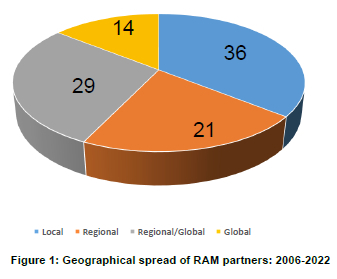
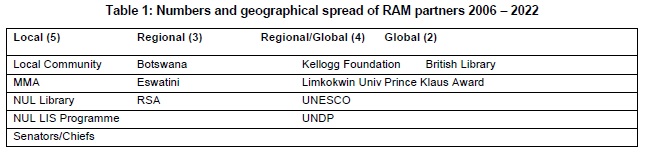
At the global level, RAM forged links of cooperation with the Prince Claus Fund of the Netherlands, the British Library and local offices or regional branches of international networks of Kellogg, UNDP, UNESCO and Limkongkwin University. Despite the fact that RAM is partially open, it continues interacting with partners for possible projects that will operate in the year 2026. Two examples involve collaboration with shared archival records in South Africa, the Free State area, and another regional/international are named Electric-South regarding subjecting selected RAM records in immersive technologies. This progress illustrates that both the number of partners and their geographical scope have increased since RAM was born in 2006, as shown in Table 1.
The local number of partnerships is the highest, then the numbers increase exponentially to the regional and global levels. As the saying goes: charity begins at home. Table 1 and the corresponding Figure 1 depict that perhaps the normal rate of growth is expected to remain so.
5.3
Grey literature plus diverse LAMs' formatsLiterature abounds on the importance of grey literature or non-conventional material in development. Geographical coverage is significant in the least developed countries where formal publishing is poor (Ambrose 1984; Moshoeshoe 1985; Nwanko, Anike & Ibeh 2022). These so-called grey items include ephemeral and non-published materials that are not controlled commercially (UBC Library 2010). For RAM, grey literature pertaining to chieftainship has been collected, vigilantly managed and in the mentioned inventory, for instance, letters, cards, correspondence, programmes, speeches and pictures.
That array of collectibles dating more than 30 years back is exemplified by: (i) a programme for thanksgiving prayers for the rain, or for the peace of the country held at Our Lady of Victories Cathedral, Maseru Saturday 14 December, 1985; (ii) a video of the old demolished palace building, depicting, not only the imposing exterior design, but also the functions, including a chapel that was said to be patronised by the Late Queen Mother 'Mamohato (Mosoeunyane-Lerotholi 2020), (iii) reports on the agricultural fields - at tsimo tsa Letseng, Lelibohong, Thaba-Khubelu 1988-1989, (iv) Barie Knitwear LTD Acquascutum of London - (a scarf, 100% pure cashmere), (v) Magazine, In-flight Certificate for one who flew on the Concord, (Royal Palace Inventory 2006).
The listed archival items and museum pieces tell who this royal figure, Moshoeshoe II, was. He was a meticulous farmer, a world class traveller, with a particular taste in dress, while being a practising Christian and an ardent believer in meaningful Sesotho culture. Principal chiefs, too, have been sensitised to the need to bequeath their items to RAM. Sensitisation workshops have been offered, and more is needed, since chiefs come and go.
Grey literature can change from hidden, inaccessible material to semi-publicised, accessible condition. Hence, documents, including audible oral praise poems of chiefs and processed manuscripts like Lithoko tsa Motlotlehi Letsie III (praise poems) were collected by Rakotsoane (2017) and semi-publicised by RAM in 2017. All such activities are in progress.
5.4
Rooting the multi-faceted RAM, also as LAM without walls, within the community of a traditional royal villageThe Palace in Maseru city still have buildings and sites that could have served as the home for RAM. However, a deliberate decision was made to locate RAM in Matsieng, the traditional royal village and the cultural seat of chieftainship. RAM used UNDP funds to rehabilitate the former paramount chief's offices. The move was commended as a symbolic invitation of the spirits of the departed paramount chiefs. They were thus immortalised within the local premises. By rooting RAM at home, the institution was indigenised physically and culturally.
The next phase is for RAM's central offices to comprehensively and coherently link communities and local partners in the Matsieng and Makhoarane areas at Thaba Bosiu and Roma. Of importance is that Matsieng is already a ward headed by a principal chief. It also has, at the Catholic Church named St Louis, a cemetery where most members of the royal family are buried. By 2024, Matsieng hosted the Matsieng, Moshoeshoe II Campus of the 120-year-old Lerotholi Polytechnic based in Maseru.
Morija is historic since the first religious missionary settlement in 1833. It boasts the resourceful MMA. Its printing works were apparently the first such plant for the production of Sesotho language reading materials in Southern Africa. There are a number of primary and secondary schools in this area, as well as the Scott Hospital where King Letsie III was born.
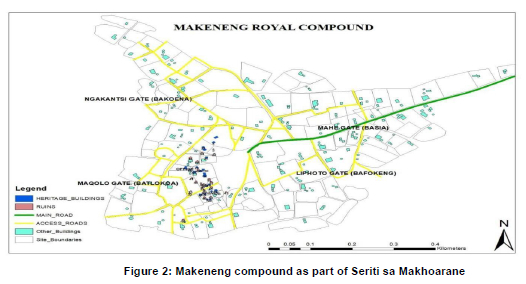
The flora and fauna that require proper environmental protection lie in the vicinity of Matsieng, Makeneng, Phahameng and Morija, villages that constitute Makhoarane. The grand plan consequently focuses on this neighbourhood which is called Seriti sa Makhoarane - SSM (the dignity of Makhoarane). Documenting, mapping and paying due respect to this local area professionally can be seen as part of indigenising and appreciating royalty.
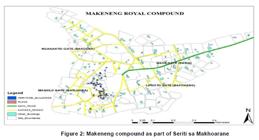
Matsieng embodies the centre as extending to Thota-Moli, at the conspicuous rock of Fika-Le-Mohala around which literature abounds (Rosenberg 2008; Sixishe 2084) that Moshoeshoe I used as a podium for nation-wide "lipitso", meaning large gatherings, discussions or Parliament. Enclosure for preserving this unique site is long overdue for RAM.
This study on indigenising does not only trace and highlight progress made but also reports on pending assignments. Evidently, SSM should provide indigenous open-air reserved parks that are even supplemented by income-generating activities and tourism-related attractions. All these can comprehensively market and showcase chieftainship. Worthy lessons from Eswatini, Botswana and South Africa have been recorded (Board of Trustees 2007). Preliminaries of SSM were publicly commended and endorsed by King Letsie III during his televised face-to-face dialogue with Youth the Future of this country on 6 March 2024. The attention of youth was duly drawn to the importance of this emerging project by RAM and MMA.
In the mentioned triangle, Thaba Bosiu remains a historical place where the graves of Moshoeshoe I, Moshoeshoe II and other chiefs are. It also accommodates Thaba Bosiu Cultural Village, the citadel of Basotho heritage.
From its inception, RAM has had a broad scope to cover tangible and intangible objects. It has embraced the appropriate lessons of preserving indoor archival, museum-related and open parks. This study reflects in detail on progress made, and this is why this discourse should further and emphatically map the pending assignment.
At Roma, the NUL campus has dinosaur footprints. The NUL Thomas Mofolo Library operates its own LAMs, significant by history, size and continuing professional growth. Moreover, the NUL operates the Moshoeshoe Institute of Leadership, which should, inter alia, promote chieftainship and research on the subject. The NUL further has an LIS unit that attaches students for experiential learning at RAM. Collaborative developmental endeavours may be forged.
Finally, in Roma, it has been stated that the earliest Oblate missionaries of the Catholic Church had their church constructed and Moshoeshoe I attended the opening event, and this building still exists (Batere & Matsau 2025). It can be seen as a monument to which the founder of the nation placed the second batch of missionaries, and he travelled there. In this regard, the place could be documented and preserved with historical and sacred linkage to RAM.
5.5
Blending imported methodologies, digitisation and ICT with indigenous set-upOne of RAM's progresses has been to digitise endangered records that covered the subject of pre-independence administration, its chieftainship and kingship spanning from the 18th century. It is important that digitising the collection through modern technology has addressed challenges and risks of loss, facilitating access as underlined by Matenje (1996) and UNESCO (no date). Digital copies have been kept by RAM, the British Library and the NUL Library. The database is available online, conserved and preserved in durable formats for cultural heritage, and accessible locally and abroad. These openly accessible records make the Lesotho chieftainship visible. Although it would have been desirable to digitise blending methods, such that the description of the Sesotho language records in the metadata is given through Sesotho terms, that was not done. Instead, EAP techniques were adopted overall. This imbalance was noted by technical people who contributed their views. In future, a thesaurus of the Sesotho language thesaurus should be written. Apparently, it had been developed by the now defunct NUL's Institute of Southern African Studies (ISAS) Documentation and Publication Division at NUL. RAM's indigenising endangered archives was commendable, although linguistically, it is an unfinished mission. RAM has thus acquired vast experience in applying modern technology in digitisation, as well as forging partnerships.
5.6
Marketing chieftainshipFrom the commercial perspective, marketing describes ways through which a product is made known and attractive to prospective buyers, and in this case, RAM and chieftainship are made visible, known and popular. In order for the product to sell, it should be embraced, acquired and consumed by the community, even the outside world. The board and staff actively market and sell the concept of chieftainship and kingship. RAM particularly plays an advocacy role, encouraging external stakeholders to invest in and support this initiative. By engaging in effective marketing, RAM can facilitate that chieftainship be more integrated into the local culture, preserving its unique attributes. Chieftainship can also be modernised and become more popular. This approach ensures the quality of both tangible and intangible objects, making them attractive, appealing and beneficial to consumers within the community and beyond. This aspect talks to the monarch and his family. The role of the constitutional monarch is modelled along British lines. Moreover, it is "modernising" and perhaps also for functionality. RAM has the duty to seek and preserve information about transforming the monarchy. He is not only the uniting factor for the nation, but the monarch also plays various roles in the global arena. For example, since 2014, the monarch has become the African Union Champion of Nutrition in Africa, a role he is performing and marketing effectively.
Prior to its unplanned lull, one of RAM's major marketing tools was a website. It was patronised by clients made up of local school learners, tourists, researchers and miscellaneous members of the public beyond Lesotho. In this way, RAM was poised towards becoming the hub from which more ideas could be incubated for knowledge creation and development. Normal services will resume by early 2026.
5.7
A competent home-grown managementRAM is a not-for-profit organisation. It is a non-governmental body registered under the Lesotho Society Act 1966 of voluntary associations, charities and cooperatives. As such, RAM is subject to corporate governance that should be accounted for annually at the Law Office. The RAM Board of Trustees consists of the nationals, responsible professionals with a proven flair in chieftainship, cultural affairs and LAMs issues. It is through the board's skills that indigenisation was mooted and implemented and is continuing. The board has introspected and internalised constraints facing RAM. Through their relentless efforts, RAM's structure will be formalised within the Secretariat of the Senior Private Secretary in His Majesty's office by late 2025. An annual budget will be ensured, and the RAM's service will be re-incarnated and be re-invigorated. Progress in preservation and indigenisation will resume as forecasted.
6. Limitations of the study
This study was the first research of its kind in the country, and it had scanty preliminary details to feed on. Data collection from the field would have yielded more informative findings. Due to time and financial constraints, , coupled with a lack of human and technical resources, such demanding methodologies were not employed.
Overall, the conceptualisation of foreign terms, such as LAMs, as indicated, makes it difficult for Lesotho authorities to internalise and appreciate LAMs. RAM and its intended indigenisation developments are then compromised. Despite the fact that RAM should be regarded as a private property of the palace to be treated differently from other national information services, it should be funded by state. However, there could be disputes in these kinds of situations.
Most budgetary cuts prioritise sectors such as food, health and sports over archives, as indicated by a member of the Board of Trustees and understood from communication between the researcher and the respondent on 22 August 2025. Therefore, RAM has been struggling.
The lack of financial self-reliance also compromises the principles of indigenisation because reliance on external financial or technical support tends to impose the latter's interests, techniques and practices.
As already stressed (Burton & Scott 2003), there generally exist unsurmountable global challenges for the museum sector in the 21st century, which include rivalry among museum services, competition over resources, markets and technology. Lesotho cannot be an exception to these conditions. Consequently, indigenising RAM and its services during these hard times can be difficult.
The term "cultural heritage" is clearly nebulous, as noted in the definitions. As described by UNESCO (2024), it involves tangible and intangible objects. Putting those two together can be cumbersome. Archaeological items excavated from the Polihali Dam site are "kept temporarily" awaiting analysis somewhere in the NUL Llibrary/Archives is a challenge.
Moreover, "cultural heritage" simply implies anything popularly embraced by society. Therefore, when the nation celebrated a bicentenary in 2024, many contradictions were observable. Several promotional occasions rightly centred elaborately on the monarchy, royal family and chieftainship. Viewers watched a joyous, rare, televised face-to-face communication of the youth and the king. The period marked elaborate celebrations in the name of Sesotho cultural attire, dance, cuisine, poetry, music, arts and entertainment of sorts. Commensurate efforts towards preserving all valuable cultural heritage for posterity were limited. These are limitations for indigenising RAM.
7. Conclusion and recommendations
This study gave a didactic account of RAM's progress since 2006, especially in indigenising chieftainship cultural heritage. The criteria comprised six selected objectives for establishing RAM and the achievements of indigenising were detailed. From the reviewed literature and opinions from preliminary data collected, RAM has advanced as a unique, cultural entity which is visible locally, regionally and globally. Despite RAM's teething problems and historical obstacles, successes in indigenisation have started and are progressing. In addition, digitisation of 30,000 archival records aged almost 200 years, was completed through British Library funding, in partnership with the NUL Library from 2007 to 2008. The output saw rare records online and useable globally. It is recommended that such endeavours should continue as they are poised to.
Undoubtedly, achievements include RAM authorities' attempts to resist imported practices. The corollary would be tantamount to coloniality and subjugation, which are criticised by Dlali-Lekhanya (2021) and Monaheng (2025). They respectively advocate for locally generated systems and repatriation of Lesotho cultural heritage.
In summary, the findings affirmed that there is progress. Nevertheless, the most impactful challenges and limitations stem from delayed RAM funding and operational budget.
It is therefore proposed that the board be vigilant in sourcing adequate local and sustainable budget, rather than relying on external funding.
It is particularly recommended that pending assignments should be attended to. One priority indigenous-akin scheme is the Open Park Museums. Documenting and preserving the triangulated area of Matsieng, Thaba Bosiu and Roma should be pursued as soon as possible. It could be more relevant as it promotes oral tradition and indigenisation. The NUL Library and Information Studies Unit should collaborate more in conducting similar applied research and follow-up studies that RAM could further benefit from.
Other relevant follow-up areas of the study that were only mentioned, for instance, decoloniality and Africanisation, could be followed up efficiently and effectively.
Finally, the study has hopefully shed light on the performance and potential of RAM, particularly by 2024, when the nation has a reason to celebrate a bicentenary.
References
- Aina, L.O. 2004. Library and information science text for Africa. Ibadan: Third World Information Services Limited.
- Ambrose, D. 1984. The collection and bibliographic control of grey literature. African Research and Documentation, 36: 11-17.
- Arinze, E. 1998. African Museums: the challenge of change. Museum International, 5(1): 31-37.
- Batere, T.G. & Matsau, P.M. 2025. Presenting on the history of the Oblates of Mary Immaculate in Lesotho on TV. Lesotho programme - Khoro ea Bophelo. Directed by Mokete Sello (16 March 2025).
- Board of Trustees. 2007. Royal Archives Board of Trustees Report of the Tour of South Africa's Cultural Centres.
- Board of Trustees. 2008. The proposed Royal Archives and Museum at Matsieng. Report of Familiarisation Trip to Swaziland, 26-28 June 2007.
- Burton, C. & Scott, C. 2003. Museums: challenges for the 21st century. International Journal of Arts Management, 5(2): 56-68.
- Kingdom of Lesotho Chieftainship Act 1968. Reprinted from 1968 Law. Published by the Authority of the Prime Minister. Government Printer, Maseru, Lesotho.
- Coombs, D.1988. Spreading the word: the library work of the British Council. Mansell.
- Dlali-Lekhanya, N. 2021. Kaofela Re Chabana Sa Khomo: Imagining the Lesotho National Museum and Art Gallery through the lens of multiculturalism. Master's dissertation, University of the Witwatersrand, Johannesburg.
- Donaldson, A. 2018. The Commonwealth: a network for now. The British Council global. [Online]. https://www.britishcouncil.org (Accessed 30 September 2025).
- Dorau, B.G. 2021. Repatriation of cultural artifacts: Overview. [Online]. https://www.ebsco.com (11 December 2025).
- Chiefdoms. [Online]. https:///www.penn.museum>sites>states> chiefdoms. (20 July 2025).
- Jiminez, A. Vannini, S. & Cox, S. 2023. A holistic decolonial lens for library and information studies. Journal of Documentation, 79(1). ISSN 0022-0418 https://doi.org/10.1108/JD-10-2021-0205
- Law, D. 2014. Hybrid libraries. [Online]. https://sites.google.com/site/dereklaw9064/publications/hybridlibraries (20 April 2014).
- Matenje, F. 1996. Preservation and conservation of library materials in the 21st century: problems and future challenges facing libraries in the SCECSAL region. Proceedings of 12th SCECSAL Maseru, Lesotho, 9-13 December, 1996, (pp. 293-306).
- Matsoai, M.E. 2012. A report on the learning tour of the archives and museums from similar institutions in the sub-region - Botswana (10 - 13 May 2012). Submitted by Assistant Project Manager to the Board of RAM. Matsieng: Royal Archives and Museum, Lesotho.
- Mohai, S. 1990. Education and training in the BLS region in Lesotho Library Association's 10th Anniversary Conference. 30 June 1989. Report edited by M.M. Chadzingwa, S.M. Mohai, A.N. Mohapi and E.M. Nthunya. Maseru: Lesotho Library Association (pp. 13-24).
- Monaheng, T. 2025. In Lesotho Momentum is building to reclaim King Moshoeshoe I's heritage: Lineo Segoete leads repatriation of Lesotho's Heritage. [Online] https://www.okayafrica.com/in-lesotho-momentum-is-building-to-reclaim-king-moshoeshoe-is-heritage/1410811. (29 September 2025).
- Moshoeshoe-Chadzingwa, M.M. 2014. Life challenges and information needs of children and young adults in Lesotho: Lessons from an internet-connected hybrid library. [Online]. https://creativecommons.org/licenses/by/3.0/ (9 December 2025).
- Mothibe, T.H. 2006. The establishment of Royal Archives, Museum and Information Centre at Matsieng: Project brief. Maseru. Unpublished.
- National Information Liaison Committee 1983. Report of the National Information Liaison Committee on The State Library and Museum Services in Lesotho. Maseru: Ministry of Education, Sports and Culture.
- Nthunya, E. 2011. Tlaleho ea 'Moka o neng o TSoaretsoe Marena a Sehlooho le a libaka ka ho thehoa ha setsi sa 'Royal Archives and Museum' Matsieng. [Report on the Meeting held for Principal Chiefs about RAM]. Holong ea Borena bo boholo, Maseru. E Hlophisitsoe ke Emma Nthunya, Project Manager, RAM, Matsieng.
- Nwankwo, N.G., Anike, A.N. & Ibeh, O.B. 2022. Challenges in the selection and acquisition of grey literature in Nigerian libraries. International Journal of Library and Information Science Studies, 8 (4): 14-23.
- Rosenberg, S. 2008. Promises of Moshoeshoe: Culture, nationalism and identity in Lesotho. Institute of Southern African Studies, National University of Lesotho.
- Royal Archives - The Concept Paper. 2006. Feasibility of the establishment of the Royal Archives, Museum and Information Centre.
- Royal Palace Archives. 2006. Minutes of a special meeting of the Board to consider the proposal to be submitted to UNDP 2006. Unpublished paper.
- Royal Palace Archives Inventory - Archives held in Maseru (Draft) submitted December 2006. Maseru: Unpublished.
- Sanders, P. 1975. Moshoeshoe Chief of the Sotho. London, Heinemann.
Accepted: 9 January 2026