Preserving the past, present and future: the case of Lesotho National Broadcasting Services
Abstract
Audio-visual recordings generated by public broadcasters contribute to a nation's collection of cultural heritage materials. Broadcasters have a responsibility to ensure that these recordings are preserved for future use to ensure that a nation's historical and cultural assets are preserved. The purpose of this study was to investigate the preservation activities maintained at the Lesotho National Broadcasting Services (LNBS) of audio-visual recordings. Head archivists and librarians, technicians, archivists and librarians, news editors, and producers made up the study's population of 10 participants. Data were gathered from respondents using interviews and observations. The findings of the study showed that poor funding for Lesotho-based organisations, poor housing and environmental conditions, and a lack of knowledge about preventive preservation techniques are all factors that contribute to the poor preservation strategies in Lesotho. To support the preservation of audio-visual resources by LNBS and other entities, the study proposes a framework for preservation procedures and guidelines that will serve as an industry-standard for the preservation of audio-visual collections in the public sector.
digital preservation; cultural heritage; audio-visual records; archives; Lesotho National Broadcasting Services
1 Introduction
The importance of local history in promoting a sense of identity, belonging, and community is widely acknowledged, and audio-visual materials form part of this local history in communities. Audio-visual recordings help to preserve recorded history, promote intercultural understanding, and shed light on people's past. Audio-visual records need attentive care since they contain irreplaceable content of historical and cultural significance. Audio-visual records are therefore included in the preservation of the world heritage and all its multicultural aspects over generations (Matangira & Ngulube 2010).
According to Edmondson (2016:27), audio-visual records refer to "works that use a carrier with reproducible images and sound, and whose recording, transmission, perception and comprehension all require technology". Audio-visual heritage includes recordings comprising recorded sounds as well as moving pictures. The literature review published in Mensah et al. (2017), Ncala (2017), and Lukileni-Lipinge and Mnjama (2017) revealed a diverse, heterogeneous, and multimedia collection that included manuscripts, photos, movies, videotapes, compact discs, and music on cassettes.
It is impossible to overestimate the importance of audio-visual records in society since their preservation is crucial to its welfare both now and in the future. Because broadcasting companies provide the public with entertaining, instructive, and informational programmes, radio and television stations must preserve these recordings for use in future broadcasts (Ngoasheng 2020). The statement "AV records are cultural heritage, carrying a huge amount of information that needs to be preserved for future use" (International Federation of Library Associations and Institutions 2004:5) is a good way to put this. Broadcasting services, in its own right, have the mandate to preserve its audio-visual records.
Audio-visual records preservation, in its broadest sense, is safeguarding against degradation to extend the material's lifespan. Wright (2012) defines preservation as the entirety of the elements required to guarantee the long-term accessibility of the visual or aural material, or other crucial characteristics of the work in question, with the least amount of quality degradation. All decisions made to guarantee that the records and the information they contain are always accessible can be considered as preservation. Access to archived audio-visual records allows generations to learn from the past, understand historical context, and gain insights into various cultures. Preservation is paramount to guarantee that future generations can access information resources at any time (Echem & Okwu 2023).
The global preservation of audio-visual materials in broadcasting services faces significant challenges, particularly in Africa. Despite the importance of these materials in preserving cultural heritage and national memory, many broadcasting organisations struggle to properly preserve and maintain their collections. Across the globe, organisations tasked with managing archives and records are facing challenges in devising strategies to maintain the ongoing integrity of the original audio-visual records so that future generations can access and use those (Komba et al. 2017). There are reasons why audio-visual preservation is neglected in most institutions, and these include inadequate resources for engaging in audiovisual preservation and reformatting activities, insufficient equipment for inspecting and viewing such materials, and a shortage of qualified personnel to care for and maintain both materials and equipment (Matangira 2010; Mnjama 2010).
Long-term preservation of audio-visual records may be impacted by the lack of technology, software, standards, rules, guidelines and trained personnel; however, it is crucial that these records be preserved for future generations. Audio-visual records must be preserved since many of them are machine-dependent, brittle and include information about media that is endangered. Therefore, this study aimed determine the preservation activities maintained at the Lesotho National Broadcasting Services (LNBS).
2 The Lesotho National Broadcasting Services
The LNBS was founded by the government of Lesotho two years after independence (1968). The 2009 Lesotho Media Policy states that LNBS must function "as an arm of the government" and as a division of the Ministry of Communication, Science and Technology, which subsequently changed to the Ministry of Information, Communication, Science, Technology and Innovation. The LNBS is composed of the following entities: Television Lesotho, Radio Lesotho and the Ultimate Radio (Lesotho Communication Authority, 2022).
Launched in 1964 with a Roman Catholic Church transmitter, Radio Lesotho aired for an hour before expanding to 24 hours per day in 1997 and became fully automated in 1998. Radio Lesotho broadcasts to all regions of the country, including the Free State in South Africa. It is available around the clock and caters to the target population of the entire nation, with Sesotho being the primary language and English being used sparingly (Lesotho Communication Authority, 2022).
Lesotho Television (LTV) is the nation's sole television network. Established in 1988 during the Papal visit, this channel on MultiChoice's DSTV (Digital Satellite Television) is based in Maseru and broadcasts for a minimum of 15 minutes, with M-Net from South Africa providing compensation for certain hours. In view of the rapid advancement of technology and the continuous transition of content from one stage to the next, LTV has grown (Lesotho Communication Authority, 2022)
At the beginning, Ultimate Radio, the English-language division of the LNBS, was a trendy youth-focused commercial station with just four permanent employees- all of whom were moved from Radio Lesotho. Its origins can be traced to a dream that Dr Motsoahe Thomas Thabane, the then minister of communication, had in 2006. The target audience for Ultimate Radio was people aged 15 to 35, a group that Radio Lesotho appears to have overlooked. Being a youth radio station, the programming combines local and international music genres, with English being the main language spoken and Sesotho spoken infrequently (Lesotho Communication Authority, 2022).
The LNBS' mission is to define inquisitive journalism for the benefit of the public by reporting on breaking news, looking into deciphering and elucidating the nation and its surroundings. As part of its public service, the LNBS is also required to educate, entertain and inform the public. One library serves the three broadcasting stations, which are all located in Maseru, Lesotho's capital. All recorded material is received by the library, where it is catalogued and kept safe (Lesotho Communication Authority, 2022).
3 Statement of the problem
There is no systematic archive or preservation system in place to preserve important historical knowledge about Lesotho (Matsasa, Sithetho, & Wekesa, 2019). Deteriorating formats and outdated playback technology make audio-visual records irretrievable for broadcasters like the LNBS. Audio-visual archivists have several difficulties in managing their collections, including poor preservation, high maintenance costs, obsolescence, and technological difficulties (Chigariro 2014).
Lesotho is not alone in having numerous difficulties with managing and preserving audio-visual materials. These issues are prevalent in many poor nations. Matangira (2010:244) states that "audio-visual materials are much more difficult to preserve than paper records". Mulauzi et al. (2021) also assert that audio-visual records are sometimes given less attention in underdeveloped nations than paper-based documents. Audio-visual records serve the primary purpose of maintaining cultural history, and without them, nothing would survive despite archivists' best efforts to safeguard the content due to obsolescence and degradation.
4 Purpose and objectives of the study
The purpose of this study was to assess the preservation activities maintained at the Lesotho National Broadcasting Service (LNBS). The specific objectives of the study were the following:
• To establish the current state of audio-visual records kept by the LNBS.
• To assess the preservation strategies for audio-visual materials at the LNBS.
• To determine the challenges of preserving audio-visual records at the LNBS.
• To recommend strategies for improving the preservation of audio-visuals at the LNBS.
The current state of audio-visual records kept by broadcasting organisations reveals significant challenges in preservation and accessibility across various regions. Audio-visual materials are especially vulnerable and deteriorate more quickly than materials like paper (Kite, 2020:4). Many broadcasting entities struggle with outdated technologies, inadequate infrastructure, and a lack of skilled personnel, which hamper their ability to maintain and access these records effectively.
The obsolescence of analogue and physical digital records is a distinct but connected issue as media technology has advanced. An enormous backlog of analogue records on deteriorating carriers is held by broadcasting organisations, which could result in the records becoming useless and information being lost forever (Sarikakis et al., 2016). Finding working playback equipment and the parts and supplies needed to digitise different formats has become challenging and costly. Basic infrastructure for analogue audio-visual archiving must be present in the audio-visual archive (Bishi, 2022:36). In order to obtain information, these carriers need playback equipment, which is not widely available (Kramer 2016).
The lack of personnel with the necessary skills and knowledge is another issue that complicates the preservation of audio-visual records (Hagedoorn & Agterberg 2016). To ensure that audio-visual records are preserved, and their contents are usable and accessible, degradation must be slowed down by hiring qualified staff to handle them. According to Duranti (2012), archivists should determine which records should be kept at the time of creation, evaluate their legitimacy, and keep an eye on them throughout the duration of their life. Audio-visual archivists should be taught general maintenance work on repairing playback equipment, such that audio-visual carriers will be digitised successfully (Bishi 2022:36)
To maintain the originality of documents, migration, encapsulation, and emulation are among the techniques used worldwide. These techniques advocate for the long-term preservation and accessibility of audio-visual content. Hoeven et al. (2007:124) aver that "developing techniques to ensure record accessibility is necessary for the long-term preservation of digital assets".
The underlying data configuration changes during migration, but the intellectual content stays the same (Sigauke & Chadikwa 2012; Whitt 2017). Ngoasheng (2020) states that encapsulation necessitates that the archive package preserves the pertinent format specifications and digital infrastructure. Wherein emulation ensures that the software and hardware environments necessary to access a source are properly involved (Whitt 2017:50).
Given its ability to adapt to occasional technological changes, migration is essential to the preservation and distribution of data (Green et al. 2016:4). The drawback of migration, according to Green et al. (2016:11), is that, in order to have the greatest outcomes, strategy decisions must be taken on an individual basis. According to Shimray and Ramaiah (2018:49), encapsulation has the following advantage: "it creates flexibility code that makes maintenance and modification simple". Conversely, the drawbacks, as stated by Shimray and Ramaiah (2018:49), are that encapsulation relies on standards to maintain readability and necessitates separate software that adds metadata to binary files in all formats. Emulation's goal of as closely mimicking the functionality of the original targets as feasible is one of its advantages (Shimray & Ramaiah 2018:52). Starting emulation from scratch, however, is costly and time-consuming and is less effective at retaining dynamic digital objects, according to Boss and Broussard (2016:3). These strategies' benefits and drawbacks give broadcasters the opportunity to create the most dependable repository for audio-visual records while avoiding complete destruction of records. Broadcasters should consider these benefits because they minimise maintenance requirements while safeguarding the legitimacy of the recording (Whitt 2017).
In order to manage audio-visual archives, broadcasting organisations depend on fundamental infrastructure and resources, such as buildings, shelves, humidity, and temperature. A stable, clean, dry, and cold temperature is crucial for the preservation of audio-visual materials (Brylawski et al. 2015). Audio-visual materials kept in informal structures in broadcasting archives are sometimes exposed to hazardous circumstances because they lack suitable housing. According to Lukileni-Iipinge and Mnjama's (2017) study on the preservation of audio-visual records at the National Archives of Namibia, the building was specifically designed to guarantee that audio-visual recordings are exposed to appropriate storage conditions in order to prevent deterioration.
Universal shelves, huge shelves on rollers, and tubes are only a few examples of the equipment used worldwide for audio-visual records, since shelving and containers are essential components for handling and storing audio-visual records properly. According to Lukileni-Iipinge and Mnjama (2017), the primary storage spaces for audiovisual materials at the National Archives of Namibia were cabinets and open shelves. Brylawski et al. (2015) state that audio-visual records shelves should be gap-free, smooth and free of intrusive hardware. The shelves on both sides of the unit, which should be secured to the floor, must be level and evenly filled in order to balance weight (Brylawski et al. 2015).
Theoretically, heating air reduces relative humidity, whereas cooling air increases it at a given temperature, pressure, and altitude. To stop moisture in the air from condensing and creating liquid droplets, dehumidifiers, desiccant dehumidifiers, and/or sensors are required. According to IASA (2014:33), maximum "humidity of 60% GH and a minimum temperature of 25% GH are needed for audio visual storage, whereas minimum and maximum temperatures of 35 °C and 8 °C, respectively, are needed". Cooling systems are essential to broadcasting organisations within their archival storage area.
Effective information material preservation is currently a challenge for information managers in African nations, particularly for librarians, records managers and archivists. Abankwah and Ngulube (2012), Wright (2011), and Schullerr (2008) argue that the majority of archival institutions worldwide face a variety of obstacles when it comes to audio-visual preservation and accessibility. The difficulties in preserving collections are identified in literature as current and enduring deterrents to audio-visual archiving (Astle & Muir 2002; Wright 2011). Thus, in order to guarantee long-term preservation, audio-visual archives must be appropriately handled in compliance with global best practices.
According to Mudzaki (2015), the audio-visual community faces several significant obstacles, including a lack of collection development policies, skills shortages, inadequate funding, and frequent infrastructure breakdowns. Lesotho is not alone in having numerous difficulties with managing and preserving audio-visual materials; these issues are prevalent in many poor nations. The nature of the material, media fragility, technological obsolescence, lack of personnel, and information centres' ability to manage digital resources and assure their preservation are among the obstacles to preserving audio-visuals (Shah et al. 2021: 9).
These difficulties in maintaining audio-visual output align with those of Zinyengere (2008) as cited by (Mnjama, 2010:142) who state that, "most of the African nations, audio visual recordings are at a risk for a number of reasons, including legal statutes regarding audio visual materials, playback equipment obsolescence, staffing, inadequate funding and training, societal attitudes toward archives, technological awareness and preservation, climate concerns, and recording accessibility."
The creation and application of sets of best practices and standards that are regulated by rules can help start the process of improving the audio-visual preservation environment without waiting for an innovative solution. One thing that is universally acknowledged is that partnerships may be used to develop and implement best practices and standards. Ncala (2017) asserts that one of the management practices and procedures for carrying out an organisation's mandate and purpose statement is the creation of policies. In addition, Anyaoku, Echedom and Baro (2019) agree that preservation policies should guide the development of strategies for preserving digital content, as well as the determination of which content should be preserved for a short, medium, or long time.
6 Methodology
This study examined the preservation efforts at the LNBS using qualitative research, which included data extraction from participants and inductive analysis. The qualitative approach included developing questions, gathering participant data, and using inductive analysis of participant data to identify broad themes (Creswell & Creswell 2018:4).
A purposive sample of 10 participants (two producers, two news editors, two archivists/librarians, three technicians, and one head of archives and libraries) was used from the study population of 42 participants. Participants were selected based on their extensive experience and knowledge in audio-visual preservation, ensuring they could provide rich, detailed insights.
Semi-structured interviews were conducted with participants physically at the LNBS offices, followed by observations for looking at a specific viewpoint. The various formats of the audio-visual records were reviewed; some were in deteriorating analogue formats, while others were in the most recent digital versions. A thematic analysis of the collected data was performed, and the results were presented in line with the objectives of the study. According to Ashfag et al. (2019), the following processes are involved in the thematic analysis method: raw data, subject search, theme refinement and grouping, and theme reporting.
The participants were given a consent form to sign, which ensured their free participation and freedom to opt out of the research if they felt uncomfortable at any stage of the study. The participants were assured of the protection of their identity, and that the information they provide would remain confidential.
7 Results and discussion
This section presents and discusses the results of this study
7.1 The current state of audio-visuals
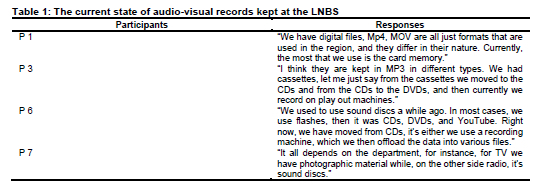
The research study sought to find out which types of audio-visual records were kept by the LNBS. In response to a question concerning the types of audio-visual records their organisation maintains, participants named magnetic media, optical discs, sound discs, and photographic material. What respondents thought about the state of the LNBS's audio-visual records is displayed in Table 1.1. One participant stated that various digital files were utilised in the place; two participants mentioned using flash drives, followed by CDs, DVDs, and YouTube; another participant stated that each department determines the types of audio-visual records they maintain.
The presence of a wide range of audio-visual records at the LNBS was confirmed by observations. These records included sound discs (vinyl discs), optical discs (CD-ROM, video discs), photographic material (film and microforms), and magnetic media (cassettes, magnetic tapes).
According to a study conducted in Ghana by Mensah et al. (2017), the majority of the holdings were audio-visual collections, which included manuscripts, films, CD-ROM's and audio. These outcomes are similar to those of Lukileni-Iipinge and Mnjama (2017) and Ncala (2017), whose investigations uncovered the contents of the diverse, mixed, and multimedia collection, comprising other VHS and DVDs, along with music tapes, videotapes, audio cassettes, projector films, compact discs, pictures, microfiche, and microfilms.
According to IRMT (2016:16-17), the following factors make all audio-visual records susceptible to loss or destruction: media quality, digital media fragility, unfavourable storage conditions, and inaccessible technology. The LNBS must instantly adapt to the restrictions of outdated technology and fragile formats, by implementing preservation strategies and moving to online preservation.
7.2 Preservation strategies for audio-visual material
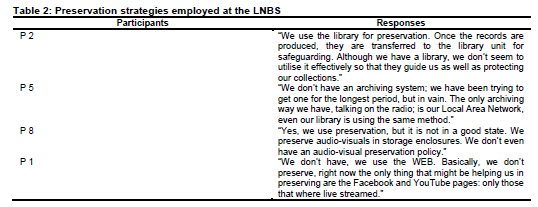
Participants were questioned about the preservation strategies used for audio-visual records at the LNBS. They discussed a variety of topics in addition to ideas and procedures for audio-visual preservation. The participants' answers to the question of which strategies their organisation used to preserve audio-visuals are shown in Table 1.2. Three individuals stated that since they lacked an archiving system and relied on the internet, they used the library for preservation. One person mentioned employing preservation strategies to keep audio-visuals in storage containers, although in poor condition.
The observation revealed that the organisation did not use even the most fundamental methods for preserving audio-visuals. Additionally, the observation demonstrated that the LNBS neglected to preserve its audio-visual records, as seen by the lack of preservation procedures and norms.
A lack of strategies results in inadequate management of audio-visual records and makes it impossible to ensure the archives' audio-visual records' preservation and accessibility. According to a study by Magama (2017), in order to handle technological challenges, infrastructure, financial resources, security and privacy issues, and the absence of acceptable standards, policies, and regulations, adequate strategies and methods for preserving digital records are needed.
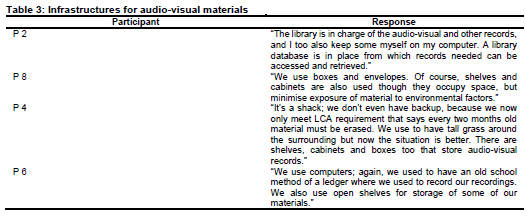
Preserving audio-visual materials requires basic infrastructure and resources. The kind of audio-visual equipment that their organisation used for storage was another question posed to the respondents. Table 1.3 presents their responses. One participant stated that the library was in charge of storing audio-visual records, while others were kept on their own computers. Three participants stated that records were kept in a shack on computers, shelves, cabinets, boxes, and envelopes.
Observations by the researcher revealed the following conditions: the doors of the storage room were never closed; employees were not present to keep an eye on how people were entering the storage; in the storage, there were also empty filing cabinets; some of the documents in the filing cabinets were unlabelled. Dust covered the filing cabinets, and the cleaners just cleaned the offices each day without going into the storage room.
A survey conducted by Lukileni-Iipinge and Mnjama (2017) at Namibia's National Archives also discovered that the most common storage spaces for negatives, photos, videocassettes, U-Matic tapes, audiocassettes, and CDs were cabinets and open shelves. At the National Film Video and Sound Archives, Ncala (2017) found similar results and that film cans, hardwood filling cabinets, acid-free preservation boxes, and non-adjustable shelving were used to hold the collections.
7.3 Challenges of preserving audio-visual records at LNBS
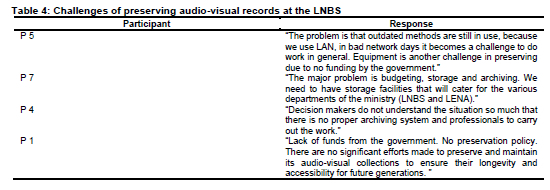
Finding out what obstacles the LNBS faces in maintaining its audio-visual collection was the aim of the research project. When asked what obstacles they faced in maintaining audio-visual materials, the participants gave several answers, such as the lack of procedural manuals and policies, a preservation policy, inadequate storage facilities, frequent changes in technology, and power outages. The response they provided is displayed below in Table 1.4. One participant mentioned that outdated techniques are making it difficult to preserve audio-visuals. Among the difficulties, according to two participants, are budgeting, preservation processes in particular, and storage. One participant stated that the professionals, the appropriate archiving system, and the situation were not understood.
According to the researcher's analysis, the main cause of the challenges in sustaining audio-visual material was a lack of financing; other challenges included old technology, a lack of political will, and poor strategies. Mensah et al. (2017) in Ghana revealed a number of challenges faced with audio-visual records preservation. These difficulties included unfavourable environmental circumstances, a dearth of knowledge, and inadequate facilities, all of which were impacted by budgetary limitations. Another investigation conducted by Lukileni-Iipinge and Mnjama (2017), demonstrated that one of the main obstacles to the preservation of audio-visual records was the ongoing advancements in technology.
Information workers need to learn how to maintain information so that it may be recovered and used as much as possible, according to Elgaral and Paivarinta (2017). The rapid advancement of technology and the massive volume of audio-visual recordings produced necessitate effective management of these records. Therefore, the LNBS needs to hire personnel who possess the knowledge and abilities needed for managing audio-visual recordings effectively.
8 Conclusion and recommendations
Without proper administration, audio-visual collections deteriorate will over time and eventually become unusable. The LNBS preservation efforts were evaluated as part of this project. The study's conclusions indicate that the organisation does not do much to preserve its audio-visual materials. One participant expressly validated the study's conclusion that there are several types of audio-visual recordings by stating that they have used photographic material, magnetic media, optical discs, and sound discs. The conclusions of the research, which were based on participant discussions about ideas and expectations for audio-visual preservation, indicate that the organisation is not significantly attempting to preserve its audiovisual records using preservation techniques.
In conclusion, to store audio-visual materials, the organisation uses a range of storage equipment types, which comprise the infrastructure used in audio-visual storage. One respondent gave examples such as open shelves, cabinets, and library databases. The investigation concluded that a lack of financial resources was one of the main reasons why audio-visual content preservation was challenging. Participants' complaints about outdated equipment, poor internet access, ignorance, a lack of storage space, and poor techniques all support this conclusion.
Based on the findings, the following recommendations are made:
• For the LNBS to manage audio-visual recordings in a competent and efficient manner, the government should provide adequate funding. The budget should cover training, internships, preservation initiatives, and archivists with the necessary training and experience. The successful creation of an audio-visual preservation programme is impeded by inadequate funding.
• For audio-visual records to be properly preserved, institutional policies and technology must be implemented immediately. To make sure the strategies put into place are appropriate, the LNBS stakeholders, government agencies, libraries, and archivists should work together. The institution must develop specific strategies and methods for the long-term preservation of records.
• By obtaining the necessary facilities and resources, the difficulties that always emerge with audio-visual preservation can be avoided. This involves striking a balance between the need for digital technology and ensuring the longevity of analogue technology. More competent library and archives personnel could do this.
• It is recommended that a shared strategy for addressing the issues the LNBS faces be explored, as these issues are not specific to the organisation but rather are prevalent throughout East and Southern Africa. For example, a structure that starts with the records' creators or owners. Afterwards, the records will be stored by being uploaded to the archives. Access requests should be managed by archivists. Lastly, an online platform for accessing the audio-visual records that has been agreed upon by users and custodians is necessary.
References
5 Literature review
- Abankwah, R. & Ngulube, P. 2012. Environmental conditions and the storage of audiovisual materials in archival institutions in the ESARBICA region. ESABRICA Journal, 31: 75-82.
- Anyaoku, E.N., Echedom, A.U.N. and Baro, E.E. 2019.Digital preservation practices in university libraries: an investigation of institutional repositories in Africa. Digital Library Perspectives, 35(1): 41-64.
- Archive and Public Culture Research Initiative. 2012. State of the Archives: Lesotho. Cape Town, Cape Town, South Africa.
- Ashfag, N., Salamon, H.B., Hussin, M.B., Rosman, A.S., Ruskam, A.B., Mohamed, A.K. and Husin, E. 2019. Exploring al-Fauz al Kabir's five thematic analysis of the Quran: A perspective from Shah Wali Allah Al-Dehlavi. Humanities & Social Science Reviews, 7(1):395-412.
- Asiamah, N., Mensah, H. K. and Oteng-Abayie, E. F. 2017. General, Target, and Accessible Population: Demystifying the Concepts for Effective Sampling. The Qualitative Report, 22(6): 1607-1621. <<Author - not used in the text>
- >
- Bishi, A. 2022. Digitisation of audio-visual archives at the National Archives of Zimbabwe. ESARBICA Journal, 41: 32-37.
- Boss, K. and Broussard, M. 2016. Challenges facing the preservation of born-digital news application. [Online]. http://blogs/uploads/2016/04/Boss-Boussard-Challenges-Facing-the-preservation-of-Born-digital-News-Applications.pdf.
- Brylawski, S., Lerman, M., Pike, R. and Smith, K. 2015. ARSC guide to audio preservation. Alexandria: CLR Publications.
- Chigariro, D. 2014. Collaboration in the management and preservation of audio-visual archives: a case study of the National Archives of Zimbabwe. Cape Town: University of Western Cape.
- Digital Preservation Coalition. 2008. Preservation management of digital materials: The handbook. New York: Digital Preservation Coalition.
- Duranti, L. 2012. Continuity and transformation in the role of archivist. Pretoria: University of South Africa.
- Echem, M. E., and E. Okwu. 2023. Library security and sustainable service delivery in Donald Ekong Library, University of Port Harcourt, Rivers State, Nigeria." Communicate: Journal of Library and Information Science, 25 (1): 89-101.
- Edmondson, R. 2004. Audio-visual archiving: philosophy and Principles. Paris: UNESCO.
- Elgaral, A. and Paivarianta, T. 2017. Opening digital archives and collection with emerging data analysis technology: A research agenda. TidsskrifteAfrkiv, 8(1): 1-15.
- International Federation of Library Associations. 2004. Guidelines for a-visual and multimedia materials in libraries and other institutions. International Federation of Library Associations and Institutions (IFLA Professional Reports, No. 80). [Online] https://protect.checkpoint.com/v2/r02/ http://www.ifla.org/files/assets/hq/publications/professional.YzJlOnVuaXNhbW9iaWxlOmM6bzo3MDY4ZiU3YTZlYTc4N2FkMjJhNzdmMTRiMzQyYilhNTo3OjBmMTU6OWE4ZTdlOGRlNDhlZTA3MDdhMzYyZTIyOTkxMTBjNGRlNTUxYmMyMTM4ZihmZGIwMTI2MDUzNiNhNmFhZiI3ZDp0OlQ6Tg -report780.pdf (Accessed on 5 December 2025).
- Hagedoorn, B. and Agterberg, B. 2016. The end of television archives as we know it? The National Archives as an agent of historical knowledge in the convergence era. Media and Communication, 4(3):162-175.
- Hoeven, J.V., Lohman, B. and Verdegem, R. 2007. Emulation for digital preservation in practice: The results. The International Journal of Digital Curation, 2(2):123-132.
- IASA. 2014. The safeguarding of the audio-visual heritage: ethics, principles and preservation strategy. Amsterdam: IASA.
- International Records Management Trust. 2016. Understanding digital records preservation initiatives. [Online]. http://www.ica.org/sites/default/files/Digital20Preservation%20Intiatives%^20Module-0-pdf
- Kite, M. 2020. Telling stories, building alliances: advocacy for audiovisual archival preservation. Chapel Hill: University of North Carolina.
- Komba, S.C., Nawe, J.M. and Manda, P. 2017. Preservation and accessibility of audio-visual records in Tanzania's Television Broadcasting Companies. University of Dar es Salaam Library Journal, 12(2): 22-36.
- Kramer, M. 2016. Opening Access to Fresh Air's archives. Provenance Journal of the Society og Georgia. Archivist, 34(1): 1-11.
- Lesotho Communication Authority. 2022. License document. Maseru: Government Prints.
- Lukileni-Iipinge, H. and Mnjama, N. 2017. Preservation of audio-visual records at the National Archives of Namibia. Journal of the South African Society, 50(2017): 79-99.
- Matangira, V. 2010. Understanding the basics of audio-visual archiving in the East and Southern African Regional Branch of the International Council on Archives. ESARBICA Journal, 22(1): 14-18.
- Matangira, V. and Ngulube, P. 2010. Understanding the basics of audiovisual archiving in Africa and the developing world: Challenges for the archive lagging behind. ESARBICA Journal, 29(2010):223-233.
- Matsasa, T., Sithetho, M. and Wekesa, B. 2019. The Lesotho National Dialogue and Stabilization Project. Maseru: Media Sector Reforms.
- Mensah, M., Adjei, E. and Adams, M. 2017. Keeping our story: Preservation of audio visual archives in Ghana. Library Philosophy and Practice (e-journal), 1-16. [Online]. file:///C:/Users/molopyanejm/Downloads/Keeping_our_story_Preservatio.pdf (Accessed 5 December 2025).
- Mnjama, N. 2010. Preservation and management of audio-visual archives in Botswana. African Journal of Library, Archives and Information Science, 20(2):139-148.
- Mudzaki, F. 2015. Establishing a lasting solution to collection development policy: Challenges for audio-visual archives to enhance access. 23rd ESARBICA General Conference (pp. 94-107). Victoria Falls, Zimbabwe: SARBICA.
- Mulauzi, F., Bwalya, P., Soko, C., Vincent, N., Jane, K. and Silungwe, F. 2021. Preservation of audio-visual archives in Zambia. ESARBICA Journal, 40(2021):42-59.
- Ncala, B. M. 2017. Preservation of, and access to audio-visual records at the national film, video and sound archives of South Africa. Pietermaritzburg: University of KwaZulu-Natal.
- Ngoasheng, C.P. 2020. Preservation of audio-visual records at the South African broadcasting corporation radio in Limpopo regional offices. Pretoria: UNISA.
- Sadiku, M.N., Shadare, A.E. and Musa, S.M. 2017. Digital preservation. International Journal of Advanced Research in Computer Science and Software Engineering, 7(4): 5-10.
- Sarikakis, K., Kolokytha, O., Kribiel, I., Rozgonyi, K. and Bafarfy, A. 2016. The governance of cultural memory through audio-visual broadcast archives: preservation and accessibility in four European Countries. [Online]. https://mediagovernance.univie.ac.at/fileadmin/user_upload/p_mediagovernance/PDF/FIATIFTAReport.pdf (Accessed 5 December 2025).
- Shah, U.A., Husain, M., Saddiqa, M.S. and Yar, M.S. 2021. Problems and challenges in the preservation of digital contents: An analytical study. Library Philosophy and Practice (e-journal), 5, 1-11.[Online]. https://www.researchgate.net/profile/Usman-Shah-7/publication/352439281_Problems_and_Challenges_in_the_Preservation_of_Digital_Contents_An_Analytical_Study/links/61559084ab3c1324134cc1fc/Problems-and-Challenges-in-the-Preservation-of-Digital-Contents-An-Analytical-Study.pdf (05 December 2025).
- Shimray, R.S. and Ramaiah, C.K. 2018. Digital preservation strategies: an overview. 11th National Conference on Recent advances in information technology (READIT=2018) (pp. 46-54). Kalpakam, Tamilnadu: IGCAR.
- Sigauke, O. and Chadikwa, S. 2012. Beyond the digitization horizon: prospects and issues for archivists and the digitization of historical records in Zimbabwe. South African Society of Archivists Conference (pp. 1-31). Pretoria: South African Society of Archivists.
- Whitt, R.S. 2017. "Through a glass, darkly", technical policy and financial actions to avert the coming digital dark ages. Santa Clara High Technology Law Journal, 33(2): 117-229.
- Wright, R. 2011. Deliverable D7.1.6 Audiovisual digital preservation status report Audiovisual Annual Status 2012, (Vol. 4). United Kingdom: Presto Prime.
- Wright, R. 2012. Preserving Moving pictures and sound. London: Charles Beagrie Ltd.
- Zinyenger, I. 2008. African audio-visual archives: A case study of the situation at the National Archives of Zimbabwe. International Preservation News, 46(1): 37-41
Accepted: 6 January 2026