Doctoral students' satisfaction with research support services at public universities in Kenya
Abstract
Research support services (RSS) play an essential role in the lives of academics and researchers. The study focused on availability of RSS and doctoral students' satisfaction with RSS provided in public university libraries in Kenya. The success of doctoral students is often determined by the extent of RSS provided by the university libraries. Every library system's main goal is to satisfy its patrons. Specifically, the paper was guided by these objectives: to assess the extent of provision of RSS in university libraries and to determine the level of satisfaction of doctoral students on available RSS. A sample size of 372 doctoral students were selected using stratified sampling and simple random sampling techniques, and 32 librarians were selected purposively from selected public universities in Kenya. This study adopted a descriptive research design and used an online survey research technique to collect data from doctoral students and librarians. Microsoft Excel and the Statistical Package for Social Science (SPSS) were used to analyse the data. Findings indicate that a wide range of RSS were provided in the selected universities and that while doctoral students are satisfied with the availability of materials, they are not happy with the currency of the materials in the library. The study concludes that there were significant differences in the provision of RSS for doctoral students across the selected public university libraries and that doctoral students have varying levels of satisfaction with the research support services provided to meet their information needs at selected public universities. The study findings will help university libraries to improve their services, provide targeted services to doctoral students and develop frameworks that will guide in resource allocation.
Research support services; user satisfaction; postgraduate students; university libraries; Kenya
1 Introduction
Universities have several important responsibilities, including research, teaching, knowledge sharing, and supporting community development. To support these objectives, university libraries have a critical role to play in providing resources and services that meet the needs of students, faculty, and researchers (Vyas & Trivedi 2020). Research Support Services (RSS) are particularly important for doctoral students who rely heavily on these services during their academic and research journey. In the past, librarians focused mainly on collection development and information discovery (Auckland 2012). However, recent changes have resulted in a greater involvement of librarians in supporting research activities (Pasipamire & Hoskins 2019). Universities and research institutions rely heavily on research support services, which serve as the foundation for research and academic excellence (Pulford, Crossman, Begg, Quach, Abomo, Hajj & Bates 2020). RSS refer to specific information services provided by libraries to promote the needs of the scholars within a particular institution (Forsman, Ndinoshiho & Poteri 2012). According to Tise, Raju, and Adam (2015) and Schoombee (2014), RSS refer to managing and providing specific information services that enhance the research life cycle process in university libraries.
User satisfaction is a crucial factor in determining the performance of academic libraries in delivering quality to their users (Gyau, Liu & Kwakye 2021). User satisfaction, as defined by Ike, Amadi, Madu-Malachy, Iheagwam, Iheanacho-Kelechi and Nwagu (2023) refers to the sense of contentment that users experience when utilising the various information resources and services provided by the library. User satisfaction also includes the ability to meet informational requirements for various daily tasks. When users' expectations are met, users are more satisfied with the services (Udem, Ikenwe & Ugwuamoke 2021). Providing information resources and services is crucial for meeting users' information needs (Olukayode & Lekan 2019). Users are more likely to use the library's resources when they are satisfied with the services they receive (Efua & Tamakloe 2023). Therefore, creating an atmosphere in which customers are content with the resources and services offered can result in higher levels of engagement and utilisation (Efua & Tamakloe 2023). Library staff must recognise the diverse needs and expectations of their users to ensure satisfaction. The primary objective of university libraries and librarians is to fulfil the requirements of their users (Barad 2019). However, even though RSS occupy a central role in academia, and more so among doctoral students, the extent to which these practices are aligned in university libraries in Kenya still needs to be explored.
University libraries serve different groups of users, including postgraduate and undergraduate students, academic and administrative staff, and researchers. Graduate students are the most significant potential beneficiaries of RSS in academic libraries. Master's and doctoral students often engage in research as part of their academic training (Rasul & Singh 2017). The slow progress of RSS has been attributed to low postgraduate completion rates in Africa. According to Raju, Raju, and Johnson (2016), postgraduate students who receive inadequate support from their academic libraries face research-related challenges including lack of academic publishing or research data management skills, which consequently slow their progress and extend their completion time.
This research presents empirical evidence on RSS among doctoral students in the African context, specifically in Kenya. This study sheds light on the nature and extent of RSS in university libraries in Kenya. Findings from the study provide insights to policymakers in academic libraries and provide guidance, allowing libraries to have more emphasis and better-planned strategies to offer RSS in universities. It will inform the development and improvement of RSS in Kenyan public university libraries, ultimately improving the research outcomes of doctoral students and lastly, it can inform theoretical models of design and delivery for information service tailored to different user groups within university libraries.
The study sought to assess the availability of RSS and the satisfaction levels of doctoral students with RSS provided by public university libraries in Kenya. Understanding and addressing these concerns are crucial for ensuring overall satisfaction with RSS. To assess how effective these services in meeting the diverse needs and expectations of doctoral students, the study is guided by the following specific objectives:
• To assess the extent of provision of RSS in university libraries.
• To determine the level of satisfaction of doctoral students with available RSS
University libraries provide a wide range of RSS in supporting the diverse needs of doctoral students. A survey about RSS among eight universities in New Zealand by Howie and Kara (2020) found significant progress in the libraries they studied, particularly in areas such as scholarly communication, research data management, and research impact. However, the authors suggested that there is still room for improvement, such as providing better training and positioning librarians in more strategic roles. Si, Zeng, Guo and Zhuang (2019) found that 96% of academic libraries offer RSS. The RSS includes research data services, research data management, open access, scholarly publishing, research impact measurement, research guides, research consultation, and recommendations for research tools.
2.1
Research support services provided for doctoral students in university librariesAccording to Tang and Zhang (2019), university libraries in the United States, Europe and Australia are more mature in providing RSS than those outside these regions. Such libraries provide services corresponding to different stages of the research lifecycle including research guides, research support tools, research data management services, publication, distribution and intellectual property services (Liang, Wang, Xue & Cui 2016). Findings of another study conducted at the University of Venda in South Africa indicated that the library provided most of the common RSS for postgraduate students but recommended a need for improvement in library facilities and staff skills (Mahwasane 2019). In Kenya, Wachira and Onyancha's (2016) qualitative case study on support services offered to remote users revealed that such services included requests for print and electronic materials access to journals, among others.
2.2
Doctoral students' satisfaction levels with the services offered for research supportStudents' satisfaction is a focal point for educational institutions (Alsheyadi & Albalushi 2020). The success of a library depends on user satisfaction, which requires evaluation of services and satisfaction levels (Larson & Owusu-Acheaw 2012). Meeting users' information needs requires providing the actual information resources and services that will satisfy the information needs of users (Larson & Owusu-Acheaw 2012). Kekana and Kheswa (2022) examined how postgraduate students used the library and how satisfied they were with it as a place to read, study, and do research. According to the study, most students were content with their access to information resources and services. The study concluded that although users were content with the access to information resources they were dissatisfied with the currency of the resources.
Although numerous studies have been conducted on RSS offered by academic libraries in developed countries, no study has been found that covers RSS for academic libraries in Kenya.
3 Methodology
The research design for this study was a descriptive survey. This study was limited to public university libraries in Kenya. Currently, there are 28 public universities in Kenya offering doctoral programmes. Eight of the 28 public university libraries participated in the study. The sampling of the university libraries was done purposively. The selection of eight chartered public universities out of 28 in Kenya was guided by a strategy to ensure equal distribution across the former eight provinces of the country. To achieve geographic representation, one university was chosen from each province. The insights gained from the selected universities can be applied to similar institutions across a wider range of Kenyan universities. The study population consisted of 5352 registered doctoral students in their second year and above, and 43 librarians who provide RSS to graduate students. To determine the sample size for doctoral students, the Yamane (1967) statistical method for determining sample size in relation to the population under investigation was used to estimate the sample size for students. The sample size was calculated based on the Yamane (1967) formula that was given as:

Where: n = the desired sample size of the target population. N= the target population e = the level of statistical significance (0.05 based on 95% confidence level)
Thus, based on the above formula, the desired sample size for this study was given as
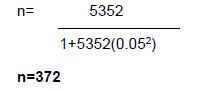
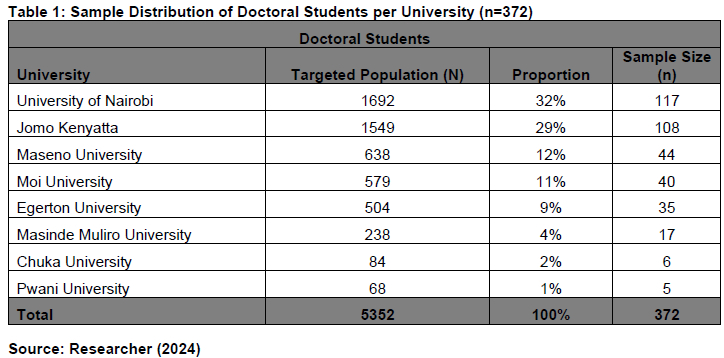
The sample size for the various universities was then calculated based on the proportional allocation and summarised in Table 1.
A sample of 372 doctoral students was obtained from the eight selected public universities through stratified sampling and simple random sampling techniques. This target population was based on the stages of writing their proposals and theses (e.g. second year, third year etc). The respondents were then selected randomly from each sub-group. A sample of 32 librarians was purposively selected based on their roles and experience in providing research support services to doctoral students. The study collected data from doctoral students and the librarians using Google Forms. A five-point Likert scale ranking of their perceptions about user satisfaction on the provision of the various RSS was presented as follows: 1 = Very Inadequate, 2 = Inadequate, 3 = Neutral, 4 = Adequate, and 5= Very Adequate for doctoral students and, planning to be offered, Not offered and Offered for the librarians.
The researcher obtained official permission from the university administrations to collect data. The students' and librarians' emails were obtained from the university registrars, doctoral program coordinators, and the university librarians, respectively. The data was collected from July 2022 to February 2023. The data, including email addresses and responses, were stored securely in a password-protected Google Sheets document accessible only to the researcher. Regular backups were made to ensure data integrity. Participants were required to sign an informed consent form before proceeding with the survey. A total of 283(76%) out of 372 questionnaires were received back from the doctoral students. A total of 26(81%) out of 32 questionnaires were received from the librarians.
The Quantitative data was analysed using SPSS and Excel, and presented as descriptive statistics using charts and tables. Ethical approval for the study was sought from the authorising bodies and individual consent from respondents was obtained.
4 Findings
The findings of this study are presented based on the objectives stated earlier. The study assesses the extent to which public university libraries in Kenya provided RSS to doctoral students and assess the satisfaction levels of the provided RSS.
4.1 The extent of RSS provision in public university libraries in Kenya
RSS provided in selected public university libraries were broadly categorised as library resources, instructional services, scholarly communication services, research data services, research data management, and research impact management services. The services were broken down into instructional services, scholarly communication service, research data services, research data management services, library resources and services and research impact services.
4.1.1 Instructional services
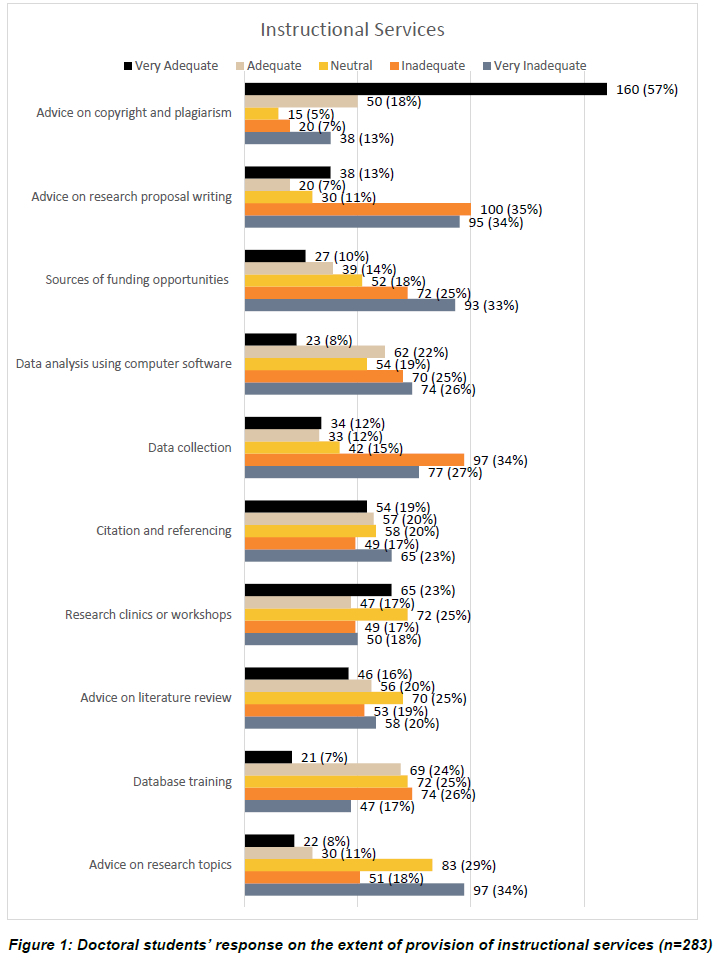
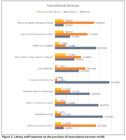
Figure 1 presents data from the doctoral students on instructional services. On specific instructional services, most offered services according to doctoral students are advice on plagiarism and copyrights as confirmed by 160(57%) of the doctoral students from selected university libraries in Kenya. Advice on the literature review 70(25%) and research clinics or workshops 72(25%) were on the neutral side of the scale. However, 93(33%), 74(26%), 65(23%), 97(34%), and 100 (35%), 97(34%) and 74(26%) of doctoral students felt that the provision of advice on sources of funding opportunities, guidance on data analysis, citation and referencing, advice on research topics and provision of advice on research proposal writing, data collection, and database training were very inadequate and inadequate respectively.
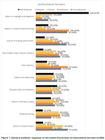
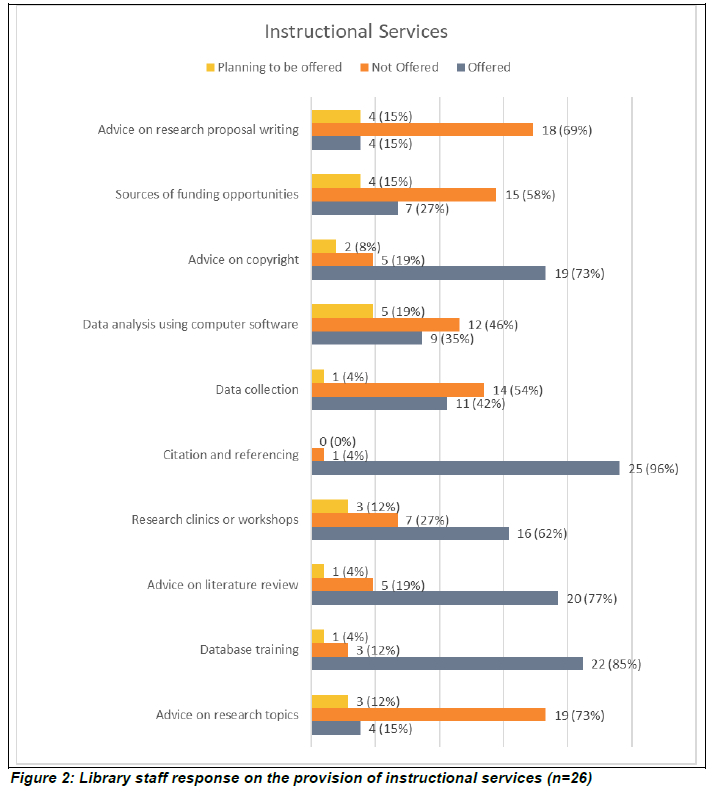
Figure 2 presents Librarians' views on instructional services in public university libraries. This study further sought the views of library staff on the kinds of instructional services offered or planned to be offered at respective libraries, as indicated in Figure 2. Most university library staff, 25(96%) and 22(85%), indicated that their respective university libraries offered citation and referencing guidance and database training, respectively. Closely following are 20(77%) of the library staff who asserted that advice on literature review was provided in their university libraries. Again, 16(62%) of the library staff indicated that research clinics or workshops were provided in their university libraries. Further analysis showed that 15(58%), 18(69%), 19(73%) 12(46%), and 14(54%) of the library staff reported that sources of funding opportunities, advice on research proposal, advise on research topic, data analysis using computer software and advice on data collection respectively were not provided in their university libraries.
4.1.2 Scholarly Communication Service
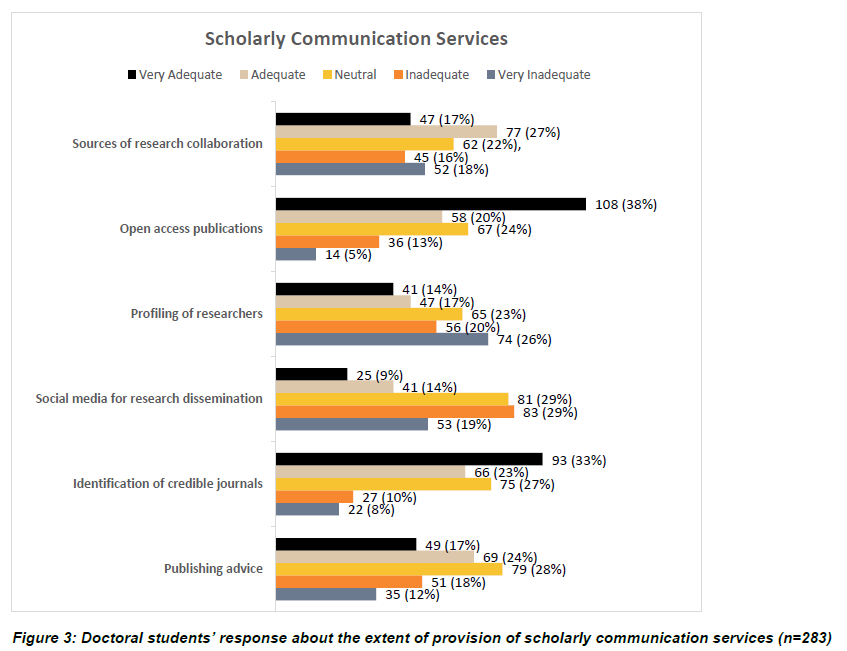
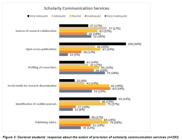
The study examined the extent to which university libraries offer scholarly communication services. Findings on specific scholarly communication services are indicated in Figure 3. Doctoral students rated advice on identifying credible journals, open-access publications, and sources for research collaboration as very adequate and adequate, with cumulative scores of 93(33%), 108(38%), and 77(27%) respectively. However, profiling of researchers, and social media for dissemination was very inadequate and inadequate as per the cumulative score of 74(26%), and 83(29%) respectively. Lastly, advice on publishing was neutral 79(28%).
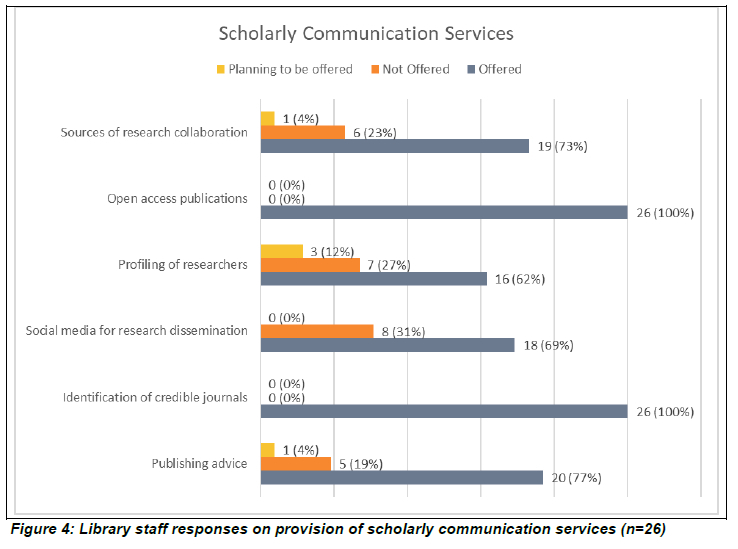
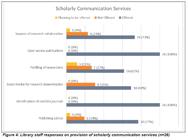
From the perspective of the library staff (Figure 4), all 26(100%) interviewed library staff indicated that respective libraries offer advice on the identification of credible journals and open-access publications. Most of these staff, 20(77%) and 19(73%), noted that publishing advice and sources of research collaboration were services provided in their university libraries, respectively. The data also show that most library staff, 18(69%) and 16(62%), asserted that social media for research dissemination and profiling researchers were part of the scholarly communication services offered in their university libraries, respectively.
4.1.3 Research data services (RDS)
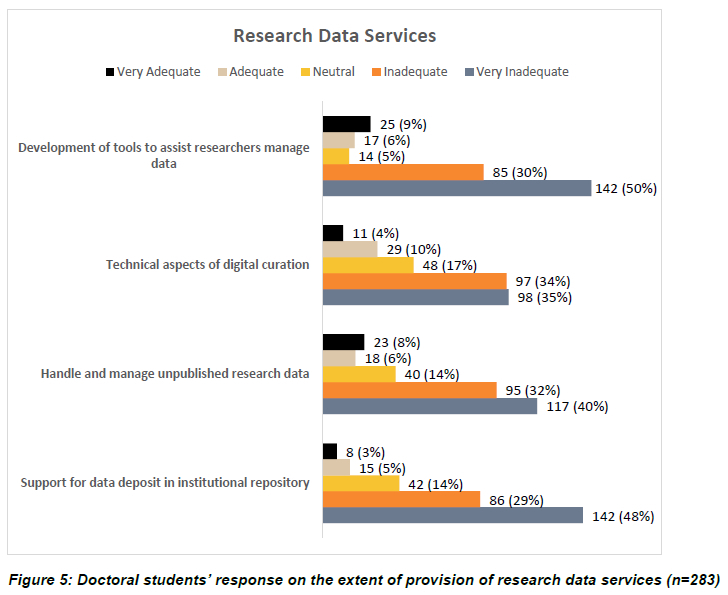
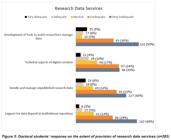
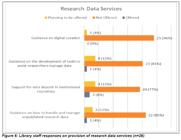
Research data services encompass a wide range of support and resources provided to researchers. This study investigated whether the public university libraries provide support for data deposit in institutional repository, handling and managing unpublished research data, technical aspects of digital curation and development of tools to assist researchers manage data by seeking the views of doctoral students and librarians. The results presented in Figure 5 revealed the extent to which various research data services were offered in the selected public university libraries based on the views of the doctoral students. In the selected universities, research data services RDS) such as support for data deposit in institutional repositories 142 (48%), guidance on the handling and management of unpublished research data 117(40%), technical aspects of digital curation 98(35%), and guidance on services for developing tools to assist researchers manage data 142(50%) were rated as very inadequate by the doctoral students.
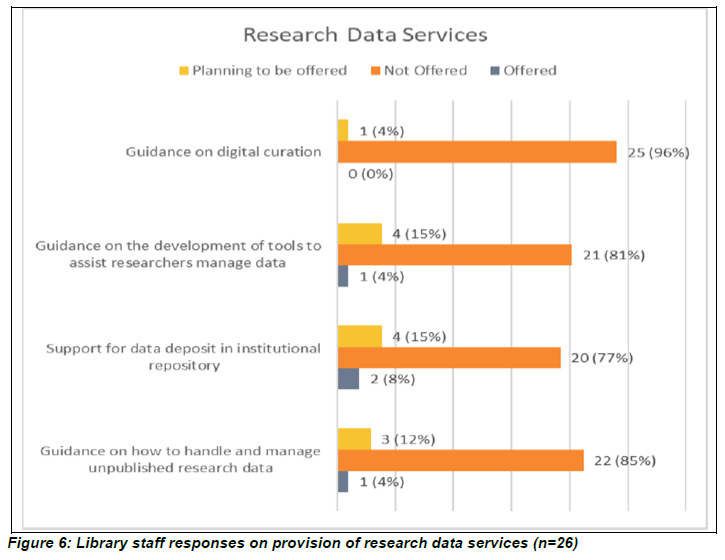
According to Figure 6, the data showed that the majority of the library staff indicated that their respective universities do not offer guidance on digital curation 25(96%), guidance on the development of tools to assist researchers manage data 21(81%), support for data deposit in institutional repositories 20(77%), and guidance on how to handle and manage unpublished research data 22(85%).
4.1.3 Research data management services
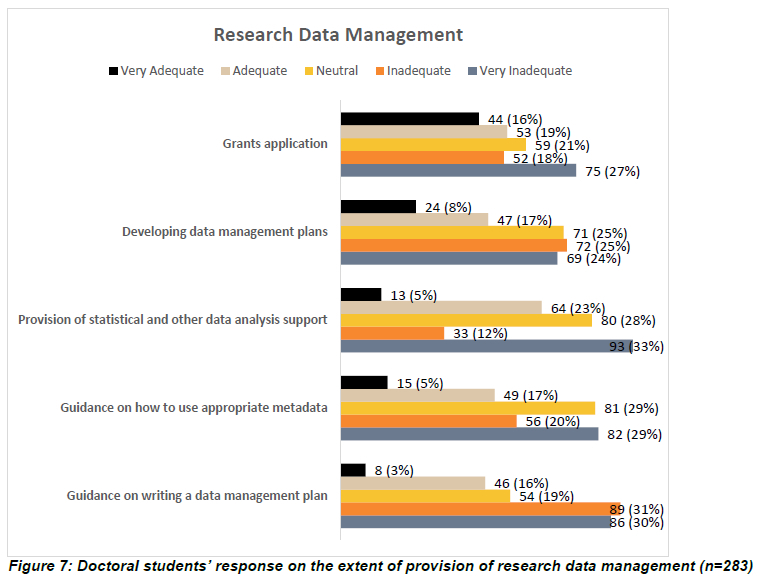
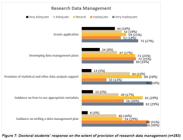
The study also explored the provision of research data management services in the public university libraries considered in this study by seeking the views of doctoral students. The responses of the doctoral students are presented in Figure 7. The study found that doctoral students in the selected universities indicated that guidance on writing and developing data management plans were inadequate, according to 89(31%) and 72(25%) of respondents, respectively. While guidance on how to assign appropriate metadata 82(29%), provision of statistical and other data analysis support 93(33%), and guidance on grants application 75(27%) were very inadequate.
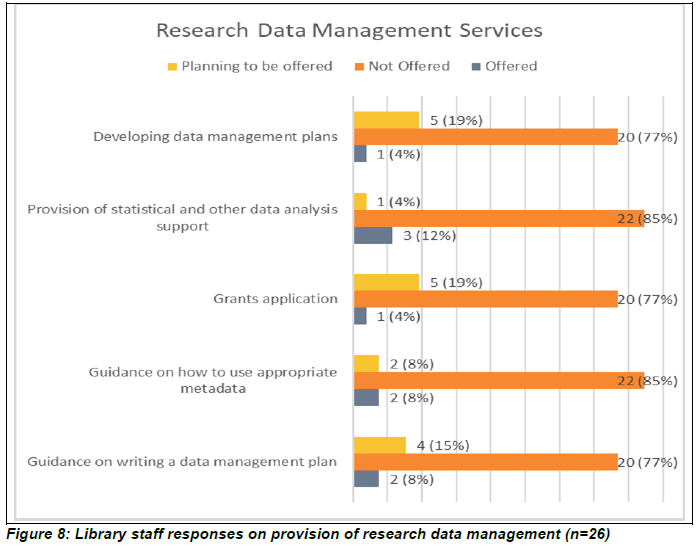
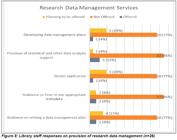
The responses of the library staff regarding the provision of research data management in selected public university libraries are outlined in Figure 8. According to the majority of the staff their respective university libraries, do not offer guidance on developing data management plans 20(77%), provide statistical and other data analysis support 22(85%), grants application 20(77%), provide guidance on using appropriate metadata 22(85%), and guidance on writing data management plans 20(77%).
4.1.4 Library Resources and Services
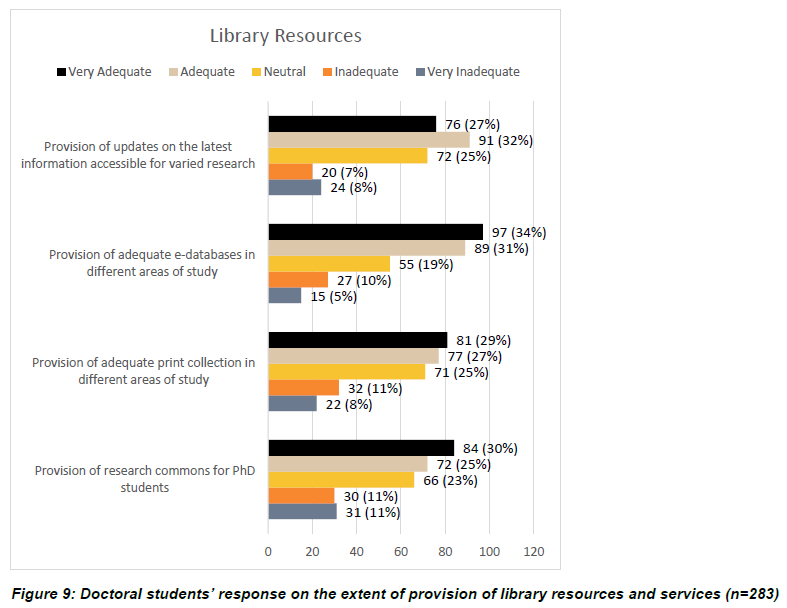
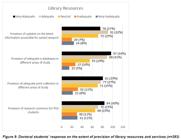
The extent of provision of library resources and services by the university libraries considered in this study based on the perspective of the doctoral students was further determined, and the data is presented in Figure 9. In the selected public university libraries, research commons (study areas), print collection in different areas of study, and e-databases in different areas of study were very adequate, as affirmed by the values 84(30%), 81(29%) and 97(34%) of doctoral students respectively. While scholarly updates (latest information accessible for varied research areas) 91(32%) was adequate.
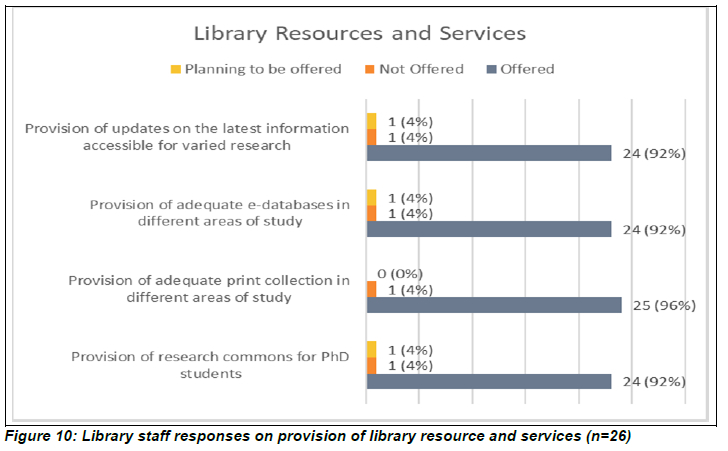
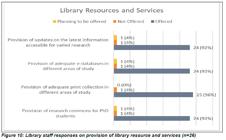
The findings presented in Figure 10 showed how the library staff responded to the questions on providing library resources and services in their respective university libraries. According to the data, 25(96%) of the library staff asserted that their respective university libraries provided adequate print collections in various areas of the study. The data further revealed that 24(92%) of the library staff reported that their universities offered research commons for PhD students, sufficient e-databases covering different areas of study, and regular updates on the latest information accessible for various research purposes.
4.1.5 Research impact services
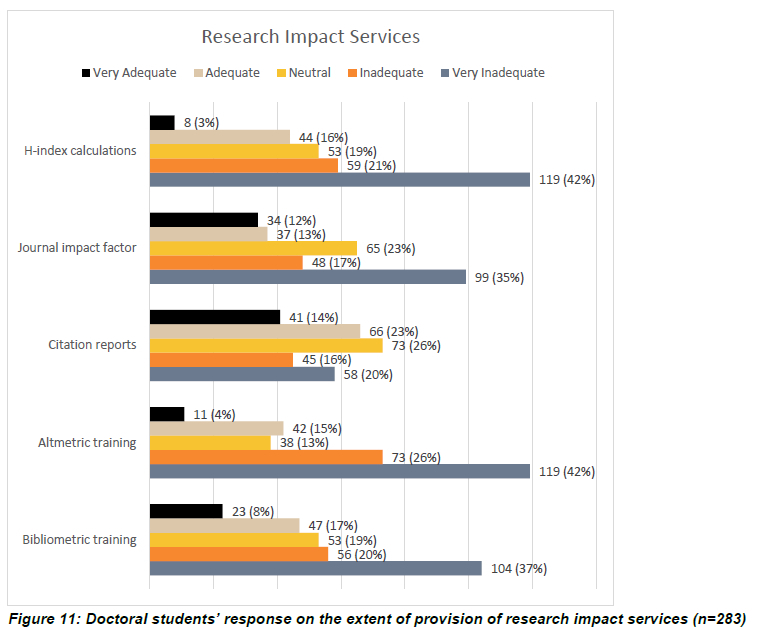
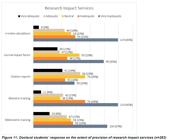
The study also investigated the extent to which research impact services were offered in the selected university libraries based on the responses of the doctoral students. Their responses are outlined in Figure 11. H-index calculations, journal impact factor, altmetrics training, and bibliometric training were very inadequate in the libraries under study, as affirmed by values of 119(42%), 99(35%), 119(42%) and 104(37%) respectively and citation reports 73(26%) was neutral.
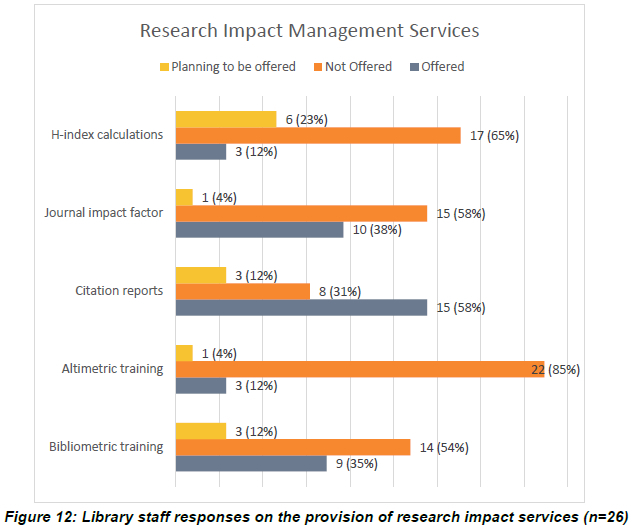
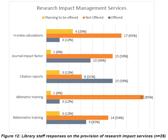
The study further sought the views of library staff on the provision of research impact services in their respective university libraries. A list of research impact services was provided to the library staff, and they were asked to select what their libraries offered, not offered, or were planning to offer. As outlined in Figure 12, the data indicated that 15(58%) of the library staff affirmed that their respective universities offered citation reports. The study also found that most of the library staff, 22(85%), indicated that the selected university libraries do not provide altmetrics training. Further analysis revealed that H-index calculations, Journal Impact Factor, altmetrics training and bibliometric training are not offered in the selected university libraries, as shown by 17(65%), 15(58%), 22(85%), and 14(54%), respectively.
4.3 Doctoral students' satisfaction levels with the services offered for research support
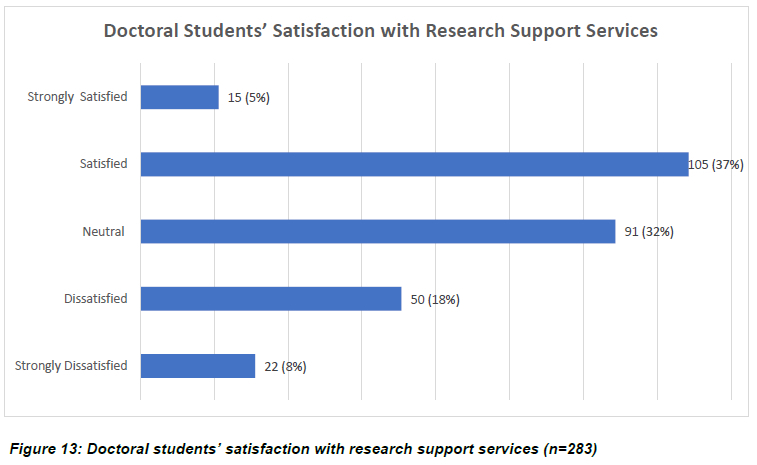
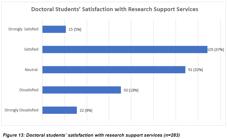
The study also investigated how satisfied the doctoral students were with the various RSS that met their research information needs, as presented in Figure 13. Of the students who were strongly dissatisfied with these services, 22(8%) in number and 50(18%) of doctoral students were strongly dissatisfied and dissatisfied respectively with the services provided in the selected public universities. On the other hand, 91(32%) of the students were neutral. The study data further revealed that 105(37%) and 15(5%) doctoral students were satisfied and strongly satisfied with the various research support services provided in meeting their research information needs, respectively.
5 Discussions
Findings showed that RSS exists in the eight universities under study. The RSS offered were generally made up of different activities, services, and products availed towards meeting the students' research needs throughout the entire research cycle and fulfilling the universities' research goals. Among the services offered are library resources, instructional services, scholarly communication services, research data services, research data management, and research impact services. These findings are consistent with the observation by Si et al. (2019) that RSS provided in top-ranking universities included scholarly communication, research data management, open access, and research consultations, among others. The study findings showed that the selected public university libraries offered diverse instructional services, scholarly communication services, research data services, research data management services, library resources, and research impact services, though to varying extents, and this also significantly differed across the university libraries considered. The findings supported the observation by Haddow and Mamtora (2017) that in response to libraries invested in diverse RSS to meet the needs of their clients. The diverse RSS offered in these university libraries could be informed by the different research needs of doctoral students while undertaking their research projects. While recognising the need for research support for doctoral students, Cook (2020) pointed out that majority of the postgraduate students seek research consultations and other relevant research information resources assistance from libraries.
It was found that the selected public university libraries provided some RSS for doctoral students. Most respondents agreed that the selected public university libraries in Kenya offer research support services to doctoral students; however, the quality and quantity of these services varied widely among the different libraries. This finding supports the argument by Tang and Zhang (2019) that university libraries demonstrated maturity in providing research support services at different stages of research lifecycles.
Parker (2012) recommended that academic libraries design their RSS within the framework of the research life cycle. The above argument also aligns with the sentiments of Pasipamire (2015) that the research lifecycle assisted libraries in providing support to researchers when they needed it at the various stages of their research projects. Liu (2017), for instance, noted that librarians assisted researchers in performing data mining, data analysis, and data integration to meet their needs in the different areas where decision-making was needed. Das and Banerjee (2021) also highlighted the increasing role of libraries in providing leadership in research data management, more so in policy development. Ince, Hoadley and Kirschner (2019) also recognised that academic libraries had become more involved in the conversations surrounding scholarly communication and publishing. Corrall, Kennan and Afzal (2013) observed that library support for bibliometrics and research impact analysis was a growing area of library investment and service.
The results further showed that both groups (doctoral students and librarians) believed that services such as copyright and plagiarism advice were adequately provided. However, there were significant gaps in other services like research proposal advice, funding opportunities, data analysis, data collection, and research topic advice, which were deemed to be inadequately provided. Doctoral students, in particular, highlighted that citation and referencing, database training, advice on literature review, and research clinics or workshops were very inadequate. This disparity could be due to communication problems. Doctoral students may not be fully aware of all the services provided by the library, or they may not feel comfortable expressing their specific needs to librarians. Also, librarians may not fully understand the extent of doctoral students' challenges or may assume that existing resources adequately meet their needs without actively seeking feedback or engaging with students to understand their perspectives.
According to the perspective of doctoral students, they are not adequately provided with services such as data deposit in institutional repositories, advice on managing unpublished research data, and technical aspects of digital curation. Library staff also confirm the unavailability of such services and guidance on digital curation. Grant application assistance, guidance on developing data management plans, provision of statistical and other data analysis support, guidance on appropriate metadata usage, and guidance on writing data management plans were identified as inadequately offered services. The inadequate provision of these services is due to the constantly changing nature of scholarly communication and research practices. Digital curation, data management, and metadata usage are relatively new areas of focus within academic libraries, and resources and expertise in these areas may still be developing. Libraries may not have dedicated staff or established procedures to provide comprehensive support in these emerging areas, which can lead to gaps in service provision. Providing services such as grant application assistance, data management plan guidance, and statistical analysis support requires expertise and resources. Libraries may face limitations in staffing, funding, or technology infrastructure, which can hinder their ability to offer these services at the level desired by doctoral students.
Furthermore, the study revealed that 105(37%) and 15(5%) doctoral students were satisfied and strongly satisfied with the various RSS provided in meeting their research information needs, respectively. In addition, a substantial number of students, 91(32%), reported being neutral. Kekana and Kheswa (2022) carried out a study on library use and user satisfaction. The study found that while users are satisfied with the availability of materials, they are not happy with the currency of the materials in the library. This does not augur well for research support at these university libraries. Larson and Owusu-Acheaw (2012) opine that the success of libraries depends on the level of user satisfaction. Therefore, libraries need to constantly evaluate their services and the satisfaction levels of their users. The quality and availability of RSS significantly impact doctorate students' academic experience. Lai (2006) suggests that service quality provides a superior indicator of user satisfaction, and that service quality can influence user satisfaction.
6. Conclusions and recommendations
The study concluded that the selected public university libraries offered a broad range of RSS for doctoral students, from instructional and scholarly communication services to library resources and research impact services. Nonetheless, there were considerable differences in the extent to which these libraries offered diverse individual RSS under these main categories.
The study concluded that, generally, library resources were the most offered RSS for doctoral students, followed by scholarly communication services and research data services, respectively. Research impact services were the least offered in these selected university libraries. There are notable gaps in critical areas such as data analysis guidance, funding sources, and data collection, indicating the need for a more holistic and standardised approach to providing RSS in public university libraries. The study reveals that doctoral students have varying levels of satisfaction with the research support services provided to meet their information needs at selected public universities. A significant proportion express satisfaction, while a notable number report dissatisfaction or neutrality. The presence of both highly dissatisfied and dissatisfied students highlights potential areas for improvement in the delivery of research support services.
The findings of the study have theoretical and practical implications. These results will assist the university library in identifying areas requiring improvement to better meet the needs and expectations of doctoral students. It will also enable the library to provide services that are tailored to the preferences and requirements of doctoral students, thereby, enhancing their experience with library services and resources. The findings will inform the decision-making process for resource allocation, ensuring that resources are directed towards services and resources that have an impact on doctoral students.
The study recommends that librarians carry out a regular needs assessment to establish the research needs of doctoral students that have been met and those not met so that they can adequately design their research support services or programmes. This can be achieved through user satisfaction surveys and seeking the day-to-day feedback of these students using various communication and feedback channels such as social media, emails, and face-to-face meetings.
The study also recommended that university library staff vigorously carry out awareness creation and sensitisation campaigns so that doctoral students are aware of the available research support provided, how to get different services, and the importance of such services. This can be undertaken during orientation sessions, trainings, and workshops, direct communications to students using various channels, and liaising with relevant departments to create awareness.
Through informed budget requests and different proposals, the study recommends that university libraries' management should seek adequate funding and supporting facilities, infrastructure, and ICT resources from the university management so that they can adequately and smoothly provide relevant research support services that meet the students' research needs and also the research goals of the institutions. With adequate budgetary allocations, it will be possible for the libraries to expand the RSS provided to students.
References
2 Literature review
- Alsheyadi, A.K. & Albalushi, J. 2020. Service quality of student services and student satisfaction: the mediating effect of cross-functional collaboration. The TQM Journal, 32(6): 1197-1215. https://doi.org/10.1108/TQM-10-2019-0234.
- Auckland, M. 2012. Re-skilling for research: an investigation into the role and skills of subject and liaison librarians required to effectively support the evolving information needs of researchers. London: Research Libraries. Retrieved from hdl.voced.edu.au/10707/204093.
- Barad, P.H. 2019. User Satisfaction with library resources and services in Himachal Pradesh University. Library Progress, 39(1): 102-109. https://doi.org/10.5958/2320-317X.2019.00010.2.
- Cook, K. 2020. The role of the academic Library in supporting postgraduate students and researchers within the Community and Health Sciences Faculty at the University of the Western Cape (Unpublished PhD Thesis). Cape Town: University of the Western Cape [Online]. etd.uwc.ac.za/bitstream/handle/11394/7287/cook_m_arts_2020.pdf?sequence=5&isAllowed=y (Access 10 May 2024)
- Corrall, S., Kennan, M.A. & Afzal, W. 2013. Bibliometrics and research data management services: emerging trends in library support for research. Library Trends, 61(3): 636-674.
-
Das, A. & Banerjee, S. 2021. Optimising research support services through libraries: a review of practices. Library Philosophy and Practice, 1-43.
» https://doi.org/10.1080/13614533.2019.1700535 - Efua, M.A. & Tamakloe, E. 2023. Users' perception of library resources in libraries: a case of university of education, Winneba Library. International Journal of Innovative Science and Research Technology, 8(2): 601-15.
- Forsman, M., Ndinoshiho, J. & Poteri, E. 2012. Research support services of university libraries. empowering people: Collaboration between Finnish and Namibian University Libraries. Tampere, Finland: The University of Tampere [Online]. trepo.tuni.fi/bitstream/handle/10024/68089/research_support_services_2012.pdf?sequence=1 (Accessed 10 May 2024)
- Gyau, E.B., Liu, J. & Kwakye, O. 2021. Evaluation of user satisfaction with academic libraries services based on students' perspectives. OALib, 08(08): 1-17. https://doi.org/10.4236/oalib.1107783.
-
Haddow, G. & Mamtora, J. 2017. Research support in Australian academic libraries: services, resources, and relationships. New Review of Academic Librarianship, 23(2-3): 89-109. doi:10.1080/13614533.2017.1318765.
» https://doi.org/10.1080/13614533.2017.1318765 - Ike, N. I., Amadi, C., Madu-Malachy, V., Iheagwam, S. N., Iheanacho-Kelechi, O. & Nwagu, O. J. 2023. The library services and users' satisfaction in academic libraries in Imo State, Nigeria. Library Philosophy and Practice (e-Journal), 7727. https://digitalcommons.unl.edu/Hbphilprac/7727.
- Ince, S., Hoadley, C. & Kirschner, P.A. 2019. The role of libraries in teaching doctoral students to become information-literate researchers. Information and Learning Sciences, 120(3/4): 158-172.
- Kekana, M.D. & Kheswa, S.E. 2022. Library use and user satisfaction of students on the service quality of the University of KwaZulu-Natal, Pietermaritzburg Campus Main Library. Mousaion: South African Journal of Information Studies, 40(2): 24. https://doi.org/10.25159/2663-659X/10054.
- Lai, J.Y. 2006. Assessment of employees' perceptions of service quality and satisfaction with e-business. Proceedings of the 2006 ACM SIGMIS CPR Conference on Computer Personnel Research: forty-four years of computer personnel research: achievements, challenges & the future. pp. 236-243. https://doi.org/10.1145/1125170.1125228.
- Larson, G. A. & Owusu-Acheaw, M. 2012. Undergraduate students' satisfaction with library services in a faculty library in university of education, Winneba, Ghana. Library Philosophy and Practice (e-Journal), 1027, 1-26.
- Liang, H., Wang, J.J., Xue, Y. & Cui, X. 2016. I.T. outsourcing research from 1992 to 2013: a literature review based on main path analysis. Information & Management, 53(2): 227-251.
- Liu, S. 2017. The best practices for L.I.S. education: embed in scientific research lifecycle. IFLA WLIC 2017 - Wroctaw, Poland - libraries [Online]. The Hague: International Federation of Library Associations and Institutions. https://library.ifla.org/id/eprint/1646/1/117-liu-en.pdf (Accessed on 20 May 2024).
- Mahwasane, N.P. 2019. Library services and facilities necessary for research support at the University of Venda areas of Limpopo province in South Africa. Gender and Behaviour, 17(2): 12910-12920.
- Olukayode, A.S. & Lekan, I.O. 2019. Perspectives of users' satisfaction on library resources and services in Oyo State College of Health Science and Technology Ibadan. Library Philosophy and Practice, 1-20
- Parker, R. 2012. What the library did next: strengthening our visibility in research support. emPowering efutures. VALA 2012 16th Biennial Conference, 6-9 February [Online]. VALA: Melbourne. http://www.vala.org.au/vala2012proceedings (Accessed on 18 January 2024).
- Pasipamire, N. 2015. Research support by subject librarians in selected state university libraries in Zimbabwe: accommodating new trends. In: the quest for deeper meaning of research support. pp. 61-79. Cape Town: University of Cape Town Libraries. https://www.ifla.org/wp-content/uploads/files/assets/academic-and-research-libraries/publications/wlic-2016/quest-for-deeper-meaning-of-research-support.pdf#page=68 (Accessed on 18 January 2024).
- Pasipamire, N. & Hoskins, R. 2019. Conceptualisation and practice of research support: a proposed model for effective research support in Zimbabwean university libraries. South African Journal of Libraries and Information Science, 85(1): 12-23.
- Pulford, J., Crossman, S., Begg, S., Quach, J. A., Abomo, P., El Hajj, T. & Bates, I. 2020. Strengthening research management and support services in sub-Saharan African universities and research institutions. A.A.S. Open Research, 3(31): 31-42.
- Raju, R., Raju, J. & Johnson, G. 2016. Research support services in South African academic libraries. In: Quality and the academic library. pp. 167-177. Amsterdam: Elsevier.
- Rasul, A. & Singh, D. 2017. The role of academic libraries in facilitating postgraduate students' research. Malaysian Journal of Library & Information Science, 15(3): 75-84.
- Schoombee, L. 2014. The curious instance of the library's traveling poll: determining obstacles in the research process [Online]. Annual IATUL Conference. Helsinki: IATUL. pp.1-17. https://docs.lib.purdue.edu/iatul/2014/servicedesign/3 (Accessed 10 May 2024).
- Si, L., Zeng, Y., Guo, S. & Zhuang, X. 2019. Investigation and analysis of research support services in academic libraries. The Electronic Library, 37(2): 281-301.
- Tang, Y. & Zhang, C. 2019. Development and practice of research support services in Peking University Library. International Journal of Library and Information Services, 8(2): 22-39.
- Tise, E., Raju, R. & Adam, A. 2015. From research support to research partners. In: Raju, R., Adam, A., Johnson, G. Miller, C. & Pietersen, J. (eds.). The quest for deeper meaning of research support [Online]. University of Cape Town: Cape Town. pp. 1-12. https://www.ifla.org/wp-content/uploads/2019/05/assets/academic-and-research-libraries/publications/wlic-2016/quest-for-deeper-meaning-of-research-support.pdf (Accessed 10 May 2024).
- Udem, O.K., Ikenwe, J.I. & Ugwuamoke, E.C. 2021. Undergraduates' perception of library service quality and value in the 21st-century in Southeast Nigeria: a case study. Library Philosophy and Practice (e-Journal), 4501. https://papers.ssrn.com/sol3/papers.cfm?abstract_id=3731835.
- Vyas, D. M. & Trivedi, D.M. 2020. Research Support services of the Maharaja Sayajirao University Library during Covid-19: a survey. Library Philosophy and Practice (e-Journal). https://digitalcommons.unl.edu/libphilprac/4836.
- Yamane, T. 1967. Statistics: an introductory analysis. 2nd ed. New York: Harper and Row.
Accepted: 27 May 2024