Going mobile for smart public libraries: factors influencing the adoption of smartphones in accessing EIRs
Abstract
With the advent of mobile technology in the fourth industrial revolution (4IR), public libraries revolutionise traditional library services and push boundaries of digital innovation by integrating emerging technologies into the provision of the Electronic Information Resources (EIRs) in order to remain relevant and competitive and increase digital presence. This study sought to unearth the factors influencing library patrons' behavioural intention to use smartphones to access EIRs in the City of Johannesburg Libraries in the Gauteng Province of South Africa. The study applied a conceptual framework underpinned by the Unified Theory of Acceptance and Use of Technology (UTAUT) model. The survey research design was adopted, following the quantitative research approach anchored in the positivism worldview. Data were collected using a questionnaire from 223 library patrons who were selected through convenience sampling. The Statistical Package for the Social Sciences version 22 (SPSS) software was used to analyse the data. The results revealed that 98.7% of library patrons own smartphones or mobile phones. The findings also showed that 62.3% of the respondents preferred to use smartphones to access the library website and the internet. The study further revealed that performance expectancy, effort expectancy, social influences, and facilitating conditions were the key factors for the adoption and use of smartphones to access EIRs in CoJ's libraries, accounting for 39.4% of the variance. It is recommended that public libraries should develop mobile library websites and mobile apps to make the latest trend of "libraries in the pocket of library patrons" a reality in line with the digital transformation strategy.
smartphones; mobile technologies; technology adoption; public libraries; electronic information resources; Unified Theory of Acceptance and Use of Technology (UTAUT) model
1 Introduction and background
The advent of mobile technology and ubiquitous smartphones in the fourth industrial revolution (4IR) has resulted in public libraries revolutionising traditional library services and pushing the boundaries of digital innovation by integrating emerging technologies into the provision of the electronic information resources (EIRs) in order to remain relevant and competitive and increase digital presence. According to the Independent Communications Authority of South Africa (ICASA) (2020), smartphone penetration was at 91.2% in 2019. This trend of the mobile revolution enables organisations, with no exception of public libraries, to leapfrog technological trends and developments and transition to a knowledge-based economy built on digital services (Centre for Strategic and International Studies (CSIS) 2020). Therefore, the researchers argue that incorporating mobile technology, which includes smartphones, into the delivery of electronic library resources would allow the City of Johannesburg's (CoJ) public libraries to "leapfrog" to a higher state of development.
Lee and Song (2015) attest that the proliferation of mobile device ownership challenges libraries to stay current with cutting-edge mobile technology advancement and to initiate mobile library websites, mobile applications, and mobile online public access catalogue (OPAC). Potnis, Regensstreif-Harms and Cortez (2016) and Guo, Liu and Bielefield (2018) state that the unprecedented adoption and use of a variety of context-specific mobile technology, defined as "libraries in hand" or "libraries in the pocket" of library patrons, and the ever-increasing demand for location-aware library services, have compelled public libraries to "go mobile".
Mobile digital devices, supported by mobile technology, enable patrons to access e-library services, free digital content, and e-resources in an era of blended and distance learning modes to curtail exclusion in learning, research, and employment prospects in the contemporary information ecosystem (Khomo, Naicker, Chisita & Rajkoomar 2023; Mashaba & Pretorius 2023; Mpendulo 2023). According to Adetayo and Williams-Ilemobola (2021:1) and Boloka and Ngoepe (2024), libraries should "not be left behind" in the development linked to information technology to provide library patrons, including Generation X, Generation Y, and Generation Z, with more convenient library services.
Factors with a negative impact on the adoption of smartphones for educational and information retrieval include slow responses to searches and poor compatibility with the smartphone operating system, data costs, a lack of awareness of the existing online library services, a lack of computer skills, poor internet connectivity, and poor download speeds (Abbas, MacFarlane & Robinson 2020:35; Adetayo & Williams-Ilemobola 2021; Chaputula & Mutula 2018; Mosweu & Bwalya 2018; Ndou 2021). Alotaibi, Johnson and Rowley (2023) maintain that awareness and training sessions and the "simple to use" technology system influence its usage.
Limited research into the user's adoption of information systems and inadequate information literacy skills are partly accountable for their underutilisation in developing countries (Eyaufe 2018). However, there is a dearth of literature in the area of adoption of smartphones to access e-resources in the context of public libraries in a developing country, such as South Africa.
This study used the conceptual framework underpinned by the Unified Theory of Acceptance and Use of Technology (UTAUT) (Venkatesh, Morris, Davis & Davis 2003) to investigate the factors influencing the adoption of smartphones to access e-resources, with a focus on library patrons in the CoJ's public libraries. Furthermore, this study has the potential to assist in the policy and decision-making interventions in the domains of digital transformation strategy, capacity building, infrastructure development, financial support, and designing mobile-friendly websites and apps, as well as a structured framework for a digital literacy in public libraries.
2 Problem statement
Libraries, including public libraries in developing countries, invest and spend substantial funding on purchasing and subscribing to e-resources to drive their digital transformation strategy and technology information systems projects, which are not grounded in empirical research (American Library Association (ALA) 2023; Mashaba & Pretorius 2023; Van der Westhuizen, Potgieter-Richardson & Rensleigh 2024). As observed by Potnis, Winberry and Finn (2020), free access to electronic resources provided by public libraries does not necessarily lead to their use by patrons, hence there is an underutilisation of library resources.
The underutilisation of e-resources is mostly attributed to the library patrons' preference of generic search engines like Google and YouTube over paid electronic databases (Mashaba & Pretorius 2023). The existing literature on the acceptance and adoption of technology for accessing e-resources focuses on university students (Mashaba & Pretorius 2023; Xu & Du 2019) and neglects patrons using public libraries. Unfortunately, the approach of a lack of integrating empirical research prior to the rollout of information technology is a precursor for the low adoption of technology in the realm of the public library sector.
In the 2022/23 financial year, the Gauteng Department of Sport, Arts, Culture and Recreation allocated R24 million to CoJ's public libraries to procure information resources and/or digital information resources and other programmes as per the business plan. According to the City's 2023 Library and Information Services Report, more than R22 million was spent on the purchase of e-resources to take advantage of some new technologies, such as mobile internet, smartphones, and other mobile reading devices (Xu & Du 2019).
The low usage of e-resources, the laissez-faire method to comprehend factors contributing to low usage, and the low adoption and underutilisation of technology (Mosweu & Bwalya 2018) are gravely concerning, particularly when the majority of the marginalised and disadvantaged community are facing digital exclusion. Mashaba and Pretorius (2023) and Gumede (2021) thus state that it is imperative to ascertain and comprehend the extent of utilisation of the available electronic databases, as the cost of e-resources should be justified by the usage.
3 Purpose and objectives of the study
This study investigated further factors influencing the adoption and usage of smartphones for accessing EIRs beyond what is indicated in the literature. Therefore, the following objectives guided the study:
• To establish the ownership rates of mobile devices/smartphones by library patrons in public libraries in the City of Johannesburg.
• To ascertain the frequency of utilisation of EIRs by library patrons.
• To examine the factors influencing library patrons' behavioural intention to use smartphones/mobile devices to access EIRs.
4 Conceptual framework
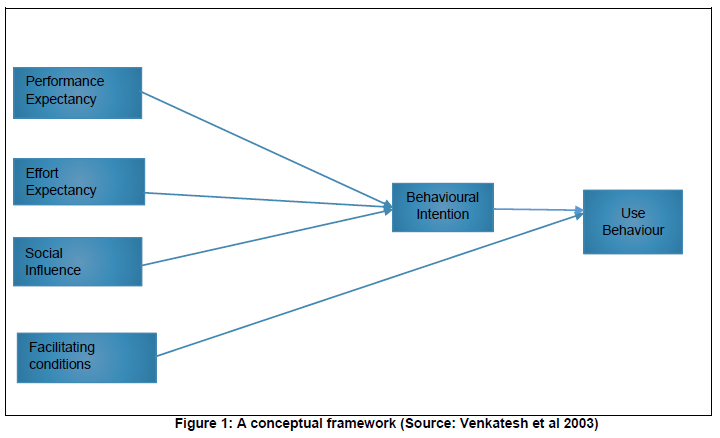
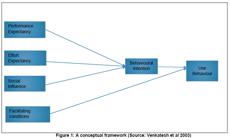
According to Ngulube (2020), a conceptual framework links concepts from several theories and offers a scope of the most imperative variables to be studied or specifies what information should be collected and analysed. In this study, the researchers incorporated aspects and concepts from theory, literature, knowledge of the context, and models to formulate the conceptual framework (Ngulube 2020). The conceptual framework helped to determine the factors influencing the adoption of smartphones by patrons in the CoJ public libraries to access e-resources. Lin (2019: 13) posits that the success of digital information technology depends on whether users accept the technology and use it. The UTAUT model, which is widely applied across various disciplines in different developing and developed countries (Gupta, Manrai & Goel 2019: 176), underpinned the conceptual framework to provide a unified theoretical basis to explain, understand, and make predictions about how individuals accept and ultimately adopt new technology services (Alotaibi et al. 2023: 908). According to the UTAUT model, effort expectancy, performance expectancy, social influences, and facilitating conditions are determinants of the intention to use technology at individual level (Venkatesh et al. 2003), as explained subsequently.
• Performance expectancy can be defined as "the degree to which the user expects that using the system will help him or her to attain gains in job performance" (Venkatesh et al. 2003: 447).
• Effort expectancy is defined as "the degree to which technology is perceived to be easy to use" (Venkatesh et al. 2003). The variables of effort expectancy include perceived ease of use, complexity, and ease of use (Lin 2019). The easier the technology is to use, the more it is embraced.
• Social influence refers to "the degree to which a person perceives that important others believe he or she should use the new system" (Venkatesh et al. 2003: 451).
• Facilitating conditions "refer to the degree to which an individual believes that organisational and technical infrastructure exists to support the use of the system" (Venkatesh et al. 2003: 453).
• Behavioural intention is an individual's subjective view of the probability that he or she will perform the behaviour in question (Venkatesh et al. 2003: 288). Chao (2019) reveals that behavioural intention was significantly and positively influenced by performance expectancy and effort expectancy.
In addition, the four main determinants of the UTAUT model recognise the moderating effect of four other factors, namely, gender, age, experience, and voluntariness of usage (Gupta et al. 2019). However, in line with similar observations by Venkatesh, Thong and Xu (2012) and Dwivedi, Rana, Jeyaraj, Clement and Williams (2019), this study applied only a subset of the theoretical model, and four moderators were excluded since there may not be any variation in the moderator for the adoption and use context. During its validation in the originating research, the UTAUT model showed that it could explain 70% of the variation in usage intention (acceptance) of technology, unlike the previous models that account for between 17% and 53% only of the variance in use intentions (Venkatesh et al. 2003). Lin (2019) applied the UTAUT as the theoretical model for the exploration of factors influencing the users' intentions to read e-books, while Chaputula and Mutula (2018) applied the model for library-related uses of mobile phones, Ndinoshiho and Nassimbeni (2024) for the incorporation of web technologies, and Cilliers, Viljoen and Chinyamurindi (2017) for accessing health-related information using mobile phones. A conceptual framework based on the UTAUT model is depicted in Figure 1.
The literature reviewed subsequently is grouped according to the research objectives and theoretical framework.
5.1 Establishing mobile devices/ smartphones ownership by library patrons in public libraries
According to Big Data (2024), there are 6.84 billion smartphones across the globe, with 94.4% millennials in the United States owning a smartphone, whereas 98% of Generation Z own a smartphone. There are approximately 20 million to 22 million people in South Africa using a smartphone, implying that about one third of the country's population owns a smartphone (Statista 2023). Literature indicates that ownership of smartphones among university students in the world is omnipresent, and students have completely embraced them to access information resources in the digital milieu (Aba & Makinde 2020; Chaputula & Mutula 2018).
5.2 Ascertainment of the frequency of utilisation of EIRs by library patrons
There has been a paradigm shift in the world, as public libraries are investing a major percentage of their budget in the procurement of electronic resources such as e-books, e-journals, and full-text databases. Empirical studies show that the frequently used EIRs are e-databases, e-books, e-journals, mobile websites, library websites, OPAC, and e-research reports (Burhansab, Batcha & Ahmad 2020; Chaputula & Mutula 2018; Liasu & Bakrin 2022; Liu & Briggs 2015; Guo et al. 2018; Mahato 2023).
5.3 Factors influencing utilisation of smartphones/mobile devices to access EIRs
It is pragmatic and progressive for librarians in public libraries to transform library services and to understand the factors influencing the use of smartphones to access EIRs so that no one is left behind in the 4IR era.
According to Mosweu and Bwalya (2018), performance expectancy is an immeasurable motivation factor for technology adoption, as embraced in other empirical studies in Botswana and South Africa. Performance expectancy significantly influences the intention to use a mobile technology in accessing EIRs and library services (Liebenberg, Benadé & Ellis 2018). In the same vein, Alajm (2019) associates acceptance of technology use with performance expectancy. Based on the extended UTAUT model, Lin (2019) studied factors affecting the use of e-books and found that performance expectancy did not have a significant influence on the technology use intention.
A number of studies indicate that an easy-to-use system stands a higher chance of being adopted by users, which ultimately leads to increased usage of EIRs (Mosweu & Bwalya 2018; Mollel & Mwantimwa 2019; Rogers 2005; Venkatesh et al. 2003). With reference to Roger's (2005) theory of diffusion of innovation, if the technological innovations are more complex and complicated, the speed of adoption will be slower.
Facilitating conditions and individual innovation had a significant influence on the use intention (Lin 2019). A study by Mokwana (2021) revealed that facilitating conditions and social influence are not predictors among learners to use smartphones to access information. Empirical studies have shown that social influence predicts the behavioural intention to use technology (Alajm 2019; Baishya & Samalia 2020; Williams, Saunderson & Dhoest 2021). Mollel and Mwantimwa (2019) discovered that perceived usefulness, ease of use, information communication technology competence, and facilitating conditions have been found to play a significant role in predicting the acceptance of EIR utilisation.
6 Research methodology
The quantitative research method and positivism paradigm were used in this study. The positivism paradigm, aligned with the quantitative research method, emphasises measuring variables to draw causal conclusions, and relies on the hypothetico-deductive method to verify a priori hypotheses, test theories, and achieve generalisability (Creswell & Plano Clark 2018; Park, Konge & Artino 2020). In line with the positivism paradigm, the researchers administered a structured questionnaire to determine the factors influencing the adoption of smartphones to access e-resources by patrons in the CoJ public libraries. The population under study were library patrons from eight regional and branch libraries across seven regions in Johannesburg, Gauteng Province in South Africa. Eight out of 91 libraries were purposively sampled, as the method allows researchers to select cases using their judgement to meet the objectives of the study (Saunders, Lewis & Thornhill 2016). This allowed them to also consider time and resource constraints, and convenience sampling techniques were used to select the respondents.
As observed by Bornstein, Jager and Putnick (2017), the generalisation and inference of the entire population are limited due to the non-random selection of the participants. A sample of 223 library patrons out of the 370 in the targeted population, giving a response rate of 60.1%, participated in this study. The sample comprised 123 (55.2%) male and 100 (44.8%) female respondents. The characteristics of the library patrons participating in this study comprised the students, learners, and patrons who make use of smartphones to access EIRs and library services.
This study made use of the survey research design and a self-administered structured questionnaire consisting of a set of adapted measurement statements for each of the variables of the UTAUT model, measured on a 5-point Likert scale (strongly disagree to strongly agree). The researchers collected the data from August 2022 to November 2022. Ethical considerations were adhered to in this study. Based on the guidelines proffered by Bryman (2016), all respondents gave informed consent, anonymity was ensured, and participation was voluntary.
The results from the survey were analysed using a Statistical Package for the Social Sciences (SPSS) version 22. Descriptive statistics and frequencies were analysed, together with inferential statistics. A Cronbach's alpha analysis and tests for significant difference were performed. Reliability of some of the questionnaire items in this study were ascertained by calculating the Cronbach's alpha values of the constructs in the questions. In this study, Cronbach's coefficient alpha value was 0.70 and above, indicating satisfactory internal consistency (Hair, Ortinau & Harrison 2021). Multiple regression analyses were done to examine the type and extent of the relationship between the independent and dependent variables.
7 Results and discussions
The results are presented using frequencies, and descriptive and correlation statistics, and consequently discussed and interpreted through comparison with previous studies. The results are also categorised in the subsequent sections according to the following objectives of the study: ownership of mobile devices/smartphones, categories of EIRs used by library patrons, frequency of utilisation of EIRs, and factors influencing library patrons' behavioural intention to use smartphones to access EIRs. The majority (97) (43.5%) of the patrons indicated that their age group was 21-29 years, while 67 (30%) revealed 16-20 years, 41 (18.4%) indicated 30-39 years, 13 (5.8%) revealed 40-49 years, and only five (5) (2.2%) were aged between 50-59 years. With regards to gender, most (123) (55.2%) of the respondents were male and 100 (44.8%) were female.
7.1 Smartphones/mobile phones ownership
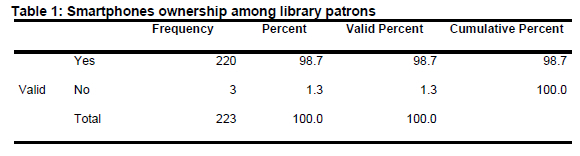
As reflected in Table 1, the majority (220) (98.7%) of the library patrons owned smartphones or mobile phones, supported by wi-fi connectivity and internet capabilities, which was one of the important determinants for using them to access EIRs and online library services. Ocran (2017) opines that the increased penetration of smartphones is partly attributed to their downward price, as well as the preference of mobile applications rather than using a web browser. Only three (1.3%) out of 223 library patrons indicated that they did not own smartphones.
A study conducted by Chaputula and Mutula (2018) found that 99.7% of students owned mobile phones, while Tabassum, Mostofa and Nowrin's (2018) findings showed that 100% of students owned smartphones. The findings of this study and literature (Matumba 2021) confirmed that the proliferation of smartphones offers librarians new modes to offer information resources to users to circumvent footfalls. Wei and Yang (2017) denote that smartphones and tablets have surpassed personal computers (PCs) as the first choice for internet users in most developed and developing countries.
7.2 Categories of EIRs used by library patrons
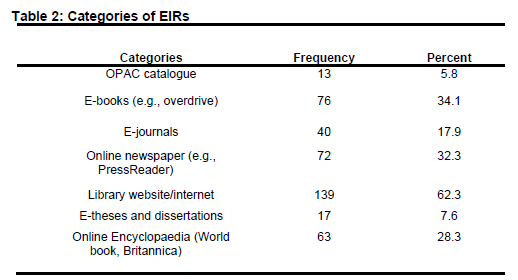
The question posed to the respondents was on the categories of EIRs used by the patrons. Table 1 shows that 139 (62.3%) respondents preferred a library website or internet, while 76 (34.1%) used e-books (overdrive), 72 (32.3%) used online newspaper (PressReader), 63 (28.3%) used an online encyclopaedia, and 40 (17.9%) used e-journals. The utilisation of the e-theses and dissertations, as mentioned by 17 (7.6%) respondents, remained very low, which could imply that patrons within public libraries are primary and high school learners who prefer library website or internet.
The results further revealed that OPAC catalogue, mentioned by 13 (5.8%) respondents, was one of the lowest used online databases for searching information. Unsurprisingly, a low use of the OPAC circulation system may be attributed to an unavailability of the system in CoJ's libraries at the time of the data collection.
Similar results by Eyaufe (2018) at Nigerian and South African academic institutions found that internet, and e-theses and dissertations usage ranked highest among students. This study's results were consistent with those of previous studies (Chaputula & Mutula 2018; Liu & Briggs 2015; Liasu & Bakrin 2022; Mahato 2023) which found that patrons preferred to use smartphones to access the library website or internet, e-books, OPAC, online newspaper, e-journals, and online databases.
Dube and Jacobs (2022) allude that library leaders should reimagine and reevaluate the current library services model to enhance the patrons' experiences by offering contemporary services through transforming the traditional library and information services into online library services. A study conducted by Mawere and Sai (2018) also found that students preferred to access EIRs through the university website under the "library website".
The respondents were asked whether they knew that the CoJ's libraries offer EIRs. The majority (129) (57.8%) of the respondents responded that they were not aware of the EIRs, while the rest (94) (42.2%) indicated that they were aware of EIRs. This finding implied that there could be a misalignment between the CoJ's Integrated Communication and Marketing Strategy and LIS communication and marketing interventions on the EIRs, attributed to fragmentation and siloed working. This finding indicated that a lack of awareness programmes, a lack of library orientation, ineffective marketing strategy, and library user education or training are linked to a low level of awareness of the EIRs (Eyaufe 2018; Singh & Madhusudhan 2023; Shokane & Bopape 2023).
7.3 Factors influencing utilisation of smartphones/ mobile devices to access EIRs
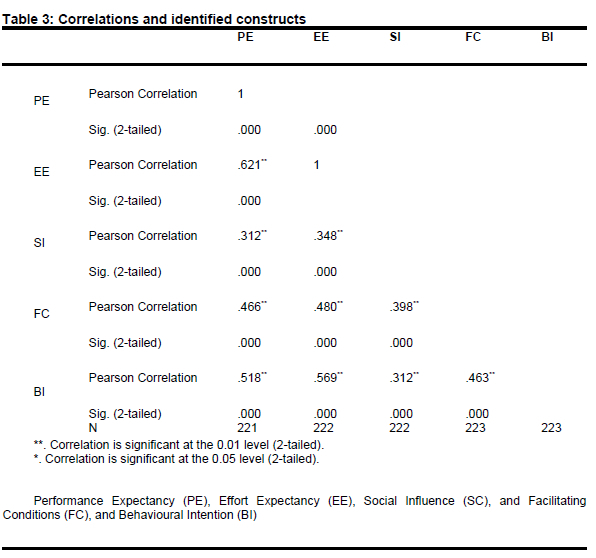
In this section, as shown in Table 3, researchers examine the correlation between behavioural intention (BI) (a dependent variable) and the factors influencing the utilisation of smartphones/mobile devices to access EIRs, namely, performance expectancy (PE), effort expectancy (EE), social influence (SI), and facilitating conditions (FC) (independent variables).
Pearson's product moment correlation coefficient results presented in Table 3 revealed that there was a strong, positive correlation that was statistically significant between PE and BI (r= 0.518, p=0.000) at the 5% level of significance. This suggests that the patrons were more likely to use smartphones to access EIRs, as they believed that mobile technology would enable them to accomplish learning, educational, and research tasks efficiently. The findings were in line with those from various other studies (Liebenberg et al. 2018; Singh, Maharana & Sahu 2023; Chaputula & Mutula 2018), which found the relationship between acceptance of technology and PE. Dube and Jacobs (2022) allude that time, place, and distance are not a barrier within the "libraries without walls" context, leading to improved educational and research performance among students.
The Pearson correlation between EE and BI (r=0.569, p=0.000) indicated that there was a strong, positive relationship that was statistically significant. In this study, EE was found to be a powerful predictor in the adoption of smartphones to access EIRs. This implies that an increase in the EE variable does have a significance value related to the use intention of smartphones to access EIRs. This finding concurred with the results of studies by Mosweu and Bwalya (2018), Xu (2023), Rogers (2005), and Venkatesh et al. (2003), that an easy-to-use system and the user-friendliness of the information system are predictors of the BI by users to accept and adopt technological innovation. Mwambakulu and Chikumba (2020) and Alotaibi et al. (2023) recommend that the future development of library technologies or apps should be grounded on the "easy-to-use" system.
SI and BI (r= 0.312, p= 0.000) have a moderately positive relationship that is statistically significant. As Venkatesh et al. (2003) state, other people could influence an individual to use technology. Librarians, teachers, friends, and family members may influence the patrons' use of smartphones to access EIRs. Ndinoshiho and Nassimbeni (2024) report that librarians were influenced to adopt, use, and incorporate web technologies in library services by patrons.
The early adopters and ardent patrons of mobile technology might be tasked with promoting the use of smartphones to access and retrieve EIRs at peer-to-peer level. This implies that patrons in the CoJ libraries are influenced by others to adopt and use smartphones or mobile technology to access EIRs. The findings of this study support early studies by Williams et al. (2021) and Xu (2023), which found that SI predicts the BI to use technology. Furthermore, Bothma and Mostert (2023) also agree that the SI construct acts as a catalyst to adopt new technology in developing countries. In contrast, SI is not a predictor among learners to use smartphones to access information for their studies (Mokwana 2021).
Table 3 presents the correlation analysis results between FC and BI. The findings revealed that there was a positive and significant association between FC and BI (r=0.463, p=0.000). Based on this evidence, it is thought that when initiatives such as organisational support and technical infrastructure are put in place, BI to adopt smartphones to access EIRs increases. Aligned with the findings of Boloka and Ngoepe (2024), within a public library realm, a well-developed telecommunication system and internet connections are a necessity for bridging both the information services and digital chasm. Mbambo and Jiyane (2023) maintain that CoJ's e-learning centres acquire more funds to purchase more laptops, e-resources, sustainable free Wi-Fi, and internet.
The impact of FC on adoption and use of newly introduced technology was studied by Lin (2019) and Ndinoshiho and Nassimbeni (2024). Their results suggested that librarians had to think of innovative methods to train first-time library patrons to gain advanced ICT skills for accessing EIRs through smartphones before the system went live. Ankamah, Gyesi and Amponsah (2022) proclaim that computer literacy skills and regular training on the use of e-resources have a positive relationship with the awareness of e-resources.
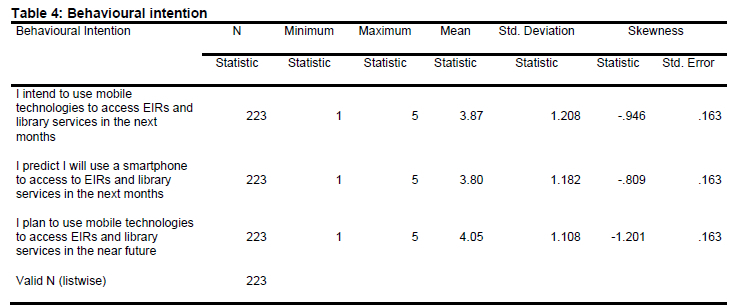
Interpretation of the mean scores was based on Sekaran's (2003) interpretation: good agreement (2.34 to 3.66) to strong agreement (3.67 to 5.00). Based on the examination of BI, as evidenced in Table 4, the mean scores ranged between 3.87 and 4.05, which means library patrons intended and planned to use smartphones or mobile technologies to access EIRs and library services in the subsequent months or near future.
The results of this current study were in congruence with the findings of Venkatesh et al. (2003) and Alajmi (2019), which revealed that UTAUT constructs, such as PE, EE, FC, and SI, have some influence over the degree of adoption and use of the smartphones.
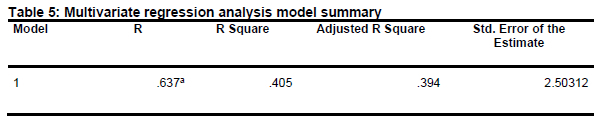
R squared (R2= 0.394), as illustrated in Table 5, shows the multiple regression model summary in relation to the adoption of smartphones to access EIRs in CoJ's libraries. The total variance contributed by four predictor factors was 39.4%. This was in line with Lin's (2019) and Ndinoshiho and Nassimbeni's (2024) assertions, that the four major constructs of UTAUT influence users' BI to use technology. In the view of Chao (2019), behavioural intention is significantly and positively influenced by PE and EE. Bothma and Mostert (2023) state that BI directly and positively influences the use of technology. The other unidentified constructs accounted for 60.6% of variance not explained by the predictor factors.
8 Conclusions
Based on the findings, it can be concluded that 98.7% of library patrons in the CoJ's public libraries owned smartphones. The statistical results of this study showed that most of the patrons preferred a library website/internet, while a few preferred e-books (overdrive), online newspaper (PressReader), e-journals, and the OPAC catalogue. The results showed that most of the respondents were not aware that CoJ libraries provided EIRs, regardless of promotional initiatives by public libraries to market them. This study established that the four key constructs (PE, EE, SI, and FC) of the UTAUT model were found to influence the adoption and use of smartphones to access EIRs by patrons.
The study pinpointed that the omnipresence of smartphones, free Wi-Fi, and EIRs are constituents of the digital transformation strategy within a smart public library for achieving "Universal Internet and Information/ Knowledge Access for All". For instance, with the growing demand and use of digital collections, the Generation Z and millennials read more on their smartphones than older generations (ALA 2023). In the 21st century, public libraries can aid to bridge the digital divide - a gap between those with access to technology and digital tools and those without. This can be achieved through integrating mobile technology in their strategic plans to remain relevant intergenerationally, and for a sustainable funding of the digital infrastructure. In the digital collection development epoch fast-tracked by the Covid-19 pandemic and technological advancements, public libraries should be more agile, dexterous, and reflective of the Generation Z and millennials' information needs and digital information seeking behaviour, and thus adapt to a changing information landscape. Based on the findings of this study, the theoretical models, and the literature reviewed, the following recommendations are proffered:
• Libraries should strengthen their digital literacy rollout programme, focusing on EIRs' access and retrieval for all levels of patrons, from beginners to intermediates, to promote a digital culture by leveraging the Bring Your Own Device (BYOD) practice.
• Libraries should also develop mobile library websites and mobile apps for mobile patrons in order to make the latest trend of "libraries in hand or libraries in the pocket of library patrons" a reality in the 4IR era. It is imperative for mobile apps to be able to work even offline to allow patrons to access EIRs 24 hours a day.
• Adequate digital devices, such as tablets, laptops, computers, and internet routers, should be provided to libraries located in townships, informal settlements, and hostels (TISH) to inculcate a digital transformation culture and bridge the digital divide, and thus ensuring that "no one is left behind".
• Libraries should intensify outreach programmes, digital marketing, digital information source awareness campaigns, and library user education training to promote EIRs.
• Library management should implement change management initiatives to overcome resistance to change and a siloed mentality, and to embrace and adopt mobile technology.
• An e-learning website and the library's Facebook page should include the EIRs' links to target millennials and Generation Z patrons. The CoJ's public libraries, through their ICT departments, should consider creating a Virtual Private Network (VPN) link to ensure that patrons have access to the EIRs from outside the city's library network.
• A growing mobile technology and ubiquitous smartphones and apps should be integrated and adopted in the provision of digital information sources. Mobile technologies or digital innovations in the public library sector should be easy to use to increase their adoption. Davis (1989) made similar observations, that perceived the ease of use (PEOU) construct as influencing an individual to use a particular system if it would be free of effort. Librarians should improve their ICT skills through specialised training programmes and workshops to counteract the underutilisation of EIRs. Library patrons intend, predict, and plan to use mobile technology to access EIRs and library services in the near future. The usage of EIRs in CoJ's public libraries should be perpetually surveyed to monitor the level of usage and impact to demonstrate the social or financial return on investment in public libraries.
This study focused on eight out of 91 libraries only in the CoJ, hence future studies may target other libraries, as well as other public libraries in the Gauteng Province in order to permit the generalisation of the findings across the sector.
9 Implications of the study
To the best of the researchers' knowledge, no similar study has been conducted in public libraries, with special focus on the Gauteng Province in South Africa. The findings of this study offer valuable insights into the acceptance and use of smartphones to access EIRs in the public library context. The findings revealed that PE, EE, SI, and FC variables influence the users' BI to adopt and use smartphones to access EIRs. This study has the potential to assist in the policy, practical, and decision-making interventions in the domains of capacity building programmes, information technology resources, financial support, and designing of mobile-friendly websites and apps to improve the underutilisation of the EIRs and provide user-centric digital innovative services to younger generations.
References
Aba, J.I. and Makinde, T.O. 2020. Utilization of smartphones for retrieving research information resources in libraries by undergraduates. In Handbook of research on digital devices for inclusivity and engagement in libraries. A. Tella, Ed. Hershey, PA: IGI Global. 328-349. [Online]. https://doi.org/10.4018/978-1-5225-9034-7.ch017. (5 August 2024).
5 Literature review
- Abbas, Z., Macfarlane, A. and Robinson, L. 2020. Use of mobile technologies by law students in the law library: a detailed investigation. Legal Information Management, 20(1): 31-39. DOI: 10.1017/S1472669620000079.
- Adetayo, A.J. and Williams-Ilemobola, O. 2021. Librarians' generation and social media adoption in selected academic libraries in Southwestern, Nigeria. Library Philosophy and Practice [e-journal]. 4984. [Online]. https://digitalcommons.unl.edu/libphilprac/4984. (23 July 2024).
- Alajmi, M.A. 2019. The acceptance and use of electronic information resources among faculty of selected Gulf Cooperation Council States universities. Information Development, 35(3): 447466. [Online]. https://doi.org/10.1177/0266666918755535. (9 August 2024).
- Alotaibi, F.A.A., Johnson, F. and Rowley, J. 2023. Google scholar or university digital libraries: a comparison of student perceptions and intention to use. Journal of Librarianship and Information Science, 55(4): 906-920. DOI: 10.1177/09610006221111197
- American Library Association. 2023. Digital public library ecosystem 2023 report. [Online]. www.ala.org/sites/default/files/advocacy/content/ebooks/Digital-PL-Ecosystem-Report%20%281%29.pdf (22 March 2025).
- Ankamah, S., Gyesi, K. and Amponsah, V. 2022. Use of electronic resources in research and learning in a health sciences library in Ghana: an analysis of awareness and perception of users. Information Development. DOI: 10.1177/02666669221107378.
- Baishya, K. and Samalia, H.V. 2020. Extending unified theory of acceptance and use of technology with perceived monetary value for smartphone adoption at the bottom of the pyramid. International Journal of Information Management, 51: 102036. [Online]. https://doi.org/10.1016/i.iiinfomgt.2019.11.004. (5 August 2024).
- Big Data. 2024. How many people own smartphones? (2024-2029). [Online]. https://whatsthebigdata.com/smartphone-stats/ (12 August 2024).
- Boloka, M. and Ngoepe, M. 2024. Leaving no one behind: information (re)"packagingfor rural dwellers in South Africa. Information Development. [Online]. https://doi.org/10.1177/02666669241227877. (10 August 2024).
- Bornstein, M.H., Jager, J. and Putnick, D.L. 2017. Sampling in developmental science: Situations, shortcomings, solutions, and standards. Developmental Review, 33(4): 357-370.
- Bothma, M. and Mostert, L. 2023. Adopting the technology acceptance model: a Namibian perspective. South African Journal of Information Management, 25(1): a1624. [Online]. https://doi.org/10.4102/saiim.v25i1.1624. (5 August 2024).
- Centre for Strategic and International Studies (CSIS). 2020. The Need for a leapfrog strategy. [Online]. https://www.csis.org/analysis/need-leapfrog-strategy (11 August 2024)
- Chaputula, A.H. and Mutula, S. 2018. Factors impacting library-related uses of mobile phones by students in public universities in Malawi. South African Journal of Libraries and Information Science, 84(1): 35-46.
- Chao, C.M. 2019. Factors determining the behavioral intention to use mobile learning: an application and extension of the UTAUT model. Front. Psychol. [Online]. https://doi.org/10.3389/fpsyg.2019.01652 (6 August 2020).
- Cilliers, L., Viljoen, K.L.A. and Chinyamurindi, W.F. 2017. A study on students' acceptance of mobile phone use to seek health information in South Africa. Health Information Management Journal, 20(10): 1-10. DOI: 10.1177/1833358317706185.
- Davis, F.D. 1989. Perceived usefulness, perceived ease of use, and user acceptance of information technology. MIS Quarterly, 13(3): 319-340.
- Dube, T.V. and Jacobs, L. 2023. Academic library services extension during the COVID-19 pandemic: considerations in higher education institutions in the Gauteng Province, South Africa. Library Management, 44(1/2): 17-39.
- Dwivedi, Y.K., Rana, N.P., Jeyaraj, A., Clement, M. and Williams, M.D. 2019. Re-examining the unified theory of acceptance and use of technology (UTAUT): towards a revised theoretical model. Information Systems Frontiers, 21: 719-734.
- Eyaufe, O.O. 2018. Use of electronic information resources among doctoral students in the social sciences: a comparative study of University of KwaZulu- Natal (UKZN), South Africa and Obafemi Awolowo University (OAU), Nigeria. PhD thesis. University of KwaZulu- Natal.
- Gauteng Department of Sports, Arts, Culture and Recreation. 2022/2023 Annual Report. [Online]. http://www.gauteng.gov.za (2 August 2024).
- Gumede, L.E. 2021. Exploring undergraduate students' use and experience of online library resources: a case study of a University of Technology. Master's dissertation. Durban University of Technology.
- Guo, Y.J., Liu, Y.Q. and Bielefield, A. 2018. The provision of mobile services in US urban libraries. Information Technology and Libraries. [Online]. https://doi.org/10.6017/ital.v37i2.10170. (12 August 2024).
- Gupta, K.P., Manrai, R. and Goel, U. 2019. Factors influencing adoption of payments banks by Indian customers: extending UTAUT with perceived credibility. Journal of Asia Business Studies, 13(2): 173-195. [Online]. https://doi.org/10.1108/JABS-07-2017-0111. (12 July 2024).
- Hair, J.F., Ortinau, D.J. and Harrison, D.E. 2021. Essentials of marketing research. New York, NY: McGraw-Hill.
- Independent Communications Authority of South Africa (ICASA). 2020. The State of the ICT Sector Report in South Africa. [Online]. https://www.icasa.org.za/uploads/files/State-of-the-ICT-Sector-Report-March-2020.pdf (12 June 2024).
- Khomo, M.P., Naicker, N., Chisita, C.T. and Rajkoomar, M. 2023. Factors contributing to the successful development and use of mobile digital libraries: a systematic literature review. Digital Library Perspectives, 39(3): 353-370. [Online]. https://doi.org/10.1108/DLP-08-2022-0062. (12 August 2024).
- Liasu, J.A. and Bakrin, S.F. 2022. The impact of electronic information resources on the reading habits of library users at Osun state university, Nigeria. Library Philosophy & Practice [e-journal]: 7055. [Online]. https://digitalcommons.unl.edu/libphilprac/7055 (12 May 2024).
- Liebenberg, J., Benadé, T. and Ellis, S.M. 2018. Acceptance of ICT: Applicability of the Unified Theory of Acceptance and Use of Technology (UTAUT) model to South African Students. African Journal of Information Systems, 10(3): 160173.
- Liu, Y.Q. and Briggs, S. 2015. A library in the palm of your hand: mobile services in top 100 universities libraries. Information Technology and Libraries, 34(2): 133-148.
- Liu, L., Su, X., Akram, U. and Abrar, M. 2020. The user acceptance behavior to mobile digital libraries. International Journal of Enterprise Information Systems (IJEIS), 16(2): 38-53.
- Mahato, M. 2023. Awareness of E-resources among the library and information science students in SKB University: a study. International Journal of Creative Research Thoughts (IJCRT), 11(3): 408-414.
- Mashaba, M.C. and Pretorius, A.B. 2023. Electronic library resource use by postgraduate students at a university of technology in South Africa. South African Journal of Information Management, 25(1): a1602. [Online]. https://doi.org/10.4102/sajim.v25i1.1602. (7 August 2024).
- Matumba, M.R. 2021. Perceptions of academic librarians' use of mobile technology in providing library services at UOTs in KwaZulu- Natal. Master's dissertation. Durban University of Technology.
- Mawere, T. and Sai, K.O.S. 2018. An investigation on e-resource utilisation among university students in a developing country: a case of Great Zimbabwe University. South African Journal of Information Management, 20(1): 1-7. DOI:10.4102/sajim.v20i1.860.
- Mbambo, S.M. and Jiyane, G.V. 2023. Strategies for marketing information and knowledge services of electronic learning centres in the City of Johannesburg Public Libraries. South African Journal of Libraries and Information Science, 89(1). [Online]. https://doi.org/10.7553/89-1-2171 (1 August 2024).
- Mokwana, S.F. 2021. Factors that affect smartphone adoption by high school students in Gauteng, Ekurhuleni Region. Master's dissertation. University of South Africa.
- Mollel M.M. and Mwantimwa K. 2019. Users' acceptance of e-resources usage at the institute of finance management, Tanzania. International Journal of Education and Development Using Information and Communication Technology, 15(4): 5-21.
- Mosweu, O. and Bwalya, K.J. 2018. A multivariate analysis of the determinants for adoption and use of the document workflow management system in Botswana's public sector. South African Journal of Libraries and & Information Science, 84(2): 27-38.
- Mpendulo, N. 2023. Digital transformation in City of Johannesburg Libraries postpandemic: redesigning and repurposing the use of library spaces through hybrid library services. [Online]. https://repository.ifla.org/handle/123456789/2691 (12 July 2024).
- Mwambakulu, M.F. and Chikumba, P.A. 2020. Smartphone usage patterns in public universities in Malawi: student perspectives. South African Journal of Libraries and & Information Science, 86(2): 26-37.
- Ndinoshiho, J. and Nassimbeni, M. 2024. Factors influencing the incorporation of web technologies by university libraries in Southern African development community. South African Journal of Libraries and & Information Science, 90(1). DOI: 10.7553/90-1-2311.
- Ndou, A.S. 2021. Relationship between access to ICT and the use of electronic library resources by scholars and postgraduate students in a rural-based South African university. South African Journal of Libraries and Information Science, 87(1). [Online]. http://dx.doi.org/10.7553/87-1-2004. (2 July 2024).
- Ngulube, P. 2020. Theory and theorising in information science scholarship. In: Handbook of research on connecting research methods for information science research. P Ngulube, Eds. Hershey, PA: IGI Global. 18-39
- Ocran, T. K. 2017. Perception of students on mobile technology based library services. Library Philosophy and Practice [e-journal]:1802. [Online]. https://digitalcommons.unl.edu/libphilprac/1802 (12 April 2024).
- Potnis, D.P., Regenstreif-Harms, R. and Cortez, E. 2016. Identifying key steps for developing mobile applications and mobile websites for libraries. Information Technologies and Libraries, 35(3): 40-58. [Online]. https://doi.org/10.6017/ital.v35i3.8652. (10 July 2024).
- Potnis, D.D., Winberry, J. and Finn, B. 2020. Best practices for managing innovations in public libraries in the USA. Journal of Librarianship and Information Science, 53(3). [Online]. https://doi.org/10.1177/096100062094856 (23 August 2024).
- Saunders, M., Lewis, P. and Thornhill, A. 2016. Research methods for business students. 7th ed. Harlow: Pearson.
- Sekaran, U. 2003. Research method for business: a skill building approach. 4th ed. Chichester: John Wiley and Sons.
- Shokane, M.M. and Bopape, S.T. 2023. Awareness and usage of information retrieval functionalities found in the online public access catalogue by undergraduates at the University of Venda. Mousaion: South African Journal of Information Studies. [Online]. https://doi.org/10.25159/2663-659X/12753. (5 July 2024).
- Singh, B.P. and Madhusudhan, M. 2023. Mobile apps-based applications in libraries and information centers: a systematic review of the literature and future research agendas. International Journal of Librarianship, 8(3): 83-102.
- Singh, K., Maharana, B. and Sahu, A. 2023. Information seeking through android smartphone mobile technology by legal practitioners and judicial library services. International Journal of Library and Information Studies, 13(2): 1-5.
- Statista. 2023. Smartphone users in South Africa 2014-2023. [Online]. https://www.statista.com/statistics/488376/forecast-of-smartphone-users-in-south-africa/ (1 May 2024).
- Van der Westhuizen, J., Potgieter-Richardson, A. and Rensleigh, C. 2024. Barriers preventing the optimal use of e-books: A South African undergraduate perspective. South African Journal of Information Management, 26(1). https://doi.org/10.4102/saiim.v26i1.1750 (18 March 2025).
- Venkatesh, V., Morris, M.G., Davis, G.B. and Davis, F.D. 2003. User acceptance of information technology: toward a unified view. MIS Quarterly, 27(3): 425-478.
- Venkatesh, V., Thong, J. and Xu, X. 2012. Consumer acceptance and use of information technology: extending the unified theory of acceptance and use of technology. MIS Quarterly, 36(1): 157-178.
- Wei, Q. and Yang, Y. 2017. WeChat library: a new mode of mobile library service. The Electronic Library, 35(1): 198-208.
- Williams, M.L., Saunderson, I.P. and Dhoest, A. 2021. Students' perceptions of the adoption and use of social media in academic libraries: A UTAUT Study. South African Journal for Communication Theory and Research, 47(1). [Online]. https://doi.org/10.1080/02500167.2021.1876123. (6 May 2024).
- Xu, F. and Du, J.T. 2019. Examining differences and similarities between graduate and undergraduate students' user satisfaction with digital libraries. The Journal of Academic Librarianship, 45(6). [Online]. https://doi.org/10.1016/i.acalib.2019.102072 (19 June 2024).
- Xu, H. 2023. Influencing factors of behavioral intention and use behavior of online learning platforms among public college students in Chengdu, Sichuan Province, China. AU-GSB E-Journal, 16(2): 76-85. [Online]. https://doi.org/10.14456/augsbeir.2023.29. (5 August 2024).
Accepted: 1 April 2025