Author normativities for artificial intelligence: analysis from Latin America librarianship approach
Abstract
Artificial intelligence (AI), in its broadest sense, is intelligence exhibited by machines, particularly computer systems (Wikipedia 2024) In this regard, for the present study, AI is an informative action that uses third-party information to give answers to different questions, so it can be said that it is linked with libraries by common objectives, since these are actors that implement ways to foster access to information. Therefore, it can be said that both the action and the actor are articulated to satisfy information needs. Nowadays, AI raises challenges mainly about how to legislate ownership and reproducibility of information that this technology uses and produces. Therefore, the aim of this research was to study and identify the author normativities to legislate information used and produced by AI that have been developed in Latin America. The methodology for this study was carried out through a bibliography review and quantitative methods, with exploratory, explanatory, descriptive and predictive research levels. Findings obtained indicated that Latin America is gradually advancing in reviewing and updating author normativities to legislate the information used and produced by AI.
Artificial intelligence; copyright; open licenses; third-party information; libraries; Latin America
1 Introduction
At global level, the implementation of different emerging information technologies, such as artificial intelligence (AI) has been promoted. In this regard, AI is an informative action that uses information from third parties to produce answers to different questions, so it can be said that this technology is linked to libraries through common objectives, since they are actors that implement ways to maximise access of the said goods; therefore, it can be assumed that both the action and the actor are articulated to satisfy information needs. Nowadays, AI raises multiple challenges for governments, research centres (RC) and higher education institutions (HEIs), among which knowing how to legislate authorship, ownership, recognition, and reproducibility of information that uses and produces the AI, since the current debate is based on the fact that only those expressions that are the product of human intellect have regulations for their use.
A fundamental factor about the impact of AI is to promote that governments, HEIs and RCs identify, develop, and implement different types of legal normativities to support the use of open access information by the said technology. In this sense, AI has raised the issue that the academic communities of HEIs and RC express doubts and concerns about what legal norms to implement to promote openness, depositing, self-archiving and/or use of third-party academic products available in open access.
Based on the above, the aim of this research was to study and identify the author normativities to legislate information used and produced by AI that has been developed in Latin America.
To date, the use of AI in multiple social and scientific issues has brought about considerable debates by different actors and sectors at regional and global level, whose axis is to analyse the benefits and unfavourable aspects that might be obtained from AI, which are applied in different approaches and fields of knowledge, such as education, medicine, politics, culture, and others. Likewise, AI has generated the production of much literature that analyses the concepts, elements, factors, advantages, disadvantages, challenges, and trends of technology, and in which the main elements are focused on undertaking research with different methods to assimilate, understand and make proposals to the doubts and concerns about this subject.
Given the implementation of AI in various social structures and considerable literature about such phenomenon, this research focused on analysing the impact of this technology on its general and informative theoretical elements, and in the library and information science approach.
AI has multiple concepts from the mid-twentieth century according to different fields of knowledge, and for the purposes of this research, some terms that are considered significant are the following: AI as any task performed by a program or machine that, if a human carried out the same activity, a human would have to apply intelligence to accomplish the task. (Minsky & McCarthy 1950 cfr. Afshar 2022:57). AI programs functioning as software code generators and as "automatic" programmers; and AI programs producing traditional literary works comparable to those thus, the development and implementation of sophisticated computer programs is the principal means investigators use in attempts to create artificial intelligence of a human author. (Butler 1985:710-711)
AI is a field of study that seeks to explain and emulate intelligence behavior in terms of computational processes. (Schalkoff 1990 cfr.; Ballardini, He & Roos 2019: 2)
AI systems as systems which have the capacity to process data and information in a way that resembles intelligent behavior, and typically includes aspects of reasoning, learning, perception, prediction, planning or control. AI systems are information-processing technologies. AI systems may include several methods, such as but not limited to machine learning and machine reasoning. (UNESCO 2021:6)
AI with Machine learning refers to the capabilities of a computer to adapt to new circumstances and to detect and extrapolate patterns. (Russell & Norvig 2015 cfr. UNESCO 2023:13)
The concepts given about AI have different approaches and objectives according to the field of knowledge in which they are implemented and the evolution and maturity of factors and types that comprise it, such as automation of tasks; development of skill; emulation of human cognitive processes; machine learning; evolution of processes that impact in the production of texts, images and audio; and autonomous decision-making to respond to different approaches, among other informational activities.
In this regard, AI raises a set of general concerns for society. Of a specialised nature for the scientific community among these concerns are authority, recognition, ownership, use of informative expressions of third parties, copyright regulations and open licensing to justify usability. At the global level, in different fields of knowledge, such as education, science, law, social sciences, culture, among others, a set of concerns have been expressed about the relationship between AI and author normativities, such as copyright and licences. Therefore, it can be argued that AI fosters a set of legal challenges regarding the traditional way in which international standards recognise and protect producers of goods and services.
In this sense, different international organisations (UNESCO 2023; WIPO 2019) and regional organisations (US 2023; EU 2024; OECD 2023b) have presented their approach to the challenges and trends manifested by the implementation of normativities for the recognition of the authorship of the content used and produced by AI, given that each region has a different vision and approach to the situation generated by AI. Likewise, the set of concerns raised by AI and copyright has promoted a vast production of literature at global level in which this phenomenon is analysed and researched in accordance with the objectives, nature and trends of governments, institutions, and society.
Therefore, it is identified that the phenomenon of normativities to legislate the products that AI uses and produces is a topic of debate and interest for different organisations and institutions at a global level. Therefore, it was relevant for study to identify the author normativities to legislate information used and produced by AI that has been developed in Latin America.
3 Methodology
The methodology of this research was carried out through a bibliographic review as well as with quantitative methods because the phenomenon required delimitation, exploration, explanation, prediction and understanding of properties, factors, features, and trends about the topic being analysed. For the bibliographic review, search and analysis of theoretical and referential elements of the topic were carried out, and factors, main elements and types of development and implementation of AI normativities from Latin America were investigated.
An exploratory analysis was carried out on official websites of governments, universities, libraries, WIPO Lex Data Search, OECD.AI observatory, national AI policies and strategies, Latin American Artificial Intelligence Index and Creative Commons chapter by country, which were used as main sources to map and retrieve information. Search and retrieval of data in references sources were carried out based on a set of three defined variables:
1. National strategies. Investigated national and policy strategies to develop and implement AI.
2. Copyright laws. Investigated whether there were factors about AI in legislation on copyright.
3. Open licences. Investigated whether the Creative Commons chapters by Latin American countries have any statement about AI.
Based on implemented methodology, findings obtained and some specificities about the subject of study are presented below.
4 Findings
The findings of the study are based on data from countries that have recorded their initiatives in resources defined for retrieval of information. For those countries from which information is not retrieved, it could be interpreted that they have not developed, implemented, or documented their actions and/or regulations.
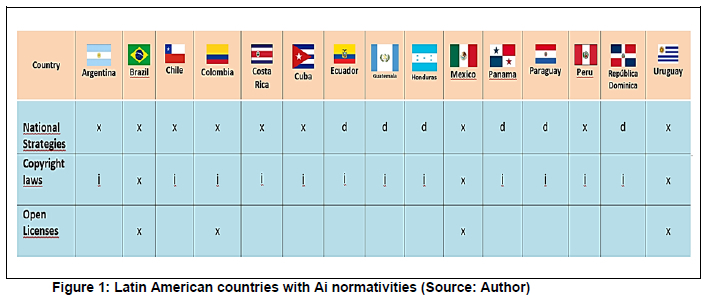
General findings from Latin American countries are shown in figure 1 mainly regarding three defined variables about the study of AI.
Figure 1 presents countries that meet variables, and these are marked with an "x". Countries without an "x" do not present these elements. The letter "d" is used to refer those countries that are developing the study variable. In addition, some findings are marked with an "i" to indicate that the variable is intrinsic in the analysis.
Figure 1 indicates the general findings from countries analysed, with nine countries having a national strategy about AI and six having strategies in development. Likewise, figure 1 shows that three countries analysed included specific factors about AI in copyright laws and 12 countries have factors legislated regarding computer programs and databases, which might be interpreted as legal basis to legislate AI. Also, it is stated that four countries have implemented open licences linked with AI, although findings from Creative Commons chapters by Latin America countries do not indicate actions and/or relationships regarding AI.
In addition, in line with defined variables, specifics of findings obtained are presented below by country in alphabetical order:
Argentina
National strategies. Argentina has a National Plan of AI (Argentina 2021; OECD.AI 2024).
Copyright laws. The "Ley N° 11723 - Régimen legal de la propiedad intelectual" (Argentina 2020; OMPI, WIPO Lex) does not specify factors to legislate AI.
Licences. Argentina's Creative Commons chapter does not refer to a link between open licences and AI.
Brazil
National strategies. Brazil has an AI Strategy (Brazil 2023; OECD.AI 2024)
Copyright laws. The proposal "Ley No, 2338/2023" Section III states 'Measures to promote innovation', and article 42 establishes the elements of copyright related to AI (Brazil 2023).
Licences. The Creative Commons Brazil chapter notes that AI training should be associated with copyright and fair use (Wolfson 2023).
Chile
National strategies. Chile has an AI National Policy (MinCiencia 2020; OECD.AI 2024) and the Santiago Declaration (MinCiencia 2023).
Copyright laws. The "Ley 17336. Propiedad Intelectual" (Chile 2019) does not specify the regulation of AI.
Licences. The national AI policy in its objective 3.4.1 about an updated intellectual property system of the national AI policy contemplates the use of open licences aligned with the country's internal regulations in accordance with the global legal and commercial flow (MinCiencia 2020:60).
Colombia
National strategies. Colombia has an "AI National Strategy" (CONPES 2019; OECD.AI 2024).
Copyright laws. Colombia's national AI strategy will work in coordination with the National Copyright Directorate of the country, with the objective of addressing issues related to the link between copyright and AI (CONPES 2019:45).
Licences. The Creative Commons chapter of Colombia do not refer to information and/or a link between open licences and AI.
Costa Rica
National strategies. Costa Rica has promoted the "creation of a high-level commission for digital government of the bicentennial" 2018. (Baiocchi 2023).
Copyright laws. Costa Rica has the "Ley de Derechos de Autor y Derechos Conexos, No. 6683", which does not specify the regulation of AI (Registro Nacional República de Costa Rica 2013; WIPO Lex 2022).
Cuba
National strategies. The Cuban Ministry of Communications (Mincom) presented the Artificial Intelligence Development Strategy to create a National AI Research Institute. (Venegas 2024; Soler 2023).
Copyright laws. The "Ley 154/2022 de los Derechos del Autor y del Artista Intérprete" (Gaceta Oficial de la República de Cuba 2022), does not specify the regulation of AI.
Licences. Cuba does not have information about the creative commons chapter linked with AI.
Ecuador
National strategies. Ecuador develops an Artificial Intelligence Strategy, aligned with the Digital Agenda (Albornoz 2020).
Copyright laws. The "Código Orgánico de la Economía Social de los Conocimientos, Creatividad e Innovación (Código Ingenios)" (República del Ecuador 2016) does not specify legislating AI issues.
Licenses. Article 4 of "Código Orgánico de la Economía Social de los Conocimientos, Creatividad e Innovación (Código Ingenios)" (República del Ecuador 2016), points out that "Knowledge constitutes a good of public interest". Its access will be free, and it will not have more restrictions than those established in this Code, the Constitution. The Creative Commons chapter of Ecuador does not refer to information about legislating AI licences.
Guatemala
National strategies. Guatemala has a Bill to legislate AI, which is being evaluated by the Senate of this country (Gobierno de la República de Guatemala 2023).
Copyright laws. The "Ley de Derechos de Autor y Derechos Conexos" (Gobierno de la República de Guatemala, 2003) does not specify the regulation of AI.
Licences. The use of licences for open data is indicated in the Public Policy of Guatemala (República de Guatemala 2018: 67-69).
Honduras
National strategies. Honduras does not refer to a strategy on AI.
Copyright laws. The "Ley del Derecho de Autor y de los Derechos Conexos, Decreto 4-99-E" of Honduras (Honduras 2006) does not refer to information to legislate AI.
Licences. the Honduras Creative Commons Chapter does not refer to information or links between licences and AI.
México
National strategies. Mexico is considered to have developed the first initiative in Latin America to legislate AI through "Estrategia lA-MX 2018.1" (México 2018); and at date, the Mexican Senate analysed and debated the regulation of AI in terms of intellectual property and copyright laws (Soto 2023).
The "Ley Federal de Derecho de Autor" of México (2020), in its chapter IV, "Computer programs and databases" articles 101 to 114 defines the protection of such expressions, (México 2020: 18-20) However, factors linked to legislating AI are not specified.
Licences. The Creative Commons Mexico chapter participated in the definition of considerations and seven principles to address copyright to AI (Creative Commons 2023).
Panamá
National strategies. Panama does not have a national strategy for AI (CENIA 2023:227).
Copyright laws. The "Ley N° 64 de 10 de octubre de 2012 sobre el Derecho de Autor y Derechos Conexos" (Panamá 2012) does not specify the regulation of AI.
Licences. Panama's Creative Commons chapter does not refer to information on the link between open licences and AI.
Paraguay
National strategies. Paraguay is developing a proposal for an AI regulation strategy (Venegas 2023)
Copyright laws. La "Ley N° 1328/1998 de Derecho de Autor y Derechos Conexos" of Paraguay (2010) does not specify the regulation of AI.
Licences. Paraguay's Creative Commons chapter does not provide information on the link between open licences and AI.
Peru
National strategies. Peru has a National AI Strategy (República de Peru, 2021) with aim of presenting some key aspects of the development of AI in Peru and seeks external contributions.
Copyright laws. The "Ley sobre el Derecho de Autor (Decreto Legislativo N° 822, modificado por el Decreto Legislativo N° 1391)" (República de Peru 2018) does not specify the regulation of AI.
Licences. The Creative Commons chapter of Peru does not refer to information on the link between open licences and AI.
República Dominicana
National strategies. The Dominican Republic has a National Artificial Intelligence Strategy (República Dominicana 2023).
Copyright laws. The "Ley No. 65-00 sobre Derecho de autor" (República Dominicana 2000) does not specify the regulation of AI.
The Creative Commons chapter of the Dominican Republic does not refer to information on the link between open licences and AI.
Uruguay
National strategies. Uruguay has an "AI Strategy for The Digital Government" (República Oriental del Uruguay 2019).
Copyright laws. The "Ley N° 9739 de Derechos de Autor (promulgada el 17 de diciembre de 1937)" (República Oriental del Uruguay 2020) does not specify the regulation of AI.
The Creative Commons Uruguay chapter does not refer to information on the implementation of open licences and AI; however, it participated in the definition of considerations and seven principles to address copyright to AI (Creative Commons 2023).
The findings obtained from the review literature and the sources for data recovery allow us to identify a vast diversity of elements around the situation of normativities, copyright legislation and licences from the Latin American region to legislate AI; therefore, the following section discusses the findings obtained according to the study variables and proposes a series of recommendations to be addressed.
5 Discussion and recommendations
The findings obtained indicate that there is a collective consensus that AI holds favourable and unfavourable elements for society. Therefore, the concern about the legislation of information used and produced by AI brings about diverse approaches that contribute to the objectives, particularities, legal foundations, schools of thought, among other factors, of each region.
AI proposes the use of informative expressions for the training of technology and that computer programming and algorithm definition are responsible for compiling and organising data and information to provide answers to different questions. In parallel to the discussion of the findings of the literature review, it is relevant to discuss the findings obtained from the defined consultation sources, which are addressed in accordance with the variables defined for the study.
National Strategies. From 2018 to date, the Latin American countries have developed instruments to outline lines of action for the challenges posed by AI in accordance with the objectives, nature and trends of their legal frameworks, regulations, educational systems, and sustainable development. The findings obtained indicate that the Latin American region is focused on addressing the ethical, moral, educational, and administrative use of AI by countries, since it emphasises addressing data privacy, respect for human rights and mitigating its unfavourable effects.
Likewise, the findings obtained from national strategies by country do not refer to factors for the regulation of the use and/or production of expressions by AI and leaves in the background the recognition of the authorship of the expressions the AI uses to produce outputs. This situation might lead to cases of plagiarism (Chomsky, Roberts & Watumull 2023). According to the results obtained and discussion about this variable, there are elements to define four recommendations to direct national AI strategies. These recommendations are as follows:
• The legislation of the expressions that AI uses and produces must be tightened and must be part of the national plans of action on this technology.
• Given the emerging dynamism of AI, it is necessary that national strategies should promote the implementation of reviews and updates to the regulatory frameworks to legislate the expressions used and produced by AI.
• Harmony with the regulations, social and cultural values of Latin America should be fostered to delimit contributing factors between the expressions used and produced by AI.
• A Latin American regional body should be created that coordinates strategies, commitments, agreements and outputs with a collective and common vision on AI.
Copyright Laws. The discussion of the third variable on copyright laws and AI of Latin American countries is focused on studying three main concepts, which are authority and ownership, the computer expressions that are protected and the exceptions that such regulations protect.
The findings indicate that three Latin American countries have proposed including the regulation of expressions used and produced by AI in their corresponding copyright laws. Such initiatives are associated with the national strategies of the countries analysed, since a fundamental part of the advancement and innovation of said emerging technology could have rights and obligations. In the case of the 12 countries that do not refer to factors for legislating AI copyright, the findings emphasise that the authors and/or owners of expressions are attributed to human persons and institutions with legal personality.
Therefore, it can be argued that findings are associated with the labour systems of the countries, through which it is indicated that the goods and services created and/or developed with inputs, facilities and/or infrastructure of some entity (mainly public institutions), by moral right, corresponds with the entity that created it. In addition, by heritage right, the entity, mostly partly, will own the reproduction, distribution, communication, and transformation of the goods and/or service produced with public funds. (México 2020b:51-52; OMPI 2016:20) Likewise, this position is linked to the trends in which the legal personality of an entity is proposed to be the representative of the moral and patrimonial rights of the AI (Aziz 2023:14) Therefore, these proposals are subject to study and harmonisation with regulations, objectives, legal frameworks, and trends posed by the challenge of legislating AI.
Also, the finding about the copyright laws of the 15 Latin American countries on the protection of computer programs, computing and databases is significant, since these findings allow them to be interpreted as basis for legislating the AI, since technology is an informative expression developed with computer and algorithmic factors, and is necessary ensure that AI is an instrument that supports the development of societies and does not violate their civil and human rights.
The findings obtained from this study variable allow us to define that copyright laws must be outlined as norms to protect, regulate, and guarantee that the authors, owners and/or creators of expressions used and/or created by AI are guaranteed the recognition of their ownership. That is, being recognised and cited, this may be one of the main strategies to avoid the assumption that AI engages in plagiarism by using and not citing data and research results available in open access. The findings showed that AI copyright legislation requires a strong commitment and link with the copyright laws of each Latin American country, since they are regulations that contribute to the dynamism with which AI is developed, due to favourable or unfavourable aspects. Hence the call to the Latin American region to undertake and/or adapt in working groups for the analysis and debate of said trend.
Based on the discussion of the findings obtained, four recommendations are proposed, and they are the following:
• It is essential to promote the updating of the concepts of authorship and/or ownership of the expressions that produce AI; that is, recognise that programmers and computer scientists are subject to the ownership of such products with the objective of enjoying the rights created with such technology.
• Copyright laws should be subject to updates and include AI as a type of expression that protects, since it might be interpreted. It is intrinsically included in the regulations as it is associated as a product derived from computer and information technology programs.
• Promote regulations by including expressions used and/or produced by AI contribute to the universal human right that societies benefit from products derived from science and culture, such as AI.
Open licences. The findings indicate that four Latin American countries associate open licences with the expressions used and produced by AI in line with the Creative Commons and AI licensing principles of 2023. The findings of those Latin American countries that do not directly link open licensing with AI might be interpreted as being derived from being known guarantees, but little used to justify the actions of opening up science in their contexts. The licensing of expressions used and produced by AI is an emerging issue that requires investigation, since such guarantees justify the legality of the use of informative expressions available on multiple platforms. Likewise, licensing is an activity that is considered de facto when making copyrighted expressions available in open access.
The discussion about this study variable focuses on the fact that the open licensing of informative expressions is not associated, regulated and/or registered in copyright laws, given that they are guarantees of 'good intention' that encourage actions of free access to information goods produced with public funds. However, open licensing is not totally alien to the copyright laws of Latin America, since in the analysis of such regulation elements are identified that encourage designating to the public domain those expressions that comply with the periods and requirements to determine them in such modality, which includes computer programs, computers, and databases. Hence, in accordance with the findings of the literature review, there are elements to propose that one of the alternatives for AI to be subject to this type of guarantee is that the expressions produced by AI are subject to the public domain.
In parallel, a sub-variable of study about whether the Creative Commons chapters from Latin American countries propose initiatives and/or elements of relationship between licensing and AI, the findings obtained did not refer to proposals about the subject; and instead, the principles established in the 2023 CC Summit (Creative Communities, 2023) are interpreted to favour the always use of informative by AI with the recognition of the author, owner and/or creator.
Based on the findings, two proposals might be raised to justify the relationship between open licences and AI. First, there is UNESCO's set of four open licences for AI, such as: Attribution (By); Non-Commercial (NC); No-Derivatives (ND) and Share-Alike (SA) (UNESCO 2023:51). The second recommendation is from the Open Data Commons program of Creative Commons and Open Data Creative Commons of the Open Knowledge Foundation, who delimit a set of open licences to assign to the data to justify its opening, such as following: Creative Commons Zero (CC0-1.0), Open Data Commons Public Domain Dedication and License (PDDL-1.0), Open Data Commons Attribution License (ODC-By-1.0) and Open Data Commons Open Database License (ODbL-1.0) (OKF n.d.).
Based on the discussion of the findings obtained, there are elements to raise the relevance of undertaking significant collective actions in Latin America, mainly focused on strengthening the use of third-party information by IA within the framework of author normativities, which is essential for governments, HEIs, RCs and society in general to have a guarantee that the information used and generated by AI does not cause vulnerable actions and/or incur unfavourable consequences for the usefulness of the information; and likewise, since AI is an emerging topic, it is essential to continue studying and researching the topic in its different factors.
6 Conclusions
AI is an information action parallel to library actions, in which it is proven that information is an essential good for the development of innovative actions useful to society. The link between copyright and AI is an issue that must be addressed in accordance with the dynamics in which the development of AI moves, to avoid delays and improve the ways in which the recovered information is used. Fostering legislation on AI copyright at global and regional level is meaningful for the information recovered so that AI does not infringe on rights, and/or incur plagiarism actions.
AI regulation will solidify the universal human right to benefit societies with the products derived from science and culture, within the framework of laws, rights, and ethics. The global debates and discussions about legislating the expressions of AI require it to be linked to the set of norms and standards with which the open access and open science movements have been treated to date. In the Latin America region, the legal action regarding AI is being developed, and part of this progress is the implementation of legal frameworks that regulate the actions of the use of AI, with the objective that the benefits obtained from AI will not lead to engaging in harmful actions of plagiarism.
There is consensus among academic literature, legal regulations, and bibliographic styles so that the corporate entity or organisation will be recorded as the author, owner and/or responsible creator of AI.
References
2 Literature review
- Afshar, M.S. 2022. Artificial intelligence and inventorship: does the patent inventor have to be human? Hastings Science and Technology Law Journal, 13(1): 55-72 [Online]. https://repository.uchastings.edu/hastings_science_technology_law_journal/vol13/iss1/5
- Albornoz, M. 2020. Ecuador: inteligencia artificial sin rumbo fijo. https://www.empatia.la/blogpost-ecuador-ia/
- Argentina. 2020. Ley N° 11723 - Régimen legal de la propiedad intelectual. https://servicios.infoleg.gob.ar/infolegInternet/anexos/40000-44999/42755/texact.htm
- Argentina. 2021. Plan Nacional de Inteligencia Artificial. https://oecd-opsi.org/wp-content/uploads/2021/02/Argentina-National-AI-Strategy.pdf
- Aziz, A. 2023. Artificial intelligence produced original work: a new approach to copyright protection and ownership. https://www.ei-ai.org/index.php/eiai/article/view/15
- Baiocchi, A. 2023. Inteligencia artificial en Costa Rica: justicia, ética e inclusión para no dejar a nadie atrás. https://www.unesco.org/es/articles/inteligencia-artificial-en-costa-rica-iusticia-etica-e-inclusion-para-no-deiar-nadie-atras
- Ballardini, R., He, K. & Ross, T. 2019. AI-generated content: authorship and inventorship in the age of artificial intelligence. In Pihlaiarine, T., Vesala, J &Honkkila, O. (Eds.), Online distribution of content in the EU. Elgar Online. https://www.semanticscholar.org/paper/AI-generated-content%3A-authorship-and-inventorship-Ballardini-Kan/4713a0628267550abf7db5d61fbedc562bf290f5
- Brazil. 2023. Projeto de Lei n° 2338. https://www25.senado.leg.br/web/atividade/materias/-/materia/157233
- CENIA, 2023. Índice Latinoamericano de Inteligencia Artificial. https://indicelatam.cl/wp-content/uploads/2023/09/ILIA-ESP_compressed.pdf
- Chile. 2019. Ley 17336. https://www.bcn.cl/leychile/navegar?idNorma=28933
- Chomsky, N., Roberts, I. and Watumull, J. 2023. The false promise of ChatGPT. The New York Times. https://www.nytimes.com/2023/03/08/opinion/noam-chomsky-chatgpt-ai.html
- CONPES. 2019. Política Nacional para la Transformación Digital e Inteligencia Artificial. https://siteal.iiep.unesco.org/sites/default/files/sit_accion_files/11134.pdf
- Creative Commons. 2023. Making AI work for creators and the commons. https://creativecommons.org/2023/10/07/making-ai-work-for-creators-and-the-commons/
- EU. 2024. The AI office: what is it, and how does it work?. https://artificialintelligenceact.eu/the-ai-office-summary/
- Gaceta Oficial de la República de Cuba. 2022. Ley 154/2022 de los Derechos del Autor y del Artista Intérprete. https://3ce.cu/sites/default/files/2023-01/ley-154-2022-de-los-derechos-del-autor-y-del-artista-interprete.pdf
- Gobierno de la República de Guatemala. 2003. Ley de Derechos de Autor y Derechos Conexos. https://wipolex-res.wipo.int/edocs/lexdocs/laws/es/gt/gt040es_1.pdf
- Gobierno de la República de Guatemala. 2023.Guatemala presente en el 1er foro sobre la ética de la Inteligencia Artificial en América Latina y el Caribe. https://agn.gt/guatemala-en-el-primer-foro-de-etica-de-la-inteligencia-artificial/
- Honduras. 2006. Ley del Derecho de Autor y de los Derechos Conexos, Decreto 4-99-E. https://www.wipo.int/wipolex/es/text/234858
- México. 2018. Estrategia de Inteligencia Artificial MX. https://www.gob.mx/epn/articulos/estrategia-de-inteligencia-artificial-mx-2018
- México. 2020. Ley Federal del Derecho de Autor. https://www.diputados.gob.mx/LeyesBiblio/pdf/LFDA.pdf
- México. 2020b. Ley Federal del Trabajo. Artículo 163, capítulo V. Disponible en. https://docs.mexico.iustia.com/federales/ley-federal-del-trabaio.pdf
- MinCiencia. 2020. Política Nacional de Inteligencia Artificial. https://www.minciencia.gob.cl/areas/inteligencia-artificial/politica-nacional-de-inteligencia-artificial/
- MinCiencia. 2023. Declaración de Santiago. https://minciencia.gob.cl/uploads/filer_public/40/2a/402a35a0-1222-4dab-b090-5c81bbf34237/declaracion_de_santiago.pdf
- OECD. 2023. Recommendation of the Council on Artificial Intelligence. https://legalinstruments.oecd.Org/en/instruments/oecd-legal-0449#:~:text=a)AI%20actors%20should%20respect,and%20internationallv%20recognised%20labour%20rights
- OECD.AI. 2024. Artificial intelligence policy observatory. https://oecd.ai/en/
- OMPI. 2016. Principios básicos del derecho de autor y los derechos conexos. OMPI. http://www.wipo.int/edocs/pubdocs/es/wipo_pub_909_2016.pdf
- OKF. n.d. Open data handbook. https://opendatahandbook.org/guide/en/how-to-open-up-data/
- Panamá. 2012. Ley N° 64 de 10 de octubre de 2012 sobre el Derecho de Autor y Derechos Conexos. https://wipolex-res.wipo.int/edocs/lexdocs/laws/es/pa/pa043es.pdf
- Paraguay. 2010. Ley N° 1328/1998 de Derecho de Autor y Derechos Conexos. https://www.wipo.int/wipolex/es/text/129429
- Registro Nacional República de Costa Rica. 2013. Ley de Derechos de Autor y Derechos Conexos, No. 6683. http://www.pgrweb.go.cr/scii/Busgueda/Normativa/Normas/nrm_texto_completo.aspx?param1=NRTC&nValor1=1&nValor2=21098&nValor3=22417&strTipM=TC#:~:text=Derechos%20Conexos%20No.-,6683%20del%2014%20de%20octubre%20de%201982%20v%20sus%20reformas,sus%20obras%20literarias%20v%20art%C3%ADsticas.
- República Dominicana. 2000. Ley No. 65-00 sobre Derecho de autor. https://www.egeda.do/documentos/Lev%20No.65-00%20sobre%20Derecho%20de%20Autor.pdf
- República Dominicana. 2023. Estrategia Nacional de Inteligencia Artificial. https://agendadigital.gob.do/wp-content/uploads/2023/10/Final_ENIA-Estrategia-Nacional-de-Inteligencia-Artificial-de-la-Republica-Dominicana-.pdf
- República del Ecuador. 2016. Código Orgánico de la Economía Social de los Conocimientos, Creatividad e Innovación (Código Ingenios). https://www.ambiente.gob.ec/wp-content/uploads/downloads/2018/05/Codigo-Organico-Economia-Social-de-los-Conosimientos.pdf
- República de Peru. 2018. Ley sobre el Derecho de Autor (Decreto Legislativo N° 822, modificado por el Decreto Legislativo N° 1391) https://cdn.www.gob.pe/uploads/document/file/1669698/DL%20822.pdf.pdf
- República de Peru, 2021. Estrategia Nacional de Inteligencia Artificial. https://cdn.www.gob.pe/uploads/document/file/1909267/National%20Artificial%20Intelligence%20Strategv%20-%20Peru.pdf
- República Oriental del Uruguav. 2019. IA strategy. https://www.gub.uv/agencia-gobierno-electronico-sociedad-informacion-conocimiento/comunicacion/publicaciones/ia-strategv-english-version/ia-strategv-english-version
- República Oriental del Uruguav. 2020. Ley N° 9739 de Derechos de Autor (promulgada el 17 de diciembre de 1937). https://www.impo.com.uv/bases/leves/9739-1937
- Soler, L. 2023. Estrategia de desarrollo de la AI en Cuba, un proyecto para la transformación digital. https://www.cubahora.cu/ciencia-v-tecnologia/estrategia-de-desarrollo-de-la-ia-en-cuba-un-provecto-para-la-transformacion-digital
- Soto, A. 2023. Plantean en el Senado garantizar derechos de autor v propiedad intelectual en regulación de IA. https://comunicacionsocial.senado.gob.mx/informacion/comunicados/7250-plantean-en-el-senado-garantizar-derechos-de-autor-v-propiedad-intelectual-en-regulacion-de-ia
- US Copvright Office. 2023. Artificial intelligence and copyright. https://www.federalregister.gov/documents/2023/08/30/2023-18624/artificial-intelligence-and-copvright
- UNESCO. 2021. Recommendation on the Ethics of Artificial Intelligence. https://unesdoc.unesco.org/ark:/48223/pf0000381133/PDF/381133eng.pdf.multi.page=3
Accepted: 31 August 2024