Preservation management framework in library and archival institutions: a conceptual research
Abstract
On a daily basis, organisations, both government and non-government, produce a lot of goods, provide services and create records as evidence of their business transactions. It is therefore critical to acquire, preserve, and disseminate the various artefacts, goods, and information resources as evidence of the world's social, intellectual, artistic, and spiritual achievements. Failure to protect these resources could lead to the world's loss of assets, history, legacy, education, and misinformed planning. Preservation, therefore, ensures that there is continued access to goods, services, and information resources for the long term. However, the preservation management process is still new in most developing libraries and archival institutions and is challenged by various predicaments with various flavours from one continent to the other. The key challenge is the lack of conceptual management frameworks that can be used for preservation in small developing libraries and archival institutions. The purpose of this study was to develop a management framework that can be used for sustainable preservation management, especially in less-resourced library and archival institutions. The paper presents a literature review, professional hands-on experience, and evaluation of views and opinions on management, frameworks, and sustainable preservation.
Preservation framework; heritage protection; management; preservation sustainability
1 Introduction
Libraries and archives are entrusted with ensuring that the information, knowledge and records produced are continuously created or received, maintained, protected and made accessible on a daily basis and in the future. To achieve their mandates, libraries and archives have adopted preservation as the means to ensure continued access to the information, knowledge and records for the short and long term. This is critical for libraries and archives to ensure that there is evidence of the world's social, intellectual, artistic, and spiritual achievements and a focus for affective investment, hence a repository of shareable feelings and emotions (Salerno & Rigney, 2024). Preservation of information, knowledge, and records is an important aspect of public interest so that the vital legacy of cultural, educational, aesthetic, inspirational, economic, and energy benefits is maintained and enriched for future generations (Avrami, 2016:104).
Libraries and archives have therefore developed and adopted various preservation measures throughout the world. Preservation activities include the development of a teaching curriculum, the adoption of ICTs for managing collections, the development of environmental conditions management frameworks, and the creation of entrepreneurs, opportunities, and measurable results in sustainable preservation (Orr Scott, Richards, & Fatoric, 2021; Coben, 2014). However, a significant number of libraries and archives are non-profit oriented organisations. Therefore, they suffer the challenges of weaknesses in providing services that are intangible, weak customer influences, and it is hard for them to measure their economic outputs. Libraries and archives significantly depend on government funding, donations, and, where possible, private and community funding. Often, these resources contributed to libraries and archives intruding on the internal management processes. Literature has evidently shown that preservation of library and archival resources ends up being challenged by low government prioritisation, leading to the undermining of strong employee commitment to preservation and conservation services (Verticchio et al., 2021). Sesana, Gagnon, Bertolin, and Hughes (2018) are of the view that the challenges in preservation and sustainability are also exacerbated by the lack of training and research in preservation management. One of the critical concerns in preservation is the poor management functions such as strategic leadership, poor planning and directing, a lack of skills and expertise, a lack of prioritisation and resource allocation, unsustainability issues, weak management frameworks and poor everyday work habits, costs, and lack of time and information (Rachman & Ratnasari, 2022; Avrami, 2016; Eboreime, 2009). Studies conducted by Segaetsho (2018; 2020; 2024) continuously observed the key research gap, among others, as the lack of frameworks in preservation management. These ultimately result in poor or weak contextualisation of management functions in preservation, especially in institutions with less-resourced environments. The challenges that remain unsolved are thus related to the principles of preservation management, frameworks, and sustainability of preservation in library and archival institutions. There is a need for a precise model of preservation management. This study, therefore, proposes a preservation management framework that can be adopted by library and archival institutions in a less-resourced environment. The presented paper is conceptual research organised in ideas that explain graphically and in a narrative form, the key factors, variables, components, and concepts that identify the interrelationships in preservation management. The development of this conceptual research required the researcher to consider the following issues: What are the relevant principles or ideas aligned with preservation management in libraries and archives? What are the management theoretical frameworks or models available in relation to preservation? How can the preservation management process be sustainably achieved, given the limited resources in developing countries?
The rationale and significance of this study are four-fold. Firstly, the researcher conducted a review of the literature on preservation principles and the common definitions of preservation in libraries and archives. From the literature review and personal experiences over 16 years, the study was able to obtain insights into preservation principles and develop a proposition on the general definition of preservation and the activities thereof, associated with preservation. The findings will help researchers and professionals find a common ground on what encompasses preservation activities and their general definition. As argued by MacInnis (2011), conceptual research has the benefit of contributions that envision new, relating, explicating, or debating. The study, therefore, aims to reveal what is unseen and make known what is unknown in the preservation of library and archival collections. Secondly, the study evaluated literature on management and, therefore, provides a common understanding of how the world generally perceives management and what the basic activities of management are. The findings of this aspect will help library and archival professionals and scholars to have basic knowledge of what management is and how its activities can be contextualised for preservation. This is further clarified by the development of a preservation management framework. Thirdly, the paper reviewed theoretical frameworks and literature on sustainability, especially considering small developing libraries and archival institutions.
This was important because preservation in libraries and archives seems to lack its own professional theoretical frameworks. As opined by Segaetsho (2020), preservation functions in libraries and archives mainly depend on libraries and records management theories and other theories from various fields. This has resulted in a lack of common understanding and professional stance on preservation. To address this challenge, the study reviewed theories on management and preservation sustainability and attempted to align preservation with some of the theories that relate to management in libraries and archives. Lastly, the study adds value to the literature and organisational practicality in libraries and archives through the development of a preservation management framework that brings in the ideas that explain graphically and in a narrative form, the key factors, variables, and concepts that identify the interrelationships of activities of preservation, management, and sustainability.
2 Related literature review
The following sections provide a literature review on principles of preservation, management, and preservation sustainability.
2.1 Principles of preservation
The history of preservation is presented in different contexts from one continent to another. Preservation is interpreted differently, often depending on the form or category of materials to be preserved. The word preservation in general context as illustrated in dictionaries is "the activity or process of keeping something valued alive, intact, or free from damage or decay" (Merriam-Webster, 2024:01), or "the act of keeping something the same or of preventing it from being damaged" (Cambridge Dictionary, 2024:01). Contextualising this into cultural heritage perspective, especially the libraries and archives, preservation "includes all the managerial and financial considerations, including storage and accommodation provisions, staffing levels, policies, techniques and methods involved in preserving library and archive materials and information contained in them" (Harvey & Mahard, 2014:08; International Federation of Library Association (IFLA), 1998:05). In simple contexts, the International Council of Museums (ICOM) (2008:01) defines preservation as "all measures and actions aimed at avoiding and minimizing future deterioration or loss".
From the definitions given, one can say preservation is all about protecting, safeguarding, and minimising damage to whatever humanity wants to use today, tomorrow or in the future. The principles for preservation should thus aim at keeping collections, regardless of form, safe for use currently and in the long term. Literature presents many principles to keep in mind. Harvey and Mahard (2014) categorised the principles into three forms of 'context and aims of preservation', 'general principles', and 'specific principles'. The 'context and aim' principles are geared towards preservation as a key component in the sustainability of cultural property, taking into account the need for users, retaining authenticity, and that preservation is the responsibility of all. The general principles provide that efforts for preservation to create long-lived objects and materials, advocacy and collaboration are important, and taking preservation measures now is better than doing nothing (Caple, 2000:2011). In addition, active management and care, understanding the structure and information in the materials, and preference for addressing large quantities over individual collections are important principles in preservation (IFLA, 2018; Caple, 2011; Getty Conservation Institute, 1992). Lastly, the specific principles address both analogue and digital collections. These include, appraisal, keeping original multiple copies, doing less harmful interventive measures at high quality and ethics, and ensuring that preservation actions do not exceed personal expertise (Harvey & Mahard, 2014). Segaetsho (2024) emphasises that the preservation principles are rather a complex multidisciplinary element that contains relationships and various disciplines, such as social sciences, applied sciences, arts and humanities, education, engineering and many others. Preservation principles are affected by increasing interconnectivity, societal points of view and needs, blurring boundaries of organisations, modernisation of things due to changing technology, changing economic and political landscape, and new innovations. As observed by scholars, professionals, and society at large, preservation is affected by the convergence of practice across libraries, archives, and museums, stimulated and enabled by information and communication technology (ICTs) (Harvey & Mahard, 2014). Consequently, preservation functions and dreams must change with the times and align with current trends of management. However, one such important aspect is the application of theories to guide the principles in preservation management.
The application of theories in preservation is mainly guided by the overarching line of discipline. A review of literature observed that application of theories depends on the focus of the study, as discussed and adopted by various authors on various topics of interest (Gerster, Boret, Morimoto, Gordon & Shibayama, 2023; Ngulube, 2020; Upward, 2000; Digital Curation Centre, 2024; Dube, 2015). For instance, research specific to disaster management as part of preservation relies significantly on disaster management theories and National Disaster Plans, such as community-based disaster risk reduction as applied by Jagirdhar and Sastry (2014), while digital preservation issues would depend on digital information management theories, such as open archives information system (OAIS), and digital curation life cycle models, as applied by Shivarama et al. (2016) and Hopfgartner and Davidson (2018). However, common theories applied specifically to preservation topics include the Record Lifecycle Theory, the Records Entity Life History, the Records Continuum Model, the Krtalic and Hasenay Preservation Model, the Preservation Policy Maturity Model, and many others (Ngulube, 2020; Msibi, 2015; Gkinni, 2014; Krtalic & Hasenay, 2011). Despite all the theories and principles, one important aspect is the ability to manage preservation activities. The next literature review provides a contextualisation of preservation to management.
2.2 Preservation and management
The definition of management revolves around the process of organising, decision-making, coordination or supervision, and planning. Over 17 years ago, Boddy (2008:10) perceived management as "the activity of getting things done with the aid of people and other resources". To date, researchers still perceive management as the forecasting, planning, organising, coordinating, leading, and controlling of processes in an organisation, individual, or community (Griffin, 2022; Jowah, 2015; Deslandes, 2014). Researchers and practitioners concur that management is all about creating an environment that allows effective use of resources and people, focusing on human capital, considering their employees as the most important asset of the organisation (Pagan-Castaño, Ballester-Miquel, Sánchez-García, & Guijarro-García, 2022)
However, without value in the whole process, managing becomes useless. Researchers posit that value is critical in achieving social value and business value, and creating shared value serves as an opportunity for sustainable growth for small and medium-sized enterprises (Rubio-Andrés, Del Mar Ramos-González, & Sastre-Castillo, 2022). Values are critical in ensuring that resources (inputs) are transformed into goods or services that are more beneficial than the original costs of resources (Daly & Walsh, 2010). Effective and efficient management requires the responsibility of achieving purpose, processes, and outcomes with value. The questions that need to be addressed are: "How do we manage the preservation programme?", "In what context do we mean by 'preservation management'?" From the definitions of management, management plays many roles. These include monitoring, disseminations, controlling, advocacy, mentoring, leadership, liaison, entrepreneurship, innovations, creativity, resource allocation and budgeting, and negotiation to achieve organisational goals (Mahmood, Basharat, & Bashir, 2012). The process of getting things done using people and resources requires performing certain management tasks, such as planning, organising, leading, and controlling, as illustrated in Figure 1 (Boddy, 2010). The following discussions contextualise these management tasks into preservation processes and principles.
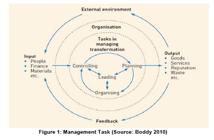
Planning task: This is a "decision activity requiring the process of ascertaining objectives and deciding on activities to attain the objectives" (Chandan, 2013:57). It is all about directing the work to be done through forecasting the future, assessing resources, evaluating both the internal and external environment, and developing objectives to be achieved for value. One of the key preservation principles is to ensure that the holdings in heritage institutions are maintained for present and future generations. This tallies with the foundation of planning. Planning as a management function is about bridging between the present and the future. It is setting out the overall direction of the work (Griffin, 2022). The preservation planning process requires preparing for change and coping with new environmental uncertainties, hence reducing the risks of damage to heritage properties. Planning in preservation is anticipatory in nature, a system of decisions, and is focused on the desire for the future. The preservation planning process is critical in ensuring that there are exploitations, control, direction, speed, and efficiency. As observed by Peter Drucker (2010) and Swaim (2011), the planning process, among others, consists of six Ps: purpose, philosophy, premise, policies, plans, and priorities.
Organising task: This is the process of systematically collecting and assembling inputs (people and resources) to carry out intentions or decisions about what the organisation wants to accomplish (Beauchamp, Hulme, Clarke, Hamilton, & Harvey, 2021). It is the activity of bringing together ideas from the planning process into comprehensive and cohesive products by allocating time and effort, developing policies/strategies, human resource management, and developing organisational structures. Preservation management must consider organising its functions or activities into comprehensive products and services that will lead to the protection of collections from deterioration. The organised functions must be transformed into the required goods and services that will allow sustainable long-term access to collections.
Leading task: To achieve the required outputs, there is a need for the process to be led through activities such as effort, commitment, motivation, guidance, leadership, mentoring, teamwork, and many other skills. The leading task is the art of making things happen through the act of motivating or pursuing people to perform tasks that are intended to achieve specific objectives or goods and services (Griffin, 2022). Leading is thus premised on various traits of leadership and inspirations. As illustrated in literature (Adair, 2007; Mumford, Campion, & Morgeson, 2007; Al Ajmi, 2024), leading involves the art of negotiation, conflict resolution, adaptability, conceptual skills, cognitive skills, interpersonal skills, critical thinking, decision-making, problem-solving, strategising, and relationship building. Preservation management must be perceived as a function that requires a strataplex of skills to direct the protection of collections from deterioration.
Controlling task: The management tasks of planning, organising, and leading must be controlled to attain value. As emphasised by Kwok (2014), the controlling task involves monitoring the progress, comparing it with plans, and taking corrective actions to gain value. It is making sure that things go as planned (directing) using variables such as physical, financial, inventories, and building (Namazi & Rezaei, 2024; Osedo, 2012). It is about ascertaining that the budget used for inputs for product development and the transformation process is such that the output goods and services are worth a value greater than the budget for inputs and the transformation process. Controlling in preservation is thus a continuous analysis and measuring of actual operational preservation functions and costs against the established standards developed during the planning process.
2.3 Preservation and sustainability
The term sustainability has a variety of definitions in alignment with the various specialisation areas. However, a significant literature contextualises sustainability to meet the economic, social, and environmental needs of the present and future generations (United Nations, 2016; Porter & Córdoba, 2009). The United Nations (UN) World Commission on Environment and Development defines sustainable development as "development that meets the needs of the present without compromising the ability of future generations to meet their own needs" (UN, 1987:01). Suitability therefore demands the ability to identify problems, coming up with possible costs-effective solutions, and choosing the most appropriate alternative without depleting available resources.
To achieve sustainability in cultural heritage institutions, over the past decades, researchers and practitioners have proposed various solutions. For instance, analysing and measuring energy input towards conservation heating systems, evaluating and critically analysing cleaning, consolidation, and protection operations, developing disaster plans/strategies, improved the teaching and learning curriculum, developing greenhouse preservation strategies, preserving awareness, developing sustainable lighting designs, collaborating, and many others, are examples of sustainable preservation initiatives (Balliana et al., 2016; Blades, Poupard, & Barber, 2011). Lowe (2020) proposes that preservation sustainability could be achieved through differing degrees of effort, disruption of the existing building, learning from cultural preservation traditions, rethinking the role of archivists, and reconsidering environmental impact, for instance reconsidering acquisitions policies. In addition, preservation should keep adopting products and ideas from the world of modern industry and commerce and apply them to achieve long-term protection and sustainability of collections (Caple, 2011). Rachman and Ratnasari (2022) concur with Shirvani Dastgerdi, Sargolini, and Pierantoni (2019) that it is important to reconsider framework concepts on sustainable cultural heritage preservation.
Literature discusses a vast number of compounding challenges of preservation and sustainability, including financial crises, economic crises, educational challenges, inadequate expertise, infrastructure and instrumentation, political instability, and social legitimacy (Bang, M0lgaard Cleemann, & Bramming, 2010). Moreover, the preservation challenges include social ignorance and a lack of appreciation from the society, a lack of support from private sectors and local communities, unavailability of appropriate framework structures, climate change, documentation issues, negative environmental ICT impacts, and many others (Pendergrass, Sampson, Walsh, & Alagna, 2019; Zaid, Abioye, & Olatise 2012; Eboreime, 2009).
3 Insights and proposition derived from literature on preservation, management and sustainability
The presentation of sections 2 to 4 has revealed a significant number of insights and prospects in relation to preservation. The following is a summary of the insights and propositions derived from the presented literature on preservation principles, management and sustainability.
• Preservation principles: Preservation in libraries and archives is premised on the ability to provide managerial and financial considerations, including storage and accommodation provisions, staffing levels, policies, techniques and methods involved in preserving library and archival materials and information contained in them (Harvey & Mahard, 2014; IFLA, 1998; ICOM, 2008). The process is or should be guided by the key deterioration agents and effects observed in the library and archival institutions, depending on the form or type of the collections themselves. Preservation is thus defined in libraries and archives as the process of organising, decision-making, coordination or leading, controlling, and planning the protection of collections from deterioration or damage, both for short- or long-term access. The activities in the process, include staffing, budgeting, and monitoring and controlling various risks such as pests, theft and vandalism, natural decay, mishandling, acidity, environmental issues, disasters, and many others.
• Preservation management: Management (planning, organisation, value, cheapness, effectiveness, controllability, staffing, equipment, education curriculum, services, economically, environmentally friendly, socially tolerable, etc.) is a dependent variable that is important for the topic of sustainable preservation management in less-resourced cultural heritage institutions (Rachman & Ratnasari, 2022; Shirvani Dastgerdi, Sargolini, & Pierantoni, 2019). The process is concerned with the ability to effectively use resources and human labour to achieve value-added outputs. Effective and valuable processes/outputs are those that are important, worthy, or useful both financially and intangibly/non-financial. Such processes should allow the budget used for inputs of product development and transformation processes to be such that the output goods and/or services are worth a value greater than the budget for input and the transformation process (Namazi & Rezaei, 2024; Kwok, 2014; Osedo, 2012).
• Preservation and sustainability: Sustainability is understood in different contexts depending on the field of interest. However, literature concurs that sustainability should be contextualised towards achieving economic, social, and environmental use of resources, both internal and external to an individual, organisation, or system, without depletion to allow usage in future generations.
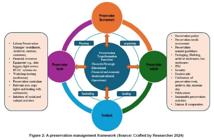
Through triangulation of the insights derived from literature and professional experiences on preservation principles, management, and sustainability, the next section presents a proposed preservation management framework that can be used in less-resourced cultural heritage institutions, especially libraries and archives. The proposed framework offers a pictorial (Figure 2) and narrative integration of variables and concepts that identify the interrelationships of preservation principles, management and sustainability.
4 Proposed preservation management framework
The theories are a representation of a complex phenomenon by identifying major elements, perspectives, and relationships (Ngulube, Mathipa, & Gumbo, 2015). Management is a broad, universal human activity that cannot be controlled by one phenomenon. Therefore, there are various theories applicable to the management of some specific management tasks, some are holistic, while others are tactical to achieve certain objectives. The various management theories available in literature include the Structural Functionalist Systems Theory, Scientific Management, Hard Systems Theory, General Systems Theory of Management, Record Lifecycle Model, Continuum Model, and many more (Bertalanffy, 1950; Krtalic & Hasenay, 2011; An, 2003). However, the conceptualisation of a preservation management strategy in this article was guided by the General Systems Theory of Management (GSTM) developed in the early 1950s by Bertalanffy (1950) and the preservation framework developed by Krtalic and Hasenay (2011). The GSTM is a famous multidisciplinary approach with applications in engineering, physical and biological systems, and social context and interaction of systems (Norcross, VandenBos, Freedheim, & Olatunji, 2016). The GSTM advocates for management as a synergetic series of cohesive collections of resources, activities, information, and subsystems that interact with one another to create the overall organisational system or output. Therefore, the management process can be an open system (the one that interacts with its environment; interdependently) or a closed system (the one that has almost no interactions with its external environment) (Skyttner, 2005; Bertalanffy, 1968; Johnson, Kast, & Rosenzweig, 1964).
This study sees preservation management as an open system that is interdependent on other functions of heritage institutions and should have a macrostructure of systems that are hierarchical and decomposable. From its definition, preservation refers to the protection of cultural heritage from damage through various managerial activities such as housekeeping, pest management, staffing, environmental considerations, building, conservation, and many more activities (Harvey & Mahard, 2014). Therefore, one can say preservation is a conglomerate of various scientific, sociological, biological, physical, mechanical and human systems. Systems theory allows for an understanding of the connections between various parts of the organisation and how they interact with one another. The construct of the GSTM thus posits that management should consider the environment, input, transformation process, outputs, and feedback (Appel-Meulenbroek & Danivska, 2022; Todaro, Daddi, Testa, & Iraldo, 2020). This article, therefore, perceives preservation management as an open system influenced by both internal and external factors of organisational operations, as illustrated in Figure 2.
The preservation management framework presented in Figure 2 aligns the preservation functions proposed by Krtalic and Hasenay (2011) with the management tasks in a GSTM. Krtalic and Hasenay (2011) perceive preservation functions to be five key components: (1) strategic and theoretical, (2) economic and legal, (3) educational, (4) technical and operational, and (5) cultural and social. Table 1 presents these functions in alignment with the key constructs of environment, input, transformation, output, and feedback as proposed by the GSTM. The next sections provide a rationalisation on the conceptualisation of the Krtalic and Hasenay (2011) and the GSTM (Bertalanffy, 1950).
Preservation environment: An important aspect in management is to be able to fully understand both internal and external factors of operation. Such factors could be influenced by location, region, and scientific, sociological, biological, physical, mechanical, and human factors. As part of preservation principles, it is important that preservation functions should be the responsibility of all, not only preservationists or conservators (Caple, 2011). In that context, it is therefore critical for organisations to provide an environment that allows all stakeholders to take part in preservation, including cultural heritage customers. As indicated in literature (Carpenter, Bauer, & Erdogan, 2012; Porter & Córdoba, 2009), the environment includes intangible resources such as goodwill, licence, authorisation, ideas, permissions to undertake certain activities, natural, and encompassing manmade environments.
Preservation inputs: These inputs are the major components of production, like labour, raw materials, fuel or electricity. The inputs, as illustrated in Table 1, could be political (national political systems and incentives to companies), social (different beliefs and cultures), and environmental (natural resources). Preservation management thus requires effective identification of all relevant resources, equipment, skills, and expertise, including political, social or environmental inputs. These could be shared inputs that are specific functions of other systems. For example, the housekeeping could be run by a different department or unit within an organisation, but not necessarily a preservation unit. The preservation principle, which advocates for preference for addressing large quantities over individual collections, is an important principle for achieving sustainability of preservation inputs. Such a principle also aligns well with the management process (planning, organising, leading and controlling) to create an environment that allows effective use of resources and people to accomplish objectives (Saylor Academy, 2012).
Preservation transformation process: This is all about working to produce a product or service from inputs. The transformational process of preservation, therefore, involves various systems of functions such as digital technologies, social web technologies to digitise, and issues of education, theories, social, and cultural perspectives, and economic stance(Boamah & Liew, 2017; Krtalic & Hasenay, 2011). For example, the social constructs, beliefs, and culture mould the society we live in. If society is of the view that certain artefacts are valueless (government, private, museum, clinic, school, association etc.), there is less likelihood of getting support for preserving such artefacts. It is therefore important to develop a preservation programme that also takes into account and becomes relevant to the society and its beliefs. Therefore, the social and cultural constructs of transformation could develop activities such as participation in cultural events (e.g. culture day, international events, etc.) (see Table 1). The management process of preservation planning, organising, staffing, directing and controlling results in a system of preservation outputs is discussed in the next section.
Preservation outputs: These are primarily things like the goods or services that institutions intend to manufacture and later sell to the market that is part of the organisation's external environment. As demonstrated in Table 1, the five key preservation functions should result in various preservation outputs. Such preservation output activities include preservation strategies (e.g. integrated pest management strategy, housekeeping strategy, strategy on environmental considerations, access and security, etc.); understanding cultural behaviour and being relevant to society; pervasive actions (actions existing in line with sustainability, e.g. packaging, shelving, power supply); liaison and cooperation programmes; publications, inductions and orientations on preservation, and conference participation. The hands-on or operational activities, for example, releases various preservation outputs such as care and handling (packaging, shelving, archival enclosures, box enclosures, large materials, photographs, readers rules, etc.); housekeeping (cleaning guidelines attire, handling, shelves, security, pest chemicals, etc.); binding; conducting risk assessment; building and maintenance; reprographics; and security, disaster management and conservation treatment. These services or outputs need to be established in such a way that the value of the preservation process is sustainable and efficient.
Feedback: The final component of a properly functioning organisational system, in this case a preservation programme, is the ability to gauge the value of services (outputs) for improvement. The feedback is derived from internal and external elements like customer reviews, quality assurance audits and financial results in relation to the long-term existence of collections. As part of preservation principles, the 'context and aims of preservation' is to safeguard collections for use in the current and long term. Through the monitoring and control process in preservation, heritage systems should be able to get feedback on whether collections are stable or deteriorating. For example, the use of data loggers on temperature and relative humidity should help cultural heritage institutions to account for whether their building environments are achieving the required environmental considerations. The feedback should allow evaluation (control process) of whether the inputs that have been invested in preservation have value, and whether they are sustainable. Through such a process, cultural heritage institutions can thus shift or adjust the preservation transformation process for improvement.
5 Conclusion
There is a profound belief that preservation is good for society and for the planet. While this may indeed be the case, there are significant challenges in preservation, such as the need for cost-effective preservation management strategies that are economic and sustainable. This paper demonstrated preservation's contributions to environmental, economic, and social sustainability through the development of a preservation management framework that can be adopted by less-resourced heritage institutions. The preservation management framework proposes that preservation management should be a systematic process that requires inputs and transformation in order to achieve value-added preservation outputs. The process should take into consideration the internal and external environment of the organisation. The feedback received on the monitoring and control process of preservation activities should guide how to pivot going forward. Although the developed preservation management framework could contribute to research, knowledge, and advancement in preservation management, there is a need to test the model for viability through both further research and practical application.
6 Future research
On a practical basis, the framework needs to be tested by practitioners and evaluated to see its impact. In addition, further research needs to be conducted to fill the gap in the lack of theoretical frameworks specific to the preservation of library and archival collections. For example, digital preservation is a relatively new field, but it already has an ISO standard and various models that guide its operations. However, this is not the case when it comes to classical preservation of graphic materials in libraries and archives. The developed model for preservation management is a starting point that requires further research on implementation models. Further research is required on measuring the preservation maturity in libraries and archives that will adopt the proposed management framework. Lastly, the pragmatic philosophical stance argues for a reality that is based on practical usefulness (Mihaela & Nick, 2008; Hannes & Lockwood, 2011). In line with these pragmatic perceptions, it is critical, in writing and in practice, to market and advocate for the implementation of the model using various methods or strategies.
References
- Adair, J. E. 2007. Develop your leadership skills (Vol. 37). London and Philadelphia: Kogan Page Publishers.
- Al Ajmi, H. R. 2024. Principals' leadership skills to meet the national strategy for education in basic schools. Journal of Education and e-Learning Research, 11(2): 413-421.
- An, X. 2003. An integrated approach to records management. The Information Management Journal, 37(4): 24-30.
- Appel-Meulenbroek, R. and Danivska, V. 2022. A handbook of management theories and models for office environments and services (p. 270). Taylor & Francis.
- Avrami, E. 2016. Making historic preservation sustainable. Journal of the American Planning Association, 82(2): 104-112.
- Balliana, E.G., Ricci, G. Pesce, C. and Zendri, E. 2016. Assessing the value of green conservation for cultural heritage: Positive and critical aspects of already available methodologies. International Journal of Conservation Science, 7(1): 185-202.
- Bang, A., Molgaard Cleemann, C. and Bramming, P. 2010. How to create business value in the knowledge economy: Accelerating thoughts of Peter F. Drucker. Management Decision, 48(4): 616-627.
- Blades, N., Poupard, S. and Barber, L. 2011. Analysing the energy consumption of conservation heating systems at the National Trust. Journal of the Institute of Conservation, 34(1): 16-27.
- Boamah, E. and Liew, C.L. 2017. Conceptualising the digitisation and preservation of indigenous knowledge: The importance of attitudes. In: Choemprayong, S., Crestani, F., and Cunningham, S. (eds), Digital libraries: Data, information, and knowledge for digital lives. ICADL 2017. Lecture notes in computer science, vol. 10647. Springer, Cham. https://doi.org/10.1007/978-3-319-70232-2_6 (10 June 2024).
- Boddy D. 2008. Management: An introduction. 4th ed. Harlow: Financial Times Prentice Hall.
- Boddy D. 2010. Management: An introduction, 5th ed. Harlow: Financial Times Prentice Hall.
- Carpenter, M., Bauer, T. and Erdogan, B. 2012. Management principles (v. 1.0), Creative Commons. https://2012books.lardbucket.org/books/management-principles-v1.0/index.html (20 February 2025).
- Caple, C. 2000. Conservation skills: Judgement, method and decision making, London: Routledge.
- Caple, C. 2011. Preventive conservation in museums. 1st ed. Routledge. ISBN 9780415579704
- Cambridge Dictionary. 2024. Preservation, Cambridge University Press & Assessment 2024. https://dictionary.cambridge.org/dictionary/english/preservation (30 May 2024).
- Chandan, J.S. 2013. Management theory & practice. India: Khanishik Printing Press, Vikas Publishing House.
- Coben, L.S. 2014. Sustainable preservation: Creating entrepreneurs, opportunities, and measurable results. Public Archaeology, 13(1-3): 278-287.
- Daly, P. and Walsh, J.S. 2010. Drucker's theory of the business and organisations: challenging business assumptions. Management Decision, 48(4): 500-511.
- Deslandes G. 2014. Management in xenophon's philosophy: a retrospective analysis. 38th Annual Research Conference, Philosophy of Management, 2014, July 14-16, Chicago: USA.
- Digital Curation Centre. 2024. DCC Curation Lifecycle Model. (18 July 2024). [Online]. https://www.dcc.ac.uk/guidance/curation-lifecycle-model (9 December 2025).
-
Dube, E. 2015. Improving disaster risk reduction capacity of District Civil Protection Units in managing veld fires: A case of Mangwe District in Matabeleland South Province, Zimbabwe. Jàmbá: Journal of Disaster Risk Studies, 7(1): 143. doi: 10.4102/jamba.v7i1.143
» https://doi.org/10.4102/jamba.v7i1.143 - Eboreime J. 2009. Challenges of heritage management in Africa: Cultural heritage and the law protecting immovable heritage in English speaking countries of sub-Sahara Africa. ICCROM. [Online] http://www.iccrom.org/ifrcdn/pdf/ICCROM_ICS08_CulturalHeritageandLaw_en.pdf (30 May 2024).
- Gerster, J., Boret, S.P., Morimoto, R., Gordon, A. and Shibayama, A. 2023. The potential of disaster digital archive in disaster education: The case of the Japan Disasters Digital Archives (JDA) and its geo-location functions. International Journal of Disaster Risk Reduction, 77: 103085
- Getty Conservation Institute. 1992. Preventive conservation. GCI Newsletter, 7(1): 4-7.
- Gkinni, Z. 2014. A preservation policy maturity model: a practical tool for Greek libraries and archives. Journal of the Institute of Conservation, 37(1): 55-64. https://doi.org/10.1080/19455224.2013.873729
- Griffin, R.W. 2022. Fundamentals of management. Cengage Learning.
- Hannes, K. and Lockwood, C. 2011. Pragmatism as the philosophical foundation for the Joanna Briggs meta-aggregative approach to qualitative evidence synthesis, Journal of Advanced Nursing, 67(7): 1632-1642.
- Harvey, R. and Mahard, M.R. 2014. Preservation management handbook; 21st-century guide for libraries, archives and museums, Lanham, Boulder, New York, Toronto, Plymouth, UK: Rowman & Littlefield.
- Hopfgartner, F. and Davidson, J. 2018. Digital preservation and curation of self-tracking data: A position paper. KDD 2018 Workshop on Knowledge Discovery and User Modelling for Smart Cities August 20, 2018 - London: United Kingdom.
- International Council of Museums (ICOM). 2008. Terminology for conservation (2008). ICOM-CC [Online]. https://www.icom-cc.org/en/terminology-for-conservation. (02 June 2024).
- International Federation of Library Association (IFLA). 1998. Principles for the Care and Handling of Library Material, International Preservation Issues, Number One, Paris: IFLA PAC, Washington DR: CLIR. [Online]. https://www.ifla.org/files/assets/pac/ipi/ipi1-en.pdf (31 May 2024).
- International Federation of Library Associations and Institutions (IFLA). 2018. Libraries and the Sustainable Development Goals: A Storytelling Manual, 6-6. International Federation of Library Associations and Institutions (IFLA). [Online] https://repository.ifla.org/handle/123456789/19 (20 June 2024).
- Jowah, L.E. 2015. Manager's perception of what constitutes good management which should enhance productivity in institutions of higher learning. European Journal of Business and Innovation Research, 3(05): 49-67.
- Johnson, R.A., Kast, F.E. and Rosenzweig, J.E. 1964. Systems theory and management. Management Science, 10(2): 367-384.
- Kwok, A.C. 2014. The evolution of management theories: A literature review. Nang Yan Business Journal, 3(1): 28-40.
- Krtalic, M. and Hasenay, D. 2011. Exploring a framework for comprehensive and successful preservation management in libraries, Journal of Documentation, 68(3): 353-377.
- Merriam-Webster, 2024. Preservation. Merriam-Webster Dictionary [Online].https://www.merriam-webster.com/dictionary/preservation (30 May 2024).
- Mumford, T.V., Campion, M.A. and Morgeson, F.P. 2007. The leadership skills strataplex: leadership skill requirements across organizational levels. The Leadership Quarterly, 18(2): 154-166.
- Namazi, M. and Rezaei, G. 2024. Modelling the role of strategic planning, strategic management accounting information system, and psychological factors on the budgetary slack. In Accounting Forum, 48(02): 279-306.
- Ngulube, P. 2020. Theory and theorising in information science scholarship. In Patrick Ngulube, Handbook of research on connecting research methods for information science research. IGI Global: United States of America.
- Ngulube, P., Mathipa, E.R. and Gumbo, M.T. 2015. Theoretical and conceptual framework in the social sciences. In Mathipa, ER and Gumbo, MT. (eds). Addressing research challenges: Making headway in developing researchers. Mosala-MASEDI Publishers & Booksellers cc: Noordwyk, pp. 43-66.
- Norcross, J.C., VandenBos, G.R, Freedheim, D.K. and Olatunji, B.O. 2016. Systems theories. In APA handbook of clinical psychology: Theory and research. American Psychological Association. Business Strategy & Development, 3(1): 39-54. [Online]. https://doi.org/10.1037/14773-008eview (9 December 2025).
- Orr Scott, A., Richards, J. and Fatoric. S. 2021. Climate change and cultural heritage: A systematic literature review (2016-2020). The Historic Environment: Policy & Practice, 12(3-4): 434-477.
- Osedo, O. A. 2012. An essay on the role and place of planning, organising, controlling, directing, and coordination in archives administration. (5 April 2012). [Online]. https://ssrn.com/abstract=2034930 or http://dx.doi.org/10.2139/ssrn.2034930. (11 May 2024).
- Porter, T. and Córdoba, J. 2009. Three views of systems theories and their implications for sustainability education. Journal of Management Education, 33(3): 323-347.
- Ramdhani, A., Ramdhani, M.A. and Amin, A.S. 2014. Writing a literature review research paper: A step-by-step approach. International Journal of Basic and Applied Science, 03(01): 47-56.
- Ravitch, S.M. and Riggan, M. 2016. Reason and rigor: How conceptual frameworks guide research. 2nd ed. Sage.
- Salerno, D. and Rigney, A. 2024. Archiving activism in the digital age. Amsterdam: Institute of Network Cultures 2024 (Theory on Demand 52). [Online]. https://doi.org/10.25969/mediarep/22074 (22 March 2025).
- Saylor Academy. 2012. Principles of management, v. 1.1. [Online] https://saylordotorg.github.io/text_principles-of-management-v1.1/index.html (20 February 2025).
- Segaetsho, T. 2018. Environmental considerations: Preservation of library and archival papers. Lambert Academic Publishing (LAP).
- Segaetsho, T. 2020. Transcending theories of preservation in library and archives: The perspective in the ESARBICA. Segomotso Keakopa and Tshepho Mosweu (Eds), Cases on electronic record management in the ESARBICA region, (pp. 243-261), IGI Global Publishing.
- Segaetsho, T. 2024. Integration of conservation studies in library and information science curriculum in the Eastern and Southern African Region, Chai Goi (Eds), The impact of VR-based learning on student engagement and learning outcomes in higher education (Chapter 15), (pp. 259-273), IGI Global Publishing.[Online].https://doi.org/10.4018/978-1-6684-9859-0.ch015 (9 December 2025).
- Sesana, E., Gagnon, A., Bertolin, C. and Hughes, J. 2018. Adapting cultural heritage to climate change risks: Perspectives of cultural heritage experts in Europe. Geosciences, 8(8): 305.
- Shivarama, J., Sheela, V., Deepak, A.B. and Agadi, K.B. 2016. Digital curation strategies for information management in higher education institutions. INFLIBNET Centre, Gandhinagar, Gujarat. [Online]. https://ir.inflibnet.ac.in/server/api/core/bitstreams/1255fa2b-070b-4e85-a895-edee89fcb9b2/content (12 May 2025).
- Skyttner, L. 2005. General systems theory: Problems, perspectives, practice. World Scientific.
- Swaim, R. W. 2011. The strategic Drucker: growth strategies and marketing insights from the works of Peter Drucker. John Wiley & Sons.
- Todaro, N.M., Daddi, T., Testa, F. and Iraldo, F. 2020. Organization and management theories in environmental management systems research: A systematic literature review, Business Strategy & Development, 3(1): 1-16.
- UNESCO. 2009. Cultural heritage. Glossary, UNESCO Framework for Cultural Statistics. [Online]. https://uis.unesco.org/en/glossary (5 June 2024).
- United Nations. 1987. United Nations World Commission on Environment and Development, ed. A/42/427. Our Common Future: Report of the World Commission on Environment and Development. Oxford: Oxford University Press. [Online]. https://www.un-documents.net/ocf-02.htm (19 June 2024).
- United Nations. 2016. The sustainable development goals report 2016. New York. [Online]. https://unstats.un.org/sdgs/report/2016/The%20Sustainable%20Development%20Goals%0Report%202016.pdf (19 June 2024).
- Upward, F. 2000. Modelling the continuum as a paradigm shift in recordkeeping and archiving process and beyond: a personal reflection. Records Management Journal, 10(3):115-139.
- Verticchio, E., Frascha, F., Bertolin, C. and Siani, A.M. 2021. Climate induced risk for the preservation of paper collections: Comparative study among three historic libraries in Italy. Building and Environment, 206: 108394.
- Von Bertalanffy, L. 1950. An outline of general system theory. British Journal for the Philosophy of Science, 1: 134-165. [Online]. https://doi.org/10.1093/bjps/I.2.134 (9 December 2025).
Accepted: 7 January 2026