Self-efficacy in the adoption of online commercial databases by Information Studies students at the University of Limpopo in South Africa
Abstract
Online Commercial Database (OCDs) training offered by academic libraries is intended to produce students with high levels of self-efficacy in adopting and using OCDs in their academic work. For students to use OCDs, they need to be computer literate and be able to use search tools and strategies. This multimethod study employed a questionnaire to collect data from sixty-six (66) 4th-year-level Bachelor of Information Studies (BIS) degree students at the University of Limpopo in South Africa and document analysis to review the assignments of the students. Data were analysed using Social Statistical Package Software and thematic analysis. The results of the study show that many of the students cannot use OCDs due to lack of search skills. The study established that attending OCD training increased levels of self-efficacy to varying degrees but did not translate into full use and adoption of these databases. The study recommends that the library tailors OCD training according to the needs of students.
Self-efficacy; online commercial databases; free online databases; OCD training; computer literacy
1 Introduction and background
University students should have high levels of self-efficacy in adopting and using library online commercial databases (OCDs) in their academic work. This is because there has been a rapid shift from print to electronic resources over the past decade (Rafi, JianMing & Ahmad 2019) resulting in digital technologies replacing traditional information delivery. This is best demonstrated by the fact that academic libraries in South Africa pay more than R1 billion subscribing to electronic resources (Kleyn & Nicholson 2018). These include SABINET, Emerald, EBSCOhost and ScienceDirect which these libraries subscribe to in order to provide quality information to students. Some believe that OCDs have a significant impact on the research productivity of scientists (Ani, Ngulube & Onyancha 2015; Adetomiwa & Okwilagwe 2018) and student performance (Olalla-Soler 2018). Despite the huge amount of money universities spend on database subscriptions in order to accrue benefits associated with the use of these resources, many users, including students, do not use these databases optimally, particularly in developing nations of Africa (Foo, Majid & Chang 2017; Ukachi 2015). According to Gusenbauer and Haddaway (2019), students mostly use information contained in free online databases, some of which is of poor quality. The problem of using free online databases, particularly in academic settings, is loss of serendipity, capability, and deep learning (Salehi, Du & Ashman 2018). Scholars (Mabunda, Mukonza & Mudzanani 2023; Adetomiwa & Okwilagwe 2018) attribute the underuse of OCDs to the lack of information literacy skills, low levels of linguistic proficiency, computer illiteracy, inconsistent electricity supply, and lack of awareness and self-efficacy, just to mention a few.
To ensure that electronic database resources in academic institutions are used to the maximum for the benefit of users and to equate the financial resources spent acquiring them, librarians conduct information literacy sessions (Ng & Tan 2017). Information literacy means the ability to search, access, evaluate, use, and communicate information effectively in various contexts (Cerný & Potancok 2023). Information literate students can find, evaluate, and use the information they need (Hatlevik, Throndsen & Gudmundsdottir 2018). Some universities offer information literacy as standalone credit-bearing courses, with the direct support of the academic library (Jones & Mastrorilli 2022). A prerequisite to learning about OCDs is self-efficacy in using computers. Dogru (2017) and Pan (2020) noted that "students who have technology skills and frequently use technology have higher levels of self-efficacy" of which it will make it easy for them to follow OCD training. In this study, self-efficacy refers to the beliefs of individuals in their abilities to organise activities and actions that are necessary to display a particular performance and achieve the performance in a successful way (Bandura 1995). Self-efficacy levels can be classified as high, medium, or low (Bruning, Dempsey, Kauffman, McKim & Zumbrunn 2013). For example, students who believe that they have the necessary skills to search for OCDs, during and after training, and believe they can use those skills to excel, show high levels of self-efficacy, whereas students with low levels of self-efficacy do not excel, as they do not believe that they can complete certain tasks (Bandura 2005). Bandura (1997) found that students with high self-efficacy achieve successful outcomes due to increased motivation, effort, and focus on the task. Therefore, it is important for 4th-year-level students pursuing Bachelor of Information Studies (BIS) to have high self-efficacy levels in search strategies used for searching OCDs. To use relevant search tools and techniques, students must attend OCD training, and learn about Boolean operators, truncation, nesting, and wildcards. This training is supposed to enhance self-efficacy levels in the adoption of OCDs. Failure to do so may result in the University of Limpopo (UL) producing information professionals who cannot be able to search for information for patrons using OCDs.
2 Aim of the study
This study aims to evaluate self-efficacy levels in the adoption of OCDs by 4th-year-level students pursuing a BIS at the UL. The specific objectives of the study are to:
• determine the attitudes of 4th-year-level students pursuing BIS at the UL towards OCD training.
• assess their self-efficacy levels in the adoption of OCDs when completing assignments.
• identify challenges experienced by 4th-year-level students pursuing BIS at the UL after OCD training.
3 Contextual setting
The study was on self-efficacy in the adoption of library OCDs by Information Studies students at the UL which is located in South Africa, Limpopo province, East of the City of Polokwane in Mankweng Township. UL constitutes four faculties, namely, Faculties of Humanities, Health Sciences, Management and Law, and Sciences and Agriculture. The UL's Library was relevant for the study because it offers OCD training as part of the Library and Information Literacy module which is compulsory for all students of Information Studies. The study focused on the 4th-year-level which is a final year for students doing a BIS , which is in the Faculty of Humanities. Information Studies final-year students were deemed relevant for this study because they attended OCD training and are being trained to become librarians, who will be expected to lead information literacy trainings.
The course is fully administered by the academic librarians and students learn 'hands-on' by following the OCD demonstration. The predominant mode of training is group training in which a class consists of approximately 80 students. Delich and Roberts (2017) underscore that a class of this size should be divided into subsets. The first author was ethically cleared to analyse the reference lists of some assignments to confirm the reference lists of the marked assignments of the students. Among others, the training covers referencing techniques, search strategies, including Boolean operators, truncation and nesting, and wildcards. The UL Library subscribes to 48 OCDs, including SABINET, EBSCOhost, JSTOR, LexisNexis, Jutastat, Geoscience World, and ScienceDirect, just to name a few.
4 Research problem
OCD training equips students with the skills to use OCD independently (Ilogho & Nkiko 2014), as well as prepares them to complete academic work. Therefore, academic libraries including UL Library offer group and individual OCD training to students with the intention of enhancing their levels of self-efficacy. Despite the UL Library offering OCD training, the researchers observed that students pursuing the 4th-year-level BIS at the UL, still struggle to perform effective and efficient information searches using OCDs. Ilogho and Nkiko (2014) found that students who rely on free online databases when writing academic work usually lack database searching skills, utilise irrelevant information, and fail to properly reference sources.
Mapulanga, Chisoni, and Chaputula (2023) and Sonya (2014) agree that students in higher learning institutions lack the skills and competencies essential to find and evaluate information. Mahmood (2016) established that some students tend to overestimate their Information Literacy (IL) skills, resulting in a mismatch between self-efficacy and actual performance. This results in students relying more on free online databases, which also contain poor quality information, instead of utilising the OCDs, which the library spent millions of rands subscribing to. Despite these challenges, university students must show high self-efficacy levels in the adoption and use of OCDs for academic purposes, because the quality of academic work depends on the credibility of sources mainly contained in the OCDs.
OCD sources are written by experts in the field and go through review processes before they are published, therefore, they are crucial for academic purposes. As part of the academic requirements, BIS students need to know how to cite and reference sources when writing assignments (Seng, Carlon & Cross 2020). Moreover, some of these 4th-year-level students may be employed as librarians after completion of their studies and would be expected to offer IL training to the library users. As such, the researchers were prompted to conduct this study to evaluate self-efficacy levels in the adoption and use of OCDs by 4th-year-level students pursuing a BIS at the UL.
5 Research methodology
The researchers adopted a pragmatic approach to address the research problem, recognising the need to employ multiple methods to obtain complete insights. Mixed-method research was used, integrating both qualitative and quantitative approaches. Mixing the two approaches in this study improved the reliability and validity of the data collected (Venkatesh, Brown & Bala 2013). In terms of research design, the researchers used a case study design to gain an in-depth exploration of the efficacy levels of the respondents (Priya 2021).
The total population of this research comprised of 66 fourth year-level students pursuing BIS at the UL. The participants were suitable for this research because they had undergone OCD training and are expected to use OCDs for their academic tasks. The population of this study was sampled using the non-probability sampling method known as the total population sampling method (Etikan, Musa, & Alkassim 2016). This means that the entire population was included in the study because it was relatively small. Total population sampling was used to ensure representation of the entire population (Etikan, Musa
& Alkassim 2016). Data were collected using a questionnaire that included both open-ended and closed-ended questions to capture both qualitative and quantitative data. The questionnaire was divided into the following categories: OCD training, factors affecting the improvement of self-efficacy levels during OCD training, access to OCDs, tasks written after the OCD training, and challenges encountered during and after OCD training. The validity and reliability of the questionnaire were ensured by pre-testing the questionnaire with five students. The first author distributed the questionnaire in person to the 4th-year-level BIS students while in class and collected them the following week also in class.
Sixty-three (63) questionnaires were returned, while 3 were not returned to the author. Thus, resulting in a response rate of 95%. Additionally, document analysis was also used to collect qualitative data by analysing 66 assignments given to participants after training.
Quantitative data was analysed using IBM Statistical Package for Social Science (SPSS) 23 software. This software assisted researchers in producing a visual representation of the study codes and themes (Creswell & Poth 2018). Qualitative data was analysed using thematic analysis. To use this method, researchers identified, analysed, and reported patterns (themes) emanating from the data (Liamputtong 2009). Descriptive statistics, such as frequency tables and percentages, were used in data analysis and summaries. The researchers sought and obtained permission from the UL research ethics committee and the lecturer before conducting the study. The students were informed about the study and voluntarily participated.
6 Results and findings of the study
This section will first present the results obtained through the structured questionnaire followed by the findings obtained from document analysis. The results are discussed according to the objectives of the study.
6.1 Attitudes of students on OCD training
This question sought to establish the attitudes of 4th-year-level students pursuing BIS at the UL towards OCD. Respondents were asked questions using the Likert scale containing four response options; Strongly Agree (SA), Agree (A), Disagree (D), and Strongly Disagree (SD) to indicate their level of agreement or disagreement with the statements provided in Table 1.
Overwhelmingly, respondents either strongly disagree (30 or 47.6 %) or disagree (18 or 28.5%) that they have negative attitude towards OCD training and as such they feel reluctant to attend the training. A small number of respondents (4, 6.3 %) strongly disagree while 11 (17.4%) agree that they have a negative attitude towards OCD training and as such they feel reluctant to attend the training. As can be seen, the majority of respondents (33, 52.3%) strongly agree followed by 20 (31.7%) agree that they have a positive attitude towards OCD training and are willing to attend another OCD training.
6.2 Self-efficacy levels in the use of OCDs according to completed assignments
In this question, respondents were asked to rate their levels of self-efficacy in relation to the use of OCDs by looking at the assignments completed after OCD training. The rating scales were Low, Medium, and High.
More than half 41 (65.1%) of the respondents rated their self-efficacy levels medium, 22 (34.9%) indicated high in terms of the use of OCDs. None of the respondents rated their levels of self-efficacy as low. To account for the rating, respondents were asked to justify the options selected.
6.3 Reasons given for rating self-efficacy levels based on assignments completed after OCD training
This was an open-ended question, a follow-up to Table 2 where respondents were asked to motivate why they rated themselves as either Low, Medium, or High. The ratings were unevenly distributed between medium and high levels.
6.3.1
Reasons for rating self-efficacy levels mediumThe results reveal that 41 (65.1%) respondents who rated their self-efficacy levels medium in terms of using OCDs for their academic work indicated that they have improved self-efficacy levels as they obtain moderate marks, while others have good information search skills required when using OCDs and others attributed their response to their ability to source academic articles after training. A few attributed this to their improved comprehension and mastery of Boolean operators and the formulation of keywords. Some respondents expressed that:
Respondent 1:
"I think I am well, based on the assignment completed after OCD training and I see that I have achieved better marks than before".Respondent 2:"I
rated my self-efficacy level medium because I have improved self-efficacy levels".Respondent 3: "Because I can search for OCDs and assist others".
Respondent 4:
"I can use search tools and techniques to retrieve relevant information for my studies without the help of others".6.3.2
Reasons for rating self-efficacy levels highTwenty-five (39.6%) respondents who rated their levels of self-efficacy as high in terms of using OCDs for their academic work, cited the ability to use online databases as a key factor that enhances their efficacy levels. This enables access to published scholarly works from a wide range of information sources. Furthermore, they highlighted their ability to acknowledge work of other authors available from OCDs. Additionally, some respondents indicated that they rated their self-efficacy levels high in terms of using OCDs because after training, they were able to use search tools and techniques, which allowed them to access relevant information. Some respondents expressed that:
Respondent 1:
"I rated my self-efficacy levels high based on assignments completed after OCD training because I have meritorious achievement in my academic work".Respondent 2:
"I rated my self-efficacy levels high because I am able to use various OCDs and it is by using Boolean operators and wildcards".Respondent 3:
"I rated my levels of self-efficacy high because I find it easier to get information when I use Boolean operators".Respondent 4:
"I rated my self-efficacy levels excellent, as in all my assignments, I can recognise the work of other people".Respondent 5:
"I rated my self-efficacy levels excellent simply because I can cite OCD journals in my academic work and make good presentations".To establish whether respondents used OCDs, free online databases, or printed books, document analysis was conducted by analysing sources cited in-text and listed under references of the assignments they had completed.
As part of the assignment instructions, the respondents were required to complete the assignment they wrote after OCD training by citing ten reference sources. Table 3 reveals that, of the 63 respondents, the majority 29 (46%) of the respondents used printed books, 20 (31.7%) used free online databases, while 14 (22.2%) used OCD e-journals.
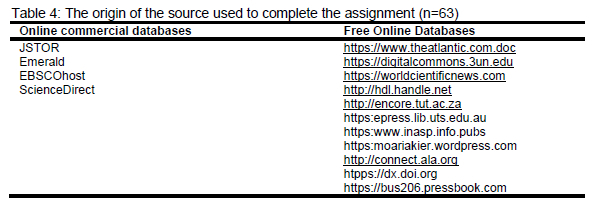
It was necessary to confirm whether the sources were covered in OCD or in free online databases.
Interestingly, three OCDs, namely, JSTOR, EBSCOhost, and ScienceDirect searched by respondents, were used for demonstration purposes during OCD training. These databases are multidisciplinary in nature, which means that they cover a wide range of subject areas.
6.4 Challenges with the use of OCDs after training
This was an open-ended question in which the respondents were asked to identify the challenges faced when using OCDs. Challenges are divided according to the following themes:
6.4.1
Search tools and techniquesRespondents expressed that they face the challenge of using Boolean operators because they end up being confused when they formulate keywords. The three basic Boolean operators are: AND, OR, and NOT which are used alongside keywords that let one expand or narrow search parameters when using a database or search engine.
One respondent stated that: 'I still struggle with the use of truncation because truncation use signs that are difficult to interpret'. Forty-nine (78%) still struggled with the advanced search for information. Advanced search strategy refers to a set of filters offered by online databases to narrow the scope of a search query to eliminate irrelevant information (Dikotla 2021).
6.4.2
Lack of confidence in using OCDs independentlySome respondents reported their challenge as lack of confidence in accessing OCDs independently. Whenever they needed to access OCDs, they sought help or validation from peers (classmates or friends). Seeking validation from others means that respondents may not know their capabilities of using the OCDs until they actually implement the skills learnt into practice by actually using the OCDs independently. Students struggling with selected search strategies are encouraged to consult librarians or experienced peers. These peers are likely to be among those who did not need OCD training, as their levels of self-efficacy were high.
6.4.3
Limited access to OCDsStudents must have an appropriate ICT infrastructure, such as computers with Internet connectivity to access OCDs. Access to OCDs should be available 24/7. Expectedly, 2 (3%) of the respondents who reside off-campus commented that they struggled to access OCDs when not on campus for various reasons including limited access to the Internet.
7 Discussion of the results
This section discusses the findings and results of the study and is organised and discussed according to the objectives presented in Section 1.1.
7.1 The attitudes of 4th-year-level students pursuing BIS at UL towards OCD training
The success or failure of the student in OCD training is influenced by their attitudes (Thompson 2021). Delich and Roberts (2017) suggest that if a student interprets the outcome of his actions to be successful, his levels of self-efficacy increase and tend to remain resilient and persevere in the face of difficulties. This study revealed that the majority (52.4%) of respondents have positive attitudes towards OCD training. Bai (2020) indicates that positive attitudes of students toward learning have a direct, significant, and positive impact on student performance. Therefore, positive attitudes of students indicate their readiness to absorb OCD training due to the strong relationship that exists between student attitudes and academic achievement (Alhamami 2022). Therefore, academic librarians need to take advantage of the situation and ensure that they impart information search skills to students while they are still receptive to learn how to search OCDs.
7.2
Self-efficacy levels in the use of OCDs according to completed assignmentsThe level of self-efficacy has a greater influence on the ability of undergraduates to access electronic library resources for academic purposes (Ebijuwa & Mabawonku 2019). Furthermore, self-efficacy levels have an impact on the use of library information technology that includes OCDs (Saville & Foster 2021). The level of self-efficacy of 4th-year-level students is satisfactory as evidenced by 41 (65%) respondents who rated their levels of self-efficacy as medium and 22 (34.9%) as high. However, high levels of self-efficacy do not translate into the adoption and use of OCDs, as was the case in this study.
Both qualitative findings from document analysis and quantitative results from the questionnaire confirmed that students do not frequently use OCDs to complete their assignments despite their self-efficacy levels being medium and high, respectively. Similarly, Salehi et al. (2018) found that students declared using the Google search engine as their primary or only information seeking tool even after training.
7.3
Reasons for a self-efficacy level rating based on assignments completed after OCD trainingThe study revealed that 5 (22%) respondents rated their self-efficacy levels medium. Mid-level academic self-efficacy may reflect ambivalence about one's potential to participate in class discussion or score high on course examinations. Therefore, there is still room for improvement of efficacy levels from medium to high to ensure the maximum OCD usage and completing quality academic work. An earlier study by Galyon et al. (2012) showed that after a high skill level has been attained, high self-efficacy will not necessarily predict how efficiently and effectively one will use skills at that level.
The 4 (6.3%) respondents who indicated that they rated their levels of self-efficacy high stated that they can use various OCDs for academic work and are able to access unlimited information. This suggests that self-efficacy is essential in online learning and is considered a key determinant of success. This is because individuals with high self-efficacy levels imagine success, anticipate potential outcomes of diverse strategies, and are more likely to initiate a new behaviour than those with less self-efficacy who imagine failure, harbour self-doubts, and tend to procrastinate (Hagger, Cameron, Hamilton, Hankonen & Lintunen 2020). The implication is that only few students have high ability and competency to search OCDs without the assistance of librarians or peers.
7.4
Challenges faced by students during and after OCD trainingThe challenges students faced are largely related to search tools and techniques, specifically truncation, formulation of keywords and advanced searches. The findings of this study are consistent with a study by Mitchell-Kamalie (2011) at the University of Western Cape in South Africa, and Greenlee (2014) at Olivet Nazarene University in Bourbonnais, Illinois. These studies established that many students in higher learning institutions do not have the necessary skills to search for OCDs effectively and efficiently. Non-usage of OCDs amounts to students' failure to address their academic needs and it is a wastage of library resources and efforts. In this sense, database search skills are essential for the success of students in information retrieval (Walden University 2024).
Another challenge was the inability to use OCD independently, suggesting that the training outcome has not been achieved. According to Komissarov and Murray (2016), users should be able to use OCDs independently after OCD training. The inability of students to search OCDs independently implies reliance on librarians or peers. For librarians, it implies work overload. Failure to rely on librarians and peers may propel students to continue relying on free online databases that contain poor quality information. The situation of this nature may also impact on the employability of students as librarians because the key responsibilities of librarians include searching OCDs and training users on how to use the OCDs. PatonAsh and Wilmont (2015) noted that the inability of students to search OCDs independently affects students' academic performance and produces librarians who cannot search information for the patrons. Therefore, it is necessary to empower the students to use the OCDs independently.
Most universities have computerised and digitalised libraries and computer laboratories (Musingafi, Mapuranga, Chiwanza & Zebron 2015). This covers the UL Library. Despite the availability of these ICT resources, 4th-year-level BIS students are unable to access OCDs for their academic work due to poor network and inconsistent power supply especially for students that are residing off campus. Students who live on campus have an advantage over those who live off campus because the UL Library has backup in case of power outage. This suggests that there is unequal access to OCDs among students on and off campus. Consequently, students who have limited access to OCDs often submit their assignments late because they spend more hours travelling to campus, resulting in poor academic performance (Lynch 2017). However, many universities give assignments early in the year and students with problems may address the challenge with respective lecturers.
8. Limitations of the study
The scope of the study was limited to the UL. Although, this benefited the study since researchers gained detailed and contextualised insights, the results or findings may not be generalised to a larger population, which may not be representative of the small sample of students in the current study.
9. Conclusion
There is no doubt that the majority (52.4%) of the respondents have positive attitudes toward OCD training. However, the results or findings of this study revealed that the UL Library's OCD training does not always achieve maximum impact on the self-efficacy of the BIS students. This is because the self-efficacy levels of many (65%) students are still at the medium level even after attending OCD training. This suggests that some efforts are still required to increase the level of self-efficacy of students to high levels, in order to reap the benefits of OCD training. Luo, Chen, Yu and Zhang (2023) recommend that incentive mechanisms should be established to motivate students to learn and increase their commitment to learning.
The study also established that there is no relationship between OCD training, self-efficacy levels, and OCD use. This means that the medium and high self-efficacy levels of the BIS students did not translate into the use or citation of sources from OCDs to complete their assignments. The point in question is illustrated by the fact that only a handful of students (22%) used OCD after training. As Sejane (2017) would attest, high levels of self-efficacy of students do not mean that one will adopt and use OCD for academic work.
Another notable result is that self- efficacy could be high in in some aspects of database searching (for example: Boolean operators) and low on others (for example: keywords formulation and truncation). Researchers recommend a continuous training wherein certain slots are tailored for students who would still struggle with some strategies even after OCD training. Librarians and lecturers can look at the possibility of OCD training modules on the university library website where students are able to practice search strategy on their own until they are able to use it. The use of generative artificial intelligence in OCD training may also be considered.
The study further established that OCDs are underused. Document analysis revealed that many students use the printed books and Internet or free online databases more than OCDs to complete their assignments. This emerged from the analysis of the list of references to the assignments that students completed after OCD training. There are various factors that influence the use of OCDs. Personal challenges relate to the student's inability to use search tools and techniques during and after OCD training. Infrastructure challenges are related to a large number of students in IL classes, poor network connectivity, and inconsistent power supply in the form of load shedding. There is no doubt that these challenges hamper the accessibility and use of OCDs, and the implications thereof are profound.
The struggle of the 4th-year-level students pursuing BIS to search and retrieve information using OCDs implies that once they are employed as librarians they may not be adequately prepared to facilitate or train library users on the use of OCDs. Additionally, students without the necessary skills struggle to support research and complete tasks at work. They may not be able to conduct user surveys, for example, that require reliable information from OCDs. If the majority of students cannot use OCDs, student performance is impacted, and the image of the university tarnished. Finally, the study concludes that high self-efficacy is the key to successful OCD training; therefore, a clear understanding and tailored OCD training is needed.
An in-depth examination of lecturers' and librarians' commitment to OCD training, as well as how the use of OCD-related information sources influences lecturers' assessments and students' academic performance, would be useful. Further research could compare the lecturers' and librarians' commitment to OCD training. Moreover, further research could also investigate the leadership roles of the University Librarian and the Head of the Department of Information Studies, as well as how collective leadership can support effective OCD training.
References
- Alhamami, M. 2022. Language learners' attitudes toward online and face-to-face language environments [Online]. Frontiers in Psychology, 13: 926310. https://www.frontiersin.org/iournals/psychology/articles/10.3389/fpsyg.2022.926310/full
- Ani, O.E., Ngulube, P. & Onyancha, O.B. 2015. Perceived effect of accessibility and utilization of electronic resources on productivity of academic staff in selected Nigerian universities. SAGEOpen, 5(4): 1-7 215824401560758.
-
Bai, Y. 2020. The relationship of test takers' learning motivation, attitudes towards the actual test use, and test performance of the College English Test in China. Language Testing in Asia, 10(1): 1-18. doi: 10.1186/s40468-020-00108-z
» https://doi.org/10.1186/s40468-020-00108-z - Bandura, A. 1995. Self-efficacy in changing societies. New York: Cambridge University Press.
- Bandura, A. 1997. Self-efficacy: The exercise of control. New York: W. H. Freeman.
- Bandura, A. 2005. The evolution of Social Cognitive Theory. In Smith, K.G. & Hitt, M.A. (eds.). Great minds in management. Oxford: Oxford University Press.
- Bruning, R., Dempsey, M., Kauffman, D.F., McKim, C. & Zumbrunn, S. 2013. Examining dimensions of self-efficacy for writing. Journal of Educational Psychology, 105(1): 25-38.
-
Cerný, J. & Potancok, M. 2023. Information literacy in international masters students: a competitive and business intelligence course perspective. Cogent Education, 10(1): 2161701. DOI: 10.1080/2331186X.2022.2161701.
» https://doi.org/10.1080/2331186X.2022.2161701 - Creswell, J.W. & Poth, C.N. 2018. Qualitative inquiry and research design: choosing among five approaches. 4th ed. Thousand Oaks: Sage.
- Delich, N.A. & Roberts, S.D. 2017. Empowering students through the application of self-efficacy theory in school of social work: an intervention model. International Journal of School Social Work, 2(1): 1-13.
- Dikotla, M.A. 2021. Remodelling the public sector knowledge management system using key knowledge management processes. Collection and Curation, 40(4): 158-165.
- Dogru, M. 2017. Development of a self-efficacy scale of technology usage in education. EURASIA Journal of Mathematics, Science and Technology Education, 13(6): 1785-1798.
- Ebijuwa, A.S. & Mabawonku, I. 2019. Computer self-efficacy as a predictor of the use of electronic library resources by undergraduates in federal universities in South-west Nigeria. Global Knowledge, Memory and Communication, 68(4): 323-336.
- Etikan, I., Musa, S.A. & Alkassim, R.S. 2016. Comparison of convenience sampling and purposive sampling. American Journal of Theoretical and Applied Statistics, 5(1): 1-4.
- Foo, S., Majid, S. & Chang, Y.K. 2017. Assessing information literacy skills among young information age students in Singapore. Aslib Journal of Information Management, 69(3): 335-353.
- Galyon, C.E., Blondín, C.A., Yaw, J.S., Nalls, M.L. & Williams, D.L. 2012. The relationship of academic self-efficacy to class participation and exam performance. Social Psychology of Education, 15(2): 233-249. https://doi.org/10.1007/s11218-011-9175-x
- Greenlee, P. 2014. Tutorials: Resource instruction for distance learners. The Christian Librarian, 57(2): 96-101.
- Gusenbauer, M. & Haddaway, N.R. 2019. Which academic search systems are suitable for systematic reviews or meta-analyses? Evaluating retrieval qualities of Google Scholar, PubMed, and 26 other resources. Research Synthesis Method, 11(2): 181-217.
- Hagger, M.S., Cameron, L.D., Hamilton, K., Hankonen, N. & Lintunen, T. 2020. The Handbook of behaviour change. New York: Cambridge University Press.
- Hatlevik, O.E., Throndsen, I., Loi, M. & Gudmundsdottir, G.B. 2018. Students' ICT self-efficacy and computer and information literacy: determinants and relationships. Computers and Education, 118(1): 107-119.
- Ilogho, J.E. & Nkiko, C. 2014. Information literacy search skills of students in five selected private universities in Ogun State, Nigeria: a survey [Online]. Library Philosophy and Practice, 1040: 1-22. http://digitalcommons.unl.edu/libphilprac/10400
- Jones, W.L. & Mastrorilli, T. 2022. Assessing the impact of an information literacy course on students' academic achievement: a mixed-methods study. Evidence Based Library and Information Practice, 17(2): 61-87. https://doi.org/10.18438/EBLIP30090
- Kleyn, L & Nicholson, D.R. 2018. Cost of accessing academic research is way too high. https://www.wits.ac.za/news/latest-news/in-their-own-words/2018/2018-10/cost-of-accessing-academic-research-is-way-too-high.html
- Komissarov, S. & Murray, J. 2016. Factors that influence undergraduate information-seeking behaviour and opportunities for student success. Journal of Academic Librarianship, 42(4): 423-429.
- Liamputtong, P. 2009. Qualitative research methods. 3rd ed. Oxford: Oxford University Press.
- Lynch, M. 2017. The absence of the internet at home is a problem for some students. https://www.theedadvocate.org/the-absence-of-internet-at-home-is-a-problem-for-some-students/
- Mabunda, M.V., Mukonza, R.M. & Mudzanani, L.R. 2023. The effects of loadshedding on small and medium enterprises in the Collins Chabane local municipality. Journal of Innovation and Entrepreneurship 12(57): 1-20. https://doi.org/10.1186/s13731-023-00327-7.
- Mahmood, K. 2016. Do people overestimate their information literacy skills? a systematic review of empirical evidence on the Dunning-Kruger Effect. Communication in Information Literacy, 1(2): 199-213.
- Mapulanga, P., Chisoni, F. & Chaputula, A.H. 2023. Information literacy skills and competencies of nursing students at Kamuzu University of Health Sciences in Malawi. South African Journal Libraries & Information Science, 89(1): 1-13.
- Mawere, T. & Sai, K.O.S. 2018. An investigation on e-resource utilisation among university students in a developing country: a case of Great Zimbabwe University. South African Journal of Information Management, 20(1): 1-7.
- Musingafi, M.C.C., Mapuranga, B., Chiwanza, K. & Zebron, S. 2015. Challenges for open and distance learning (ODL) students: Experiences from students of the Zimbabwe Open University. Journal of Education and Practice, 6(18): 5966.
- Mitchell-Kamalie, L. 2011. Successful information literacy through librarian - lecturer collaboration. PhD thesis (Library and Information Science). Bellville: University of the Western Cape.
- Ng, P.L. & Tan, A.K.G. 2017. Determinants of e-Resource usage by open distance learning university students. Malaysian Journal of Library & Information Science, 22(1): 29-44.
- Olalla-Soler, C. 2018. Using electronic information resources to solve cultural translation problems. Journal of Documentation, 74(6): 1293-1317.
- Pan, X. 2020. Technology acceptance, technological self-efficacy, and attitude toward technology-based self-directed learning: Learning motivation as a mediator. Frontiers in Psychology, 11: 1-11. https://doi.org/10.3389/fpsyg.2020.564294
- Paton-Ash, M. & Wilmot, D. 2015. Issues and challenges facing school libraries in selected primary schools in Gauteng Province, South Africa. South African journal of education, 35(1): 1-12.
- Priya, A. 2021. Case study methodology of qualitative research: key attributes and navigating the conundrums in its application. Sociological Bulletin, 70(1): 94-110. https://doi.org/10.1177/0038022920970318
- Rafi, M., JianMing, Z. & Ahmad, K. 2019. Evaluating the impact of digital library database resources on the productivity of academic research. Information Discovery and Delivery, 47(1): 42-52.
- Salehi, S., Du, J.T. & Ashman, H. 2018. Use of Web search engines and personalisation in information searching for educational purposes. Information Research, 23(2): 1-13. https://files.eric.ed.gov/fulltext/EJ1182241.pdf
- Saville, J.D. & Foster, L.L. 2021. Does technology self-efficacy influence the effect of training presentation mode on training self-efficacy? Computers in Human Behaviour Reports. 4:100124. https://www.sciencedirect.com/science/article/pii/S24519588210007259
- Sejane, L. 2017. Access to and use of electronic information resources in the academic libraries of the Lesotho library consortium. PhD (Information Studies) thesis. Pietermaritzburg: University of KwaZulu Natal.
- Sonya, L. 2014. The importance of knowing how to get things: information literacy and the healthcare professional. Journal of Mental Health, 23(3): 113-114.
- Thompson, A.S. 2021. Attitudes and Beliefs. In: Gregersen, T. & Mercer, S. (eds). The Routledge handbook of the psychology of language learning and teaching. London: Routledge. pp. 149-160. doi: 10.4324/9780429321498-15
- Ukachi, B. 2015. Information literacy of students as a correlate of their use of electronic resources in university libraries in Nigeria. The Electronic Library, 33(3): 486-501.
- Venkatesh, V., Brown, S.A. & Bala, H. 2013. Bridging the qualitative-quantitative divide: guidelines for conducting mixed methods research in information systems. MIS Quarterly, 37(1): 21-54.
Accepted: 4 June 2024