Cloud computing as a disaster management tool for documentary heritage management: reflections by the National University of Lesotho
Abstract
Archives exist to collect and manage the memory of nations, including documentary heritage management. The transformation of the archives from the physical to digital format is even more imperative in the digital age. The purpose of this paper is to investigate the usage of cloud computing as a disaster management tool for documentary heritage management from the perspective of the National University of Lesotho's Library (NUL) digitisation project. This single qualitative case study used interviews as a technique for data collection. Data was collected from the NUL digitisation project team consisting of seven purposively selected staff members. The analysis of data was done manually and thematically in accordance with the research objectives. The findings of the study revealed that the NUL understands what disaster management entails, although there are no proper mechanisms in place for guiding the management of disasters. Furthermore, the results showed that, currently, there is no policy framework guiding the management of disasters at the institutional level. Additionally, the findings showed that cloud computing may indeed be used as a disaster management tool because of its associated benefits. The study makes a meaningful and original contribution to the body of knowledge by recommending a framework for the adoption of cloud computing as a disaster management tool for documentary heritage management in libraries.
digital preservation; cloud computing; disaster management; disaster management tool; digitisation
1 Introduction
Archives exist to collect and manage the memory of nations, including documentary heritage (Ngulube, Modisane & Mnkeni-Saurombe 2011; Ryden, 2023). The transformation of these archives from a physical to a digital format is even more imperative in the digital age. There are several advantages associated with digital transformation of archives. Digital archives save storage space, unlike printed/physical archives. Globally, organisations in both the public and private sectors in countries such as the United States (US), France, Denmark, Switzerland, the United Kingdom (UK), Canada, Germany, Spain, the Netherlands, and Japan use cloud-based data centres for the storage of records and data (McLeod & Gormly 2018; Slingerland 2024). In Africa, the storage of records in the cloud is operational in South Africa, Namibia, Ethiopia, and Botswana as part of a package for the utilisation of an EDRMS for records management (Shibambu 2022; Karlos 2023; Julaihi et al. 2024).
The information management landscape has witnessed a profound transformation from the physical to the digital in the 21st century, with libraries becoming not only curators of printed works but also stewards of extensive digital collections. The digital collections are also affected by disasters such as cybersecurity threats, hardware and storage failures, data corruption, and obsolescence of file formats and software, among others (Somvir, Kumar & Kaushik 2024). Rachman and Afidhan (2018) highlight the need for disaster preparedness plans and policies for digital collections in Indonesia, as digital collections grow. One advantage of digital collections is that they can be accessed with ease from any geographical location, but they are being destroyed by different forms of disasters resulting from floods, fires, and other forms of disasters (Robertson 2016). Lesotho is susceptible to many hazards classified as hydro-meteorological (floods, storms, strong winds and heavy snow) and climatological (droughts, extreme heat, cold temperatures, wildfires and changing erratic weather patterns) hazards (Lesotho Multi-hazard Health Contingency Plan, 2020/23). These can affect physical collections in libraries. Specifically, the challenges faced by digital materials include hardware failures, cyber-attacks, power outages, IT failures, and obsolescence. A lack of formal digital disaster preparedness policies and risk assessments has put digital collections in academic libraries at risk of destruction by these disasters (Rachman 2020). With the increasing global socio-economic devastations, both the international community and national disaster management authorities make disaster preparedness, response, and mitigation their top priority.
Najar and Wani (2021) define a disaster as a calamity, either man-made or natural, that negatively affects livelihoods and property. In the context of libraries, a disaster may be defined as any catastrophic occurrence that significantly affects the regular operations of the library (Verma & Shahane 2020; Abidin, Kiran & Samsuddin 2024). The literature reports an increase since the 1950s, in terms of the number of disasters as well as the magnitude, and the number of people affected (Prestamo 2018; Mahmoodi, Jasemi Zergani, Hashemi & Millar 2022). Disaster management involves "extensive coordination, communication and integration within a dynamic and ad hoc environment" (Dorasamy et al. 2013:183). The Lesotho Disaster Management Act, 1997, defines disaster management as
a continuous and dynamic multi-sectoral, multi-disciplinary process of planning which seeks, by the systematic study and analysis of disasters, to improve measures relating to prevention, mitigation, emergency preparedness, response and post-disaster recovery.
Several authors define cloud computing differently. In the context of libraries and other information centres specifically, cloud computing refers "to the usage remote servers and computing resources intended to store, manage, and process data, thereby transcending the constraints imposed by traditional, on-premises IT based infrastructures" (Ashikuzzaman 2024:1). According to Suman, Patel and Vijesh (2023), cloud computing is a web-based platform that utilise virtually shared servers to provide infrastructure devices, platforms, software, and other resources as a service and hosting to customers on a pay-per-use basis. For Mishra and Rohit (2023:3), cloud computing is the "distribution of services like servers, databases, networks, software, storage etc. by use of the internet for faster innovation, flexible ICT tools and economies of scale".
2 Study context
The study was contextually set at the NUL in Maseru, Lesotho. The NUL is the only public university in Lesotho. It was established through the National University Act No. 13 of 1975, with its supreme body being the Council and Senate as the principal academic authority. The hub of information services for the university is currently located at the Thomas Mofolo building, which is on the main campus in the town of Roma, while the other campus is in Maseru, named the Institute of Extra Mural Studies (IEMS) (Tseole & Modiba 2023).
3 Problem statement
Several types of information services, including documentary heritage information services, are faced with the challenge of being destroyed by different types of disasters if there are no proper strategies in place to safeguard them. Ngulube et al. (2011) note that when information specialists receive holdings in their repositories, they also accept the responsibility and custody of those materials. They should therefore protect these materials from disasters. One of the strategies or tools that can be used to protect the holdings from disasters is cloud computing because of its benefits associated with significant cost cutting, improved reliability and access to records, regardless of the location, flexibility, scalability, enhanced data protection, and more (Mosweu, Luthuli & Mosweu 2019). The other benefits of cloud computing, as identified by Maqueira-Marín et al. (2022), include improved access to real-time standard platforms, low implementation costs and minimal risk of disaster recovery and its accompanying costs. Similarly, Gupta et al. (2021) opine that an organisation that adopts cloud computing does not have to worry about space upgrade, as is always the case with physically based servers, where costs are always incurred every time there is an upgrade. The literature lists examples of academic libraries that have adopted cloud computing, and they include those in Nigeria, India and Pakistan (Chudasma, Bhatt & Trivedi 2019; Asim, Arif & Rafiq 2024; Mabawonku et al. 2024; Nazir, Shahzad & Khan 2025).
However, despite its benefits, evidence suggests that academic libraries are lagging in adopting cloud computing as a preservation strategy and disaster management tool (Masenya 2021). Organisations in the services of protecting heritage information should therefore guard against any loss of their holdings caused by disasters, whether natural or man-made (Olubiyo 2023). To the best knowledge of the researcher, no study has been undertaken in Lesotho with the aim of using cloud computing technology as a disaster management tool for documentary heritage. The only closely related study is the one conducted by Tseole (2020), which investigated cloud technology services at the NUL. The difference is that while the current study focuses specifically on cloud computing as a disaster management tool, the other study was more general in its approach.
4 Purpose and study objectives
The purpose of this study was to investigate the usage of cloud computing as a disaster management tool for documentary heritage management at the NUL. To achieve this purpose, the following objectives guided the study.
• To determine how cloud computing can be used as a disaster management tool for documentary heritage management from the experiences and perspective of the National University of Lesotho Library digitisation project.
• To suggest a framework for the adoption of cloud computing as a disaster management tool for documentary heritage management in libraries in Lesotho.
Consistent with the study objectives, this section reviews the relevant literature about the usage of cloud computing as a disaster management tool.
5.1
Disaster management in academic librariesHeritage information is not a renewable resource and therefore should be sustainably protected, both locally and globally (Yale University 2014; Moustafa 2015). Kamatula, Mnkeni-Saurombe and Mosweu (2013) opine that heritage can refer to anything that has been carried over from the past, such as documents, which serve as evidence of the inherited past by present-day society. According to UNESCO (2015), documentary heritage refers to items that are moveable, such as signs, codes, sounds, and images, which can be preserved and are reproducible.
Disaster management should be part of all institutions dealing with documentary heritage management. According to Reza, Rajab, and Rosidanti (2022:102), disaster management is "the management of the risks and consequences of a disaster." It includes various aspects of planning and responses in all phases of a disaster event: mitigation, preparedness, response, and recovery. Libraries, including academic libraries, have transitioned from managing physical collections such as rare manuscripts, historic photographs, research datasets, and more, to digital ones. As custodians of both physical and digital heritage, academic libraries grapple with an array of challenges that threaten their collections, such as the ever-present threats of disasters (Somvir et al. 2024).
Al Kurdi (2021) states that the total number of disasters has doubled since the 1980s. Specifically, Ngulube et al. (2011) lists the following disasters that have affected documentary collection since 2003: hurricane Ivan that destroyed records at the Cayman Islands National Archive in 2004; hurricanes Katrina and Rita caused large-scale devastation in Louisiana, Mississippi and Alabama in the US in 2005; and the Free State library was burnt to ashes as a result of public demonstrations in 2011. Salvaging fire-destroyed collections at Jagger libraries of the University of Cape Town in South Africa continued for years after the blaze (Viljoen 2023). The significance of disaster preparedness and management in libraries is considered a core area of library and information science and its related disciplines, including archival sciences, and is proposed to be included as a strategic response to an emergency (Chisita & Ngulube 2022).
5.2
The use of cloud computing as a disaster management tool in academic librariesCloud computing is the latest technological trend that has greatly affected the service operation of all organisations, including those in libraries and other information industries (Njoku & Ken-Agbiriogu 2021). Cloud computing is defined as a technology that depends on the processing and storage of computer data through a centralised and commercialised server that is accessed via the internet (Niqresh & Tawalbeh 2020). It is based on the premise that instead of individuals and organisations buying the necessary hardware and software, they can receive these through subscription from a third party for the required amount (Jahangiri, Saberi & Vakilamofrad 2021).
Cloud computing is considered a viable strategy to consider a disaster management strategy by academic libraries (Masenya 2020; Singhal et al. 2023). The existing literature also provides evidence of increased interest in cloud-based storage in the records profession (Tsvuura, Mbawuya & Ngulube 2021; Ferguson-Boucher 2011). With the emergence of diverse technologies, cloud computing is one of the key solutions to providing off-site storage that deals with redundancy and is scalable. In the context of documentary heritage management, cloud computing could include online storage, backup solutions and collaboration services (Tsvuura et al. 2021 ; Islam, Islam, Anwar & Alam 2023). By safeguarding digital content in geographically dispersed data centres, cloud storage minimises the vulnerability to physical disasters and hardware failures, enabling efficient data recovery (Somvir et al. 2024). According to Mosweu et al. 2019), one of the benefits of cloud computing associated with the management of records is that it facilitates convenient, on-demand network access to a shared pool of configured computing resources. For Islam et al. (2023), cloud computing also offers several benefits for libraries, like reducing the cost related to hardware and software, maintenance, local technical needs, and high electricity consumption.
6 Research methodology
The study was qualitative in nature and adopted a case study design. The qualitative approach was found to be relevant for the study because it answers questions about experiences, meaning and perspectives, most often from the standpoint of the participant (Hammarberg et al., 2016:499). Similarly, Powell and Connaway (2004), Tseole (2020), and Mohajan (2018) argue that the qualitative approach focuses on observing events from the participant's point of view and the purpose is to understand the attitudes, behaviours and opinions of study participants. Structured interviews were used for data collection from seven members of the NUL digitisation team.
The census sampling technique was therefore used for selecting the study sample while the findings were presented thematically in accordance with the objectives of the study. Similarly, in studying the creation and storage of records in the cloud by Zimbabwe Open University, Tsvuura et al. (2021) followed the same methodology. Interviews were conducted with seven staff members who made up the digitisation team and who were available at the time. Data analysis was done manually through content analysis.
7 Findings and discussion
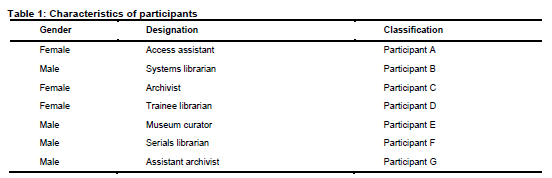
The following section presents the study findings based on the interviews conducted by the researchers in line with the study objectives. The interviews were recorded using a smartphone. Permission to record the interviews was requested from and granted by the participants. The researchers explained that the collection of data through an interview was purely academic and that, immediately after the paper is completed, all recordings would be destroyed and that the paper would in no way be used for profit-making by the researchers. Table 1 below presents the characteristics of the study participants.
Consistent with the objectives, the findings of the current study are presented under the following themes: disaster management in libraries, cloud computing as a disaster management tool for libraries and the challenges of using cloud computing in the library context.
7.1 Disaster management in libraries
Bansal (2015) argues that disaster plan and management are essential for the efficient functioning of libraries and other information centres. Similarly, (Ansari et al. 2024) also believe that good disaster planning and management for libraries are important as they protect the valuable assets held by those libraries. Nonetheless, libraries continue to face several challenges, the biggest of which are disasters. Libraries should therefore prioritise and react to these disasters as they pose significant threats to libraries and other custodians of different information, including heritage information. The first question sought to identify the understanding of disaster management in the context of libraries, and the following were the responses from the participants:
• Participant A
Libraries contain crucial information that needs to be preserved and protected from different types of disasters. For instance, library buildings from the very beginning should be strategically erected at places that may not be easily affected by disasters such as water.
• Participant B
It is about safeguarding of the records held by the library against natural disasters.
• Participant C
A tool or a mechanism that the libraries use to prevent disasters from affecting or destroying collections.
• Participant D
To manage risks emanating from libraries which may affect documentary collections.
• Participant E
Disasters are not different across different contexts. However, in libraries, disaster management is about anything meant to manage a disaster that can harm the collection.
• Participant F
A disaster plan in place to mitigate hazards that may occur and affect library collections.
As a follow-up to the question on the understanding of disaster management above, participants were requested to state whether their library ever experienced any type of disaster which they could remember, and even though there was a difference in terms of the exact year, all participants were of the same view that their libraries experienced a fire that affected the library server room. Participants further mentioned that some library collections were destroyed by water in the process of extinguishing the fire by the campus fire department.
Furthermore, participants were asked if their library had either a disaster management policy or a plan. All participants indicated that their library does not have either a disaster management policy or policy plan. This, despite the presence of the Lesotho National Disaster Risk Reduction Policy (2011), the study revealed that this has not trickled down to the institutional level. Several studies have revealed this to be the case for libraries in most parts of the world, including in Malaysia (Juryiah & Norazlina 2015), Jamaica (Harris 2021) and Australia (Cowell 2020). Contrary to the findings, Cheema et al. (2016) suggest that it is important for institutions to have disaster plans and, in the absence of either a coherent policy or a plan, a disaster is exacerbated because there is no clear boundary of mandate or jurisdiction. In their study on disaster preparedness in universities, Cheema et al. (2016) recommend that universities should develop emergency plans based on the following important elements:
• Action steps that give campus officials the roadmap of what to do in on a crisis.
• The scope of the plan explains the roles and responsibilities of staff and students at different stages.
• Communication methods include a communications centre that will ensure effective information exchange.
• Clarified media responsibilities to avoid misinformation.
7.1 Cloud computing as a disaster management tool for libraries
In line with one of the study objectives, participants were requested to state the extent to which they believe cloud computing may be used as a tool for disaster management, and they all held the same view that, indeed, cloud computing could be used as a disaster management tool because cloud computing facilitates a safer storage in which collections may be retrieved even after the disaster. The following are the responses from participants:
• Participant A
I believe, using cloud computing, we can still have our records in the event of disasters, we can still have access to the records.
• Participant B
Yes, cloud computing can be used as a disaster management tool even though we currently do not have a guideline/policy to formalise it.
• Participant C
Cloud computing is helpful as we can still be able to retrieve our collections in the event of a disaster.
• Participant D
Partially yes, cloud computing may be used as a disaster management tool to minimise damage if a disaster strikes.
• Participant E
Even though I am not knowledgeable about cloud computing, my understanding is that of having to keep our digitised records in a different location and not on local server. I don't even know where the cloud is, but I believe therefore in the event of a disaster we can still have access to those records as they are not located locally.
Reviewing the literature on the role of cloud computing in disaster-prone environments, Masenya (2021) holds that cloud computing offer and alternative as a preservation strategy. Similarly, Kaur et al. (2022) state that information technology has previously been used at different phases of a disaster. In particular, "cloud computing provides the facilities of infrastructure, software, and platform for information sharing to disaster management departments, data security, and backup" (Kaur et al. 2022; Habiba & Akhter 2013). Vermiglio et al. (2022) also argue that information systems have supported disaster management practitioners in recent times by providing access to data collected by emerging technologies, including the Internet of Things (loT), cloud computing, machine learning, artificial intelligence, social media communication and blockchain. Peteva (2023) suggests that cloud computing provides opportunities for storing, accessing and sharing digital cultural content.
STL Digital (2023) provides the following characteristics of cloud computing if applied in the context of disaster management:
• Backup and restore: The fastest and by far the cheapest ways to recover data through cloud-based recovery approaches. Moreover, it also helps to mitigate regional events, such as natural disasters, by moving the data to different geographical locations.
• Warm standby: Cloud computing enables organisations to obtain a scaled-down version of a completely functional business environment. The scaled-down version will constantly run alongside the actual environment in a different geographic location, far from the central server. In this way, the organisation will always have a backup version in a separate location in case of disasters.
On the question of the challenges of cloud computing, participants unanimously agreed that libraries, particularly in Lesotho, face challenges related to funding. They believe that even though there may be strategies in place to address certain issues, what normally becomes a challenge is financing those strategies. In the case of cloud computing, for instance, the concern is that even though their systems are in the cloud, sustainability in terms of continued subscription may be a challenge. Interestingly, one participant mentioned the issue related to the digital divide, that even though they work hard to avoid disasters by making use of technology, not all clients have access to computers and the internet. In line with this view, authors such as Koulouris, Vraimaki and Koloniari (2021), and Abidin, Abdullah, Shaari and Saad (2024) mention that even as library services are improved using the latest technological developments, challenges such as the digital divide and technological obsolesce remain, thus, calling for more, including strategies in addressing disparities in access to information. A recent example is the British Library on 29 October 2023, which faced a malicious cyberattack in the form of ransomware and services were interrupted. This, therefore, led to the development of a comprehensive framework aimed at improving security measures to protect the library's valuable collection (British Library 2024; Abidin et al. 2024).
8 Recommendations
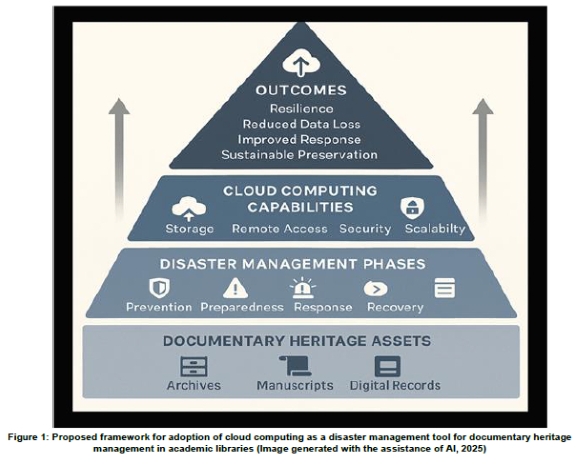
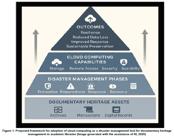
The second objective of this study sought to propose a framework for the adoption of cloud computing as a disaster management tool for documentary heritage management in academic libraries in Lesotho. The pyramid design in Figure 2 depicts a hierarchical and foundational approach to implementing cloud computing as a tool for disaster management in heritage institutions. The proposed framework consists of four layers, which include documentary heritage assets, disaster management phases, cloud computing capabilities, and outcomes. Each one of these layers represents a critical component, building towards the goal of resilience and sustainable preservation using cloud computing.
8.1
Layers one: Documentary heritage assetsAt the foundation of the pyramid are the heritage resources that include archives, manuscripts, and digital records. These assets form the core of cultural memory and institutional knowledge, making their protection the primary objective of the framework.
8.2
Layer two: Disaster management phasesThe next layer comprises the four phases of disaster management:
• Prevention: Implementing proactive measures such as secure cloud storage and risk monitoring.
• Preparedness: Training personnel and conducting cloud-based simulations to ensure readiness.
• Response: Leveraging cloud platforms for real-time access and coordination during crises.
• Recovery: Restoring data from cloud backups and performing post-disaster evaluations.
This layer ensures that disaster management processes are systematically integrated into heritage preservation strategies.
8.3
Layer three: Cloud computing capabilitiesAbove the disaster management phases are the enabling technologies:
• Storage and backup: Providing redundancy and secure archiving.
• Remote access: Maintaining continuity of operations during disruptions.
• Security and encryption: Protecting sensitive heritage data from cyber threats.
• Scalability: Allowing institutions to adapt resources as needs evolve.
These capabilities empower disaster management activities and strengthen institutional resilience.
8.4 Later four: Outcomes
At the apex of the pyramid are the desired outcomes:
• Resilience
• Reduced data loss
• Improved response
• Sustainable preservation
9 Conclusion
The purpose of this study was to investigate the usage of cloud computing as a disaster management tool. In conclusion, the study demonstrates that cloud computing offers a viable and strategic solution for disaster management in the preservation of documentary heritage. By harnessing cloud computing capabilities such as secure storage, remote access, and scalability, institutions can significantly reduce the risk of data loss and improve their ability to respond effectively to different disasters. The integration of cloud technologies across all phases ensures a comprehensive approach to safeguarding cultural and historical resources.
The proposed framework provides a clear structure for aligning documentary heritage assets, disaster management processes, and technological enablers towards achieving resilience and sustainable preservation. Successful implementation, however, depends on collaboration among key stakeholders and addressing barriers such as infrastructure limitations and skill gaps.
References
5 Literature review
- Abidin, A., Abdullah, M.N., Shaari, N. and Saad, N.S. 2024. Library disaster preparedness in Southeast Asia: A systematic review. ASEAN Journal of Community Engagement, 8(1): 73-92.
- Al Kurdi, O.F. 2021. A critical comparative review of emergency and disaster management in the Arab world. Journal of Business and Socio-economic Development, 1(1): 24-46.
- Abidin M.I., Kiran K, Samsuddin, S.F. 2024. In the line of disaster: preparedness and effective response of academic libraries in Malaysia. Library Management, 45(8-9): 506-526.
- Ansari, A.J., Vaidya, P., Malik, B.A. and Ali, P.M.N. 2024. Preparing for the unthinkable: A systematic look at disaster preparedness in libraries. In International Journal of Disaster Risk Reduction, Vol. 108. Elsevier Ltd. [Online] https://doi.org/10.1016/j.ijdrr.2024.104551 (9 December 2025).
- Asim, M., Arif, M. and Rafiq, M. 2024. Adoption and uses of cloud computing in academic libraries: A systematic literature. Journal of Information Science, 0(0). https://doi.org/10.1177/01655515241263272
- Ashikuzzaman, M.D. 2024. Cloud computing in library services: Practical advice for building and managing cloud-based library systems. [Online]. https://www.lisedunetwork.com/cloud-computing-in-library-services-practical-advice-for-building-and-managing-cloud-based-library-systems/ (15 October 2024).
- Balcik, B. and Beamon, B. M. 2008. Facility location in humanitarian relief. International Journal of Logistics: Research and Applications, 11: 101-121.
- Bansal. J 2015. Disaster management in libraries: an overview. Gyankosh- The Journal of Library and Information Management, 6(1):9-13.
- British Library, 2024. Cyber-attack recovery update. [Online] https://www.bl.uk/about/cyber-attack (10 October 2025).
- Cheema, A.R., Mehmood, A. and Imran, M. 2016. Learning from the past: Analysis of disaster management structures, policies and institutions in Pakistan. Disaster Prevention and Management, 25(4): 449-463. [Online] .https://doi.org/10.1108/DPM-10-2015-0243 (9 December 2025).
- Chisita, C.T. and Ngulube, P. 2022. A framework for librarians to inform the citizenry during disasters: Reflections on the COVID-19 pandemic. Journal of Disaster Risk Studies, 14(1): 1-11.
- Chudasma, P., Bhatt, A and Trivedi, D. 2019. Application of cloud computing in university libraries: Case study of selected university libraries in Gujarat. [Online]. https://digitalcommons.unl.edu/cgi/viewcontent.cgi?article=6375&context=libphilprac (9 December 2025).
- Dorasamy, M., Raman, M. and Kaliannan, M. 2013. Knowledge management systems in support of disasters management: A two-decade review. Technological Forecasting and Social Change, 80(9):1834-1853.
- Disaster Management Act, 1997, Lesotho. (Act No. 2 of 1997).
- Ferguson-Boucher, K. and Convery, N. 2011. Storing information in the cloud - A research project. Journal of the Society of Archivists, 32(2): 221-239. [Online]. https://doi.org/10.1080/00379816.2011.619693 (9 December 2025).
- Gupta, N., Gupta, K., Singh, A., Kaur, A. and Gupta, D. 2016. Cloud computing: a walk through in models, challenges, and energy solutions. IOP Conference Series: Materials Science and Engineering. 1st International Conference on Computational Research and Data Analytics (ICCRDA 2020) 24th October 2020, Rajpura, India. [Online]. DOI 10.1088/1757-899X/1022/1/012070 (9 December 2025).
- Habiba, M. and Akhter, S. 2013. A Cloud Based Natural Disaster Management System. In: Park, J.J. (.H., Arabnia, H.R., Kim, C., Shi, W., Gil, JM. (eds) Grid and Pervasive Computing. GPC 2013. Lecture Notes in Computer Science, vol 7861. Springer, Berlin, Heidelberg. https://doi.org/10.1007/978-3-642-38027-3_16
- Hammarberg, K., Kirkman, M. and De Lacey, S. 2016. Qualitative research methods: when to use them and how to judge them. Human Reproduction, 31(3): 498-501.
- Harris, C.A. 2021. The role of Veterinarians in mass casualty isasters: a continuing need for integration to disaster management. Front Public Health. doi: 10.3389/fpubh.2021.644654.
- Islam, M.N., Islam, M.S., Anwar, A. and Alam, M.K. 2023. Cloud computing applications in library services of Bangladesh: a study on librarians' perceptions. Information Discovery and Delivery, 51(1): 88-104.
- Jahangiri, P., Saberi, M.K. and Vakilimofrad, H. 2021. Development and psychometric evaluation of the cloud computing acceptance questionnaire for academic libraries. The Journal of Academic Librarianship, 47(5): 1-11.
- Kamatula, G., Mnkeni-Saurombe, N. and Mosweu, O. 2013. The role of archives in the promotion of documentary national heritage in Tanzania, South Africa and Botswana. ESARBICA, 32: 109-127.
- Karlos, A.N.T. 2023 Assessing the use of cloud computing for records management in selected organisations in Namibia. [Online]. https://repository.unam.edu.na/server/api/core/bitstreams/7f516694-c2a7-461b-ab2d-53b4d14b9b82/content (26 April 2025).
- Kaur, M., Kaur, P.D. and Sood, S.K. 2022. ICT in disaster management context: a descriptive and critical review. Environmental Science and Pollution Research, 29(57), 86796-86814. [Online] https://doi.org/10.1007/s11356-022-21475-5 (9 December 2025).
- Koulouris, A., Vraimaki, E. and Koloniari, M. 2021. COVID-19 and library social media use, Reference Services Review, 49(1): 9-38.
- Kumar Suman, A. and Patel, M. 2023. An efficacy of cloud computing and its application in libraries. International Journal of Research and Analysis in Science and Engineering, 6.
- Lesotho National Risk Reduction Policy 2011. [Online]. https://www.preventionweb.net/publication/lesotho-national-risk-reduction-policy-2011 (10 December 2025).
- Mabawonku, T.O., Babatope, J., Anyanwu, P.C. and Akintunde, E.B. 2024. Adoption of cloud computing in academic libraries in Lagos and Ogun States. Preservation, Digital Technology & Culture, 53(4): 259-266.
- Maqueira-Marín, J.M., De Oliveira-Dias, D., Jafari Navimipour, N., Gardas, B. and Unal, M. 2022. Cloud computing and human resource management: systematic literature review and future research agenda. In Kybernetes 51(6): 2172-2191. Emerald Group Holdings Ltd. [Online]. https://doi.org/10.1108/K-05-2021-0420 (9 December 2025).
- Masenya, T.M. 2020. Application of modern technologies in the management of records in public libraries. Journal of the South African Society of Archivists, 53: 65-79. [Online]. https://doi.org/10.4314/jsasa.v53i1.5. (9 December 2025).
- Mishra, R. and Rohit, R. 2023. Inevitable tools for resources preservation: Data security and cloud computing for libraries. Journal of Library and Information Science, 47(1 -2): 39-51.
- Mohajan, H.K. 2018. Qualitative research methodology in social sciences and related subjects. Journal of Economic Development, Environment and People, 7(1): 23. [Online]. https://doi.org/10.26458/jedep.v7i1.571 (9 December 2025).
- Najar, J.K., and Wani, Z. A. 2021. A study of disaster preparedness of archives & museum in seismic zone - v, flood prone and conflict ridden Kashmir. Collection and Curation, 40(2): 33-41. https://doi.org/10.1108/CC-02-2020-0003
- Nazir, S., Shahzad, K. and Khan, S.A. 2025. Developing a framework for cloud computing adoption in academic libraries: an empirical investigation from university librarians. Global Knowledge, Memory and Communication, Vol. ahead-of-print No. ahead-of-print. [Online]. https://doi.org/10.1108/GKMC-01-2024-. (9 December 2025).
- Ngulube, P., Modisane, C. K., and Mnkeni-Saurombe, N. 2011. Disaster preparedness and the strategic management of public records in South Africa: Guarding against collective cultural amnesia. Information Development, 27(4): 239-250. https://doi.org/10.1177/0266666911417641_(9
- Njoku, L.C. and Ken-Agbiriogu, E. 2021. Awareness and use of cloud computing: Its implications in selected academic libraries in Imo State, Nigeria. Information Impact: Journal of Information and Knowledge Management, 12(1):62-75.
- Olubiyo, P.O. 2023. A literature survey of disaster management strategies in library and information centres. Library Philosophy and Practice. [Online]. https://orcid.org/0000-0001-7340-1866 (09 December 2025).
- Peteva, I. 2023. The impact of cloud technologies on preserving and promoting cultural identity. Conference Proceedings, 13.
- Powell, R.R. and Connaway, L.S. 2004. Basic research methods for librarians. Connecticut: Libraries Unlimited.
- Prestamo, A. M.2018. Libraries and Natural Disasters. Journal of Library Administration, 58(1): 9-13.
- Rachman Y.B. 2020. Disaster preparedness of academic libraries: A case study from Indonesia. Preservation Digital Technology & Culture, 49(2): 67-74.
- Rachman, Y.B. and Afidhan, S. 2018. Digital disaster preparedness of Indonesian special libraries. Preservation, Digital Technology and Culture, 47(2): 54-59.
- Reza, I., Rajab. and Rosindati. 2022. Natural post-disaster management archive model. Journal of Good Governance, 18(2): 100-111.
- Robertson, G. 2016. People, paper, data: Disaster planning for libraries. In Robertson, G. (ed.), Library security and disaster planning, London: Chandos Publishing. pp. 111-119.
- Ryden, R. 2023. National archives, national memory? How national archives describe themselves and their mission. Archival Science, 23: 297-326.
- Singhal, S., Sharma, A., Gourisaria, M.K., Sharma, B. and Dhaou, I.B. 2023. A disaster management system using cloud computing. 2023 20th ACS/IEEE International Conference on Computer Systems and Applications (AICCSA), Giza, Egypt, 2023, pp. 1-6.
- Shibambu, A. 2022. Migration of government records from on-premises to cloud computing storage in South Africa. South African Journal of Libraries and Information Science, 88(1): 1-11.
- Slingerland, C. 2024. The countries with the best cloud technology in the world. [Online]. https://www.cloudzero.com/blog/countries-with-the-best-cloud-technology/ (26 April 2025).
- Somvir, R., Kumar V and Kaushik, S. 2024. The role of technology in disaster preparedness for digital collections in libraries. [Online] .https://www.ijlsit.org/html-article/20751 (9 December 2025)
- STL Digital. 2023. What is cloud computing? Everything you need to know. [Online]. https://www.stldigital.tech/blog/what-is-cloud-computing-everything-you-need-to-know/ (25 October 2024).
- Tseole, T. 2022. Application of multi-methods in understanding knowledge retention in the cross-border mergers of the telecommunications industry in Lesotho. In: P. Ngulube (ed.), Handbook of research on mixed methods research in information science. Hershey, PA: IGI Global, 440-469.
- Tseole, T. and Modiba, M. 2023. Framework for the provision of information services through a smart self-service kiosk at the National University of Lesotho Library. [Online]. https://doi.org/10.7553/89-1-2192 (9 December 2025).
- Tsvuura, G., Mbawuya, K.D. and Ngulube, P. 2021. Creation and storage of records in the cloud by Zimbabwe Open University. ESARBICA Journal: Journal of the Eastern and Southern Africa Regional Branch of the International Council on Archives, 40, 1-20. [Online]. https://doi.org/10.4314/esarjo.v40i1.1 (9 December 2025).
- UNESCO, 2015. Recommendation concerning the preservation of, and access to documentary heritage including in digital form. [Online]. https://unesdoc.unesco.org/ark:/48223/pf0000244675.page=5 (25 November 2024).
- Verma, S. and Shahane, S. 2020. Disaster management system activities in university libraries in India: A study. PhD thesis, Jiwaji University, India.
- Vermiglio C., Noto G., Rodríguez Bolívar M.P., and Zarone, V. 2022. Disaster management and emerging technologies: a performance-based perspective. Meditari Accountancy Research, 30(4):1093-1117.
Accepted: 9 January 2026