Preserving language through digital neologisms: a study of word-formation processes in the digital age
Abstract
This paper examines the role of neologisms in preserving linguistic knowledge, focusing on how digital platforms, particularly social media, contribute to the creation, dissemination, and preservation of these terms in the digital age. By analysing trending neologisms and the word processes by which they are formed, this study highlights the potential of digital media to safeguard language and facilitate its future retrieval. The creation of neologisms has become a crucial aspect of modern language development, reflecting the changing needs of communication in the digital age. While the phenomenon of neologism formation is not new to English, the advent of the internet and digital devices has accelerated the process, fostering an environment where new terms are coined rapidly to address the lack of linguistic knowledge for emerging technologies, cultural shifts, and societal changes. Data were collected from the web to explore both established and context-specific neologisms, providing insights into their usage across different digital environments. The onomasiological theory of word formation serves as the theoretical framework for understanding how these new words are created and evolve in the digital age. The findings suggest that social media platforms, such as Facebook, play a significant role in not only preserving but also enabling the retrieval of linguistic knowledge, thereby contributing to the digital preservation of language for future generations.
Word formation processes; neologisms; digital age; library information science
1 Introduction
The rapid expansion of digital communication has transformed language, giving rise to digital neologisms, which are newly coined words and expressions that capture emerging technologies, practices, and social realities. While such linguistic innovations are often examined within the framework of word-formation processes, they also carry significant implications for library and information studies (LIS). Neologisms are not merely playful lexical creations, for they embody evolving forms of knowledge that shape how information is produced, retrieved, and preserved in digital environments. This raises critical questions for LIS, such as how libraries and information systems accommodate new lexical items, and how information professionals can ensure that these culturally significant words are systematically documented as part of the collective memory. This study, therefore, views digital neologisms as both linguistic artefacts and information resources, underscoring the vital role of LIS in preserving language in the digital age.
Language reflects social growth and development, and its vitality is often measured by how widely it is used. As Crystal (1998; 2006) observes, English has become the world's lingua franca, spoken across diverse racial and geographical contexts. The explosion of information technology has accelerated the global spread of English and contributed to the continuous creation of new words to meet the communicative demands of the digital era. McCulloch (2019) argues that social media platforms have made internet users more creative with language than ever before. Similarly, Ekanjume-Ilongo and Adesanmi (2019) note that social media reshapes communication across geographical divides, while Ekanjume (2023) highlights the role of platforms such as Facebook, Twitter, and Instagram in changing how individuals construct their daily interactions.
Among these platforms, Facebook stands out as a particularly influential site of linguistic innovation. With over 2.70 billion monthly active users worldwide (Dean 2024), it not only facilitates interpersonal communication but also provides a space for linguistic experimentation and knowledge sharing. Research shows that Facebook encourages interaction through both linguistic and non-linguistic means, supporting two-way exchanges that allow users to respond, reflect, and co-create meaning (Mustafa et al. 2015; Ekanjume 2023). This communicative environment fosters the invention and circulation of neologisms, especially among younger generations such as Millennials and Generation Zs, who dominate internet usage (Farrel 2024; Warren 2024). While their digital vocabulary has become an integral part of everyday communication, it often appears complex and inaccessible to older generations, highlighting the need for systematic documentation and study.
Although Southern Africa is multilingual, this study deliberately focuses on English neologisms for several reasons. Firstly, English is the dominant language of digital communication in the region, serving as the lingua franca across diverse linguistic communities. Secondly, much of the technological infrastructure that drives digital platforms, such as software interfaces, search algorithms, and databases, operates with English as the default language, positioning it at the centre of neologism creation and dissemination. Thirdly, while indigenous-language neologisms exist, they are often under-documented or confined to smaller communities, making systematic analysis more difficult. Thus, English provides a rich and accessible entry point for examining digital neologisms while laying the groundwork for future studies on other Southern African languages.
Neologisms emerge primarily through established word-formation processes such as affixation, compounding, blending, clipping, acronymy, borrowing, and coinage (Murray 1995; Plag 2005). While these processes are not entirely new, their creative use in digital spaces generates innovative lexical items that reflect contemporary realities. As Crystal (2003) explains, people coin new terms to capture inventions, concepts, or phenomena for which existing words are inadequate. Such words, however, are not only linguistic innovations, but they are also informational units that influence metadata construction, indexing, cataloguing, and digital archiving. If left undocumented, gaps in retrieval and preservation may emerge within LIS systems, undermining access to evolving knowledge.
This study, therefore, examines the word-formation processes that shape English neologisms on Facebook, highlighting their role in digital communication and their implications for LIS. By analysing how neologisms are created, circulated, and adopted on social media, the study contributes to a deeper understanding of both linguistic innovation and knowledge preservation in the digital age. Facebook is not only a site of entertainment and social networking; it also plays a multifaceted role in sustaining language practices, enabling knowledge sharing, and preserving emerging vocabulary for broader usage. In this sense, the platform functions as both a linguistic laboratory and an archival space, demonstrating how technology can be harnessed to preserve language as a dynamic and evolving resource.
Several studies conducted by different authors have discussed the morphological analysis of neologisms; however, the phenomenon is rarely investigated in the context of the linguistic landscape (Kolobe 2015) in the digital age. Some studies related to the morphological analysis of neologisms used on social media have been conducted. For example, Mustafa et al. (2015) conducted a study that aimed to focus on common word-formation processes used by Malaysian young generations who are active Facebook users. In addition, Nkhata and Jimaima (2020) conducted a similar study on morphological analysis of neologisms on Zambian online media. The findings of their study stated that newly coined words have been invented over time, and social media neologisms should be viewed as an outcome of the creativity and productivity of language.
Mworia (2015) investigated the use of English neologisms on Twitter, with the objectives of determining how Social Networking Site (SNS) neologisms deviate from Standard English, examining factors influencing their production and usage, and evaluating their effectiveness in communication. Her findings validated the hypothesis that social media neologisms deviate from Standard English, particularly at the phonological level through elision, reflecting the human tendency to manipulate language to facilitate communication. Similar patterns of linguistic innovation have been observed in studies of other platforms, such as Facebook and Instagram, where neologisms often emerge to meet the demands of rapid, interactive communication (Ekanjume 2023; McCulloch 2019). While Mworia focused on deviation from Standard English, other studies highlight additional motivating factors, such as creativity, identity expression, and community belonging among netizens (Farrel 2024; Warren 2024). Collectively, these studies suggest that digital neologisms are not only linguistic phenomena but also social and cognitive tools, supporting the argument that examining neologisms on Facebook can reveal both word-formation processes and their implications for knowledge documentation and preservation in LIS studies. This comparison highlights the need for research that bridges linguistic analysis and information science by examining how neologisms serve as both communicative innovations and units of information in digital spaces.
Magaiwa (2016) examined neologisms in the Igikuria language in Kenya, aiming to determine the nature of these newly coined words. The study found that multiple word-formation processes can produce different terms denoting the same concept, resulting in synonyms, and that the interpretation of these neologisms, whether literal or loose, depends on the context and the encyclopaedic knowledge accessed. Magaiwa (2016) further argues that the processes of broadening and narrowing of concepts are central to understanding Igikuria neologisms, with the Relevance Theory providing a suitable explanatory framework. While this study shares an interest in word formation and semantic interpretation with Mworia (2015) and other research, it differs significantly in context and medium, as Magaiwa (2015) did not focus on neologisms emerging from social media platforms, such as Facebook. Nonetheless, the study highlights a crucial principle applicable to digital neologisms: understanding new lexical items requires attention to context, semantic flexibility, and user interpretation. This insight supports the current study's focus on Facebook, where context-dependent usage and generational creativity shape the formation and comprehension of English neologisms, further linking linguistic innovation to information organisation and preservation in digital spaces.
Mensah (2016) explored the semantics and morphology of Mfantse neologisms, focusing on common word-formation processes, types of neologisms, and the meanings attributed to these lexical items. Her study concluded that neologisms in Mfantse arise not only from scientific and technological developments but also from cultural practices, where speakers extend or create words to suit contextual needs, contributing to language growth. Notably, several neologisms were widely recognised across radio stations, indicating that certain newly coined terms can achieve broad community usage. While Mensah's study, like Magaiwa's (2016), emphasises indigenous-language word formation and semantic interpretation, it differs from research on social media neologisms, as it is situated in broadcast media rather than digital interactive platforms. Nevertheless, the findings underscore a shared principle with studies of digital neologisms: new words reflect evolving communicative and cultural practices, and their adoption depends on user familiarity and exposure. This insight reinforces the relevance of examining Facebook neologisms, where widespread digital engagement shapes both the creation and diffusion of new English lexical items, linking linguistic innovation to information documentation and preservation within LIS.
Kolobe (2015) examined neologisms in the form of exocentric compounds as used in Southern African newspapers, focusing on the structural patterns of these compounds and the relationship between form and meaning. Using a two-level approach alongside a pragmatic framework and the WordNet Similarity tool, the study highlighted how individual constituents contribute to the overall meaning of a neologism, and how language users draw on their world knowledge to interpret newly encountered terms. Similar to Mensah (2016) and Magaiwa (2016), Kolobe (2015) demonstrates that understanding neologisms relies on contextual and cognitive processes, although her study differs in medium, using print newspapers rather than social media platforms. Collectively, these studies reveal a recurring theme: while linguistic innovation is well-documented, the systematic preservation of neologistic knowledge in information systems remains underexplored. This gap highlights the relevance of the current study, which investigates Facebook neologisms from both a word-formation perspective and in terms of their documentation, indexing, and preservation within LIS.
Despite the valuable insights provided by studies such as Mworia (2015), Magaiwa (2016), Mensah (2016), and Kolobe (2015), several gaps remain in the literature. First, much of the research focused on either indigenous-language neologisms or print and broadcast media, with limited attention to digital platforms like Facebook, where neologisms emerge rapidly and interactively. Secondly, while the linguistic properties and word-formation processes of neologisms have been explored, few studies have examined their implications for LIS, particularly in relation to documentation, indexing, and preservation within digital information systems. Thirdly, existing studies often treat linguistic innovation and information organisation as separate domains, without addressing how neologisms function simultaneously as communicative tools and units of information in online contexts. The present study addresses these gaps by investigating English neologisms on Facebook, combining a linguistic analysis of word-formation processes with an LIS perspective on knowledge preservation. By doing so, it situates digital neologisms at the intersection of language innovation, social media use, and information management, providing both theoretical and practical insights for scholars and information professionals in the digital age.
3 Theoretical framework
The study is underpinned by Stekauer's (2002) onomasiological theory of word formation, which is relevant to LIS in the context of digital language management, information retrieval, and knowledge preservation. Stekauer (2002) theorises that the onomasiological model of word formation extends the requirements of a speech community regarding its naming needs from with the conceptual reflection of extra-linguistic reality and development through a semantic analysis to produce a new linguistic form such as neologisms. This theory advocates for the naming process as a critical linguistic function. It explains that it reflects the community need to categorise and conceptualise the world through language.
The onomasiological theory of word formation guided both data classification and interpretation. Regarding data classification, Facebook neologisms were collected and classified according to the conceptual domains they represent. Each neologism was coded based on the semantic concept it conveys, reflecting Stekauer's emphasis on the relationship between concept and linguistic form. Regarding interpretation and coding, the morphological structure of each neologism was analysed in relation to the conceptual need it fulfils. This allowed for a systematic understanding of how linguistic creativity addresses emerging social and technological phenomena. For example, a neologism coined to describe a new online trend or behaviour was interpreted not only by its structure but by the societal or technological concept it encodes, bridging linguistic analysis with LIS concerns such as information retrieval and archiving.
In LIS, this framework can be instrumental in understanding the processes through which new terms (neologisms) emerge, especially in the rapidly evolving digital and technological landscape. The current study argues that the new world of technology has provided various ways for speakers to promote knowledge preservation and appreciation. To substantiate, the study demonstrates that the rapidly evolving increase of digital networks and platforms such as WhatsApp, Facebook, Twitter, Instagram, and forums has necessitated new forms of communication to provide space for the creation, management, and preservation of new words (neologisms) to express emerging concepts and ideas. This realisation brings forth the connection between linguistic knowledge and LIS professionals, where the latter are expected to navigate the processes through which neologisms are formed, classified, and managed within digital archives for future retrieval and analysis as an enhancement of language preservation (Lor 2013). Just as Stekauer's onomasiology describes the process through which words are formed to reflect new ideas or realities, LIS professionals engage in similar practices of conceptualising, categorising, and preserving emerging knowledge, whether through metadata, ontologies, or subject indexing (Pilerot 2012; Borgman 2003; 2015).
4 Methodology
This study was explanatory in nature and adopted an interpretivist perspective on the phenomenon of neologism and language preservation in the digital age. The qualitative approach adopted was relevant in the current study because it helped the researchers to explore word formation processes, such as neology, within the framework of library and information science (Togia & Malliari 2017). Through a survey, researchers collected 100 neologisms used on Facebook, and 31 of them were used as a sample based on their fitting word-formation process type. The study employed a purposive sampling method because it aimed to analyse neologisms that are both meaningful and representative of evolving digital communication practices, rather than simply a numerical subset. The purposive approach was chosen based on three factors, namely, frequency of use, relevance to emerging concepts, and clarity of morphological structure. For frequency of use, neologisms that appeared repeatedly across multiple posts or user interactions were prioritised, ensuring that the analysis focuses on terms with broader circulation and impact. In line with emerging concepts, only neologisms that clearly reflected technological, social, or cultural developments were included, in alignment with the study's aim of linking linguistic innovation to knowledge preservation. For clarity of morphological structure, neologisms that demonstrated identifiable word-formation processes were selected to facilitate a systematic morphological and semantic analysis.
Facebook was found to be the most popular media platform for revealing the usage of well-established trending neologisms, as well as the creation of context-specific ones. The Facebook posts analysed in this study were collected from publicly accessible groups and pages where English-language content is actively shared, including platforms focused on social interaction, education, and technology. Data collection was limited to posts published between January and June 2024 to ensure a contemporary snapshot of neologism usage. Only posts containing explicitly identifiable neologisms, words, or expressions not found in standard dictionaries and reflecting emerging concepts were included. Selection prioritised posts with clear linguistic context, allowing for accurate morphological and semantic analysis. Hashtags and trending topics within these groups were also used to identify relevant neologisms, ensuring that the sample represents widely recognised and actively used terms in the digital community.
In the context of this study, Facebook could serve as attested to by Pilerot (2012) and Borgman (2015), as a functional platform for language practitioners in terms of linguistic development, retrieval, and learning, while LIS professionals use it for information classification, management, archiving, and indexing, considering semantic analysis, cultural exchange, and language preservation. Content analysis of the collected data enhanced a better understanding of how and why words are formed, as well as why knowledge information can be categorised, and retrieved for future use on Facebook as a social media platform.
Although the data for this study were collected from publicly accessible Facebook groups and pages, ethical principles were strictly observed. All neologisms and associated posts were anonymised to protect user identities, and no personal information was recorded or disclosed. The study focused exclusively on content intended for public viewing, ensuring that data collection was non-intrusive and did not involve direct interaction with users.
5. Findings and discussion
Each of the collected neologisms was analysed to determine its word class and meaning, based on the context in which the word was used on Facebook during data collection. In addition to the structural and semantic analysis, the study situated neologism usage within a sociolinguistic framework, considering factors such as age, digital literacy, and social function. The population primarily comprised members of the Millennial (born 1981-1996) and Generation Z (born 1997-2012) cohorts, who are highly active on digital platforms. Their frequent engagement with social media significantly shapes both the creation and adoption of neologisms.
Although specific demographic details, such as region or education level, could not always be identified due to the public nature of posts, general observations suggest that these neologisms reflect youth culture, online trends, and peer-group interactions. The social functions of these neologisms include identity expression where users coin or adopt terms to signal membership in digital communities or align with generational norms, efficient communication where shortened forms, acronyms, and blended words allow rapid expression of complex ideas or trending concepts, and humour and creativity where many neologisms serve playful, rhetorical, or ironic functions that enhance engagement and social bonding. These sociolinguistic insights demonstrate that word-formation processes are not only structural but also socially and culturally motivated, linking linguistic innovation to the broader dynamics of digital communication. This dual focus, on both structural and social aspects, provides a comprehensive understanding of neologisms as both linguistic phenomena and tools for social interaction in the digital age.
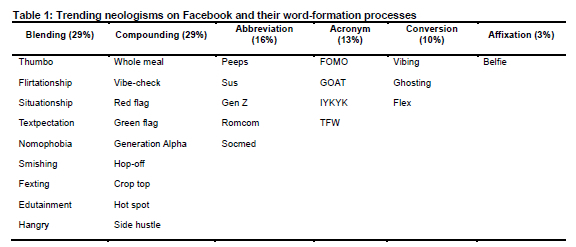
Neologisms are classified into various word-formation types, including abbreviation, compounding, acronym, blending, affixation, clipping, conversion, eponym, and reduplication (Murray 1995; Yule 2006). The descriptive classification is followed by an example of the neologism and the percentage frequency of neologism word-formation types.
The table above presents an analysis of neologisms collected from Facebook, along with the word-formation processes to which they belong, as well as their usage percentages. The table reveals that blending and compounding are the most common word-formation processes used by netizens, at 29% each, with the others being abbreviation (16%), acronym (13%), conversion (10%), and affixation (3%). The percentages presented in the analysis are based on the purposive sample of 31 neologisms selected from the initial pool of 100 collected from Facebook posts. For each feature reported, the percentage reflects the proportion of neologisms in the sample that exhibit that feature. For instance, since nine out of the 31 neologisms were classified as blending, this is reported as 29% of the sample.
Word-formation processes are the core of neologisms; without them, new words cannot be created in the English language. When it is said that neologisms are new words formed in the language, this does not necessarily mean new words that people have neither seen nor heard of before. Facebook users can understand some neologisms, though their understanding may not be exhaustive. When this happens, Plag (2005) asserts that there are word-formation rules that enable people to decompose words, isolate their constituents, and infer their meaning based on these parts. The following is a detailed presentation of neologisms as used on Facebook, along with their associated word-formation processes.
A) Blending
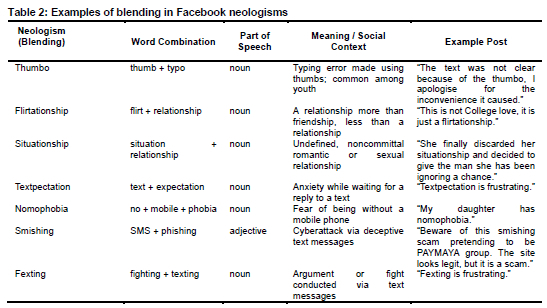
Blending, where parts of two distinct words are combined to form a new term, appeared nine times (29%) in the collected data, indicating that netizens frequently use this word-formation process to create concise and meaningful neologisms. This aligns with Lehrer (2007) and Crystal (2003), who note that blends are fashionable and widely used in digital communication.
The findings confirmed that blending is a prevalent and socially functional word-formation process on Facebook, used to create short, expressive, and culturally resonant terms. This reinforces the observation that digital users prefer concise, meaningful forms that efficiently convey emerging concepts.
B) Compounding
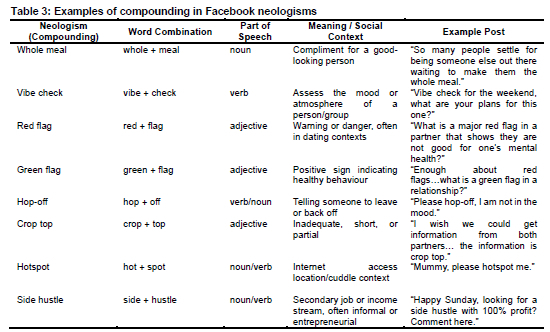
Compounding, where two or more words are combined to form a new lexical item, appeared nine times (29%) in the collected data, matching the frequency of blending. This indicates that compound words are highly productive in contemporary digital communication, reflecting a preference for concise, expressive, and contextually meaningful terms (Bolinger 1980; Katamba 1994; Plag 2005).
The prevalence of compounding in this study aligns with Mworia's (2015) findings, who found that social media users favour concise compound words to convey meaning efficiently. It also supports Onyedum (2012), who highlighted compounding as a creative and productive process in both formal and informal contexts. Compared to blending, compounding emphasises clarity and semantic transparency, often allowing immediate understanding without additional explanation.
The use of compound neologisms on Facebook reflects creativity, identity-building, and digital efficiency. Terms like vibe check, side hustle, and hotspot demonstrate how users adapt language to social and technological contexts, signalling membership in online communities and facilitating rapid, context-dependent communication. The evolving meanings of words, such as "hotspot," illustrate semantic flexibility, showing how language innovation accommodates both social and technological needs while contributing to ongoing language evolution.
C) Acronym
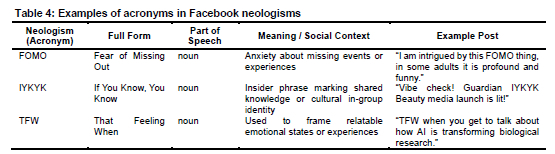
Acronyms, formed by extracting the initial letters of multi-word expressions, appeared four times (13%) in the dataset, functioning primarily as nouns. Their presence indicates that digital communication favours brevity and memorability, with users opting for shortened forms to convey complex meanings quickly (Yule, 2006).
The current findings echo Mworia's (2015) observations that acronyms are widely used on social media but often require repeated exposure before becoming widely understood. For instance, FOMO, also identified in Mworia's dataset, illustrates the persistence of certain acronyms across platforms and time. While Mworia emphasises the role of familiarisation, the present study extends this by demonstrating how acronyms like IYKYK and TFW also function as markers of digital in-group membership, making them more than just shortcuts.
The use of acronyms on Facebook highlights key aspects of digital language innovation, which include creativity and efficiency, identity-building, and sociolinguistic stratification. In the area of creativity and efficiency, acronyms compress lengthy expressions into memorable tokens. Regarding identity-building, acronyms such as IYKYK create exclusivity, signalling who belongs to online subcultures. For sociolinguistic stratification, understanding acronyms depends on age, exposure, and digital literacy, with younger, tech-savvy users being more likely to adopt and spread them.
This suggests that acronyms are not only linguistic shortcuts but also social tools that shape participation in online communities while contributing to ongoing lexical expansion and cultural expression.
D) Abbreviations
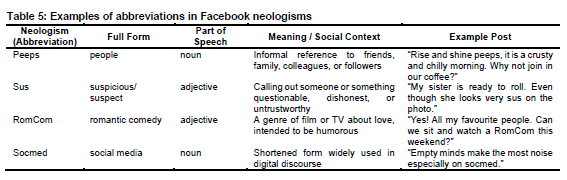
Abbreviations, which shorten existing words or phrases, appeared five times (16%) in the dataset. Their use reflects the influence of digital culture, where speed, brevity, and familiarity drive word-formation practices. As Crystal (2003) notes, abbreviations are linked to the popularisation of concepts, making them easily recognisable in contemporary discourse. Greenfield and Subrahmanyam (2003) similarly found that abbreviations accelerate online communication by reducing typing effort while maintaining clarity.
These findings extend Mworia's (2015) observation that neologisms on social platforms deviate from Standard English by demonstrating that abbreviations are a deliberate strategy for efficiency. While Mworia emphasises linguistic deviation, the current study highlights abbreviation as a cultural practice shaped by speed and informality. In comparison, Magaiwa's (2016) findings on Igikuria show that meaning depends heavily on context; the same applies here, since "sus" or "peeps" require familiarity with digital slang to be understood.
From the findings, it can be said that abbreviations highlight several important linguistic trends. There is the aspect of efficiency and convenience where shortened forms reduce typing effort in fast-paced communication. There are also identity and generational markers where abbreviations like sus are associated with younger speakers, particularly Gen Z, marking group identity. Additionally, there is cultural diffusion, as evidenced by terms like "RomCom" and "socmed," which demonstrate how abbreviations spread across domains (entertainment and technology) and become embedded in global online discourse.
Thus, abbreviations function as both linguistic shortcuts and sociolinguistic signals, reinforcing digital-era preferences for brevity while shaping online identity and interaction.
E) Conversion
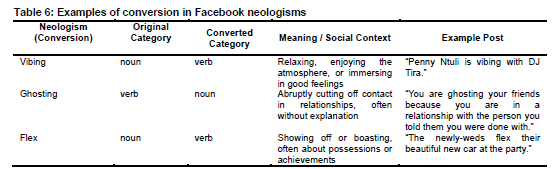
Conversion, which involves shifting a word from one grammatical category to another without changing its form, appeared three times (10%) in the dataset. Although less frequent than other word-formation processes, conversion remains a productive strategy in digital discourse, particularly because it enables flexibility in the use of words. In this study, nouns are most frequently converted into verbs, reflecting users' preference for dynamic, action-oriented expressions.
While Mworia (2015) emphasises semantic innovation in Facebook neologisms, this study highlights grammatical innovation through conversion. Words like "ghosting" and "flex" illustrate how meanings shift when categories change, aligning with Magaiwa's (2016) point that contextual use determines interpretation. Unlike abbreviations or acronyms, which prioritise brevity, conversion emphasises expressive versatility, allowing users to shift effortlessly between describing states (vibing) and actions (to vibe).
These findings have implications for language evolution, as conversion leads to dynamic meaning-making, allowing a single lexical item to serve multiple communicative purposes. Additionally, it highlights the concept of cultural embedding, where we encounter terms like 'flex,' which originated in African American Vernacular English before gaining global traction on platforms like Facebook. Moreover, it indicates that the dominance of noun-verb conversions suggests a strong demand for lexical items that denote actions and identities in digital spaces.
Although conversion may not be the most frequent process in online neologism formation, it plays a crucial role in expanding the expressive range of digital communication by enabling flexibility and context-driven meaning.
F) Affixation
Affixation, which involves attaching prefixes or suffixes to existing words to create new lexical items, appeared only once (3%) in the dataset. While infrequent, its presence highlights how even minor morphological modifications can yield impactful neologisms in digital discourse. In online spaces such as Facebook, affixation tends to favour suffixation (especially with -ie), which often adds a playful or personalised nuance to the base word.

While blending and abbreviation dominate neologism creation on Facebook, affixation, though rare, remains a productive process. Belfie illustrates how affixation is often intertwined with digital culture and visual trends, in this case, extending the already popular selfie. Unlike acronyms or abbreviations that prioritise speed, affixation often prioritises creativity and humour, which aligns with Crystal's (2003) observation that digital communication frequently exploits wordplay to capture attention.
This finding revealed that affixation creates terms that resonate with specific online trends, such as selfie culture, leading to the phenomenon of cultural anchoring. It also introduces the concept of expressive creativity, where even a single affix, such as "-ie," can generate entirely new semantic categories. Although less common in the dataset, affixed neologisms like "belfie" spread quickly when attached to viral social media phenomena.
While affixation may not be as statistically significant as blending or abbreviation, its symbolic and cultural power in online spaces underscores its ongoing role in shaping digital neologisms.
6 Conclusion and recommendations
This study has shown that neologisms on Facebook are predominantly formed through blending and compounding (29% each), followed by abbreviations (16%), acronyms (13%), conversions (10%), and affixation (3%). These patterns confirm earlier findings by scholars such as Mworia (2015) and Magaiwa (2019), but they also highlight Facebook as a uniquely dynamic space where creativity, brevity, and social identity shape linguistic innovation. For example, blending reflects digital users' preference for fashionable, concise expressions (Crystal, 2003), while compounding demonstrates the continued productivity of one of the most established processes of English (Plag, 2005). Acronyms and abbreviations, closely tied to the Gen Z digital culture, reveal how efficiency and insider identity are privileged in online communication.
From a sociolinguistic perspective, the findings suggest that neologisms are not only linguistic innovations but also tools for identity-building, efficiency, and community bonding. Their frequent use among younger, digitally literate populations indicates how social media platforms both shape and reflect contemporary communicative practices.
The findings of this study carry significant implications for LIS. Since neologisms arise through established linguistic processes, LIS professionals must adopt systematic strategies to classify, index, and archive these emerging terms. This ensures consistency, accuracy, and retrievability across digital libraries and knowledge repositories. Moreover, because neologisms carry cultural and social meanings beyond their lexical form, cataloguing systems should integrate semantic and contextual metadata to preserve not only the words but also the circumstances of their use.
Ultimately, this study demonstrates that the evolving digital lexicon is a site of both linguistic creativity and cultural identity. As language continues to expand in response to technological and social changes, LIS professionals play a pivotal role in documenting and preserving these innovations. By integrating neologisms into structured knowledge systems, they safeguard linguistic creativity for future generations and ensure that today's digital expressions remain part of tomorrow's cultural and scholarly record.
This study highlights the urgent need for systematic strategies within the LIS field to address the challenges posed by digital neologisms. Given the lack of a comprehensive index for these emerging lexical items, there is a risk that certain groups, particularly older generations or those with limited digital literacy, may struggle to access or understand new terms. This underscores the necessity for LIS professionals to actively document, classify, and preserve neologisms as part of knowledge management practices.
Firstly, LIS institutions should develop frameworks for cataloguing and indexing neologisms in digital repositories, ensuring consistency across metadata, thesauri, and ontologies. Integrating neologisms into linguistic databases and subject-specific vocabularies will support both accessibility and long-term preservation.
Secondly, LIS professionals must broaden their approaches to information collection and retrieval, incorporating strategies that capture the social and cultural contexts in which neologisms are coined and used. This will ensure that neologisms are not only preserved as lexical forms but also as markers of digital culture and identity.
Finally, further research is recommended to explore the intersection of language and LIS, with a particular focus on developing effective methodologies for tracking, classifying, and archiving neologisms across different digital platforms. Such research would strengthen LIS knowledge management practices and enhance the usability of neologisms in future information retrieval systems, thereby safeguarding the evolving lexicon for both present and future generations.
References
2 Literature review
- Bolinger, D. 1980. Language - the loaded weapon. The use and abuse of language today. London: Longman.
- Borgman, C.L. 2003. The invisible library: Paradox of the global information infrastructure. Library Trends, 51(4): 652-674. [Online]. http://hdl.handle.net/2142/8487 (09 December 2025).
- Borgman, C.L. 2015. Big data, little data, no data: Scholarship in the networked world. Cambridge, MA: MIT Press.
- Crystal, D. 1998. English as a global language (Canto ed.). Cambridge, U.K: Cambridge University Press.
- Crystal, D. 2003. The Cambridge encyclopaedia of the English language. (2nd ed.). New York: Cambridge University Press.
- Crystal, D. 2006. Language and the internet. (2nd ed.). Cambridge: Cambridge University Press.
- Dean, B. 2024. Backlinko: SEO, Content marketing, and link building strategies. [Online]. https://backlinko.com/ (9 December 2025).
- Ekanjume, B. 2023. Recontextualising communication: Leveraging social media to effect transformational change in African universities. An inaugural lecture delivered at ISAS Auditorium, National University of Lesotho.
- Ekanjume-Ilongo, B. & Adesanmi, T. O. 2019. A discourse interpretation of digitally mediated texts as transformation tools among selected WhatsApp users. African Journal of Inter/Multidisciplinary Studies, 1(1): 37-48.
- Farrel, C. 2024. What is Generation Alpha? Meaning, characteristics and future. Exploring the 21st Century's Next Generation of Innovators. [Online]. https://www.investopedia.com (09 December 2025).
- Greenfield, P.M. & Subrahmanyam, K. 2003. Online discourse in a teen chat room: New codes and new modes of coherence in a visual medium. Journal of Applied Developmental Psychology, 24: 633-649.
- Katamba, F. 1994. English words. London: Routledge.
-
Kolobe, M. 2015. Analysis of neologisms in newspapers. US-China Foreign Language, 13(4): 231-235. [Online]. doi:10.17265/1539-8080/2015.04.001 (09 December 2025).
» https://doi.org/10.17265/1539-8080/2015.04.001 - Lehrer, A. 2007. Blendalicious. In M. Judith. (ed.). Lexical creativity, texts and contexts. Philadelphia: John Benjamins Publishing.
- Lor, P. 2013. Preserving, developing and promoting indigenous languages: Things South African libraries can do. Innovation, 45:23-50. [Online]. https://repository.up.ac.za/server/api/core/bitstreams/e129423a-1a23-4c0d-abe2-b3f8671641a1/content (9 December 2025).
- Magaiwa, M.M. 2016. Neologisms in Igikuria. Kenya: University of Nairobi.
- McCulloch, G. 2019. Because internet: Understanding the new rules of language. New York: Riverhead Books.
- Mensah, E.C. 2016. A morpho-semantic analysis of Mfantse neologisms in some radio stations in the central region. Ghana: University of Cape Coast.
- Murray, T.E. 1995. The structure of English: Phonetics, phonology, morphology. Massachusetts: Allyn and Bacon.
- Nkhata, L. & Jimaima, H. 2020. Neologisms: A morphological analysis of social media discourses on the Zambian online media. Multidisciplinary Journal of Language and Social Sciences Education, 3(2): 66-93.
- Onyedum, A. 2012. Social media neologisms: A morpho-semantic analysis. Lagos: University of Lagos.
- Plag, I. 2005. Word-formation in English. Cambridge: Cambridge University Press.
- Stekauer, P. 2002. On the theory of Neologisms and Nonce formations. Austrian Journal of Linguistics, 22(1): 97-112.
- Togia, A. & Malliari, A. 2017. Research methods in library and information science. Qualitative versus quantitative research. InTech. [Online]. http://dx.doi.org/10.5772/intechopen.68749 (09 December 2025).
- Warren, K. 2024. Generation Z (Gen Z): Definition, birth years, and demographics. [Online]. https://www.investopedia.com (14 June 2024).
- Yule, G. 2006. The study of language. 3rd ed. Cambridge: Cambridge University Press.
Accepted: 9 January 2026