Academic librarian competencies and artificial intelligence
Abstract
Artificial intelligence (AI) is likely to change employment patterns across the global economy, but it is hard to predict what type of change will happen and how fast. The purpose of this paper is to bring together initial thoughts on the impacts of AI specifically on the work of library professionals, based on a hermeneutic literature review. Generative AI is likely to change the nature of everyday office work, in a way that will impact roles across the library. Changes brought by AI for the information literacy trainer, manager, data specialist and collection manager are considered. Impacts on all library staff competencies are discussed. The final section asks whether the impact on job roles in lower resourced contexts in the global south, such as Kenya, will be different.
Artificial intelligence; library skills; staff competencies; Kenya; United Kingdom
1 Introduction
It is likely that artificial intelligence (AI) will have a significant long-term impact on employment, including librarians' roles; but we do not know the exact character of such changes. Susskind (2020) has long predicted the end of all professions due to AI. However, equally seminal studies of the impact of AI on employment have suggested that it is "low skill" work that is most vulnerable (Frey & Osborne, 2017). For example, according to Frey and Osborne (2017), professional librarians have "only" a 65% vulnerability to computerisation, whereas "library assistants clerical" are at 95% risk and "library technicians" at 99%. So, the longstanding debate is unclear about the overall impact and the relative impact on skilled and unskilled work, albeit both predictions are rather alarming.
The debate has taken a new turn with the advent of generative AI. Its capability to perform high-status and creative tasks such as writing text and even data analysis would seem to encroach on core professional skills. Some professions in the global north are being highly impacted, such as marketing, and, ironically, the IT profession, because of generative Al's ability to write computer code. However, the broadest impacts might be on general office work. Microsoft proposes that generative AI such as Copilot (built into MS Office) will increase productivity of office workers, increasing their uninterrupted focus time and creativity (Microsoft 2023). Microsoft's account casts the change in positive terms, as freeing office workers to spend time on the more interesting tasks, but it does seem that generative AI could produce job losses in everyday office and knowledge work. Again, it remains unclear whether its impact might be more on skilled workers or lower skilled workers (however that might be defined). Meanwhile, the young white male profile of the IT industry has prompted fears about the impact of AI on gender equality (Collett, Neff & Gomes 2022).
The precise impact of AI on employment will vary geographically too, depending on the make-up of different economies. A UK government report found that professional occupations and employees with more qualifications are most exposed to AI (Department of Education, UK Government 2023). Again, a recent study of the UK economy suggested the potential for a loss of 7 million jobs caused by generative AI, with particular impact on the work of women and ethnic minorities (Jung & Deskian 2024). This makes for an alarming headline. Closer reading of the report revealed that this depth of job losses is highly dependent on the case where integrated AI systems are adopted, which would transform non-routine white collar work tasks. They see routine cognitive tasks in the back office as most exposed to AI; followed by organisational and strategic tasks. Non-routine cognitive and analytical tasks as well as interpersonal/communication tasks are less exposed at the current level of AI development.
All things considered, it is not surprising that considerable emotion is attached to AI and its impact on working lives. If we are looking for comfort from such disturbing studies, Willcocks (2020) suggests that change will be complex and much slower than implied by some newspaper headlines. This suggests that some work might be enhanced by AI and that the workforce has time to adjust. Also, optimistically, most general predictions point to the importance of soft skills in an AI world. For example, in an admittedly rather dated reference, the World Economic Forum (WEF) (2016) suggests that the skills needed to thrive in an AI world are:
1. Complex problem solving
2. Critical thinking
3. Creativity
4. People management
5. Coordinating with others
6. Emotional intelligence
7. Judgement and decision-making
8. Service orientation
9. Negotiation
10. Cognitive flexibility
Much of this is about high-level "people skills" or ability to learn and solve problems. To summarise, we can guess that some roles will disappear, be diminished, or be dominated by AI. One thinks of the delivery driver, whose every movement and action are potentially tracked and controlled by AI. But in other cases, AI may liberate workers from mundane tasks, and so empower them or even extend their capabilities. Probably all these will happen, the questions remain about what the balance will be, how quickly it will happen and how the impact will differ geographically and by sector.
Looking specifically at library work, there is the possibility that AI will somehow replace libraries or librarians. But this seems highly unlikely. What AI does appear to do is increase the accessibility of knowledge, through translation, summarisation, improved searching, and recommendation. As a profession, we must surely welcome such benefits. The controversies around AI, especially generative AI, seem to foreground the need for high-level information skills and ethical awareness rather than diminish their value. Given the need for more research to develop AI, this will be a call on libraries as essential to the research infrastructure. Given the potential for a large number of workers to reskill for AI, information roles in libraries will be needed to support such learning.
The purpose of this paper is to bring together initial thoughts on the impacts of AI specifically on the work of library professionals and the competencies required. Towards the end of the paper, there is a reflection on how this might play out in a low-resourced context, such as Kenya. This view is optimistic in emphasising the continuity with existing competencies, translated into the AI context.
2 Methodology
The process of conducting this study was that of a hermeneutic review (Boell & Cecez-Kecmanovic 2010; 2014). A hermeneutic review is a narrative approach to a literature review conceived as a profoundly iterative, deepening process of understanding a complex topic that moves backwards and forwards between processes of searching and reading/interpretation. Unlike a systematic literature review, it does not see it as possible to be fully transparent or replicable, or to be unbiased or comprehensive. It gives primacy to an iterative circling movement between searching and reading/interpretation and back to searching again, including reappraisal of items previously excluded. In contrast to a systematic literature review, it decentres a reproducible systematic database search in favour of multiple search tactics, carried out over an extended time period (because it is recognised that databases are not comprehensive and search terms cannot capture a topic accurately or fully). A hermeneutic review recognises the value of starting points and core authors in review articles, rather than controlled, large-scale search in databases. These give a sense of the main themes and key reference points in the literature. These could include non-peer-reviewed articles and it is likely for the current topic to include grey literature, such as white papers and other reports.
This points to the drawbacks of only citing peer-reviewed articles. They are supported by the author's insights based on understanding of the sector and observing previous changes in the profession. Later search tactics were following up on citations by or of key articles, setting up alerts, asking people questions and serendipity. The reading/interpreting circle consists of the processes of analytical reading, mapping/classifying, critical assessment, argument development and defining a research problem (Boell & Cecez-Kecmanovic 2014). The paper is composed of two elements, first a section on the impact on librarian competencies in a global north context, and secondly, some considerations are developed to think about how these factors might play out differently in a low-resourced context.
What is artificial intelligence?
As a foundation for the discussion, it is important to clarify the meaning of the rather ambiguous and contested concept of artificial intelligence. Much of the uncertainty around the impact of AI on work arises from its complex nature. AI is an umbrella term describing a "general purpose" technology. Thus Vinuesa et al. (2020) define AI as follows:
any software technology with at least one of the following capabilities: perception - including audio, visual, textual, and tactile (e.g., face recognition), decision-making (e.g., medical diagnosis systems), prediction (e.g., weather forecast), automatic knowledge extraction and pattern recognition from data (e.g. discovery of fake news circles in social media), and logical reasoning (e.g., theory development from premises). This new encompasses a large variety of subfields, including machine learning.
Generative AI adds a further dimension to the characteristics of an already complex technology. The uncertainty this creates is reinforced by the current speed and hard-to-predict trajectory of change. In addition, the controversial ethics of AI around privacy, bias and transparency make it a challenging technology to handle responsibly and safely. Given these factors, the character of Al's effects are correspondingly complex, looking different in different contexts and at different times. To take the library example, given its complex nature, AI can lead to changes all around the library, often driven by adoption by actors other than the library itself (Cox & Mazumdar, 2023; Cox, 2023). This makes it impossible to give a definitive or comprehensive answer to a question about AI competencies for librarians. Nevertheless, some useful observations can be made.
In the first place, generative Al's main impact may be on the way it changes everyday office work. We need to consider these effects and their impact on librarian competencies. Then we need to consider impacts on specialist roles. It may be that some libraries have technical development staff or can employ AI experts. There is wider literature that can describe the nature of this expertise (Anton, Behne & Teuteberg 2020; Verma, Lamsal & Verma 2022). This is likely to revolve around code and statistics, the core competencies of the data scientist, and it will be combined with a passion for cultural content. It is an interesting question whether the advent of AI will have a significant impact on the IT librarian, beyond the need to master a new specific set of technologies. However, much of this paper focuses on reflecting how AI might shift the competencies required for four existing academic library roles, placing them in order of which are least affected to which are most affected.
1. Information literacy trainer
2. Manager
3. Data specialist
4. Collection manager
Librarian as office worker
One of the biggest impacts of generative AI will arise from the way it is built into everyday office work applications such as word processors, spreadsheets and presentation software. It seems that it will offer the following:
1. Summarising and filtering of content, such as summarising emails or lengthy documents, and taking minutes and summarising meetings.
2. Repurposing or restyling of content, such as converting documents to presentations or changing the tone or style of emails or documents to suit different purposes and audiences.
3. Drafting generic types of documents.
4. Basic analysis, such as automating some aspects of data processing and analysis.
From how ChatGPT is being used, we can also see that it can assist in supporting creative processes such as supplying the first draft of a document, be it a policy or training plan. Since much library work consists of generating documents, presentations, and reports, as well as decision-making via meetings, this will undoubtedly impact library work, and the skills and knowledge required. The balance lies in how far these functions can be optimised so that they are genuinely helpful and actually increase effectiveness. For example, one impact might be to shift work from completing tasks, such as writing minutes, to simply checking something that was automated. It has been suggested that this would actually reduce effectiveness, because the worker loses sense of the wider context (Simkute et al. 2024). These authors suggest the potential for a number of other unintended impacts of generative AI, such as interruption and unhelpful restricting of tasks.
Assuming these issues are solved, generative AI may be very helpful in offering initial processing of data, but this would surely benefit the human worker and allow them to focus on the task of interpretation, which implies understanding of the context. AI might be able to provide data on a problem and perform statistical analyses and create visualisations, but it requires humans, with their understanding of context, to check that the right statistical analyses have been done, to offer understanding of why results are found, evaluate whether trends are good or bad, and plan and action interventions to change. Nevertheless, increased productivity might be accompanied by reduced staffing.
The implication in terms of skills for the librarian as office worker is that it is likely to be that some skills become less valuable (such as some writing skills or data-processing skills) and others become more valuable, including the human dimensions of communication such as coordination, emotional intelligence and negotiation. There is an onus on people to retrain to use tools effectively, implying willingness to learn.
Information literacy trainer
With its rounded answers to questions posed in a conversation on natural language, generative AI is certainly changing how people search for information. The failures of accuracy and less obvious, but insidious, biases in popular generative AI tools like ChatGPT mean that users need to be critical of the results they receive from them. Therefore, teaching information and academic literacies will need to integrate critical appreciation of generative AI as an information source, alongside other information sources, folded within wider user training in academic skills. The generative AI literacy model presented in Zhao, Cox and Cai (2024) provides a useful starting point for reflecting on what additional skills need to be acquired. The model suggests that generative AI literacy has five elements:
1. Pragmatic understanding: The individual can use generative AI effectively and interpret the information it produces critically by (a) picking the right tool for the task, (b) using the tool effectively through prompts and (c) critically interpreting the outputs in view of their limits, such as information accuracy, currency, citability and bias.
2. Safety understanding: The individual can use generative AI safely (e.g. is aware of privacy risks).
3. Reflective understanding: The individual can assess and take action to manage the indirect and unintended impacts of AI on their experience, such as on their learning processes or potential dependency.
4. Socio-ethical understanding: The individual understands the societal impacts of AI, including as Intellectual Property Rights (IPR) issues, impact on information culture, misinformation and disinformation and its social impacts such as through an exploitative process of creation, and the impacts on jobs/job enrichment, equity of access, environmental impacts, and implications of the undue power of bit tech companies.
5. Contextual understanding: The individual understands how to use generative AI appropriately in a particular context and make their own use explicit, as appropriate.
Examining this model, it seems that integrating generative AI literacy into wider information and academic literacies will build on competencies the literacy librarian already has, such as insights into information behaviour and pedagogic principles. The following are areas where knowledge will need to be refreshed:
• The range of generative AI services. In addition to increasingly familiar services such as ChatGPT, Google Gemini and Copilot, there are a proliferating number of research tools that incorporate AI, including generative AI capabilities (Baytas & Ruediger 2024). Some are from familiar database providers. Generative AI may become a standard way to interact with library databases. Many of the issues of ChatGPT may be solved in this context by tying its language capabilities to authoritative sources through Retrieval Augmented Generation. But many generative AI research tools are from companies that are new to the domain. Tracking this rapidly changing field to ensure that advice on the best and safest applications are in use will be the challenge.
• Understanding the landscape of tools will also require understanding of prompt design for each service and awareness of the limits.
• Zhao et al.'s (2024) definition places emphasis on users of generative AI, reflecting on unintended impacts on learning processes or increased technology dependence. Promoting a reflective approach to the use of technology is important.
• Ethical knowledge. Al's wide societal impacts imply a strong grasp of less obvious ethical issues, such as environmental concerns (Corrêa et al. 2023; Hagendorff 2024).
Given the nature of AI, it may be that raising academic staff literacy will need to be a focus, not just that of students. It may also be that the literacy trainer is drawn into wider discussions about AI policy with academic departments, and student and staff support services, requiring familiar skills in the policy design space, such as in collaboration, coordination and influencing.
The manager with the role of leading responsible AI development and implementation
Mikalef and Gupta's (2021) notion of AI capability suggests that in addition to technical skills, AI requires significant business skills for AI project management and technology implementation. The library manager has probably already gained these from many rounds of implementing new systems in the last few years. Mikalef and Gupta (2021) also mention the ability to coordinate responses and the ability to change and take risk as intangible resources that an organisation needs for AI capability. As much as organisational resources, these attributes could be seen as leadership skills that the library manager is likely to possess. Strategy works to position the library in relation to a wider library community, especially institutional AI strategies and policies would also be a familiar role to the manager. Using AI will also imply building collaborations within the institution and outside the organisation with partners and suppliers. AI development is also likely to involve communicating effectively with technical staff/ teams. Much of this seems to be an application of general leadership and management skills to the context of AI; therefore, in itself it does not require novel skills, only to apply them to the AI context.
Clearly the manager in this role needs a basic understanding of AI, but more in terms of high-level understanding of potential uses and applications of AI than the detailed mechanics of machine learning or natural language processing. Perhaps most critically, the manager needs to develop a vision for how AI might be used in the library and how its wider use might impact the library. Such a vision implies a knowledge of the potentiality of the technology, including its ethical dimensions. It suggests a need for skills in horizon scanning in relation to technologies, policies and regulation, and a keen understanding of changing patterns of information behaviour. So, perhaps the implication of AI is that the manager's job does refocus more closely on technologies. However, it seems important to balance a fascination with technology with a strong grasp on other key priorities such as equality, diversity and inclusion, and staff wellbeing.
Data specialists
AI-based research methods are proliferating across disciplines. In addition to engineers and other scientists using AI methods, there are growing numbers of digital humanists and computational social scientists. Since the current concept of AI is dependent on data, data management, governance and stewardship are of increased importance. Libraries are a plausible focus point for multidisciplinary communities of data scientist scholars, partly because of the roles they have developed in research data management (RDM). Data specialists in libraries, such as those working in RDM may find broader value in their expertise, when it is translated into the AI context. The kind of areas that they could offer support in include:
• Search. The data search landscape remains complex and hard to navigate. Librarians have a good understanding of searching techniques, so can apply their skills to data search.
• Copyright and licensing. Libraries have a professional focus on intellectual property rights.
• Promoting data sharing. Librarians' instincts to promote data sharing through standards-based description and open standards could prove critical to AI development. If open data is key to societally responsible AI development (Ziesche 2023), this could be a critical role.
• Data quality and provenance.
• Data ethics. Ethics issues such as those around privacy, consent and representation become very important. These values are core to our profession.
• Preservation/disposition. Digital preservation is another area commonly within library remits. Therefore, it seems likely that long-term preservation of data products will fall within the work of librarians.
We could characterise the staff development needs as translational, taking pre-existing competencies in information into the data/AI environment. For example, information search skills to data search skills.
Collection managers
Collection management may experience a deeper shift, as descriptive AI technologies have the potential to greatly enhance access to special collections as data. Generative AI may be relevant to collection management, e.g. producing item level description. But descriptive AI, which identifies patterns in large quantities of data, may be the key technology here. Thus, in image collections, AI could identify objects or even people. In a video collection, it might produce transcripts that could enhance search. This will make it difficult to digitise material like handwritten manuscripts and make them more accessible. In this context, skills in item level description may decline in value relative to skills in managing automated processes.
Applying AI to such collections in a responsible, ethical way implies a large number of decisions (Lee 2023; Padilla et al. 2023). These are in keeping with considerations that have emerged driven by the decolonisation agenda. Making a careful decision about which collections should be prioritised is important, especially in the known historical biases in collections and even in past digitisation decision-making. There is a need to consider the rights of those who are represented in collections and other stakeholders. This implies consultation with communities as a participatory process. It is also about making explainable applications that meet user needs. Given the nature of AI, making it explainable is not easy, but it is helpful that librarians have a strong grasp of what users want to use collections for. Fully documenting projects and sharing code and training data sets are also part of responsible AI. There is also a need to evaluate the impact of AI, including from a sustainability perspective. If carried through successfully, AI use in special collections could be beacons of responsible AI.
4 Summary and discussion
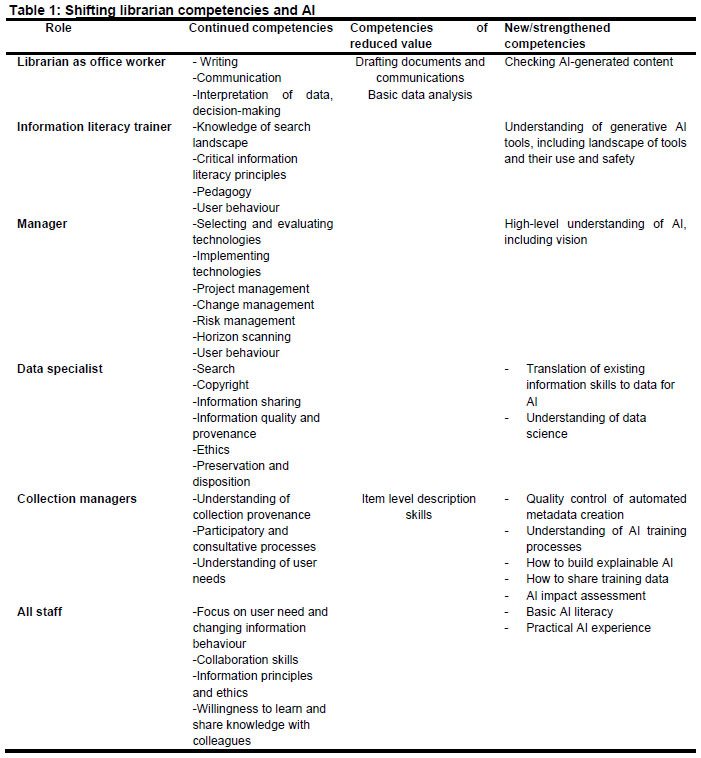
The argument in this paper has been that AI is likely to lead to shifts in librarian competencies, rather than complete transformations. Table 1 summarises the position.
The use of generative AI will shift the skillsets needed for everyday office tasks. For specialist roles, for information literacy trainers we will see integration of a new type of information resource and new ways of interacting with resources into the range of sources, based on ongoing critical information literacy principles. For managers who are tasked with leadership around AI, we could characterise the change as a refocusing of attention on AI technologies across the library, driven by an emerging vision of what AI can do for the library. For data specialists, it is about translation of their skills from information and resources, and research data management to data for the AI context. For collection managers there is a new set of technical knowledge to absorb. As the table above makes clear, it is hard to see many areas where existing professional knowledge is reduced in value.
We can see from examining a number of specific roles that there will be some shifts in the library skills base. But given the nature of AI as a general-purpose technology, all library staff will need to acquire basic AI literacy, including a strong grasp of its ethical dimensions. This may be less to do with the mechanics of machine learning, and more to do with practical exploration of newly emerging AI-based technologies with emphasis on informational and ethical issues. Another competency across the profession is finding out how user behaviour is changing so that AI can be supported in line with user needs rather than in service of techno-utopianism of the big tech companies. This implies qualities such as willingness to learn and to share experiences, so that knowledge is shared within the organisation and across the profession. Across the board, it is likely to require more and diverse collaborations. Therefore, soft skills come to the fore, in alignment with the WEF (2016) predictions.
4.1 The African context: the case of kenya
As the author is based in a global north context most of the current paper has focussed on that context, particularly the UK. For a paper in a South African journal, it is important to extend the discussion to ask how AI might impact library work in the continent. Other authors in this special issue are in a much better position to reflect on this, but a few comments can be offered. Considering the wider context, there is no doubt that AI has the potential to assist in reaching aspirations in African countries such as the Sustainable Development Goals in terms of tackling climate change and improving agriculture, health, fintech and education (Miailhe et al. 2019; Sætra 2023). Yet, to take the example of Kenya, AI is "a beacon of promise and a terrain fraught with challenges" (Musumba 2024: 6). Kenya has a relatively well-developed national AI policy (African Observatory on Responsible AI 2024), but as with other countries in Africa, policy lags behind rapid technology development and in ensuring responsible AI (Akello 2022; Jili 2023; Musumba 2024). There is a growing amount of research and development in AI in Kenya (OECD, 2024). It has been reported to be the fifth most AI-ready economy in Africa, but it remains ninetieth in the world and scores low on AI skills (UN 2023).
Many young Kenyans, even in the countryside, are employed in data labelling and annotation for AI for big tech companies based in the global north (Kidmose 2024), but these are relatively paid and precarious roles, often with little route for career progression. They can involve serious emotional labour because of the exposure to toxic content (Perrigo 2023). Therefore, there is a risk that AI could reinforce extractivism towards the global south. Nkoudou (2023) wrote about the threat that AI could be a form of technocoloniality in Africa. The continent is already subject to digital/data colonialism by big tech companies (Birhane 2020; Coleman 2019; Kwet 2019), and China also sought to develop strong influences in Africa through technology (Gravett 2020). If we accept Crawford's (2021) characterisation of AI, it is inherently exploitative and extractive, and one can fear that AI will only usher in another round of exploitation.
A pessimistic view would see this pattern of exploitation as likely to continue, especially if African countries seek to simply follow global north models of AI development (Musumba 2024). They are at a huge disadvantage in terms of socio-technical infrastructure needed for AI: in terms of reliable power sources, computing power and storage, high-quality data, financial resources, supportive government policies and skilled manpower. Yet there is optimism: an international survey done in 2023 showed that 84% of Kenyan university students wanted to learn about AI and that around two-thirds were actively using it already, which were higher levels than any other country in the survey (Chegg.org 2023). We can think in terms of the potential for African centric notions of AI (Kwamboka & Mwagiru 2023; Eke et al. 2023; Mhlambi 2020). Certainly, there are positive possibilities if AI is developed locally in ways sensitive to local needs, rather than based on imposed models.
Turning specifically to the library context, in many ways one would assume that the same shifts in competencies would be needed that have already been described. Given that the focus of AI development is in the USA and that access to many AI applications requires extra financial resources (and strong socio-technical infrastructures), it may be that the changes come more slowly to Kenya where resources are less abundant. The same library specialist roles exist, but the time and resources to upgrade skills may be less. Nevertheless, there may be some significant differences. Whereas UK academic libraires buy in technologies, it may be that access to technical skills to leverage open-source solutions is better in the Kenyan context. This could allow the adoption of AI technologies at a lower cost and in ways that can be adapted to local needs. It would be beneficial if this made African research and indigenous knowledge more visible.
5 Conclusion and recommendations
The aim of this paper was to consider how AI might change the competencies for library work. This was discussed firstly via the impacts of AI on general office work. Impacts on specialists such as information literacy trainers and data specialists were then considered, as well as the wider needs of all professionals. The final section considered how such changes might play out in a low-resourced context, such as Kenya. It will take time to see if this succeeds in practice.
The findings of this paper are optimistic about the relevance of librarians' skills to AI. However, they do imply that there is a need for librarians to update and translate their knowledge for a data-oriented AI landscape. The need to update existing skills is not a new message for the library profession. Most librarians appreciate the need to constantly learn and update their skills. Often, this has to be a personal effort. Where managers have the resources for workforce development, it is useful to create time for staff to experiment with AI and develop a basic understanding that can inform their professional role. Some libraries have created reading groups or learning circles where staff learn together and discuss how to respond to AI. Many libraries are running internal conferences for their staff to build knowledge. New competencies will also be developed through pilot projects with AI. Furthermore, where resources are available, staff can be supported to attend conferences or even taught courses to update their relevant skills. Librarians are typically generous in sharing their experiences with each other and therefore the strength of the profession is in learning collectively.
African Observatory on Responsible AI. 2024. website https://www.africanobservatory.ai/.
Akello, J. 2022. Artificial Intelligence in Kenya, policy brief. Paradigm Initiative. [Online] https://paradigmhq.org/wp-content/uploads/2022/02/Artificial-Inteligence-in-Kenya-1.pdf.
Anton, E., Behne, A. and Teuteberg, F. 2020. The humans behind Artificial Intelligence - An operationalisation of AI competencies. European Conference on Information Systems Proceedings. https://aisel.aisnet.org/ecis2020_rp/141.
References
- Birhane, A. 2020. Algorithmic colonization of Africa. SCRIPTed, 17: 389.
- Boell, S.K. and Cecez-Kecmanovic, D. 2010. Literature reviews and the hermeneutic circle. Australian Academic & Research Libraries, 41(2): 129-144.
- Boell, S.K. and Cecez-Kecmanovic, D. 2014. A hermeneutic approach for conducting literature reviews and literature searches. Communications of the Association for Information Systems, 34(1): 12.
- Chegg.org. 2023. Global Student Survey. [Online] Chegg.org Global Student Survey 2023.
- Coleman, D. 2018. Digital colonialism: The 21st century scramble for Africa through the extraction and control of user data and the limitations of data protection laws. Michigan Journal of Race and Law, 24: 417.
- Collett, C., Neff, G. and Gomes, L. 2022. The effects of AI on the working lives of women. Paris: United Nations Educational, Scientific and Cultural Organization, InterAmerican Development Bank, Organisation for Economic Co-operation and Development. [Online] https://unesdoc.unesco.org/ark:/48223/pf0000380861.
- Corrêa, N.K., Galvão, C., Santos, J.W., Del Pino, C., Pinto, E.P., Barbosa, C., ... and De Oliveira, N. 2023. Worldwide AI ethics: A review of 200 guidelines and recommendations for AI governance. Patterns, 4(10). https://doi.org/10.1016/j.patter.2023.100857.
- Cox, A. 2023. How artificial intelligence might change academic library work: Applying the competencies literature and the theory of the professions. Journal of the Association for Information Science and Technology, 74(3): 367-380.
- Cox, A.M. and Mazumdar, S. 2022. Defining artificial intelligence for librarians. Journal of Librarianship and Information Science, 09610006221142029.
- Department of Education, UK Government. 2023. The impact of AI on UK jobs and training. [Online] https://www.gov.uk/government/publications/the-impact-of-ai-on-uk-jobs-and-training.
- Eke, D.O., Wakunuma, K. and Akintoye, S. (eds) 2023. Responsible AI in Africa: challenges and opportunities. Palgrave.
- Frey, C.B. and Osborne, M.A. 2017. The future of employment: How susceptible are jobs to computerisation? Technological Forecasting and Social Change, 114: 254-280.
- Gravett, W.H. 2023Digital coloniser? China and artificial intelligence in Africa. In Survival December 2020-January 2021: A World After Trump (pp. 153-177). Routledge.
- Hagendorff, T. 2024. Mapping the ethics of generative AI: A comprehensive scoping review. arXiv preprint arXiv:2402.08323.
- Jili, B. 2023. Kenya must update its regulatory frameworks to keep pace with AI. [Online] https://www.techpolicy.press/kenya-must-update-its-regulatory-frameworks-to-keep-pace-with-ai/
- Jung, C. and Deskian, B. (2024). Transformed by AI. How generative Artificial Intelligence could affect work in the UK and how to manage it. Institute for Public Policy Research. https://www.ippr.org/articles/transformed-by-ai.
- Kidmose, A. 2024. Rural Kenyans power West's AI revolution. Now they want more. [Online] https://www.aljazeera.com/features/2024/2/3/in-rural-kenya-young-people-join-ai-revolution
- Kwamboka, L. and Mwagiru, A. 2023. Artificial Intelligence practitioners' guide: Kenya. [Online] https://www.data4sdgs.org/resources/artificial-intelligence-practitioners-guide-kenya.
- Kwet, M. 2019 Digital colonialism: US empire and the new imperialism in the Global South. Race & Class, 60(4): 3-26.
- Lee, B. 2023. The 'Collections as ML Data' checklist for machine learning and cultural heritage. Journal of the Association for Information Science and Technology, Early view. https://doi.org/10.1002/asi.24765.
- Miailhe, N., Hodes, C., Jain, A., Iliadis, N., Alanoca, S. and Png, J. 2019. AI for sustainable development goals. Delphi, 2, 207.
- Microsoft. 2023. Will AI fix work? [Online] https://www.microsoft.com/en-us/worklab/work-trend-index/will-ai-fix-work.
- Mikalef, P. and Gupta, M. 2021. Artificial intelligence capability: Conceptualization, measurement calibration, and empirical study on its impact on organizational creativity and firm performance. Information & Management, 58(3). https://doi.org/10.1016/j.im.2021.103434.
- Musumba, G. 2024. Artificial Intelligence for inclusive development: Guiding Kenya's policy landscape. A Policy Brief. Kictanet. https://www.kictanet.or.ke/mdocs-posts/artificial-intelligence-for-inclusive-development-guiding-kenyas-policy-landscape/.
- Nkoudou, T.H. 2023. We need a decolonized appropriation of AI in Africa. Nature Human Behaviour, 7(11): 1810-1811.
- OECD. 2024. AI in Kenya. [Online] https://oecd.ai/en/dashboards/countries/Kenya
- Padilla, T., Scates Kettler, H., Varmer, S. and Shorish, Y. 2023. Vancouver Statement on Collections as Data. [Online] https://zenodo.org/records/8342171
- Perrigo, B. 2023. Exclusive: Open AI used Kenyan workers on less than $2 per hour to make ChatGPT less toxic. Time magazine Sætra, H.S. 2022. AI for the sustainable development goals. CRC Press.
- Simkute, A., Tankelevitch, L., Kewenig, V., Scott, A. E., Sellen, A. and Rintel, S. 2024. Ironies of Generative AI: Understanding and mitigating productivity loss in human-AI interactions. [Online] arXiv preprint arXiv:2402.11364.
- Susskind, D. 2020. A world without work: Technology, automation and how we should respond. Penguin UK.
- UN. 2023. 2022 UN Kenya Annual Results Report Kenya. [Online] https://kenya.un.org/en/255194-un-kenya-2022-annual-results-report.
- Verma, A., Lamsal, K. and Verma, P. 2022. An investigation of skill requirements in artificial intelligence and machine learning job advertisements. Industry and Higher Education, 36(1): 63-73.
- Willcocks, L. 2020. Robo-Apocalypse cancelled? Reframing the automation and future of work debate. Journal of Information Technology, 35: 026839622092583.
- World Economic Forum. 2016. The 10 skills you need to thrive in the Fourth Industrial Revolution. [Online] https://www.weforum.org/agenda/2016/01/the-10-skills-you-need-to-thrive-in-the-fourth-industrial-revolution/.
- Zhao, X., Cox, A. and Cai, L. 2024. ChatGPT and the digitisation of writing. Humanities and Social Sciences Communications, 11(1): 1-9. https://doi.org/10.1057/s41599-024-02904-x.
Accepted: 31 August 2024