Emerging technologies and skills to improve service delivery in digital libraries
Abstract
Emerging technologies such as artificial intelligence have become a dominant technological focus in the academic context that enables libraries to restructure their activities. AI enhances library operations and service delivery within the virtual workplace ecosystem, leading to seamless digital information flow that supports innovative services tailored to meet evolving user needs. The purpose of this study was to investigate how emerging technologies and skills can improve service delivery in digital libraries. The positivist quantitative approach research methodology was adopted in this study applying a survey data collection method coupled with literature review. Data were analysed through statistical instruments and visually presented. The study revealed that adopting a wide scale of technologies would require digital competencies and algorithmic literacy to influence broader access to knowledge and re-engineer library operations for efficiency in virtual and physical environment. The study recommended that artificial intelligence-driven technologies would better position libraries for future innovative changes through efficient systems integration to streamline services and foster greater accessibility to knowledge resources to enrich user experience. Adopting emerging technologies improved distribution and sharing of resources, leading to better service delivery, as cybrarians could devote valuable time to supporting users.
Artificial intelligence; digital libraries; disruptive technologies; service delivery; staff competencies
1 Introduction
Changes in the information environment have been precipitated by the adoption of emerging technologies such as artificial intelligence (AI) for digital transformation (Dx), thus impacting on professional skills and competencies of library staff. Optimisation of AI enables libraries to transcend to digitally accessible platforms given the integration of different technologies to provide a responsive and sustainable solution (Okunlaya et al. 2022). This means that AI technology encourages the library's digital transformation and improves the creation of value services for users. Sridevi and Shanmugam (2017:61) affirm that AI is the current technology used to manage the digital library, while Luca, Narayan and Cox (2022) posit that AI and robotics contributes to the digital transformation of libraries, hence enabling a higher level of productivity in various library management processes and around-the-clock access services and decision-making capabilities.
The transition gives libraries a competitive advantage by incorporating different communication technologies that provide sustainable and responsive solution such as digital workspaces; however, professionals must be firmly grounded in digital literacy-related competencies such as the skills to use emerging technologies, specifically AI literacy (Luca et al. 2022). These skills include the ability to understand and implement AI tools and the Internet of Things (IoT) to optimise workflows, cloud computing to offer innovative and flexible resources on economies of scale, robotics to automate repetitive tasks, including improving the services of digital libraries. Information professionals must have the requisite knowledge, skills and competencies required to be equal partners in their organisations in ensuring that, through AI, libraries are digitally transformed to improve service delivery (Jain & Akakandelwa 2016).
In libraries, AI systems would optimise collection management decisions by identifying trends and predicting demand for specific materials, bridge in time for round-the-clock access of resources and bridge in space in digitising materials for ease of retrieval (Omame & Alex-Nmecha, 2020). Effort has been minimised for robotic machines and chatbots as virtual assistants for effective delivery of information to streamline information retrieval process in ensuring speed. Despite the introduction of digital technologies, it should be noted that both AI and librarians reinforce each other in providing essential services to patrons (Vijayakumar & Sheshadri 2019) in that they are interdependent rather than supplementary in digital library operations.
Digital transformation refers to coordinated shifts to digital platforms based on emerging technologies introduced to influence the operating model of libraries and education, including cultural, service and personnel combined shifts (Brooks & McCormack 2020). Integration of these technologies into all aspects of library services and operations is essential to improve access to information, streamline administrative processes and enrich the learning and research experience for students and faculty using AI.
AI is the most imperative emerging technology that shapes the future of libraries and serves as a transformative force with its multifaceted capabilities powered by machine learning algorithms and use of natural language processing for book classification to metadata enrichment to enhance library services (Ali, Naeem & Bhatti 2021; Vijayakumar & Sheshadri 2019). Cox and Mazumdar (2022) elaborate that AI either perform cognitive or sensory processes and can emulate tasks requiring human intelligence. Their pivotal role is to simplify operations to ensure accuracy and to amplify the efficiency and search retrieval processes.
Digital libraries (DL) integrate a wide range of electronic resources, such as e-books, electronic journals in online platforms to enable a technology ecosystem for more connections and interrelations with the physical space. Operations rendered by cybrarians are streamlined for efficient retrieval of information with reference to the framework on smart libraries and smart self-service kiosk (Modiba & Chisita 2023:3-4; Tseole & Modiba 2023:5).
According to Cox (2022) and Tseole and Modiba (2023:2), DL can be described in the context of smart library, space managed through sensors, IoT and, in the dimension of AI, for knowledge discovery with application of professional skills. These libraries rely on the ability of librarians to function in an interconnected information ecosystem to provide virtual services and collaborate with other libraries.
Service delivery in the context of academic libraries is the process of providing access to various resources using cyber-physical systems and intelligent technology poised to improve user experience and efficiency for staff in pursuit of excellence and effectiveness (Modiba & Chisita 2023). This may require reskilling staff as the organisation adapts and reshapes services.
Therefore, this study explored the adoption of emerging technologies like AI for robotic process automation for routine activities and makerspaces in academic libraries to enhance student learning and provide tailored services for researchers. It emphasises the importance of librarians possessing the necessary digital literacy skills in instruction proficiency to effectively search and evaluate the credibility of sources and virtual collaboration. This digital integration demands a new skill sets from library staff, facilitating a seamless transition and fostering a cultural shift towards embracing new roles in the evolving educational landscape.
2 Contextual setting
In the context of 26 academic libraries in South African higher education, eight universities formed a sample frame of 130 from five provinces. These universities were chosen as they were, to a large extent, comparable in terms of their core business, which is similar with variable components of input and output variables in either teaching and learning (Green cluster) and had a strong research focus (MacGregor 2010). Each institution is defined by distinct characters, such as size, growth, and research profile, among other components. The business entity was academic libraries, and the clientele representative was the university community comprised of students (undergraduates, postgraduates), researchers and academics at all levels of the academic programmes (Alexander et al. 2019).
Adequate library resourcing is an important agenda in universities, as it has proved to be a critically indispensable element in the efficient functionality of academic libraries. More so are the issues of diverse workforce and an increase in enrolment in universities that have an impact on the transformative agenda of services and resource provision. Catering for diversity in all forms and an increase in student numbers requires repositioning to achieve sustainability. Reimagining library facilities and infrastructure positions libraries to respond to the evolving needs for a hybrid, flexible model that provides access to physical and e-services, with appropriate ICT to support multimodal learning technologies (Gleason 2018).
3 Problem statement
The established problem is that there are not enough skills for professionals to function effectively in digital environments (Ocholla & Ocholla 2020; Dube & Ngulube 2013). A lack of skills will have an adverse effect on service delivery. A lack of support to use emerging technologies would deprive staff of the flexibility to engage remotely while maintaining good work balance in the hybrid way of working. Distance learning students would be inadequately supported in the virtual mode of learning and thus would have to be physically on campus sites.
The human resource allocation problem also has to do with relevant skills and competencies that are tuned to foster innovation, efficiency, and productivity in a knowledge-driven economy. A lack of these required skills poses a challenge of poor customer satisfaction. Dube and Ngulube (2013) posit that delivering superior value service in emerging areas is a problem if the level of education is not attuned to global trends. This problem can be averted by hiring newly skilled professionals, although it comes at cost (Blake-Gonzalez 2011:8).
The lack of digital literacy skills would lead to slow adoption of the new technologies that are implemented. Therefore, staff and students need to be equipped with the relevant skills to adapt to changes in an AI-driven environment. Most of the services in libraries are still manual, and it is not easy for students to access services after hours. This can delay the delivery of the academic programme and would lead to poor performance and not completing projects on time. Luca et al. (2022:186) suggest a review and support of the curriculum with ethical, trustworthy, and transparent use of AI, given the implications for AI literacy and impact on scholarly communication to reshape knowledge and services.
To digitally transform libraries, AI becomes essential, as it yields efficiency and high productivity levels, such as using robotics to automate manual functions such as shelving. User needs and expectations such as the demand for round-the-clock access to library materials inevitably impose severe stress on the shrinking financial resources in terms of affordability to acquire more online resources and render virtual services. In addition, staff training needs also comes at a cost. Meeting critical service requirements becomes complex due to new demands exacerbated by demographic changes, in addition to technological advances such as AI.
4 Purpose and objectives of the study
The purpose of this research was to examine emerging technologies and skills to improve service delivery in digital libraries. The following are objectives of the study:
• To evaluate professional skills ideal for digital libraries.
• Determine how emerging technologies have impacted professional skills.
• Examine the extent of adoption of emerging technologies in providing solutions for academic libraries.
• Recommend opportunities for improving service delivery
5 Review of literature
This section presents the review of the literature on emerging technologies and skills to improve service delivery in digital libraries.
5.1 Librarianship skills requirements
The new developments in libraries have expanded the role and scope of librarianship prompted by realignment of services towards innovative services and realignment of skills to better serve users and support the curriculum. The South African Committee of Higher Education Libraries (2021:31) posits that "the Library and Information Science (LIS) sector is governed by a set of competencies and skills comparable to post positions in an academic library." Librarians are required to have a South African Qualifications Accredited (LIS) qualification, coupled with specific professional skills, which Raju (2017:6-7) describes as including personal attributes required to function effectively in a digital library. Furthermore, the South African Committee of Higher Education Libraries (2021:9-11) provides in more detail the library ICT competencies due to the new and innovative service delivery focal points. Personal attributes complement competencies and result in high-quality performance and efficient service delivery.
Advanced technology knowledge and staff expertise in an academic library of the 21st century are fundamental skills to realign with changing priorities and reallocation of resources. The repositioning of libraries has prompted libraries to redefine and align their services towards innovation and embrace user-centric library services. The framework for librarians is designed primarily within the constituency of international trends affecting the functions of academic libraries associated with industry, as it influences practice and inherently requires the emergence of new roles and responsibilities. Since 75% of South African libraries have incorporated new roles in their staff complement (South African Committee of Higher Education Libraries 2021:31), new virtual services are precipitated by the hybrid service offering and remote working given the immersion of software and tools that are inclined towards faculty-embedded librarianship and improved efficiencies in a digital integrated learning environment.
Continuous staff development has become imperative in the job change process for library success and thus should be part of the strategic agenda. Planning for staff development initiatives reflects the universities' progressive response and move towards embracing innovative changes and provides opportunities for growth and positioning. Further, it has been observed that more non-LIS qualification holders are joining the LIS profession, offering support in IT, finance and human resource functions. This creates opportunities for other disciplines to further their studies and eventually join librarianship (Carlson 2022).
5.2
Human resource skillsHuman resources skills are indispensable in organisational operational activities; thus, attracting well-trained, experienced, and committed professionals will enable good services to be provided. Dube and Ngulube (2013:2) state that efforts must be made to retain well-performing staff with relevant skills in an ever-changing digital environment, as knowledge retention is the multidimensional component of human resource strategies to retain expert knowledge. Therefore, it is essential that recruitment strategies are geared to recruit talent to better serve emerging digital needs.
Ocholla and Ocholla (2020:7-8) explain the relevance of interlinkages in the context of 4IR and the influence in future jobs that should embrace the principle of everywhere and any time of resource access. Policy directives are heightened and should support the transformative agenda by being adaptable, responsive and ethical.
Certain skills are essential based on microeconomic impacts such as declining budgets and staff competency levels in understanding principles on infrastructure, broadening access, funding, human resources, collections, institutional effectiveness, and professional values (Association of College and Research Libraries 2011). The Horizon report (Alexander et al. 2019) also provides the following perspectives. Growth, constraints, collapse, developments in technology, practices and transformation, as influencing the competencies necessary to address issues on access, equity and cost was driven by changing demographics.
Future jobs will require librarians to be suitably qualified, competent, adaptive, innovative, ethical and critical thinkers in solving complex problems. These skills will enable them to deliver smart services with use of smart technologies, that is, to know how tools work, develop workflows that would serve users in an innovative way. Smart leadership would approve the use of adaptable resources for physical and virtual access in the technology ecosystem.
Newman and Dickinson (2017) point out the need for libraries to position themselves to meet the need for online support by suggesting hybridisation in multiskilling, integrating information technology (IT) and proactive library support to expand learners' capabilities. Carlson (2022:50) states that leaders should dispel the myth that productivity is equal to being on campus at a specific work location. Attaining work-life balance is important, providing flexibility to workers, and having faith that work will be done. Remote work is building a new culture for libraries, and some libraries are successfully implementing this practice.
5.3
Emerging technologies and impact professional skillsAs libraries increasingly use digital technologies and resources, there is a demand for library professionals with qualifications in areas such as digital technology, management, and communication skills (Choi & Rasmussen 2009:466). Computer-related competencies remain effective and relevant in the 21st century. Learning delivery (instructional technologies, presentation skills), resource creation and description are still relevant in librarianship and information management sciences, such as metadata creation, indexing and quality, as well as institutional repository management.
The preparedness of staff to use newly introduced systems is valuable. Peng, Li-Hua and Moffett (2007:202) affirm that the three key elements that influence appropriate resourcing in knowledge and information research are people, technology and process. Staff should be able to embrace new technology and changes in technology. They should have the necessary skills to support users virtually and through contact sessions. This requires the personnel to have the competencies to be specialists in IT.
The ubiquity of information has had an influence on librarian skills requirements to have a more technical focus in terms of roles and responsibilities, given the changes brought about by IT. Carlson (2022:40) states that the role requires a combination of technical, teaching and people skills, which are rare on campuses. As a result of automation, a combination of more specialised and soft skills is required. Librarians must be tech-savvy. Duties have increased to include helping scholars find scholarly work and spending more time interacting with users. This is because more services are delivered through a computer, phone, and other virtual platforms.
The resource dispositions contribute to the redesigned LIS digital landscape in the way information is disseminated, thus responding to digital native needs. These are young computer-literate users that embrace high-tech environments and require academic libraries to be a one-stop shop for all their information and technology needs (Makori, 2009; Moyane et al. 2020:597).
Open-source journals and open education resources play a more important role in scholarship and have become significant in response to the high cost of textbooks, embracing open deals for publishing (Carlson 2022:27; 31). OERs require coordination by librarians, as they understand copyright restrictions and can find new materials.
5.4
Technology advancements adoptionThrough digital transformation, the workforce, culture, and technologies have transformed educational and operating models to provide strategic directions and value proposition (Brooks & McCormack 2020). The reason for this is that technology resources are pivotal in managing the digital environment, and monitoring and evaluating user satisfaction primarily obtained from electronic feedback surveys.
Sridevi and Shanmugam (2017) posit that AI applications are effective in managing the digital library. AI goes beyond automated library routine operations and creates intelligent rational systems that replicate human behaviour without the librarian's intervention. It encompasses different systems, such as robotics often used for automatic programming for routine tasks; Natural Language Processing (NLP) used for planning and decision support; expert systems as they contain knowledge base; and a subsystem useful in organising content in reference services, technical services functions -cataloguing, classification, indexing and conversational technology like chatbots popularly (Asemi & Asemi 2018; Omame & Alex-Nmecha 2020). AI is essential in digital and virtual libraries where resources and services are completely computerised, as it enables librarians to focus on meaningfully disseminating knowledge and information. This is confirmed by Omame and Alex-Nmecha (2020) who explain that AI can do the job faster than humans and can handle complex work efficiently with reduced errors and defects.
Makerspaces have evolved as libraries demonstrated an interest in learning through practical skills and putting different technologies in one space. These technologies can promote entrepreneurial skills (Burke 2015). Training in the use of this equipment is essential, particularly in the use of 3D printers. The adoption of chatbots in reference services has been effective in the delivery of information in digital environments. Nawaz and Saldeen (2020:443) highlight that chatbots "enhance routine services at the reference desk to increase service output as they facilitate multiple user benefit of the simultaneous user chat service." Their availability around the clock increases user engagement by allowing staff to conveniently interact with clients in a live chat environment at any time. This change could be in the form of automating the most repetitive tasks, allowing the employee to focus on the more interesting aspects of the job, such as those that require imagination, problem solving and collaboration. Therefore, it could lead to role expansion (Cox 2021:11).
Against the backdrop that human work is likely to diminish, the wavering expression is that some roles could be enhanced by AI, as this will free up professionals' time from 'routine work' to focus on more creative and social aspects of work that is beyond automation (Cox 2021:1-2). Although Frey and Osborne (2017) state that at least 65% of work activities could be automated, achievement is at 30% at the most. A hybrid professional approach will result in a balance with the necessary technology integration of services and resources. Cox (2022:5) provides an illustrative match of the skills needed for integration of AI services. These tools can serve as vehicles driving efficiency in libraries adopted alongside other information and communication technologies. The right ambience in physical buildings still appeals to users and can improve the use of technologies in library spaces. The smart library can be achieved with the fusion of IoT through sensor data, thus giving users the convenience of accessible resources and services anywhere and at any time for adaptable self-learning.
The continuous access to a myriad of networked devices, therefore, results in a natural shift to preferred use of virtual space with round-the-clock access to resources, services, and scholarly materials. Understanding other complexities related to the education system could allow academic libraries to review their service operations to ensure that integrated diverse information resources are aligned with the academic programme.
5.5 Opportunities for improvement in service delivery
Considerations for collaboration and partnerships with library stakeholders such as faculties and space management departments become essential for master planning and on IT infrastructure and human development given the migration of collection shifts to online platforms. The need to repurpose physical spaces to accommodate technology and comfort became essential. Carlson (2022:11) reiterates that new "changes can create a sense of purpose" and bring excitement to staff opportunities to reimagine workspaces. Digital spaces can present opportunities for students at different institutions to work on joint projects and extend opportunities for information sharing that often result in costs savings when using collaborative platforms for virtual meetings instead of travelling, thus saving valuable time. Cox (2022) argues that hybridisation, aligned with managerial values, promotes efficiency and cost savings by enabling professionals to work remotely while also supporting students virtually.
Relevant staff competencies with suitable qualifications would be necessary in revitalised library services. In this regard, the South African Committee of Higher Education Libraries (2021:17) suggests that libraries should focus on building partnerships and collaborations throughout the institution to best support teaching, learning and research strategies. Significantly, professional associations in the LIS make a huge contribution to the professional development of librarians. This means that institutions such as the IFLA would play a role at international level and LIASA at national level in providing platforms for engagements and networking.
6 Research methodology
This article used a quantitative approach with the application of the probability sampling method as the primary sample method. The sample frame consisted of 130 with 91 respondents, consisting of senior management, librarians and staff in specialised portfolios. Data collection methods included the use of a survey instrument, coupled with a review of the literature. Data were analysed using statistical instruments such as SPSS. The analysis is presented in visual images such as graphs with summaries. The reliability of the data was measured by the validity of the process that ensured the accuracy of the results by applying cross-checking techniques during the analysis of the raw data.
Internal validity in terms of consistency measured what it was intended to measure. Face validity was carried out with the participation of a statistician for quality assurance to ensure data verification and the validity of the results. The Mann-Whitney U test was applied to assess whether there were statistically significant differences between the two groups. The choice of this nonparametric test was motivated by use of the Likert-scale questionnaire. There were no significant differences in most items, in some cases marginally below 5% in other p-values, they were below 10%.
For reliability testing, Cronbach's alpha served as a measure for the internal consistency of a scale, or a collection of items designed to evaluate a single construct. Higher values of Cronbach's alpha imply strong correlations among the scale items, indicating that they are effectively measuring a shared underlying construct.
7 Findings of the study
The findings revealed that when examining emerging technologies, use of digital communications, combined with professional skills, would deliver effective services in libraries; therefore, it becomes essential that academic library staff have the essential skills to perform key service operations. The result confirms that libraries view these skills as essential with priority of human resources, which is interpretated as staff competencies and the ability to make decisions, and financial and digital skills that relate to understanding and adoption of emerging technologies. Staff development is considered relevant to respond to the rapid innovations.
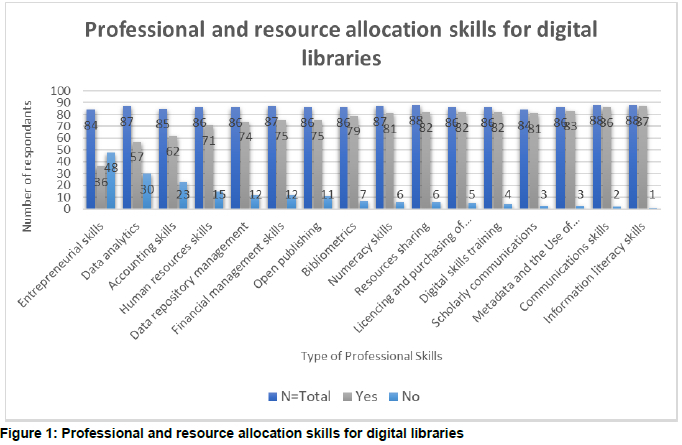
Institutions confirmed the top five skills their staff must have to deliver effective library services, as reflected in figure 1. Digital literacies that include information literacy and research kills, that is, metadata and the use of bibliographic management systems and scholarly communications, were considered essential for libraries to be optimally responsive to user needs. The skills reported have a significant effect on optimal performance in a digital library.
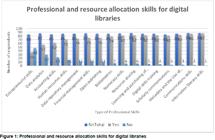
In the context of providing essential competencies, alignment of service operations activities with institutional goals is essential, and ensuring strategic alignment to meet short-, medium- and long-term objectives is essential (Jain & Akakandelwa 2016). All strategic elements should be interlinked to achieve an optimal balance with the desired performance output. Dube and Ngulube (2013) state that to survive and maintain sustainability in a rapidly changing academic environment, staff competencies and technology tools are the key drivers of the effective management of university libraries.
Analyses of changing roles of library professionals, and flexibility in the virtual learning environment, staff development needs and future strategic management are essential for an efficient organisation (Association of College and Research Libraries 2011).
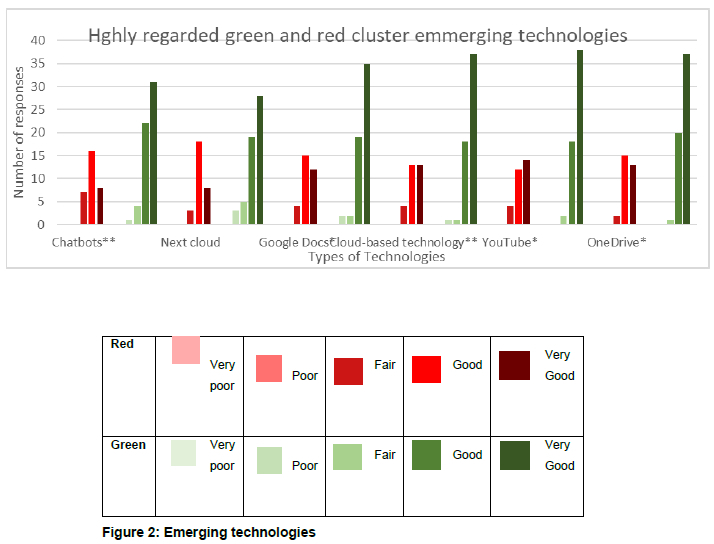
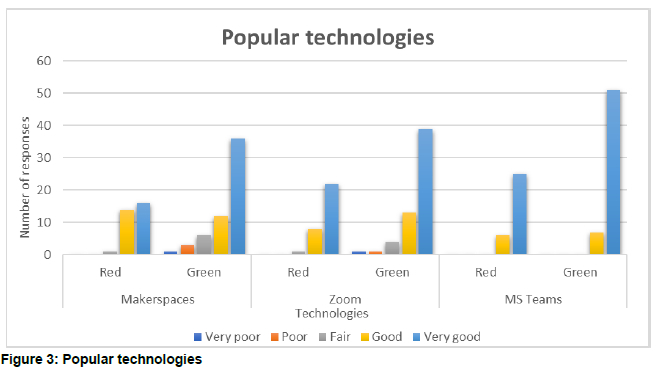
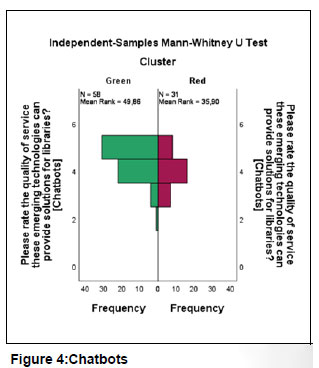
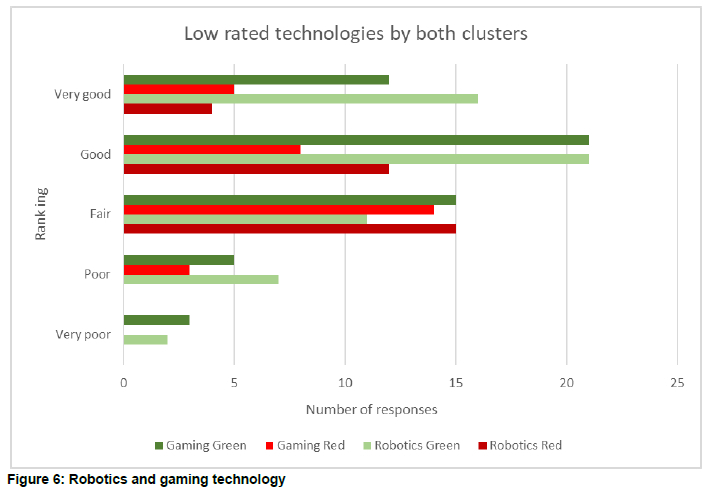
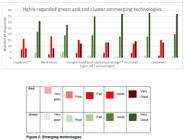
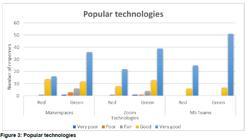
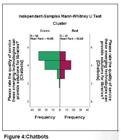
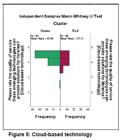
Figures 2 and 3 indicate the average scores that institutions perceive the level of importance merging technologies can provide solutions for libraries. Communication platforms were rated highly important. Makerspaces, Zoom and MS Teams received high ratings as library services from both the red and green cluster institutions. In the green group, YouTube, cloud-based technology, OneDrive, Google Docs and chatbots were regarded important with not much difference between the universities, as reflected in figures 4 and 5 below.
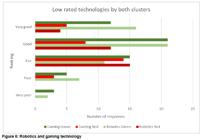
Robotics had an average of 3.70, which confirmed findings that although it is important as a self-help tool, the uptake is low, at 4% in South Africa (Ocholla & Ocholla, 2020). Given that most libraries are gradually adopting AI, this percentage is likely to increase from the lower ranking (15,8%) and gaming (14,3%).
The level of importance of trends that provide effective library services for both clusters In South African universities is an average of 64,7% - (65%) adoption of technologies. The red cluster is at 64,7% and the green cluster at 65,9% - (66%), which shows good uptake; however, with a constant increase, as previously reported by Ocholla and Ocholla (2020:361) that 64% of academic libraries responded positively to the changing environment in line with academic trends. The top current trends in South African university libraries previously overlap with those of this research study, such as shift to electronic resources (e-books and databases), digital literacy, digital scholarship (institutional libraries), use of LibGuides and off-campus access. Constant monitoring of trends will assist the universities to adapt accordingly in line with their strategic resource and service provisioning, particularly with respect to relevant competencies and IT infrastructure support.
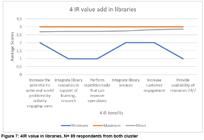
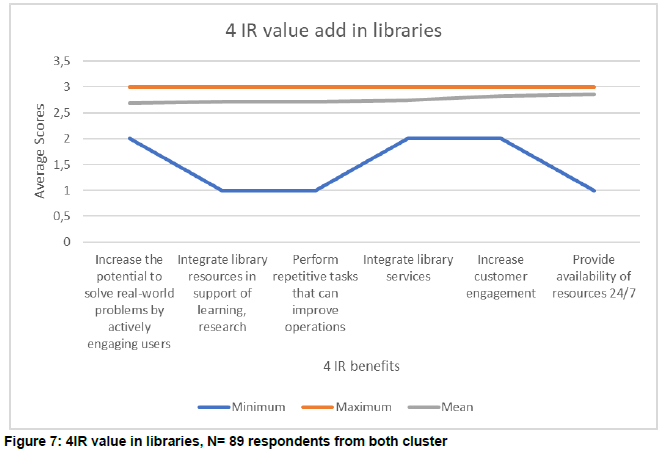
The adoption of 4IR would deliver the top five functions for both the red and green clusters, where 1 represents "low likelihood" and 5 signifies "high likelihood". Delivering library services around the clock appealed to the respondents to accelerate the use of library resources, followed by increasing customer engagement with integrated services. The potential of some technologies such as chatbots and robotics to perform repetitive tasks can enrich customer experience with greater accessibility of knowledge resources through digital platforms to enhance learning and research. The adoption of AI would eliminate human errors and defects (Omame & Alex-Nmecha, 2020). Despite the view that technologies are becoming more complex, the application of AI simplifies tasks to make them more comprehensible (Nawaz & Saldeen 2020). AI is a great tool that can increase productivity and bring something new to all modern working spaces. Evident convenience for hybridisation, aligned with managerial objectives with technologies' capabilities being used from various ends, confirms arguments for efficiency and cost savings (Cox 2022:4).
Technological proficiency and knowledge sharing are two approaches that all institutions in the red cluster found to be highly useful, with knowledge sharing being the only approach that the red cluster rated as useful to a very high extent, higher than the green cluster. The green cluster consistently rated the approaches higher than the red cluster to a very high degree, apart from the knowledge-sharing approach.
8 Recommendations
In principle, web technologies and other emerging technologies such as 4IR change how we live and work, and should be integrated into the library's strategic agenda. As new technologies enable libraries to adapt to changes caused by innovations, the need for critical skills supporting educational and learning programmes is increasing and should be included in future skills projections. In this way, librarians would need to acquire new skills to meet user needs. This implies that staff development should be a continuous strategic response for libraries to position themselves in the digital environment (South African Committee of Higher Education Libraries, 2021); therefore, it becomes an imperative focal point on prioritising essential skills (Dube & Ngulube, 2013) and has clear policies encapsulating benefits of the skilled workforce while being mindful of equity targets required for certain jobs.
The adoption of RFID, robotics and chatbots and the use of makerspaces are seen as transformative steps towards modernising operations and enhancing user experience. These technologies are expected to streamline processes, improve accuracy, and speed, and foster innovative learning and research environments (Gleason, 2018). Networked infrastructure and communications technology, staffing and finances are intricate in digital libraries. The adoption of AI technologies has transformed library services, thus responding to the new generation of library user needs. Cox (2021) states that the impact of AI in academic libraries has been informative, allowing ease of integration with other applications to provide better access to services and resources, such as chatbots that can be easily integrated with the website to expand library services, improve user experience, and promote collaboration between different stakeholders (Omame & Alex-Nmecha, 2020).
Adoption of cloud-based technologies, such as Dropbox, Skype and Google Docs, supports the shift to online learning and emphasises the student-centred learning, since such resources are available at any time without physical building constraints (Alexander et al. 2019; Gleason, 2018). Blake-Gonzalez (2011:8) cautions that making a digital investment in changes brought about by new staff competency requirements comes at a cost, hence necessitates improved resource management to demonstrates a culture of learning and growth. Having a sustainable financial model would have positive implications for service delivery, as new technologies are acquired in response to new trends. Recruitment strategies should be able to attract staff with the right skills to meet the demands of innovative services.
10 Conclusion
Digital libraries promise efficient delivery of library operations with the use of modern technology, such as AI, as it has great potential for library and information service (Omame & Alex-Nmecha, 2020:135). Librarians have improved their engagement with users using various digital platforms such as conversation platforms and the quick retrieval and discoverability of content. On a large scale, AI will shape the future and influence the acquisition of new skills and competencies. Using a range of technologies, libraries can reimagine their operations and seek new ways to meet customer needs in a full-text online resources domain. Libraries that are AI driven will be accustomed to continuously develop their staff skills to provide individual and group user support.
Re-engineering operations, as influenced by AI and cyber-physical systems with reliable and secure IT infrastructure, allow efficient systems integration, thus enabling libraries to respond to both physical and virtual spaces. A hybrid service with the right personnel competencies to support emerging technologies would provide a systematic approach to respond to user preferential needs.
This requires digital literacy for both librarians and users. Data literacy and scholarly communication have become essential skills for researchers. The newly acquired skills would increase the development of new knowledge and are likely to create more opportunities to improve further use of AI technologies. New research niche areas could be developed with more research on further adoption of emerging technologies in libraries and their impact on services as responsive initiatives.
Alexander, B., Ashford-Rowe, K., Barajas-Murphy, N., Dobbin, G., Knott, J., McCormack, M., Pomerantz, J., Seilhamer, R. and Weber, N. 2019. EDUCAUSE Horizon Report: 2019 Higher Education Edition. EDUCAUSE.
References
- Ali, M.Y., Naeem, S.B. and Bhatti, R. 2021. Artificial Intelligence (AI) in Pakistani university library services. Library Hi Tech News, 38(8): 12-15.
- Asemi, A. and Asemi, A. 2018. Artificial Intelligence (AI) application in library systems in Iran: a taxonomy study. Library Philosophy and Practice, 2.
- Association of College and Research Libraries. 2011. Standards for Libraries in Higher Education. C&RL News, 73(1): 3448. https://doi.org/https://doi.org/10.5860/crln.73.1.8693.
- Blake Gonzalez, B. 2011. Resource allocation strategies in doctoral/research university (extensive) libraries. ProQuest LLC.
- Brooks, D.C. and McCormack, M. 2020. Driving digital transformation in higher education. EDUCAUSE. https://www.educause.edu/ecar/research-publications/driving-digital-transformation-in-higher-education/2020/introduction-and-key-findings%20.
- Burke, J. 2015. Making sense: Can makerspaces work in academic libraries? [Electronic version]. ACRL Conference Proceedings.
- Carlson, S. 2022. The library of the future: how the heart of the campus is transforming. Washington, DC: The Chronicle of Higher Education.
- Choi, Y. and Rasmussen, E. 2009. What qualifications and skills are important for digital librarian positions in academic libraries? A job advertisement analysis. The Journal of Academic Librarianship, 35(5): 457-467.
- Cox, A. 2021. The impact of AI, machine learning, automation and robotics on the information professions: A report for CILIP. CILIP.
- Cox, A. 2022. How artificial intelligence might change academic library work: applying the competencies literature and the theory of the professions. Journal of the Association for Information Science and Technology: 1-14. https://doi.org/10.1002/asi.24635
- Cox, A.M. and Mazumdar, S. 2022. Defining artificial intelligence for librarians. Journal of Librarianship and Information Science. https://doi.org/doi:10.1177/09610006221142029
- Dube, L. and Ngulube, P. 2013. Pathways for retaining human capital in academic departments of a South African university. South African Journal of Information Management, 15. https://doi.org/10.4102/sajim.v15i2.560
- Gleason, N.W. 2018. Higher education in the era of the fourth industrial revolution. Bibliographies. Singapore: Palgrave Macmillan.
- MacGregor, K. 2010. South Africa: New university clusters emerge. University World News 24.
- Makori, E.O. 2009. Reinventing academic libraries in Kenya. Library Hi Tech News, 26(5/6): 10-13.
- Modiba, T,M. and Chisita, C.T. 2023. Libraries in an era of constant flux: establishing smart libraries in South Africa. Global Knowledge, Memory and Communication: 16. https://doi.org/https://doi.org/10.1108/GKMC-12-2022-0290.
- Moyane, S., Dube, L., Nkomo, N. and Ngulube, P. 2020. Competitive intelligence as a coping strategy for academic libraries in South Africa. Library Management, 41(6/7): 593-606. https://doi.org/10.1108/LM-05-2020-0083. https://doi.org/10.1108/LM-05-2020-0083
- Nawaz, N. and Saldeen, M.A. 2020. Artificial Intelligence chatbots for library reference services. Journal of Management Information & Decision Sciences, 23: 442-449.
- Newman, D. and Dickinson, M. 2017. Preparing students for success in hybrid learning environments with academic resource centers. New Directions for Teaching and Learning, 2017(149): 79-88.
- Peng, J., Li-Hua, R. and Moffett, S. 2007. Trend of knowledge management in China: challenges and opportunities. Journal of Technology Management in China, 2(3): 198-211. https://doi.org/10.1108/17468770710825142
- Raju, J. 2017. LIS professional competency index for the higher education sector in South Africa. University of Cape Town Libraries.
- South African Committee of Higher Education Libraries. 2021. State of South African academic libraries report: embracing new frontiers. CHELSA (Pretoria: CHELSA). https://chelsa.ac.za/wp-content/uploads/2021/08/StateOfSouthAfricanLibrariesReport.pdf.
- Sridevi, P.C. and A.P. Shanmugam. 2017. Artificial Intelligence and its applications in libraries." E-Resources Management, 1: 61-63.
- Vijayakumar, S. and Sheshadri, K.N. 2019. Applications of artificial intelligence in academic libraries. International Journal of Computer Sciences and Engineering, 7(1): 136-140.
Accepted: 31 August 2024