
 Language and translation as tools for the archiving and preservation of Indigenous knowledge: the case of Lesotho
Abstract
Translation, along with interpreting and prostitution, is said to be one of the oldest professions in the world. While language was used as a tool for knowledge acquisition, translation, on the other hand, was used to facilitate trade and knowledge sharing among nations. In sub-Saharan Africa, there is little historico-cultural documentation in African languages, as early documentation was done by the missionaries and the first European settlers in European languages - English, French, Dutch, Portuguese and Spanish. In Lesotho, a plethora of historico-cultural writings were done by missionaries, most of which have not been translated into Sesotho for ease of access by the common man, who may not be proficient in English and French, but are able to read and write in Sesotho. The present paper discusses problems related to language and the insufficiency of Sesotho records, archives and special collections, as many of the early records remain untranslated in the archives. It advocates for translation as a tool for documentation and archiving of indigenous knowledge and its transmission to future generations. The paper further argues for language as one of the primary tools through which socio-cultural information can be archived.
language; translation; archive; documentation; Indigenous knowledge; Lesotho
1 Introduction
From the beginning of time, language, as a subset of culture, has been used as a tool for oral documentation of human experiences over time and space, thus continuing the culture of a people regardless of origin and culture. Based on archaeological evidence available to date, it was only in 3200 BC that cuneiform writing was used to document human experiences in Mesopotamia, present-day Iraq (The Editors of Encyclopaedia Britannica 2020). Since then, language ceased to be an oral systematic medium of communicating ideas or feelings by using conventionalised signs, sounds, gestures, or marks having understood meanings (MWD2 2024). It then became a tool for formal written documentation, thus archiving and preserving the savoir-faire of a people. As a result, it was used as a tool for knowledge self-appropriation as people started documenting their experiences and archiving and preserving historico-cultural records for future generations, as it has been observed in the writing of pre-Christian philosophers and scientific pathfinders such as Solon, Thales, Plato, Pythagoras, and others, some of whom travelled to Egypt, which was then the hub of knowledge and education, to study principles of democracy as stated by Sebotsa and Mahula (2022:135-155) and corroborated by Siculus (1990:88):
For many of the ancient customs that were current among the Egyptians were valued not only among the native inhabitants but also were admired greatly by the Greeks. For this reason, Greeks of the highest repute for learning were eager to visit Egypt, that they might gain knowledge of its noteworthy laws and customs. For albeit the country of old was inhospitable to the strangers for the reason just mentioned, yet nonetheless in ancient times Orpheus and the poet Homer were anxious to voyage thither, as were many others as well in later days including Pythagoras of Samos and even Solon the law giver.'
Translation and interpreting, as some of the oldest professions in the world, were used to facilitate trade and knowledge sharing among people of different cultures and thus different linguistic backgrounds. The closest proof of this is the translation of the Hebrew Bible into Greek in the 3rd century known as the Septuagint (the five books of Moses) in the Old Testament and epistolary correspondence between the Apostles and different nations and cultures in the New Testament, all of which have been passed down to modern-day Christians through the science and art of translation.
In Lesotho, formal written documentation started with the arrival of French missionaries in 1833, although it can be argued that there existed informal documentation in the form of rock paintings, which, if they were to be deciphered from the Bushmen cultural perspective, would most probably amount to the then form of meaningful writing in the same manner as the Egyptian hieroglyphs. While the missionaries and early European settlers had evangelisation and civilisation in mind, their presence among Basotho had a few ripple effects as they documented cultural aspects and indigenous knowledge (IK) that would otherwise have disappeared for good with modernisation à la European, the flip-side of which is the fact that documented material remains either in English or French. This paper presents, and analyses problems related to the insufficiency of records, archives and special collections in Sesotho. It also advocates for translation as a tool for documentation, safeguarding and archiving of language and IK and their transmission to future generations. It argues for language as one of the primary tools through which socio-cultural information can be archived. It shows how a lack of funding for translation projects and low remuneration for technical professional translators hinder the re-documentation progress in Sesotho.
The paper further advocates for the documentation of such oral history in Sesotho, as most of it is extralinguistic and can never be rendered accurately in any other language due to a lack of terminological equivalence and linguistic symmetry between languages. It posits that existing oral knowledge needs to be complemented by modern digital methods, since any word of mouth can never be told the same way at all times and by different narrators. Using the Oxford Insight AI Preparedness Index, it endeavours to demonstrate the role that digitisation might play in the quest to preserve language and IK in the digital age. The paper included a desktop study using already available information in the books and newspapers listed in the methodology to contribute to a larger pool of thought on knowledge preservation and archiving for the greater benefit of the present and future generations.
2 Understanding indigenous knowledge
The adjective 'indigenous' is generally associated with tradition and vernacular, as it refers to the state of originating from a specific geographic area, not imported or exotic (Osman 2009; Matšela 1979). The concept of knowledge, on the other hand, is abstract as it can be understood from many perspectives depending on one's position at any given time. It is pervasive, evaluative, agential and objective as it plays a pivotal role in people's conceptual reality and their intellectual and practical life. Thus, people, as cognitive beings, principally learn the phenomenon of knowledge within the framework of a social and cultural niche by responding to experiences and exchanging information. It is one of the pathways through which people understand themselves as it delineates their philosophy as part of a larger social and cultural niche (Vega-Encabo 2016). The meaning of the two terms 'indigenous' and 'knowledge', working together, is by no means explicit, particularly in the context of development, as there exists a plethora of definitions employed by different authors from their different perspectives. Be that as it may, such definitions converge at a certain point as they share a particular common semantic symmetry and address the same broad issues.
Thus, IK can be understood to be unique, traditional, local knowledge that is conditioned by socio-cultural traditions and inculcated into individuals from birth, thus structuring the manner in which they interact with their environment (Sillitoe et al. 2005). Viewed from the African perspective, IK is a context-bound knowledge acquired and understood within the kernel and husk of culture, usually transmitted and inherited orally over time and space (Ngozwana 2015). From the African linguistic perspective, the term 'indigenous knowledge' (IK) is a compound noun, the denotatum of which is a type of knowledge that is intrinsically tied to a particular African indigenous language as the unique means through which a people's philosophy can be understood (Sebotsa & Mahula 2022). Thus, IK systems go beyond human ability to cohabit sustainably with nature, ranging from mannerisms to art forms, from social existence to paradigms of public administration and governance. It is a system because it was organised and logical. The logic for the movement towards its revival is premised on the fact that current developmental paradigms are not working as well as expected.
The concept of IK has been around for more than two decades, and its relevance today cannot be overemphasised, particularly in view of climate change, the Fourth Industrial Revolution (4IR) and Fifth Industrialisation Revolution (5IR) at the time when there is justifiable fear that something might or will go wrong if the two phenomena take place without strict political monitoring and stern adherence to human ethical standards. In Africa, interest in IK was sparked by the need for a 'back-to-the-future' school of thought that puts the value of the systems that respect human dignity as understood from the botho philosophy, including the environment and all that it contains, over progress that threatens to efface the African way of life, the African philosophy.
3 Methodology
This was a desktop study, which means it relied on existing information and arranged it in a manner that suited the object of the study. Data were collected from seminal books authored by the French missionaries, European settlers and Basotho, as well as newspapers, as indicated below:
• The Basutos by Eugène Casalis (1861)
• Mekhoa le Maele a Basotho by Azariel Sekese (1907)
• Basutoland by Austin Coates (1966)
Newspapers consulted:
• Leselinyana la Lesotho (1870 & 1936)
• Naleli ea Lesotho (1907)
• Mphatlalatsane (1953)
• Mochochonono (1974)
Since this is a multidisciplinary study, it is worth noting that it took a multidisciplinary analytical approach that blend ethnographic methodology and the hermeneutics of suspicion with the objective to show that language and translation rank very high on a list of tools used for archiving and preservation of knowledge heritage for future generations. The object further consists of uncovering and elucidating hidden meanings behind certain formulations, while concomitantly showing how certain terms were translated and lexicalised into the language. The choice of blending both the ethnographic methodology and the hermeneutics of suspicion is based on the fact that the researcher in question is a bona fide Mosotho with translational, lexicological and analytical competencies in the Sesotho language. The researcher endeavoured to elucidate the importance of using language, linguistics and translation to understand the etymology and logic behind preserving Sesotho as a language, cultural practices and IK.
4 Language as an archival tool
Some of the African languages have been ascribed the title 'indigenous languages', as they are currently facing extinction due to the overuse of European languages that function either as official languages or a lingua franca. Thus, it would not be an exaggeration to suggest that loss of a language is loss of culture, loss of an organised system of survival and loss of history and literature because all these were registered in the personal memory through language (Ademowo 2010). In view of the above, the role that language might play in the preservation and archiving of IK cannot be overemphasised at any point in time because using language in the preservation of IK is as good as preserving language itself since a well-preserved language safeguards the history and heritage of the people that have worked hard to make it a chef d'oeuvre amidst tumultuous winds of socio-linguistic change occasioned by globalisation and, nowadays, social media. As an archival tool, language is an unparalleled conservatory and a self-explanatory hub of certain practices whose etymology has been lost in the maze of ordinary but opaque linguistic symbolisms.
Thus, based on oral history that holds that Moshoeshoe I was advised to marry many wives by Mohlomi with the aim of forging peace with neighbouring chiefs, it would not be fallacious to conclude that originally, the Basotho were generally monogamous, with the exception of Paramount Chiefs who had more than one wife. Proof of this lies in the lexicosemantic analysis of Sesotho noun classifications and the meaning of the 7th noun-class prefix (C7) se- when it is added to the stem -thepu, as it can be observed with the adjective sethepu = se + thepu in Example A below, where the 7th class prefix se-adds the adjectival meaning to denote - of or belonging to; characteristic of; manner resembling:
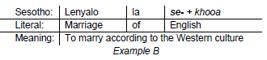
With regard to:
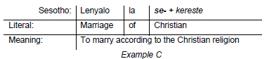
Language has two main functions, namely to describe the world around man and to argue (Baboya 2008). I would like to add a third function - to register information, and in this particular case, indigenous information, which is the raison d'être for the present paper.
Description of the reality and information registration
In the quest to describe the world around man, man names things as observed by Wagner (2010:3):
Because of new inventions and changes, every language is in need of new words - borrowed, derived or otherwise formed - simply because new things need new words. The human community is steadily growing and developing, just as the tool we use to communicate: Language.
In Lesotho, this became a sine qua non from the arrival of the French missionaries in 1833 and European settlers in 1868, who brought not only a new religion, but also a new socio-cultural governmental system and thus a new politico-administrative concept, including technological artefacts and conceptual ideas that were foreign to the Basotho, hence the need for naming them in Sesotho. However, some of the terms that were coined then have become so ordinary that their etymology is almost taken for granted, if not totally forgotten. The present paper only takes interest in politico-administrative terms 'muso 'government', ntlo-kholo 'headquarters' and tona-kholo 'prime minister' and undertakes a lexicosemantic analysis to demonstrate the manner in which language functions as a tool to describe the world around man and register information, and in this case, culturally indigenous information.
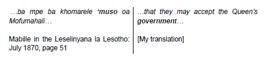
Morphologically speaking, 'Muso government' is a deverbal noun derived from ho busa 'to govern', whereby the nominal prefix mo- (C3) combines with verbal prefix b- to obtain mo- + bu- > 'mu- through the process of consonant permutation that usually takes place during the derivation of deverbal nouns. To finalise the derivation process, the verbal suffix is replaced by the nominal suffix -o to obtain 'mu + s + -o > 'muso. Since the governmental system, as it is known today, did not exist in the pre-colonial era, it is the position of the present paper that this term did not exist before the interaction with Europeans, based on the information provided by Casalis (1861), Machobane (1990) and Mothibe (2013) that Moshoeshoe I used a governing system composed of himself and two Matona, who functioned as his eyes, ears and right-hand men. What may be the first use of the term muso has been observed by Sebotsa (2016) in the translation of the New Testament of 1856 in Mathew 6:9-10 and what may be the very first translation of the prayer "Our Father":

While Sebotsa (2016) does not claim this to be the first use in a lay document, the term muso has also been found in the formal non-religious document in the Leselinyana la Lesotho of 1870:
According to Sebotsa (2016) the term tona-kholo [N + A]N did not exist in the early 1900s until the time around the beginning of the deliberation on independence in the 1950s, based on the system of governance used before the independence. In July 1936, Leselinyana la Lesotho opted for a phrasal noun tona e kholo 'minister who is big = prime minister':

The above quotation is proof that the term tona-kholo [N + A]N did not exist because missionaries who were the main contributors to the Leselinyana la Lesotho had acquired and learnt the hues and tones of the Sesotho language. The fact that they established a newspaper is proof enough, even though it is known that, at the beginning, the missionaries worked with Basotho, as in the case of the translation of The Pilgrim's Progress: From this World to that which is to Come, in the Manner of Allegory4: written by John Bunyan (1684) and translated into Sesotho by Adolphe Mabille and Filemone Rapetloane (1877) as Leeto la Mokereste: ho tloha fatseng la joale ho ea finyella ho le tla tla ka mokhoa oa setsoantso sa toro.
While Sebotsa (2016) does not claim to know the exact date of the lexicalisation of the term tona-kholo [N + A]N, he discovered that it was only in 1953 that it was adopted as a compound noun, which highlights the morphological evolution from the phrasal noun tona e kholo to a compound noun tona-kholo [N + A]N, as it can be observed in the quotation extracted from an article published in Mphatlalatsane, a newspaper no longer in publication:
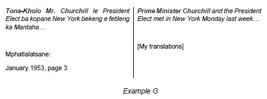
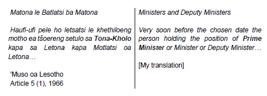
At the risk of repetition, the quotation below clearly shows that this is the term that was adopted by the Constitutional Commission of 1966 during the deliberations preceding the transition to independence, since the British insisted that Lesotho use the Westminster model, as highlighted by Machobane (1990). Thus, the term tona-kholo 'primemMinister' [N + A]N, appears officially in the report of the Constitutional Commission of 1966:
As for ntlo-kholo [N + A]N, it is a compound denoting 'headquarters' as the head 'ntlo' is a noun (C9), while the second component plays an adjectival role as in tona-kholo [N + A]N above. The term most probably owes its etymology to the Sesotho proverb Molao o tloha ntlo-kholo o ea ntloaneng, literally meaning 'the law starts from the main house to the minor house', but to be understood from a polygamous perspective to refer to the fact that culture is first upheld at the first wife's house, which is known as the main house, and then passed on to other smaller houses.
During the planting season, seeds and agricultural implements came from this house. In times of war, this is the place where the shield and spears of the chief were kept. In traditional medical practices, this was the first house where the doctor would start (Sekese 1907). Upon the adoption of the western politico-administration, this is the term that was preferred to metaphorically highlight the role that the headquarters of any private institutions and non-governmental organisations (NGOs) might play in terms of the services they provide, as can be seen in the quotation below extracted from the Mochochonono, a newspaper no longer in publication:
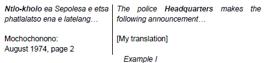
Based on the arguments provided above, I have every reason to believe that this term did not exist before the introduction of the western politico-administration, which is the raison d'être for the present paper - to show the power of language in preserving IK in changing times.
5 Translation as an archival tool
While some of the information has been documented in English and French, much of the indigenous information continues to be an oral tradition as it remains untranslated in the museums because only a few oral historians and those conversant in English and French have the opportunity to talk about it, thus starting another chain of word of mouth. However, grapevine telegraph has never been a reliable source of information, nor has it ever been an accurate method of transferring from one generation to another, since it is inherently imprecise, ephemeral and subject to the interpretation and opinion of the narrator. The object of the current section consists of unveiling the role of translation as an archival tool for indigenous information, which is at risk of total loss if it remains.
While it is true that new words are coined due to new innovations, it remains undeniable that some words become archaic or effaced in modern-day language use because the artefacts and practices they denote have been lost.
In his documentation that has not been translated into Sesotho, Casalis (1861:124), has this to say about Basotho manners and customs:
The natives, in forming their settlements, have felt the necessity of bestowing some care on the choice of the site. The tribes who inhabit countries where the rains are frequent invariably place their dwellings on the hills, on account of the insalubrity of the low ground. They are careful that the aspect should be good and say it is essential the first rays of the rising sun should fall without any obstacle upon the fold which contains their flocks.
This used to be common knowledge. Read in the context of the current situation in Lesotho, however, where people build and live in the low grounds in Lesotho, it becomes manifest that somewhere along the spectrum of development à la European, much of the Sesotho indigenous savoir-faire and savoir-vivre have been lost. The key term in Casalis' observation, of the manners and customs of the Basotho of the 1860s, is 'insalubrity', the adjective of which is 'insalubrious', defined as 'not conducive to health' in the MWD (2024). It is, therefore, manifest that traditional construction in the hills was not a matter of choice, but a matter of survival, which has been lost in the maze of progress as people now construct in the low grounds, thus eating up arable land. Settlement patterns in the hills were chosen expressly by political leaders for purposes of defence and economics, while the low grounds were reserved as arable land and pastureland. Agriculture and cattle rearing were not only means of self-sustenance but also constituted principal movable family wealth (Matšela 1979).
Casalis' observation may also be read in the context of the current situation, where people also construct houses and graze their flock in the wetlands generally found in the lower grounds. This is currently a cause for concern for the Lesotho Government and GIZ, a German organisation behind the ReNOKA campaign advocating for the protection and conservation of the environment and Lesotho's natural resources. Wetlands are areas of land that are covered all year round or for varying periods of time during the year, including during the planting season. Healthy wetland systems play a crucial role in climate regulation as they contribute to carbon cycling, absorption of toxins, flood control, erosion reduction, and the maintenance of groundwater levels. They also play an important role in water purification, especially in urban and agricultural areas. They remain an important support system for a wide range of fauna and flora. Floristically and structurally speaking, the wetlands of Lesotho are unique compared to those found in other parts of the Southern African region. The soil types and fauna found in these wetlands vary greatly from those found in the surrounding areas. A study carried out in 2015 found that 70% of the population residing in rural areas depend on agricultural activities, and the rearing of livestock was a means of production and livelihood. Thus, misappropriation of arable land for construction and grazing has an impact on the agricultural sector, as only 11% of the land remains arable to the point that agriculture represents a mere 5.0% of the GDP. Other sub-sectors, such as horticulture, have decreased their contribution to the GDP by almost half, from 40.9% in 2001 to 22.4% in 2011 (LNDC 2018).
In view of the above, translation as an archival tool substantiates its relevance within the context of information dissemination, which is generally done in English, even when such information is meant for agrarian populations, who mostly know how to read and write, but are not erudite in English. It would not be an exaggeration to say that the translation of Casalis' book 'The Basutos (1861)' into Sesotho would shed much-needed light on IK, and contribute to the general quest to regain the old, but organised systems that managed to establish healthy relationships between living things and their environment and attain sustainable use of natural resources. There is a plethora of documents produced on the revival and mainstreaming of IK that have not been translated into Sesotho. However, for the purposes and arguments in this study, I shall only cite one, which was produced expressly for the purposes of enhancing sustainable land management practices in Lesotho. The SADC, SARDC and NUL (2021) report on 'Mainstreaming Indigenous Knowledge Systems in Integrated Catchment Management in the Kingdom of Lesotho' provides an invaluable body of knowledge that can bring about change in terms of land management practices in Lesotho. The report states that IK has been designated as a system because it consists of traditional practices that yielded positive results without fail. It aligns itself with the objectives of the United Nations Sustainable Development (2021), which urges governments and intergovernmental organisations to respect, record and include IK systems in their research development programmes with the aim to conserve natural biodiversity and sustainability of agricultural and natural resource management systems. According to the SADC, SARDC and NUL (2021), this is because it has been discovered that communities at grassroots level depend on IK to take decisions on issues surrounding agriculture, healthcare, education, food preparation and natural resource management in their daily activities, and such communities consider IK important, as it is used to help the Basotho to consistently have a good harvest with large amounts of forage for their animals.
In terms of government and what is currently known as the rule of law, Casalis (1861:228) notes a somewhat topsy-turvy, but interesting phenomenon, which may explain the origin of the problem:
The chiefs have the right of making laws, and publishing regulations required by the necessities of the times. These laws, which are generally temporary, have received the name Molaos (out law, or commandment). Higher than these edicts rank the Mekhoa (the use and wont), which constitute the real laws of the country.
Based on Casalis' report, it becomes manifest that Mekhoa's 'philosophy of life, logic of life', was of prime importance and superior to what the western system of governance refers to as Molao 'law', as Mekhoa constituted the philosophy and logic within which is encapsulated IK systems of the Basotho. Proof of this is provided by Sekese (1907), who published Mekhoa le Maele a Basotho 'Philosophy and Proverbs of Basotho', in which he writes:
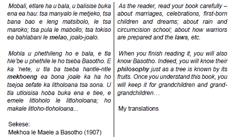
In view of the above, it would not be fallacious to conclude that Molao 'law' took precedence over Mekhoa 'philosophy' from the arrival of the missionaries and western settlers in their quest to "civilise" Basotho, who, according to Casalis (1861), were primitive. Furthermore, the British rule that started in 1868, when Lesotho became a British protectorate and in 1884, after it became a colony, most probably imposed a certain nomenclature that was not consistent with the Sesotho cultural nomenclature. It is my position that if Casalis' book 'The Basutos' were translated into Sesotho, much of the IK encapsulated in the Basotho philosophy would be shared widely in a language that the people understand.
Regarding the proverbs, Casalis (1861) holds that they were a spontaneous production of public reason and conscience. For him, the language was admirably endowed with energetic precision expressed through figurative speech. He continues to compare the wisdom and philosophy of the Basotho to that of King Solomon in the Bible and Horace, who, according to Grant (2024), was a great Latin lyric poet who lived between 65 BC and 8 BC. To name but a few in the words of Casalis:
1 Cunning devours its master.
Solomon said, 'Who so digeth a pit shall fall therein.'
2 A knife and the meat cannot be long together (A precept against adultery).
Solomon says in the same sense, 'Can a man take fire in his bosom, and his clothes not be burned?'
3 As one goes, so one returns.
Horace said, Coelum, non animum, mutant qui trans mare currant', meaning "The sky, not the mind, is changed by those who run across the sea."
4 Perseverance always triumphs.
Horace said, 'Labor omnia vincit improbus', meaning 'Hard work conquers all.'
If the missionaries could find a semblance of their own culture in the Basotho culture, including maxims that they understood unequivocally to be the equivalent of western thought and western philosophy, it becomes manifest that the Basotho were neither barbaric nor primitive, as Casalis suggested. They looked at life from a different angle, which is not opposed to that of the French missionaries. Casalis' biases are now to be understood from the perspective of French missionaries, who, in their ignorance of social anthropology, succumbed to the old European vices - Eurocentrism and Euro-supremacy. It is my position that books of great importance in the history of Basotho need to be translated into Sesotho with the aim of reviving philosophical aspects and proverbs that remain pertinent in modern-day Lesotho but are no longer in use due to the ephemerality of oral tradition over time and space. The books listed below, in no particular order, are of prime importance in the quest to translate, reanimate and re-appropriate Sesotho IK systems:
1. The Basutos by Eugène Casalis (1861)
2. La fin tragique des Bushmen: les derniers hommes vivants de l'âge de la pièrre 'The tragic end of the Bushmen: the last living men of the Stone Age' by Victor Ellenberger (1953)
3. An exploratory tour to the North East of the Cape of Good Hope by Thomas Arbousset & François Daumas (1846)
4. Basutoland by Austin Coates (1966)
There may be more books that need to be translated, as much of the documentation by Catholic and Anglican missionaries has not been made accessible to the general public. A book of particular interest for the present study is Basutoland by Coates (1966) in which he narrates the first encounter between Mohlomi and Moshoeshoe I, where the former imparted the 'peace' concept as one of unique philosophical features of the Sesotho IK systems, which has dissipated in recent years, only to be replaced by unhealthy practices inherent in the western politico-administrative system. Thus, Coates (1966:17) writes:
But Mohlomi, as we have said, was a psychic, and when he saw the son Lepoqo, he rose from his place, and detaching one of his own long ear-rings, he fastened it to your man's ear saying, 'This is the sign of power'. And he prophesied concerning Lepoqo, foretelling the day when he would be a ruler of men, advising him to understand men well and to judge them justly. When Lepoqo heard these words his heart trembled, for since boyhood he had desired to be ruler of all his people but could not see how this should come about; and he was emboldened to as the question that lay close to his heart. What medicine, he asked Mohlomi, had the great old chief used to acquire and maintain such power? To this the old chief gave a revolutionary answer: 'Power is not acquired by medicine; the heart is medicine.' With this, Mohlomi gave young Lepoqo much counsel, telling him never to trust the doctor's behest, but to rule with love and justice to all, and to be a man of peace.
It is no secret that Lesotho has been rocked by untold political instability since 1986. Some people would argue against this statement, pointing to several periods in history where there was no peace in Lesotho. Political upheavals and politically motivated murders that surged after 1986 have placed Lesotho 25th on the list of most dangerous countries in Africa in 2023, based on the Global Peace Index (GPI) using 23 qualitative and quantitative indicators. Mauritius obtained a GPI score of 1.546 as the most peaceful country in Africa, while Lesotho obtained a GPI score of 2.191. South Sudan obtained the GPI score of 3.221, making it the most dangerous country in Africa (World Population Review 2024). Events over time and space have shown that there is a relationship between political instability and corruption, as the latter has always been a key factor that has shaped the dynamics of conflict and insecurity in the political and economic structures across West African countries (Transparency International 2014).
The same is true with Lesotho, coupled with a lack of political accountability and rule of law to the point that Lesotho fares terribly in comparison with other countries in the region on numerous measures of popular demand for accountability, ranked 56 out of 137 countries on political transformation and 75 out of 137 countries on governance index (BTI Transformation Index 2024). This has led to the Basotho having a negative attitude towards democracy as a foreign paradigm of governance. Thus, an increased perception of rampant corruption has brought about the sentiment that it is pointless to oppose it based on the anecdotal evidence that corruption is one of the main reasons for the general perception, particularly among the youth, that the status quo cannot change under the current democratic system, which renders participation in politics futile (Monyake 2017).
In terms of IK systems, this is cause for concern, particularly when it is common knowledge that Lepoqo (Moshoeshoe I) embraced peace, while upholding the policy of non-tolerance for theft and corruption for the common good. Thus, the status quo in Lesotho calls for the return to the old ways and indigenous forms of accountability as per Mekhoa 'philosophy' of the Basotho of the times of Moshoeshoe I. As highlighted by Casalis (1861), an incorrigible thief 'sometimes pays with his head', in accordance with the Basotho proverb as a major harbour of Basotho philosophy and IK (not the western law), even though, generally, theft was repaired by restitution and a fine, while treason and rebellion against authority were considered a serious crime and therefore treated with less lenity. Translation of books and material lead to the re-establishment of peace and prosperity for all would mean re-appropriation of indigenous cultural paradigms with the object to reclaim and return to the IK systems that have shaped the resilience of the Basotho as people over time and space because the hybrid system currently in play has defects concerning the manner in which the system deals with politically motivated crimes and corruption.
In the context of the Fourth Industrial Revolution, there is an absolute need to digitise translated books and material, as this is another form of archiving language and the content therein for the benefit of future generations. The missionaries have done their part in documenting the oral history of the time using the available resources of the time. It is incumbent upon the current generation to leverage modern-day resources to re-document, conserve and re-appropriate their own history using digital technology and artificial intelligence (AI). In line with the Oxford Insights (2023) on Government AI Readiness Index 2023, which operates on three pillars (government, technology sector and data and infrastructure), it is, firstly, imperative for a government to have a strategic vision for development and governance over AI. This includes establishing appropriate regulations and paying greater attention to ethical risks. Secondly, a government's technology sector should have good human capital, coupled with innovation capacity, the skills and training for the people involved in the sector. Lastly, there is a necessity for appropriate infrastructure to power AI tools with the objective of making them available to the general public.
6 Low remuneration and lack of funding for translation projects
The question of low remuneration has been discussed from the time translation was professionalised. Authors such as Hale (2011), Choolun (2009), Sebotsa (2018), and others discussed at length the merits of proper remuneration. At the risk of repetition, translation, along with interpreting, is said to be one of the oldest professions in the world; however, there is a great deal of reticence and restraint when the issue of remuneration is mentioned. This is mostly due to what Obst (2010:xi) observed about interpreting:
Few people, especially in the United States, understand the profession of interpretation. They know what lawyers, engineers, architects, and brain surgeons all are about. But the art of interpretation is a mystery to many. They may assume that it consists of bilingual people changing words spoken in one language into the same words of another language. That is not at all what professional interpretation is. In challenging situations, accurate interpretation is no less sophisticated, complex, and intellectually demanding than brain surgery. The professional interpreter is required to carry more general knowledge into each job than architects and engineers need in the daily exercise of their profession. It requires the analytical skills of trial lawyers and their acting ability in the courtroom. It also requires a great deal of creativity.
While it is true that translation and interpreting are two distinct disciplines that are not practised in the same space and environment, they are compared here because, mechanically, they require the same amount of effort to master the hues and tones of both the source and target language, and greater attention to detail. However, the lack of knowledge in terms of what it takes to practice either one of them at the highest technical level has led to low remuneration for professionals.
It is no secret that money remains the main motivating factor in any discipline. However, in view of the above, translators with multiple streams of income may refuse to participate in important translation projects based on the budget and time allocated for them because the habit of clients offering work with tight deadlines and expecting perfect translation, while not ready to pay perfect money, is legendary. Even more legendary is the Lesotho procurement system that requires three quotations and then offers the contract to the service provider with the lowest quotation. Anecdotal evidence has shown that, due to a lack of opportunities, this kind of procurement system is manipulative, as it forces service providers, including translators, into lowering their tariffs, which drives them below the poverty line. It makes no professional sense that the reason why a particular provider is right for the job is that they are cheap. Thus, it is recommended that meritocracy be at the heart of such translation projects because, at this level, selection is always based on competence and experience. After all, it is no secret that the cheapest services are not always the best, since they sometimes turn out to be twice as expensive because they often require a great deal of refinement by other service providers who do not always come cheap.
7 Conclusion
The object of the present study consisted of proving that language and translation are tools for archiving and preserving IK. Using seminal writings, the study found that a large volume of IK has been lost, as some aspects of the Basotho philosophy have faded into oblivion. While the language currently in use keeps certain aspects of Basotho culture, some forgotten IK systems have been recorded and can be recovered through the translation of important seminal documents and books. However, care should be taken to allocate ample time and budget, as tight deadlines and low remuneration tend to hamper the progress of translation projects. What is even more important is collaboration with historians, anthropologists and the local community, with the objective of undertaking sufficient research that would yield positive results. It is recommended that concerned government ministries and NGOs collaborate in these projects to provide the required technical support to the team of translators, historians, anthropologists, local communities and specialists in the field under study. In the information age, digitisation and AI cannot be overlooked, as they form a critical component of modern living, including archiving, safeguarding and preservation of information. It is important to keep one leg forward lest the nation be left behind while concentrating on past IK systems, instead of soldiering on and tapping into modern think-tanks to reflect on ways in which the 4IR and 5IR might bridge the gap using digital forms of information preservation and knowledge exchange over time and space for the greater benefit of both present and future generations.
References
- Ademowo, A.J. 2010. Teaching science and technology: the employment of indigenous African languages. The Journal of Pan African Studies, 3(9): 50-56.
- Baboya, E.A. 2008. Approche culturelle de la dénomination en terminologie. In Diki-Kidiri, M. (ed.). Le vocabulaire scientifique dans les langues africaines. Paris: Karthala.
- BTI Transformation Index. 2024. Lesotho Country Report. [Online]. https://bti-project.org/en/reports/country-report/LSO (4 April 2025).
- Casalis, E. 1861. The Basutos. Morja: Morija Museum & Archives.
- Grant, M. Horace. 2024. Encyclopedia Britannica. [Online]. https://www.britannica.com/biography/Horace-Roman-poet (19 August 2024).
- Hale, S. 2011. The need to raise the bar: Court interpreters as specialised experts. In Coulthard, M. and Johnson, A. (Eds.). The Routledge Handbook of Forensic Linguistics. London. Routledge.
- Lipka, L. 2002. English lexicology: lexical structure, word semantics and word formation. Tübingen: Gunter Narr Verlag.
- LNDC. 2018. Lesotho agriculture and aquaculture sector profile. Maseru.
- Marchand, H. 1969. The categories and types of present-day English word-formation: A synchronic-diachronic approach. Munich: Beck.
- Machobane, L.B.B.J. 1990. Government and Change in Lesotho 1800-1966, London: Macmillan Press Ltd.
- Matšela, Z.A. 1979. The indigenous education of the Basotho and its implications for educational development in Lesotho. Doctoral dissertation. University of Massachusetts Amherst. [Online]. https://doi.org/10.7275/11748 (9 December 2025).
- Merriam-Webster Dictionary. 2025. Language. Merriam-Webster.com. [Online]. https://www.merriam-webster.com/dictionary/language (6 August 2024).
- Monyake, M. 2017. Bringing the citizen back in: Individual-level correlates of popular demand for accountability in Lesotho. In M. Thabane, M. (ed.). Towards anatomy of persistent political instability in Lesotho, 1966-1926. Morija: Morija Printing Works, 259-279.
- Mothibe, T. 2013. State and society, 1824-1833. In: Pule, N.W. and Thabane, M. (eds.). Essays on aspects of the Political Economy of Lesotho 1500-2000. Roma: National University of Lesotho Printing.
- Ngozwana, N. 2015. Understandings of democracy and citizenship in Lesotho: Implications for civic education. Doctoral thesis. Durban: University of KwaZulu-Natal. [Online]. http://hdl.handle.net/10413/12110 (9 December 2025).
- Obst, H. 2010. White House interpreter: The art of interpretation. Bloomington: Author House.
- Oxford Insights. 2023. Government AI Readiness Index 2023.[Online]. https://oxfordinsights.com/ai-readiness/ai-readiness-index/ (7 August 2024).
- ReNOKA. 2024. [Online]. https://renoka.org/ (19 August 2024).
- SADC, SARDC & NUL. 2021. Mainstreaming indigenous knowledge systems in integrated catchment management in the Kingdom of Lesotho. SADC, SARDC. NUL, Gaborone, Harare, Maseru.
- Sebotsa, M. & Mahula, K. 2022. Language as a kennel, a husk of the African philosophy: The case of Lesotho. In Kretzer, M.M. & Kaschula, R.H. (eds.), Handbook of language policy and education in countries of the Southern African Development Community (SADC). Boston: Brill.
- Sekese, A. 1907. Mekhoa le maele a Basotho. Morija: Morija Sesuto Book Depot.
- Siculus, D. 1990. The antiquities of Egypt. New Branswick: Transaction Publishers.
- The Editors of Encyclopaedia Britannica. 2020. Where did writing first develop? Encyclopedia Britannica. [Online]. https://www.britannica.com/question/Where-did-writing-first-develop (7 August 2024).
- Transparency International. 2014. Financial statement for the year ended 31 December 2014. [Online]. https://efaidnbmnnnibpcajpcglclefindmkaj/ https://files.transparencycdn.org/images/2014_Financial_Statements.pdf (9 December 2025).
- United Nations Sustainable Development. 2022. Agenda 2021. [Online]. https://sustainabledevelopment.un.org/content/documents/Agenda21.pdf (19 August 2024).
- Vega-Encabo, J. 2016. The concept of knowledge: what is it for? Disputatio, 8(43): 188-202.
Accepted: 9 January 2026
2 Bathepu are an isiXhosa-speaking minority group living in the southern part of Lesotho, whose matrimonial cultural practices are diametrically opposed to those of Basotho, as Bathepu's matrimonial cultural practice is synonymous with polygamy. Thus, the suggestive power of metaphor makes it manifest that the Basotho conceptualise polygamy as not belonging, non-characteristic and not representative of their own culture, but that of Bathepu.
3 The source language has not been stated. However, today, the sentence 'ho tle 'muso oa hau' is understood as the equivalent of 'your kingdom come'.
4 Most probably the first veritable translation of a religious book beside the Bible. It was edited several times over time.
