Implementation of resource description and access in the Gauteng Province, South Africa
Abstract
Resource description (cataloguing) and the organisation of knowledge (classification) have evolved over the past decade due to the shifting online landscape. Currently, there are more electronic resources than there were a decade ago. The utilisation of such resources has also escalated due to the continual advancements in information technology (IT). Consequently, the resource description environment has had to reevaluate its approach to resource description. A new resource description standard, termed Resource Description and Access (RDA) has been developed to accommodate these changes. This standard was intended to be implemented in South Africa in 2013. Nonetheless, the extent of progress in the implementation phase within libraries and other resource description contexts remains uncertain. This study sought to examine the current implementation status of RDA in Gauteng Province, South Africa. This study involved eight heads of cataloguing library departments and 15 cataloguers. They originated from four academic libraries and four public libraries. The results demonstrate that RDA has been partially executed in six out of the eight libraries. The implementation period spans from 2013 to 2016. The rationale for adopting RDA is that libraries aspire to integrate into the global cataloguing community. Individuals who had not yet implemented RDA attributed their decision to its complexity and insufficient IT infrastructure. The RDA is disseminated through the Library and Information Association of South Africa (LIASA) interest group known as the Interest Group for Bibliographic Standards (IGBIS), the National Library of South Africa (NLSA), and various other organisations. The study advises libraries to fully implement RDA to ensure interoperability of bibliographic records and to allocate resources for this endeavour.
AACR2; cataloguing; Gauteng; resource description and access; RDA; South Africa
1 Introduction
Currently, the information society confronts significant challenges and opportunities due to the constantly evolving Information and Communication Technologies (ICTs). These changes are linked to the advancement of electronic resources, compelling libraries to devise new strategies for resource management and delivering sufficient information to patrons. Akidi and Okezie (2018) assert that ICTs in libraries improve data and information storage, enable full-text searching, minimise irrelevant and duplicate search results, promote collaboration and network formation, and facilitate resource sharing among libraries. The advent of technology has transformed libraries from physical entities to hybrid operations encompassing virtual or digital libraries.
The integration of technology in libraries has sparked a growing discourse regarding the future of knowledge organisation and resource description (Mzayiya 2016; Sibiya 2017). Adebayo (2013) observes that the advent of technology in libraries has doubled the workload of cataloguers in the 21st century. Information is now available in various formats (audio, digital, large print, braille, graphics, and images, among others), necessitating diverse cataloguing and classification methods.
The changes have rendered the Anglo-American Cataloguing Rules (AACR2) cataloguing standard obsolete. AACR2 was created to facilitate the description of physical resources and the card catalogue (Atilgan, Ozel & Cakmak 2015). The introduction and evolution of various material formats in information services has presented issues and challenges in the generation of metadata. Consequently, ACCR2 became inadequate for managing digital materials and future advancements in information and communication technologies in cataloguing (Keenan 2014; Long 2018). Consequently, ACCR3 was suggested. Nonetheless, its plans were entirely altered to RDA after it did not resolve ACCR2 challenges (Perez-Lizano 2016; Osman 2016). Consequently, the new cataloguing standard RDA was established to supplant AACR2.
Ahonsi (2014) posits that RDA represents a significant re-evaluation of cataloguing theory and practice, designed to aid libraries in generating effective metadata for resource discovery within linked-data environments. In contrast to AACR2, which was tailored for card catalogues, RDA is formulated for the online environment and is grounded in two principles:
Functional Requirements for Bibliographic Records (FRBR) and Functional Requirements for Authority Data (FRAD), enabling compatibility with formats beyond print (Perez-Lizano 2016; Aboyade & Eluwole 2018). These frameworks enable users to locate, identify, select, and retrieve resources that align with their informational needs.
Furthermore, RDA, with its web attributes, generates standardised bibliographic records for online resources, ensuring libraries maintain relevance on the web (Oni, Oshiotse & Abubaker 2018), while simultaneously striving to manage metadata across all domains (El-Sherbini 2011). At present, RDA serves as both a standard and a mechanism for connectivity, visibility, and machine-to-machine interaction (Çakmak 2018). The RDA was established to direct and educate cataloguers in the creation of bibliographic records, with the objective of improving resource description and discoverability.
2 Background to the study
The National Library of South Africa (NLSA) formed the Resource Description and Access-South African Joint Steering Committee (RDA-SA Joint Steering Committee) as an advisory entity to assist South African cataloguing communities in making decisions about RDA implementation. Van Rensburg (2017) states that from 2010 to 2013, the RDA-SA Steering Committee convened multiple meetings and resolved that all libraries in South Africa should voluntarily adopt RDA by 2013.
The RDA-SA Steering Committee organised multiple successful training workshops in March 2013. The workshops were organised by the Interest Group for Bibliographic Standards (IGBIS) of the Library and Information Association of South Africa (LIASA). The NLSA obtained funding from the Department of Arts and Culture to facilitate the transition from AACR2 to RDA. Van Rensburg (2017) states that NLSA-RDA workshops were originally conducted in five provinces: Eastern Cape, Free State, Gauteng, KwaZulu-Natal, and Western Cape. Subsequently, they were accommodated in various cities and provinces upon request. These training sessions facilitated the persuasion of libraries and cataloguers to implement RDA.
3 Problem statement
In South Africa, as elsewhere, the evolving technology in information services has necessitated a transformation in bibliographic control and the creation and management of metadata, particularly within library communities, to adapt to new and forthcoming ICT advancements (Mzayiya 2016; Abdullah 2018).
Literature indicates that numerous prominent libraries have embraced RDA, whereas smaller libraries are awaiting feedback from early adopters before contemplating its implementation (Oguntayo & Adeleke 2016; Aboyade & Eluwole 2018). Osman's (2016) study on RDA implementation revealed that certain libraries that adopted RDA criticised it for not fulfilling its intended objective of enhancing cataloguing. Additionally, the initial literature on RDA criticised it for being excessively abstract (Caesar & Eichel 2009). Nevertheless, this may no longer be relevant today as RDA and its Toolkit undergo frequent revisions and updates (Bane 2019; IGBIS Newsletter 2019).
Research conducted in Africa indicated challenges associated with the implementation of RDA. Ahonsi (2014), in a study of sub-Saharan Africa, identified challenges pertaining to electricity, staffing deficiencies, financial constraints, and language barriers in the implementation of RDA.
At the time of the study, only two reports existed regarding the implementation of RDA in South Africa. Rasana (2018) conducted a survey on the implementation of RDA in selected libraries in KwaZulu-Natal (KZN) province, revealing that certain libraries utilise non-RDA compliant systems and do not subscribe to the RDA Toolkit. Conversely, van Rensburg (2017) investigated the adoption of RDA in academic libraries within the Western Cape Province and discovered that while all have adopted RDA, it has not been fully implemented.
Despite the training sessions conducted by IGBIS, it remains unclear whether RDA has been comprehensively implemented throughout South Africa. This study aimed to examine the implementation of RDA in Gauteng province, South Africa. This aims to elaborate on the research previously undertaken in KwaZulu-Natal (Rasana 2018) and the Western Cape (van Rensburg 2017).
The objectives of the study are to:
• determine the progress made in the adoption and implementation of RDA in libraries in Gauteng,
• determine the time taken to implement RDA,
• determine adopter categories of libraries, and
• determine the communication channels of RDA.
4 Theoretical framework
The study adopted the Diffusion of Innovations Theory (DoI) (Rogers 2003). The theory elucidates the process by which innovations are disseminated over time within a social system. Rogers (2003) asserts that during diffusion, an innovation is disseminated throughout a society. This study considers RDA an innovation due to its status as a new standard founded on advancements in information technology. This theory encompasses numerous constructs; however, the paper addresses only those relevant to this study.
The theory posits that communication, temporal factors, and social systems are critical elements in the innovation diffusion process. Rogers (2003) posits that innovation is disseminated over time via communication channels within a social system. The communication aims to disseminate information regarding the applicability of the innovation across various communication networks or platforms within a social system. This study examines libraries as the social system in which RDA is implemented.
The theory explains various categories of adopters. These are players in the diffusion process who embrace innovations at specific intervals. Rogers (2003) classifies them into five categories:
a) Innovators are the group that actively participates in getting information about an innovation. This process includes researching and networking about the new idea or product. These could be libraries that were actively participating in researching the transition from AACR2 to RDA. They are RDA field tests, research libraries, and members of the Joint Steering Committee (JSC) of the implementation of RDA in South Africa.
b) Early adopters are the local and highly influential people whom potential adopters look up to before they adopt innovations. They organise the adoption of innovations. These could be cataloguing institutions that adopted RDA in South Africa before or by 31 March 2013 or before the end of 2013.
c) The early majority adopts innovations just before the average member of the system. They are an important link in the diffusion process. They deliberate first before they adopt an innovation. These could be libraries that implemented RDA in South Africa after 2013 but before the end of 2015.
d) The late majority adopts innovation just after average members adopt an innovation. Their adoption is influenced mainly by economic benefits or peer pressure. They are mainly sceptical about innovations and adopt them mostly after everyone else has adopted them. Libraries may comprise the late majority, having implemented RDA later than others. They adopted RDA in 2015, two years after the official date of implementation.
e) Laggards are the last group in the system to adapt and innovate. They are suspicious of innovations and change agents. These could mean libraries that are still using AACR2
The present study modelled this categorisation as it concentrates on the same phenomenon, RDA, and presents findings according to adopter categories. This study employs communication and time constructs to elucidate the diffusion of RDA in Gauteng. This is the manner in which the innovation (RDA) is conveyed and the temporal classifications that organisations belong to.
The DoI theory was utilised as the present study investigated issues related to the adoption of RDA prompted by technological advancements. DoI examines the factors influencing the rate and rationale behind the adoption or acceptance of an innovation. The DoI is utilised to examine the cataloguing departments that adopted or declined RDA. The DoI theory facilitated the researchers' analysis of the adoption, implementation, and application rates of RDA, as well as the innovation diffusion process of RDA, through the constructs of communication and time (adopter categories).
This section provides a concise analysis and discourse on the literature regarding the implementation of RDA in both a global and South African context. This section commences with an examination of the rationale for implementing RDA, followed by an overview of its adoption status globally, specifically in Africa and South Africa.
5.1
Reasons for adopting RDAThere are several reasons for adopting RDA, including user-friendliness, the creation of complete records, global accessibility, ease of use, and a forward-looking approach. In the United States, Park and Tosaka (2015) assert that libraries adopt RDA due to their significant dependence on bibliographic records from the Library of Congress, which adheres to RDA standards. Dunsire (2016) contends that libraries adopt RDA due to its global relevance. Goldberga et al. (2014) assert that RDA enables libraries to administer digital collections and online information while facilitating international collaboration. This aligns with the objective of RDA, which aims to offer a flexible and adaptable framework to accommodate technological advancements in bibliographic description and metadata management, while also generating standardised data for global sharing and utilisation (Tosaka 2000; Morris & Wiggins 2016).
Kalwara, Dale, and Coleman (2017) assert that the new RDA elements of data-content type, media type, and carrier type-superseded the General Material Designations (GMDs) of AACR2 to accommodate both contemporary and prospective material descriptions when integrated. Keenen (2014) asserts that RDA, by utilising FRBR and FRAD, accommodates both existing and emerging resource types. Goldberga et al. (2014) indicate that the Latvian National Library intends to transition to RDA for the management of its digital collection and online information, maintain international collaboration, and establish a cataloguing system, as Latvia has historically lacked local cataloguing regulations.
According to van Rensburg (2017), libraries in the Western Cape province of South Africa adopted RDA due to their membership in the Name Authority Cooperative program (NACO). Van Rensburg (2017) asserts that the RDA-SA Steering Committee found it facile to adopt RDA due to South Africa's status as an English-speaking cataloguing nation.
The concise literature review indicates that RDA is implemented for multiple reasons, chiefly to ensure compliance with international standards and to facilitate interoperability.
5.2
RDA adoption statusThis section will delineate the status of RDA adoption from both a global and African viewpoint. The initial topic for discussion is the global perspective.
5.2.1 Adoption of RDA from a global perspective
This section provides a concise overview of the literature regarding the global adoption of RDA. The adoption of RDA in countries of the Global North predates the proposed implementation date of 2013 in South Africa. Park and Tosaka (2015) indicate that certain libraries in the United States commenced RDA testing as early as 2010 and did not revert to AACR2.
Hunt (2013) asserts that these libraries belong to the innovators category. Various libraries in the United States adopted RDA from 2014 to 2016 (Hanford 2014). Nonetheless, a recent study by Long (2018) revealed that approximately ten large public libraries within the same nation have not adopted RDA.
Young (2013) asserts that the British Library is one of the principal libraries that effectively implemented RDA. Certain libraries adopted a "wait and see" strategy (Park & Tosaka 2015; Cullen 2016; Oguntayo & Adeleke 2016), exemplified by the Duke University library, which postponed the implementation of RDA until successful reports were available (Turner 2014). Moreover, Goldberga et al. (2014) and the EURIG Annual Meeting 2020 - Community Report (2020) indicate that the National Library of Latvia has yet to adopt RDA but is currently in the process of implementation.
A study by Cross et al. (2014) revealed that merely 10% of libraries in Canada have fully adopted RDA, 56% have partially adopted it, and the remaining 34% have yet to implement RDA. Abdullah et al. (2018) indicate that the National Library of Malaysia (NLM) declared its intention to achieve complete RDA implementation by 2017. Rahman et al. (2021) assert that the adoption of RDA in Malaysia remains in its nascent phase, with the NLM as the sole library to have implemented RDA. Aliverti, Behrens, and Schaffner (2016) indicate that three German-speaking nations-Germany, Austria, and German-speaking Switzerland-adopted RDA circa 2015-2016. Perez-Lizano (2016) indicates that libraries in Mexico continue to encounter prevalent cataloguing challenges that impede progress in implementation.
The EURIG Annual Meeting 2020 - Community Report (2020) indicates that the National Libraries of Great Britain, Israel, Iceland, Finland, Sweden, and Spain adopted RDA in the years 2013, 2014, 2015, 2016, 2017, and 2019, respectively, though not uniformly. Slovakia, Slovenia, Norway, Poland, and Hungary are among the countries that have partially adopted RDA. Complete implementation is anticipated between 2021 and 2024 in certain libraries.
Panchyshyn, Lambert and McCutcheon (2019) conducted a study to examine the implementation of RDA in public libraries across the United States. It was discovered that 22% of cataloguers lacked knowledge of RDA, indicating its non-adoption in their respective libraries.
A report by Ashley et al. (2019) indicates significant RDA adoption in Europe. This is due to adoption grants conferred by European Projects.
Worldwide, libraries exhibit varying rates of RDA adoption; some have not implemented RDA, while others remain undecided. The literature indicates that English-speaking countries adopt RDA more rapidly than non-English-speaking countries. Perez-Lizano (2016) corroborates this. Caesar and Eichel (2009) and Morris and Wiggins (2016) contend that the full implementation of RDA across all libraries will require time.
5.2.2 Adoption of RDA from an African perspective
An alternative adoption pattern among libraries in foreign nations has been noted. Ahonsi (2014) asserts that cataloguers in Global South nations, especially in Africa, will face challenges in adapting to RDA, despite the necessity for libraries to transition to online cataloguing and implement RDA.
Research examining the adoption of RDA and cataloguers' familiarity with RDA in Nigeria has identified prevalent cataloguing challenges faced by libraries, including inadequate library automation, constrained budgets, insufficient ICT skills, a scarcity of cataloguers, and the absence of RDA training (Arinola, Adigun, Oladeji & Adekunjo 2012; Oguntayo & Adeleke 2016; Oni, Oshiotse & Abubakar 2018). These challenges hinder libraries from transitioning to RDA, thus delaying the full implementation of RDA in Nigerian libraries. Sambo (2021) indicates that while 70% of cataloguers in Nigeria are familiar with RDA, many have never utilised it. Osman (2016) asserts that Egyptian libraries have not yet adopted RDA.
According to van Wyk and Nhlabati (2014), the NLSA and University of South Africa (UNISA) libraries in South Africa have adopted RDA, although the specific implementation dates remain unspecified. Van Rensburg (2017) states that four academic libraries in the Western Cape of South Africa adopted RDA between 2013 and 2015. An unspecified quantity of academic and public libraries in KwaZulu-Natal have adopted RDA since 2013 (Rasana 2018; Sibiya 2017), making RDA a fundamental criterion for cataloguing employment opportunities in South Africa (Sibiya & Shongwe 2018).
The literature reveals challenges in the implementation of RDA in Africa, specifically in South Africa. Several studies have been undertaken within the South African context. Only two provinces have been examined to date: the Western Cape and KwaZulu-Natal. No identifiable study has examined the implementation of RDA in prominent public and academic libraries within the Gauteng province. The research concentrated on the Gauteng province to provide an alternative South African perspective.
6 Research methodology
The study adopted a qualitative research approach. Creswell (2013) states that qualitative researchers gather data personally through interviews or direct observation of participants in their natural environments. This research gathered qualitative data via semi-structured interviews and employed qualitative content analysis techniques. The researchers contended that examining RDA implementation necessitates qualitative research methodologies. The researchers believe that quantifying the investigation would have been challenging. A case study design was utilised (Kumar 2014). The Gauteng province of South Africa was chosen as a case study. This province was chosen due to the absence of comparable studies conducted therein.
The study's population comprised four academic libraries (Wits University, Tshwane University of Technology, the University of Johannesburg, and Sefako Makgatho Health Sciences University libraries) and four public cataloguing institutions (22 Solomon Street Library and Information Services, Es'kia Mphahlele Library Services, City of Ekurhuleni Library Services, and Mogale City Library Services). Eight heads of cataloguing departments and 15 librarians (cataloguers) were intentionally sampled (Kumar 2014). Leaders of cataloguing departments articulated responses on behalf of libraries, while cataloguers expressed their individual perspectives. A total of 23 participants were present.
Semi-structured interviews were employed to gather data. The researchers aimed to regulate the interview direction by administering questions in a standardised and direct fashion, while simultaneously permitting participants to elaborate beyond the posed enquiries. Two interview schedules were created: one for heads of cataloguing departments and another for cataloguers, to facilitate the interview process. The interviews were performed in person.
The data were analysed utilising the qualitative data analysis framework established by Miles, Huberman and Saldana (2014), which posits that analysis should encompass data condensation, data display, and the formulation and validation of conclusions.
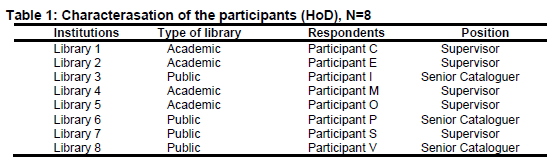
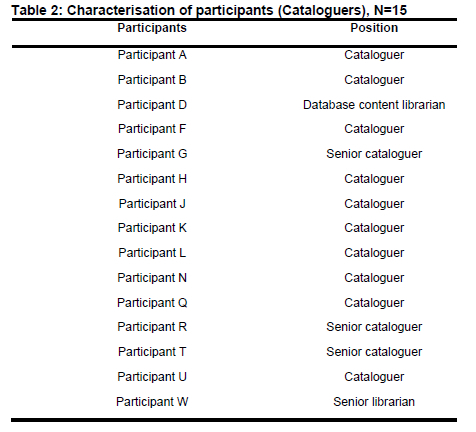
The eight department heads were designated as Library 1 through Library 8 (or C, E, I, M, O, P, S, and V). This was executed to distinguish them from the cataloguers. Cataloguers are classified according to Table 2.
7 Findings
This section presents the findings of the study. The process begins with the categorisation of respondents, succeeded by the adoption and non-adoption of RDA. The final segment of the findings pertains to RDA communication channels.
7.1 Characteristics of the participants
Participants were categorised based on libraries and cataloguers. Table 1 presents data regarding the distribution and classification of participants according to institution (library), library type, and job profile. These are Heads of Department who provided responses on behalf of libraries.
The table reveals that among the eight participating libraries, four are academic and four are public. The table indicates that five supervisors and three senior cataloguers provided responses on behalf of their institutions. Table 2 presents the classification of cataloguers by their respective positions.
Table 2 indicates that cataloguers possess two ranks: cataloguer and senior cataloguer.
7.2 RDA adoption
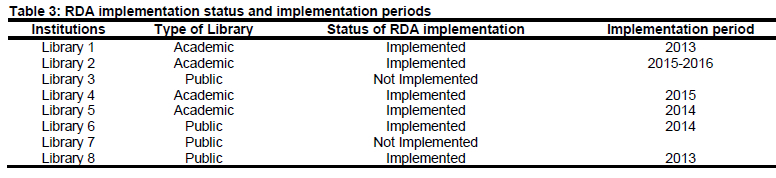
The study was to determine the extent to which libraries have embraced RDA and the advancements achieved in its implementation. Table 3 displays the responses.
Table 3 indicates that six libraries adopted RDA during various timeframes as follows: Two libraries adopted RDA in 2013, two additional libraries in 2014, one library in 2015, and the final library between 2015 and 2016, although the respondent was uncertain of the precise year. However, the supervisor, who joined in 2016, discovered that the library was already utilising RDA. RDA was implemented in the libraries participating in the study between 2013 and 2016. Two public libraries have yet to implement RDA.
7.2.1
Reason for the adoption of RDALibraries were asked to state the reasons for the adoption of RDA. The responses are provided below:
Library 1: The library mentioned that it had no choice because everybody (other libraries) was adopting RDA. "Yes, we had no choice, because it [AACR2] changes, and if you belong to a consortium and everybody is moving that way, you can't stay there and say I am not moving, otherwise you won't benefit from the consortium".
Library 2: stated that "It is the same reason why everyone [adopts RDA]. Every library should move because you should not hold on to the past. AACR2 is dead, it has been replaced officially. So, if you want to keep abreast with the new trends, then you must move with time. If you want your library users not to struggle, RDA is the way to go". Library 2 revealed that information from the Interest Group for Bibliographic Standards (IGBIS) workshop also played a major role in the decision to implement RDA.
Library 4: indicated that "because everybody is going that way, we don't want to be left behind. We are also cataloguing e-resources, I believe they are catered for in RDA more than they were in AACR2. We are very slow with the implementation". They implemented RDA in 2015-2016.
Library 5: stated: "Our institution thinks internationally, therefore we also decided that we have to implement it immediately to share records with others in the Online Computer Library Centre [OCLC] and to the World Catalogue (WorldCat). To embrace RDA as a library, we move up with the system. After attending workshops, we decided to implement. It was voluntary."
Library 6: stated "Well, it seems like most of the libraries all over the world are changing to RDA and we want to keep up with times and the way of doing things and because we sometimes [do] copy cataloguing from WorldCat and their libraries are using RDA. If we are still using AACR2, we will have to change everything, which will be counterproductive because if we also change to RDA, we can just copy catalogue the RDA stuff and not change back to AACR2".
Library 8 said "To make it more user-friendly and to make it not so difficult for future cataloguers because they know that in [field] 300, there must be illustration and they must type that. They don't need to go back and look at the abbreviations and the punctuation and all those things".
The findings indicate that libraries adopted RDA primarily to align with their peers and the latest advancements in the LIS field. The purpose is to facilitate the contribution of records to OCLC. Adopters also employed RDA to leverage consortia advantages for users and cataloguers. Most libraries indicated that the rationale for adopting RDA was its suitability for accommodating new developments, such as digital resources, which AACR2 did not address.
7.2.2
RDA implementation stagesIt was essential to determine the stages of RDA implementation to ascertain whether it has been fully or partially executed. Four libraries reported that, to their knowledge, they have fully implemented RDA. RDA enables the downloading of bibliographic records from OCLC and the description of these records in RDA format.
Two libraries indicated that they cannot say they have fully implemented because "The way I see it, we have mixed things that we were doing with AACR2 and just implemented few fields from RDA" (Library 4). This library indicated that their systems librarian is contacting system librarians from other institutions to get their system ready for full implementation. Another library only uses RDA on selected types of books or printed information sources.
This is Library 8 who said, "We don't use RDA in our fiction subject and biographies. We are making use of in-house specification".
7.3
RDA non-adoptersThis question sought to identify the reasons behind the non-adoption of RDA. It attempts to find out why RDA is not implemented in the two cataloguing institutions. The responses were as follows:
Library 3 said: "It's bureaucracy. We want to get ahead because at present we also can't download records. We have to copy and paste from OCLC. It is not even the library, you know the city's IT [Information Technology] department is not getting the things in place. So, we are sitting and working with Symphony [system]."
Library 7 said; "The problem is the IT network. We went for training late in 2016. Thereafter, [we] had system challenges. It duplicated items on the catalogue. We stopped cataloguing for six months. With RDA we found there is a lot of work that needs to be done since it is not the same as AACR2. We just stopped. The budget is short [too]. We observed it would take time for us since we had a back-log. We therefore collectively decided to put RDA on hold".
Both libraries that have not adopted RDA stated that their reluctance to transition to RDA is not a matter of willingness. They continue to encounter difficulties with library systems and insufficient support from IT departments.
Progress made in preparations to implement RDA
The study also found it necessary to determine how far non-adopters have gone with the preparations for the implementation of RDA.
7.3.2 Intention to implement RDA
It was necessary to find out whether libraries have the intention to implement RDA.
The responses are as follows:
Library 3: "The thing with RDA is not going with the flow. You are staying behind and when you have people working for you and they want to move on to other libraries, they don't have a good knowledge of RDA, it might be a problem. [For example] someone from here wants to go either at a senior post at a university library, it might not be easy. It is not the library's unwillingness, it is [our city's] IT department. We must make sure that we are complying with whatever they want to do and that we are sitting with the outdated [system]".
Library 7: "Yes, we are, but we have done nothing other than the 2016 training which only highlighted what to expect in RDA. We will implement it as soon as possible. We still have to subscribe to the Toolkit and ask for money to implement or make use of RDA as well as the UKS System developers. There are challenges with the system".
The findings indicate that libraries are willing to adopt RDA, since not adopting RDA is also a challenge to them and their cataloguers.
7.4
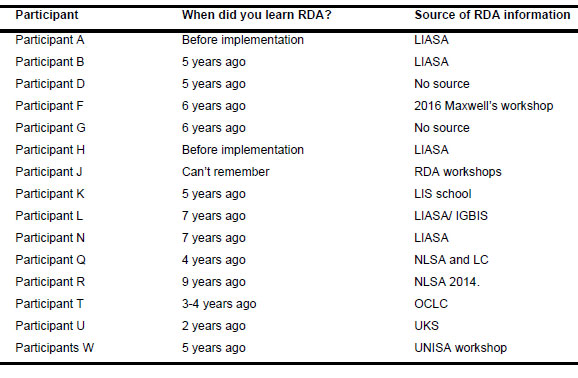
RDA communication channelsTo determine the communication channels used in the diffusion of RDA, participants (cataloguers) were asked how and when they got information about RDA. Table 4 summarises the responses.
The findings reveal various communication channels employed to convey RDA in Gauteng. LIASA is the predominant channel utilised. The researchers assert that LIASA's interest group IGBIS significantly contributed. IGBIS is a community of practice focused on resource description and knowledge organisation within LIASA. Additional communication channels encompass Robert Maxwell's workshop, RDA workshops, LIS school, Library of Congress, Universal Knowledge Systems (UKS), UNISA, and NLSA, while others indicated a lack of recollection regarding the sources.
The findings indicate that some cataloguers are aware of RDA prior to its implementation, while others do not remember, and some recall it from two to seven years ago.
8 Discussions of findings
The findings of the study reveal that six of the eight libraries participating have adopted RDA. The primary justification offered by the libraries for adopting RDA is their commitment to aligning with the latest developments in the LIS sector to address current advancements. The literature has presented various justifications for the adoption of RDA. Dunsire (2016) asserts that RDA is adopted due to its global applicability. This aligns with the sentiments expressed by institutions that are universally adopting it and aspire to join the ranks of global adopters. Goldberga et al. (2014) asserted that RDA is utilised for international collaboration. In the Western Cape Province of South Africa, van Rensburg (2017) discovered that libraries implemented RDA to join a library consortium.
The study indicated that RDA has been partially implemented in numerous libraries. This is due to its application of AACR2 rules. This indicates the utilisation of both RDA and AACR2 regulations. Cross et al. (2024) reported analogous results. It was discovered that merely 10% of libraries have completely adopted RDA. Aliverti, Behrens and Schaffner (2016) reported analogous results in Germany. The EURIG Annual Meeting 2020 - Community Report (2020) revealed that numerous libraries within the European Union have partially adopted RDA. Consequently, it is unsurprising that Gauteng libraries have not completely adopted RDA. Nevertheless, few reported having fully implemented RDA.
In Gauteng, the categories of DoI adoption include innovators, early majority, and laggards (Rogers, 2003). The innovators are individuals who embraced RDA in 2013. This is due to the fact that it was the year designated for implementation in South Africa. The early majority consists of individuals who embraced RDA between 2014 and 2016. This is a relatively short duration since 2013, thus leading to the inference that they constitute the early majority. The laggards are individuals who have not yet embraced RDA in any capacity. Two public institutions fall under this classification.
The DoI asserts that communication channels significantly influence its dissemination. This study identified IGBIS, NLSA, UNISA, and UKS as the primary communication channels for the dissemination of RDA. This is due to their provision of the majority of information regarding RDA. This is corroborated by van Rensburg (2017).
The study revealed that certain libraries have not implemented RDA (laggards), yet they expressed interest in its adoption. They indicated that the primary reasons for the non-implementation of RDA were its bureaucratic characteristics and insufficient IT infrastructure. Cross et al. (2014) confirmed that resource scarcity is the primary reason for the non-adoption of RDA. Arinola et al. (2012) and Oni, Oshiotse, and Abubakar (2018) express identical sentiments. Caesar and Eichel (2009) contend that RDA is excessively abstract; however, this claim is contested by Bane (2019) and the IGBIS Newsletter (2019). They expressed a willingness to implement RDA at a subsequent phase. It is not unexpected that some libraries have yet to implement RDA. This phenomenon is observed globally, as evidenced by Goldberga et al. (2014) and the EURIG Annual Meeting 2020 - Community Report (2020).
9 Conclusion and recommendations
The study concluded that libraries in the Gauteng Province of South Africa can be categorised as either adopters or non-adopters of RDA. All academic libraries have partially implemented RDA, whereas only two of the four public libraries involved in the study have done so. Multiple justifications were provided for both adoption and non-adoption. The primary motive for adoption is to align with current trends, while the principal reason for non-adoption is insufficient resources.
Diverse communication channels are employed to convey the innovation (RDA). These entities include the NLSA and IGBIS. We also determine that RDA was adopted at various intervals, commencing from 2013 to 2016. The study identified three categories of adopters based on the varying timelines of RDA adoption: innovators, early majority, and laggards.
Consequently, it is advisable for libraries to furnish resources for the comprehensive implementation of RDA, as this reflects a global trend. Libraries that have not yet implemented RDA risk obsolescence. Libraries are advised to comprehensively adopt RDA. This signifies a transition from AACR2. This will enhance the interoperability of records among libraries.
It is advisable to conduct additional research to assess the implementation of RDA throughout South Africa in order to monitor progress.
References
5 Literature review
- Abdullah, C. Z. H., Daud, S. C., Ariff, N. Z. Z. M., and Shaifuddin, N. 2018. Bibliographic control and resource description access standard in Malaysia. International Journal of Academic Research in Progressive Education and Development, 7(3): 96-102.
- Aboyade, W. A. and Eluwole, O. A. 2018. Implementation of resource description and access (RDA) in Nigeria: awareness, cataloguers' perception and challenges. Journal of Applied Information Science and Technology, 11(2): 79-86.
- Adebayo, O. 2013. Challenges associated with cataloguing electronic resources in selected University Libraries in Southwest Nigeria. Chinese Librarianship: an International Electronic Journal, 36:15-24. URL: http://www.iclc.us/cliei/cl36adebayo.pdf
- Ahonsi, A. 2014. Resource description and access (RDA) handbook for facilitating the understanding of RDA rules by librarians and catalogers in English-speaking countries in sub-Saharan Africa. [Online]. http://hdl.handle.net/2142/50025 (23 November 2023).
- Akidi, J.O. and Okezie, C.A. 2028. application of ICT to cataloguing and classification for effective bibliographic control in the national library of Nigeria: issues and challenges. Library Philosophy and Practice, 1-21.
- Aliverti, C., Behrens, R. and Schaffner, V. 2016. RDA in Germany, Austria, and German-speaking Switzerland: a new standard not only for libraries. Italian Journal of Library and Information Science, 7(2): 253-278.
- Arinola, A. A., Adigun, G.O., Oladeji, B. O. and Adekunjo, O. A. 2012. Impact of ICT on cataloguing and classification of library materials; case study of some selected university libraries in South-West Nigeria. American International Journal of Contemporary Research, 2(6):122-126.
- Ashley, K., Jones, S., Biro, T., Bangert, D. and Lazzeri, E. 2019. D2.1 RDA results, adoption and take-up report. RDA Research Data Alliance Europe.
- Bane, K. 2019. Teaching RDA after 3R. [Online].
- Caesar, I. and Eichel, D. 2009. Challenges for the implementation of resource description and access (RDA) case study Germany, 2008. 17th annual BOBCATSSS symposium (Bobcatsss 2009). 28-30 January 2009. Porto. [Online]. http://eprints.rclis.org/12927/1/95.pdf (23 November 2023).
- Creswell, J. W. 2013. Qualitative Inquiry and research design: choosing among five approaches. 3rd ed. Los Angeles: Sage.
- Cross, E., Andrews, S., Grover, T., Oliver, C. and Riva, P. 2014. In the company of my peers: implementation of RDA in Canada. Cataloging & Classification Quarterly, 52 (6-7): 747-774.
- Cullen, G. 2016. Implementation in Ireland: a survey of CONUL member libraries and Institute of Technology libraries. Presented at the CONUL Conference, July 2015. Athlone, Ireland.
- Dunsire, G. 2012. RDA (Resource Description and Access) and its application to rare books, manuscripts, and their digital surrogates. [Online]. http://www.gordondunsire.com/pubs/docs/RDARareBooks.pdf (23 November 2023).
- El-Sherbini, M. 2013. RDA Strategies for implementation. London: Facet Publishing.
- EURIG Annual Meeting- Community reports (2020). The ISSN International Centre Conferenc, 18-19 May 2020. Virtual Conference. [Online]. http://www.rda-rsc.org/sites/all/files/RDA%20in%20Europe%20May%2020200.pdf (23 November 2023).
- Goldberga, A., Kreislere, M., Sauka, J., Sturmane, A and Virbule, I. 2014. RDA: from strategy to experiments and implementation in Latvia (including an overview of the situation in the Baltic States). Journal of Library Metadata, 14:205-221.
- Hunt, S. 2013. RDA: an innovation in cataloguing. Insights. 27(2): 185-189. http://dx.doi.org/10.1629/2048-7754.69
- Kalwara, J., Dale, M. and Coleman, M. 2017. Note on operations: GMD or no GMD, RDA implementation for a Consortial catalog. Library, Information Science & Technology Abstracts. 61(3):162-170.
- Newsletter of the Interest Group for Bibliographic Standards. 2019. IGBIS-in-Touch. 13(1):1-12.
- Long, C. E. 2018. RDA implementation in large US public libraries. Library Resources & Technical Services, 62(3):98:113., https://doi.org/10.5860/lrts.62n3.98
- Miles, M. B., Huberman, A. M. and Saldana, J. 2014. Qualitative data analysis: A Method sourcebook. 3rd ed. Los Angeles: Sage.
- Morris, S. R. and Wiggins B. 2016. Implementing RDA at the Library of Congress. Journal of Library and Information Science. 7 (2):199-228.
- Mzayiya, I. 2016. The role of academic libraries in South Africa. [Online]. http://libdspace.ufh.ac.za (23 November 2023).
- Oguntayo, S. and Adeleke, A. A. 2016. Awareness, knowledge and implementation of RDA in academic libraries in Nigeria. Paper presented at the 36th Annual Workshop of NLA/Cataloguing, Classification & Indexing Section, 24 - 28 October, University of Calabar, Calabar, Cross River State, Nigeria.
- Oni, O., Oshiotse, J and Abubakar, T. G. 2018. Cataloguers' awareness and perception of resource description and access (RDA) rules for cataloguing practice in some selected libraries in Bauchi State of Nigeria. Webology. 15(1):108-120.
- Osman, R. 2016. Are we ready for BIBFRAME?: the future of the new model in the Arab Region. Cybrarians Journal, 41:1-13.
- Perez-Lizano, E. 2016. Implementing resource, description, and access in a time of change in the small academic library, Quarterly, 33 (4): 353-370.
- Rahman, A. L. A. et al. 2021. Librarian acceptance on the resource description and access (RDA). International Journal of Academic Research in Business and Social Sciences, 11(12): 709-722. http://dx/dio.org/10.6007/IJARBSS/v11-i12/11812
- Rasana, N. 2018. Transition from AACR2 to RDA by certain KZN Libraries [Online]. https://cdn.ymaws.com/www.liasa.org.za/resource/group/121b9995-3f25-4730-86dd-d0d9ea8d7995/workshoppresentations/2018/transitionfromaacr2torda.pdf(23 November 2023).
- Sambo, A. S. 2021. Awareness and use of resources description and access (RDA) among Librarians in Nigeria Libraries. Library Progress (International), 41(1):120-129. http://dx.doi.org/10.5958/2320-317X.2021.00013.1
- Sibiya P. T. 2017. The link between cataloguing and classification curriculum and job requirements. [Online]. http://uzspace.unizulu.ac.za:8080/xmlui/bitstream/handle/10530/1668 (Institutional repository), University of Zululand (23 November 2023).
- Sibiya, P. T. and Shongwe, M. M. 2018. A comparison of the cataloguing and classification curriculum and job requirements. Library Management, 39 (6-7): 474-487. https://doi.org/10.1108/LM-09-2017-0089
Accepted: 11 March 2025