Job characteristics, burnout and the relationship with recovery experiences
Abstract
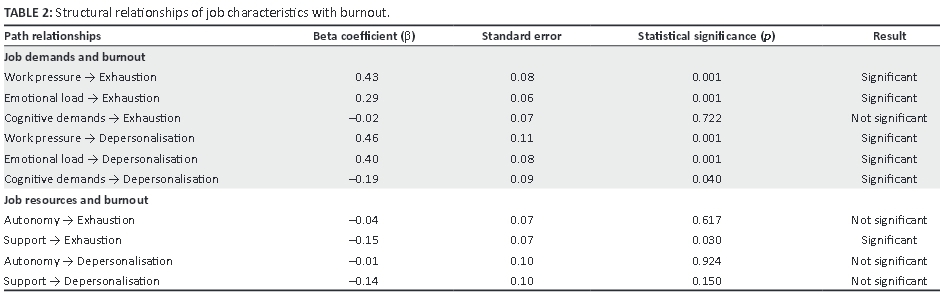
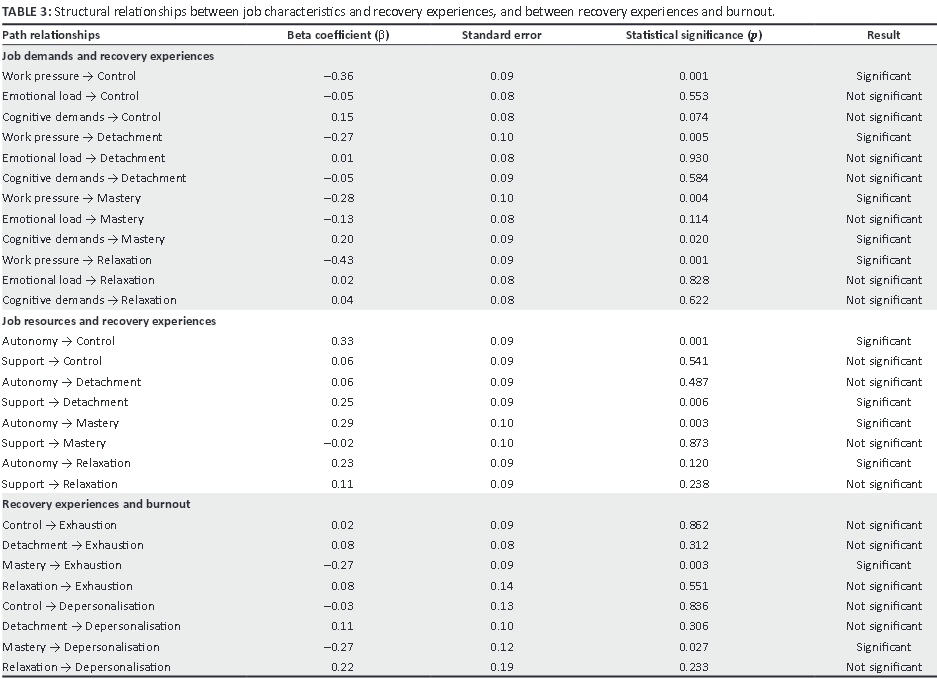
ORIENTATION: Job characteristics (consisting of job demands and job resources) have an impact on burnout. However, it is unclear whether recovery strategies might influence this relationship amongst staff members at a tertiary education institution in South Africa. RESEARCH PURPOSE: The primary objective of this study was to determine whether recovery strategies influence and moderate the relationship between job demands, job resources and burnout. MOTIVATION FOR THE STUDY: Recovery strategies may influence and buffer the negative effects of job demands on burnout and may influence and enhance the positive influence of job resources on burnout. RESEARCH APPROACH, DESIGN AND METHOD: Cross-sectional data was collected amongst employees at a tertiary education institution (N = 366). MAIN FINDINGS: The results of the structural equation modelling revealed significant positive relationships between work pressure, emotional demands and a lack of social support with burnout. Also, work pressure was related to all four recovery strategies and different job resources were associated with different recovery strategies. Finally, mastery experiences were the only recovery strategy that significantly predicted burnout. PRACTICAL/MANAGERIAL IMPLICATIONS: Employees are encouraged to engage in recovery strategies that will reduce their burnout levels, especially mastery experiences. CONTRIBUTION/VALUE-ADD: This study adds to the body of literature on effort recovery in South Africa. Very little empirical research has been done in South Africa regarding the use and benefits of different recovery strategies. Recommendations for future research are made.
 Thumbnail