Digital consumer perspectives on data access in an emerging market
Abstract
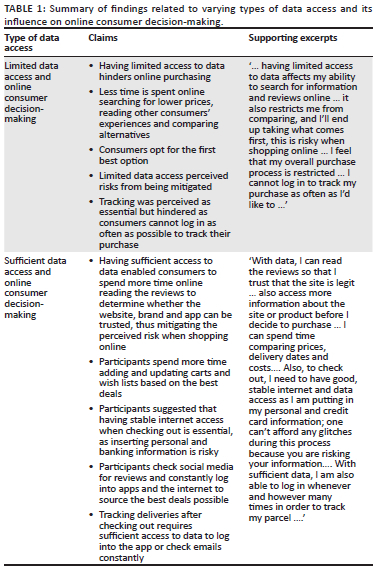
BACKGROUND: Various data access types influence online purchasing in South Africa, contributing to a digital divide. Literature on consumers' perceptions of data access and its influence on online consumer decision-making is scant OBJECTIVES: This study explores South African consumers' perceptions of data access and its influence on online consumer decision-making METHOD: Plowright's Framework for Integrated Methodology (FraIM) guided the study's methodological choices. Through purposive sampling, 25 participants who purchased online 6 months before data collection participated in four virtual focus group discussions. Tesch's eight steps guided the data analysis procedure RESULTS: Access to data lies on a continuum from limited to sufficient data access, impacted by location, infrastructure, affordability, time spent online, data usage and device, and supporting factors. Limited data access impedes online consumer decision-making, whereas sufficient data access supports online consumer decision-making. With better data access, consumers can spend more time online deliberating risks by searching for information, reading reviews, comparing alternatives, tracking purchases and influencing other consumers to purchase online CONCLUSION: A lack of data access impedes, while sufficient data access supports online consumer decision-making CONTRIBUTION: This study adds to the limited knowledge of data access and its implications for decision-making in South Africa. Using the FraIM in a marketing-related study provides novel methodological insights for future research
data access; digital divide; decision-making; online buying; emerging markets; framework for integrated methodology (FraIM); digital consumers; internet access
 Thumbnail