The human dimension in the institutionalisation of enterprise content management
Abstract
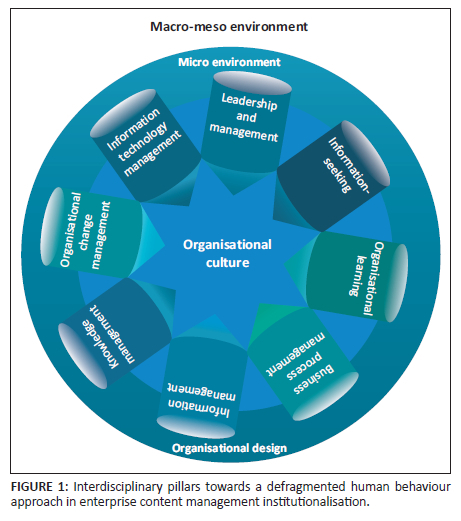
BACKGROUND: Enterprise content management (ECM) solutions should be fully institutionalised to achieve improved efficiency, effectiveness or productivity. An ethnographic study spanning 10 years revealed a fragmented view of human behaviour during the institutionalisation of ECM, which was triggered by an implementation at NamPower. OBJECTIVES: Inherent human dimensions observed during the implementation and institutionalisation process sparked discussions with project team members, peers and colleagues, discovering that observed behavioural patterns transcended single institutional boundaries, revealing a globally manifested phenomenon. Consequently, the study focused extensively on the failures of people's issues in institutionalisation rather than on procedural or technological failures. METHOD: Data collection utilised an information management maturity instrument, gathering 108 responses and conducting a comparative analysis with 296 additional respondents to provide empirical data. This process included a critical analysis of human behaviour frameworks, serving as the theoretical foundation for conceptualising an interdisciplinary approach to human-centred ECM institutionalisation. RESULTS: Data collection highlighted areas for improvement, and the critical analysis of human behaviour frameworks led to a better understanding of the human ecological context in employees' interactions with information. CONCLUSION: The results indicated involvement of various disciplines in ECM institutionalisation, perpetuating typical siloed approaches, resulting in a fragmented understanding of human behaviour. This paper discusses the complexity of the human ecological dimension and advocates for an interdisciplinary approach to ECM institutionalisation. CONTRIBUTION: Knowledge managers, with their deeper understanding of the human dimension, are ideally positioned to facilitate a systematic interdisciplinary approach to the institutionalisation of ECM, essential for achieving critical success.
enterprise content management institutionalisation; human-centric solutions; systematic interdisciplinary approach; human behaviour; knowledge management facilitation
 Thumbnail