Research Landscape and Future Agenda for Health Technology Assessment of Medical Devices in Low- and Middle-Income Countries
Abstract
Health technology assessment (HTA) plays a critical role in evaluating medical devices (MDs) in low- and middle-income countries (LMICs), yet its implementation remains limited. This study examines the current research landscape of HTA for MDs in LMICs, and outlines a future agenda to strengthen its role in evidence-informed decision making. It explores the difficulties in MD adoption, the limitations of existing HTA frameworks, and the potential of early HTA (EHTA) to support local innovation. The findings highlight the need for context-sensitive HTA models, regulatory harmonisation, and regional collaborations. Strengthening HTA could enhance MD evaluation, foster local innovation, and improve healthcare sustainability. Future research should focus on developing adaptable evaluation methods that are tailored to resource-limited settings, such as approaches that integrate the early lifecycle assessment of MDs, build institutional capacity, and assess the policy impact of HTA on procurement and equitable access.
Abstract
Gesondheidstegnologie-assessering (GTA) speel 'n deurslaggewende rol in die evaluering van mediese toestelle (MTs) in lae- en middelinkomstelande (LMILs), maar die implementering daarvan bly beperk. Hierdie studie ondersoek die huidige navorsingslandskap van GTA vir MTs in LMILs en skets 'n toekomstige agenda om die rol daarvan in bewysgebaseerde besluitneming te versterk. Dit verken die uitdagings verbonde aan MT-aanvaarding, die beperkings van bestaande GTA-raamwerke, en die potensiaal van vroeë GTA (vGTA) om plaaslike innovasie te ondersteun. Die bevindinge beklemtoon die noodsaaklikheid van konteks-gesensitiseerde GTA-modelle, regulatoriese harmonisering en streeksamewerking. Deur GTA te versterk kan MT-evaluering verbeter word, plaaslike innovasie bevorder word en gesondheidsorgvolhoubaarheid versterk word. Toekomstige navorsing behoort te fokus op die ontwikkeling van aanpasbare evalueringsmetodes wat geskik is vir hulpbronbeperkte omgewings, soos benaderings wat vroeë lewensiklus-assessering van MTs integreer, institusionele kapasiteit bou en die beleidsimpak van GTA op verkryging en regverdige toegang evalueer.
1. INTRODUCTION
1.1.
Background to the problemInnovative medical technologies are crucial for improving healthcare, yet their evaluation, adoption, and sustainable use remain significant problems in low- and middle-income countries (LMICs) [1]. Many medical devices (MDs) acquired in these settings are unsuitable for local infrastructure and clinical needs, as they are designed for settings with well-developed healthcare systems, assuming access to reliable electricity, trained personnel, and effective maintenance systems - resources that are frequently lacking in LMICs [2], [3], [4]. Consequently, these devices are often left unused, resulting in substantial resource waste and missed opportunities to improve healthcare delivery . Studies estimate that 70-90% of MDs in low-income settings are non-functional or broken, with 80% being donated [5], [6].
This heavy reliance on imported MDs limits LMICs' ability to respond effectively to health crises, as seen during the COVID-19 pandemic, which exposed vulnerabilities in MD value chains (MDVCs) [3]. The pandemic underscored the need for robust local production and innovation to ensure:
• Greater health system resilience
• Self-sustainability
• More agile responses to public health emergencies
South Africa plays a critical role in the MD supply chain in sub-Saharan Africa, serving as a regional hub in the Middle East's and Africa's MD market [7]. However, its local production capacity remains low because of several bottlenecks, such as high production costs, regulatory barriers, limited access to financing, and a lack of technical expertise in advanced medical technology manufacturing [7]. As a result, up to 76% of its MDs are imported, with local production primarily limited to low-tech, low-value items such as surgical goods and disposable needles [7]. This dependence on imports exacerbates vulnerabilities in the region's MD supply chain, affecting not only South Africa but also many LMICs that rely on it for procurement [3], [5], [7], [8]. The COVID-19 crisis highlighted these weaknesses, as supply chain disruptions led to shortages of critical medical technologies, emphasising the need to strengthen local manufacturing capabilities [3], [8].
Addressing these difficulties requires MDVCs in LMICs to be strengthened. Health technology assessment (HTA), defined in Section 1.2 below, has been recognised as a key tool to optimise procurement, guide innovation, and ensure sustainable medical technologies [5], [9], [10]. Mukherjee (2021) highlights how HTA could enhance decision-making in MDVCs, ensuring that MDs are evaluated for clinical, economic, and operational feasibility before integration into healthcare systems [8]. Studies have also highlighted the potential of HTA to help manufacturers by incorporating it in the earlier stages of the MD lifecycle [5], [11], [12]. By using HTA early in the MD's lifecycle, local manufacturers could gain early insights into market access, cost-effectiveness, and regulatory requirements, reducing uncertainties and risks in product development [12], [13]. This approach could encourage the production of context-appropriate MDs, improve the chances of successful commercialisation, and ultimately support the growth of local manufacturing while reducing dependence on imports.
Despite the growing interest in using HTA in developing countries, it remains underused, especially for MDs, where assessments typically focus on pharmaceuticals rather than on medical technologies [14], [15], [16], [17]. The absence of suitable systematic evaluation frameworks contributes to inefficiencies, inconsistent procurement policies, and weak regulatory oversight, emphasising the need for a structured approach to integrating HTA into MDVCs.
1.2.
Defining HTA and early HTAHTA is a globally recognised tool for supporting evidence-based decision-making at all levels of healthcare service delivery. According to Wilkinson et al. [17] HTA is
a multidisciplinary field that addresses the clinical, economic, organisational, social, legal, and ethical impacts of a health technology, considering its specific healthcare context as well as available alternatives.
The World Health Organisation (WHO) has long advocated the integration of HTA into health systems, as highlighted in Resolution WHA 67.23, which promotes HTA as a mechanism for achieving universal healthcare coverage [9], [10].
HTA efforts in South Africa remain fragmented, with a primary focus on pharmaceuticals and limited formal assessment mechanisms for MDs in the public sector [14], [15], [17]. The absence of standardised HTA methodologies has resulted in inconsistent evaluations by healthcare providers and funders, exacerbated by poor coordination and limited analytical capacity [17]. These gaps hinder the effective evaluation, procurement, and integration of MDs in South Africa's public healthcare system, requiring more tailored HTA approaches.
Some researchers have suggested adopting established MD HTA frameworks, such as the European Network for HTA (EUnetHTA) core model, to address these problems [14], [18], [19]. However, such frameworks are resource-intensive and require significant adaptation to local contexts. They also assume the availability of robust clinical evidence, which is often scarce in resource-constrained settings, particularly for MDs [18], [20].
MDs pose unique difficulties that make it inefficient to apply pharmaceutical-focused HTA frameworks directly [21], [22]. Unlike pharmaceuticals with well-established assessment guidelines, MDs require different evaluation approaches owing to their incremental improvements, operator dependence, and diverse usage scenarios [22], [23]. Traditional HTA frameworks designed for pharmaceuticals fail to account for these complexities, which underscores the need for adapted methodologies that are suited to MD evaluation in LMICs [22]. In response, stakeholders have increasingly advocated a lifecycle approach to HTA, which incorporates early evaluation of MDs during development - a process known as early HTA (EHTA) [24], [25]. Similar lifecycle-based evaluation methods have long been applied in other complex industries such as defence, aerospace, and systems engineering, in which the early-stage assessment of design, feasibility, and sustainability is critical to avoid costly failures later in the product lifecycle [26], [27], [28]. Drawing on these established practices, healthcare systems could strengthen HTA by integrating lifecycle thinking into MD evaluation, thus ensuring that early design and contextual fit are systematically considered alongside clinical and economic evidence.
EHTA applies HTA principles at the preliminary stages of a technology's lifecycle, enabling stakeholders to assess the potential value, barriers to market access, and cost-effectiveness before full-scale implementation [29]. Defined as
all methods used to inform industry and other stakeholders about the potential value of new medical products in development, including methods to quantify and manage uncertainty,
EHTA facilitates proactive decision-making [29], [30], which is particularly beneficial for locally manufactured MDs. By providing early insights, EHTA could help to streamline market entry, encourage local production, and reduce dependence on imports, which is critical for LMICs.
1.3. Contribution of this study
While previous studies have explored HTA's role in pharmaceutical decision-making, a gap remains in understanding how HTA, particularly EHTA, could be applied to MDs in developing countries. This study aims to address this gap by conducting a scoping review that seeks to answer the following questions:
1. What are the problems in and barriers to adopting and evaluating MDs in LMICs, and how do they affect HTA processes?
2. How do HTA frameworks that are tailored for MDs differ from those designed for pharmaceuticals, particularly in their data and evidence requirements?
3. What alternative tools and methodologies could enhance MD evaluation and adoption in resource-constrained settings?
4. How could EHTA complement HTA, and what key concepts and tools could improve HTA's applicability in LMICs?
5. In what ways has HTA been applied in MDVCs, and what lessons could be drawn from both successful and failed implementations?
This research article analyses the literature on HTA and EHTA for MDs in LMICs, and identifies key areas that need further investigation. Collating and synthesising available evidence highlights priority themes and gaps to strengthen MD evaluation systems in LMICs. By doing so, this study contributes insights to guide researchers, policymakers, and industry stakeholders in ensuring that innovations are assessed, integrated, and aligned with local healthcare needs in resource-constrained settings.
We present the methodology in section 2, outlining the scoping review process. Section 3 reports the key findings, including research trends, problems, and thematic insights. Section 4 discusses the implications, alternative approaches, and lessons from implementation. Section 5 proposes a research framework and agenda for strengthening HTA in LMICs. The conclusions and the study's limitations are summarised in section 5.
2. METHOD
This study carried out a scoping review to explore systematically the key concepts, components, and types of HTA and EHTA for MDs, focusing on their applicability in the medical device value chains (MDVCs) of developing countries (LMICs). Unlike systematic reviews, which focus on assessing and synthesising high-quality evidence for specific research questions, scoping reviews aim to map the breadth and depth of the literature on a given topic, identify key themes, and highlight gaps for future research [31]. This approach is particularly valuable when the research topic is broad, evolving, and not yet well-defined.
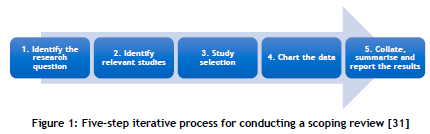
Following the preferred reporting items for systematic reviews and meta-analyses extension for scoping reviews (PRISMA-ScR) framework, this review adhered to a rigorous and transparent methodology to ensure its reproducibility and comprehensiveness in capturing the relevant literature. Scoping reviews are methodical and iterative, requiring repeated steps to ensure comprehensive coverage of the literature [31]. This study followed the five-step iterative process shown in Figure 1 and outlined by Arksey and O'Malley (2005), which begins by identifying the research question to establish the scope and objectives of the review.
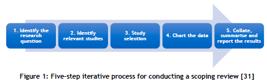
A structured search was conducted in multiple databases to identify relevant studies. Then, predefined inclusion and exclusion criteria were applied to filter the literature during the study selection phase. Key information from the selected studies was then extracted and categorised in the data charting stage. Finally, the findings were synthesised to collate, summarise, and report the results, mapping key themes and identifying research gaps.
In addition to the five steps outlined above, the analysis incorporated a sixth step that focused on in-depth content analysis. This step involved comparing how HTA has been applied across different LMIC contexts, identifying country-level applications, barriers, and lessons. This extension allowed for a more detailed discussion in Section 4, linking the mapped research themes to practical experiences and examples from specific settings.
A scoping review is not typically conducted by a single individual, as best practice emphasises the need for multiple reviewers to enhance reliability, minimise bias, and ensure a rigorous review process. However, engaging additional reviewers was not feasible because of the practical difficulties that are often encountered in postgraduate research projects. The supervisor was consulted about these constraints, as they had the necessary expertise in the scoping review methodology. Their guidance helped to structure the review process, to support the selection and assessment of the literature, and to uphold the methodological integrity of the study, ensuring a structured and thorough review.
2.1. Identifying research questions
Although a scoping study has a broad scope, a well-constructed question is essential to guide the research, break down the topic into manageable components, and develop a clear plan [32]. To achieve this, the research questions in Section 1.3 were formulated using the Joanna Briggs Institute's PCC (population, concept, and context) methodology, ensuring a structured and systematic approach. In this study, the "population" criterion was less relevant, as the focus was on a specific field rather than on individual participants. The formulated questions aimed to explore key concepts, components, and types of HTA and EHTA for MDs, to assess their applicability in MDVCs in LMICs, and to identify knowledge gaps that could hinder successful implementation.
2.2. Identifying relevant studies
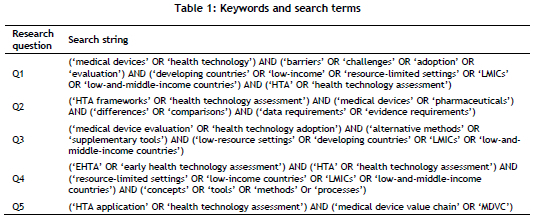
A structured search was conducted in PubMed, Scopus, and Web of Science, which were chosen to ensure a comprehensive literature coverage. Scopus and Web of Science were included for their rigorous quality control, broad interdisciplinary scope, and citation-tracking capabilities, while PubMed was chosen for its specialised biomedical focus, making it one of the most comprehensive databases for health-related research [33]. The search terms were developed on the basis of the research questions and refined using Boolean operators, truncation, and phrase searching. The complete search strategy is summarised in Table 1.
2.3. Study selection
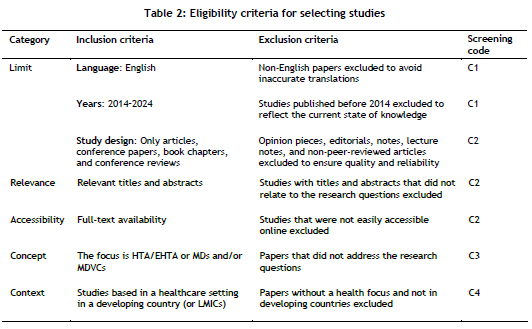
The predefined eligibility criteria are shown in Table 2 were applied to ensure the inclusion of high-quality and relevant studies. The selection process followed a structured approach to ensure comprehensiveness and relevance to the study objectives. Studies were screened based on their title and abstract relevance, followed by full-text analysis to determine their suitability.
By adhering to these defined selection criteria, the review aimed to be comprehensive, robust, and applicable to the context of developing countries, ensuring that the findings were relevant and valuable for informing HTA and EHTA applications in MDVCs.
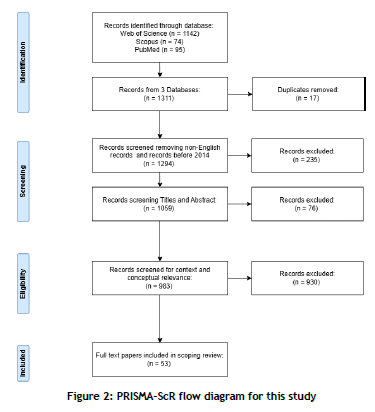
The study selection process is visually represented in Figure 2, which follows the PRISMA flow diagram. The process began with 1,311 records identified from PubMed, Scopus, and Web of Science, with 17 duplicate records removed. The remaining 1,294 studies underwent initial screening using Code C1 (language and timeframe restrictions), thus excluding 235 studies. A further 76 studies were removed in the second screening phase (C2) based on their title, abstract relevance, and full-text availability. The next phase applied Codes C3 and C4, screening for conceptual and contextual relevance, which excluded 930 studies. Ultimately, 53 studies met the full inclusion criteria and were included in the final analysis.
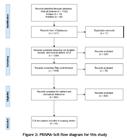
This stepwise approach ensured a rigorous and transparent selection process, refining the dataset to include only high-quality, relevant, and methodologically sound studies that would contribute valuable insights into the role of HTA and EHTA in MD value chains in LMICs.
2.4. Charting the data
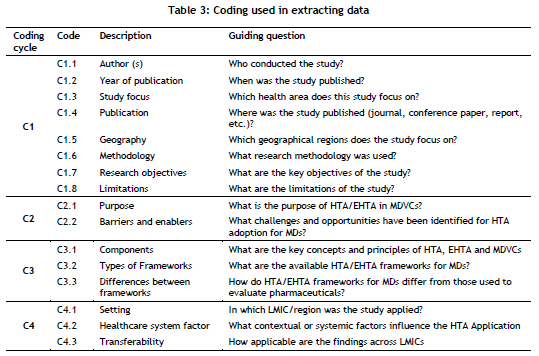
After being selected, the studies were analysed using Atlas.ti to extract, code, and categorise relevant data. This enabled a structured synthesis of key concepts and applications of HTA and EHTA in MDVCs. The systematic data extraction process ensured alignment with the research questions and objectives. Studies were categorised through three coding cycles: Coding cycle 1 (summarised in Appendix A) captured study characteristics, including how HTA/EHTA for MDs has been researched, published, and applied in healthcare. Coding cycle 2 examined the purpose of HTA/EHTA in MDVCs and the difficulties and opportunities in evaluating MDs. Coding cycle 3 explored the typology of HTAs. The coding framework, including the guiding questions for data extraction, is presented in Table 3.
The coding framework was iteratively refined as studies were reviewed, ensuring flexibility in capturing emerging themes. This structured approach to charting data facilitated a comprehensive synthesis of findings, aligning with the study's overarching objectives to understand HTA, EHTA, and MDVCs in LMICs.
3. RESULTS
This section presents the key findings in formulating a research framework, thus detailing the current landscape of HTA and EHTA in evaluating MDs in LMICs. It explores trends in scientific production, thematic shifts in research, and the problems affecting MD adoption and assessment. The section also examines differences between HTA frameworks for MDs and pharmaceuticals, alternative methodologies for MD evaluation in resource-limited settings, and key lessons from HTA implementation in various regions.
3.1. Overview of scientific production
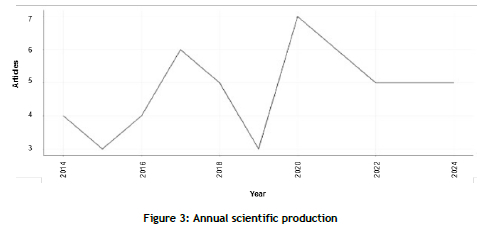
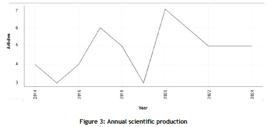
The literature analysis identified 53 relevant studies published between 2014 and 2024, reflecting an evolving research landscape on HTA and EHTA in the context of MDVCs in LMICs. The annual distribution of scientific output shows notable fluctuations, with peaks observed in 2017, 2020, and 2021, as shown in Figure 3. The increase in publications in 2020 corresponds with the onset of the COVID-19 pandemic, which heightened global attention on medical technology assessment, supply chain resilience, and access to MDs in LMICs [1], [24], [34], [35], [36]. Despite this increase, the research output has stabilised in recent years, suggesting that, while the field remains active, further efforts are required to sustain momentum.
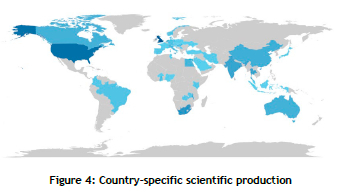
Collaboration patterns reveal a strong international dimension in HTA research, with 60.38% of the studies involving co-authorship from multiple countries. As illustrated in Figure 4, high-income countries such as the United States, the United Kingdom, and various European nations dominate research production, despite the database focusing specifically on HTA in LMICs. This reflects the outsized influence of high-income countries in shaping HTA frameworks for LMICs, largely because of their well-established research institutions, greater funding availability, and extensive expertise in evidence-based policymaking [37], [38].
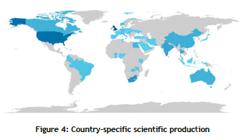
The significant presence of high-income countries in LMIC-focused HTA research is driven by global health initiatives, donor-funded projects, and institutional collaborations that position high-income country institutions as primary research leaders. Organisations such as the WHO, the World Bank, and global health funding agencies frequently support HTA development in LMICs, often relying on existing research and frameworks from high-income settings [9], [10], [39]. While these collaborations provide technical expertise and funding, they also reinforce the use of methodologies that may not fully align with LMIC healthcare systems [40]. Many HTA frameworks developed in high-income countries assume the availability of robust clinical data, strong regulatory systems, and well-resourced health infrastructure - conditions that are often absent in LMICs [40]. As a result, adopting these frameworks without adaptation risks overlooking key contextual problems in resource-constrained settings [18], [20], [40].
South Africa stands out as the leading contributor in sub-Saharan Africa, reinforcing its role as a regional hub for MD evaluation and HTA policymaking. Its prominence could be attributed to a relatively well-developed healthcare system, strong academic institutions, and an established HTA discourse, particularly in its public sector [37], [41]. However, beyond South Africa, HTA research engagement by other LMICs remains significantly lower, as evidenced by the limited representation of African, South Asian, and Latin American countries in Figure 4. This disparity reflects critical problems, including insufficient funding, weak institutional support, and a lack of trained HTA professionals, all of which hinder independent research efforts in these regions [37], [40], [42], [43].
While high-income country collaborations remain essential for capacity building, the limited research independence of LMICs underscores the need for stronger regional research networks and increased South-South collaboration. Developing locally driven HTA methodologies and reducing reliance on externally developed frameworks could ensure that MD evaluations are more contextually relevant and aligned with the realities of LMIC healthcare systems.
3.2. Thematic analysis
3.2.1. Evolution of research themes
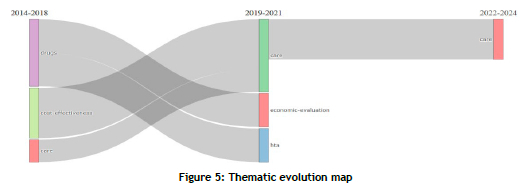
The thematic evolution of the literature, as illustrated in Figure 5, highlights a shift in research focus over time. Between 2014 and 2018, studies were predominantly centred on pharmaceutical assessments, cost-effectiveness analysis, and patient-care considerations, reflecting HTA's traditional emphasis on high-cost pharmaceuticals and their alignment with global health initiatives, such as the WHO's roadmap for improving access to medicines and vaccines [38], [40], [44], [45]. In the period that followed (2019-2021), research diversified to incorporate economic evaluation, HTA applications for MDs, and implementation difficulties, signalling a growing recognition of the complexities surrounding MDs and the need for tailored HTA methodologies [22], [46], [47]. By 2022-2024, care emerged as the dominant theme, reinforcing the increasing recognition of HTA's role in healthcare access and system-wide efficiency. Economic considerations persisted, but became less central than in earlier periods.
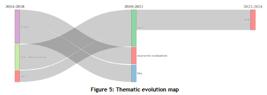
The transition of themes over time suggests a gradual broadening of HTA applications, moving from economic and cost-driven analyses towards a more comprehensive approach that integrates equity, healthcare access, and policy alignment in LMICs. However, despite this expansion, research gaps remain in localised adaptations of HTA frameworks for MDs in resource-limited settings.
3.2.2. Keyword analysis and conceptual structure
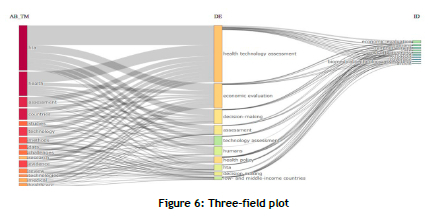
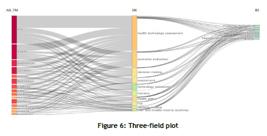
The keyword co-occurrence analysis, depicted in Figure 6, highlights the centrality of economic evaluation, cost-effectiveness, reimbursement, and decision-making in the HTA research landscape. These recurring terms indicate that HTA research focuses primarily on financial viability and regulatory assessments, particularly in LMICs where resource allocation is a critical concern [25], [40], [42], [45], [48], [49]. In addition, the presence of "health policy" alongside economic terms signals a growing emphasis on integrating HTA into broader healthcare decision-making processes [25], [46], [50]. The co-occurrence of "technology assessment" with "decision-making" and "implementation" emphasises the increasing effort to adapt HTA methodologies for MDs [25], [46], [50]. Unlike pharmaceuticals, MD adoption involves operational feasibility, regulatory adaptation, and system integration, making these emerging themes particularly relevant for LMICs [25], [46], [50]. This shift reflects a broader recognition that effective MD evaluation must extend beyond clinical efficacy to consider economic and contextual applicability [25], [46], [50], [51].
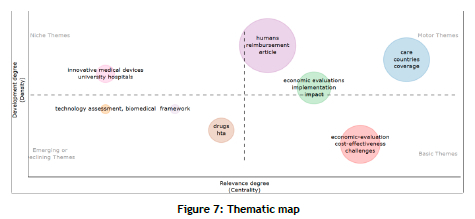
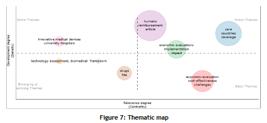
A deeper exploration of the conceptual structure, illustrated in Figure 7, reveals distinct thematic clusters. Motor themes, including "care," "coverage," and "countries", are well-developed and highly relevant, underscoring HTA's increasing importance in healthcare accessibility and policy discussions [1], [39], [45], [52], [53], [54]. Basic themes, such as "economic evaluation" and "cost-effectiveness", remain fundamental to the field but are still evolving, requiring further research refinement [22], [23], [55], [56]. Meanwhile, niche themes, such as "innovative medical devices" and "university hospitals", suggest that, while academic institutions drive MD innovations, their integration into healthcare systems is still underdeveloped [57]. Last, emerging or declining themes, such as "technology assessment" and "biomedical framework", indicate a shift from traditional technology evaluation approaches towards more applied, decision-oriented frameworks for MDs [11], [22].
3.3. Research collaboration and geographic trends
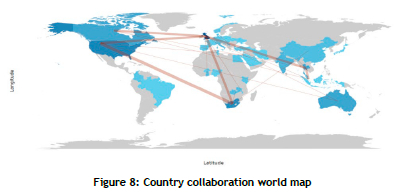
Figure 8 illustrates the global collaboration patterns in HTA research related to LMICs. The strongest collaborative ties are observed between the United States, the United Kingdom, and European nations, which act as primary research hubs, with notable partnerships extending to LMICs such as South Africa, India, Brazil, Thailand, Nigeria, and Kenya. Despite the database's emphasis on LMICs, Figure 8 highlights the relatively low level of South-South collaboration. South Africa emerges as the most prominent HTA collaborator in sub-Saharan Africa - a finding consistent with Figure 4, which identifies it as the leading research contributor in the region.
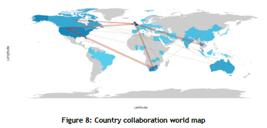
However, regional collaborations among LMICs remain limited, reflecting a continued reliance on high-income country partnerships rather than on intra-regional networks. This lack of South-South collaborations presents a critical difficulty, as many HTA frameworks are still largely adapted from high-income country models, raising concerns about their contextual relevance for LMICs [1], [25], [34], [37], [41]. The limited exchange of locally generated evidence and expertise could hinder the development of HTA methodologies that are tailored to the unique problems of MDVCs in resource-limited settings.
4. DISCUSSION
4.1. Adoption and evaluation difficulties for MDs using HTA
As highlighted in Section 3, one of the dominant themes emerging from the literature is the persistent difficulties of adopting and evaluating MDs using HTA in LMICs. These include data scarcity, limited expertise, and systemic barriers, which have a direct impact on the effectiveness of HTA in informing healthcare decisions. This section discusses the implications of these problems, and explores their consequences for MD adoption in LMICs.
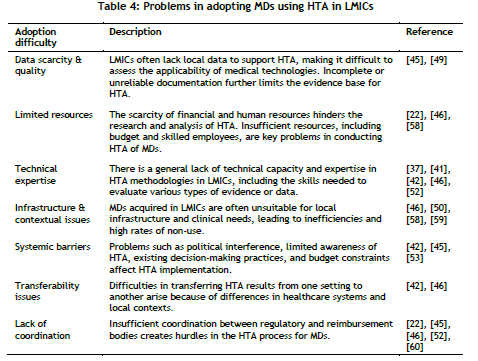
The adoption and evaluation of MDs using HTA in LMICs is hindered by several interrelated barriers, as summarised in Table 4. The problems with and barriers to adopting and evaluating MDs in LMICs have profound implications for HTA processes, affecting their effectiveness in informing healthcare decisions.
Data scarcity and quality limitations significantly restrict the evidence base for HTA, making it difficult to conduct comprehensive evaluations that accurately assess the clinical, economic, and operational value of MDs [45], [49]. Without reliable local data, decision-makers often rely on extrapolated evidence from high-income countries, which may not align with the contextual realities in LMICs [40], [43], [45], [47]. In addition, the lack of technical expertise and limited resources constrain methodological rigour, leading to inconsistent, fragmented, or low-quality HTA reports [36], [40], [48], [53], [61]. The absence of skilled professionals and robust evaluation frameworks prevents thorough comparative assessments, resulting in weaker decision-making and inefficient resource allocation.
Beyond the technical problems, systemic and political barriers hinder HTA implementation even more. Weak policy integration, regulatory misalignment, and limited institutional support prevent HTA findings from being effectively incorporated into national health policies [42], [45], [53]. Even when conducted, HTA efforts are often undermined by poor stakeholder coordination and competing interests that obstruct the translation of evidence into practice [22], [45], [46], [52], [60]. In Zambia, for instance, HTA remains loosely defined in government studies, limiting its policy impact [54]. In Kenya, the National Health Insurance Fund and the Ministry of Health develop benefit packages independently, resulting in misalignment [54]. At the same time, research organisations conduct economic evaluations that policymakers do not always commission or use [54]. In Indonesia, despite an HTA study demonstrating that cetuximab was not cost-effective and leading to its removal from public health insurance, resistance from clinicians led to the reversal of this decision within a year [38]. More broadly, LMICs face systemic barriers to integrating HTA into policymaking, including a lack of high-quality local studies, limited stakeholder trust and understanding of HTA, institutional inertia, and political pressures that often outweigh evidence-based decision-making [54].
These barriers reduce the impact of HTA in guiding MD adoption, leading to suboptimal procurement, underuse of technology, and inefficiencies in healthcare delivery. Addressing these problems requires targeted investments in data infrastructure, workforce development, and stronger policy frameworks to enhance HTA's role in optimising MD evaluation and adoption in LMICs.
4.2. Differences between HTA frameworks for MDs and pharmaceuticals
Section 3 also revealed that a key theme in the literature is the methodological gap between frameworks that are developed for pharmaceuticals and those that are suitable for MDs. This section builds on those findings by discussing the unique features of MDs, such as incremental innovation, operator dependence, and weaker evidence bases, and how these factors require methodological adaptations.
HTA frameworks for MDs differ from those for pharmaceuticals in their data requirements, methodological approaches, and adaptability to innovation. Unlike pharmaceuticals, which undergo rigorous clinical trials before regulatory approval, MDs typically face less stringent licensing requirements, resulting in a weaker clinical evidence base [22]. This disparity makes applying traditional HTA methodologies to MDs more problematic, as they often lack large-scale randomised controlled trials (RCTs), which are considered the gold standard for pharmaceuticals [22].
Another critical difference is the lack of specific methodological guidance for MD-HTA. Most existing HTA frameworks were developed with pharmaceuticals in mind, leading to methodological gaps in assessing MDs, particularly regarding long-term health outcomes, learning curves, and operational complexities [22], [23], [46]. Unlike drugs with predictable pharmacological effects, MDs require user interaction, making their effectiveness highly context-dependent. As a result, MD evaluations must consider organisational factors such as operator expertise, institutional capacity, and healthcare infrastructure, which are often overlooked in pharmaceutical-focused HTA models [22].
In addition, MDs undergo continuous innovation with frequent incremental modifications that challenge conventional HTA timelines [22]. Unlike pharmaceuticals, which have relatively fixed formulations, MDs evolve rapidly, requiring adaptive HTA methodologies that can assess device modifications, software updates, and real-time performance improvements [22]. This requires that real-world evidence (RWE) be integrated into HTA processes to capture how MDs function in diverse healthcare settings beyond controlled clinical trials [34], [47].
Regarding data and evidence requirements, MD-HTA relies more on observational studies, registry data, and qualitative research rather than on the RCT-driven approach that is used for pharmaceuticals [22], [46]. The long causal pathways in MD effectiveness also demand alternative evaluation methods, such as post-market surveillance and iterative assessment models, to ensure their long-term safety and cost-effectiveness. Furthermore, qualitative research plays a crucial role in MD-HTA, providing insights into usability, patient experience, and institutional factors that quantitative clinical data alone cannot capture [22], [34], [46].
4.3.
Alternative approaches for MD evaluation in LMICsBeyond the methodological gaps identified in Section 3, the literature points to a growing interest in complementary approaches that could enhance MD evaluation and adoption in LMICs by addressing data limitations and decision-making constraints.. MCDA improves HTA transparency by integrating economic, social, and ethical factors, making it useful when clinical data is scarce [49]. However, its effectiveness depends on technical capacity and adaptation to local priorities.
EHTA facilitates proactive technology evaluation, helping to identify problems with adoption and to reduce implementation barriers by engaging stakeholders early [25]. Similarly, hospital-based HTA (HB-HTA) enables hospital-level decision-making, incorporating local data to align procurement with institutional needs [36].
Evidence-informed deliberative processes (EDPs) and the EUnetHTA core model offer structured frameworks for evidence transfer, supporting rapid MD assessments in resource-limited settings [39], [62]. In addition, South-South collaborations promote knowledge-sharing among LMICs, strengthening HTA capacity and fostering regional policy alignment [41].
4.4.
Strengthening HTA in LMICs through early HTAAs highlighted in Section 3, EHTA is increasingly recognised in the literature as a complementary approach to traditional HTA, particularly in resource-limited settings. Among the alternative methodologies we have identified, EHTA presents an approach that complements traditional HTA by addressing system constraints before market entry. Unlike standard HTA, which primarily synthesises clinical and economic evidence, EHTA integrates broader system considerations into the development phase, ensuring that MDs align with local healthcare needs and resource limitations [25]. By engaging stakeholders early, EHTA helps to identify additional costs, regulatory difficulties, and non-health outcomes, ultimately informing the development and implementation of more context-appropriate MDs [25], [57].
The key to EHTA's effectiveness is its focus on system-wide constraints rather than on evaluating devices in isolation [25], [38]. It encourages stakeholder engagement to incorporate diverse perspectives from healthcare professionals, policymakers, and end-users, ensuring that technologies are relevant, practical, and sustainable [25]. In addition, EHTA promotes adaptation to local contexts, aligning with frugal and hybrid innovation by modifying existing technologies to improve their accessibility and affordability. Through multidisciplinary methods, including epidemiological analysis, expert elicitation, and modelling, EHTA generates comprehensive insights into MD performance in complex health systems [25].
Beyond evaluation, EHTA strengthens integration and communication between HTA bodies and healthcare delivery stakeholders, bridging the gap between assessment findings and practical implementation [25], [57]. By embedding EHTA principles alongside other adaptive HTA approaches, LMICs could develop more effective, responsive frameworks that assess MDs post-market and guide their early-stage development, leading to better adoption, affordability, and long-term impact on health systems.
4.5.
Applications of HTA in MDVCs and lessons from implementationSection 3 also identified variations in HTA applications in different regions and countries. Building on that evidence, this section examines specific examples of how HTA has been implemented in diverse LMIC contexts, and the lessons that could be drawn to inform future policy and practice.
4.5.1. HTA application in countries
HTA adoption in MDVCs varies widely owing to differences in policy frameworks, technical expertise, and resource availability, with many LMICs lacking a clear legal mandate, trained personnel, and sufficient funding to support comprehensive HTA processes [48], [51], [54], [55], [58], [63]. In China, India, and South Africa, implementation remains fragmented because of complex healthcare systems with multiple insurance schemes, fiscal federalism that decentralises decision-making, and competing interests among stakeholders, all creating misalignment and hindering the effective integration of HTA findings into policy and practice [41], [54]. Ghana is working towards formalising HTA, but decision-maker awareness and acceptance remains uncertain [42]. In contrast, Thailand's HITAP programme has successfully integrated HTA over the past five to ten years, showing how structured capacity-building and policy commitment could drive progress [49].
4.5.2. Lessons from implementation
Key lessons from HTA adoption highlight the importance of stakeholder engagement, institutionalisation, and capacity building [41]. Countries with stronger HTA integration have prioritised training and local expertise, ensuring evidence-based decision-making [34]. Contextual adaptation is essential, as rigid HTA frameworks from high-income countries may not align with LMIC healthcare systems. In addition, standardised data synthesis improves transparency and reproducibility, strengthening HTA credibility [64]. Collaborative efforts, particularly South-South partnerships, have supported regional capacity-building, highlighting the need for cooperation between countries in advancing HTA methodologies for MDVCs [64].
5. CONCLUSION
This scoping review highlights the critical role of HTA in improving the evaluation and adoption of MDs in LMICs. Despite its potential to enhance procurement efficiency, support local innovation, and improve healthcare outcomes, HTA remains underused owing to regulatory gaps, limited expertise, weak institutional support, and a lack of reliable local data. Addressing these barriers requires a structured and context-sensitive approach that aligns HTA methodologies with the specific problems faced by LMICs.
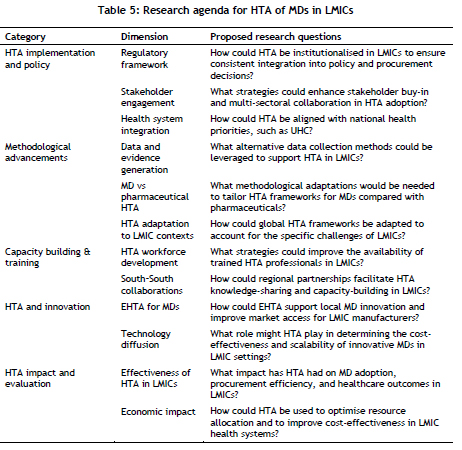
To guide future research and policy development, this study presents a research framework that identifies key areas that need attention. This framework highlights the most pressing issues in policy implementation, methodological advancements, capacity-building, innovation, and impact evaluation, ensuring that HTA efforts are strategically aligned with healthcare priorities in LMICs. Table 5 outlines the priority research areas and the questions that should inform future investigations.
Future research could examine how early HTA methods could be adapted for medical devices in LMICs, particularly in relation to lifecycle and value chain problems. Further studies are also needed to explore sustainable capacity-building strategies and the institutionalisation of HTA. In addition, research should assess the policy impact of HTA on procurement efficiency, local innovation, and equitable access to MDs.
6. LIMITATIONS
The scoping review faced several limitations. First, it focused only on English-language publications, potentially excluding relevant studies in other languages. In addition, reliance on the academic literature may have overlooked valuable insights from industry reports and policy documents. The broad scope of the study also meant that some thematic areas were not explored in depth. Furthermore, since the study was conducted by a single researcher, the selection and interpretation of findings was based on individual judgement, which might have introduced bias. While efforts were made to ensure a systematic approach, the lack of multiple reviewers could have affected the comprehensiveness and validation of the results.
ACKNOWLEDGEMENT
The authors acknowledge the use of AI tools such as Grammarly, ChatGPT, and NotebookLM in the research process. These tools contributed to improving writing clarity, information synthesis, and fact-checking. However, all final decisions, interpretations, and conclusions were made by the researcher, ensuring adherence to ethical research standards and proper citation practices. In addition, the authors recognise the contributions of the academic and research communities whose work has provided the valuable insights that informed this study.
REFERENCES
-
[1] M. Alkhaldi, A. Al Basuoni, M. Matos, M. Tanner, and S. Ahmed, "Health technology assessment in high, middle, and low-income countries: New systematic and interdisciplinary approach for sound informed-policy making: Research protocole," Risk Management and Health Care Policy, vol. 14, pp. 2757-2770, Jun. 2021. doi: 10.2147/RMHP.S310215
» https://doi.org/10.2147/RMHP.S310215 -
[2] World Health Organization, "The world health report: Health systems financing: The path to universal coverage," WHO Library Cataloguing-in-Publication Data, 2010. Accessed: Aug. 18, 2024. [Online]. Available: https://www.who.int/publications/i/item/9789241564021
» https://www.who.int/publications/i/item/9789241564021 -
[3] A. Turner, S. Grobbelaar, F. Salie, and M. Nieuwoudt, "From idea to market in the local medical device value chain: A conceptual framework," IEEE Engineering Management Review, vol. 53, no. 2, pp. 63-84, Apr. 2025. doi: 10.1109/EMR.2024.3409943
» 10.1109/EMR.2024.3409943 -
[4] L. Perry and R. Malkin, "Effectiveness of medical equipment donations to improve health systems: How much medical equipment is broken in the developing world?" Medical & Biological Engineering & Computing, vol. 49, no. 7, pp. 719-722, Jul. 2011. doi: 10.1007/s11517-011-0786-3
» 10.1007/s11517-011-0786-3 -
[5] K. Diaconu, Y.-F. Chen, C. Cummins, G. Moyao, S. Manaseki-Holland, and R. Lilford, "Methods for medical device and equipment procurement and prioritization within low- and middle-income countries: Findings of a systematic literature review," Globalization and Health, vol. 13, 59, Aug. 2017. doi: 10.1186/s12992-017-0280-2
» https://doi.org/10.1186/s12992-017-0280-2 -
[6] D. Piaggio, R. Castaldo, M. Cinelli, S. Cinelli, A. Maccaro, and L. Pecchia, "A framework for designing medical devices resilient to low-resource settings," Global Health, vol. 17, no. 1, 64, Jun. 2021. doi: 10.1186/s12992-021-00718-z
» https://doi.org/10.1186/s12992-021-00718-z -
[7] South African Medical Research Council, "The medical devices landscape in South Africa: Report of a survey conducted by the South African Medical Research Council," Jan. 2022. Accessed: Apr. 02, 2O24. [Online]. Available: http://www.investsa.gov.za/wp-content/uploads/2022/04/SAMRCMedicalDeviceLandscapeReport2022-003.pdf
» http://www.investsa.gov.za/wp-content/uploads/2022/04/SAMRCMedicalDeviceLandscapeReport2022-003.pdf -
[8] K. Mukherjee, "Integrating technology, innovation and policy: COVID-19 and HTA," Health Policy and Technology, vol. 10, no. 1, pp. 16-20, Mar. 2021. doi: 10.1016/j.hlpt.2021.01.003
» 10.1016/j.hlpt.2021.01.003 -
[9] World Health Organization, "Health intervention and technology assessment in support of universal health coverage." Accessed: Aug. 18, 2024. [Online]. Available: https://apps.who.int/gb/ebwha/pdf_files/WHA67/A67_R23-en.pdf
» https://apps.who.int/gb/ebwha/pdf_files/WHA67/A67_R23-en.pdf -
[10] N. Siegfried, T. Wilkinson, and K. Hofman, "Where from and where to for health technology assessment in South Africa? A legal and policy landscape analysis," South African Health Review, vol. 2017, no. 1, pp. 42-48, Dec. 2017. [Online]. Available: https://hdl.handle.net/10520/EJC-c80c2e26a
» https://hdl.handle.net/10520/EJC-c80c2e26a -
[11] S. Garfield et al., "Health technology assessment for molecular diagnostics: Practices, challenges, and recommendations from the medical devices and diagnostics special interest group," Value in Health, vol. 19, no. 5, pp. 577-587, Jul. 2016. doi: 10.1016/j.jval.2016.02.012
» https://doi.org/10.1016/j.jval.2016.02.012 -
[12] V. Smith et al., "Defining the clinician's role in early health technology assessment during medical device innovation: A systematic review," BMC Health Services Research, vol. 19, 514, Jul. 2019. doi: 10.1186/s12913-019-4305-9
» 10.1186/s12913-019-4305-9 -
[13] J. P. C. Grutters, A. Kluytmans, G. J. van der Wilt, and M. Tummers, "Methods for early assessment of the societal value of health technologies: A scoping review and proposal for classification," Value in Health, vol. 25, no. 7, pp. 1227-1234, Jul. 2022. doi: 10.1016/j.jval.2021.12.003
» https://doi.org/10.1016/j.jval.2021.12.003 -
[14] D. Mueller, D. Tivey, and D. Croce, "Health-technology assessment : Its role in strengthening health systems in developing countries," Southern African Journal of Public Health incorporating Strengthening Health Systems, vol. 2, no. 1, pp. 6-11, Jul. 2017. doi: 10.7196/SHS.2017.v2.i1.50
» https://doi.org/10.7196/SHS.2017.v2.i1.50 -
[15] D. Mueller, "Addressing the challenges of implementing a health technology assessment policy framework in South Africa," International Journal of Technology Assessment in Health Care, vol. 36, no. 4, pp. 453-458, Aug. 2020. doi: 10.1017/S0266462320000562
» https://doi.org/10.1017/S0266462320000562 -
[16] S. Hollingworth, A. P. Fenny, S.-Y. Yu, F. Ruiz, and K. Chalkidou, "Health technology assessment in sub-Saharan Africa: A descriptive analysis and narrative synthesis," Cost Effectiveness and Resource Allocation, vol. 19, no. 1, 39, Jul. 2021. doi: 10.1186/s12962-021-00293-5
» https://doi.org/10.1186/s12962-021-00293-5 -
[17] M. Wilkinson et al., "Health technology assessment in support of National Health Insurance in South Africa," International Journal of Technology Assessment in Health Care, vol. 38, no. 1, e44, 2022. doi: 10.1017/S0266462322000265
» https://doi.org/10.1017/S0266462322000265 -
[18] J. L. Mathew, "KNOW ESSENTIALS: A tool for informed decisions in the absence of formal HTA systems," International Journal of Technology Assessment in Health Care, vol. 27, no. 2, pp. 139-150, Apr. 2011. doi: 10.1017/S0266462311000109
» https://doi.org/10.1017/S0266462311000109 -
[19] S. Fuchs, B. Olberg, D. Panteli, and R. Busse, "Health technology assessment of medical devices in Europe: Processes, practices, and methods," International Journal of Technology Assessment in Health Care, vol. 32, no. 4, pp. 246-255, Jan. 2016. doi: 10.1017/S0266462316000349
» https://doi.org/10.1017/S0266462316000349 -
[20] J. Ming et al., "Health technology assessment of medical devices: Current landscape, challenges, and a way forward," Cost Efficient Resource Allocation, vol. 20, no. 1, 54, Oct. 2022. doi: 10.1186/s12962-022-00389-6
» https://doi.org/10.1186/s12962-022-00389-6 -
[21] E. Cowles, G. Marsden, A. Cole, and N. Devlin, "A review of NICE methods and processes across health technology assessment programmes: Why the differences and what is the impact?" Applied Health Economics and Health Policy, vol. 15, no. 4, pp. 469-477, Aug. 2017. doi: 10.1007/s40258-017-0309-y
» https://doi.org/10.1007/s40258-017-0309-y -
[22] O. Ciani, B. Wilcher, A. Van Giessen, and R. S. Taylor, "Linking the regulatory and reimbursement processes for medical devices: The need for integrated assessments," Health Economics, vol. 26, no. S1, pp. 13-29, Feb. 2017. doi: 10.1002/hec.3479
» https://doi.org/10.1002/hec.3479 -
[23] S. Prinja, G. Jyani, N. Gupta, and K. Rajsekar, "Adapting health technology assessment for drugs, medical devices, and health programs: Methodological considerations from the Indian experience," Expert Review of Pharmacoeconomics & Outcomes Research, vol. 21, no. 5, pp. 859-868, Sep. 2021. doi: 10.1080/14737167.2021.1921575
» 10.1080/14737167.2021.1921575 -
[24] S. Pankaj, A. Karun, J. Bhate, and G. Rao Ks, "Enhancing healthcare decision-making: Comparison between health technology assessments and access to medical care in a high-income country vs. low/middle income countries," Health Technology Assessment in Action, vol. 8, no. 2, Jun. 2024. doi: 10.18502/htaa.v8i2.15632
» https://doi.org/10.18502/htaa.v8i2.15632 -
[25] A. Falkowski et al., "How least developed to lower-middle income countries use health technology assessment: A scoping review," Pathogens and Global Health, vol. 117, no. 2, pp. 104-119, Mar. 2023. doi: 10.1080/20477724.2022.2106108
» https://doi.org/10.1080/20477724.2022.2106108 - [26] National Research Council. Industrial methods for the effective development and testing of defense systems. Panel on industrial methods for the effective test and development of defense systems. Committee on National Statistics, Division of Behavioral and Social Sciences and Education and Board on Army Science and Technology, Division on Engineering and Physical Sciences. Washington, DC: National Academies Press, 2012. doi: 10.17226/13291
- [27] A. Kossiakoff, W. N. Sweet, S. J. Seymour, and S. M. Biemer, Systems engineering principles and practice. Wiley, 2011. doi: 10.1002/9781118001028
- [28] L. Vaskić and K. Paetzold, "The system life cycle turbine: A proposal for a universal system life cycle model in aerospace and defense," in 2019 IEEE International Conference on Engineering, Technology and Innovation (ICE/ITMC), Jun. 2019, pp. 1-9. doi: 10.1109/ICE.2019.8792682
-
[29] K. R. Harkin, J. Sorensen, and S. Thomas, "Lifecycle evaluation of medical devices: Supporting or jeopardizing patient outcomes? A comparative analysis of evaluation models," International Journal of Technology Assessment in Health Care, vol. 40, no. 1, e2, Jan. 2024. doi: 10.1017/S026646232300274X
» https://doi.org/10.1017/S026646232300274X -
[30] M. J. Ijzerman, H. Koffijberg, E. Fenwick, and M. Krahn, "Emerging use of early health technology assessment in medical product development: A scoping review of the literature," PharmacoEconomics, vol. 35, no. 7, pp. 727-740, Jul. 2017. doi: 10.1007/s40273-017-0509-1
» https://doi.org/10.1007/s40273-017-0509-1 -
[31] H. Arksey and L. O'Malley, "Scoping studies: Towards a methodological framework," International Journal of Social Research Methodology, vol. 8, no. 1, pp. 19-32, Feb. 2005. doi: 10.1080/1364557032000119616
» https://doi.org/10.1080/1364557032000119616 -
[32] M. D. J. Peters, C. Godfrey, P. Mclnerney, Z. Munn, A. C. Tricco, and H. Khalil, "Scoping reviews," in E. Aromataris, C. Lockwood, K. Porritt, B. Pilla, and Z. Jordan (eds), JBI Manual for evidence synthesis. JBI, 2024, ch. 11. Accessed: Jul. 05, 2024. [Online]. Available: https://synthesismanual.jbi.global
» https://synthesismanual.jbi.global -
[33] P. Ossom Williamson and C. I. J. Minter, "Exploring PubMed as a reliable resource for scholarly communications services," Journal of the Medical Library Association, vol. 107, no. 1, pp. 16-29, Jan. 2019. doi: 10.5195/jmla.2019.433
» https://doi.org/10.5195/jmla.2019.433 -
[34] E. Ahmadnezhad, M. Kheirandish, A. Akbari-Sari, and A. Rashidian, "Systematic review of tools and approaches for evaluating the transferability of health technology assessments across different jurisdictions," International Journal of Health Policy and Management, vol. 13, 8218, Oct. 2024. doi: 10.34172/ijhpm.8218
» https://doi.org/10.34172/ijhpm.8218 -
[35] A. Ananthakrishnan et al., "How can health technology assessment support our response to public health emergencies?" Health Research Policy and Systems, vol. 20, no. 1, 124, Nov. 2022. doi: 10.1186/s12961-022-00925-z
» https://doi.org/10.1186/s12961-022-00925-z -
[36] M. Tang et al., "The initiation, exploration, and development of hospital-based health technology assessment in China: 2005 - 2022," Bioscience Trends, vol. 17, no. 1, pp. 1-13, Feb. 2023. doi: 10.5582/bst.2023.01013
» https://doi.org/10.5582/bst.2023.01013 -
[37] K. Hernandez-Villafuerte, R. Li, and K. J. Hofman, "Bibliometric trends of health economic evaluation in sub-Saharan Africa," Global Health, vol. 12, no. 1, 50, Dec. 2016. doi: 10.1186/s12992-016-0188-2
» https://doi.org/10.1186/s12992-016-0188-2 -
[38] Y. Teerawattananon, S. Vishwanath Dabak, A. Culyer, A. Mills, P. Kingkaew, and W. Isaranuwatchai, "Fifteen lessons from fifteen years of the health intervention and technology assessment program in Thailand," Health Systems & Reform, vol. 9, no. 3, 2330974, Dec. 2023. doi: 10.1080/23288604.2024.2330974.
» https://doi.org/10.1080/23288604.2024.2330974 -
[39] M. Isbeih, L.-F. Heupink, S. Qaddomi, R. Salman, and L. Chola, "Conducting a health technology assessment in the West Bank, occupied Palestinian territory: Lessons from a feasibility project," International Journal of Technology Assessment in Health Care, vol. 40, no. 1, e12, 2024. doi: 10.1017/S0266462324000084
» https://doi.org/10.1017/S0266462324000084 -
[40] C. Kriza et al., "A systematic review of health technology assessment tools in sub-Saharan Africa: Methodological issues and implications," Health Research Policy and Systems, vol. 12, 66, Dec. 2014. doi: 10.1186/1478-4505-12-66
» https://doi.org/10.1186/1478-4505-12-66 -
[41] K. MacQuilkan et al., "Strengthening health technology assessment systems in the global south: A comparative analysis of the HTA journeys of China, India and South Africa," Global Health Action, vol. 11, no. 1, 1527556, 2018. doi: 10.1080/16549716.2018.1527556
» https://doi.org/10.1080/16549716.2018.1527556 -
[42] R. Addo, J. Hall, M. Haas, and S. Goodall, "The knowledge and attitude of Ghanaian decision-makers and researchers towards health technology assessment," Social Science & Medicine, vol. 250, 112889, Apr. 2020. doi: 10.1016/j.socscimed.2020.112889
» https://doi.org/10.1016/j.socscimed.2020.112889 -
[43] B. Németh et al., "The transferability of health technology assessment: The European perspective with focus on central and eastern European countries," Expert Review of Pharmacoeconomics & Outcomes Research, vol. 20, no. 4, pp. 321-330, Jul. 2020. doi: 10.1080/14737167.2020.1779061
» https://doi.org/10.1080/14737167.2020.1779061 -
[44] A. J. Culyer and K. Chalkidou, "Economic evaluation for health investments en route to universal health coverage: Cost-benefit analysis or cost-effectiveness analysis?" Value in Health, vol. 22, no. 1, pp. 99-103, Jan. 2019. doi: 10.1016/j.jval.2018.06.005
» https://doi.org/10.1016/j.jval.2018.06.005 -
[45] B. S. C. Uzochukwu, C. Okeke, N. O'Brien, F. Ruiz, I. Sombie, and S. Hollingworth, "Health technology assessment and priority setting for universal health coverage: A qualitative study of stakeholders' capacity, needs, policy areas of demand and perspectives in Nigeria," Global Health, vol. 16, no. 1, 58, Dec. 2020. doi: 10.1186/s12992-020-00583-2
» https://doi.org/10.1186/s12992-020-00583-2 -
[46] O. Ciani et al., "Health technology assessment of medical devices: A survey of non-European Union agencies," International Journal of Technology and Assessment in Health Care, vol. 31, no. 3, pp. 154-165, 2015. doi: 10.1017/S0266462315000185
» https://doi.org/10.1017/S0266462315000185 -
[47] D. McNair, M. Lumpkin, S. Kern, and D. Hartman, "Use of RWE to inform regulatory, public health policy, and intervention priorities for the developing world," Clinical Pharmacology & Therapeutics, vol. 111, no. 1, pp. 44-51, Jan. 2022. doi: 10.1002/cpt.2449
» https://doi.org/10.1002/cpt.2449 -
[48] J. Bidonde et al., "Developing a tool to assess the skills to perform a health technology assessment," BMC Medical Research Methodology, vol. 22, no. 1, 78, Mar. 2022. doi: 10.1186/s12874-022-01562-4
» https://doi.org/10.1186/s12874-022-01562-4 -
[49] K. Marsh, P. Thokala, S. Youngkong, and K. Chalkidou, "Incorporating MCDA into HTA: Challenges and potential solutions, with a focus on lower income settings," Cost Effectiveness and Resource Allocation, vol. 16, no. S1, 43, Nov. 2018. doi: 10.1186/s12962-018-0125-8
» https://doi.org/10.1186/s12962-018-0125-8 -
[50] G. Palozzi, S. Brunelli, and C. Falivena, "Higher sustainability and lower opportunistic behaviour in healthcare: A new framework for performing hospital-based health technology assessment," Sustainability, vol. 10, no. 10, 3550, Oct. 2018. doi: 10.3390/su10103550
» https://doi.org/10.3390/su10103550 -
[51] W. Oortwijn, D. Determann, K. Schiffers, S. S. Tan, and J. van der Tuin, "Towards integrated health technology assessment for improving decision making in selected countries," Value in Health, vol. 20, no. 8, pp. 1121-1130, Sep. 2017. doi: 10.1016/j.jval.2017.03.011
» https://doi.org/10.1016/j.jval.2017.03.011 -
[52] J. B. Babigumira, A. M. Jenny, R. Bartlein, A. Stergachis, and L. P. Garrison, "Health technology assessment in low- and middle-income countries: A landscape assessment," Journal of Pharmaceutical Health Services Research, vol. 7, no. 1, pp. 37-42, Feb. 2016. doi: 10.1111/jphs.12120
» https://doi.org/10.1111/jphs.12120 -
[53] J. E. Doherty, T. Wilkinson, I. Edoka, and K. Hofman, "Strengthening expertise for health technology assessment and priority-setting in Africa," Global Health Action, vol. 10, no. 1, 1370194, Jan. 2017. doi: 10.1080/16549716.2017.1370194
» https://doi.org/10.1080/16549716.2017.1370194 -
[54] T. Kim et al., "Addressing challenges in health technology assessment institutionalization for furtherance of universal health coverage through south-south knowledge exchange: Lessons from Bhutan, Kenya, Thailand, and Zambia," Value in Health Regional Issues, vol. 24, pp. 187-192, May 2021. doi: 10.1016/j.vhri.2020.12.011
» https://doi.org/10.1016/j.vhri.2020.12.011 -
[55] W. M. Simangolwa, K. Govender, and J. Mbonigaba, "Health technology assessment to support health benefits package design: A systematic review of economic evaluation evidence in Zambia," BMC Health Services Research, vol. 24, no. 1, 1426, Nov. 2024. doi: 10.1186/s12913-024-11914-z
» https://doi.org/10.1186/s12913-024-11914-z -
[56] C. Daccache, R. Rizk, J. Dahham, S. M. A. A. Evers, M. Hiligsmann, and R. Karam, "Economic evaluation guidelines in low- and middle-income countries: A systematic review," International Journal of Technology Assessment in Health Care, vol. 38, no. 1, e1, 2022. doi: 10.1017/S0266462321000659
» https://doi.org/10.1017/S0266462321000659 -
[57] K. Facey, C. Henshall, L. Sampietro-Colom, and S. Thomas, "Improving the effectiveness and efficiency of evidence production for health technology assessment," International Journal of Technology Assessment in Health Care, vol. 31, no. 4, pp. 201-206, 2015. doi: 10.1017/S0266462315000355
» https://doi.org/10.1017/S0266462315000355 -
[58] F. Ramponi et al., "Assessing the potential of HTA to inform resource allocation decisions in low-income settings: The case of Malawi," Frontiers in Public Health, vol. 10, 2022. doi: 10.3389/fpubh.2022.1010702
» https://doi.org/10.3389/fpubh.2022.1010702 -
[59] P. K. Drain et al., "Diagnostic point-of-care tests in resource-limited settings," The Lancet Infectious Diseases, vol. 14, no. 3, pp. 239-249, Mar. 2014. doi: 10.1016/S1473-3099(13)70250-0
» https://doi.org/10.1016/S1473-3099(13)70250-0 -
[60] A. Fasseeh et al., "Implementation of health technology assessment in the Middle East and North Africa: Comparison between the current and preferred status," Frontiers in Pharmacology, vol. 11, Feb. 21, 2020. doi: 10.3389/fphar.2020.00015
» 10.3389/fphar.2020.00015 -
[61] T. S. Avşar and H. H. Yıldırım, "National health technology assessment in Turkiye after a decade: Are key principles followed?" International Journal of Technology Assessment in Health Care, vol. 39, no. 1, e52, 2023. doi: 10.1017/S0266462323000466
» https://doi.org/10.1017/S0266462323000466 -
[62] W. Oortwijn, S. van Oosterhout, and L. Kapiriri, "Application of evidence-informed deliberative processes in health technology assessment in low- and middle-income countries," International Journal of Technology Assessment in Health Care, vol. 36, no. 4, pp. 440-444, Aug. 2020. doi: 10.1017/S0266462320000549
» https://doi.org/10.1017/S0266462320000549 -
[63] A. Prakash, Pempa, T. Duba, K. C. Sarin, S. V. Dabak, and U. Tashi, "Advancing evidence-based decision-making in Bhutan: Development of a health technology assessment framework," The Lancet Regional Health - Southeast Asia, vol. 30, 100489, Nov. 2024. doi: 10.1016/j.lansea.2024.100489
» https://doi.org/10.1016/j.lansea.2024.100489 -
[64] M. D. Oliveira, I. Mataloto, and P. Kanavos, "Multi-criteria decision analysis for health technology assessment: Addressing methodological challenges to improve the state of the art," European Journal of Health Economics, vol. 20, no. 6, pp. 891-918, Aug. 2019. doi: 10.1007/s10198-019-01052-3
» https://doi.org/10.1007/s10198-019-01052-3
Accepted for publication 27 Oct 2025
Available online 12 Dec 2025
ORCID® identifiers
S.S. Grobbelaar
https://orcid.org/0000-0002-2793-9689
T.A. Chikunichawa
https://orcid.org/0009-0000-9507-7454
M. Persson
https://orcid.org/0000-0002-1335-2377