Scoping Review: Factors, Threats and Opportunities of Outsourcing Maintenance Activities in the South African Pulp and Paper Industry
Abstract
Outsourcing is a tool to realise the strategic intent of an organisation. Before outsourcing maintenance services, the maintenance manager should consider the relevant factors, opportunities, and threats. The study aimed to perform a scoping review of the applicable factors, opportunities, and threats in the pulp and paper industry. The review also aimed to determine whether there was a gap in the literature from a South African perspective. Scopus and Web of Science were used as databases to collect 21 articles published from 2002 to 2021. Using ATLAS.ti, 11 categories in these articles were coded, and Sankey diagrams were used to visualise the data. The percentage strength of the correlations indicated recurring themes in the literature. The results found strategy through targeted outsourcing of non-core activities (50%), supplier performance (53%), and employee impact (15%) to be critical factors. Cost reduction (42%) and access to vendor expertise (21%) were key opportunities, while poor supplier performance (29%) and loss of organisational know-how (33%) were key threats. As a recurring theme, outsourcing was found to be common to industries in Europe, Asia, and North America. Based on the findings of the scoping review, it was concluded that there was an opportunity to explore the local context. It was recommended to use the findings and to determine whether these factors, threats, and opportunities could be applied to the South African context
Abstract
Uitkontraktering is 'n instrument om die strategiese voorneme van 'n organisasie te verwesenlik. Voor die uitkontraktering van instandhoudingsdienste moet die instandhoudingsbestuurder die relevante faktore, geleenthede en bedreigings oorweeg. Die studie het ten doel gehad om 'n omvangryke oorsig van die toepaslike faktore, geleenthede en bedreigings in die pulp- en papierbedryf uit te voer. Die oorsig het ook ten doel gehad om te bepaal of daar 'n gaping in die literatuur vanuit 'n Suid-Afrikaanse perspektief was. Scopus en Web of Science is as databasisse gebruik om 21 artikels te versamel wat tussen 2002 en 2021 gepubliseer is. Deur gebruik te maak van ATLAS.ti is 11 kategorieë in hierdie artikels gekodeer, en Sankey-diagramme is gebruik om die data te visualiseer. Die persentasie sterkte van die korrelasies het herhalende temas in die literatuur aangedui. Die resultate het bevind dat strategie deur geteikende uitkontraktering van nie-kernaktiwiteite (50%), verskaffersprestasie (53%) en werknemersimpak (15%) kritieke faktore was. Kostevermindering (42%) en toegang tot verskafferskundigheid (21%) was sleutelgeleenthede, terwyl swak verskaffersprestasie (29%) en verlies aan organisatoriese kundigheid (33%) sleutelbedreigings was. As 'n herhalende tema is bevind dat uitkontraktering algemeen voorkom in nywerhede in Europa, Asië en Noord-Amerika. Gebaseer op die bevindinge van die omvangsoorsig, is tot die gevolgtrekking gekom dat daar 'n geleentheid was om die plaaslike konteks te verken. Daar is aanbeveel om die bevindinge te gebruik en te bepaal of hierdie faktore, bedreigings en geleenthede op die Suid-Afrikaanse konteks toegepas kan word.
1. INTRODUCTION
1. Background
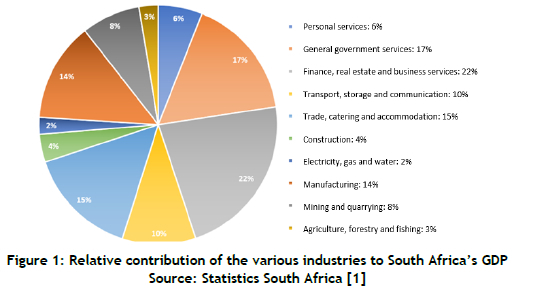
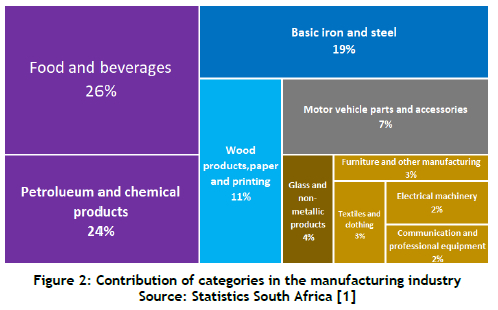
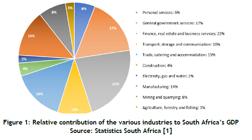
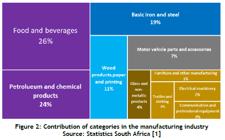
South Africa is rich in mineral and natural resources. It is a developing country with several industries that contribute to the gross domestic product (GDP). One of these industries is the process and manufacturing industry, which is responsible for converting the country's resources into valuable end-products, which in turn contribute to the country's economy. Data from the year 2021 (Figure 1) shows the relative contribution of the various industries to South Africa's GDP [1]. As can be seen, the manufacturing industry accounts for 14% of South Africa's GDP. Thus, it is the fourth largest industry in the country. Figure 2 shows the percentage contribution of each category in the manufacturing industry. The pulp and paper industry (indicated as the wood products, paper, and printing category) accounts for 11% of the manufacturing industry - a significant portion, rated fourth behind food and beverage, petrochemical, and steel. The pulp and paper industry is thus a key element of and contributor to South Africa's GDP.
In 2013, the pulp and paper industry contributed R18.2 billion to South Africa's economy. It employs over 750 000 people, and exports over R9.35 billion worth of products [2], [3] and [4]. The industry faces several challenges, such as environmental legislation, restrictions on water use, labour, and transport costs [3]. With digitalisation, the demand for newspapers, magazines, and other print media has declined by more than 1.57% year-on-year since 2014 [3]. According to Liu, et al., the Covid-19 outbreak in 2019 briefly increased the demand for personal hygiene paper products, food packaging products, corrugated packaging products, and paper-based medicinal materials. This level of growth cannot be sustainable as the world returns to normality. Thus, the industry requires strategic interventions to ensure its sustainability and profitability.
Maintenance is a key lever in delivering the strategic business objectives of an organisation. It can lead to cost-effectiveness, profitability, and overall asset reliability [6]. Several tools are available to deliver these strategic business objectives. One such tool is the outsourcing of maintenance activities in the business. Before the decision to outsource is made, careful consideration must be given to benefits, risks, and decision factors [7]. Cost is often the key driver of the decision to outsource, as it is assumed that outsourcing will lead to reduced fixed costs [7]. Employees will always be affected by outsourcing; proper onboarding is thus a critical element and a key consideration [7]. Outsourcing allows the company to focus on its core competence [18] and to eliminate activities in which it has neither a competitive advantage nor strength. The organisation must fundamentally change in structure if the outsourced activity is still to interface with current organisational systems. Management of the relationship with the service provider that will perform the outsourced activity is critical [36]. Key performance indicators must be put in place to ensure that performance is measured and monitored [19]. Finally, as maintenance is a key lever in delivering the strategic intent of a business, only certain activities must be outsourced to reap the benefits of the decision [20].
Given the large contribution of the pulp and paper industry to the South African economy, there is an opportunity to examine the present status of outsourcing in this industry. Preliminary findings indicated an increasing trend to outsource maintenance activities in the South African pulp and paper industry [8]. A scoping review of the literature was performed to identify gaps for future research in this area. The protocol used for the scoping review had the following steps [9], [10]:
• Define the research question
• Identify the relevant studies
• Study the selection
• Chart the data
• Collate, summarise, and report the results
1.1.
ObjectiveThe objective of this scoping review was:
1. To review the published research;
2. To analyse the existing work; and
3. To identify gaps in the literature.
This information was then used to determine the opportunities and threats that influence the maintenance outsourcing decision in the pulp and paper industry.
1.2.
Review questionsThe Joanna Briggs Institute [9] suggests that review questions assist in developing a scoping review protocol, facilitate an effective literature search, and provide a structure for the review report. In addition, the review question(s) must include elements of population, concept, and context to provide the reader with important information about the scope and focus of the review. To this end, the following review questions were formulated:
• What are the factors to consider when making the decision to outsource maintenance activities?
• What are the opportunities for and threats to outsourcing maintenance activities?
• What maintenance activities have been outsourced in the pulp and paper industry?
2. REVIEW METHODOLOGY
2.1. Search strategy
The literature on outsourcing maintenance activities in various industries is well developed. A preliminary search in the Scopus database on "maintenance outsource" revealed 7270 documents. Research output has increased from one document in the year 1991 to 672 documents in the year 2020. A refined search to include "pulp and paper industry" returned only 91 documents, many of which were maintenance outsourcing research based in the Swedish and Finnish pulp and paper industries. Therefore, an opportunity exists to explore the outsourcing of maintenance in the context of the South African pulp and paper industry.
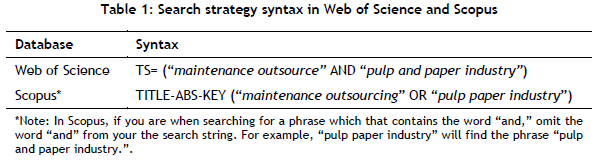
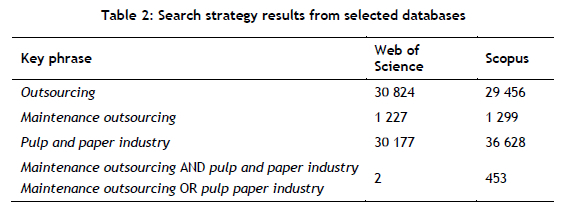
An initial search was done using keywords and key phrases that were relevant to the research topic. These were "outsourcing", "maintenance outsourcing", and "pulp and paper industry". The two databases used for the search were Scopus and Web of Science. These two databases contain high-quality peer-reviewed journal articles for the purposes of academic research [10]. After the initial selection, the Boolean operators AND, OR were used to refine the search results to a manageable level for further screening and selection. Specific syntax must be used to obtain the correct results, as shown in Table 1 below. The results of the initial search, with the refined search using Boolean operators, are shown in Table 2.
2.2. Inclusion and exclusion criteria
The following criteria were used to reduce the number of documents to a manageable level for further screening and selection:
Inclusions
• Previous Master's and doctoral theses
• Studies that describe the benefits and risks of maintenance outsourcing
• Studies that describe outsourcing in the pulp and paper industry
• Studies that describe outsourcing in a processing industry and/or environment
• Previous scoping reviews
Exclusions
• Articles not relevant to the research questions
• Research not published in English
• Duplicates from the two databases
• Research published before the year 2002 (i.e., research older than 20 years)
• Studies on outsourcing in activities other than maintenance (e.g., IT, software, HR, mining, automotive).
• Documents that could not be downloaded as PDFs
2.3. Screening and selection
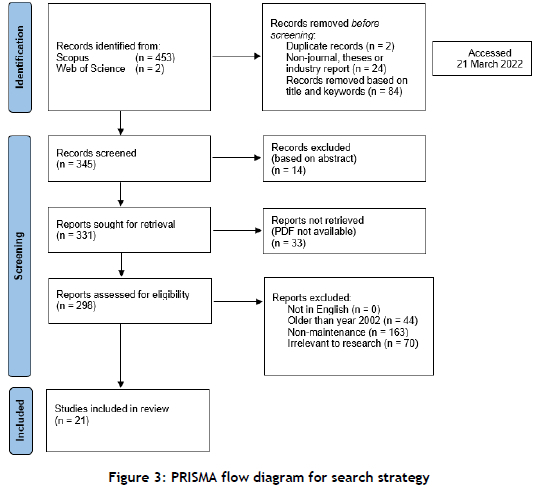
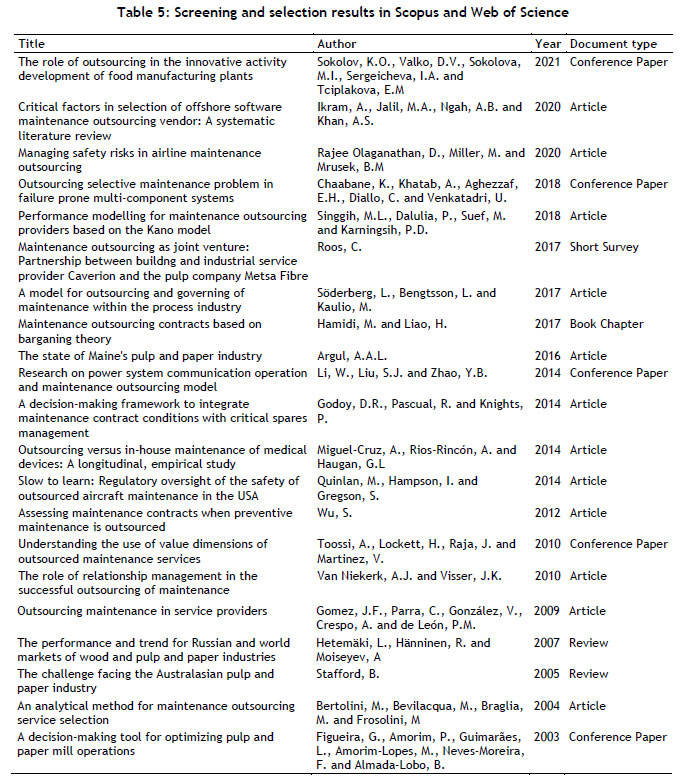
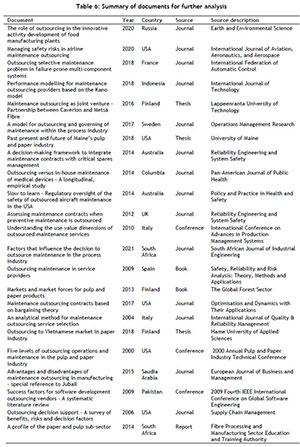
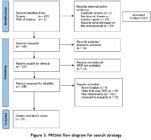
The raw data from Scopus and Web of Science was exported to Microsoft Excel® for screening and selection. Table 5 and Table 6 (see Appendix A) show the results of the screening and selection. The process from initial search to final selection is charted in the preferred reporting items for systematic reviews and meta-analyses (PRISMA) chart in Figure 3 [11], [12].
2.4. Year of publication
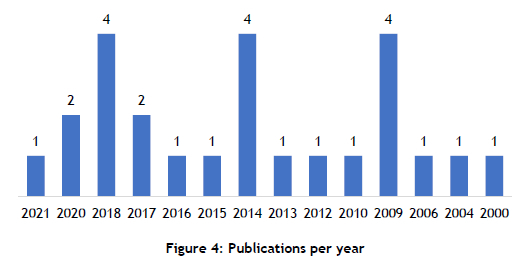
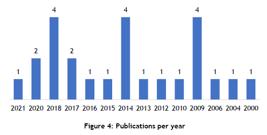
A review of the 21 articles revealed that the output of outsourcing literature has been steady over the years. Certain years have seen an increased output, particularly in 2018, 2014, and 2009. This confirmed that outsourcing is a mature subject in several fields. The breakdown of the years of publication is shown in Figure 4.
2.5. Country of origin
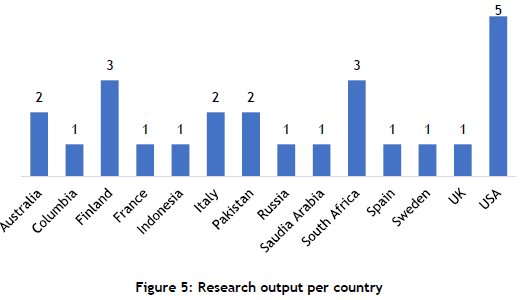
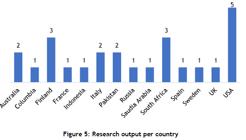
Based on the reviewed documents, the United States of America (USA) emerged as the highest research contributor. This was expected, as the USA is the world's largest pulp and paper producer [13]. Finland produced several research papers, owing to the large forest footprint in Scandinavia. Thus Finland has a highly developed pulp and paper industry, with several original equipment manufacturers (OEMs) in the area. South Africa is the largest pulp and paper producer in Africa, and is rated 11 th in the world. However, there is still the opportunity to build on the body of knowledge on outsourcing in the South African context. The breakdown of the research output per country is shown in Figure 5.
2.6. Document sources and document types
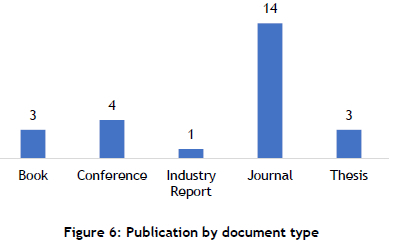
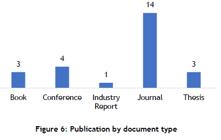
Of the documents reviewed, 18 of the 21 were articles from high-quality journals such as Supply Chain Management and the International Journal of Quality Management. Four documents were obtained from industry reports and Master's/doctoral theses; these offered a more practical perspective than the journal articles. Three documents were books. These provided a more theoretical framework for outsourcing, and were useful in the research. The document types are shown in Figure 6.
2.7. Approach to the analysis
Qualitative research methods involve non-numerical data collection followed by an explanation based on the attributes of the data. Qualitative research helps to build an understanding of how and why certain outcomes were achieved. Content analysis is a research method that is used to identify patterns and themes in qualitative data. This approach involves systematically coding and categorising specific aspects of content in textual data in order to reveal trends and patterns. This is done by quantifying the frequencies and patterns of words present in the textual data [14].
The software program ATLAS.ti was used for the content analysis of the textual data. The 21 research articles were imported into ATLAS.ti. Important information from each article was highlighted as a "quotation", and these quotations were then categorised into eleven codes. These codes were further analysed to draw conclusions. Sankey diagrams (a visualisation tool used to depict the flow from one set of information to another) were used to visualise the information. The items being connected are called nodes and the connections are called links. The thicker the width of the link, the stronger the relationship between the nodes. In this context, the Sankey diagrams were used to determine the importance of a maintenance outsourcing factor, threat, or opportunity [15].
3. RESULTS
3.1. Factors in making the decision to outsource
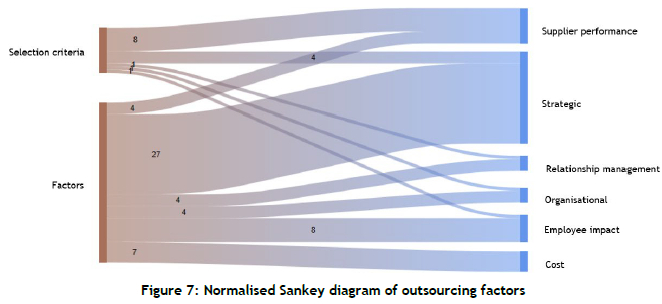
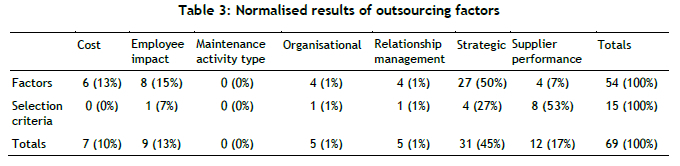
The literature identified seven (7) key factors when deciding to outsource. The literature that discussed factors, motivations, or selection criteria were coded in ATLAS.ti. These were then placed in the code groups "factors" and "selection criteria." ATLAS.ti then determined the number of times the specific code group appeared in all 21 documents, and the frequency of the code group was calculated as a percentage for each factor. This is shown in Table 3. The Sankey diagram (Figure 7) presents the information in Table 3. The thickness of the line between the code group on the left and the individual factors on the right indicates the strength of the factor. A thicker line indicates that the literature deems that factor to be more important.
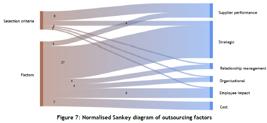
Based on the results, strategy through targeted outsourcing of non-core activities, supplier performance, and employee impact were the most important factors when making the decision to outsource. According to Quinn, managers could leverage their company's skills and resources for increased competitiveness by concentrating the firm's resources on a set of core competencies and by strategically outsourcing those activities for which the firm has neither critical need nor special capability. Strategic outsourcing has four benefits:
• It maximises the efforts of internal resources by focusing on what the firm does best. This is the firm's core competence.
• A well-developed core competence is a barrier to competitors seeking entry into the same market.
• It leverages the expertise of external suppliers that would otherwise not be available internally in the firm.
It improves the response to changes in markets, technological developments, and customer needs.
Chaabane et al. [42] showed how using numerical methods could be used to decide which components could be repaired in-house, and which could be outsourced. Using examples from the manufacture of highly engineered products in the Cummins engine, Venkatesan describes three principles that are consistent with making strategic outsourcing decisions:
• Focus on critical components that the company is good at making.
• Outsource components that other companies can manufacture well, cost-effectively, and in large quantities.
• Use outsourcing to encourage employees' commitment to improving the quality of manufactured products.
Because maintenance is a critical lever in delivering business outcomes [6], it forms part of the firm's core competence and should not be completely outsourced. As described by Gómez, certain elements of maintenance, such as corrective maintenance, can be outsourced to service providers that have developed a capability for maintaining specific equipment. Those activities that are inextricably linked to the organisation's business processes should not be outsourced, as this could cause serious organisational disruptions, as explained by Shaomin and Fernandez, et al..
In relation to supplier performance. Singgih, et al. developed a model to assess the performance of a maintenance outsourcing provider in the private healthcare industry. This model was based on the fact that the service provider needed to satisfy certain criteria in order to be deemed well-performing. The criteria were dependability, flexibility, service quality, turnaround time, contractual relationship, flexibility in billing, knowledge sharing, firm capacity, technicians' skill, administration, diagnostic accuracy, part availability, routine reporting, clarity, and attitude. While these criteria were specific to the private healthcare industry, they could be generalised and be used in other industries, including the pulp and paper industry.
It is critical that a significant change, such as outsourcing a maintenance activity, is communicated well to existing staff. According to Bertolini, et al., a company must evaluate whether it is ready to outsource by reviewing its employee structure and personnel capabilities, and how they might respond to this change. While the authors of that study are based in Italy, the principle is universally applicable, and is especially important in the South African context, which has a highly unionised employee workforce.
Kessler, et al. explored employees' responses to outsourcing in three dimensions:
• Treatment by the existing employer during the outsourcing process.
• Whether there were attractive employment prospects with the new employer.
• Treatment once the outsourcing process had been finalised.
Thus, managers need to be sensitive to the impact that the decision to outsource may have on employees, and this impact needs to be treated with sensitivity.
3.2. Opportunities of and threats to outsourcing
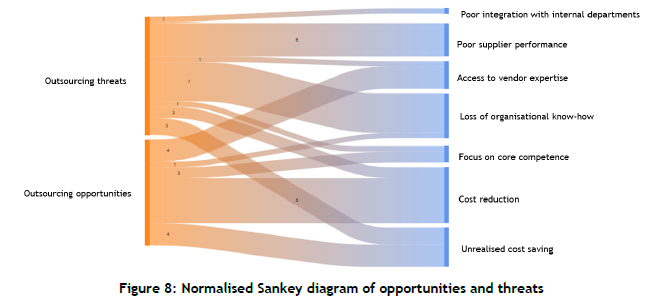
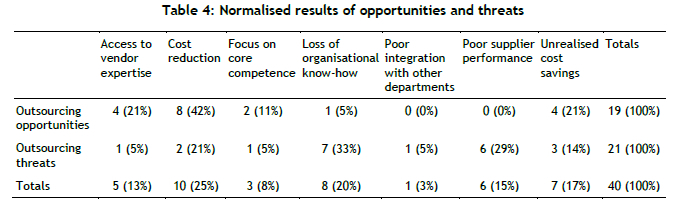
The literature identified four main opportunities of and four main threats to outsourcing. According to Table 4 and Figure 8, the analysis using ATLAS.ti found that access to vendor expertise and cost reduction were key opportunities of outsourcing. Poor supplier performance, loss of organisational know-how, and unrealised cost savings were the key threats when outsourcing. Kremic provides a detailed account from various sources of the opportunities of and threats to outsourcing. From a cost point of view, the first reason often cited for deciding to outsource is to reduce costs [24]. Economies of scale and access to specialised services are used to achieve this cost saving. In addition, having fewer employees means less infrastructure and fewer support systems. It must be noted that cost was found to be both a threat and an opportunity. There is also an opportunity to change fixed costs into variable costs, thus enabling a company to achieve better cost control. However, while firms may save costs by outsourcing, there is the threat of unrealised cost reduction. Indirect costs may include monitoring the outsourced activity, drawing up contracts, and onboarding the service provider. Significant time and capital may be spent on developing the relationship with the service provider. In addition, social costs such as low morale, absenteeism, and lower productivity are often intangible and difficult to quantity [7]. Thus, firms risk not realising the benefit of outsourcing as intended is possible.
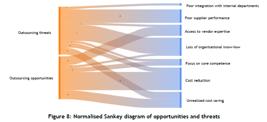
Another reason that is often cited for outsourcing is access to vendor expertise. Outsourcing to firms with the required specific knowledge is critical. According to Belcourt, a firm must "outsource when somebody else can do it better than you". The use of expert knowledge reduces the risks to and liabilities of the firm. Experts have detailed knowledge of the equipment, and can assure a firm that any maintenance work that is done will be done to high standards and will comply with legislation. In addition, well-developed experts have access to the latest technology, innovations, and best practices that can be applied to the firm. While access to vendor expertise is a great benefit, the opposite applies: employees who move to the outsourced company take with them the tacit knowledge gained from many years' experience. This is particularly applicable when the activity that is outsourced is highly integrated with other functions in the firm. Pulp and paper mills are vertically integrated, and maintenance is inextricably linked with operations. Outsourcing the incorrect maintenance activity would lead to a loss of company-specific knowledge of the critical assets and equipment that give the mill its competitive advantage. Thus, the mill may lose its core competence. Venkatesan [18] describes the risks of outsourcing the incorrect activity, and how it could go horribly wrong, in presenting a case study of Satyam Computers in India. Managers should be wary of this threat when outsourcing certain maintenance activities.
3.3. Maintenance outsourcing in the pulp and paper industry
The literature on maintenance outsourcing in several industries is well developed. This ranges from the mining industry [26] to facilities management [28], the petrochemical industry [25], food and beverage [41], and the aviation industry [27]. This section details maintenance outsourcing trends in both the global and local context.
Considering international trends [31], Pulli describes how Finnish pulp and paper industry maintenance activities could be outsourced to Vietnamese firms. Vietnam has a large pool of highly skilled young professionals at a discounted rate when compared with Finland. Pulli argues that outsourcing certain activities could be beneficial to both countries: Finland would have access to skilled labour at a discounted price, and Vietnam would benefit from the economic injection of foreign currency into the local economy. Argul presents the factors that have led to the decline of the pulp and paper industry in the state of Maine in the United States of America, and the steps that are required to restore the industry to its former glory. While the thesis [36] does not cover outsourcing directly, it does give an account of how significant a pulp and paper mill can be for its surrounding community and how important it would be to ensure that mills are sustainable for future generations. Outsourcing is one such strategic lever that could be used to restore struggling organisations. Henderson covers the five levels of outsourced maintenance, performance requirements, and the changes to be made by the supplier with reference to the Australian pulp and paper industry. The paper covers which type of maintenance activities should be outsourced and the level of competence required by the supplier to effectively execute the outsourced maintenance activity. To produce results, suppliers must invest in maintenance management as their core competence, while the firm must be willing to develop a partnership with the service provider.
Regarding the local context, Pogue covers the economic and socio-political trends in the South African pulp and paper industry. He focuses primarily on the need for skills development to propel the industry into the future. Summers and Visser investigate the factors influencing the decision to outsource maintenance activities in the process industry, and shed light on the perceptions of maintenance outsourcing in the South African context. (The processing industry consists of mining, petrochemical, pulp and paper, manufacturing, textiles, and food and beverage.)
The Broad-Based Black Economic Empowerment (BBBEE) Act, which came into effect in 2003, aimed to address the participation of previously disadvantaged individuals in the South African economy. All organisations - including those in the pulp and paper industry - must comply with this Act. Mncube describes how outsourcing maintenance activities could assist the forestry division of Sappi [37] to comply with the codes of good practice of the BBBEE Act. Ngcobo studied the socio-economic impact of outsourcing mechanical services, among other activities, in the forestry division of Mondi. Ngcobo found that outsourcing resulted in increased unemployment, lower morale, and higher rates of insecurity in the community and among employees. The community perceived outsourcing as the root cause of the poor relationship between rural communities, Mondi, and contractors [39]. This was in line with van Niekerk and Visser , who advocated the importance of relationship management to ensure the successful outsourcing of maintenance activities.
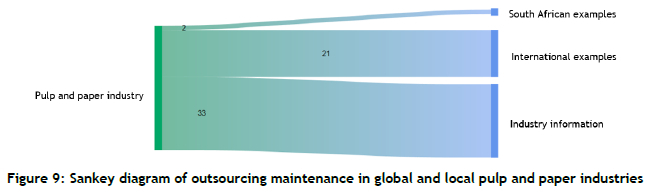
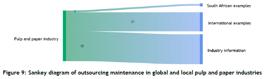
Figure 9 shows the Sankey diagram of the Atlas.ti analysis of outsourcing in the global and local context. From the figure, it is evident that the literature on outsourcing maintenance activities in the South African pulp and paper industry is limited.
4. DISCUSSION
The results of the literature review identified the factors, opportunities, threats, and examples of maintenance outsourcing in the pulp and paper industry. A careful analysis of what it would cost, the impact on employees, the structure and maturity level of the organisation, and strategic intent were key factors to consider that were found in the literature. Cost reduction should not be seen as the only benefit, and the literature identified several opportunities for outsourcing maintenance. These included access to vendor expertise, increased focus on core competence, and improved flexibility. The literature found that outsourcing might not yield the desired outcomes if the decision were not well executed. In addition, loss of company know-how, poor integration, and poor performance were significant threats. The maintenance manager needed to be aware of these threats and opportunities before deciding to outsource.
The results illustrated how the Finnish pulp and paper industry, by outsourcing to Vietnamese companies, could benefit both countries. They also discussed the levels of maintenance that could be outsourced in the Australian pulp and paper industry, and revealed the impact of a paper mill on the surrounding economy in the state of Maine in the USA. Outsourcing in the mining, petrochemical, facilities, and food and beverage industries in South Africa is well developed. However, the literature found the body of knowledge on maintenance outsourcing in the pulp and paper industry to be limited. There is thus an opportunity to add to this body of knowledge. The results addressed all three review questions, and revealed gaps that may be industry-specific for further research.
5. CONCLUSION
The scoping review provided factors, opportunities, threats, and examples of maintenance outsourcing in the pulp and paper industry. The literature identified seven key factors when deciding to outsource. Strategy, supplier performance, and employee impact were the most critical of these deciding factors. In addition, there were four main threats to and four main opportunities from the outsourcing decision. According to the analysis, cost reduction was seen to be the most important opportunity, while loss of organisational knowledge was seen to be the greatest threat. The results addressed all three review questions. In addition, it revealed a gap in the literature on outsourcing maintenance activities in the pulp and paper industry in the South African context.
REFERENCES
-
[1] J. de Beer, (2023, July). The manufacturing industry A detailed exploration of production, employment and finances.[Online]. Date accessed 08 October, 2023. [Online]. Available: https://www.statssa.gov.za/publications/Report-30-02-03/Manufacturing%20industry%202021_Media%20presentation.pdf
» https://www.statssa.gov.za/publications/Report-30-02-03/Manufacturing%20industry%202021_Media%20presentation.pdf -
[2] Fibre Processing & Manufacturing Sector Education and Training Authority (FP&M SETA). (2014, September). A profile of the paper and pulp sub-sector. Date accessed 20 May, 2023 [Online]. Available: https://www.fpmseta.org.za/downloads/FPM_sub-sector_paper_and_pulp_final.pdf
» https://www.fpmseta.org.za/downloads/FPM_sub-sector_paper_and_pulp_final.pdf -
[3] T. E. Pogue, "Wood, paper and pulp," in A. Kraak ed., Sectors and skills: The need for policy alignment, Cape Town: HSRC Press, 2009, ch. 7, pp. 132-149. Date accessed 20 May, 2023 [Online]. Available: https://ieri.org.za/sites/default/files/outputs/Sectors_and_SkiHs_Chapter_7_Wood,_paper_and_pulp.pdf
» https://ieri.org.za/sites/default/files/outputs/Sectors_and_SkiHs_Chapter_7_Wood,_paper_and_pulp.pdf -
[4] Paper Manufacturers Association of South Africa (PAMSA). "Annual summary 2020-2021: Production statistics of the South African pulp and paper industry," 2022. Date accessed 20 May, 2023 [Online]. Available: https://www.thepaperstory.co.za/wp-content/uploads/2022/02/PAMSA-Annual-Summary-2020-2021Q3.pdf
» https://www.thepaperstory.co.za/wp-content/uploads/2022/02/PAMSA-Annual-Summary-2020-2021Q3.pdf - [5] K. Liu, H. Wang, H. Liu, S. Nie, H. Du, and C. Si, "Covid 19: Challenges and perspectives for the pulp and paper industry world wide," BioResources, vol. 15, no. 3, pp. 4638-4641, 2020.
- [6] The Global Forum on Maintenance & Asset Management. The maintenance framework. Zurich, GFMAM, 2016.
- [7] T. Kremic, O. I. Tukel, and W. O. Rom, "Outsourcing decision support: A survey of benefits, risks, and decision factors," Supply Chain Management, vol. 11, no. 6, pp. 467-482, 2006.
-
[8] J. Clarke, Job creation in agriculture, forestry and fisheries in South Africa: An analysis of employment trends, opportunities and constraints in forestry and wood products industries, Working Paper 52, Institute for Poverty, Land and Agrarian Studies (PLAAS), Cape Town, 2018. Date accessed 21 May, 2023 [Online]. Available: https://repository.uwc.ac.za/bitstream/handle/10566/4537/wp_52_job_creation_agriculture_forestry_fisheries_south_africa_employment_opportunities_constraints_2018.pdf?sequence=1&isAllowed=y
» https://repository.uwc.ac.za/bitstream/handle/10566/4537/wp_52_job_creation_agriculture_forestry_fisheries_south_africa_employment_opportunities_constraints_2018.pdf?sequence=1&isAllowed=y - [9] H. Arksey, and L. O'Malley, "Scoping studies: Towards a methodological framework," International Journal of Social Research Methodology, vol. 8, no. 1, pp. 18-32, 2005.
- [10] M. Peters, C. Godfrey, H. Khalil, P. McInerney, D. Parker, and C. B. Soares, "Guidance for conducting systematic scoping reviews," International Journal of Evidence-Based Healthcare, vol. 13, no. 3, pp. 141-146, 2015.
- [11] A. Martín-Martín, E. Orduna-Malea, M. Thelwall, E. Delgado-López-Cózar, "Impact of Social Sciences blog: Google Scholar, Web of Science, and Scopus: Which is best for me?" London School of Economic and Political Science, Dec. 3, 2019.
- [12] M. J. Page, J.E. McKenzie, P.M. Bossuyt, I. Boutron, T.C. Hoffmann, C.D. Mulrow, D.M, Moher, "The PRISMA 2020 statement: An updated guideline for reporting systematic reviews," British Medical Journal, vol. 372, no. 91, 2021.
- [13] D.M. Moher, L. Shamseer, M. Clarke, D. Ghersi, A. Liberati, M. Petticrew, P. Shekelle, L.A. Stewart, and Prisma-P Group, "Preferred reporting items for systematic review and meta-analysis protocols (PRISMA-P) 2015: Elaboration and explanation," British Medical Journal, vol. 349, g7647, 2015.
- [14] A. Listo, "Past present and future of Maine's pulp and paper industry," University of Maine, Maine, 2018.
-
[15] Atlas ti. (2023, 19 August). The ultimate guide to qualitative research. Date accessed 02 April, 2022 [Online]. Available: https://atlasti.com/guides/qualitative-research-guide-part-2/qualitative-data-analysis#introduction
» https://atlasti.com/guides/qualitative-research-guide-part-2/qualitative-data-analysis#introduction -
[16] Google for Developers. (2023, 19 August). Sankey diagrams. Date accessed 02 April, 2022 [Online]. Available: https://developers.google.com/chart/interactive/docs/gallery/sankey
» https://developers.google.com/chart/interactive/docs/gallery/sankey - [17] J. B. Quinn, and F.G. Hilmer, "Strategic outsourcing," MIT Sloan Management Review, vol. 35, no. 4, pp. 43-55, 1994.
- [18] R. Venkatesan, "Strategic sourcing: To make or not to make," Harvard Business Review, vol. 70, no. 6, pp. 98-107, 1992.
- [19] J. C. Gómez, A. Crespo, P. Moreu, C. Parra, and V. González-Prida, "Outsourcing maintenance in services providers," in S. Martorell, C. Guedes Soares, and J. Barnett (eds), Safety, reliability and risk analysis: Theory, methods and applications, London: CRC Press, pp. 829-837, 2009.
- [20] W. Shaomin, "Assessing maintenance contracts when preventive maintenance is outsourced," Reliability Engineering and System Safety, vol. 98, no. 1, pp. 66-72, 2012.
- [21] M. L. Singgih, P. Dalulia, M. Suef, and P. D. Karningsih, "Performance modelling for maintenance outsourcing providers based on the Kano model," International Journal of Technology, vol. 9, no. 4, pp. 797-808, 2018.
- [22] M. Bertolini, M. Bevilacqua, M. Braglia, and M. Frosolini, "An analytical method for maintenance outsourcing service selection," International Journal of Quality & Reliability Management, vol. 21, pp. 772-788, 2004.
- [23] I. Kessler, J. Coyle-Shapiro, and J. Purcell, "Outsourcing and the employee perspective," Human Resource Management Journal, vol. 9, no. 2, p. 5-19, 1999.
- [24] M. Belcourt, "Outsourcing: The benefits and the risks," Human Resource Management Review, vol. 16, no. 2, pp. 269-279, 2006.
- [25] I. Govender, "The challenges regarding outsourcing of key maintenance functions in the liquid petroleum gas sector, South Africa," Master of Business Administration dissertation, Graduate School of Business & Leadership, University of KwaZulu Natal, Durban, 2018.
- [26] F. Khumalo, "Critical success factors for an outsourcing strategy in the Mpumalanga coal mining industry," Master of Business Administration dissertation, Gordon Institute of Business Science, University of Pretoria, Pretoria, 2006.
- [27] R. Olaganathan, M. Miller, and B. M. Mrusek, "Managing safety risks in airline maintenance outsourcing," International Journal of Aviation, Aeronautics, and Aerospace, vol. 7, no. 1, p. 1-21, 2020.
- [28] F. Buys, and R. Nkado, "A survey of approaches to maintenance management in tertiary institutions in South Africa," Construction Management and Economics, vol. 24, no. 10, pp. 997-1005, 2008.
- [29] J. C. Visagie, "Successful outsourcing of maintenance in the mining industry: Methods and principles," Magister in Philosiphae dissertation, Engineering and the Built Environment, University of Johannesburg, Johannesburg, 2005.
- [30] J. A. Badenhorst-Weiss, and J. D. Nel, "Outsourcing practices by the government sector in South Africa: A preliminary study," in 3rd International Public Procurement Conference Proceedings, 2008, pp. 28-30.
- [31] L. Hetemaki, R. Hanninen, and A. Moiseyev, "Markets and market forces for pulp and paper products," in E. Hansen, R. Panwar, and R. Vlosky (eds), The global forest sector: Changes, practices and prospects. Boca Raton, Fl: Taylor & Francis, 2013, pp. 99-128.
- [32] C. Pulli, "Outsourcing to Vietnamese market in paper industry," Master's thesis, HAME University of Applied Sciences, Hämeenlinna, Finland, 2018.
- [33] A. A. L. Argul, "Past, present and future of Maine's pulp and paper industry," Master's thesis, The University of Maine, Orono ME, 2018.
- [34] K. Henderson, "Five levels of outsourcing operations and maintenance in the pulp and paper industry," in Conference Record of 2000 Annual Pulp and Paper Industry Technical Conference (Cat. No. 00CH37111), Peach Tree City, Georgia, IEEE, 2000, pp. 9-17.
- [35] D. J. Summers, and J. K. Visser, "Factors that influence the decision to outsource maintenance in the processing industry," South African Journal of Industrial Engineering, vol. 32, no. 1, pp. 24-36, 2021.
- [36] D. M. Mncube, "Outsourcing as a black economic empowerment tool," Master's thesis, University of Johannesburg, Johannesburg, 2010.
-
[37] Sappi. "Sappi home page." Date accessed 11 March, 2022. [Online]. Available: https://www.sappi.com/group-profile
» https://www.sappi.com/group-profile - [38] S. G. Ngcobo, "The effects of outsourcing on the rural communities and business performance in selected areas of the South African forestry industry," Master's thesis, Department of Agriculture, University of Natal, Pietermaritzburg, 2001.
-
[39] Mondi Group. "Mondi home page." Date accessed 11 March, 2022. [Online]. Available: https://www.mondigroup.com/en/home/
» https://www.mondigroup.com/en/home/ - [40] A. J. van Niekerk, and J. K. Visser, "The role of relationship management in the successful outsourcing of maintenance," South African Journal of Industrial Engineering, vol. 21, no. 2, pp. 79-90, 2010.
- [41] K. O. Sokolov, D. V. Valko, M. I. Sokolova, I. A. Sergeicheva, and E. M.Tciplakova, "The role of outsourcing in the innovative activity development of food manufacturing plants," in IOP Conference Series: Earth and Environmental Science, vol. 677, no. 2, 022011, 2021.
- [42] K. Chaabane, A. Khatab, E. H. Aghezzaf, C. Diallo, and U. Venkatadri, "Outsourcing selective maintenance problem in failure prone multi-component systems," IFAC-PapersOnLine, vol. 51, no. 11, pp. 525-530, 2018.
Accepted for publication 21 Jun 2025
Available online 29 Aug 2025
ORCID® identifiers
W. Maphanga: https://orcid.org/0009-0008-2410-971X
S. Grobbelaar: https://orcid.org/0000-0001-8148-2440
R.H. Peach: https://orcid.org/0000-0002-3104-4482
J.K. Visser: https://orcid.org/0000-0003-4334-9838