A review to illuminate uncertainties associated with carbon budgets in South Africa
Abstract
The effects of climate change threaten Earth's sustainability, and South Africa has committed to limiting its contribution to the total global greenhouse gas (GHG) emission. South Africa introduced its Climate Change Bill to move the country towards a climate-resilient and low-carbon economy and society. Under the Climate Change Bill, carbon budgets are introduced as an emissions mitigation measure that limits the total emissions a facility can emit within a five-year period. Upon the promulgation of the Climate Change Bill, carbon budgets will become mandatory, and penalties will be imposed on companies exceeding their carbon budget. Current legislation provides little guidance on carbon budgeting and reporting in South Africa. This paper reviews the legislation or policies related to the carbon budgets of various countries to illuminate the uncertainties in the implementation of South African carbon budgets. This would then provide guidance on how to improve carbon reporting and planning and risk mitigations.
Abstract
Die gevolge van klimaatsverandering bedreig die Aarde se volhoubaarheid, en Suid-Afrika het hom daartoe verbind om sy bydrae tot die totale globale kweekhuisgasvrystelling (KHG) te beperk. Suid-Afrika het sy Wetsontwerp op Klimaatsverandering ingestel om die land te beweeg na 'n klimaatbestande en laekoolstofekonomie en -samelewing. Ingevolge die Wetsontwerp op Klimaatsverandering word koolstofbegrotings ingestel as 'n emissieversagtende maatreël wat die totale emissies wat 'n fasiliteit binne 'n tydperk van vyf jaar kan vrystel, beperk. Met die afkondiging van die Wetsontwerp op Klimaatsverandering, sal koolstofbegrotings verpligtend word, en sal boetes opgelê word op maatskappye wat hul koolstofbegroting oorskry. Huidige wetgewing verskaf min leiding oor koolstofbegroting en verslagdoening in Suid-Afrika. Hierdie artikel hersien die wetgewing of beleid wat verband hou met die koolstofbegrotings van verskeie lande om die onsekerhede in die implementering van Suid-Afrikaanse koolstofbegrotings te belig. Dit sal dan leiding gee oor hoe om koolstofverslagdoening en -beplanning en risikoversagting te verbeter.
1. INTRODUCTION
Accelerated climate change, with greenhouse gas emissions being one of the contributing factors, poses a continuous threat to the Earth's sustainability [1]. South Africa, as a developing country, is particularly vulnerable to the effects of climate change owing to its high dependency on fossil fuels for energy generation [2, 3].
In December 1997, South Africa signed the Kyoto Protocol and pledged to reduce its emissions by 42% by 2025 according to 'business-as-usual' (normal operating conditions) [4]. Furthermore, the Kyoto Protocol, which is a legally binding treaty on climate change, forms the basis of South Africa's emission reduction targets as submitted under the Paris Agreement [4, 5].
The Paris Agreement aims to limit the increase in the global surface temperature to below 2°C compared with pre-industrial levels, with the ideal limit being 1.5°C [1]. As a signatory of the Paris Agreement, South Africa is required to submit a nationally determined contribution (NDC) that indicates how it plans to reduce its emissions and adapt to climate change while simultaneously considering the country's circumstances, resources, and abilities [5]. The mitigation component of the NDC focuses on commitments to reducing GHG emissions, while the adaptation component describes the country's goals for mitigating the impacts of climate change. In its NDC, South Africa committed to reducing its emissions by between 398 and 510 MtCO2e (megaton carbon dioxide equivalent) by 2025, and by between 398 to 440 MtCO2e by 2030 [6]. Based on the current emissions trajectory, these targets are insufficient to keep the rise in the Earth's surface temperature below 1.5°C.1
Carbon budgets are one of the emissions mitigation measures introduced by the South African Department of Forestry, Fisheries and the Environment (DFFE) to reduce GHG emissions. At a national or sub-national level, the term 'carbon budgets' refers to setting GHG emission caps for various sectors or sources for successive pre-defined periods. Carbon budgets can also refer to an overall limit on GHGs emitted over a specified period to reach longer-term emission reduction targets. South Africa's Climate Change Bill defines carbon budgets as the maximum GHG emissions a company may emit during a specified period [7].
During the first phase of carbon budgets (spanning from January 2016 to December 2020, and extended until December 2022), facilities submitted carbon budgets voluntarily, thereby receiving an additional 5% allowance on their carbon tax liability. However, reporting carbon budgets will become mandatory with the promulgation of the Climate Change Act, and a supertax has been proposed on emissions exceeding the allocated carbon budget [8].
Current legislation provides little guidance on carbon budgeting and reporting in South Africa, as the legislation is new, which makes its practical implementation difficult. Thus this paper reviews the carbon budgets of various countries with established carbon budgets to shed light on uncertainties about the implementation of South African carbon budgets.
2. REVIEW OF NATIONAL CARBON BUDGET LEGISLATION
South Africa's Climate Change Bill was published in October 2021. Under it, a carbon budget will be allocated to any person who conducts an activity listed in terms of section 23(2) of the Bill. During the first commitment period of South Africa's mandatory carbon budgets, emissions from the following sources must be included:
• Stationary combustion;
• Civil aviation;
• Domestic aviation;
• Fugitive emissions; and
• Emissions from industrial processes and product use.
Emissions from road transportation, agriculture, forestry and land use, and waste, as well as Scope 2 and Scope 3 emissions are included voluntarily. However, should these emissions be included in the mandatory carbon budgets during the first commitment period, those emissions would need to be included in each of the subsequent commitment periods as well.
According to the Climate Change Bill, South Africa's carbon budgets need to have a duration of at least three successive five-year periods (see Figure 2-1 ) which indicates the maximum amount of GHG emissions that an entity may emit during the first five-year period. After every five-year cycle, the governing body (in this case the Department of Forestry, Fisheries and the Environment) is required to review the carbon budget. If the national GHG inventory indicates that national GHG emissions are above the national and international climate change mitigation commitments and obligations, the carbon budgets will be revised to ensure that these commitments and obligations are met.
During the allocation of the mandatory carbon budgets, the following needs to be considered [7]:
• The socio-economic impacts associated with the implementation of carbon budgets;
• The latest available scientific practices, evidence, and information;
• The best practicable environmental options available, as well as alternative GHG emissions mitigation measures;
• The national strategic policies;
• The alignment of carbon budgets with the national GHG trajectory; and
• The progress of the implementation of the GHG mitigation plans.
Any person to whom a carbon budget has been allocated may apply for the revision or cancellation of their allocated budget in the event of changes in the circumstances indicated above. Furthermore, an allocated carbon budget can be amended when an activity (for which the carbon budget has been issued) has been partially or fully acquired by an additional party. In such a case, the affected party needs to request the reallocation of the carbon budget from the relevant minister.
Under the Climate Change Bill, a person to whom a carbon budget has been allocated is required to submit a GHG mitigation plan that describes the proposed mitigation measures to ensure that the actual emissions remain within the allocated carbon budget. The GHG mitigation plans need to be implemented and approved by the DFFE, and the annual implementation of the plan must be monitored using the prescribed methodology. Furthermore, the GHG mitigation plans need to evaluate and report on progress against the allocated carbon budget. If there is evidence that the carbon budget will likely be exceeded, a description of the measures that will be implemented to remain within the carbon budget needs to be provided [7].
Since South Africa's legislation related to carbon budgets is relatively new, reviewing other countries' carbon budgets could indicate what to expect from the mandatory carbon budgets.
3. REVIEW OF INTERNATIONAL CARBON BUDGET LEGISLATION
Like South Africa, various countries have implemented carbon budgets as an emission mitigation measure to achieve their objectives as set out under the Paris Agreement. Carbon budgets (also referred to as emission budgets) allow for the distribution of annual emission reduction over a set period, thus allowing for more flexibility than with single-year interim targets.
The United Kingdom (UK) was one of the first countries to adopt carbon budgets to guide its short- and mid-term policy planning. Other countries that use carbon budgets as interim milestones towards reaching their net-zero emissions targets include France, Germany, Chile, and New Zealand [9-13].
Interim targets can be either economy-wide or sector-specific. Most countries opt for economy-wide reduction targets, which are usually expressed as a percentage reduction of 1990 or 2005 emission levels [9].
Compared with economy-wide targets, sectoral targets can provide better guidance to policymakers about the development of implementation plans while also ensuring greater accountability. Sectoral targets also give more guidance to other stakeholders.
Luxembourg [14] is one of the countries that have established sectoral targets by setting a limit on their annual GHG emissions for the main polluting sectors (such as energy and manufacturing industries, transport, buildings, agriculture, forestry, and waste). Sweden has separate milestone targets for domestic transport (excluding domestic flights), which accounts for about a third of Sweden's GHG emissions [9].
Some countries, including Ireland [9, 15], also allow for banking and borrowing emissions between adjacent carbon budget periods. If the total emissions in a carbon budget period are lower than the carbon budget, the difference may be carried to the subsequent carbon budget period. This is known as the banking of emissions. On the other hand, if the total emissions in a carbon budget period are greater than the budget for that period, the amount from the subsequent period may be carried back to the preceding emissions period. This is known as the borrowing of emissions [9].
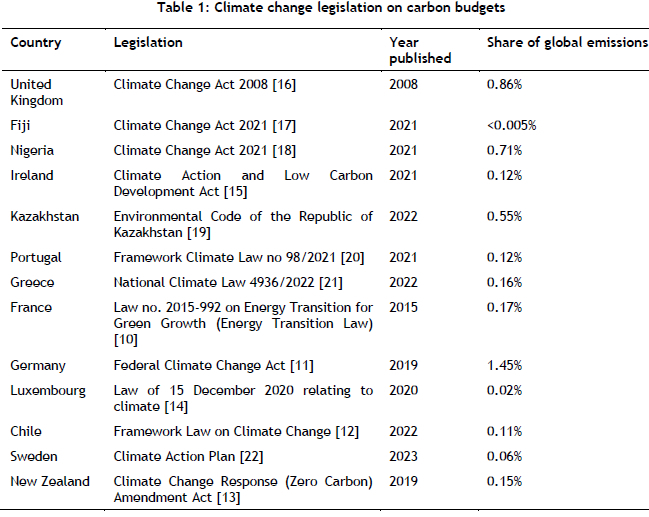
Available climate change regulations in which the carbon budget legislation for the various countries has been captured are summarised in Table 1.
The climate change legislation of the countries mentioned in Table 1 was compared with that of South Africa by looking at the following criteria:
•Carbon budget period: for how long are carbon budgets required?
•Carbon budget emission reduction requirements: to what level do emissions need to be reduced compared with the baseline period?
•Banking and borrowing of emissions: can a carbon budget surplus be transferred to and/or emissions borrowed from the preceding carbon budget period?
•Revision of carbon budgets: does the legislation provide for the revision of carbon budgets under a specific set of circumstances?
•Level of carbon budgets: are carbon budgets allocated at a sector or a national level?
•Use of international emission mitigation measures: can international emissions mitigation measures be used to ensure that carbon budgets are achieved?
•Penalties or incentives associated with carbon budgets: are any penalties or incentives implemented to ensure that carbon budgets are achieved?
3.1. How are other countries handling carbon budgets?
3.1.1. United Kingdom
The United Kingdom is currently in its fourth carbon budget period. Under the UK's carbon budget legislation, the budget period is specified as three successive five-year periods, with the first period spanning from 2008 to 2012. Furthermore, the annual equivalent emissions for the budgets must be at least 34% lower than the 1990 baseline emissions.
Under the UK's carbon legislation, scientific knowledge about climate change, the economic and social circumstances, the energy policy, the difference in circumstances between countries in the UK, and the circumstances across Europe and at the international level are all necessary to consider.
Banking and borrowing emissions across carbon budget periods are also allowed. The governing body may decide to carry back part of the allocated carbon budget for a budgetary period to the preceding budgetary period. In this case, the carbon budget for the later period is reduced while the earlier period is increased by the amount carried back. This amount, however, may not exceed 1% of the carbon budget for the later period. Suppose that the carbon budget for the budgetary period exceeds the net UK carbon account for the period: in that case, the governing body may carry forward the whole or part of the exceeded amount.
Should there be a change of method that requires the adjustment of a carbon budget earlier in the same budgetary period, the required adjustment as well as the adjusted amount would need to be specified, as required by international carbon reporting practice.
UK legislation states that a carbon budget for a period cannot be revised after the date for which the budget has been set. A carbon budget may, however, be amended after the date for which the budget has been set if there have been significant changes that could affect the basis on which the carbon budget was determined. No amendments can be made to the budget after the budgetary period has ended.
The UK's Climate Change Act also provides for the amendment of budgetary periods. The length of the budgetary period, the start date, and the end date can be amended to ensure the budgetary periods are in line with the agreed-upon periods at European or international level [16].
3.1.2. Ireland
Ireland's carbon budgets consist of five years beginning in 2021 (to 2025), and at any given time are specified for three sequential budgetary periods. For the first two budgetary periods, a 51% reduction in the annual GHG emissions is required compared with the reported 2018 emissions. For budgetary periods beyond 31 December 2030, a base year to which emission reduction is related still needs to be specified.
In the setting of Ireland's carbon budgets, the most recent national GHG emissions inventory as well as the projection of future GHG emissions, relevant scientific advice, international best practices on the reporting and removal of GHG emissions, and the need to maximise employment, the reactiveness of the state for investment, and the long-term competitiveness of the economy need to be considered. Ireland's legislation enables the carrying of carbon budget amounts from one budgetary period to another.
When there is a need to revise a carbon budget, any proposed amendments to a provisional carbon budget must be approved by the Advisory Council of Ireland. Under Ireland's legislation, a carbon budget can only be revised when new obligations are imposed by the state under the laws of the European Union, or by any international agreement, or in the event of developments in scientific knowledge relating to climate change.
Based on the limits of the carbon budget, the governing body shall prepare the maximum emissions that are permitted in the different economic sectors (known as a sectoral emission ceiling) and where different ceilings may apply to the different sectors [15].
3.1.3. Fiji
Fiji's carbon budget periods consist of five consecutive five-year periods, beginning with the period 2026 to 2030. As part of its cumulative efforts to achieve net zero GHG emissions by 2050, each carbon budget must have a greater reduction in GHG emissions than any of the previous carbon budgets. Furthermore, each of the carbon budgets must indicate the extent to which the GHG emissions will be reduced compared with Fiji's GHG emissions for 2013.
When determining Fiji's carbon budget, it is necessary to reduce emissions in the most efficient and cost-effective way within the carbon budget period and using any technology relevant to mitigating climate change. Furthermore, the best available knowledge about climate change, the economic, social and environmental circumstances, natural disasters, the adverse impact of climate change, the extent to which they will affect or have affected Fiji's national GHG emissions, and the extent to which donor funding is available, need to be considered.
To ensure that Fiji's GHG emissions are below the allocated carbon budget, prescribed fees and other charges are paid to the state on the volume of GHG emissions. Furthermore, fiscal incentives and national levies are to be introduced and implemented to limit or reduce GHG emissions relating to particular sectors or industries. To meet the objectives of the carbon budget, Fiji's governing body may develop emission reduction methodologies that are approved under the national standard, or use a foreign emissions trading scheme for which it has the appropriate consent [17].
3.1.4. Nigeria
In 2019, Nigeria was ranked as the 25th largest GHG emitter globally and the second highest in Africa after South Africa. As part of its obligations under the Paris Agreement, Nigeria implemented carbon budgets with a five-year budgetary cycle, as stated in its Climate Change Act of 2021. To ensure that the carbon budgets are in line with their NDC and that they comply with international obligations, the allocated carbon budgets are revised periodically [18].
3.1.5. Kazakhstan
For the first year in the first budgetary period of Kazakhstan (2021 to 2025), the carbon budget had to be at least 1.5% below the 1990 carbon emissions. Furthermore, the emissions for each subsequent carbon budget needed to be 1.5% below the preceding carbon budget. The same applies to the second budgetary period (2026 to 2030). For budgetary periods after 2030, the carbon budget for each calendar year is required to be at least 15% below the 1990 carbon budget [19].
3.1.6. Portugal
Portugal's carbon budget legislation is captured in their Framework Climate Law no 98/2021. To align with other climate policy instruments and international guidelines, the established carbon budget periods consist of five consecutive years, with the first and second budget periods being from 2023 to 2025 and from 2025 to 2030 respectively [20].
3.1.7. Greece
The Greek government implemented the National Climate Law 4936/2022 on the transition to neutrality and climate change adaptation in 2022. As with other carbon budgets, the Greek carbon budgets consist of consecutive five-year periods.
To meet the objectives of the carbon budgets, an assessment of a particular economic sector's annual progress in achieving the corresponding sectoral carbon budgets, an overview and quantitative assessment of the effect of sectoral policies, and measures to mitigate GHG emissions are required [21].
3.1.8. France
As indicated in Law no. 2015-992 on Energy Transition for Green Growth (Energy Transition Law), France has established carbon budgets for the following periods: 2015-2018, 2019-2023, 2024-2028, and 2029-2033. These carbon budgets aim to reduce GHG emissions by 40% between 1990 and 2030 and to reduce emissions by 75% between 1990 and 2050. With the implementation of carbon budgets in France, it is important to evaluate the environmental, social, and environmental impacts of carbon budgets on future periods and of the new low-carbon strategy especially on the competitiveness of economic activities that are subject to international competition and on the development of new local activities on growth [10].
3.1.9. Germany
Germany aims to reduce its emissions by at least 65% by 2030 and by at least 88% by 2040 compared with 1990 levels. This will be done by setting up annual emission targets for the energy, industry, transport, building, agriculture, waste, and other sectors.
The allowable annual emission budgets are to be reviewed should there be changes to the European Effort Sharing Regulation and the European Emissions trading directive.
From 2021, the difference in GHG emissions below or above the relevant permissible annual sectoral emission budgets could be added to or subtracted from the remaining sectoral emission budgets in equal instalments until the subsequent target year.
Should the annual emission budget be exceeded, an action programme for the relevant sectors needs to be provided by the relevant federal government ministry, thus ensuring compliance with the annual sectoral emission budgets in the following years. A new climate action programme will be adopted after each update of the Climate Action plan to include additional measures that are required if annual emission targets are missed.
Alterations to the annual emission budgets are permissible. However, alterations to or setting annual emission budgets can only be done after obtaining the opinion of the Council of Experts on Climate Change about the underlying assumption of GHG reduction [11].
3.1.10. Luxembourg
Luxembourg established sectoral targets by setting a limit on their annual GHG emissions for the main polluting sectors. Surplus emissions from the current carbon budget can be carried to the following year for the same sector. The trading of emissions between sectors is also allowed, provided that the national emission reduction targets have been met [14].
3.1.11. Sweden
Sweden implemented its Climate Action Plan in 2023. As part of its EU commitments, Sweden aims to reduce its national emissions in the ESR sector (including road transport, work machinery, individual heating, and agriculture) at the end of 2030 by 50% compared with its 2005 emissions, by implementing emissions budgets [22].
3.1.12. Chile
Chile implemented its Framework Law on Climate Change in 2022. The Chilean government implemented sectoral emission budgets to achieve its medium-term emission reduction objective. Chile's sectoral GHG emissions budgets represent the maximum amount of GHG emission that can be accumulated at the sectoral level for a given period. Sectoral GHG emissions budgets up until 2030 are allocated to the various sectors based on cost-effectiveness and equity criteria. The emission reduction measures that are required to achieve the sectoral emission budgets are stipulated in Chile's Sectoral Mitigation Plans.
Apart from sectoral emission budgets, national emission budgets are also implemented for each period. Chile's national GHG emissions budget represents the maximum amount of accumulated GHG emission that is required at the national level for a given period that will ensure that its goals stipulated by the Paris Agreement are met. Both these budgets are to be updated according to international commitments, as stipulated in Chile's NDC.
The Framework Law on Climate Change further requires a detailed description of the mitigation measures that will be implemented at national, regional, and communal levels to ensure that sectoral emissions budgets will be met. The proposed mitigation plans need to prioritise measures that are the most effective for mitigation while minimising the possible social, economic, and environmental costs [12].
3.1.13. New Zealand
New Zealand published its Climate Change Response (Zero Carbon) Amendment Act in 2019, in which legislation for emissions budgets is captured. The Act defines the emission budget periods as five years each between 2022 and 2050 (except for 2022 to 2025, which is four years). Under the Act, an emissions reduction plan is required that details how the prepared emissions budget will be achieved.
The setting of emissions budgets is the responsibility of the governing body. New Zealand's climate change legislation requires that there be three consecutive emissions budgets at any given time: one current emissions budget and two prospective emission budgets. It is also the minister's responsibility to ensure that the net accounting emissions do not exceed the emissions budget for the relevant budgetary periods.
Furthermore, the Act requires the reduction of emissions through domestic emissions reduction and domestic removals, with international emissions mitigation measures only being considered if a change of circumstances affects the considerations on which the relevant emissions budget was based or if it affects the ability to meet the relevant emissions budget domestically.
It is the responsibility of the governing body to determine how the progress towards meeting the emissions budgets and the 2050 target will be achieved through various pricing and policy methods.
Although emissions budgets are required to be ambitious, they should also be technically and economically achievable.
According to New Zealand's legislation, emissions can only be revised if the methodology used to measure and report it has been improved. The revision of emissions budgets may not occur after the beginning of an emissions budget.
New Zealand's Act also allows for the banking and borrowing of emissions between emission budget periods. The Commission will advise on the quantity of emissions that may be banked or borrowed between adjacent emissions budget periods [13].
4. COMPARISON OF INTERNATIONAL AND SOUTH AFRICAN CARBON BUDGET LEGISLATION
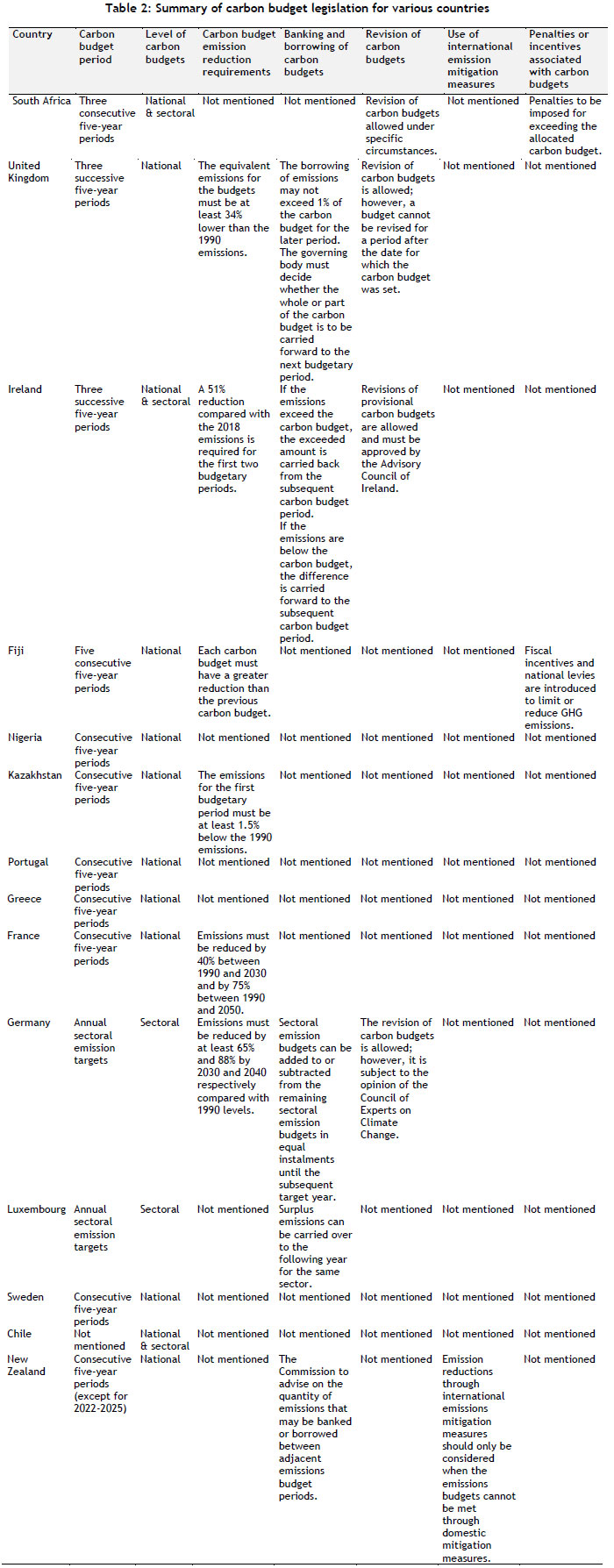
As required by international carbon reporting practice, the emissions budgets at the national level all consist of consecutive five-year periods. South Africa's legislation requires the reporting of three consecutive five-year periods. Similarly, the UK and Ireland's budgetary period also consist of three consecutive five-year periods: the current budgetary period and two provisional budgetary periods. Countries with sectoral emissions - in this case, Germany and Luxembourg - have annual emission targets that need to be reached. Chile's and Ireland's climate change legislation includes national and sectoral budgets as emissions mitigation measures. This is also true for South Africa.
Five of the thirteen countries (the UK, Germany, Luxembourg, New Zealand, and Ireland) allow for the banking and borrowing of emissions between adjacent budgetary periods. The surplus amount carried forward to the subsequent carbon budget period or the exceeded amount carried back to the preceding carbon budget period is determined by the governing body. In South Africa's Climate Change Bill, there is no mention of the banking and borrowing of emissions being allowed upon the promulgation of the bill.
South Africa, like the UK, Germany, and Ireland, allows for the revision of carbon budgets under specific circumstances. These circumstances include changes in the methodologies used on which carbon budgets are based; changes in social, economic, and environmental circumstances; and changes in international carbon accounting practices. The amended carbon budgets need to be approved by the responsible governing body, and cannot be amended after the date for which the budget has been set.
Only New Zealand's legislation mentions the use of international mitigation measures to achieve the national carbon budget. International emissions mitigation measures, however, should only be used when the carbon budgets (referred to as emission budgets) cannot be met through domestic emission mitigation measures.
Only one country mentions using incentives or penalties to achieve the allocated carbon budget. Fiji implemented monetary incentives for achieving the carbon budgets in the form of national levies. Unlike Fiji, South Africa uses a disincentive in the form of penalties on emissions exceeding the allocated carbon budget in order to ensure that the carbon budget will be achieved. Since penalties will be applied to the emissions exceeding the carbon budget, it is unlikely that the banking and borrowing of emissions will apply to South African carbon budgets.
Should penalties be applied for exceeding the allocated carbon budget, facilities to which budgets were allocated will likely only ensure that they meet their budgets. No additional steps will be taken to ensure that the facility is well within its budget, since the banking and borrowing of emissions will not apply.
The identification of potential incentives from other countries could assist policymakers during the development of new legislation or when improving existing legislation.
The carbon budget legislation for the various countries is summarised in Table 2.
5. CONCLUSION
Under the Paris Agreement, countries are required to help reduce the rise in the Earth's temperature to below 1.5°C through emissions reduction. One of the mitigation measures implemented to reduce emissions is carbon budgets (also referred to as emissions budgets).
In 2019, South Africa passed its Climate Change Bill. Upon the promulgation of the Bill, carbon budgets will become mandatory, and penalties will be applied for exceeding the allocated carbon budget.
The Bill provides little information on how carbon budgets will be implemented. Thus a review of international carbon budget legislation was undertaken in this study to illuminate some of the uncertainties. Most countries in the review have a similar carbon budget period to that of South Africa (three consecutive five-year periods). However, while international carbon budget legislation indicates the level of emissions reduction required by implementing carbon budgets, South African legislation does not provide the same information.
South Africa's is also the only legislation that provides for the implementation of penalties for exceeding the allocated carbon budget. However, there is still uncertainty about how the penalties will be implemented (for example, annually or at the end of each carbon budget).
While countries such as the UK and Ireland allow for the banking and borrowing of emissions across budgetary periods, it is unlikely that this will apply to South African carbon budgets because of the penalty that will apply for exceeding the carbon budget.
Should penalties be applied for exceeding the allocated carbon budget, facilities to which budgets were allocated will likely ensure that they meet their budgets. Thus no additional steps will be taken to ensure that the facility is well within its budget, since the banking and borrowing of emissions will not apply.
The review of different countries' incentives/disincentives for exceeding/achieving the allocated carbon budget could assist policymakers in the development of new legislation. Furthermore, the review indicates what to expect from South Africa's mandatory carbon budgets, thus allowing improved carbon reporting and planning as well as risk mitigations.
Although the review of international carbon budgets provided some insight into what to expect with the implementation of South Africa's mandatory carbon budget, there is still some uncertainty about how the budgets will be implemented. This study could be used as a blueprint or roadmap to illuminate the many remaining uncertainties.
REFERENCES
- [1] J. Blau, The Paris Agreement: Climate change, solidarity, and human rights. Palgrave Macmillan, 2017.
- [2] S. Kreft, D. Ekstein, and I. Melchior, "Global climate risk index 2017," 2017.
- [3] Republic of South Africa, "South Africa's low-emission development strategy 2050," 2020.
- [4] United Nations Framework Convention on Climate Change, "Kyoto Protocol," 1998.
- [5] United Nations Framework Convention on Climate Change, "Paris Agreement," 21st Conference of the Parties, 2015.
- [6] Republic of South Africa, "Proposed updated nationally determined contributions," 2021.
- [7] Republic of South Africa, Climate Change Bill, 2021.
- [8] Department of Environment, Forestry and Fisheries, "Carbon budget methodology document," 2021.
- [9] L. L. Re, S. Jeudy-Hugo, and C. Falduto, "Understanding countries' net-zero emissions targets," OECD/IEA Climate Change Expert Group Papers, 2021.
- [10] Government of France, "Law no. 2015-992 on Energy Transition for Green Growth (Energy Transition Law)," 2015.
- [11] The Federal Republic of Germany, "Act on Climate Protection (Federal Climate Change Act)," Bundes-Klimaschutzgesetz (KSG), BGBl. I S. 2513, 2019.
- [12] Government of Chile, Framework Law on Climate Change, 2022.
- [13] New Zealand Parliament, Climate Change Response (Zero Carbon) Amendment Act 2019, No. 61, 2019.
- [14] Government of Luxembourg, Law of 15 December 2020 Relating to Climate, 2020.
- [15] Government of Ireland, Climate Action and Low Carbon Development (Amendment) Act 2021, No. 32/2021, 2021.
- [16] UK Government, "Climate Change Act 2008", 2008.
- [17] Parliament of the Republic of Fiji, Climate Change Act 2021 (Act No. 43 of 2021), 2021.
- [18] Government of Nigeria, Climate Change Act, 2021.
- [19] Republic of Kazakhstan, "Environmental Code of the Republic of Kazakhstan Law No. 400-VI ZRK", 2022.
- [20] Government of Portugal, Framework Climate Law no. 98/2021, 2021.
- [21] Government of Greece, "Law No. 4936/2022, National Climate Law - Transition to Climate Neutrality and Adaptation to Climate Change, Emergency Provisions to Address the Energy Crisis and Protect the Environment," Government Gazette, No. 105/A, 2022.
- [22] Government of Sweden, "Sweden's Climate Change Act and Climate Policy Framework," Naturvârdsverket (Swedish Environmental Protection Agency), 2023.
ORCID® identifiers
S. Viljoen: https://orcid.org/0000-0002-9036-6609
C.S.L. Schutte: https://orcid.org/0000-0002-0119-720X
J.H. van Laar: https://orcid.org/0000-0003-0457-328X
A.G.S. Gous: https://orcid.org/0000-0002-3195-1146
1 https://climateactiontracker.org/countries/south-africa/