Strategies to Reduce Food Loss and Waste in Emerging Economies: An Interpretive Structural Modelling Approach
Abstract
This study aimed to develop a nationwide strategic framework to reduce the volume of food loss and waste in the context of developing countries. The research used expert opinions to validate the strategy derived from the literature review, and the interpretive structural modelling method (ISM) to construct a strategy in a structural hierarchy. The "matrice d'impacts croises multiplication appliquee aun classement" (MICMAC) analysis then categorised strategy elements based on driving forces and dependencies. Twenty recommendations for reducing food loss and waste (FLW) were organised in a structural strategy hierarchy. The hierarchy has seven levels, and most of the strategies are categorised as links in the MICMAC quadrant. Studies rarely find a structural hierarchy for a strategy using ISM, especially for food loss and waste reduction strategies.
Abstract
Hierdie studie het ten doel gehad om 'n landwye strategiese raamwerk te ontwikkel om die volume voedselverlies en -vermorsing in die konteks van ontwikkelende lande te verminder. Die navorsing het kundige menings gebruik om die strategie wat uit die literatuuroorsig afgelei is, te valideer, en die interpretatiewe strukturele modelleringsmetode (ISM) om 'n strategie in 'n strukturele hiërargie te konstrueer. Die "matrice d'impacts croises multiplication appliquee aun classement" (MICMAC) analise het toe strategie-elemente gekategoriseer gebaseer op dryfkragte en afhanklikhede. Twintig aanbevelings vir die vermindering van voedselverlies en -vermorsing (FLW) is in 'n strukturele strategie-hiërargie georganiseer. Die hiërargie het sewe vlakke, en die meeste van die strategieë word as skakels in die MICMAC-kwadrant gekategoriseer. Studies vind selde 'n strukturele hiërargie vir 'n strategie wat ISM gebruik, veral vir voedselverlies- en afvalverminderingsstrategieë.
1. INTRODUCTION
Food waste is the disposal of edible food in the retail and consuming phases, while food loss is decreased edibility between production and distribution [1]. The generation of food loss and waste (FLW) indicates an inefficient food supply chain system, highlighting the wastage of resources such as the land, water, labour, and energy used in food production. Food loss results from limited infrastructure and logistics, while food waste is linked to human habits [1]. Waste generation varies among countries owing to factors such as income level, urbanisation, and economic development [2]. Food loss represents a squandering of natural resources that are crucial for food production [3]. This depletion of resources leads to CO2 emissions, contributing to environmental problems. With an increasing population driving higher demand for food, food production and waste both rise accordingly [4], [5]. Food waste is an inevitable byproduct as long as humans continue to require and produce food. This study analysed strategies to reduce FLW in each stage of the food supply chain. Despite the various terms, in this study "FLW" refers collectively to the amount of edible food wasted between harvest and consumption.
According to The Economist Intelligence Unit data, Indonesia ranks as the second-largest producer of food waste globally after Saudi Arabia [6]. This information is corroborated by national data from the Ministry of Environment and Forestry Indonesia, which has revealed that 40% of Indonesia's total waste is food waste [7]. Over the two decades 2000 to 2019, Indonesia consistently generated 23-48 million tons a year of food waste [8]. The primary source of FLW in Indonesia is at the consumption stage, accounting for 42.4% of total food waste [8]. Multiple factors contribute to this waste, such as inadequate goods handling practices, suboptimal storage conditions, low-quality market standards, lack of education for producers and consumers, consumer behaviour, technological limitations, poor harvesting techniques, limited infrastructure, and low-quality packaging [8]. The economic impact of this waste is substantial, with reported losses ranging from IDR 213 trillion to IDR 551 trillion, coupled with greenhouse gas emissions of 1,702.9 MtCO2Ek, thus adversely affecting the environment [8]. The EU platform on FLW recommends the development of a national strategy as a crucial step in preventing and reducing FLW [9]. In response, the government of Indonesia has initiated intervention efforts, as outlined in a report on FLW in the country. These efforts cover 45 strategies that are condensed into five key policy areas: behaviour change, improving food system support, strengthening regulations, optimising funding and the use of FLW, and developing FLW studies and data. However, these strategies are currently in the form of recommendations, and need further analysis to determine the actions required for their effective implementation in support of reducing FLW in Indonesia.
Effective strategy implementation requires a well-defined structure [10]. The United Kingdom (UK) serves as an illustrative example, establishing a hierarchical strategy to address its FLW issues systematically. This structured approach has enabled the UK to reduce both total FLW and greenhouse gas emissions by 7%. Drawing insights from the UK's success, Indonesia could formulate a goal-oriented strategy, leveraging a hierarchical framework of actions or strategies to achieve comparable outcomes [11]. The structuring of existing systems would not only enhance system effectiveness but also improve decision-making [10]. A comprehensive and systematic strategy structure is imperative to realise Indonesia's objectives, which aim to cut the current amount of food waste by half [12].
The primary objective of this study was to design a strategic framework for reducing FLW in Indonesia. The research scope was limited, focusing specifically on FLW issues in the food supply chain stage in Indonesia. The identified strategies were based on a thorough review of the literature, and on discussions with experts.
FLW poses a critical global problem with profound environmental, economic, and social implications. In Indonesia, where food security and sustainable resource management are urgent priorities, developing an effective FLW reduction strategy is crucial. This literature review consolidates the research on FLW reduction strategies, particularly in the Indonesian context, and emphasises the potential of interpretive structural modelling (ISM) to formulate actionable recommendations.
The United Nations' Sustainable Development Goal 12.3 aims to halve per capita global FLW by 2030 [13]. European countries, guided by the European Union's Waste Framework Directive 2008/98/EC, have successfully implemented a waste management hierarchy, whic serveds as a promising framework for FLW reduction. Case studies, such as South Korea's food waste management treatment since 2005, underscore successful national efforts in FLW reduction [14]. The United Kingdom, through its Waste & Resources Action Programme in 2007, introduced the Target Measure Act as a roadmap for reducing food waste, complemented by the "Love food, hate waste" campaign to engage people in voluntarily reducing food waste [15]. Indonesia grapples with a significant FLW problem that stems from production, distribution, and consumption inefficiencies, which exacerbate food security concerns and environmental degradation [16]. In response, the Indonesian government released an Executive Summary for policymakers in 2021, outlining strategies for FLW reduction to support the implementation of a circular economy and low-carbon development [8].
ISM is a powerful decision-making tool in complex problem-solving scenarios [17], making it invaluable for structuring and visualising interrelationships in a system, particularly in the context of FLW reduction strategies. While ISM has been found to be applicable in various domains, there is a limited amount of literature on its use specifically for FLW reduction. Notably, the ISM method has been applied to model the causes of FLW in the Brazilian beef supply chain [18] and fruit and vegetable supply chain [19], and in India's perishable food supply chain [3] and agri-food supply chain at the post-harvest loss stage [20]. In addition, ISM has been used to model key factors that influence FLW reduction [21], to identify the problems that inhibit the reduction of food waste [22], and to model the barriers to implementing and optimising logistics in order to minimise agriproducts waste [23].
While other methods, such as multi-actor approaches and the Delphi technique [24], and prioritising through fuzzy step-wise weight assessment ratio [25], have been used for FLW reduction strategies, frameworks such as the FLW accounting and reporting standard (FLW standard) offer crucial guidelines for FLW measurement and reduction [26]. ISM could complement these frameworks by providing a structured approach to strategy development. Given the unique problems in Indonesia, such as cultural attitudes to food, logistical complexities, and economic disparities, tailored FLW reduction strategies are essential. ISM's ability to model complex relationships could help to identify critical leverage points and to design context-specific recommendations to address Indonesia's FLW problems. This literature review emphasises the urgency of addressing FLW in Indonesia, and highlights ISM's potential as a support tool for designing effective reduction strategies. Future research should concentrate on applying ISM to develop a recommendation design strategy framework that is tailored to Indonesia's FLW.
3. RESEARCH METHODOLOGY
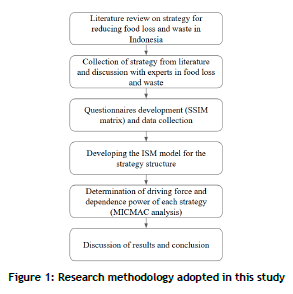
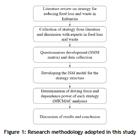
To address the research question guiding this study, the steps outlined in Figure 1 were executed. First, a literature review was conducted to identify strategies for reducing FLW in Indonesia and to establish their definitions. Next, the content validity technique was used to assess the relevance of these strategies to the context of reducing FLW. Experts were then engaged to establish contextual relationships among the selected strategies and to depict their hierarchical structure using the ISM methodology. After presenting the hierarchical structure to the experts and ensuring consensus on its consistency, the hierarchy of strategies for reducing FLW was determined through MICMAC analysis. This analysis classified the strategies on the basis of their driving and dependent power. The resulting strategy hierarchy was then analysed and discussed to identify which strategies could effectively reduce FLW in the food supply chain.
3.1. Content validity
The study used experts' opinions to establish an item-level content validity index (I-CVI) and a scale-level content validity index (S-CVI) [27]. The validity assessment required a minimum of three experts [28]. Each expert evaluated a questionnaire item on a four-point relevance scale: (1 ) irrelevant, (2) slightly relevant, (3) quite relevant, and (4) highly relevant, aiming to eliminate ambivalent and neutral value selections [29].
The I-CVI was calculated by determining the number of experts who rated an item as 3 or 4 in relevance; this number was then compared with the total number of experts involved. The formula for I-CVI is shown in Equation 1 [27]. For example, if an item received a rating of 3 or 4 from 4 out of 5 experts, its I-CVI was 0.80.
3.2.
Interpretive structural modellingISM is a system representation model resulting from elementary graph theory, producing a directional graph for complex systems that explains conceptual relationships between elements [10]. J.N. Warfield first developed ISM in 1973, using computer assistance to create maps of relationships in complex systems [30]. This process involves mathematical calculations, transforming a mental model from an abstract system into a visible, well-defined model for various purposes. According to Attri (2013), implementation of the ISM method has the following stages: (1) identify problem-related elements (done through surveying or group solving); (2) form contextual relationships between elements; (3) create a structural self-interaction matrix (SSIM); (4) initial reachability matrix based on the SSIM; (5) final reachability matrix; (6) specify the final reachability matrix partition to a different level; (7) conical matrix construction; and (8) ISM diagram construction [17].
3.3.
MICMAC analysisMICMAC is a diagram showing the strength and dependence of an element. The purpose of MICMAC analysis is to analyse the driving forces and dependencies of those elements [17], [31]. The classification of the categories of the following elements is as follows: (1 ) autonomous - quadrant I: elements in this quadrant have weak driving forces and dependencies; (2) dependent - quadrant II: elements in this quadrant have a weak driving force and very strong dependencies; (3) linkage - quadrant III: elements in this quadrant have the same strong driving force and dependence; and (4) independent - quadrant IV: elements in this quadrant have strong driving forces and weak dependencies.
4. RESULTS
4.1. Identification of strategy elements for FLW reduction
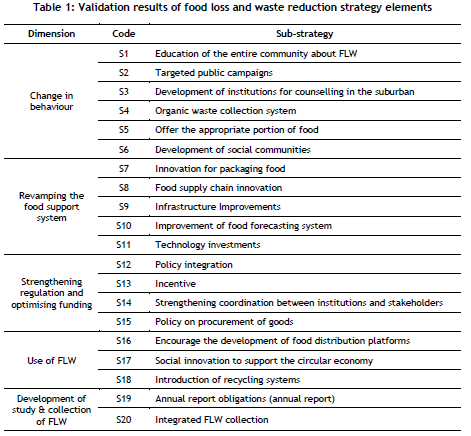
The strategy elements to reduce FLW were gathered from a study of the literature, resulting in 25 elements for the national strategy. These elements were categorised into five dimensions: behaviour change, revamping the food support system, strengthening regulation and optimising funding, use of FLW, and development of study and collection of FLW.
The I-CVI method was used to validate the relevance of these strategy elements to Indonesia's actual conditions. A score of 0.75, indicating a "good" evaluation, was used, in which three out of four experts agreed about the element's relevance, classifying it as "sufficiently relevant" or "highly relevant". The overall S-CVI value was calculated as 0.82, representing the minimum required relevance value. The assessment results revealed that 20 of the 25 strategies were deemed quite relevant to the FLW situation in Indonesia, as shown in Table 1.
4.2. Structural self-interaction matrix (SSIM)
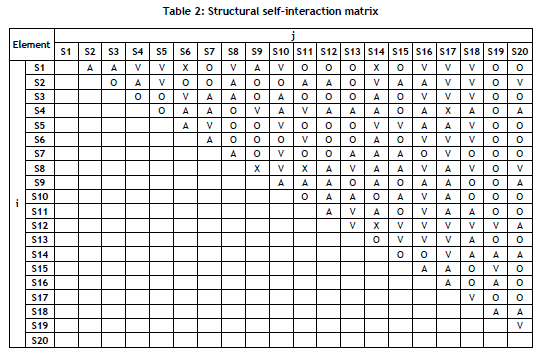
The SSIM was built on the basis of the results of expert opinion interviews; this study used insights from five experts as a fundamental reference. During the interviews, the researcher asked about the assessment of the interrelationships between strategy elements, with the experts providing assessments using four symbols: V, A, X, and O. The following are the symbols and information used in the SSIM assessment:
• V = element i affects element j but not vice versa
• A = element j affects element I but not vice versa
• X = element i and element j affect each other
• = element i and element j do not affect each other
The consensus assessment, based on five expert opinions, was determined by the mode of expert opinion or opinion most widely expressed by the experts [32]. The SSIM is shown in Table 2.
4.3. Reachability matrix based on SSIM
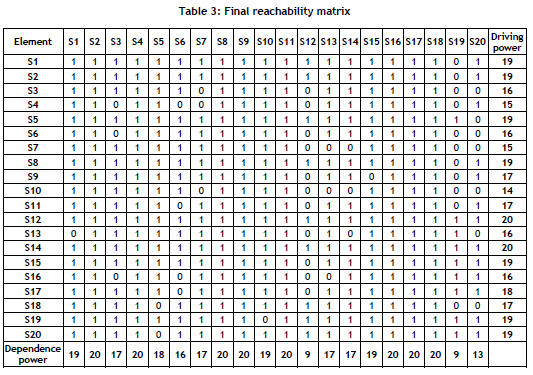
The initial reachability matrix was formed purely on the basis of the SSIM, in which the value of the SSIM's four symbols (V, A, X, and O) was substituted by binary numbers, 1 or 0. The substitute rules for its assessment are as follows:
• If the element (i,j) in the SSIM is V, then the element (i,j) is changed to 1 and element (i,j) becomes 0
• If the element (i,j) in SSIM is A, then element (i,j) is changed to 0 and element (j,i) becomes 1
• If the element (i,j) in the SSIM is X, then element (i,j) is changed to 1 and element (i,j) becomes 1
• If the element (i,j) in the SSIM is O, then the element (i,j) is changed to 0 and element (j,i) becomes 0
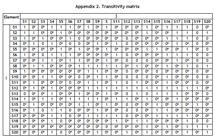
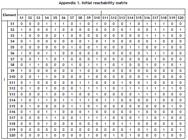
The results of the initial reachability matrix can be seen in Appendix 1. The final reachability matrix was formed by examining the rules of transitivity in the initial reachability matrix. Transitivity entails that, if element i influences element j and element j influences element k, then element i should also influence element k. This concept was applied to identify possible gaps arising from the expert opinions. The transitivity matrix is shown in Appendix 2, and the final reachability matrix is shown in Table 3.
4.4.
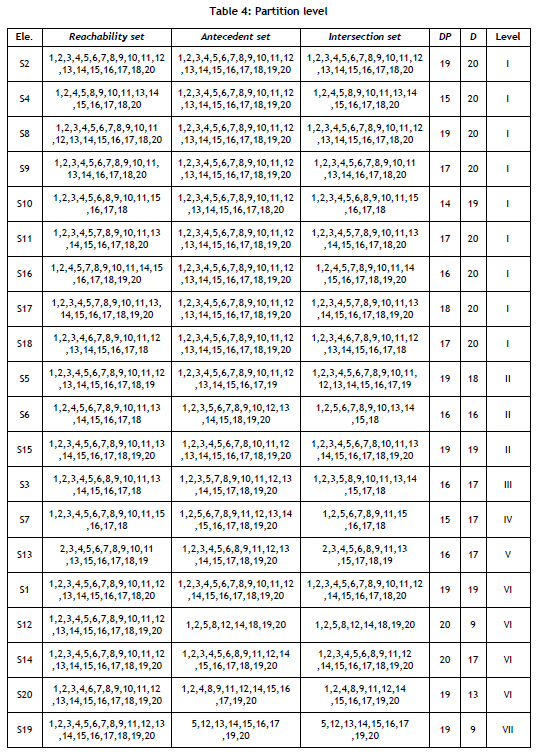
Level partitionLevel partitions were executed to establish a hierarchy in the ISM diagram model being developed. Elements in the matrix were grouped into reachability sets and antecedent sets. Once grouped, both were determined by a group slice known as the intersection set, which occurs when elements are in both the reachability and the antecedent sets. The outcomes of the level partition are shown in Table 4.
4.5.
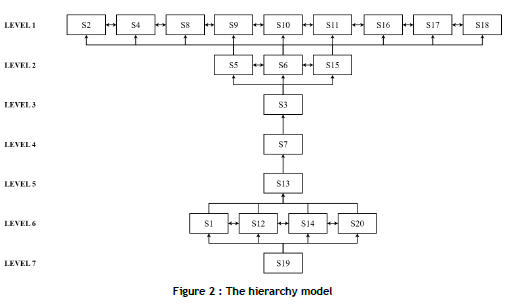
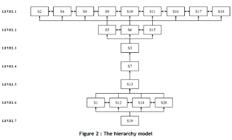
Construction of ISM diagramBased on the level partition results, seven levels of strategies were successfully structured in a hierarchical way. The final ISM diagram for the strategy to reduce the FLW amount in Indonesia is shown in Figure 2.
4.6. MICMAC analysis
The ISM diagram model for the strategy to reduce the amount of FLW in Indonesia has seven partition levels. The diagram's structural form indicates contextual relationships labelled "influencing", so that each connected arrow could be interpreted as "influencing". Moreover, the ISM diagram model's implications could be executed systematically, progressing from the lowest level to the highest to achieve the objectives.
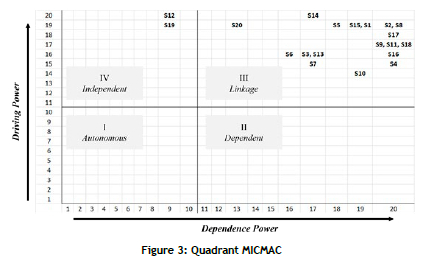
Strategy elements that had undergone ISM data processing were regrouped using MICMAC analysis, which analysed each related strategy element's driving power and dependence power. The results for driving power and dependence power in the ISM model for national FLW reduction are presented in Table 5.
Figure 3 shows four quadrants that categorise the elements based on their strength values: autonomous, dependent, linkage, and independent.
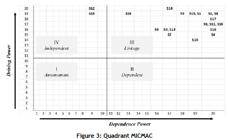
a. Quadrant I - Autonomous: No strategy elements are categorised. This quadrant is characterised by weak dependence power and weak driving power, indicating that the impact of elements in this category on the system is very small or negligible. This observation suggests that all identified strategy elements are relevant and have a substantial impact when implemented.
b. Quadrant II - Dependent: No strategy elements are observed in quadrant II. This category is characterised by weak driving power but strong dependence power. With strong dependency, strategies in this quadrant are executed when influenced by other elements with solid driving forces.
c. Quadrant III - Linkage: In this quadrant, there are 18 strategy elements. Among them, nine are at level 1: targeted public campaigns (S2), organic waste collection systems (S4), food supply chain innovation (S8), infrastructure improvement (S9), improvement of needs planning forecasting (S10), technology investment (S11), driving the development of food distribution platforms (S16), social innovation supporting the circular economy (S17), and the introduction of a recycling system (S18). The remaining elements - the appropriate food supply strategy (S5), social community development (S6), and policies on procurement of goods (S15) - are at level 2. The Institution's development strategy for extension in the region (S3) is located at level 3, the innovation strategy of food packaging (S7) at level 4, the incentive strategy (S13) at level 5, and finally, the education strategy of the entire community regarding FLW (S1) - strengthening coordination between institutions and stakeholders, and the collection of integrated FLW (S20) - are at level 6.
d. Quadrant IV - Dependent: One strategy element, S19 (annual report obligation), is observed in this category with a low dependence power value and no dependencies. It is influenced by other strategies at least. This element could serve as a key element driving other components in the system.
5. DISCUSSION
At the bottom level or level 7, the strategy element is S19, which focuses on creating an annual report obligation. Indonesia estimates FLW data systematically using the basic food balance sheet (NBM) from the Food Security Agency as a reference. Introducing an annual report obligation could leverage digital tools, such as the Food Waste Atlas implemented by European Union countries. The Food Waste Atlas serves as a platform for recording reported data [9].
Moving up to level 6, there are four strategy elements. The policy integration strategy (S12) aims to ensure that positive impacts on FLW reduction could be collectively achieved, addressing trade-offs effectively. Policy integration involves collaboration among various parties, as well as aligning and approving strategies for joint implementation. The United Kingdom, for example, has collaborated across public sectors to contribute to policymaking on FLW prevention [33].
Simultaneously, at level 6, the integrated FLW data collection strategy (S20) is an extension of the annual report obligation strategy. This integration aims to monitor FLW quantities and to compare trends each year. The collected data could also undergo analytics processing to build a knowledge base. This integration becomes a measurable parameter, determining the significant impact of nationally reducing FLW through the implemented strategies.
At level 6, strengthening coordination between institutions and stakeholders (S14) is essential for evaluating the integrated FLW data results. This coordination aims to align visions and missions, fostering collaboration among institutions and stakeholders to support FLW reduction goals in Indonesia. Indonesia established coordination through the formation of GRASP in 2021. GRASP 2030 encourages its members to collaborate, share practitioner knowledge, implement FLW reduction actions, and report on their achievements. At the same level, education about FLW in the community (S1) involves communicating Indonesia's FLW situation, outlining the types of FLW, and presenting solutions that communities could adopt to contribute to the national FLW reduction goals. In addition, formed policies could facilitate the dissemination of information and education to enlighten the public about FLW issues and to encourage the practical implementation of solutions that prevent FLW.
Entering level 5, providing incentives (S13) is introduced. This strategy aims to stimulate relevant actors to innovate in preventing and managing FLW. By offering incentives, actors have the capital to conduct research and development on FLW prevention and management innovations. The resulting innovations could serve as benchmarks for others to apply, and so contribute to realising the goal of reducing food waste.
Moving to level 4, the hierarchy introduces the innovation strategy of food packaging. This extends the lifetime and value of food from the production period until the expiration date. Using more airtight and durable packaging could significantly increase the shelf life of perishable foods such as fruits.
At level 3, the institution development strategy for extension in the region (S3) is located. Extension efforts in Indonesia could enhance the productivity and quality of products handled by producer stakeholders, indirectly contributing to FLW reduction. Indonesia's extension initiatives include providing insights into preserving food items, such as instructing fishermen about methods such as freezing fish with ice cubes and chillers [8].
At level 2, strategies are implemented with a technical approach to society. In the food business, offering appropriate portions to customers is a viable strategy. Allowing customers to choose portions according to capacity could prevent excessive food disposal. Through the "Love food, hate waste" campaign, the UK introduced an Eatwell guide to consuming food types according to need and portions.
Concurrently, social community development at this level contributes to supporting reduced FLW. Social communities serve as an extension of the public sector, offering counselling, guidance, and action programmes to promote FLW reduction. Furthermore, these communities play a crucial role in informal education, complementing formal education efforts.
In the industrial sector, a technical strategy initiative involves forming policies for procuring raw materials. This policy aims to balance supply and demand, having a positive impact on the reduction of excessive food waste. Implementing digitisation and automatic orders helps to prevent human error. The government could also ensure that suppliers in the food supply chain have contractual agreements about excess food and plans to minimise food disposal.
The Level 1, or top-level, strategy resides in the linkage quadrant, where its implementation could have an impact on itself and on other methods. In this study, nine strategies occupy the pinnacle of level 1, demonstrating a higher likelihood of technical implementation among the people of Indonesia. Strategy 9, positioned at an equivalent level, allows for simultaneous or near-future implementation.
The targeted public campaign strategy, carried out by the British state under WRAP, aims to address FLW. The UK's "Love food, hate waste" campaign targets specific food types that contribute to waste, and focuses on populations that generate more FLW than others. Indonesians have a habit of mixing organic and non-organic waste, hindering the effective recycling of organic waste. Establishing an organic waste collection system would support a more efficient recycling process, preventing the direct disposal of food waste into landfills. Like the UK model, increasing organic waste collection through specialised bins handled by waste management personnel would ensure proper disposal. Introducing recycling systems for independent organic waste processing would enhance waste management efforts.
Food supply chain innovation strategies could be carried out in line with the implementation of technology investment strategies and infrastructure improvements. Achieving food supply chain innovation requires technological support and adequate infrastructure. Food supply chain innovation is expected to increase the food production lead time so that the production process for food does not experience prolonged storage. Technology, such as reliable refrigeration for perishable items that require low temperatures, would not only prevent food spoilage but would also ensure the freshness of products until they reach consumers. Adequate infrastructure facilitates shorter lead times, with easy access to transportation and streamlined operations enabling faster mobilisation and timely delivery to consumers before products expire. In addition, integrating food supply chain innovation with enhanced forecasting would enhance the need to plan more efficient operations.
6. CONCLUSION
FLW is one of the critical problems of developing countries such as Indonesia. This study identified 20 elements in the strategy to reduce FLWs in Indonesia that were derived from studies of the literature and validated by experts. The ISM method was used to establish a hierarchical structure. It showed the interactions of the FLW reduction strategy in Indonesia, which was formed on the basis of expert opinions, and provided a hierarchical structure framework that shows the sequence of strategy steps that could be implemented to reduce FLW. The interrelationships in the ISM model highlight the influence of strategy elements on one another. These indicate the existence of drivers to implement other strategies, and their dependence on different strategies to execute the strategy itself. This research could help decision-makers in public and private organisations to decide which strategy would be applicable to reducing FLW in Indonesia. The structural hierarchy could also serve as a benchmark for future research that is focused on FLW reduction strategies and action plans.
REFERENCES
2. LITERATURE REVIEW
- [1] Food and Agricultural Organization (FAO), "Global food losses and food waste: Extent, causes and prevention," Rome, Italy, 2011.
-
[2] A. Chalak, C. Abou-Daher, J. Chaaban, and M. G. Abiad, "The global economic and regulatory determinants of household food waste generation: A cross-country analysis," Waste Management, vol. 48, pp. 418-422, Feb. 2016. doi: 10.1016/J.WASMAN.2015.11.040
» https://doi.org/10.1016/J.WASMAN.2015.11.040 -
[3] M. Balaji and K. Arshinder, "Modeling the causes of food wastage in Indian perishable food supply chain," Resources, Conservation and Recycling, vol. 114, pp. 153-167, 2016. doi: 10.1016/j.resconrec.2016.07.016
» https://doi.org/10.1016/j.resconrec.2016.07.016 -
[4] K. Jaglo, S. Kenny, and J. Stephenson, "Part 1: From farm to kitchen: The environmental impacts of US food waste," US Environmental Protection Agency, Nov. 2021. [Online]. Available: https://www.epa.gov/system/files/documents/2021-11/from-farm-to-kitchen-the-environmental-impacts-of-u.s.-food-waste_508-tagged.pdf. [Accessed: Sep. 01, 2021]
» https://www.epa.gov/system/files/documents/2021-11/from-farm-to-kitchen-the-environmental-impacts-of-u.s.-food-waste_508-tagged.pdf -
[5] D. G. Johnson, "The growth of demand will limit output growth for food over the next quarter century," Proceedings of the National Academy of Sciences of the United States of America, vol. 96, no. 11, pp. 5915-5920, May 1999. doi: 10.1073/PNAS.96.11.5915
» https://doi.org/10.1073/PNAS.96.11.5915 -
[6] The Economist Intelligence Unit and Barilla Foundation, Fixing Food 2021: An Opportunity for G20 Countries to Lead the Way. 2021. [Online]. Available: foodsustainability.eiu.com. [Accessed: Sep.01, 2021].
» foodsustainability.eiu.com -
[7] DLHK, "SIPSN - Sistem Informasi Pengelolaan Sampah Nasional." Accessed: Apr. 30, 2023. [Online]. Available: https://sipsn.menlhk.go.id/sipsn/public/data/komposisi
» https://sipsn.menlhk.go.id/sipsn/public/data/komposisi -
[8] Ministry of National Development Planning/Bappenas, Food Loss and Waste in Indonesia: Supporting the Implementation of Circular Economy and Low Carbon Development. Jakarta, Indonesia: Ministry of National Development Planning/Bappenas, 2021. [Online]. Available: https://lcdi-indonesia.id/wp-content/uploads/2021/07/Report-Kajian-FLW-ENG.pdf.[Accessed: Sep. 01, 2021].
» https://lcdi-indonesia.id/wp-content/uploads/2021/07/Report-Kajian-FLW-ENG.pdf -
[9] EU Platform on Food Losses and Food Waste, "Recommendations for Action in Food Waste Prevention," Green Industry Platform,Dec.12, 2019. [Online].Available: https://www.greenindustryplatform.org/guidance/recommendations-action-food-wasteprevention-developed-eu-platform-food-losses-and-food. [Accessed: Sep. 01, 2021].
» https://www.greenindustryplatform.org/guidance/recommendations-action-food-wasteprevention-developed-eu-platform-food-losses-and-food -
[10] J. P. Saxena, Sushil, and P. Vrat, "Hierarchy and classification of program plan elements using interpretive structural modeling: A case study of energy conservation in the Indian cement industry," Systems Practice, vol. 5, no. 6, pp. 651-670, 1992. doi: 10.1007/BF01083616
» https://doi.org/10.1007/BF01083616 -
[11] H. D. Sharma, A. D. Gupta, and Sushil, "The objectives of waste management in India: A futures inquiry," Technological Forecasting and Social Change, vol. 48, no. 3, pp. 285-309, 1995. doi: 10.1016/0040-1625(94)00066-6
» https://doi.org/10.1016/0040-1625(94)00066-6 -
[12] H. Nguyen, "Sustainable food systems: Concept and framework," Food and Agriculture Organization of the United Nations, 2018. [Online]. Available: http://www.fao.org/3/ca2079en/CA2079EN.pd
» http://www.fao.org/3/ca2079en/CA2079EN.pd - [13] United Nations, "Transforming Our World : The 2030 Agenda for Sustainable Development," 2015. doi: 10.1201/b20466-7
-
[14] United Nations Development Programme, "Food Waste Management in Korea: Focusing on Seoul - Sustainable Development Goals Policy Brief Series No. 6," 9 Dec. 2019.[Online].Available:https://files.acquia.undp.org/public/migration/seoul_policy_center/USPC-Policy-Brief-6-Food-Waste.pdf.[Accessed: 01 -Sep-2021].
» https://files.acquia.undp.org/public/migration/seoul_policy_center/USPC-Policy-Brief-6-Food-Waste.pdf -
[15] Waste Resources Action Program, "Understanding consumer food management behaviour," 2007. Accessed: Jun. 20, 2023. [Online]. Available: www.wrap.org.uk
» www.wrap.org.uk - [16] R. Ishangulyyev, S. Kim, and S. H. Lee, "Understanding food loss and waste - Why are we losing and wasting food?" Foods, vol. 8, no. 8, 297, 2019.
- [17] R. Attri, N. Dev, and V. Sharma, "Interpretive structural modelling (ISM) approach: An overview," Research Journal of Management Sciences, vol. 2, no. 2, pp. 3-8, 2013.
-
[18] V. S. M. Magalhães, L. M. D. F. Ferreira, A. da S. César, R. M. Bonfim, and C. Silva, "Food loss and waste in the Brazilian beef supply chain: An empirical analysis," The International Journal of Logistics Management, vol. 32, no. 1, pp. 214-236, 2021. doi: 10.1108/IJLM-01-2020-0038
» https://doi.org/10.1108/IJLM-01-2020-0038 -
[19] V. S. M. Magalhães, L. M. D. F. Ferreira, and C. Silva, "Using a methodological approach to model causes of food loss and waste in fruit and vegetable supply chains," Journal of Cleaner Production, vol. 283, pp. 1-13, 2021. doi: 10.1016/j.jclepro.2020.124574
» https://doi.org/10.1016/j.jclepro.2020.124574 - [20] M. Kumar and V. K. Choubey, "Modeling the causes of post-harvest loss in the agri-food supply chain to achieve sustainable development goals: An ISM approach," in Challenges and opportunities of circular economy in agri-food sector: Environmental footprints and eco-design of products and processes. 2021, Springer, pp. 133-149.
-
[21] S. Gokarn and A. Choudhary, "Modeling the key factors influencing the reduction of food loss and waste in fresh produce supply chains," Journal of Environmental Management, vol. 294, no. May, 113063, 2021. doi: 10.1016/j.jenvman.2021.113063
» https://doi.org/10.1016/j.jenvman.2021.113063 -
[22] S. Gokarn and T. S. Kuthambalayan, "Analysis of challenges inhibiting the reduction of waste in food supply chain," Journal of Cleaner Production, vol. 168, pp. 595-604, 2017. doi: 10.1016/j.jclepro.2017.09.028
» https://doi.org/10.1016/j.jclepro.2017.09.028 -
[23] S. Shekhar, R. Singh, and S. Khan, "Barriers to minimisation of agri-products wastage through optimizing logistics in India: An ISM modelling approach," Heliyon, vol. 9, no. 11, e21551, 2023. doi: 10.1016/j.heliyon.2023.e21551
» https://doi.org/10.1016/j.heliyon.2023.e21551 -
[24] R. Diaz-Ruiz, M. Costa-Font, F. López-i-Gelats, and J. M. Gil, "Food waste prevention along the food supply chain: A multi-actor approach to identify effective solutions," Resources, Conservation and Recycling, vol. 149, no. May, pp. 249-260, 2019. doi: 10.1016/j.resconrec.2019.05.031
» https://doi.org/10.1016/j.resconrec.2019.05.031 -
[25] V. S. M. Magalhães, L. M. D. F. Ferreira, and C. Silva, "Prioritising food loss and waste mitigation strategies in the fruit and vegetable supply chain: A multi-criteria approach," Sustainable Production and Consumption, vol. 31, pp. 569-581, 2022. doi: 10.1016/j.spc.2022.03.022
» https://doi.org/10.1016/j.spc.2022.03.022 -
[26] B. Lipinski, C. Hanson, J. Lomax, L. Kitinoja, R. Waite, and T. Searchinger, "Toward a sustainable food system reducing food loss and waste," Working paper, installment 2 of Creating a sustainable food future, World Resources Institute, June 2016. [Online]. Available: http://unep.org/wed/docs/WRI-UNEP-Reducing-Food-Loss-and-Waste.pdf%5Cnhttp://ebrary.ifpri.org/cdm/ref/collection/p15738coll2/id/130211
» http://unep.org/wed/docs/WRI-UNEP-Reducing-Food-Loss-and-Waste.pdf%5Cnhttp://ebrary.ifpri.org/cdm/ref/collection/p15738coll2/id/130211 -
[27] D. F. Polit, T. Beck, and S. V Owen, "Focus on research methods: Is the CVI an acceptable indicator of content validity? Appraisal and recommendations," Research in Nursing & Health, pp. 459-467, 2007. doi: 10.1002/nur.20199
» https://doi.org/10.1002/nur.20199 - [28] M. R. Lynn, "Determination and quantification of content validity," Nursing Research, no. 35, pp. 382-385, 1986.
-
[29] V. K. Shrotryia and U. Dhanda, "Content validity of assessment instrument for employee engagement," Sage Open, vol. 9, no. 1, 2019. doi: 10.1177/2158244018821751
» https://doi.org/10.1177/2158244018821751 - [30] J. N. Warfield, "Intent structures," IEEE Transactions on Systems, Man, and Cybernetics, vol. SMC3, no. 2, pp. 133-140, 1973.
-
[31] N. M. Agrawal, "Modeling Deming's quality principles to improve performance using interpretive structural modeling and MICMAC analysis," International Journal of Quality & Reliability Management, vol. 36, no. 7, pp. 1159-1180, 2019. doi: 10.1108/IJQRM-07-2018-0204
» https://doi.org/10.1108/IJQRM-07-2018-0204 -
[32] C. Mi, Y. Chen, C. S. Cheng, J. L. Uwanyirigira, and C. T. Lin, "Exploring the determinants of hot spring tourism customer satisfaction: Causal relationships analysis using ISM," Sustainability, vol. 11, no. 9, 2019. doi: 10.3390/su11092613
» https://doi.org/10.3390/su11092613 -
[33] H. Dimbleby, "National food strategy: Independent review: The plan," National Food Strategy, 2021. [Online]. Available: https://www.nationalfoodstrategy.org/wp-content/uploads/2021/07/National-Food-Strategy-The-Plan.pdf. [Accessed: 01-Sep-2021].
» https://www.nationalfoodstrategy.org/wp-content/uploads/2021/07/National-Food-Strategy-The-Plan.pdf
Accepted for publication 28 Nov 2025
Available online 12 Dec 2025
ORCID® identifiers
E.L. Afif
https://orcid.org/0009-0009-7927-0276
R. Ardi
https://orcid.org/0000-0002-5525-9920