Mitigating and Predicting Masonry Failure on Problematic Soils, using Deep-Learning Models
Abstract
This study, serving as a pilot for a PhD, investigates mortar flexibility for light masonry structures in the Free State province, addressing structural problems caused by differential soil movement because of expansive clay. Using secondary data from a prior study on mortar compositions, this study examines limiting proportions compliant with SANS 10164-1 to enhance sustainability in low-cost single-storey construction. Using machine learning, the research predicts area-specific optimal mortar compositions, leveraging evidence that higher lime and sand content would improve masonry flexibility. This approach would minimise structural deformation, reduce maintenance costs, and extend structural lifespan. The findings provide practical insights for builders and engineers, promoting cost-effective and durable construction practices in difficult soil environments. This pilot study lays the foundation for advancing sustainable building solutions, particularly in regions with expansive clay, by optimising mortar design for enhanced structural resilience.
Abstract
Hierdie studie, wat as 'n loodsstudie vir 'n PhD dien, ondersoek die buigsaamheid van mortel vir ligte messelwerkstrukture in die Vrystaat-provinsie, en spreek strukturele probleme aan wat veroorsaak word deur differensiële grondbeweging as gevolg van uitsettende klei. Deur sekondêre data uit 'n vorige studie oor mortelsamestellings te gebruik, ondersoek hierdie studie beperkende verhoudings wat voldoen aan SANS 10164-1 om volhoubaarheid in laekoste-enkelverdiepingkonstruksie te verbeter. Deur masjienleer te gebruik, voorspel die navorsing gebiedspesifieke optimale mortelsamestellings, deur gebruik te maak van bewyse dat hoër kalk- en sandinhoud die messelwerkbuigsaamheid sal verbeter. Hierdie benadering sal strukturele vervorming verminder, onderhoudskoste verminder en die strukturele lewensduur verleng. Die bevindinge bied praktiese insigte vir bouers en ingenieurs, wat koste-effektiewe en duursame konstruksiepraktyke in moeilike grondomgewings bevorder. Hierdie loodsstudie lê die grondslag vir die bevordering van volhoubare bouoplossings, veral in streke met ekspansiewe klei, deur mortelontwerp te optimaliseer vir verbeterde strukturele veerkragtigheid.
1. INTRODUCTION
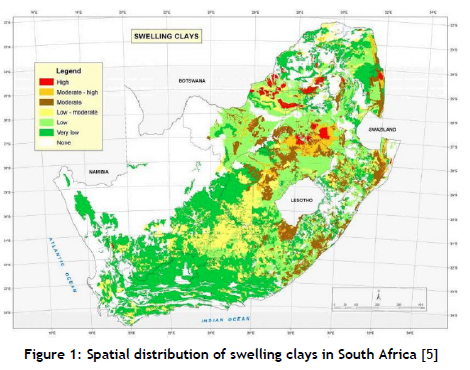
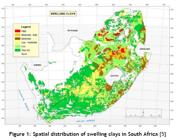
The Free State province in central South Africa has a semi-arid climate with intense rainfall and severe drought cycles [1], [2], [3], [4]. The region is underlain by diverse clayey material, with a range of swelling clays ranging from high to low, and with some areas showing negligible swelling characteristics. Figure 1 provides a visual representation of the spatial distribution of swelling clays in South Africa; areas of high swelling potential are illustrated in red, transitioning to low swelling potential in green, while regions with minimal to no swelling potential are shown in white [5]. This study focuses on the Bloemfontein area in the Free State province, investigating area-specific masonry mortar compositions for low-cost light masonry structures. Emphasis is placed on enhancing structural flexibility to accommodate expansive soils.
Although masonry flexibility is rarely a focal point in academic or professional discussions, the consequences of building light masonry structures on expansive soils are well-documented by various authors [2], [6], [7], [8], [9]. These structures often show severe cracking in walls and an impaired functionality of doors and windows because of irregular soil movement [10], [11]. These issues are frequently attributed to poor workmanship or material inadequacy; however, material inadequacy caused by expansive clays highlights the need for improved design and construction practices [7], [9], [12]. The South African National Standards for unreinforced masonry walling (SANS 10164-1) [13] often fail to account for the specific difficulties posed by high-heave soils. Experimental findings from Smith [3] revealed critical deficiencies in the standard mortar limiting proportions [13]. Higher lime and sand content in mortar designs was shown to increase flexibility and deformation capacity before failure, while also improving workability and bond strength [8].
Costigan, Pavia and Kinnane [14] provided experimental evidence of lime in masonry as improving its workability and bond strength and decreasing its overall compressive strength. Moreover, lower lime and sand content resulted in a high-strength mortar with an increased rigidity, resulting in masonry being more susceptible to cracking in expansive clay conditions. Extensive studies by multiple authors provide evidence of the economic impact of constructing light masonry structures on expansive clays [2], [6], [8], [9], [10], [11].
In 1967, a case study of a single-storey masonry house in Queenswood, Pretoria reported repair costs of about R24,000 as a result of expansive clay, equating to nearly 50% of the original construction cost of R60,000. More recently, Sehume, Stott and Theron [9] estimated that repair costs for light masonry structures on expansive clays typically account for 30-40% of the total construction cost, underscoring the need for innovative solutions to mitigate these problems.
This pilot study and the forthcoming PhD aim to address this gap by developing high-flexibility mortar compositions and by using a machine learning (ML) prediction model to predict improved area-specific mortar limiting proportions for geologic-specific conditions, thereby potentially enhancing the durability and flexibility of light masonry structures in expansive soil environments. This novel computational approach not only aims to reduce maintenance costs but also could contribute to safer and more sustainable construction practices in South Africa.
2.1.
Masonry and expansive soilsLight masonry structures are common in South Africa's housing sector owing to their design simplicity and cost-effectiveness. However, the country's variable soil conditions, particularly expansive clays, are a primary cause of structural failure, as extensively documented since the early 1960s [2], [5], [10], [15].
Stott [6] investigated the swelling behaviour of clayey soils in South Africa, identifying two key factors that contribute to masonry structure failures. First, the swelling potential of clay depends on its suction capacity, which governs its ability to absorb water. When this suction exceeds the foundation pressure exerted by light masonry structures, the clay swells, causing heave. Low-cost single-storey masonry housing units, which exert minimal foundation pressure, are particularly vulnerable to heave damage, even in soils with moderate suction potential. Second, mortar brittleness intensifies structural damage. Pidgeon [16] compared mortar designs in Australia, the United States, and South Africa, analysing their distortion thresholds (deflection-to-length ratios). The findings revealed that mortar designs in Australia and the United States accommodate greater distortion before cracking than those in South Africa. Brink [17] noted that the high montmorillonite content in South African soils increases their heave potential. Paige-Green and Turner [5] emphasised the importance of site-specific investigations, highlighting factors such as soil thickness, depth, mineralogy, and strength in order to address the geotechnical difficulties posed by expansive soils. Given the magnitude of expansive clays in South Africa, [6] advocate for region-specific construction strategies to mitigate heave-related damage.
2.2.
Masonry mortar mix designSeveral factors, including poor workmanship and inadequate material selection, contribute to crack propagation and structural failure in light masonry structures [7], [9], [10], [15]. To address these issues, [13] provides guidelines for mortar material selection to ensure effective masonry construction. Annex C of the SANS 10164-1:1980 standards categorises mortar into three classes, each defined by its strength, recommended applications, and material composition [13]. The standards specify the following applications for each mortar class:
• Class I: Suitable for highly stressed masonry, such as in multi-storey load-bearing buildings with high-strength structural units.
• Class II: Appropriate for general load-bearing applications, including parapets, balustrades, retaining structures, garden walls, and walls exposed to severe dampness.
• Class III: Designed for lightly stressed structures, such as single-storey bearing walls, where exposure to dampness is minimal.
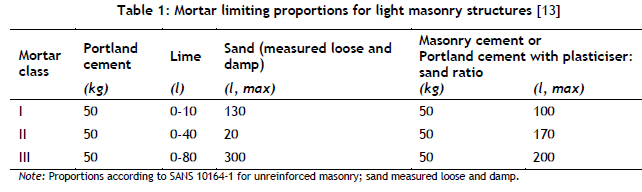
These classes specify limiting proportions of lime and sand relative to cement content. Table 1 outlines the mortar limiting proportions for each class. Class I mortar contains the lowest lime and sand proportions relative to cement, while Class III contains the highest.
Clause 3.4.2 of [13] specifies the necessity, when using specialised mortar, of verification through laboratory tests, with a high focus on mortar strength, soundness, and consistency. However, manufacturers typically reserve special mortar mixes for structure-specific projects rather than for large-scale multi-housing developments. Consequently, builders and contractors rarely adopt these mixes in low-cost housing projects, including the Reconstruction and Development Programme (RDP), because of budget and time limitations.
The economic consequences of severe cracking and structural failures in light masonry structures for RDP housing in South Africa are significant. In April 2023, Mahlati [18] reported that the average construction cost of R250,000 per RDP unit (single-storey, two-bedroom house) showed a 30% increase over five years earlier. Williams, Pidgeon and Day [10] had already estimated annual repair costs in the mid-1980s of R300,000 for single-storey masonry houses on expansive clay soils, with similar issues noted in 2018 [9]. These findings raised concerns about whether Class III mortar provided sufficient flexibility to accommodate uneven soil movement caused by expansive clays. [3] confirmed that Class III mortar often lacks adequate ductility, contributing to severe cracking, as observed by [6] in 2017 at Lerato Park in Kimberley, Northern Cape, despite the use of raft foundations [7], [8]. To enhance ductility and reduce cracking, [13] recommended increased lime and sand proportions within specified limits.
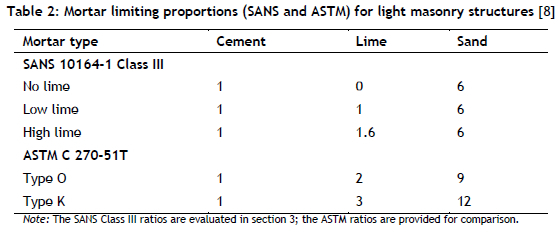
To address problems with flexibility in masonry, [14] explained the theory of flexibility in lime-based mortars, which [3] explored further in an experiment involving five masonry wall panels constructed with standard solid brick units and with varying mortar compositions. Three panels used SANS Class III mortar with different lime proportions, while two used mortar compositions based on the American Society of Testing and Materials (ASTM) standard C 270-51T [19] with higher lime and sand content. Table 2 compares the limiting proportions of the SANS and ASTM standards, with the SANS proportions (in kilograms and litres) converted to ratios for consistency with ASTM's ratio-based format.
2.3. Masonry flexibility
Achieving flexibility in masonry structures requires flexible components. Brick units, as rigid components, contribute primarily to compressive strength, while mortar flexibility depends on factors such as the proportion of Portland cement in the mix. Mortar flexibility has an inverse and nonlinear relationship with Portland cement content [3]. Portland cement gained widespread use in mortar mixes in the United Kingdom and the United States around 1930, replacing lime, which was the primary binder in Europe, America, and some South African structures [20]. In the early 1980s, Malinowski [21] showed that Portland cement's hardness, inflexibility, and impermeability cause structural damage. Studies by Costigan and Pavia [22] proved that lime-based mortar is characterised by high flexibility but low compressive strength and is well-suited for light masonry structures. As mortar is applied in thin layers between rigid brick units, which provide significant restraint, compressive failure is rare. Thus, failures in these structures typically originate from insufficient mortar flexibility rather than from inadequate compressive strength.
Mortar flexibility, driven by lime content, is critical for mitigating structural failures in light masonry structures on expansive clay soils. However, optimising mortar compositions for geotechnically problematic environments requires predictive tools that account for local soil variability and historical failure patterns. Subsection 2.4 explores the use of ML models to analyse masonry failure data and geotechnical parameters, enabling engineers to predict and identify structural risks and to select optimal mortar compositions for enhanced durability.
2.4. Machine learning - Approaches and techniques
To complement material and geotechnical testing, this study developed an ML approach to predict optimal mortar compositions tailored to regional soil conditions, particularly expansive clays in the Free State province, using secondary data from prior experiments [3]. The model enables adaptive mortar composition selection based on spatially explicit soil profiles, ensuring compliance with [13]'s guidelines.
The ML pipeline integrates three core components: (1) spatial geotechnical data acquisition, (2) a relational database for preprocessing and feature engineering, and (3) supervised regression models to predict mortar composition.
2.4.1. Geospatial soil data integration
Georeferenced soil data were sourced from the International Soil Data and Information System for Africa (iSDA) [23], which provides high-resolution raster data on key soil variables throughout the continent, including clay content, bulk density, and organic carbon levels. For this study, the iSDA v1 clay content dataset was used to extract values for topsoil (0-200 mm) and subsoil (200-500 mm) layers at specified latitude and longitudinal points in the Mangaung metro municipal area. These values served as primary predictors of soil expansiveness, corroborated by historical data from [5], [17] and [17].
2.4.2. Data engineering and PostgreSQL pipeline
A PostgreSQL relational database was used to preprocess high-dimensional, location-linked soil and mortar data that contained three tables:
• Geotechnical properties: Suction potential, plasticity index, clay content, and montmorillonite concentration.
• Structural outcomes: Observed deformation, cracking index, and flexibility coefficient (Equation 7).
• Mix designs: Cement:lime:sand ratios, strength class, and compliance tier (Classes I-III).
Spatial joins using PostGIS extensions added the soil data to the construction coordinates. The dataset was normalised, with numerical features scaled between 0 and 1 to ensure effective model training convergence [22].
2.4.3. Model architecture and training strategy
A supervised regression model was developed using Scikit-learn in Python. After testing multiple algorithms, including decision trees, support vector regression (SVR), and multi-layer perceptrons, a random forest regressor was selected for its superior handling of non-linear feature interactions and its interpretability via feature importance ranking [1].
The model was trained on 1,920 examples of known mortar mix compositions and their respective flexibility coefficients derived from prior experiments [3]. Each example was linked to the soil parameters extracted at its build location. The target variable was the flexibility coefficient (φ), as formulated in Equation 7 (subsection 4.4 of this article).
Hyperparameter optimisation was performed using five-fold cross-validation, tuning the number of trees (n=100), max depth (d=8), and minimum samples per leaf (m=4). The final model achieved an score of 0.87 and an MAE of 0.14 on a held-out validation set, indicating strong predictive capability.
2.4.4. Predictive output and compliance checks
The final model was deployed as a Python API, allowing users to input GPS coordinates and to receive a recommended mortar composition (in the format 1 :x:y) that was suitable for that location's geotechnical profile.
For example:
• Input: -29.14, 26.22 (latitude, longitude)
• Output: 1:2:9 (recommended mortar composition, compliant with Class III with enhanced lime)
All outputs were filtered through a compliance module that checked against the constraints defined in SANS 10164-1, ensuring that lime and sand ratios did not exceed the permitted thresholds.
2.4.5. Model interpretability and application
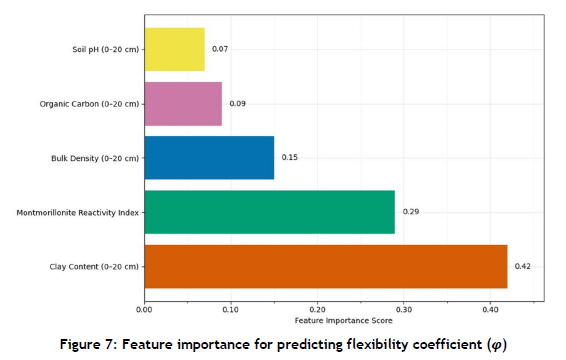
Feature importance analysis identified clay content, suction potential, and montmorillonite concentration as key predictors of required flexibility. The model supports structural engineers in low-cost housing design, particularly for RDP projects that are prone to soil heave. By enabling data-driven mortar composition selection, it enhances structural resilience in geotechnically problematic environments.
3. METHODOLOGY
This pilot study and the forthcoming PhD study have integrated multidisciplinary approaches to assess the ability of an ML model to predict optimal mortar compositions for light masonry structures in the Free State province, addressing the problems posed by expansive clays. Secondary data used were 1) mortar mix designs [3], (2) geotechnical data from a PostgreSQL database with site-specific soil properties, and (3) a Python-based ML model. The methodology included selecting mortar compositions that were compliant with the SANS 10164-1 Class III specifications, preparing and testing samples for flexibility, and developing an ML model to predict area-specific compositions. Subsections 3.1-3.6 detail the mortar proportion selection, sample preparation, mechanical testing, deformation application, and ML model development.
3.1. Mortar limiting proportions
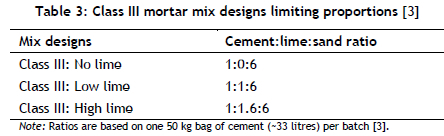
Secondary data [3], [9] provided three mortar compositions for evaluating masonry flexibility that were compliant with the SaNS 10164-1 Class III limits. Table 3 presents the resulting limiting proportions of cement:lime:sand ratios, which feature constant cement (50 kg, -33 litres) and sand proportions with varying lime proportions to assess the lime's impact on flexibility. The analysis used these limiting proportions as input for mechanical testing (subsections 3.3-3.5) and ML training (subsection 3.6).
3.2. Mortar sample preparation
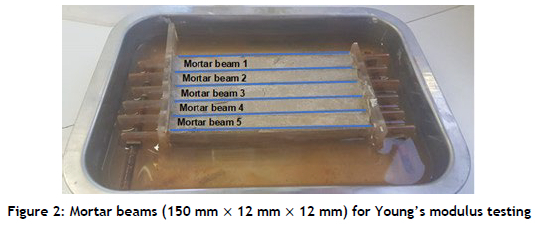
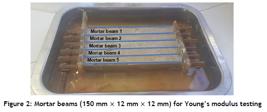
Mortar compositions (Table 3) were prepared according to the SANS 10164-1 (section 6 of [13]. Each composition (Class III: no lime, low lime, high lime) was mixed and poured into plastic perspex moulds to produce five mortar beams (150 mm χ 12 mm χ 12 mm) per composition (Figure 2). The mortar beams inside the moulds were cured in a temperature-controlled water bath (26 °C, 95% relative humidity) for seven days. After curing, the mortar beams were removed, dried with a paper towel, and air-dried at 23 °C for 24 hours before testing.
3.3. Young's modulus test
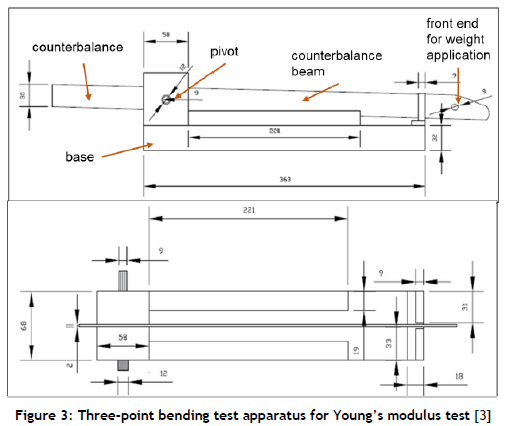
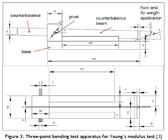
A three-point bending test apparatus adapted from a soil-bending tension device helped to determine the Young's modulus (Figure 3) [24], as [13] lacks specific mortar flexibility guidelines. The test assessed deflection under low forces, suitable for mortar flexibility:
• A bending test was chosen to measure deflection under minimal loads, unlike tensile testing.
• The apparatus, validated for mortar beams via calibration with known materials [24], required minor adjustments (e.g., load arm alignment).
• The Young's modulus equation was derived from material strength principles (Equation 13.6 in [24]).
• Five mortar beams per composition were evaluated at 23 °C and 50% relative humidity.
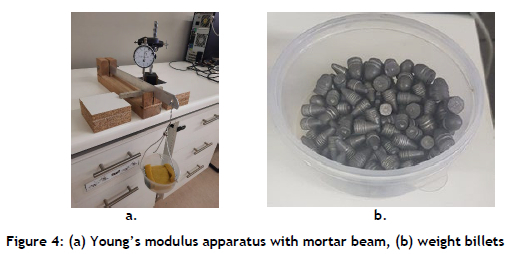
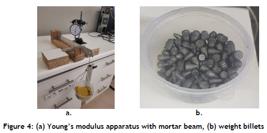
The apparatus applied a central load via a counterbalanced beam (Figure 4a). Weight billets (14 g, 0.137 N each; Figure 4b) were added every five seconds for two minutes, reaching 3.43 N (350 g). Deflection of each mortar beam was recorded using a dial gauge (0.01 mm accuracy) and video recording for verification. The recorded values were analysed to determine the Young's modulus of each mortar composition. Equations (1) and (2) were used:

where: W = weight of scale pan (N), D = distance from pivot to scale pan (mm), dp = distance from pivot to test specimen (mm), L = length of mortar beam between supports (mm), I = moment or inertia of mortar beam (mm4), y = central deflection of mortar beam (mm), and E = Young's modulus (N/mm2 = MPa).
3.4. Masonry bond strength test
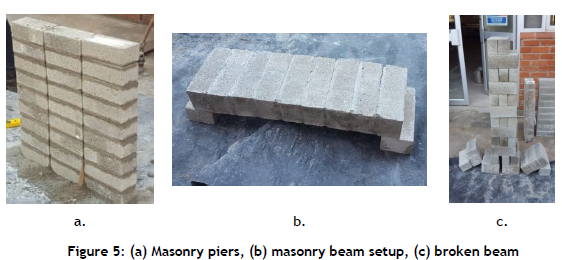
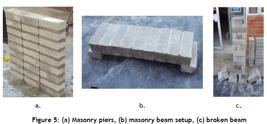
Masonry piers (nine tiers, standard cement bricks: 220 mm χ 110 mm χ 75 mm, 10 mm mortar joints) were constructed using each Class III composition (Table 3) in line with [13]. Fifteen tests (five per composition) followed in three phases:
• Phase 1: Masonry pier construction (Figure 5a).
• Phase 2: Masonry beam setup (Figure 5b).
• Phase 3: Loading until failure (Figure 5c).
The bond strength was calculated as the mean of five tests per composition:

where: = pier self-weight between supports (kg), W2 = applied brick mass (kg), and Lb = beam clear span (mm)

3.5. Deformation application
Controlled deformation was applied to masonry wall panels (1,830 mm χ 790 mm, 8 χ 10 standard cement bricks: 220 mm χ 110 mm χ 75 mm, 10 mm mortar joints) using Class III compositions (Table 3) [3]. Owing to space constraints at the Central University of Technology, Free State, smaller panels were used instead of full-size (2,000 mm χ 6,000 mm). The procedure was as follows:
• Panels were constructed in a steel frame (1,900 mm χ 1,000 mm) with 10 mm mortar joints, wrapped in plastic sheeting, and cured for seven days at 23 °C and 95% relative humidity.
• Seven industrial leveling jacks (40 mm height) supported a 3 mm steel plate at the base (Figure 6a, f, g).
• Four jacks were placed at the top corners of the wall panel (for restraint), and three at the base (one jack placed in the middle and one at each end).
• A dial gauge (0.01 mm accuracy) measured the deformation at the top center brick (Figure 6c).
• The middle jack applied upward movement at 1 mm/min until mortar failure occurred through crack formation, recording deformation (mm).
3.6. Software model development and prediction
This subsection outlines the technical architecture for an ML model to predict optimal mortar compositions for light masonry structures, using secondary data [3]. The model links soil characteristics to structural flexibility, supplementing [13]'s guidelines, which lack location-specific soil reactivity data. It integrates geospatial soil datasets, a structured database, and ML frameworks, building on mortar compositions (Table 3) and test results (subsections 3.3-3.5).
3.6.1. Data acquisition and feature design
Geotechnical data were extracted from the ISDAS v1 clay dataset [23], offering 250 m resolution for soil indicators in the Free State province. For each geolocation, the attributes at 0-200 mm and 200-500 mm depths were:
• Clay moisture content (%)
• Water pH
• Bulk density
• Organic carbon concentration
Derived indicators were a soil reactivity index (weighted montmorillonite concentration [22]) and a moisture variation potential coefficient. These were matched to empirical masonry performance data from secondary experiments [3] and the test results (subsections 3.3-3.5), with the flexibility coefficient (φ) as the response variable, defined according to Equation 7 in subsection 4.4.
3.6.2. Data cleaning and preprocessing
The dataset comprised 1,920 observations, including Table 3's mortar compositions and test outcomes. Entries with missing values, inconsistent units, or implausible ranges (e.g., clay content > 100%) were removed, yielding 1,746 records. Numerical features were scaled using min-max normalisation to a [0,1] range for model convergence [23]. The target variable (φ) (skewness γ=0.61) underwent a Box-Cox transformation to improve residual normality.
3.6.3. Model selection and validation strategy
Given the complex and non-linear relationship between soil parameters and masonry flexibility, a random forest regressor (RFR) was chosen as the primary model for its ability to handle multicollinearity and to provide ensemble-based robustness [1]. Alternative models tested were:
• Ridge regression (for linear benchmarking)
• Support vector regressor (SVR)
• Multi-layer perceptron (MLP)
The dataset was split using a stratified 80/20 split, ensuring balanced representation of all the soil reactivity classes in both training and test sets. Hyperparameter tuning was conducted using GridSearchCV with a five-fold cross-validation routine:
• Number of trees: [50, 100, 200]
• Maximum tree depth: [5, 10, 15]
• Minimum sample per leaf: [2, 4, 6]
Performance was evaluated using:
• R2 score: 0.87 (on test set)
• MAE: 0.14
• RMSE: 0.21
These metrics indicated that the selected model exhibited both high predictive accuracy and generalisability, supporting its suitability for deployment in real-world construction planning scenarios.
3.6.4. Model deployment and use case integration
The model was exported via Joblib to a Flask-based Python API, accepting latitude and longitude inputs (e.g., -29.14, 26.22) and outputting recommended mortar compositions (e.g., 1:2:9, Class III with enhanced lime) and predicted flexibility. The outputs were filtered for compliance limits [13], with a reliability score based on completeness and confidence intervals. This model thus supports data-driven mortar selection for low-cost housing (e.g., RDP projects) in expansive soil environments, enhancing its structural resilience.
4. RESULTS
This section presents the results of the physical tests (subsections 3.3-3.5) and the predictive modeling (subsection 3.6) for light masonry structures, using mortar compositions from Table 3 and secondary data [3].
4.1. Young's modulus test
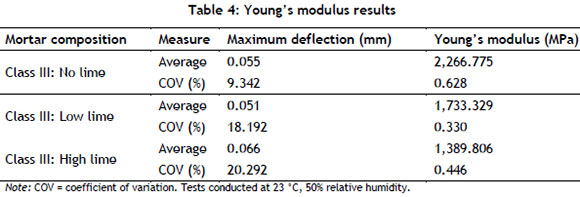
Five mortar beams per composition (Table 3) were tested (subsection 3.3). Table 4 shows that higher lime content increased deflection and decreased Young's modulus, indicating greater flexibility.
4.2. Masonry bond strength
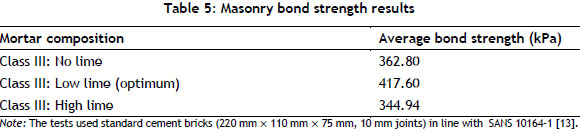
Five masonry piers per composition (Table 3) were evaluated (subsection 3.4). Table 5 shows that increasing lime and sand improved workability and bond strength up to an optimal level (low lime), with a decrease at higher lime content.
4.3. Deformation application
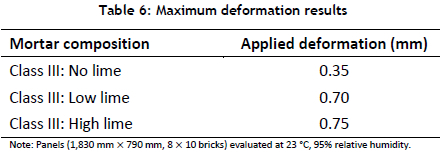
One wall panel per composition (Table 3) was evaluated (section 3.5). Table 6 shows higher deformation with increased lime, indicating enhanced flexibility.
4.4. Derived masonry flexibility coefficient
Increasing the lime proportions reduced strength but increased bond strength to an optimal level (low lime) and enhanced flexibility (Tables 4-6). A flexibility coefficient (φ) was derived via regression on test data:

where: φ = flexibility coefficient, I = ratio of lime to cement in mortar variant, and S = ratio of sand to cement in mortar variant
4.5. Predictive outputs and case interpretation
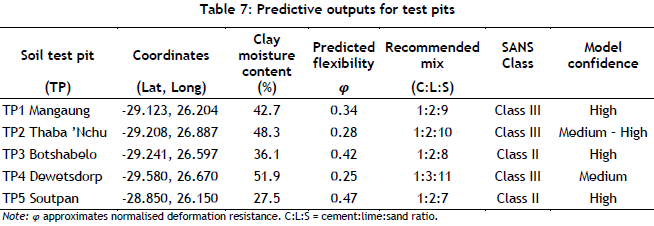
The RFP (section 3.6.3) achieved an of 0.87, MAE of 0.14, and RMSE of 0.21. Table 7 presents the predictions for five Free State locations, selected for soil variability. Higher clay content correlated with lower flexibility coefficients, requiring higher lime and sand ratios, compliant with [13].
5. DISCUSSION
This section interprets the predictive model's outcomes (subsection 4.5) and test results (subsections 4.14.3), highlighting their implications for light masonry structures in expansive clay environments.
5.1. Model interpretation and feature influence
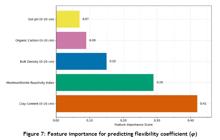
Feature importance analysis (subsection 3.6.2, Figure 7) identifies clay content as the primary predictor of the flexibility coefficient (φ), followed by suction potential and bulk density. This aligns with geotechnical models [5], [16] and test results (Tables 4-6), in which higher clay content reduced flexibility, requiring increased lime proportions (Table 3) to mitigate structural stress in shallow masonry foundations.
5.2. Real-world implications
The predictive model enables initiative-taking maintenance by identifying high-risk zones for low-cost housing units. For example, Thaba 'Nchu (TP2, Table 7), with high clay content (48.3%), requires a 1:2:10 mortar composition, which aligns with observed historical cracking in similar soils [3]. This data-driven approach, validated by physical tests (sections 4-6), supports quantifiable design changes.
Integrating the model with local government GIS systems could enhance urban development zoning, particularly in peri-urban areas with limited technical capacity. Poor mortar flexibility contributes to high maintenance costs in single-storey masonry structures, and this tool offers cost-effective, context-specific solutions that are compliant with [13]. This study advances multidisciplinary efforts to combine computational intelligence and materials engineering. By leveraging the iSDA Africa: Clay Content Dataset v1 [23] and ML, it provides localised mortar composition prescriptions, surpassing [13]'s generalised guidelines. Higher clay content (0-200 mm stratum) consistently correlates with lower φ values (Table 7), requiring higher lime and sand ratios to counter shrink-swell dynamics, thus improving the resilience of affordable housing in the Free State.
Limitations include the iSDA v1 dataset's potential under-representation of intra-site variability, which may affect prediction accuracy. The empirical dataset [3] lacks standardisation across sites, risking bias in the flexibility coefficient (section 4.4). The model also lacks a feedback loop to incorporate post-construction performance data, which could be a future research direction. Despite these, the model's high (0.87, subsection 4.5) and alignment with physical tests (Tables 4-6) confirm its reliability.
This work reframes mortar composition design as a predictive exercise, integrating spatial data, engineered metrics, and probabilistic reasoning. It supports stakeholders by providing context-specific recommendations to enhance structural durability in expansive soil environments.
6. CONCLUSION
This pilot study integrates machine-learning techniques to optimise mortar compositions for light masonry structures on expansive soils, thus reducing cracking in low-cost housing units. The model's high accuracy (R2 = 0.87, subsection 4.5) and validated test results (Tables 4-6) support preliminary, reproducible, soil-aware designs that are compliant with [13]. Future work will incorporate real-time soil data, expand geographic scope cases, and include cost-performance modelling to develop a robust decision support system for South African construction.
REFERENCES
2. LITERATURE REVIEW
-
[1] T. M. Alabi et al., "A review on the integrated optimization techniques and machine learning approaches for modelling, prediction, and decision making on integrated energy systems," Renew Energy, vol. 194, pp. 822-849, Jul. 2022, doi: 10.1016/j.renene.2022.05.123
» https://doi.org/10.1016/j.renene.2022.05.123 -
[2] J. E. Jennings and J. E. Kerrich, "The heaving of buildings and the associated economic consequences, with particular reference to the Orange Free State Goldfields," Civil Engineer = Siviele Ingenieurswese, no. 5, pp. 122-135, May. 1963. doi: 10.10520/AJA10212019_17314
» https://doi.org/10.10520/AJA10212019_17314 - [3] Z. Smith. "Finite element model of masonry structures on expansive soils," Master's in Engineering dissertation, Central University of Technology, Free State, 2022.
-
[4] P. R. Stott and E. Theron, "Some shortcomings in the standard South African testing procedures for assessing heaving clay," Journal of the South African Institution of Civil Engineering, vol. 57, no. 2, pp. 36-44, 2015. doi: 10.17159/2309-8775/2015/v57n2a5
» https://doi.org/10.17159/2309-8775/2015/v57n2a5 -
[5] P. Paige-Green and D. P. Turner. "The preliminary identification of problem soils for infrastructure projects," Civil Engineering = Siviele Ingenieurswese, vol. 2009, no. 3, pp. 63-70, Apr. 2009, doi: 10.13140/RG.2.1.3564.2962
» https://doi.org/10.13140/RG.2.1.3564.2962 - [6] P. R. Stott, "Identification and assessment of problematic expansive soils," Doctor of Engineering thesis, Central University of Technology, Free State, 2017.
- [7] D. M. Bester, "The determination of moisture variation patterns in clay soils under a light structure house," Master's in Engineering dissertation, Central University of Technology, Free State, 2017.
-
[8] P. R. Stott, Z. Smith, and E. Theron, "Alleviating the problem of cracking of masonry buildings on expansive clay by building flexibility into the masonry," Journal of the South African Institution of Civil Engineering, vol. 65, no. 1, pp. 7-18, Mar. 2023. doi: 10.17159/2309-8775/2023/v65n1a2
» https://doi.org/10.17159/2309-8775/2023/v65n1a2 - [9] L. C. Sehume, P. R. Stott, and E. Theron, "The influence of mortar mix design on resistance to damage in light structures built on expansive clay," in Out-Of-The Box 2018 Conference Proceedings, Pretoria: CSIR, Oct. 2018, pp. 165-173.
- [10] A. A. B. Williams, J. T. Pidgeon, and P. W. Day, "Expansive soils: Problem soils in South Africa - state of the art," The Civil Engineer in South Africa, vol. 27, no. July, pp. 367-401, Jul. 1985.
-
[11] S. Vorwerk, D. Cameron, and G. Keppel, "Chapter 22 - Clay Soil in Suburban Environments: Movement and Stabilization through Vegetation," in Ground Improvement Case Histories, B. Indraratna, J. Chu, and C. Rujikiatkamjorn, Eds., Butterworth-Heinemann, 2015, pp. 655-682. Available: www.sciencedirect.com/science/article/pii/B9780081001912000228
» www.sciencedirect.com/science/article/pii/B9780081001912000228 -
[12] African News Agency, "DA questions cost of fixing RDP houses," IOL, Mar. 04, 2015. [Online]. Available: https://iol.co.za/news/politics/2015-03-04-da-questions-cost-of-fixing-rdp-houses/. [Accessed: 20/03/2025]
» https://iol.co.za/news/politics/2015-03-04-da-questions-cost-of-fixing-rdp-houses/ - [13] SABS, The structural use of masonry. Part 1: Unreinforced masonry walling, SANS 10164-1:1980, Pretoria, 1980.
-
[14] A. Costigan, S. Pavía, and O. Kinnane, "An experimental evaluation of prediction models for the mechanical behavior of unreinforced, lime-mortar masonry under compression," Journal of Building Engineering, vol. 4, no. 4, pp. 283-294, Dec. 2015. doi: 10.1016/j.jobe.2015.09.006
» https://doi.org/10.1016/j.jobe.2015.09.006 - [15] I. J. A. Brackley, "Swell pressure and free swell in a compacted clay," in Proceedings of the 3rd International Conference on Expansive Soils, Jerusalem: Jerusalem Academic Press, 1973, pp. 169176.
- [16] J. T. Pidgeon, "A comparison of existing methods for the design of stiffened raft foundations on expansive soils," in 7th Regional Conference for Africa on Soil Mechanics and Foundation Engineering. Accra: National Building Research Institute of the CSIR, Jun. 1980.
- [17] A. B. A. Brink, "On the significance of stratigraphy in the prediction of the engineering behaviour of soils and rocks in southern Africa," Doctor of Science thesis, University of Pretoria, Pretoria, 1977.
-
[18] Z. Mahlati, "Government increases the money it spends on RDP, social housing," News24, Mar. 31, 2023. [Online]. Available: https://www.news24.com/politics/government-increases-the-money-it-spends-on-rdp-social-housing-20230331. [Accessed: 20/03/2025]
» https://www.news24.com/politics/government-increases-the-money-it-spends-on-rdp-social-housing-20230331 - [19] ASTM International, Standard Specification for Mortar for Unit Masonry, ASTM C 270-01. 2001.
-
[20] The Concrete Center, "Mortar," Concrete Centre, 2024. [Online]. Available: https://www.concretecentre.com/Specification/What-is-Concrete/Mortar.aspx. [Accessed: 6/11/2024]
» https://www.concretecentre.com/Specification/What-is-Concrete/Mortar.aspx - [21] R. Malinowski, "Ancient mortars as criterion in analysis of old architecture," in Proceedings ICCROM Symposium, Rome: ICCROM, Nov. 1981, pp. 341-349.
- [22] A. Costigan and S. Pavía, "Compressive, flexural and bond strength of brick/lime mortar masonry," in Proceedings of PROHITEC 09, F. M. Mazzolani. London: Taylor and Francis Group, 2009, pp. 16091615.
-
[23] T. Hengl et al., "African soil properties and nutrients mapped at 30 m spatial resolution using two-scale ensemble machine learning," Scientific Reports, vol. 11, no. 1, p. 6130, Mar. 2021. https://doi.org/10.1038/s41598-021-85639-y
» https://doi.org/10.1038/s41598-021-85639-y - [24] J. Case, Lord Chilver, and C. T. F. Ross, Strength of materials and structures, 4th ed. London: Butterworth-Heinemann, 1999. doi: 10.1016/B978-0-340-71920-6.X5000-6
ORCID® identifiers
Z. Smith
https://orcid.org/0000-0001-6059-6748
L. Grobbelaar
https://orcid.org/0009-0007-1084-963X