A Conceptual System Dynamics Model of Green Hydrogen Development in Indonesia's Energy Transition
Abstract
Indonesia's abundant renewable energy resources present a strategic opportunity to develop green hydrogen as a cornerstone of its energy transition. However, progress has been hindered by high costs, infrastructure limitations, and the absence of a clear implementation roadmap. This article presents a conceptual system dynamics model that is designed to capture the structural complexity and interdependencies involved in realising green hydrogen development in Indonesia. Using a systems thinking approach, the model incorporates actor analysis, a system diagram, and causal loop diagrams to identify key feedback loops - both reinforcing and balancing - that influence infrastructure growth, policy effectiveness, and technological adoption. The model also maps stakeholder dynamics in government agencies, among industry actors, and in research institutions. By revealing leverage points and system bottlenecks, this conceptual framework provides a strategic lens to support roadmap development, policy design, and future scenario analysis for Indonesia's green hydrogen economy.
Abstract
Indonesië se oorvloedige hernubare energiebronne bied 'n strategiese geleentheid om groen waterstof te ontwikkel as 'n hoeksteen van sy energie-oorgang. Vordering is egter belemmer deur hoë koste, infrastruktuurbeperkings en die afwesigheid van 'n duidelike implementeringspadkaart. Hierdie artikel bied 'n konseptuele stelseldinamika (SD) model wat ontwerp is om die strukturele kompleksiteit en interafhanklikhede wat betrokke is by die verwesenliking van groen waterstofontwikkeling in Indonesië vas te lê. Deur 'n stelseldenkebenadering te gebruik, inkorporeer die model akteuranalise, 'n stelseldiagram en oorsaaklike lusdiagramme (CLDs) om sleutel terugvoerlusse - beide versterkend en balanserend - te identifiseer wat infrastruktuurgroei, beleidseffektiwiteit en tegnologiese aanvaarding beïnvloed. Die model karteer ook belanghebberdinamika oor regerings-agentskappe, bedryfsakteurs en navorsingsinstellings. Deur hefboompunte en stelselbottelnekke te openbaar, bied hierdie konseptuele raamwerk 'n strategiese lens om padkaartontwikkeling, beleidsontwerp en toekomstige scenario-analise vir Indonesië se groen waterstofekonomie te ondersteun.
1. INTRODUCTION
The International Renewable Energy Agency (IRENA) has indicated that Indonesia has substantial renewable energy resources; however, most of these resources, including the potential for renewable energy, remain underdeveloped. According to IRENA [1], geothermal and hydro energy are currently the primary sources of new and renewable energy, while solar and wind energy have seen limited development.
The potential for new and renewable energy is closely linked to Indonesia's capability to advance green hydrogen. According to the International Energy Agency (IEA), Indonesia's extensive new and renewable energy resources present a chance to generate low-carbon ("green") hydrogen via water electrolysis, using electricity from these energy sources [2]. At present, the cost of producing low-emission ("green") hydrogen remains higher than that of hydrogen created from fossil fuels; however, the anticipated decrease in prices for electrolysers and renewable energy-based electricity should enhance the competitiveness of low-emission hydrogen [2]. The Hydrogen Council [3] defines green hydrogen as hydrogen that is generated through water electrolysis that uses renewable energy sources. Traditionally, hydrogen obtained from renewable methods via electrolysis is referred to as green hydrogen; when it is generated from coal gasification combined with water vapour, it is termed brown hydrogen; hydrogen produced from general fossil fuels (such as natural gas) is known as grey hydrogen; while hydrogen derived from methane through a carbon capture and storage process is categorised as blue hydrogen [4].
Most of the hydrogen used in Indonesia is derived from natural gas, and is used primarily in the industrial sector, particularly as a feedstock for fertilisers. In 2021, Indonesia's hydrogen demand was about 1.75 million tonnes (Mt H2), nearly all of which was for the chemical and refining sectors [2]. According to IRENA [1], low-emission hydrogen is expected to play a significant role in Indonesia's efforts to decarbonise hard-to-abate industries, including the iron, steel, chemical, and aluminium sectors. Concerning the need and potential for developing green hydrogen in Indonesia, the Ministry of Energy and Mineral Resources (MEMR) has indicated that the country should gradually transition to low-carbon hydrogen to replace hydrogen that is currently produced from fossil fuels.
Indonesia has significant potential to develop green hydrogen production by leveraging its new and renewable energy resources. To enhance the production of green hydrogen, Indonesia must increase the installed capacity of power plants that use new and renewable energy as part of its energy transition strategy. Hydrogen production from renewable energy can occur by taking advantage of the surplus electricity supply, which is currently an issue in Indonesia. By analysing the low electricity demand at night time, the surplus electricity generated from renewable energy sources could help to calculate the potential hydrogen production [5]. According to Indonesia Fuel Cell and Hydrogen Energy and Indonesia Research and Innovation Agency [5], Indonesia can produce up to 1.2 million tonnes of hydrogen daily, assuming a renewable energy potential, particularly from hydropower and geothermal sources, of 50,000 MW, with the premise that 55 kWh is required to produce 1 kg of H2 with a system efficiency of 60%.
Infrastructure development and value chain improvements are essential for establishing hydrogen production pathways for hydrogen adoption in Indonesia. The efficiency of hydrogen in lowering emissions and costs relies on the chosen hydrogen production method. Historically, Indonesia has produced and used "grey" hydrogen, which produces significant carbon emissions [6]. At present, initiatives are in place to enhance the hydrogen infrastructure, including constructing hydrogen pipelines in Banten and West Java, submarine pipelines connecting Indonesia to Singapore, and creating a hydrogen-based vehicle ecosystem [7]. There is a pressing need for a streamlined hydrogen value chain, particularly concerning renewable energy power stations. This approach aims to lower investment in electricity networks and reduce hydrogen distribution and logistics costs. The lower the cost of producing hydrogen, the more it will facilitate the domestic adoption of hydrogen technology [7].
Indonesia released a national hydrogen strategy at the end of 2023, but the country currently lacks a detailed national roadmap for hydrogen. The national hydrogen strategy outlines the existing state of hydrogen use in Indonesia, and sets out the nation's goals and direction for hydrogen development [8]. As a nation, Indonesia has considerable renewable energy resources, yet much of its renewable energy potential remains underused. Indonesia's national hydrogen strategy aims to "establish a hydrogen economy that aids in the energy transition and plays a crucial role in the endeavours to decarbonise the global energy system". However, the strategy provides limited guidance on the concrete steps to scale-up green hydrogen development. While the strategy articulates broad goals - such as establishing a hydrogen economy to support the energy transition and decarbonisation efforts - it lacks a systemic approach that captures the interdependencies, time delays, and feedback mechanisms involved in scaling-up green hydrogen in Indonesia.
This gap motivates the present study. Despite growing attention to hydrogen policy and technology, few studies have taken a systems thinking approach to model the dynamic interactions among the key drivers of green hydrogen development - such as policy incentives, infrastructure planning, technology costs, and market adoption. Even fewer have explicitly focused on the Indonesian context, where institutional complexity, energy transitions, and economic priorities intersect.
This paper contributes to the literature and the policy discourse by proposing a conceptual model, rooted in system dynamics, to map the causal relationships and feedback loops shaping green hydrogen development in Indonesia. This approach enables a structured exploration of leverage points and potential unintended consequences, offering a strategic lens to inform future planning, coordination, and policy formulation. The conceptual model provides a foundation for scenario analysis and quantitative simulation in future research, thereby supporting a more adaptive and coherent policy design for Indonesia's transition to a green hydrogen economy. Here, "green hydrogen development" refers to the realisation of green hydrogen infrastructure - such as the scaling-up of electrolyser capacity and renewable energy integration - rather than merely policy aspirations or planning documents.
2.1.
Green hydrogen in the energy system and transitionThe international energy framework is progressing towards enhancement and transformation with the transition to a net zero emission energy system [9]. Speeding up the transition to a more sustainable global energy framework is crucial for addressing the climate emergency, and green hydrogen energy solutions show considerable potential for incorporating renewable energy sources [10]. In a renewable energy system, green hydrogen is set to become the leading trend in advancing hydrogen energy [9]. As a fuel that emits no greenhouse gases, green hydrogen holds the promise of substituting fossil fuels in various sectors, such as transportation, industry, construction, and energy production [10]. Hydrogen has been shown to be an effective solution for lowering greenhouse gas emissions and achieving the Sustainable Development Goals set by the United Nations [11].
The fundamental principle governing hydrogen production requires both a source of feedstock (from which hydrogen is extracted) and energy to facilitate this extraction [11]. Hydrogen production depends mainly on fossil fuels, with natural gas and coal being the primary energy sources. By the end of 2021, it was estimated that roughly 47% of hydrogen production worldwide originated from natural gas, 27% came from coal, 22% was derived from oil as a by-product, about 3% was generated through electrolysis powered by the electrical grid, and only 1% of global hydrogen production was directly sourced from renewable energy [12].
Hydrogen is a flexible energy carrier that can be generated from numerous resources. Although most hydrogen is presently produced from fossil fuels, especially natural gas, there is a growing interest in using electricity from the grid or renewable sources such as wind, solar, geothermal, and biomass. At present, the output of green hydrogen is constrained by the accessibility and expense of renewable energy sources, and by the technologies used in the electrolysis process, particularly electrolysers [10]. One of these difficulties lies in the requirement for additional technological improvements to enhance overall performance (such as efficiency and lifespan) and in establishing hydrogen policies to reach economies of scale to reduce costs [13].
The IEA [14] states that generating hydrogen from fossil fuels is presently the most cost-effective method, while renewable sources remain the priciest approach to producing hydrogen. Nevertheless, for green hydrogen to become more cost-effective than fossil fuels, technological progress and reductions in costs are necessary [15].
2.2.
Green hydrogen developmentThe production of green hydrogen involves a method that uses electrolysis to divide water into hydrogen and oxygen, powered by renewable energy sources such as biomass, solar energy, and wind energy [15]. It can establish a positive feedback loop for electricity grids that rely on renewable sources, since hydrogen can offer essential flexibility to power systems, stabilising non-dispatchable renewable generation [16]. Conversely, the production of green hydrogen demands significant quantities of renewable energy and water. Therefore, regions with plentiful renewable energy assets and convenient access to water supplies have been identified as ideal locations for generating substantial volumes of green hydrogen [15]. To reach the goal of expanding green hydrogen production and its use, specifics need to be clarified by the relevant authorities. They could promote its adoption by boosting manufacturing capabilities and ensuring a continuous supply of renewable energy [13].
Historically, the main expense in producing green hydrogen has been the price of renewable electricity. Nonetheless, the ongoing decline in costs for solar photovoltaic and wind power has shifted the focus, making the expenses tied to electrolysers the key cost factor in the renewable hydrogen production system [10]. Green hydrogen is pricier (2.50-6.80 USD/kgH2) than traditional grey hydrogen. Nonetheless, the price of green hydrogen is decreasing swiftly because of the combined impact of lower electrolyser expenses and more affordable renewable energy, making it competitive with blue hydrogen in the near future [17].
The levelised cost of hydrogen (LCOH) is a widely used measure for assessing the production costs of hydrogen from different energy sources, analogous to how the levelised cost of energy functions as a benchmark for evaluating the costs of electricity generated from renewable sources [18]. LCOH provides a thorough perspective on the expenses associated with generating one kilogram of hydrogen by factoring in the capital expenditure (CAPEX) and operational expenses (OPEX) of the initiatives, production efficiency, system lifespan, performance decline, and the energy costs involved [19]. The expense associated with hydrogen production is affected by the electrolysis technology used, the costs related to infrastructure (which includes storage, transportation, and distribution) and the energy source needed for production [10], [17]. Fluctuations in energy availability and market dynamics influence the overall LCOH. Moreover, advancements in technology, including enhanced electrolysis efficiency and new catalyst development, could lead to cost savings and reduce the LCOH over time [10].
Minimising the initial investment is crucial during the initial stage of promoting hydrogen production. To achieve cost equality, technical efficiency must be improved, equipment and material production costs must be reduced, and production should be increased in scale [20]. Electrolysis, a process that extracts hydrogen and oxygen from water through electricity, is expected to experience substantial reductions in costs thanks to economies of scale. With the declining costs of renewable electricity and improvements in electrolyser technology, the expenses associated with green hydrogen production are projected to decrease by 30% over the next ten years [13]. Reducing the cost of electrolysers [13] and lowering electricity expenses by using excess energy [21], [22], [23] could help to reduce the production costs of green hydrogen.
2.3. Integration of electrolyser with renewable power plant
Grid-integrated electrolysis involves incorporating hydrogen technologies into the electrical grid, which supports the creation of energy systems that are both efficient and stable [24]. The use of alkaline water electrolysis in conjunction with renewable energy sources is essential for sustainable hydrogen production with minimal CO2 emissions [24]. Combining water electrolysis with renewable energy allows for significant advantages, as excess electrical energy can be effectively converted into hydrogen for storage through chemical processes. This contributes to reducing the gap between energy supply and demand [25].
While solar and wind energy are commonly used for solar base loads because of their broad availability, other renewable energy sources such as geothermal, hydropower, and biomass are also heavily used [26]. The direct integration of renewable energy into the power grid is difficult because of the mismatch between energy demand and supply, alongside limited electricity storage options. Consequently, surplus electrical energy should be chemically converted into hydrogen for later use [27].
One application of incorporating hydrogen technology into the electricity grid involves using surplus or excess electrical energy to generate green hydrogen. In Indonesia, hydrogen production from renewable resources could leverage the available surplus electricity, which is currently problematic [5]. Several studies have focused on producing green hydrogen from the surplus energy generated by hydropower. The production of green hydrogen results from the excess electricity derived from spilled or additional water resources. Generally, the volume of green hydrogen produced is assessed by estimating the percentage of surplus energy that could be used [28], [29], [30], [31], [32].
2.4. Competition between renewable energy and green hydrogen technologies in energy transition
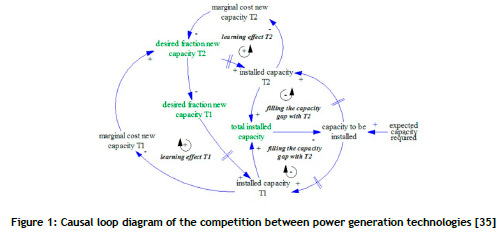
In the transition to renewable energy sources, the development of technology in power generation faces numerous uncertainties prior to achieving commercial viability and entering the competitive landscape of energy technologies [33], [34], [35]. "Competitive landscape" here refers to the rivalry among different technologies that will eventually be developed and implemented as power plants. Pruyt et al. [33] created an SD model that illustrates the structure and dynamics of this competition in electricity generation technologies.
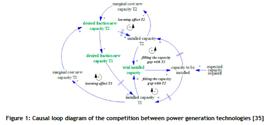
In this model, the competition of technology with other technologies in adding new installed capacity is based only on its marginal investment cost. The investment cost in question is the cost of building new installed technology capacity. This model assumes that decisions about developing and adopting electricity generation technology are based on the rationality of developers who make decisions only on the basis of the investment cost of which technology is cheaper among the available technologies. In addition, in the context of developing new and renewable energy technologies, the cost of technology should decrease over time, in proportion to the learning rate of the adoption of the technology. The more that energy technologies are developed and installed, the cheaper the marginal investment cost will be. This study uses this as the foundation for building a conceptual model for developing green hydrogen in Indonesia's energy transition, where its development depends on technological competition from the development of power plants and green hydrogen technology that uses renewable energy sources.
3. METHODOLOGY
This study adopted systems thinking and a systems analysis approach to explore Indonesia's complex socio-technical dynamics of green hydrogen development. System analysis is a productive foundation for advancing the field of policy analysis [36], [37]. Given the emergent and interdependent nature of factors such as policy design, infrastructure readiness, technological maturity, and market behaviour, a qualitative modelling method was used to conceptualise their interactions and to identify potential leverage points. It had three main stages: actor analysis, system mapping, and a causal loop diagram (CLD). The ultimate outcome of the model - green hydrogen development - is interpreted as the realisation of physical infrastructure and capacity, which results from the interplay of policy, market readiness, and technology cost dynamics.
This study conducted an actor analysis to identify and classify the key stakeholders involved in Indonesia's green hydrogen development landscape. This included government bodies, private sector players, and research institutions. The findings from the actor analysis, specifically, should typically result in a requirement to modify and enhance the original substantive systems analysis [36]. By incorporating the needs of key stakeholders as additional outcomes of interest and policy instruments or interventions under the control of these stakeholders with the system diagram, it would effectively broaden the system boundaries, allowing for a more comprehensive representation of the policy landscape [36].
The system diagram thus should provide a more robust conceptual basis for analysing the potential impacts of a broader range of policy options on a more diverse set of outcomes [36]. It also illustrates the problem owner and the objectives sought by the problem owner, all the stakeholders involved in the industry development, the functioning of the system, and the policy measures required to affect the system's output.
Formal models serve as effective tools to investigate the behaviour of systems, making them essential for considering the potential future developments of those systems [38]. A diverse range of models has been created to guide the shift towards a low-carbon economy. Regarding hydrogen energy, three model types have stood out, of which one is system dynamics [38]. As part of system dynamics, this study used a CLD as a system conceptualisation technique to explore comprehensively the pathways to green hydrogen development in Indonesia. System dynamics conveys a system or model through a CLD that illustrates the connections between various variables, including feedback loops. The fundamental elements of a CLD are the variables and the direct cause-and-effect connections linking them. These connections can be either positive or negative. CLDs are extremely useful for visualising systems, identifying loops, assessing their polarity (positive and reinforcing or negative and balancing), and understanding how one loop affects other loops [39].
Integral to SD modelling, these methods facilitate identifying and analysing complex interdependencies among the key factors that influence green hydrogen development. By mapping feedback mechanisms and external influences, these approaches provide a structured framework for assessing policy impacts and technological advancements in the green hydrogen ecosystem in Indonesia.
4. CONCEPTUAL SYSTEM DYNAMICS MODEL DEVELOPMENT FOR REALISING GREEN HYDROGEN IN INDONESIA
This section presents the development of a conceptual system dynamics (SD) model that captures the structural and behavioural complexities of realising green hydrogen development in Indonesia. The model aims to explore how policy interventions, technological learning, infrastructure readiness, and actor behaviour interact to shape the actual deployment of green hydrogen capacity over time. The modelling process begins with an actor analysis to identify the key stakeholders, their roles, and interests. It then moves on to the construction of a system diagram and a CLD, which together provide a qualitative representation of the system's feedback mechanisms and interdependencies. These conceptual tools form the foundation for future quantitative modelling and scenario analysis.
4.1. Actor analysis
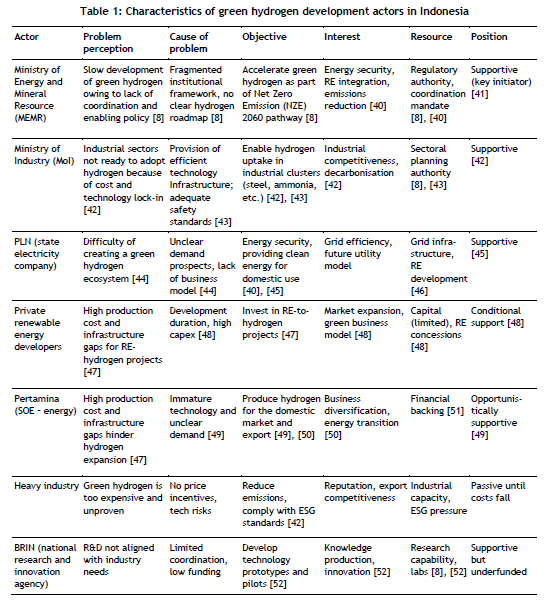
Actors are divided into three groups: those affected by the problem and the solution, those officially engaged in the policy intervention, and those who have a vested interest in implementing the solution [36].
The MEMR, the first actor, is the central government body responsible for formulating and implementing national energy policies. It is concerned about the slow progress of green hydrogen because of institutional fragmentation and the absence of a coherent national strategy or roadmap.
The second actor is the Ministry of Industry (MoI), which oversees industrial development, decarbonising sectors such as steel and ammonia. They are concerned that high hydrogen costs and a lack of incentives make industrial adoption difficult and uncompetitive.
The third actor is the state electricity company, PLN, Indonesia's national electricity utility, which manages power generation, transmission, and distribution. It views hydrogen cautiously, and is worried about various problems in creating a green hydrogen ecosystem.
The fourth actor is private renewable energy (RE) developers. These are independent power producers and clean energy firms interested in coupling renewable energy with hydrogen. They are concerned about the high production costs and infrastructure gaps for RE-hydrogen projects.
The fifth actor is Pertamina, Indonesia's most significant energy state-owned enterprise (SOE). It was traditionally focused on oil and gas, but is now moving towards an energy transition. Their concern lies in the infrastructure and economic problems that hinder the scale-up of green hydrogen, although they see business potential in the domestic market and in exports.
The sixth actor is heavy industry. Large industrial firms are potentially key users of green hydrogen to decarbonise their operations. Despite recognising its future value, they are hesitant to shift owing to the cost, technology risk, and limited regulatory pressure.
The seventh actor is BRIN, the national research and innovation agency. BRIN leads national research and innovation policy, and aims to develop technology prototypes and pilots. Their concern is that limited funding and weak connections to industry reduce the impact and scalability of their research outputs.
4.2. Conceptual model
4.2.1. System mapping with system diagram
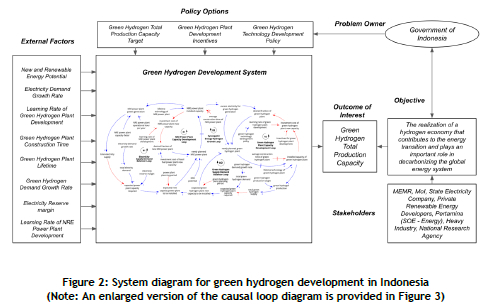
Figure 2 presents a system diagram of Indonesia's green hydrogen development, capturing the key dynamic interactions between policy levers, external factors, and system feedback loops. The Government of Indonesia is identified as the main problem owner, supported by stakeholders such as the MEMR, MoI, PLN, private renewable energy developers, Pertamina, heavy industry, and BRIN. Policy interventions include setting production capacity targets, providing investment incentives, and promoting technology development, all of which influence the development pathway of green hydrogen production capacity.
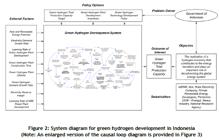
The system is influenced by various external factors, including renewable energy potential, electricity demand growth, plant construction times, lifetimes, and technology learning rates. These elements interact through five key feedback loops: three balancing loops (B1 : electricity supply-demand, B2: green hydrogen supply-demand, and B3: synergistic energy-hydrogen growth) and two reinforcing loops (R1: new and renewable energy (NRE) capacity development, and R2: green hydrogen plant capacity development). These feedback mechanisms shape the outcome of interest - total green hydrogen production capacity -which ultimately supports the national objective of realising a hydrogen economy that contributes to the energy transition and to global decarbonisation efforts.
4.2.2. Causal loop diagram
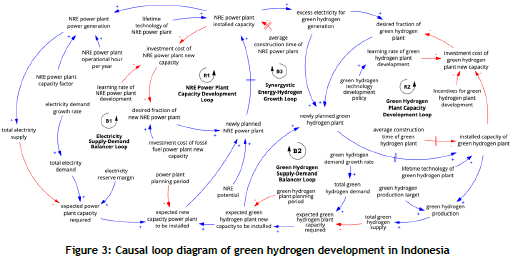
The CLD presented in this study, shown in Figure 3, illustrates the dynamic interactions in the green hydrogen development system in Indonesia, focusing on the interdependencies between NRE electricity generation, green hydrogen production, policy interventions, and investment behaviour. It integrates balancing and reinforcing feedback loops to capture the system's complexity and its response to changing demands, costs, and policy incentives.
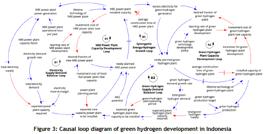
This model is structured on five primary feedback loops: three balancing loops (B1, B2, and B3) that stabilise supply-demand relationships in the electricity and hydrogen sectors, and also has synergies between renewable electricity and hydrogen production; and two reinforcing loops (R1 and R2) that amplify growth via cost reduction and learning effects.
The CLD incorporates several critical elements such as learning-by-doing effects, investment cost dynamics, planning, construction delays, reserve margin requirements, and government incentives. By doing so, it highlights how policy instruments and private sector responses could shape the trajectory of green hydrogen development, especially under the conditions of energy transition.
The following is an explanation of each loop:
Loop B1 - Electricity supply-demand balancer loop (balancing)
This loop represents the mechanism by which the electricity system balances generation and consumption. As total electricity demand increases (driven by factors such as economic and population growth), the expected power plant capacity required also rises. To maintain a stable electricity reserve margin, additional new capacity of power plants must be planned and installed. When these plants - particularly NRE power plants - are commissioned, they contribute to the total electricity supply, which in turn helps to meet the increasing demand, thus closing the loop. This classic balancing mechanism seeks to stabilise electricity availability in the system.
Loop B2 - Green hydrogen supply-demand balancer loop (balancing)
This loop reflects the balancing dynamics in the green hydrogen sector. As total green hydrogen demand grows, because of increasing industrial applications or decarbonisation policies, the expected capacity of green hydrogen plants must be increased. This prompts the planning and installation of new green hydrogen production capacity. Once operational, the installed capacity of green hydrogen plants enhances the total green hydrogen supply, thus helping to meet demand. This loop ensures that green hydrogen availability remains aligned with usage needs, functioning as a stabilising feedback loop.
Loop B3 - Synergistic energy-hydrogen growth loop (balancing)
Loop R3 captures the positive synergy between renewable electricity generation and green hydrogen production. As the NRE power plant's installed capacity increases, more excess electricity is available to generate green hydrogen, particularly during periods of low demand or oversupply. This surplus electricity provides a low-cost input for hydrogen production, encouraging the planning of additional NRE-powered green hydrogen plants. The subsequent increase in green hydrogen plant capacity further drives hydrogen production, thereby balancing the growth of both renewable electricity and green hydrogen sectors.
Loop R1 - NRE power plant capacity development loop (reinforcing)
Loop R1 highlights the reinforcing cycle in NRE expansion driven by cost reductions and learning. As the NRE power plant's installed capacity increases, the learning rate of NRE power plant development would affect the economies of scale of the power plant. This learning reduces the investment cost of new NRE capacity, making it more attractive to invest in renewable projects. This leads to an increase in the desired fraction of NRE in the generation mix and results in more newly planned NRE power plants, further increasing installed capacity. This creates a self-reinforcing growth dynamic in renewable electricity development.
Loop R2 - Green hydrogen plant capacity development loop (reinforcing)
This loop represents a reinforcing feedback that is driven by technology learning and policy incentives. As the installed capacity of green hydrogen plants increases, the learning rate of green hydrogen plants would lower the investment cost for new green hydrogen capacity. In addition, incentives for green hydrogen development provided by the government would further reduce investment barriers. These dynamics increase the desired fraction of new capacity allocated to green hydrogen, resulting in greater newly planned green hydrogen capacity and subsequently more installations. This loop facilitates the rapid scaling of green hydrogen infrastructure.
5. DISCUSSION
The conceptual SD model developed in this study offers a structured framework to understand the feedback mechanisms and actor dynamics influencing the realisation of green hydrogen development in Indonesia. While the model remains qualitative, it highlights critical relationships that could serve as the foundation for future quantitative modelling and scenario-based analysis. One of the key strengths of this model lies in its ability to map how technological learning, policy incentives, and infrastructure development interact with demand and supply dynamics. By extending this model into a quantitative simulation, policymakers and planners could evaluate the impact of various interventions - such as subsidies for electrolyser technology, accelerated renewable energy deployment, or coordinated roadmap implementation - on the growth trajectory of green hydrogen capacity. This would enable scenario-based decision-making, allowing for adaptive strategies under uncertainty.
The feedback loops identified in the model also have important implications for policy design. For instance, the reinforcing loop between installed green hydrogen capacity and reduced investment costs through learning-by-doing suggests that early-stage government support would be crucial to activating positive momentum in the sector. Similarly, the balancing loops related to electricity and hydrogen supply-demand highlight the importance of aligning infrastructure readiness with market development. The actor analysis further underscores the fragmented nature of Indonesia's institutional landscape, which could delay or distort implementation. Agencies such as MEMR, MoI, PLN, and BRIN must strengthen coordination mechanisms and align their respective roles in a coherent national hydrogen strategy. Investment incentives, streamlined permitting processes, and targeted support for demonstration projects could accelerate system-wide progress and trigger reinforcing growth dynamics.
The reinforcing and balancing loops proposed in this conceptual model are reflected in several real-world cases of renewable energy and hydrogen development. For instance, large-scale solar PV deployment in India has demonstrated strong learning effects and economies of scale, leading to dramatic cost reductions in module and installation costs over the past decade [52]. In Indonesia, similar trends are emerging: utility-scale solar power purchase agreement prices dropped from around USD 0.25/kWh in 2015 to around USD 0.056/kWh by 2022, largely driven by auction mechanisms and project scaling [53]. This validates the reinforcing loop R1 in our model, in which increased deployment reduces costs, thereby encouraging further investment. In addition, the EU Hydrogen Strategy provides a concrete example of loop R2: electrolyser costs are projected to fall significantly because of policy subsidies, increased manufacturing capacity, and large-scale procurement programmes such as the European Hydrogen Bank's €720 million auction in 2024 [54]. In Indonesia, early-stage hydrogen pilots led by Pertamina and PLN - including a 100 kg/day green hydrogen facility in Lampung - represent efforts to initiate similar dynamics, linking public investment with technology demonstration and learning [6]. These international and domestic cases reinforce the credibility and applicability of the feedback mechanisms proposed in our model.
Beyond policy measures, the model has strategic value in supporting long-term planning. By illuminating interdependencies between policy, market behaviour, and infrastructure timelines, the model could serve as a diagnostic tool to identify potential bottlenecks and unintended consequences. For example, over-reliance on future hydrogen demand without sufficient renewable electricity supply might destabilise the system, while neglecting to invest in electrolyser manufacturing capacity might slow down cost reductions. Therefore, the model could inform the design of a robust national roadmap for green hydrogen development - one that integrates energy transition goals with industrial decarbonisation targets and technology readiness. Overall, this systems thinking approach helps to reframe green hydrogen development not as a linear deployment problem, but as a dynamic and multi-actor transition process that requires continuous learning, coordination, and feedback-informed policy design.
6. CONCLUSION
This study has developed a conceptual SD model to explore the realisation of green hydrogen development in Indonesia. Through a structured systems thinking approach - comprising actor analysis, system mapping, and CLDs - the model identifies key feedback loops and interdependencies that shape green hydrogen deployment. It reveals how reinforcing loops such as technology learning and policy incentives could accelerate growth, while balancing loops reflect infrastructure and demand constraints that must be managed. By mapping these dynamics, the model should provide a foundation for future quantitative simulations and scenario analysis to inform strategic planning.
The primary contribution of this work lies in offering a systems-based lens to understand green hydrogen development as a multi-actor, feedback-driven transition process. Rather than viewing development as a linear technology rollout, the model highlights how coordination, timing, and leverage points play a critical role. This conceptual model could support policymakers in designing more adaptive and coherent strategies to guide Indonesia towards a sustainable hydrogen economy. Future research could build on this framework by operationalising it into a quantitative SD model to test specific policy interventions under different scenarios.
FUNDINGThis research was funded by Universitas Indonesia, Hibah PUTI Q1 2024, Grant Number: NKB-465/UN2.RST/HKP.05.00/2024.
REFERENCES
2. LITERATURE REVIEW
-
[1] Indonesia Energy Transition Outlook. 2022. [Online]. Available: https://www.irena.org/Publications/2022/Oct/Indonesia-Energy-Transition-Outlook
» https://www.irena.org/Publications/2022/Oct/Indonesia-Energy-Transition-Outlook - [2] IEA, An energy sector roadmap to net zero emissions in Indonesia. OECD, 2022. doi: 10.1787/4a9e9439-en
-
[3] Hydrogen Council and McKinsey & Company, "Hydrogen for net-zero: A critical cost-competitive energy vector," Nov. 2021. [Online]. Available: https://hydrogencouncil.com/wp-content/uploads/2021/11/Hydrogen-for-Net-Zero.pdf
» https://hydrogencouncil.com/wp-content/uploads/2021/11/Hydrogen-for-Net-Zero.pdf -
[4] T. K. Blank and P. Molloy, "Hydrogen's Decarbonization Impact for Industry: Near-term challenges and long-term potential," 2020. [Online]. Available: https://rmi.org/wp-content/uploads/2020/01/hydrogen_insight_brief.pdf
» https://rmi.org/wp-content/uploads/2020/01/hydrogen_insight_brief.pdf -
[5] IFHE & BRIN, Indonesia hidrogen roadmap. IFHE Press, 2023. [Online]. Available: https://ifhe.or.id/wp-content/uploads/2023/06/indonesia%20hidrogen%20roadmap.pdf
» https://ifhe.or.id/wp-content/uploads/2023/06/indonesia%20hidrogen%20roadmap.pdf -
[6] PLN, "Kolaborasi Global, PLN Gandeng Pupuk Indonesia dan ACWA Power Siap Bangun Pabrik Hidrogen Terbesar di Indonesia," https://web.pln.co.id/media/siaran-pers/2023/09/kolaborasi-global-pln-gandeng-pupuk-indonesia-dan-acwa-power-siap-bangun-pabrik-hidrogen-terbesar-di-indonesia.
» https://web.pln.co.id/media/siaran-pers/2023/09/kolaborasi-global-pln-gandeng-pupuk-indonesia-dan-acwa-power-siap-bangun-pabrik-hidrogen-terbesar-di-indonesia -
[7] IESR, "Indonesia energy transition outlook 2024," Dec. 2023. [Online]. Available: https://iesr.or.id/pustaka/indonesia-energy-transition-outlook-ieto-2024/
» https://iesr.or.id/pustaka/indonesia-energy-transition-outlook-ieto-2024/ -
[8] ESDM, "Strategi Hidrogen Nasional," 2023. [Online]. Available: www.ebtke.esdm.go.id
» www.ebtke.esdm.go.id -
[9] A. O. M. Maka, M. Mehmood, and T. N. Chaudhary, "Green hydrogen revolution and its pathway towards sustainable development," Clean Energy, vol. 9, no. 2, pp. 124-131, Feb. 2025. doi: 10.1093/ce/zkae106
» https://doi.org/10.1093/ce/zkae106 -
[10] J. Gómez and R. Castro, "Green hydrogen energy systems: A review on their contribution to a renewable energy system," Energies, vol. 17, no. 13, 3110, Jul. 01, 2024. doi: 10.3390/en17133110
» 10.3390/en17133110 - [11] F. Barbir, "Future of fuel cells and hydrogen," in PEM fuel cells: Theory and practice, 2nd ed., ch. 12, Academic Press, pp. 469-508, 2012. doi: 10.1016/B978-0-12-387710-9.00012-6
-
[12] IRENA, Hydrogen: Overview. https://www.irena.org/Energy%20Transition/Technology/Hydrogen
» https://www.irena.org/Energy%20Transition/Technology/Hydrogen -
[13] IRENA, Green hydrogen : A guide to policy making. International Renewable Energy Agency, 2020. [Online]. Available: https://www.irena.org/media/Files/IRENA/Agency/Publication/2020/Nov/IRENA_Green_hydrogen_policy_2020.pdf
» https://www.irena.org/media/Files/IRENA/Agency/Publication/2020/Nov/IRENA_Green_hydrogen_policy_2020.pdf -
[14] IEA, "Global hydrogen review 2021," 2021. [Online]. Available: www.iea.org/t & c/
» www.iea.org/t & c/ -
[15] A. O. M. Maka and M. Mehmood, "Green hydrogen energy production: Current status and potential,"Clean Energy, vol. 8, no. 2, pp. 1-7, Apr. 2024. doi: 10.1093/ce/zkae012.
» https://doi.org/10.1093/ce/zkae012 -
[16] IRENA, Global renewables outlook: Energy transformation 2050. International Renewable Energy Agency, 2020. [Online]. Available: https://www.irena.org/publications/2020/Apr/Global-Renewables-Outlook-2020
» https://www.irena.org/publications/2020/Apr/Global-Renewables-Outlook-2020 -
[17] T. Capurso, M. Stefanizzi, M. Torresi, and S. M. Camporeale, "Perspective of the role of hydrogen in the 21st century energy transition," Energy Conversion and Management, vol. 251, 114898, Jan. 01, 2022. doi: 10.1016/j.enconman.2021.114898
» https://doi.org/10.1016/j.enconman.2021.114898 -
[18] Zulfhazli, A. R. Keeley, S. Takeda, and S. Managi, "A systematic review of the techno-economic assessment of various hydrogen production methods of power generation," Frontiers in Sustainability, vol. 3, 2022. [Online]. Available: https://www.frontiersin.org/journals/sustainability/articles/10.3389/frsus.2022.943145
» https://www.frontiersin.org/journals/sustainability/articles/10.3389/frsus.2022.943145 -
[19] M. Chatenet et al., "Water electrolysis: From textbook knowledge to the latest scientific strategies and industrial developments," Chemical Society Revues, vol. 51, no. 11, pp. 4583-4762, 2022. doi: 10.1039/D0CS01079K
» https://doi.org/10.1039/D0CS01079K -
[20] A. Kovač, M. Paranos, and D. Marcius, "Hydrogen in energy transition: A review," International Journal of Hydrogen Energy, vol. 46, no. 16, pp. 10016-10035, Mar. 2021. doi: 10.1016/j.ijhydene.2020.11.256
» https://doi.org/10.1016/j.ijhydene.2020.11.256 -
[21] D. J. Jovan, G. Dolanc, and B. Pregelj, "Utilization of excess water accumulation for green hydrogen production in a run-of-river hydropower plant," Renewable Energy, vol. 195, pp. 780-794, Aug. 2022. doi: 10.1016/J.RENENE.2022.06.079
» https://doi.org/10.1016/J.RENENE.2022.06.079 -
[22] A. Giocoli, V. Motola, N. Scarlat, N. Pierro, and S. Dipinto, "Techno-economic viability of renewable electricity surplus to green hydrogen and biomethane, for a future sustainable energy system: Hints from southern Italy," Renewable and Sustainable Energy Transition, vol. 3, 100051, Aug. 2023. doi: 10.1016/J.RSET.2023.100051
» https://doi.org/10.1016/J.RSET.2023.100051 -
[23] D. J. Jovan, G. Dolanc, and B. Pregelj, "Cogeneration of green hydrogen in a cascade hydropower plant," Energy Conversion and Management: X, vol. 10, 100081, Jun. 2021. doi: 10.1016/J.ECMX.2021.100081
» https://doi.org/10.1016/J.ECMX.2021.100081 -
[24] S. G. Nnabuife, A. K. Hamzat, J. Whidborne, B. Kuang, and K. W. Jenkins, "Integration of renewable energy sources in tandem with electrolysis: A technology review for green hydrogen production," International Journal of Hydrogen Energy, vol. 107, pp. 218-240, Mar. 2024. doi: 10.1016/j.ijhydene.2024.06.342
» https://doi.org/10.1016/j.ijhydene.2024.06.342 -
[25] M. Wang, Z. Wang, X. Gong, and Z. Guo, "The intensification technologies to water electrolysis for hydrogen production - A review," Renewable and Sustainable Energy Reviews, vol. 29, pp. 573-588, Jan. 2014. doi: 10.1016/J.RSER.2013.08.090
» https://doi.org/10.1016/J.RSER.2013.08.090 -
[26] J. Brauns and T. Turek, "Alkaline water electrolysis powered by renewable energy: A review," Processes, vol. 8, no. 2, 248, Feb. 01, 2020. doi: 10.3390/pr8020248
» https://doi.org/10.3390/pr8020248 -
[27] S. O. Bade, O. S. Tomomewo, A. Meenakshisundaram, P. Ferron, and B. A. Oni, "Economic, social, and regulatory challenges of green hydrogen production and utilization in the US: A review," International Journal of Hydrogen Energy, vol. 49, pp. 314-335, Jan. 2024. doi: 10.1016/J.IJHYDENE.2023.08.157
» https://doi.org/10.1016/J.IJHYDENE.2023.08.157 -
[28] S. R. Andrus, R. J. Diffely, and T. L. Alford, "Theoretical analysis of green hydrogen from hydropower: A case study of the Northwest Columbia River system," International Journal of Hydrogen Energy, vol. 48, no. 22, pp. 7993-8001, Mar. 2023. doi: 10.1016/J.IJHYDENE.2022.11.027
» https://doi.org/10.1016/J.IJHYDENE.2022.11.027 -
[29] W. C. Nadaleti, V. A. Lourenço, and G. Americo, "Green hydrogen-based pathways and alternatives: Towards the renewable energy transition in South America's regions - Part A," International Journal of Hydrogen Energy, vol. 46, no. 43, pp. 22247-22255, Jun. 2021. doi: 10.1016/J.IJHYDENE.2021.03.239
» 10.1016/J.IJHYDENE.2021.03.239 -
[30] O. Bamisile et al., "Environmental impact of hydrogen production from Southwest China's hydro power water abandonment control," International Journal of Hydrogen Energy, vol. 45, no. 46, pp. 25587-25598, Sep. 2020. doi: 10.1016/J.IJHYDENE.2020.06.289
» https://doi.org/10.1016/J.IJHYDENE.2020.06.289 -
[31] R. Bhandari and S. Subedi, "Evaluation of surplus hydroelectricity potential in Nepal until 2040 and its use for hydrogen production via electrolysis," Renewable Energy, vol. 212, pp. 403-414, Aug. 2023. doi: 10.1016/J.RENENE.2023.05.062
» https://doi.org/10.1016/J.RENENE.2023.05.062 -
[32] D. F. Botelho, C. A. Moraes, and L. W. de Oliveira, "Green hydrogen production from hydro spilled energy in Brazilian hydropower plants," International Journal of Hydrogen Energy, vol. 68, pp. 575-585, May 2024. doi: 10.1016/J.IJHYDENE.2024.04.255
» 10.1016/J.IJHYDENE.2024.04.255 -
[33] E. Pruyt, J. Kwakkel, G. Yücel, C. Hamarat, and G. Yücel, "Energy transitions towards sustainability: A staged exploration of complexity and deep uncertainty," presented at the 29th International Conference of the System Dynamics Society, 2011. [Online]. Available: https://www.researchgate.net/publication/234549962
» https://www.researchgate.net/publication/234549962 -
[34] A. D. Setiawan, A. Sutrisno, and R. Singh, "Responsible innovation in practice with system dynamics modelling: The case of energy technology adoption," International Journal of Innovation and Sustainable Development, vol. 12, no. 4, pp. 387-420, Jan. 2018. doi: 10.1504/IJISD.2018.095048
» https://doi.org/10.1504/IJISD.2018.095048 -
[35] A. Hidayatno, B. A. Jafino, A. D. Setiawan, and W. W. Purwanto, "When and why does transition fail? A model-based identification of adoption barriers and policy vulnerabilities for transition to natural gas vehicles," Energy Policy, vol. 138, 111239, 2020. doi: https://doi.org/10.1016/j.enpol.2020.111239
» https://doi.org/10.1016/j.enpol.2020.111239 - [36] W. A. H. Thissen and W. E. Walker, Public policy analysis: New developments. Boston, MA: Springer, 2013.
- [37] S. Damayanti, A. Hidayatno, and A. D. Setiawan, "User acceptance of electric vehicles in Indonesia: A conceptual model," in ACM International Conference Proceeding Series, Association for Computing Machinery, Jun. 2020, pp. 110-115. doi: 10.1145/3400934.3400956.
-
[38] W. McDowall, "Exploring possible transition pathways for hydrogen energy: A hybrid approach using socio-technical scenarios and energy system modelling," Futures, vol. 63, pp. 1-14, 2014. doi: 10.1016/j.futures.2014.07.004
» https://doi.org/10.1016/j.futures.2014.07.004 - [39] E. Pruyt, Small system dynamics models for big issues: Triple jump towards real-world complexity. Delft, The Netherlands: TU Delft Library, 2013.
-
[40] F. Kurniawan, "Analysing the renewable energy transition in Indonesia: An examination through the actors, objectives, and context framework," Master's thesis, University of Twente, Enschede, The Netherlands, 2024. [Online]. Available: https://purl.utwente.nl/essays/103019
» https://purl.utwente.nl/essays/103019 -
[41] ESDM, "Kementerian ESDm Dukung Pengembangan Hidrogen Hijau." [Online]. Available: https://www.esdm.go.id/id/media-center/arsip-berita/kementerian-esdm-dukung-pengembangan-hidrogen-hijau
» https://www.esdm.go.id/id/media-center/arsip-berita/kementerian-esdm-dukung-pengembangan-hidrogen-hijau -
[42] D. L. Priastiandaru, "Kemenperin Dorong Pelaku Industri Manfaatkan Hidrogen Hijau," Kompas.com. [Online]. Available: https://lestari.kompas.com/read/2024/09/11/070000286/kemenperin-dorong-pelaku-industri-manfaatkan-hidrogen-hijau
» https://lestari.kompas.com/read/2024/09/11/070000286/kemenperin-dorong-pelaku-industri-manfaatkan-hidrogen-hijau -
[43] E. Catriana and S. R. D. Setiawan, "Kemenperin Susun Peta Jalan Pengembangan Hidrogen Hijau untuk Industri," Kompas.com. [Online]. Available: https://money.kompas.com/read/2024/08/15/140826926/kemenperin-susun-peta-jalan-pengembangan-hidrogen-hijau-untuk-industri?page=all
» https://money.kompas.com/read/2024/08/15/140826926/kemenperin-susun-peta-jalan-pengembangan-hidrogen-hijau-untuk-industri?page=all -
[44] M. C. G. Prayudhia, "PLN sebut hidrogen hijau miliki potensi bisnis yang besar," ANTARA. [Online]. Available: https://www.antaranews.com/berita/4308655/pln-sebut-hidrogen-hijau-miliki-potensi-bisnis-yang-besar
» https://www.antaranews.com/berita/4308655/pln-sebut-hidrogen-hijau-miliki-potensi-bisnis-yang-besar -
[45] F. M. Itsnaini and B. P. Jatmiko, "PLN Kembangkan Teknologi Hidrogen Hijau sebagai Energi dan Bahan Bakar," Kompas.com. [Online]. Available: https://lestari.kompas.com/read/2024/10/17/204400786/pln-kembangkan-teknologi-hidrogen-hijau-sebagai-energi-dan-bahan-bakar
» https://lestari.kompas.com/read/2024/10/17/204400786/pln-kembangkan-teknologi-hidrogen-hijau-sebagai-energi-dan-bahan-bakar -
[46] A. A. Artanti, "PLN Ungkap Cara Produksi Hidrogen Hijau," Metro TV. [Online]. Available: https://www.metrotvnews.com/read/bJECa5xM-pln-ungkap-cara-produksi-hidrogen-hijau
» https://www.metrotvnews.com/read/bJECa5xM-pln-ungkap-cara-produksi-hidrogen-hijau -
[47] D. L. Priastiandaru, "Pengembangan Hidrogen Hijau Butuh Investasi Rp 395 Triliun Hingga 2060," Kompas.com. [Online]. Available: https://lestari.kompas.com/read/2024/08/17/070000286/pengembangan-hidrogen-hijau-butuh-investasi-rp-395-triliun-hingga-2060
» https://lestari.kompas.com/read/2024/08/17/070000286/pengembangan-hidrogen-hijau-butuh-investasi-rp-395-triliun-hingga-2060 -
[48] A. S. Perwitasari and P. Nityakanti, "Punya Daya Tarik, Bisnis Energi Hijau Dilirik," Kontan.co.id. [Online]. Available: https://jelajahekonomi.kontan.co.id/ekonomi-infrastruktur/news/punya-daya-tarik-bisnis-energi-hijau-dilirik
» https://jelajahekonomi.kontan.co.id/ekonomi-infrastruktur/news/punya-daya-tarik-bisnis-energi-hijau-dilirik -
[49] F. D. Muliawati, "Kembangkan Hidrogen Hijau, PGE Incar Pasar Ekspor," CNBC Indonesia. [Online]. Available: https://www.cnbcindonesia.com/news/20250115153145-4-603420/kembangkan-hidrogen-hijau-pge-incar-pasar-ekspor
» https://www.cnbcindonesia.com/news/20250115153145-4-603420/kembangkan-hidrogen-hijau-pge-incar-pasar-ekspor -
[50] F. Yunianto, "PGE dan Pertagas kolaborasi kajian pengembangan hidrogen hijau," ANTARA. [Online]. Available: https://www.antaranews.com/berita/4633957/pge-dan-pertagas-kolaborasi-kajian-pengembangan-hidrogen-hijau
» https://www.antaranews.com/berita/4633957/pge-dan-pertagas-kolaborasi-kajian-pengembangan-hidrogen-hijau -
[51] A. Umah, "Pertamina Mulai Kaji Pemanfaatan Hidrogen Hijau," CNBC Indonesia. [Online]. Available: https://www.cnbcindonesia.com/news/20210715113209-4-261076/pertamina-mulai-kaji-pemanfaatan-hidrogen-hijau
» https://www.cnbcindonesia.com/news/20210715113209-4-261076/pertamina-mulai-kaji-pemanfaatan-hidrogen-hijau -
[52] BRIN, "Riset dalam Peta Ekosistem Hidrogen Wujudkan NZE 2060," BRIN. [Online]. Available: https://www.brin.go.id/press-release/115876/riset-dalam-peta-ekosistem-hidrogen-wujudkannze-206
» https://www.brin.go.id/press-release/115876/riset-dalam-peta-ekosistem-hidrogen-wujudkannze-206
Accepted for publication 26 Aug 2025
Available online 12 Dec 2025
ORCID® identifiers
D.R.C. Pratama
https://orcid.org/0009-0006-2230-0700
A.D. Setiawan
https://orcid.org/0000-0002-7453-190X