The influence of project management maturity on perceived project success: a case study of the Lesotho water sector
Abstract
This study aims to determine the project management maturity level of four organisations in the Lesotho Water Sector. It assesses its influence on perceived project success by undertaking case studies in these organisations. It, therefore, contributes to the limited literature on project management maturity in the water sector in Africa. The results indicated that the average project management maturity was 2, with one organisation at a maturity level of 3. A total of 53% of executed projects were perceived as successful. The study found that high-maturity-level organisations tend to execute projects more successfully. Additional factors that may lead to project failure in this sector were identified.
Abstract
Hierdie studie het ten doel om die projekbestuur-volwassenheidvlak van vier organisasies in die Lesotho-watersektor te bepaal. Dit beoordeel die invloed daarvan op waargenome projeksukses deur gevallestudies in hierdie organisasies te onderneem. Dit dra dus by tot die beperkte literatuur oor projekbestuurvolwassenheid in die watersektor en in Afrika. Die resultate het aangedui dat die gemiddelde projekbestuur-volwassenheid 2 was, met een organisasie op 'n volwassenheidsvlak van 3. Altesaam 53% van uitgevoerde projekte is as suksesvol beskou. Die studie het bevind dat hoë-volwassenheid-vlak organisasies geneig is om projekte meer suksesvol uit te voer. Bykomende faktore wat tot projekmislukking in hierdie sektor kan lei, is geïdentifiseer.
1. INTRODUCTION
Project management has been around for decades as a management tool that helps organisations achieve their objectives [1], [2]. The triple constraint - also called 'the iron triangle', which is to deliver projects on time, within schedule, and within the required scope - is often used as the primary criterion for measuring project success [3]. Ofori and Deffo [4] state that although practitioners' awareness and knowledge of project management practices have risen significantly over the past few years, many projects continue to fail. Thus, one may ask: What can be done to attain project success?
Studies suggest that the proper use of project management tools and techniques affects the success of projects; on the other hand, the inaccurate use, or lack of use, of these tools may yield undesired project outcomes [1]. In addition, most organisations invest enormous resources to develop their project management processes. One of the ways in which organisations attempt to achieve project success is to measure the level of their project management maturity. This is done to ascertain which improvements must be implemented to achieve the desired or ideal project management maturity level. Frameworks known as project management maturity models (PMMMs) are utilised to measure the level of project management maturity in organisations [5]. When an organisation measures its project management maturity level, it can benchmark its project management processes with best practices and similar organisations, thus structuring a route to improvement [6].
This paper investigates the influence of project management maturity on perceived project success and focuses on four organisations in the Lesotho Water Sector. The sector's primary mandate is to develop, update, and monitor the implementation of the water policy, water and sanitation legislation and strategies, and the preparation and coordination of all water sector management activities. This includes international water supplies and the provision of direction on water resources management and use [7]. It is achieved through their organisational entities, which are the Water Commission, the Department of Water Affairs, the Department of Rural Water Supply, the Lesotho Lowlands Water Supply Scheme Unit, the Water and Sewerage Company (WASCO), the Lesotho Highlands Development Authority (LHDA), and the Lesotho Electricity and Water Authority (LEWA).
Few studies have been done on African project management maturity, particularly in the water sector. Therefore, this study contributes to the body of knowledge in this regard.
2.1.
Projects and project managementThe Project Management Institute (PMI) [8] states that a project is a temporary endeavour to create a unique product, service, or result. A project is a series of multi-functional activities and tasks with a specific objective to be completed within certain specifications. It has a definite start and end date and a limited budget and uses human and non-human resources [9]. Most project definitions include the element of 'uniqueness' [9].
Organisational project management can be defined as the organisation's receptiveness to project management. This could also be described as increasing the level of sharing and expanding the commonality of project management methodologies across all projects [4].
Shenhar and Dvir [10] developed the 'diamond model' to classify projects into four categories to deal with uniqueness in projects. They are as follows:
• Novelty - represents the uncertainty or level of innovation of the project goals, the market, or both.
• Technology - represents the level of the technological uncertainty of the project.
• Complexity - measures the intricacy of the product, task, and project organisation.
• Pace - measures the urgency of the project.
The diamond model helps to assess the project's risk and the benefits that could be derived, and to select the best management approach to use [10].
The PMBOK® Guide [8] states that project management is the application of knowledge, skills, tools, and techniques to project activities to meet the project requirements. This can be achieved by appropriately applying and integrating the identified project management processes. Anantatmula and Rad [11] agree that the ultimate goal of project management is to make effective and well-organised use of available resources to complete a project within time, scope, and cost. Lientz and Rea [12] suggest that managing a project involves the following main activities:
• Allocating and managing resources across projects, within projects, and with non-project work.
• Dealing with issues and opportunities that span across projects.
• Gathering, using, and refining lessons learned across projects.
• Providing a structure for project management that encompasses projects of all sizes and types.
2.2.
Improving project management skills and results over time. Project management maturity'Maturity' is defined as being mature, fully developed, or approaching perfection [4]. Several authors have defined 'project management maturity' in recent years. Gomes et al. [13] outline project management maturity as the level where an organisation follows optimal and best practices in executing its projects, leading to favourable outcomes. When an organisation matures, its project management processes and procedures are optimally structured to achieve its strategic objectives [14]. Therefore, project management maturity implies that the organisation is perfectly adapted to execute its projects effectively and efficiently [14]. Nicholas and Steyn [15] state that project management maturity is an organisation's ability or skill in managing projects, including its methodology and standardised methods for planning and control, multi-project integration, and constant improvement. Organisations with higher maturity levels are expected to have a competitive advantage, as they are successful in their project effectiveness and capability [16].
'Maturity in project management' refers to applying recognised, measured, and innovative processes and procedures that lead to the continuous execution of successful projects [17]. Crawford [18] defines project management maturity as an ongoing process in which organisations experience tangible improvements at different stages of development. By improving their maturity, many organisations have seen positive outcomes, which include reduced project completion times, improved budgetary control, improved strategic management decision-making, and sustainable growth and profitability over the long term [18].
The organisation's ability to implement project management knowledge and practices reflects its level of project management maturity [19]. When combined with the organisational maturity process, project management provides a beneficial tool for decision support and monitoring, thus making business strategy implementation more visible, monitored, and measurable [19].
2.3. The measurement of project management maturity
Project management maturity is typically measured by PMMMs. Maturity models fall into three categories [15]:
• Technical delivery process models, originating from total quality management, emphasise process documentation, and have five maturity levels.
• Project management process models focus on the ten knowledge areas of PMI. They also have five levels of maturity.
• Total organisational models, which address the entire organisation.
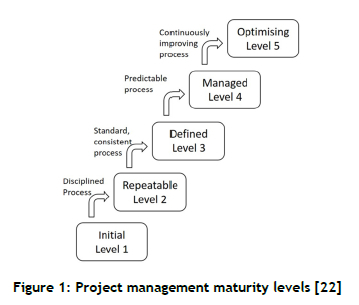
Most PMMMs use the Software Engineering Institute's 'capability maturity models' (CMMs) as a basis. In these models, practices are assessed against standard measures [20]. The maturity models usually comprise five linear stages [20]:
• Level 1: Initial, ad hoc; the initial level where organisations have erratic procedures or informal guidelines.
• Level 2: Repeatable, consistent; basic structured processes and standards are in place and are regularly used.
• Level 3: Defined, integrated - most organisational standards and established processes are in place.
• Level 4: Managed and comprehensive; all project management processes and procedures are established and are regularly measured.
• Level 5: Optimised, adaptive, sustained; the organisation has optimised processes and demonstrates consistent excellence, innovation and optimisation across all aspects of project execution and management.
The maturity levels are outlined in Figure 1. About two-thirds of organisations that measured their maturity level were rated at levels 1 or 2 (out of five linear stages) [16]. The defence and petrochemical industries were at higher maturity levels than those in insurance, finance, health services, and telecommunications [16]. However, it is not essential for every organisation to be rated at level 5. Christoph and Konrad [21] proposed the idea of an industry-specific 'ideal' level of maturity. One might reason that achieving maturity is a continuous journey rather than a fixed destination [16].
2.4.
Project management maturity modelsProject management maturity models (PMMMs) are formal tools that are used to measure and compare an organisation's project management practices and procedures against best practices to map out a structured path to improvement [23]. These models also compare or benchmark an organisation's project management practices and procedures with those of its competitors. Pretorius et al. [24] state that there are currently over 30 PMMMs. Most of them have originated from the capability management maturity integration model (CMMI) [24]. Fabbro [25] classifies the various PMMMs into three categories. These are:
1. Maturity models for leading project management organisations.
2. Most cited and historic maturity models.
3. Most recent maturity models.
Maturity models encompass a wide range of frameworks, including, but not limited to, the following:
• Capability maturity model (CMM) and capability maturity model integration (CMMI) [20]
• Project management process maturity model [26], [27]
• Portfolio, programme and project management maturity model (P3M3) [28]
• Project management maturity model [29]
• Organisational project management maturity model (OPM3) [30]
• PRINCE2 maturity models [31]
• Prado-PMMM [39] and the project management competence model [32]
• Berkeley PM process maturity model [26], [33]
• PM solutions project management maturity model [33].
PMMMs are usually associated with project management bodies of knowledge, such as the PMBOK® Guide [34], and the focus is on project management knowledge areas [35].
2.5.
The impact of project management maturity on perceived project successVarious studies have led scholars to hold conflicting views about the influence of project management maturity on project success. Rad and Levin [36] suggested that higher project management maturity levels could lead to more effective project processes and procedures, in which the deliverables are of higher quality, project costs are lower, and project team morale is higher. Grant and Pennypacker [23] investigated the impact of organisational project management maturity on project success and found that it does, in fact, affect performance. Sidenko [37] established a positive relationship between project management maturity and project success in the information technology sector [37]. Many organisations have realised benefits through maturity improvement, such as shortened project completion times, better control over project costs, heightened effectiveness in strategic management decision-making, and sustained long-term growth and profitability [18].
In the study in which Busse et al. [22] replicated a study by Yazici [38] in 2009, they found that project management maturity significantly influences project success. The outcome differences were associated with the studied service sectors [38]. In line with these authors, Gomes [13] highlighted that the higher levels of organisational maturity positively influenced the organisation's project success, primarily when project management practices were implemented. Therefore, it stands to reason that organisations with a higher level of project management maturity would be better equipped to enhance their overall organisational success [22].
Other studies found no correlation between project management maturity and project success. Nicholas and Steyn [15] noted that few research publications could find a correlation between project management maturity and success, and that the authors who did so were primarily industry consultants. Skulmoski [39] posited that project management maturity was still emerging, lacking concrete ways to identify which competencies contributed to project success. Torres [40] suggested that, even though there was empirical evidence that higher levels of project management maturity resulted in value, more was needed, as studies that were done to establish the relationship offered mixed results. Jugdev and Thomas [35] suggested that the absence of a universally adopted PMMM could amplify the significance of project management maturity.
3. RESEARCH QUESTIONS AND PROPOSITION
The following research questions are presented below:
RQ1: How many projects are perceived as successful, challenged, or failed in the four organisations in the Lesotho Water Sector?
RQ2: What is the average project management maturity level of the four organisations in the Lesotho Water Sector?
In the light of the prevailing ambiguity within scholarly and practical circles about the influence of project management maturity on perceived project success, as discussed in section 2.5, this study undertook to investigate the following proposition:
P: The higher the level of an organisation's project management maturity, the higher the likelihood that projects the organisation executes will succeed.
The following studies support the proposition: [11], [17], [22].
4. METHODOLOGY
This study adopted a pragmatic research approach, using qualitative research methods to collect, analyse, and interpret the data to answer the research questions and to address the proposition [41]. The case study research approach was applicable, as in-depth data collection techniques such as interviews and a review of organisational documents were conducted [42].
The research was approved by the Ethics Committee of the Faculty of Engineering, the Built Environment and Information Technology at the University of Pretoria. The Lesotho Water Sector signed a letter of consent endorsing the research project, and informed consent was obtained from all interviewees. Member checking was a standard practice in which all interviewees could review the interview findings to ensure their data was not misinterpreted.
The primary research data was collected via semi-structured interviews and triangulated with secondary textual data obtained by the case organisations. The primary and secondary data were imported into a computer-aided qualitative data analysis software package and then analysed using thematic analysis and a deductive coding approach.
The interviews were done with senior people working on projects in the four organisations in the Lesotho Water Sector. A total of eight people were interviewed. This demographic was chosen because of their understanding of and experience with projects. The questionnaire that was used in the interview consisted of open-ended, closed, and Likert-scale questions.
Construct validity was ensured by using well-defined constructs and converging multiple sources of evidence through data triangulation. Internal validity was achieved through member checking, as described earlier. A case study protocol was established to ensure reliability and to maintain a chain of evidence.
5. RESULTS
5.1. Data
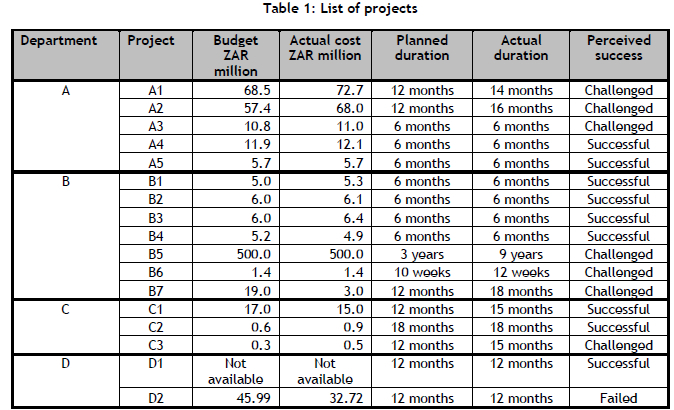
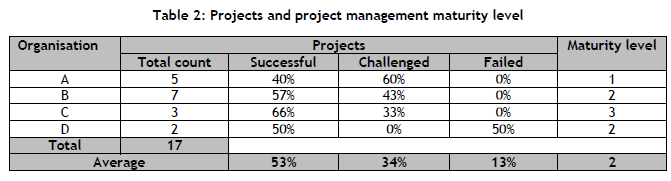
The data was collected from the four organisations in the Lesotho Water Sector. The participants' experience in projects ranged from 10 to 21 years. The types of projects they worked on varied in scale, budget, and time, as outlined in Table 1. Of the 17 completed projects, nine were perceived as successful, seven were perceived as challenged, and one as failed. These are shown in Table 1. Table 2 illustrates the project management maturity levels of the four Lesotho Water Sector organisations and their perceived project success.
5.1.1. Organisation A
Respondents noted that the organisation did not have processes or well-defined project management practices and was rated on project management maturity level 1. The secondary data showed that, for some projects, proper stakeholder involvement and feasibility studies were not done, which resulted in projects being challenged. Some projects were politically influenced, and, as a result, proper planning was not done before construction began. It was noted that the implementation was a success for projects for which feasibility studies were done and when end users were engaged at the start of the project.
5.1.2. Organisation B
Organisation B had defined processes and project management practices to some extent and was rated on project management maturity level 2. The secondary data indicated that, for most projects, many scope changes needed to be taken into consideration, and most of the time, this resulted in cost increases and prolonged project execution. Procurement processes were lengthy, increasing costs due to the delayed project initiation. In some instances, mobilising funds, especially those financed outside the company, also impacted the timely execution of projects.
5.1.3. Organisation C
Organisation C had well-defined processes and project management practices and was rated on project management maturity level 3. Most of the projects they implemented met the objectives and achieved stakeholder satisfaction. Successful implementation was ascribed to a clear project plan based on project identification, involvement of all stakeholders in project design, and the fact that they implemented only projects that were flexible in respect of time. The projects that were challenged had unrealistic timelines, a lack of clear project management roles between implementing agencies, and poor project definition and scope identification.
5.1.4. Organisation D
Organisation D had defined processes and project management practices to some extent and was rated on project management maturity level 2. Poor planning, poor monitoring, poor implementation, political interference, and frequent scope changes were contributing factors that led to failed projects.
5.1.5. Summary of organisations
Table 2 shows the project outcomes and maturity levels for the four organisations. On average, the success rate of the projects for all the organisations was 53%, with 34% challenged and 13% failed. The average maturity level was 2.
Organisation C was the most mature because of its higher success rate. On the other hand, Organisation A was the least mature, had a lower success rate, and had a higher proportion of challenged projects. Despite having fewer projects, Organisation D had a notable failure rate, which could be a focus for further analysis and improvement. The highest success rate was that of Organisation C at 66%, and the lowest success rate was that of Organisation A at 40%.
5.1.6. The Lesotho Water Sector
Most of the participants and the secondary data findings agreed that a higher level of project management maturity could increase the likelihood of project success. The study found that projects in the Lesotho Water Sector that were externally funded by international organisations tended to be successful, as the funders set the standards. Also, these projects were subject to a proper selection process. Projects with solid management buy-in usually thrive, as they have all the necessary support, including allocating resources and empowering team members to execute their tasks effectively. The following were identified as additional factors that often lead to project failure in the Lesotho Water Sector:
• Lack of well-defined project management processes
• Poor project definition
• Scope creep
• Unrealistic timelines
• Poor stakeholder engagement
• Lengthy procurement processes
• Difficulties in mobilising funds
• Political interference
To measure project success, the four organisations used various metrics, including the following:
• Monitoring and evaluation reports - which were monthly and quarterly
• Project closure evaluation reports
• Grievance identification through consultations
• Performance management contracts
• Project management software for critical path monitoring
• Client ratings
5.2. Discussion
The research questions and proposition were stated as follows:
RQ1: How many projects are perceived as successful, challenged, or failed in organisations in the Lesotho Water Sector?
Following the interviews that were carried out and study of the secondary data, 17 projects were identified by the four organisations. Nine were perceived as successful, seven as challenged, and one as failed.
RQ2: What is the average project management maturity level of the four organisations in the Lesotho Water Sector?
Different participants stated the level of project management maturity in the four organisations. On average, the project management maturity level was 2.
P: The higher the level of an organisation's project management maturity, the higher the likelihood that projects the organisation executes will succeed.
The data in Table 2 suggested a positive correlation between the project management maturity level and the success rate of projects in the Lesotho Water Sector:
• The organisation with the highest maturity level (Organisation C: Level 3) had the highest success rate (66%).
• Organisations with medium maturity levels (Organisation B and D: Level 2) had an intermediate average success rate (53.5%).
• The organisation with the lowest maturity level (Organisation A) had the lowest success rate (40%). THUS, the proposition was supported by Table 2.6
6. CONCLUSIONS AND RECOMMENDATIONS
6.1. Conclusions
The study aimed to establish whether project management maturity influences project success in the four organisations in the Lesotho Water Sector. This was investigated by conducting a case study with the four organisations. The study indicated that high-maturity-level organisations in the Lesotho Water Sector tended to execute projects more successfully. This result is consistent with the findings of other studies that established that higher levels of project management maturity yielded a higher likelihood of project success [11], [13], [22]. Table 2 shows that low maturity levels resulted in low success rates in the Lesotho Water Sector. Additional factors that often contributed to the failure of projects in the sector were identified.
In conclusion, organisations that aim to increase their project success rates should focus on improving their project management maturity. Several project management maturity models would be useful in evaluating project management maturity [17]. These models provide clear and quantifiable methods for assessing an organisation's project management maturity by allowing a comparison of defined, specific capabilities at both the project and the programme levels against established benchmarks [16], [17]. By investing in higher maturity levels, organisations could see more successful project outcomes, ultimately leading to better performance and competitive advantage.
6.2. Limitations and recommendations
The study's findings may be context-specific to the Lesotho environment and might not readily apply to other regions or countries. Factors unique to Lesotho, such as cultural norms, socio-economic conditions, geography, and political influences, may influence project management practices and project success outcomes differently from those in other settings.
The small sample size of this study may limit the extent to which its findings could be generalised to the broader population of project managers in similar and other industries.
A more comprehensive comparison of the projects in this study to investigate the reasons that could have contributed to their outcomes could be a valuable direction for future research.
Further research should be conducted to explore innovative capacity development strategies to improve project management practices and project management maturity in organisations. This could include formal and informal training programmes, mentorship initiatives, and the incorporation of improved knowledge management approaches.
The impact of new technology implementation, such as artificial intelligence analytics tools, on project management maturity and project management success should be investigated.
REFERENCES
2. LITERATURE REVIEW
- [1] P. Patanakul, B. lewwongcharoen, and D. Milosevic, "An empirical study on the use of project management tools and techniques across project life-cycle and their impact on project success," Journal of General Management, vol. 35, no. 3, pp. 41-65, 2010.
- [2] F. A. Mir, and A. H. Pinnington, "Exploring the value of project management: Linking project management performance and project success," International Journal of Project Management, vol. 32, pp. 202-217, 2014.
- [3] J. Pollack, J., Helm, and D. Adler, "What is the iron triangle, and how has it changed?" International Journal of Managing Projects in Business, vol. 11, no. 2, pp. 527-547, 2018.
- [4] D. Ofori, and W. Deffor, "Assessing project management maturity in Africa: A Ghanaian perspective," International Journal of Business Administration, vol. 4, no. 6, pp. 41-61, 2013.
- [5] J. Farrokh, and A. K. Mansur, "Project management maturity models and organizational project management maturity model (OPM3®): A critical morphological evaluation," World Academy of Science, Engineering and Technology, vol. 77, pp. 60-63, 2013.
- [6] D. Hillson, "Assessing organisational project management capability," Journal of Facilities Management, vol. 2, no. 3, pp. 298-311, 2003.
-
[7] Lesotho Ministry of Water, Ministry of Water. [Online]. Available: www.water.org.ls [Accessed Oct. 15, 2022].
» www.water.org.ls - [8] Project Management lnstitute (PMl), A guide to the project management body of knowledge (PMBOK® guide), 6th ed. Newtown Square PA: Project Management Institute, 2017.
- [9] H. Kerzner, Project management - A systems approach to planning, scheduling and controlling, 10th ed. John Wiley & Sons, 2009.
- [10] J. A. Shenhar, and D. Dvir, Reinventing project management: The diamond approach to successful growth and innovation. Boston: Harvard Business Review Press, 2007.
- [11] V. S. Anantatmula, and P. F. Rad, "Role of organizational project management maturity factors on project success," Engineering Management Journal, vol. 30, no. 3, pp. 165-178, 2018.
- [12] B. Lientz, and K. Rea, Project management for the 21st century, 3rd ed. Butterworth-Heinemann, 2001.
- [13] J. Gomes, M. Romào, and H. Carvalho, Organisational maturity and project success in healthcare: The mediation of project management. In: HEALTHINF 2016-9th international conference on health informatics, proceedings; part of 9th international joint conference on Biomedical Engineering Systems and Technologies, BIOSTEC 2016, pp.359-364, 2016.
- [14] E. S. Andersen, and S.A. Jessen, "Project maturity in organisations," International Journal of Project Management, vol. 21, no. 6, pp. 457-461, 2003.
- [15] J. M. Nicholas, and H. Steyn, Project management for engineering, business and technology, 6th ed. New York: Routledge, 2021.
- [16] S. Pretorius, H. Steyn, and T. J. Bond-Barnard, "Project management maturity and project management success in developing countries," South African Journal of Industrial Engineering, vol. 34, no. 2, pp. 36-48, 2023.
- [17] S. Pretorius, H. Steyn, and T. J. Bond-Barnard, "The relationship between project management maturity and project success," Journal of Modern Project Management, vol. 10, no. 29, pp. 219231, 2022.
- [18] K. Crawford, Project management maturity model, 4th ed. Boco Raton FL: Auerbach Publications, 2021.
- [19] M. A. Karim, T. S. Ong, S. Huei Ng, H. Muhammad, and N. A. Ali, "Organizational aspects and practices for enhancing organisational project management maturity," Sustainability, vol. 14, pp. 1-21, 2022.
-
[20] Carnegie Mellon University. 2020. Carnegie Mellon Software Engineering Institute: Capability maturity models. Available at: http://www.sei.cmu.edu/cmmi (Accessed: 11 October 2023).
» http://www.sei.cmu.edu/cmmi - [21] A. J. Christoph, and S. Konrad, "Project complexity as an influencing factor on the balance of costs and benefits in project management maturity modelling," Procedia - Social and Behavioral Sciences, vol. 119, pp. 162-171, 2014.
- [22] R. Busse, H. Zafer, and M. Warner, "Rethinking the roles of project management maturity and organisational culture for perceived performance: An empirical study based on German evidence," European Journal of International Management, vol. 14, no. 4, pp. 730-752, 2020.
- [23] K. P. Grant, and J. S. Pennypacker, "Project management maturity: An assessment of project management capabilities among and between selected industries," IEEE Transactions on Engineering Management, vol. 53, no. 1, pp. 59-68, 2006.
- [24] S. Pretorius, H. Steyn, and J. C. Jordaan, "Project management maturity and project management success in the engineering and construction industries in Southern Africa," South African Journal of Industrial Engineering, vol. 23, no. 3, pp. 1-12, 2012.
- [25] S. Fabbro, "Project management maturity models: Literature review and new developments," Journal of Modern Project Management, vol. 8, no. 3, pp. 31-45, 2021.
- [26] C. W. Ibbs, and Y. H. Kwak, "Assessing project management maturity," Project Management Journal, vol. 31, no. 1, pp. 32-43, 2000.
- [27] Y. H. Kwak, and C. W. Ibbs, "Project management process maturity PM2 model," Journal of Management in Engineering, vol. 18, no. 3, pp. 1-6, 2002.
- [28] Office of Government Commerce, Manage successful projects with PRINCE2®. London: TSO, 2009.
- [29] H. Kerzner, Using the project management maturity model: Strategic planning for project management, 3rd ed. Hoboken, NJ: John Wiley & Sons, 2019.
- [30] Project Management Institute (PMI), Organizational project management maturity model (OPM3), 2nd ed. Newtown Square PA: Project Management Institute, 2008.
- [31] R. D. Archibald, and D. Prado, "Introduction to maturity in project management," PM World Journal, vol. 3, no. 1, pp. 1-14, 2014.
- [32] R. Gareis, and M. Huemann, "Project management competencies in the project-oriented organisation," in The Gower handbook of project management, J. R. Turner, and S. J. Simister, Eds, Aldershot: Gower, pp. 709-721, 2000.
- [33] J. S. Pennypacker, and K. P. Grant, "Project management maturity: An industry benchmark," Project Management Journal, vol. 34, no. 1, pp. 4-11, 2003.
- [34] Project Management Institute (PMI), A guide to the project management body of knowledge: PMBOK® guide, 6th ed. Newtown Square PA: Project Management Institute, 2021.
- [35] K. Jugdev, and J. Thomas, "Project management maturity models: The silver bullets of competitive advantage?" Project Management Journal, vol. 33, no. 4, pp. 4-14, 2002.
- [36] P. F. Rad, and G. Levin, The advanced project management office: A comprehensive look at function and implementation. Boca Raton, FL: CRC Press, 2002.
- [37] S. Sidenko, Information technology project management: Project management maturity and its effect on project success, Library and Archives Canada, 2005.
- [38] H. Yazici, "The role of project management maturity and organisational culture in perceived performance," Project Management Journal, vol. 40, no. 3, pp. 14-33, 2009.
- [39] G. Skulmoski, "Project maturity and competence interface," Cost Engineering, vol. 43, no. 6, pp. 11-18, 2001.
- [40] L. C. Torres, "A contingency view on the effect of project management maturity on perceived performance," Unpublished PhD thesis, Skema Business School, 2014.
- [41] A. Mertens, Research and evaluation in education and psychology: Integrating diversity with quantitative, qualitative and mixed methods. Thousand Oaks, CA: SAGE Publication, 2009.
- [42] J. Creswell, Qualitative inquiry and research design. Thousand Oaks, CA: SAGE Publication, 2007.
ORCID® identifiers
S. Pretorius: https://orcid.org/0000-0003-4612-9558
M.P.M. Mohlapiso: https://orcid.org/0009-0008-3306-6897