A Framework for Advancing Industrial Engineering Through Engineering Education Using Virtual Reality
Abstract
This study investigates the incorporation of virtual reality (VR) into industrial engineering (IE) education to close the gap between theoretical knowledge and real-world application. A VR-based framework was created by conducting a systematic literature review and applying the design science research methodology (DSRM) to improve hands-on learning, to model intricate industrial systems, and to increase student engagement. The framework aims to create engaging, hands-on experiences to improve understanding and to ensure preparedness for industry. Although suggestions for improvement were provided, evaluations from experts and students using a questionnaire demonstrated the framework's potential to enhance learning outcomes. This study emphasises how VR could modernise IE education.
Abstract
Hierdie studie ondersoek die integrasie van virtuele werklikheid (VR) in bedryfsingenieurswese-onderrig om die gaping tussen teoretiese kennis en werklike toepassing te oorbrug. 'n VR-gebaseerde raamwerk is ontwikkel deur 'n sistematiese literatuuroorsig uit te voer en die ontwerpkunde-navorsingsmetodologie (DSRM) toe te pas om praktiese leer te verbeter, ingewikkelde industriële stelsels te modelleer en studentebetrokkenheid te verhoog. Die raamwerk het ten doel om boeiende, praktiese ervarings te skep om begrip te verbeter en gereedheid vir die nywerheid te verseker. Hoewel voorstelle vir verbetering verskaf is, het evaluerings deur kundiges en studente met behulp van 'n vraelys die raamwerk se potensiaal getoon om leeruitkomste te verbeter. Hierdie studie beklemtoon hoe VR bedryfsingenieurswese-onderrig kan moderniseer.
1. INTRODUCTION
As technology continues to shape modern society, traditional teaching methods in industrial engineering (IE) are often seen as less engaging and effective than they could be[1,2]. With the growing integration of digital tools in education, there is increasing speculation that conventional learning approaches may soon be replaced by advanced technological solutions[1]. One such innovation is virtual reality (VR), which has gained attention for its ability to create immersive, interactive learning environments that simulate real-world experiences[3]. VR is a digitally generated multimodal immersion that allows participants to perceive the "virtual" experience[4], making it particularly valuable in fields that require practical application, such as IE. By enabling students to engage with complex industrial concepts practically and experientially, VR represents a promising avenue for enhancing IE education.
The incorporation of VR into IE education is redefining how students acquire, apply, and retain knowledge[5]. As industries progressively adopt VR for training and operational purposes, academic institutions are beginning to recognise its potential to improve learning outcomes[6]. Given the rapid evolution of technology, VR has emerged as a powerful educational tool that is able to offer students a more engaging and hands-on learning experience than traditional methods.
However, despite its potential, the application of VR in IE education remains underexplored. While many studies have examined the role of VR in general education and in other engineering disciplines, limited research focuses specifically on its use in IE[7-14]. The primary aim of this research is to investigate how VR could be systematically integrated into IE education to enhance the connection between theoretical knowledge and practical application. By addressing this gap, the study highlights the significance of VR as a tool for improving student engagement, comprehension, and industry preparedness.
To achieve this objective, the article is structured as follows: The literature review examines the evolution of VR in IE education and its role in enhancing learning outcomes. The research methodology outlines the approach taken to analyse prior studies. The results and discussion present key findings, followed by a conclusion that summarises the study's insights and implications for future research.
2.1. Evolution of industrial engineering and virtual reality technologies
The development of large-scale manufacturing and of contemporary industrial systems, along with wider socio-economic factors, was the main driver of the birth of the field of IE in the United States during the early 20th century[15]. Human labour, equipment, raw materials, financial resources, and methodical procedures are all integrated in IE. The adoption of Industry 4.0 principles, which incorporate technologies such as artificial intelligence (AI), the Internet of Things (IoT), VR, and augmented reality (AR) is a major trend in IE today[16]. Interest in VR has varied over the past 20 years[16]. VR is sometimes defined either as an advanced interactive simulation that mimics a 3D environment[17] or as a computer-based system that offers users immersive 3D visual and auditory experiences[13]. In 1992, the Karolinska Institute was the first university to conduct VR research[18]. Even though early VR technology was somewhat primitive, its promise a teaching tool quickly became apparent.
2.2. Engineering education: Key concepts and the impact of emerging technologies
A variety of fields such as mechanical, chemical, polymer, textile, electrical, glass, and ceramic engineering, as well as environmental science, are included in the intrinsically complex field of engineering education[20]. Curriculum creation is an essential part of engineering education, since it determines the organisation, structure, and overall effectiveness of programmes. Competency-based education methods that emphasise the development of practical skills and the capacity to address real-world issues have become popular in recent years[20,21]. There is also a growing emphasis on experiential and interdisciplinary learning methodologies that promote cross-disciplinary collaboration and that allow students to apply engineering ideas in a variety of contexts[22,23]. Since active learning techniques promote student participation and enhance the understanding of difficult engineering concepts, they are recommended as better than conventional lecture-based approaches. Instructional strategies that directly engage students in the learning process are referred to as "active learning"[24]. By giving students the technical know-how to handle future industry challenges, the incorporation of cutting-edge digital technologies such as VR and IoT is revolutionising engineering education[25].
2.3. The role of virtual reality in enhancing industrial engineering education
Students are more motivated and engaged when IE courses use VR. A hands-on and participatory approach is encouraged by VR-based learning, which is frequently more successful than traditional teaching techniques[26]. Students gain multisensory stimulation from VR's immersive nature, which enhances their comprehension of subjects, boosts their academic performance, and makes learning more interesting[1,17]. In addition, by providing equitable educational opportunities for students with disabilities and those participating in remote learning programmes, VR could promote inclusive learning. Moreover, it could help organisations to reduce expenses, minimise risks, and decrease their dependence on physical infrastructure[3]. To evaluate VR's long-term viability and efficacy in engineering education, more research is necessary. Research on how VR affects the teaching of IE constantly emphasises the technology's advantages, especially when it comes to fostering a more engaging and immersive learning environment[27]. The beneficial effects of VR in education are becoming more widely acknowledged as this field of study expands[17,28-32]. However, there are also drawbacks that should be carefully examined before incorporating the technology into engineering courses[27].
2.4. Design science research methodology and key design considerations
Various definitions of design requirements have been proposed by students[33]. However, in general they refer to the conditions that a project must meet in order to be considered successful. The development of design criteria has been guided by a standardised six-step methodology[34]. Identifying the issue and examining its underlying causes is the first step in making sure that the problem is clearly stated, backed by data-driven insights and logical reasoning. The next step is to specify the objectives of the solution, elucidating the anticipated enhancements and results that are derived from theoretical foundations and goal-oriented planning. Following this, the artifact is created and put into use with an emphasis on the development process and real-world application. The final phase, illustration, proves the artifact's effectiveness by applying it in real-life situations and assessing significant metrics.
3. RESEARCH METHODOLOGY
A systematic literature review was conducted to identify the necessary design criteria to develop a framework to advance IE through engineering education using VR. The steps for the systematic literature review involved formulating the research question; defining the scope and collecting data from three databases (Scopus, Wiley Online, and IEEE Xplore); determining and applying the inclusion and exclusion criteria; screening titles, abstracts, and full texts; and selecting relevant articles. Of 7,173 initial records, 19 journal articles met the criteria for inclusion. The final articles were imported into Mendeley for data extraction and analysis, focusing on VR applications, difficulties, and design criteria to aid with the drafting of the proposed framework. The extracted design criteria - incorporating VR for hands-on learning enhancement, simulating complex systems and real-world scenarios with VR, boosting student engagement through interactive VR experiences, assessing the effectiveness of VR in education, designing gamified VR for ethical and engaging learning, enhancing spatial reasoning through immersive VR, and identifying key elements for effective VR training - were synthesised.
Following the identification of these design criteria, the design science research methodology (DSRM) was applied to develop the framework, as proposed by[34]. The DSRM consists of six iterative steps:
1. Problem identification and motivation - Defining the issue and its underlying causes.
2. Define the objectives of a solution - Establishing the goals and intended outcomes of the framework.
3. Design and development - Planning and implementing the proposed solution.
4. Demonstration - Illustrating the framework's application in a relevant context.
5. Evaluation - Assessing the framework's effectiveness and identifying areas for improvement.
6. Communication - Documenting and disseminating the findings.
The DSRM allows for an iterative process that enables a return to earlier stages when necessary. Specifically, revisions can be made by going back from the evaluation (Step 5) or communication (Step 6) phases to define objectives (Step 2) or design and development (Step 3), depending on the need for refinement.
To assess the framework's suitability and to identify potential improvements, a questionnaire was distributed to a panel of IE experts and students so that they could evaluate the developed framework. Their feedback was analysed to determine whether modifications were required to enhance the framework's effectiveness in advancing IE education through VR.
4. RESULTS AND DISCUSSION
4.1. Proposed framework
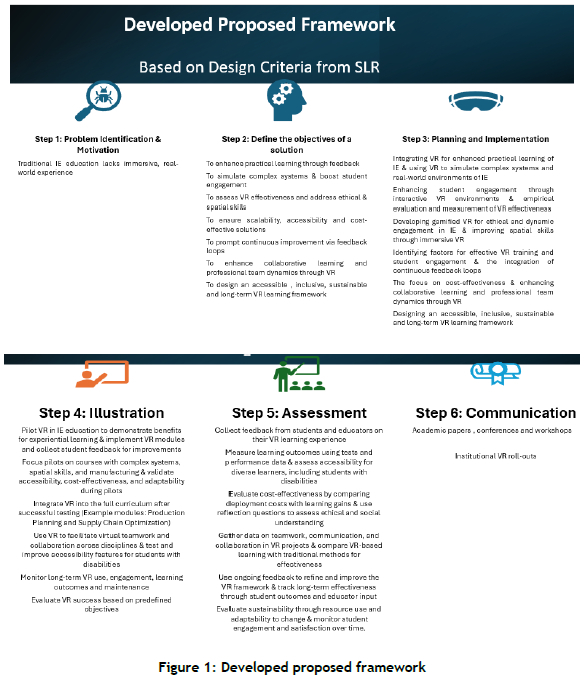
A summary of the proposed framework is illustrated in Figure 1.
4.1.1. Problem identification and motivation - Step 1
There is a significant gap in IE education when it comes to providing practical, hands-on learning experiences. Conventional teaching methods often lack the immersive and interactive elements needed to connect theoretical knowledge effectively with real-world applications[31,35]. To bridge this gap, the proposed framework integrates VR as a tool to improve learning outcomes and to create a more engaging educational experience.
4.1.2. Define the objectives of a solution - Step 2
After identifying the key issue of the lack of practical, hands-on experiences in IE education, along with its root cause in traditional teaching methods that fail to create immersive learning environments, clear objectives for designing the artefact must be established[34]:
Enhancing practical learning: VR provides immersive, hands-on experiences that replicate real-world industrial settings[31,36].
Simulating complex systems: VR enables intricate engineering systems and processes to be modelled and visualised[37,38].
Boosting student engagement: Interactive VR environments promote active participation in learning[39].
Assessing VR effectiveness: Robust evaluation methods are essential to measure VR's impact on learning outcomes[29,40].
Addressing ethical decision-making and spatial skills: Gamified VR environments enhance ethical decision-making and spatial reasoning[41,42].
4.1.3. Design and development - Step 3
The next phase involves designing a framework that addresses the identified challenges and that aligns with the established objectives[34]. The framework consists of the following components:
Enhancing practical learning with VR: VR and virtual experiential learning (VEL) will be integrated to bridge the gap in hands-on learning[43,44]. Immersive VR modules will simulate industrial processes, allowing students to interact with virtual production lines.
Simulating complex systems and real-world environments: VR will replicate intricate engineering systems, such as supply chains and manufacturing processes, offering realistic, dynamic simulations[35].
Boosting student engagement: Interactive VR environments, including virtual labs and collaborative tasks, will promote active participation and deeper learning[31].
Evaluating VR effectiveness: Assessment tools will measure student knowledge, retention, and engagement before and after VR experiences, ensuring measurable learning outcomes[8].
Developing gamified VR for ethics and engagement: Gamification elements such as rewards and decision-making scenarios will enhance ethical education and encourage student involvement[41].
Improving spatial skills: Immersive VR tasks will strengthen spatial reasoning through design challenges and interactive exercises[42].
Optimising VR training: Feedback from students and educators will identify key success factors and barriers, refining VR-based learning experiences[45].
4.1.4. Demonstration - Step 4
The illustration phase demonstrates the framework through pilot studies and real-world applications in IE education, showcasing how VR enhances experiential learning[34]. This involves implementing VR modules, testing them with students, and collecting feedback on their usability and effectiveness[6]. To ensure successful implementation, pilot programmes should be introduced in selected courses, particularly those covering complex systems, spatial skills, and manufacturing processes. Constant refinement through iterative testing and student feedback will improve VR modules. Once proven effective, VR can be fully integrated into the curriculum. Engineering students, especially those in IE, will participate, with evaluation based on the objectives from Step 2.
4.1.5. Evaluation - Step 5
After the illustration step, the framework will be evaluated using three key criteria[34]. First, qualitative feedback from students and educators will provide insights into user engagement and perceived educational value. Next, quantitative metrics, such as performance evaluations and tests, will objectively assess learning outcomes. Finally, comparative studies will analyse the effectiveness of VR-based learning versus traditional methods, measuring its overall impact on education.
4.1.6. Communication - Step 6
The final step involves presenting the framework and findings in academic publications, conferences, and workshops[34]. Case studies and pilot results will be shared with educators, researchers, and practitioners in IE education[6]. Detailed reports and recommendations will guide future VR integration efforts. Collaboration with other institutions will expand VR adoption in engineering education, ensuring constant improvement and broader implementation.
4.2. Evaluation of the proposed framework results
4.2.1. Industrial engineering experts
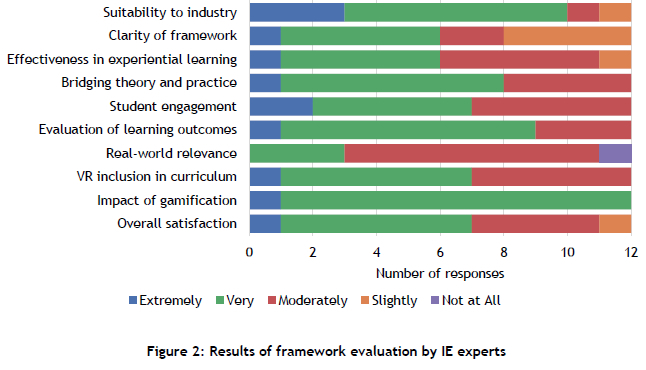
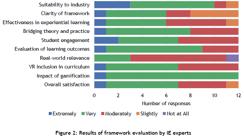
A total of 12 responses were received from experts during the evaluation process. These are pictured in Figure 2. The findings are summarised below the figure.
Suitability to industry
When asked about the suitability of the VR framework in addressing key difficulties in IE education, three of the 12 respondents found it extremely suitable, while seven rated it as very suitable. One respondent found it moderately suitable, and another found it slightly suitable. This suggests that the majority of participants saw strong potential in the framework for bridging the theory-practice gap and enhancing experiential learning.
Clarity of framework
The clarity of the proposed VR framework received mixed feedback. One respondent found it extremely clear, while five rated it as very clear. However, two respondents found it moderately clear, and four rated it as only slightly clear. This indicated a need for better articulation of the framework's structure, possibly with visual aids or step-by-step guidelines to improve comprehension.
Effectiveness in experiential learning
Regarding the effectiveness of VR simulations in improving experiential learning, one respondent rated it as extremely effective, while five found it very effective. Another five respondents rated it as moderately effective, and one found it slightly effective. While the majority saw value in VR for experiential learning, some might have required more concrete evidence or real-world examples to be fully convinced.
Bridging theory and practice
When evaluating how well the framework bridges the gap between theory and practice, one respondent believed that it does so completely, while seven respondents rated it as substantially effective. Four respondents found it to be moderately effective, suggesting that, while most participants saw its value, improvements might be needed to ensure its stronger practical application.
Student engagement
The potential of VR's immersive elements to enhance student engagement received positive feedback. Two respondents rated it as extremely suitable, five as very suitable, and the remaining five as moderately suitable. This reinforced the idea that gamification and interactivity could improve learning outcomes significantly, although refinements in implementation might be necessary.
Evaluation of learning outcomes
Regarding the framework's approach to evaluating learning outcomes through simulations and performance indicators, one respondent found it extremely suitable, eight rated it very suitable, and three found it moderately suitable. The strong positive response indicated confidence in the assessment techniques, although additional validation might be beneficial.
Real-world relevance
The framework's real-world relevance was rated as very effective by eight respondents, while two found it moderately effective and the other two rated it as slightly effective. This suggested that, while the framework is largely aligned with real-world applications, some refinements might be necessary to improve its practical impact.
VR inclusion in curriculum
The practicality of integrating VR into the existing IE curriculum received a mixed response. One respondent found it extremely practical, six rated it as very practical, while five respondents found it moderately practical. The results suggested that, while VR integration is feasible, factors such as cost, accessibility, and implementation strategies would need to be carefully considered.
Impact of gamification
The impact of interactive and gamified VR environments on improving the learning experience was highly rated. One respondent found it extremely impactful, while the other 11 respondents rated it as very impactful. This overwhelming support indicated strong confidence in the use of gamification for learning in IE education.
Additional features suggested
AR integration for a blended learning experience.
A pilot feasibility study on institutional readiness for VR implementation.
A feedback loop for constant improvement to refine the framework over time.
Enhancing realism in simulations to reflect industrial challenges and the human element better.
Overall satisfaction
In relation to overall satisfaction with the framework's design and potential impact, one respondent was extremely satisfied, six were very satisfied, four were moderately satisfied, and one was slightly satisfied. While most respondents were positive about the framework, improvements in clarity, implementation details, and ethical considerations could enhance satisfaction levels.
4.2.2. Industrial engineering students
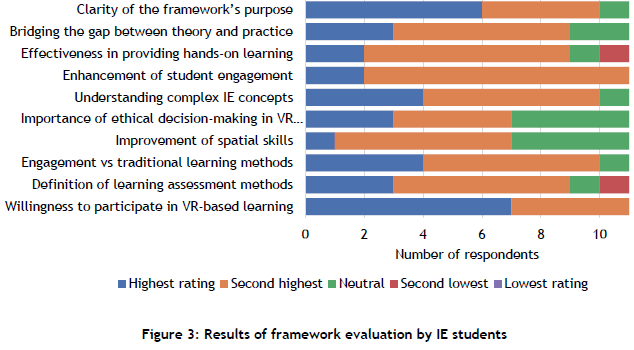
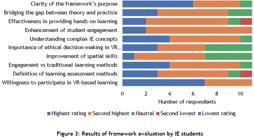
A total of 11 responses were received from students during the evaluation process. The responses are illustrated in Figure 3. The findings are summarised below the figure.
Clarity of the framework's purpose
When asked how clearly they understood the purpose of integrating VR into IE education, six of the 11 respondents found it very clear, while four rated it as moderately clear. Only one respondent rated their understanding as slightly clear. This suggested that, while most respondents grasped the framework's purpose, additional clarification could benefit a small subset of users.
Bridging the gap between theory and practice
The majority of the respondents believed that the framework effectively addresses the gap between theoretical knowledge and practical application. Three of the 11 respondents strongly agreed, and six agreed. However, two respondents remained neutral. These findings indicated that, while the framework was generally well-received, a small portion of participants may have required additional supporting evidence or real-world case studies to appreciate its impact fully.
Effectiveness in providing hands-on learning
When evaluating the effectiveness of the framework in providing hands-on, practical learning experiences through VR, two respondents found it extremely effective, seven rated it very effective, while one respondent rated it moderately effective and one rated it slightly effective. This reinforced the framework's potential for enhancing experiential learning, although refinements may be necessary to address varying learning preferences.
Enhancement of student engagement
The use of VR to improve student engagement was rated highly by the respondents. Two of the 11 respondents strongly agreed, while nine agreed that VR could enhance engagement. This overwhelming support suggested that interactive and immersive learning experiences were well-regarded.
Understanding complex IE concepts
The application of VR to simulate complex IE systems was positively received. Four respondents strongly agreed, while six agreed. Only one respondent was neutral. This indicated that the majority believed that VR has the potential to simplify difficult concepts and to improve comprehension.
Importance of ethical decision-making in VR simulations
The integration of ethical decision-making scenarios into the framework was rated as extremely important by three respondents, very important by four, and moderately important by another four. This indicated a strong recognition of ethical considerations in the learning process, although some respondents might have needed further demonstration of how ethical considerations would be incorporated.
Improvement of spatial skills
The potential of VR to enhance spatial skills (such as spatial reasoning and manipulation) received varied responses. One respondent rated it extremely effective, six rated it very effective, while four rated it as moderately effective. This suggested that, while VR was seen to be beneficial, improvements in the framework might be needed to strengthen its application in spatial learning.
Engagement vs traditional learning methods
When asked whether VR-based learning would be more engaging than traditional IE education methods, four respondents strongly agreed, six agreed, and one remained neutral. The strong positive response reinforced the perception that VR offers a more engaging learning experience than conventional approaches.
-
Definition of learning assessment methods
The respondents were asked whether the framework clearly defined methods for assessing the effectiveness of VR in learning outcomes. Three respondents rated the methods as very well defined, six rated them as adequately defined, while one respondent remained neutral and one more found them somewhat defined. These responses suggested that, while the assessment methods were generally clear, further refinement and explanation could be beneficial.
Willingness to participate in VR-based learning
The likelihood of students participating in VR-based learning if it were implemented was found to be high. Seven respondents stated that they were very likely to participate, while four stated that they were likely. This indicated strong interest and enthusiasm for the use of VR in IE education.
Evaluation and feedback
The responses indicated that nine of the 11 respondents found the assessment methods for VR learning effectiveness to be well or adequately defined. In addition, seven of the respondents indicated that they would be "very likely" to participate in VR-based learning if it were implemented in their courses, thus demonstrating strong interest in adoption.
General feedback
The key strengths that were highlighted included the practical integration of lean and six sigma methodologies, enhanced student engagement, and real-life simulation benefits. Some concerns were about ensuring accessibility and inclusivity, balancing theory and application, and the need for more real-world case studies.
Areas for improvement
The respondents suggested balancing theory and application by incorporating more real-world case studies and simulations; clarifying its methodological application to improve its usability; ensuring accessibility and inclusivity, particularly for students with disabilities; enhancing hands-on practical elements to complement virtual learning; and integrating ethical decision-making scenarios as part of VR simulations.
Additional suggestions
The respondents suggested that virtual collaboration and teamwork be encouraged in VR learning environments, that learning objectives align closely with course goals, that Bloom's taxonomy be integrated to support different cognitive skill levels, and that future research on VR equipment and its applicability in IE education and VR complement hands-on experience rather than replace it.
The feedback suggested that the VR framework was generally well received, with strong support for its potential for engagement and learning. However, improvements in clarity, accessibility, and integration of ethical decision-making would enhance its effectiveness.
5. RECOMMENDATIONS AND CONCLUSION
The development and evaluation of the proposed VR framework for IE education provided valuable insights into its potential to enhance experiential learning, to bridge the gap between theory and practice, and to improve student engagement. The framework was carefully designed using the six-step DSRM, ensuring a structured approach to identifying problems, setting objectives, designing, demonstrating, evaluating, and communicating.
The findings from the expert and student evaluations highlighted strong support for integrating VR into IE education. The experts recognised the framework's effectiveness in simulating complex systems, improving hands-on learning, and fostering student engagement. The majority found the framework to be well suited for addressing key educational challenges, although some did suggest enhancements for clarity and implementation strategies. Similarly, the students responded positively to the framework's potential for improving engagement, understanding complex concepts, and providing immersive learning experiences. However, some concerns were raised about accessibility, inclusivity, and the need for additional real-world case studies to strengthen its practical application.
One of the key strengths of the framework is its ability to integrate gamification and ethical decision-making elements, which received high ratings from both the experts and the students. The use of VR to enhance spatial skills and problem-solving was also acknowledged as a valuable aspect of the framework. In addition, the proposed evaluation mechanisms, such as performance assessments and comparative studies, were well received, with recommendations for further refinement.
Despite its promising potential, several areas for improvement were identified. Enhancing the clarity of the framework's structure, ensuring better articulation of learning objectives, and incorporating more real-world simulations were key recommendations from the feedback. Furthermore, accessibility concerns, particularly for students with disabilities, highlighted the need to consider an inclusive design. A blended approach that combines VR with traditional hands-on experiences was also suggested to maximise the learning benefits.
The proposed VR framework represents a significant step forward in modernising IE education by leveraging immersive technologies to enhance learning outcomes. While the results indicate strong feasibility and effectiveness, ongoing refinements, pilot studies, and collaboration with educational institutions would be essential to optimise its implementation. The limitations of the study include the small sample of experts and students, which may not have fully represented the IE education community. In addition, long-term outcomes were not examined, as the evaluation concentrated on short-term perceptions.
By addressing the identified challenges and incorporating the suggested improvements, the framework should have the potential to transform the way in which IE is taught, making learning more interactive, engaging, and practically relevant for future engineers.
To enhance the effectiveness and implementation of the proposed VR framework for IE education, the following key recommendations are proposed:
1. Refine framework clarity and structure - Improve the articulation of learning objectives, instructional flow, and user guidance to ensure seamless adoption by educators and students.
2. Expand real-world simulations - Incorporate additional industry-based case studies and practical scenarios to strengthen the connection between theoretical learning and real-world applications.
3. Enhance accessibility and inclusivity - Implement design modifications to accommodate students with disabilities, ensuring that VR learning experiences are accessible to all learners.
4. Integrate a blended learning approach - Combine VR with traditional hands-on methods, such as laboratory exercises and physical prototyping, to create a more comprehensive learning experience.
5. Optimise gamification and ethical learning elements - Develop gamified learning mechanics and ethical decision-making simulations to reinforce engagement and critical thinking.
6. Conduct pilot studies and longitudinal assessments - Implement controlled studies to measure the long-term impact of VR on student performance, cognitive skill development, and industry readiness.
7. Develop cost-effective implementation strategies - Explore scalable, budget-friendly VR solutions, such as open-source platforms and industry collaborations, to ensure sustainable integration in educational institutions.
8. Strengthen evaluation mechanisms - Refine assessment tools to measure VR's effectiveness, incorporating both qualitative and quantitative metrics for constant improvement.
By addressing these areas, the proposed VR framework could be optimised to transform IE education, providing students with a dynamic and immersive learning environment that bridges the gap between theory and practice.
REFERENCES
2. LITERATURE REVIEW
- [1] Abulrub, A.H.G., Attridge, A., Williams, M.A., 2011. Virtual reality in engineering education: The future of creative learning, International Journal of Emerging Technologies in Learning (iJET), 6(4), pp 4-11.
- [2] Kim, J., Kim, K.S., Ka, J., Kim, W., 2023. Teaching methodology for understanding virtual reality and application development in engineering major, Sustainability, 15(3), 2725.
- [3] Soliman, M., Pesyridis, A., Dalaymani-Zad, D., Gronfula, M., Kourmpetis, M., 2021. The application of virtual reality in engineering education, Applied Sciences, 11(6), 2879.
- [4] Franchi, J., 1995. Virtual reality: An overview, ERIC Clearinghouse on Information and Technology, ERIC Digest ED386178, pp 1-6.
- [5] Au, E.H., Lee, J.J., 2017. Virtual reality in education: A tool for learning in the experience age, International Journal of Innovation in Education, 4(4), pp 215-226.
- [6] Henrich, A., Schultze, T., 2022. Work in progress: Do students benefit from using VR as a tool in engineering exercises? EDUNINE 2022 - 6th IEEE World Engineering Education Conference: Rethinking Engineering Education after COVID-19: A Path to the New Normal, pp 1-4.
- [7] Balzerkiewitz, H.P., Schade, N., Stechert, C., 2022. Evaluation of the learning effect of VR on engineering education: Case study in machine elements, 2022 IEEE International Conference on Industrial Engineering and Engineering Management, pp 1252-1256.
- [8] Hee Lee, J., Shvetsova, O.A., 2019. The impact of VR application on student's competency development: A comparative study of regular and VR engineering classes with similar competency scopes, Sustainability, 11(8), 2221.
- [9] Fairén, M., Moyés, J., Insa, E., 2020. VR4Health: Personalized teaching and learning anatomy using VR, Journal of Medical Systems, 44(5), 94.
- [10] Marks, B., Thomas, J., 2022. Adoption of virtual reality technology in higher education: An evaluation of five teaching semesters in a purpose-designed laboratory, Education and Information Technologies, 27(1), pp 1287-1305.
- [11] Motejlek, J., Alpay, E., 2019. A taxonomy for virtual and augmented reality in education, Proceedings of the 46th SEFI Annual Conference 2018: Creativity, Innovation and Entrepreneurship for Engineering Education Excellence, pp 1089-1100.
- [12] Christou, C., 2015. Virtual reality in education, In Tzanavari, A. and Tsapatsoulis, N. (Eds.), In Affective, interactive and cognitive methods for e-learning design: Creating an optimal education experience. IGI Global, pp 228-243.
- [13] Farsi, G.A., Yusof, A.B.M., Fauzi, W.J., Rusli, M.E., Malik, S.I., Tawafak, R.M., Marhew, R., Jabbar, J., 2021. The practicality of virtual reality applications in education: Limitations and recommendations, Journal of Natural Sciences, 48(7), pp 142-155.
- [14] Sharma, M., Kumar, P., Singh, D.K., 2023. The role of virtual reality in education: A comprehensive review of research and application, 2023 1st DMIHER International Conference on Artificial Intelligence in Education and Industry 4.0, IDICAIEI, pp 1-6.
- [15] Li, X., Liu, D., Sun, J., Zhu, Z., 2022. Challenges of industrial engineering in big data environment and its new directions on extension intelligence, Procedia Computer Science, 214(C), pp 1561-1567.
- [16] McGovern, E., Moreira, G., Luna-Nevarez, C., 2020. An application of virtual reality in education: Can this technology enhance the quality of students' learning experience? Journal of Education for Business, 95(7), pp 490-496.
- [17] Han, Y., 2023. Virtual reality in engineering education, SHS Web of Conferences, 157, 02001.
- [18] Dettori, G., 2015. Review of "Critical perspectives on technology and education", British Journal of Educational Technology, 47(1), E3.
- [19] Shahid, M.A., Rahman, M., Ahmed, F., 2022. Challenges in engineering education: A review, Proceedings of the 5th International Conference on Industrial & Mechanical Engineering and Operations Management, pp 1-7.
- [20] Chacko, T., 2014. Moving toward competency-based education: Challenges and the way forward, Archives of Medicine and Health Sciences, 2(2), pp 247-253.
- [21] Henri, M., Johnson, M.D., Nepal, B., 2017. A review of competency-based learning: Tools, assessments, and recommendations, Journal of Engineering Education, 106(4), pp 607-638.
- [22] Van den Beemt, A., MacLeod, M., Van der Veen, J., Van de Ven, A., Van Baalen, S., Klaassen, R., Boon, M., 2020. Interdisciplinary engineering education: A review of vision, teaching, and support, Journal of Engineering Education, 109(3), pp 508-555.
- [23] Kolmos, A., Holgaard, J.E., Routhe, H.W., Winther, M., Bertel, L., 2024. Interdisciplinary project types in engineering education, European Journal of Engineering Education, 49(2), pp 257-282.
- [24] Prince, M., 2004. Does active learning work? A review of the research, Journal of Engineering Education, 93(3), pp 223-231.
- [25] Vries, P., Klaassen, R., Ceulemans, D., Ioannides, M., 2018. Emerging technologies in engineering education: Do we need them and can we make them work? Centre for Engineering Education. DOI: 10.13140/RG.2.2.16595.84008
- [26] Brown, C., Davis, M., 2020. Traditional teaching techniques vs virtual reality: A comparative analysis in industrial engineering education, Journal of Engineering Education Research, 28(4), pp 210-230.
- [27] Johnson, R., Williams, L., 2019. Exploring the impact of virtual reality on industrial engineering education, International Journal of Engineering Education, 36(2), pp 78-95.
- [28] Petkov, T., Mitkova, M., Surchev, S., Popov, S., Todorov, M., Sotirova, E., Sotirov, S., Bozov, H., Minkov, M., Tankov, I., 2019. An application of virtual reality technology in education, 2019 29th Annual Conference of the European Association for Education in Electrical and Information Engineering (EAEEIE).
- [29] Di Lanzo, J.A., Valentine, A., Sohel, F., Yapp, A.Y.T., Muparadzi, K.C., Abdelmalek, M., 2020. A review of the uses of virtual reality in engineering education, Computer Applications in Engineering Education, 28(3), pp 748-763.
- [30] Ruiz-Cantisani, M.I., Lima-Sagui, F.D.C., Aceves-Campos, N., Ipina-Sifuentes, R., Flores, E.G.R., 2020. Virtual reality as a tool for active learning and student engagement: Industrial engineering experience, IEEE Global Engineering Education Conference, EDUCON, vol. 2020 (April), pp 1031-1037.
- [31] Jindal, R., Mittal, S.K., Bansal, A., 2023. Engineering education and the use of virtual reality: Idea and possibility, 2023 2nd Edition of IEEE Delhi Section Flagship Conference (DELCON), pp 1-7.
- [32] Oje, A.V., Hunsu, N.J., May, D., 2023. Virtual reality assisted engineering education: A multimedia learning perspective, Computers & Education: X Reality, 3, 100033.
- [33] Ralph, P., Wand, Y., 2009. A proposal for a formal definition of the design concept, Open Journal Systems, 14, pp 103-136.
- [34] Peffers, K., Tuunanen, T., Rothenberger, M.A., Chatterjee, S., 2008. A design science research methodology for information systems research, Journal of Management Information Systems, 24(3), pp 45-77.
- [35] Han, B., Weeks, D.J., Leite, F., 2023. Virtual reality-facilitated engineering education: A case study on sustainable systems knowledge, Computer Applications in Engineering Education, 31(5), pp 1174-1189.
- [36] Jalil, J.M.N., Bazua, A.C., Herran, L.C.F., Castillo, F.I.G., Katase, D.O., Valenzuela, O.A.G., 2022. The virtual reality as a flexible resource to improve engineering education, IEEE Global Engineering Education Conference EDUCON, pp 579-585.
- [37] Mahmood, K., Otto, T., Kuts, V., Terkaj, W., Modoni, G., Urgo, M., Colombo, G., Haidegger, G., Kovacs, P., Stahre, J., 2021. Advancement in production engineering education through virtual learning factory toolkit concept, Proceedings of the Estonian Academy of Sciences, 70(4), pp 374-382.
- [38] Rodriguez-Salvador, M., Algarra-Chavez, M.F., 2023. Using virtual reality to facilitate teaching-learning of technology innovation systems, Proceedings of the 2023 7th International Conference on Education and E-Learning, pp 54-58.
- [39] Gonzalez Almaguer, C.A., Aguirre Acosta, A.C., Perez Murueta, P.O., 2021. Gamification and simulation: Distance education for industrial engineering students, Future of Educational Innovation Workshop Series - Machine Learning-Driven Digital Technologies for Educational Innovation Workshop, Institute of Electrical and Electronics Engineers (IEEE), pp 1-7.
- [40] Lopez, C.E., Ashour, O., Cunningham, J.D., Tucker, C., 2021. A study on the effectiveness of the CLICK approach in an operations research course, ASEE Annual Conference and Exposition, Conference Proceedings.
- [41] Al Zahrani, M., Fawzy, M., 2020. Engineering education gaming: Case study of engineering ethics game modeling, 2020 Industrial and Systems Engineering Conference, ISEC 2020, pp 1-5.
- [42] Conesa, J., Mula, F.J., Bartlett, K.A., Naya, F., Contero, M., 2023. The influence of immersive and collaborative virtual environments in improving spatial skills, Applied Sciences (Switzerland), 13(14), 8426, pp 1-17.
- [43] Vaz de Carvalho, C., 2019. Virtual experiential learning in engineering education, Proceedings - Frontiers in Education Conference, FIE 2019-Octob, pp 1-8.
- [44] Krajčovič, M., Gabajová, G., Matys, M., Furmannová, B., Dulina, Ľ., 2022. Virtual reality as an immersive teaching aid to enhance the connection between education and practice, Sustainability, 14(15), 9580.
- [45] Kwok, A.P.K., Yan, M., Deng, X.H., Chen, X.Y., Huang, Y.T., 2022. Exploring the facilitating and obstructing factors of using virtual reality for 5S training: An exploratory qualitative study from students' perspectives in an industrial engineering undergraduate course, Computer Applications in Engineering Education, 30(4), pp 1072-1085.
Accepted for publication 2 Dec 2025
Available online 22 May 2026
ORCID® identifiers
T. Ramashitja: https://orcid.org/0009-0000-5758-2900
K.R. Ramdass: https://orcid.org/0000-0001-5480-3368
P.M. Gouws: https://orcid.org/0000-0001-9820-8544
N. Ndou: https://orcid.org/0000-0002-2092-6885