Interpretive Maintenance Quality Function Deployment: A New Model for Production in SMEs
Abstract
Small and medium enterprises (SMEs) play a crucial role in the economic development of developing countries. To remain competitive with larger organisations, SMEs must produce high-quality products at competitive prices. To improve product quality, overall equipment effectiveness (OEE), and profitability, SMEs need to optimise the use of their resources. However, the current production strategies used by this sector are insufficient to meet these objectives. In this context, developing and implementing a new strategy to improve quality, productivity, and OEE in SMEs is essential. This paper presents an innovative model, called 'interpretive maintenance quality function deployment' (IMQFD), that is aimed at enhancing these key parameters and supporting the growth of the SME sector in the midst of the ongoing industrial revolution.
Abstract
Klein en medium ondernemings (KMOs) speel 'n deurslaggewende rol in die ekonomiese ontwikkeling van ontwikkelende lande. Om mededingend met groter organisasies te bly, moet KMOs produkte van hoë gehalte teen mededingende pryse produseer. Om produkkwaliteit, algehele toerustingdoeltreffendheid (OEE), en winsgewendheid te verbeter, moet KMOs die gebruik van hul hulpbronne optimeer. Die huidige produksiestrategieë wat deur hierdie sektor aangewend word, is egter onvoldoende om hierdie doelwitte te bereik. In hierdie konteks is die ontwikkeling en implementering van 'n nuwe strategie om kwaliteit, produktiwiteit, en OEE binne KMOs te verbeter noodsaaklik. Hierdie artikel bied 'n innoverende model, genaamd 'Interpreterende instandhoudingskwaliteit-funksie-ontplooiing' (IMQFD), wat daarop gemik is om hierdie sleutelparameters te verbeter en die groei van die KMO-sektor te ondersteun te midde van die voortslepende industriële revolusie.
1. INTRODUCTION
India is regarded as one of the fast-growing economies in the world. Small and medium enterprises (SMEs) play a pivotal role in its economic development. As a result of globalisation, the competition from local and global players is increased; and so SMEs have to improve the quality of their products or services. However, the inefficiency and crawling nature of production in this sector reduces its actual impact on the economy. Customers demand quality products at comparatively low prices. This demand is forcing industries to adopt different strategies in their production lines. Different models and production techniques are proposed in the literature, and studies on the implementation of some of these models are also reported. Total quality management (TQM) and total productive maintenance (TPM) are some that Indian industries use. There are different examples of research that integrates two or more conventional production techniques to gain the advantages of each [1],[2]. A study by Sahooa and Yadav (2020) [3] pointed out that the integration of TQM and TPM could enhance the production and quality of products.
Most of these studies have focused on the large-scale sector, while the effective implementation of such a strategy in the SME sector has not been widely reported. Even though SMEs play a vital role in a country's total production, they are unaware of the positive aspects of integrating production techniques [4]. The study also pointed out that unavailability of total production area, a lack of initial investment, and the non-interest of the managers in adopting new strategies are some major reasons behind this.
In order to overcome these inherent deficiencies in the SME sector, systematic approaches need to be developed. In this study, a new model, 'interpretive maintenance quality function deployment' (IMQFD), is proposed that could improve the quality of SMEs' products. This model integrates two existing models, the interpretive structural model (ISM) [5], [6] and maintenance quality function deployment (MQFD) [2]. The combined model could yield more accurate results in identifying the critical factors associated with the production process, and help the management to make appropriate decisions in overcoming the problems related to those factors.
SMEs play a major role in enhancing the wealth of societies. In an era of globalisation, organisations can operate across geographical borders. Large organisations could perform better by outsourcing their operations to SMEs, which could reduce the cost of their operations [7]. In the Indian context, the SME sector is the second-largest job provider [8], and makes a major contribution to gross domestic product, increasing its share from 8% to 30% during the past decade [9]. However, the situation needs to be improved. The arrival of sub-contracted work from large enterprises to SMEs shines a new light in SMEs' production and economic growth. They have the ability to adopt innovations owing to their organisational structures and flexibility, the availability of technically skilled workers, and the expertise of the owners [7]. Yet SMEs are found to suffer many deficiencies that prevent them from competing globally along with large organisations [10]-[11]. Adequate financial assistance is required for the smooth running of these industries. They also face other difficulties such as improvements to existing products, a lack of market research, improper inventory management [12], and inadequate performance in maintenance. In this context, different studies of SMEs have been carried out to overcome such deficiencies. The implementation of the lean manufacturing process (LMP) [13] revealed that it could influence the economic, environmental, and social performance of SMEs. The cost associated value stream mapping tool proposed by Menon et al. (2020, 2021) [14]-[15] is an example of the implementation of the lean manufacturing tool in SMEs that could reduce the total time and cost of production. The integration of LMP and TPM could also improve the productivity of the industry [16].
Another finding during this literature review was that SMEs are defined differently in various economies, based on different factors such as the number of employees, their annual turnover, and their initial investment [17]. SMEs in India are known as 'micro small medium enterprises' (MSMEs) in line with the Micro, Small and Medium Enterprises Development Act of 2005. According to the categorisation that was implemented from 1 July 2020, the definition of organisations under the category of MSMEs is based on their initial investment and their annual turnover. Micro enterprises invest up to Rupees 10 million with a turnover below Rupees 50 million; small enterprises invest up to Rupees 100 million with a turnover of less than Rupees 500 million; and medium enterprises invest up to Rupees 500 million with a turnover below Rupees 2.5 billion. The quality of a product is one of the major aspects in SMEs that could enhance the goodwill that organisations enjoy, and could gain the trust of their customers [18]. In an era of globalisation, customers have the right to demand products of improved quality, and organisations have to deliver good quality products at a reasonable price. The quality of a finished product is influenced by different factors [19] that include production planning, processes, and scheduling. Thus, it is highly important to maintain a defined process line, a predetermined production schedule, and regular quality checks. In such a context, the in-line quality check yields significant acceptance, and also reduces the wasting of materials [18]. Many studies have been carried out on efficient and effective in-line quality checks using industrial robots, and thereby ensuring zero defect manufacturing (ZDM) [20]. ZDM is a key concept in manufacturing. Human-centric ZDM attains signficant improvements in production. However, the practicality of these methods is difficult owing to the resistance of human operators to the changes that occur in their production line [21]. Tools such as Poka-yoke could be used in such situations to prevent or correct the mistakes made by the human operators, and would help to fix problems at the outset [22]. Another tool, such as six-sigma, would also lead to zero defects in products and so improve the quality of products [23]-[24]. Synergising Poka-yoke with six-sigma tools would result in close to zero mistakes in production.
While considering the quality of a manufactured product, it is important to list the key factors that reduce the quality of the product. Quality function deployment (QFD) is one tool to find the major factors that affect product quality. This tool was developed in Japan in the late 1960s. While using this tool, it would be helpful to convert the customer's voice into their language and then into technical languages. The identification of prioritised technical languages based on the customer language would help the management to make strategic decisions about the production line in order to improve the overall output of the product [25]. The unquenchable thirst of customers for quality products should lead researchers to identify new ideas for production. The synergising effect of QFD with benchmarking showed a drastic change in companies' production rate, reducing the total cost of production and so improving their profits [26]. The tactical blending of TQM with QFD resulted in a new model called total quality function deployment (TQFD) [27], with which the quality issues with the product are identified from both internal and external customers, and then converted to suitable technical languages with the help of TQFD. This model's appropriate suggestions about production should have a great impact on product quality. In order to prioritise the technical languages in QFD, the combined use of QFD with fuzzy logic has been reported, in which the effective ranking of technical languages is possible instead of the conventional ranking methods [28]. From the literature it is evident that QFD is an effective tool to meet customers' requirements by converting their different languages into technical requirements.
The proper maintenance of equipment is also an important factor to reduce defects and thereby to improve the quality of products [29]. It helps to stabilise manufacturing and to improve the performance of the entire system. Various techniques such as predictive maintenance can identify the life of each machine tool and help with the planning of maintenance activities. Maintenance and quality are two sides of the same coin: without the presence of either, the existence of the entire organisation could be in trouble. Improper maintenance activities lead to the malfunctioning of machine tools and thus to defective products [30]. TPM is a powerful method in the manufacturing sector to reduce the malfunctioning of machine tools. It uses the synergy of conventional maintenance engineering principles and TQM concepts [31], and plays a dominant role in the quality of a product. According to TPM, every person working in the organisation has a responsibility to do the overall maintenance of machine tools, quite apart from the organisation's maintenance team. If the maintenance work goes well, that reduces the total downtime of machinery, improves the overall effectiveness of equipment, and improves productivity. It also results in good-quality products with zero defects and needing zero maintenance [32]. OEE is the soul of TPM outputs, which is the product of the availability, performance efficiency, and quality rate of the machine tools [33]. If an organisation can achieve improvements in all these areas, it would make the implementation of TPM truly worthwhile for industries. However, slow managerial decision-making about the different conditions in organisations holds them back from the implementation of such practices. This is a major problem in SMEs. Atna and Alitu (2015) [34] showed that finding an easier and more effective method for TPM implementation would solve these difficulties. If an organisation could successfully apply the pillars of TPM, that would definitely improve their productivity and the quality of their products - and the enterprise's OEE. Therefore, every individual in the organisation should accept it as their responsibility.
As the literature points out, QFD has enormous benefits in manufacturing, and TPM plays a vital role in maintenance. The synergising effect of both could enhance the production system, improve the quality of products, increase profits, and add to goodwill towards the organisation. This has led to the birth of a new model, MQFD [2], in which the authors tactically coupled the TPM and QFD techniques. This is a significant leap ahead for production industries [35]. At the same time, this model is effective in the service sector, which includes banking and education [35]. Further studies were carried out with this model by combining MQFD with the analytic hierarchy process (AHP) technique [36], and calling the combination analytic maintenance quality function deployment (AMQFD), in which the strategic decisions given to the different TPM pillars are prioritised by AHP. However, allocating weightages to the critical factors of a production system was difficult when using this model. This was rectified by incorporating the fuzzy-based AHP model into AMQFD [37]. This study prioritised the customer's language, and thereby was able to rank the technical descriptors in MQFD, which in turn helped with the successful implementation of MQFD in industries [38]. Compared with the fuzzy-rough-set approach, the ISM methodology invented in 1973 is an easy-to-understand alternative for prioritising the customer language, in which the interrelationship and driving-dependency power of each factor in a complex production system can be easily identified without many calculations. At present, many researchers use the ISM methodology to find the interrelationships between their study elements. This methodology has a high success rate in MSMEs too. Studies have been carried out using ISM in steel manufacturing SMEs to find the interrelationships between the innovation enablers [5]. The identification of the interrelationships of possible obstacles in the remanufacturing sectors in India [39] and of the interrelationships of the cusp factors that help to implement the practice of social sustainability in the manufacturing sectors [40] are some examples of ISM implementation.
Various studies have been found in the literature that incorporate strategic management principles in organisations in order to achieve a higher degree of quality in operational performance. However, a model that integrates the ISM methodology with the MQFD has not been found in the literature. This has opened the way to a more intensive study of the incorporation of ISM with MQFD and the development of the new model, IMQFD.
3. CHARACTERISTICS OF IMQFD MODEL
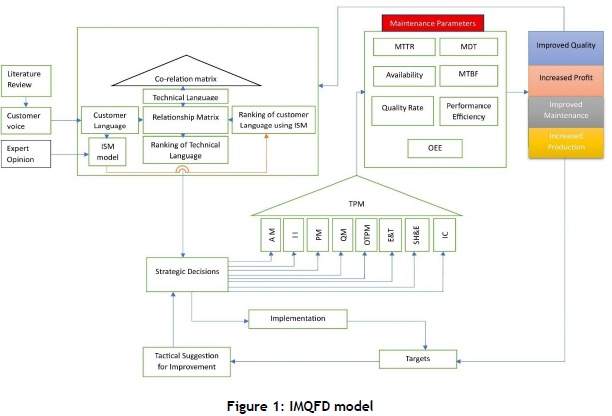
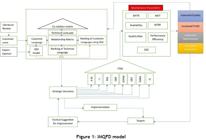
The strategic approach of the IMQFD model originates in establishing the mission of improving quality, productivity, and OEE in SMEs. The conceptual principles of the IMQFD model are shown in Figure 1. The model progresses through five phases. The tasks to be carried out in each phase are briefly described below.
3.1.
First phase of IMQFDThe IMQFD model gives much attention to the customer's voice. The implementation of this model begins with the selection of an appropriate SME. A suitable product is also identified at this stage. A detailed literature review could reveal the factors affecting the quality of this product. After identifying the factors, they would need to be validated by using a field survey, which could be accomplished by preparing a questionnaire based on the identified factors. Feedback from customers could also be analysed to sort out the most important parameters, called 'customer languages' (CLs).
3.2.
Second phase of IMQFDThis phase plays a key role in this model, in which the prioritisation of CLs is carried out using the ISM. Through the literature review it was found that the ISM is an appropriate tool for finding the interrelationships of the CLs and so helping to prioritise the CLs. It could be performed by creating another questionnaire that leads to the identification of the interdependencies of the CLs. This stage is performed with the help of experts from industry and academia. The diagraph obtained from the ISM shows the interdependencies of the CLs, and ranks all the driving CLs to dependent CLs from 'n' to 1, where 'n' represents the number of level partitionings in the ISM methodology. The rank of the CLs is the same if they are in the same level. The ranking of the CLs helps to obtain the customer technical interactive score (CTIS) in the next phase.
3.3.
Third phase of IMQFDThe main focus in this phase is to find out the most important technical requirements (TRs) as a solution to rectifying the identified CLs. This can be done by the formation of a 'house of quality' (HoQ). By conducting an effective discussion with an expert in SMEs, the necessary TRs can be listed. Using the correlation matrices in the HoQ and the identified ranks together with the ISM would help to identify the CTIS and the correlated weightage of the technical language. The percentage normalised value of both would help to identify the most important TRs, which would need much attention to rectify the customers' concerns. This has to be reported in the managerial section; and managers would need to be educated about the importance of this new model in rectifying customers' concerns. Detailing the implementation benefits for the organisation could also be shared in this phase.
3.4.
Fourth phase of IMQFDThe implementation of the most important TRs through the TPM pillars is the next step in this model. For this purpose, an IMQFD team needs to be formed in the organisation that consists of at least one management person, an IMQFD expert, a quality supervisor, and the machine tool operators. The primary aim of the team is to set a target for production outputs. It is important that the team create awareness among the members of the organisation. The IMQFD expert has to explain to and convince the team about the strategic decisions that need to be implemented in the organisation, and how they could be carried out with the help of TPM. The consent and support of the management would be vital for the implementation.
3.5.
Fifth phase of IMQFDThe role of this model is to ensure zero defects and zero breakdowns, and thereby to improve quality, productivity, and OEE. After the effective implementation of all the relevant recommendations formulated by the IMQFD team, the variations in the maintenance parameters such as mean time between failure (MTBF), mean down time (MDT), availability, mean time to repair (MTTR), performance analysis, rate of quality, and OEE would need to be analysed and computed. The maintenance parameters can vary according to the SMEs involved. If the OEE value does not occur within the internationally accepted range, then phase four would need to be repeated by updating the strategic decisions on the TPM pillars until the required value is obtained. An improvement in the rate of quality would lead to the quality and productivity of the product. If these outputs were not up to the defined target, the IMQFD team would have to analyse the issues and suggest tactical advice for the TPM pillars.
The process in IMQFD is continuous in nature, and the process moves forwards until the set targets achieve their optimum levels. After the effective implementation of the IMQFD model, these parameters would definitely show a remarkable improvement over the conventional production process. Each year, the IMQFD team should raise the organisation's targets, and should make decisions accordingly. In this way the decline of SMEs could be reduced and the quality of products, productivity, and OEE in those organisations be improved.
4. IMPLEMENTATION OF IMQFD MODEL
In order to validate the model, a plywood manufacturing SME was chosen. Plywood is a highly versatile product, and it played a crucial role in rapid construction in the Covid-19 pandemic. A thorough literature review revealed 16 factors affecting the quality of plywood. A detailed questionnaire was prepared, based on these factors. After the validation of the questionnaire using Cronbach's alpha, data was collected from 30 customers, which confirmed that the major problems were with quality.
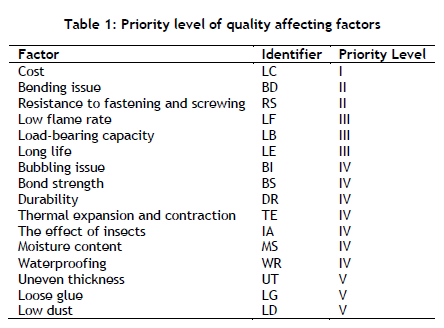
Consequently, the ISM methodology was used to prioritise and rank these factors, based on their interdependencies and driving capacity. The factor mentioned as compromising the cost of plywood was high driving power. The factor of 'cost' was categorised in priority level 1. The remaining 15 factors were similarly prioritised using the ISM methodology into levels 2 to 5. The other elements in the same priority level were also considered to have the same rank. The detailed output of the ISM methodology is described below in Table 1.
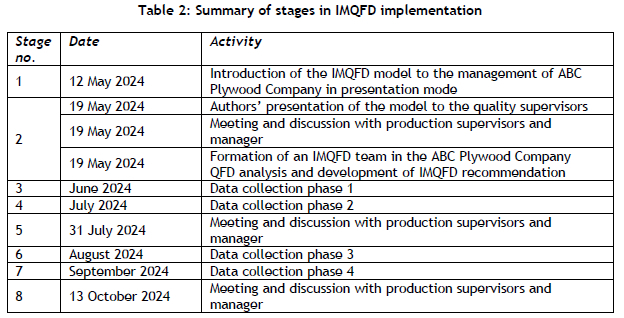
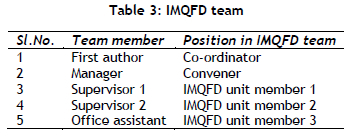
To validate the model, a reputable SME in the plywood manufacturing sector, located in the Ernakulam district of Kerala State in India, was approached. The organisation is identified in this article simply as 'ABC Plywood Company'. The entire implementation process was carried out in eight stages. A summary of the implementation is given in Table 2, and the team formed to implement IMQFD in the company is listed in Table 3.
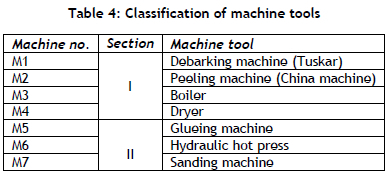
After the completion of stages 1 and 2, the IMQFD team identified the machines for the study. Seven machines were considered for the implementation of the model owing to their high level of influence in the production process. The details of the machines are given in Table 4.
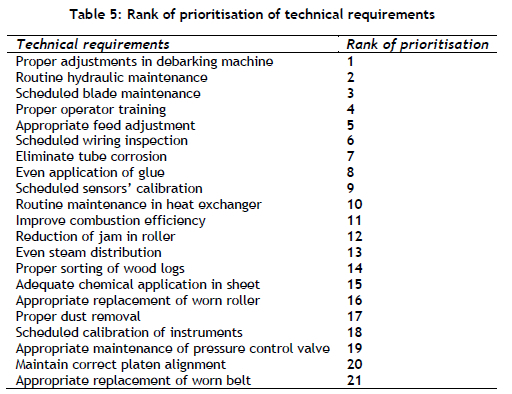
During the later stages, a QFD analysis was done, based on the ISM outputs, in order to prioritise the TRs of these machines. The prioritised TRs are listed in Table 5. Strategic decisions were taken about the implementation of the model, and these were recorded.
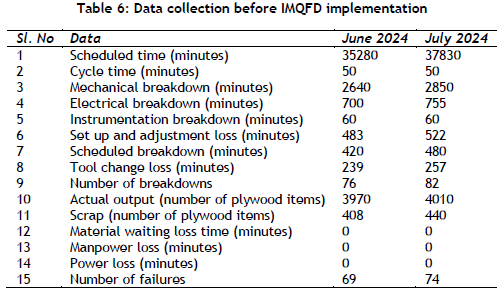
Stages 3 and 4 were carried out in June and July 2024. Data required to compute the maintenance parameters of the seven machines in this period was identified. Machine tools M1, M2, and M7 operated 12 hours daily, while M3-M6 operated for 24 hours. All data was recorded, as detailed in Table 6.
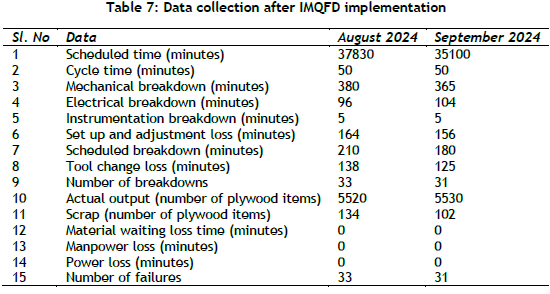
After the identification of the maintenance parameter during June and July, it was found that the performance efficiency, quality rate, and OEE of the machines in the company could not cope with international standards [41]. Thus, the new model was implemented, based on the identified recommendations and the data collected for August and September 2024, as shown in Table 7.
5. RESULTS AND DISCUSSION
5.1. Mean down time
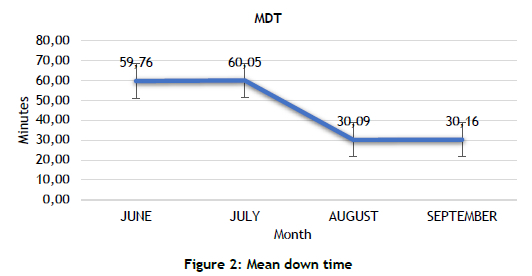
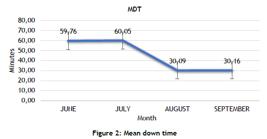
The average number of breakdowns for the machines was reduced from 70 to 30 after the implementation of the IMQFD model. The MDT values were also reduced from 60 minutes to 30 minutes.
5.2. Mean time between failures
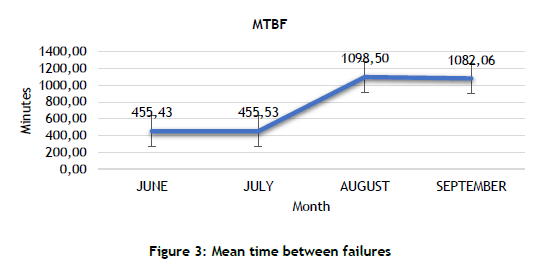
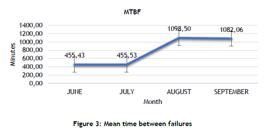
Through the implementation of the TPM pillars with the IMQFD recommendations, the company successfully reduced the number of failures that occurred in its machines. The average working time for the machines between the successive failures was calculated to be 455 minutes in the months of June and July. The implementation of the IMQFD model reduced the working time of the machines, on average, to 1098.5 minutes in August and 1082 minutes in September.
5.3. Mean time taken to repair
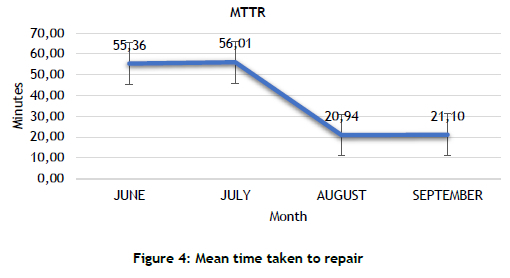
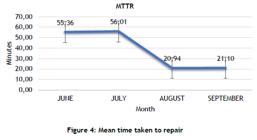
The MTTR values in the months of June and July were 55 and 56 minutes respectively, which decreased sharply to an average of 21 minutes in the two months following the implementation of IMQFD.
5.4. Availability
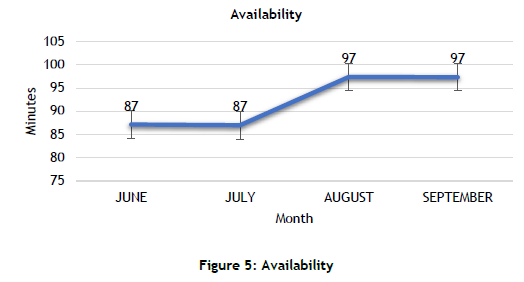
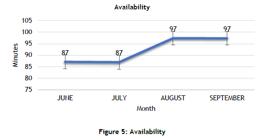
Before the implementation of IMQFD, the percentage availability of the machines was less than 87 per cent; this improved to 97 per cent in the two months following implementation.
5.5. Performance efficiency
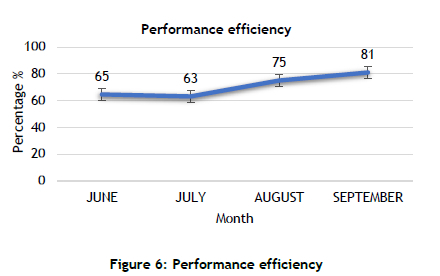
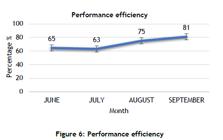
The machines' performance efficiency was unstable, and was less than 66 per cent. However, the implementation of IMQFD helped the company to attain maximum efficiency from its machines, and its values increased in the two months that followed. By the end of September the industry was able to achieve a performance efficiency of 81 per cent.
5.6. Rate of quality
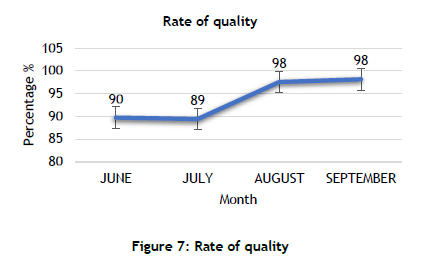
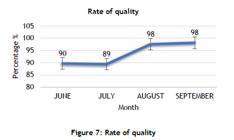
One of the primary objectives of the model was to improve the quality of the products without any additional investment in the company. The implementation of the IMQFD model helped the ABC Plywood Company to achieve a greater number of quality products and to reduce the number of defective products. The values are shown in Figure 7.
5.7. Overall equipment effectiveness
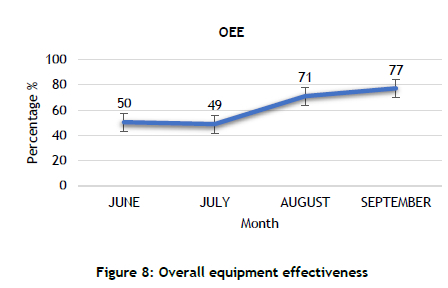
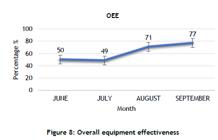
The plywood company is trailing behind the global average of an OEE value of 85 per cent [41]. However, the implementation of the IMQFD model could effectively enhance its performance efficiency and the availability of machines, and could improve the rate of quality of the plywood. The model was shown to have improved the OEE of the company, reaching a value of 77 per cent in September 2024.
6. CONCLUSION AND FUTURE WORK
SMEs play a significant role in the Indian economy. However, the quality of products, productivity, and OEE are caught in a bottleneck. Present-day consumers are highly quality conscious, and the market is consumer driven. To keep pace with consumer demand, SMEs are striving to produce high-quality products at the most competitive prices. In order to help them to bridge the gap, a new model, IMQFD, was proposed that could enhance product quality, productivity, and OEE in SMEs. The model was implemented and validated for a period of four months in a plywood manufacturing SME in India. The OEE value showed a significant increase from 49 per cent to 77 per cent during that period. Effective implementation was also able to reduce the number of defective products and to improve the rate of quality to 98 per cent. The MDT and MTTR were reduced with the help of the strategic recommendations made by the IMQFD team. The MTBF, the availability of machines, and their performance efficiency underwent a remarkable change after the implementation of the IMQFD model in the SME. This study has shown that the implementation of the IMQFD model would be a better alternative for SMEs wishing to achieve improved profits, greater core competence, and goodwill in society.
REFERENCES
2. LITERATURE REVIEW
-
[1] Musthopa, Harsanto, B., & Yunani, A. 2023. 'Electric power distribution maintenance model for industrial customers: Total productive maintenance (TPM), reliability-centered maintenance (RCM), and four-discipline execution (4DX) approach', Energy Reports, 10, pp 3186-3196. doi: 10.1016/j.egyr.2023.09.129
» https://doi.org/10.1016/j.egyr.2023.09.129 -
[2] Pramod, V.R., Devadasan, S.R., Muthu, S., Jagathyraj, V.P., & Moorthy, G.D. 2006. 'Integrating TPM and QFD for improving quality in maintenance engineering', Journal of Quality in Maintenance Engineering, 12(2), pp 150-171. doi: 10.1108/13552510610667174
» https://doi.org/10.1108/13552510610667174 -
[3] Sahoo, S., & Yadav, S. 2020. 'Influences of TPM and TQM practices on performance of engineering product and component manufacturers', Procedia Manufacturing, 43, pp 728-735. doi: 10.1016/j.promfg.2020.02.111
» https://doi.org/10.1016/j.promfg.2020.02.111 -
[4] McDermott, O., Nelson, S., Antony, J., & Sony, M. 2023. 'Industry 4.0 readiness in west of Ireland small and medium and micro enterprises: An exploratory study', Quality Management Journal, 30(2), pp 105-120. doi: 10.1080/10686967.2171325
» https://doi.org/10.1080/10686967.2171325 -
[5] Kiron, K.R., & Kannan, K. 2018. 'Innovation capability for sustainable development of SMEs: An interpretive structural modelling methodology for analysing the interactions among factors', International Journal of Business Innovation and Research, 15(4), pp 514-535. doi:10.1504/IJBIR.2018.090467
» https://doi.org/10.1504/IJBIR.2018.090467 -
[6] Kota, S., Mishra, R.P., Krishna Jasti, N.V., & Kale, S. 2021. 'Sustainable production system critical success factors: An interpretive structural modelling approach', Procedia CIRP, 98, pp 324-329. doi: 10.1016/j. procir.2021.01.111
» https://doi.org/10.1016/j. procir.2021.01.111 -
[7] Sudhir Kumar, R. & Bala Subrahmanya, M.H. 2010. 'Influence of subcontracting on innovation and economic performance of SMEs in Indian automobile industry', Technovation, 30(11 -12), pp 558-569. doi: 10.1016/j.technovation.2010.06.005
» https://doi.org/10.1016/j.technovation.2010.06.005 -
[8] Chen, Y., Debnath, S., Sekhri, S., & Sekhri, V. 2023. 'The impact of Covid-19 containment lockdowns on MSMEs in India and resilience of exporting firms', Journal of Economic Behavior and Organization, 210, pp 320-341. doi: 10.1016/j.jebo.2023.04.001
» https://doi.org/10.1016/j.jebo.2023.04.001 -
[9] Kiron, K.R., & Kannan, K. 2014. 'An investigation on the innovations in steel re-rolling MSMEs with reference to industries in Kerala State, India', Applied Mechanics and Materials, 592-594, pp 27112715. doi: 10.4028/www.scientific.net/AMM.592-594.2711
» www.scientific.net/AMM.592-594.2711 -
[10] Gunasekaran, A., Rai, B.K., & Griffin, M. 2011. 'Resilience and competitiveness of small and medium size enterprises: An empirical research', International Journal of Production Research, 49(18), pp 5489-5509. doi: 10.1080/00207543.2011.563831
» https://doi.org/10.1080/00207543.2011.563831 -
[11] Michael Gnanaraj, S., Devadasan, S.R., & Shalij, P.R. 2010. 'Current state maps on the implementation of lean and six-sigma paradigms and an exclusive model for deploying lean six-sigma in SMEs', International Journal of Productivity and Quality Management, 5(3), pp 286-309. doi:10.1504/IJPQM.2010.03207
» https://doi.org/10.1504/IJPQM.2010.03207 -
[12] Kumar, S., Goel, U., Joshi, P., & Johri, A. 2024 'Factors affecting information & communication technology (ICT) adoption among MSMEs', Journal of Open Innovation: Technology, Market, and Complexity, 10(1), pp 1-10. doi: 10.1016/j.joitmc.2023.100205
» https://doi.org/10.1016/j.joitmc.2023.100205 -
[13] Sajan, M.P., Shalij, P.R., Ramesh, A., & Biju, A.P. 2017. 'Lean manufacturing practices in Indian manufacturing SMEs and their effect on sustainability performance', Journal of Manufacturing Technology Management, 28(6), pp 772-793. doi: 10.1108/JMTM-12-2016-0188
» https://doi.org/10.1108/JMTM-12-2016-0188 -
[14] Rajesh Menon, B., Shalij, P.R., Kiron, K.R., Sreejith, J., & Sajeesh, P. 2020. 'Cost value stream mapping as a lean assessment tool in a small-scale industry', International Journal of Productivity and Quality Management, 30(1), pp 72-91. doi: 10.1504/IJPQM.2020.107274
» https://doi.org/10.1504/IJPQM.2020.107274 -
[15] Rajesh Menon, B., Shalij, P.R., Sajeesh, P., Tom, G., & Pramod, V.R. 2021. 'Cost value-stream mapping as a lean assessment tool in a surgical glove manufacturing company', South African Journal of Industrial Engineering, 32(1), pp 157-170. doi: 10.7166/32-1-2368
» https://doi.org/10.7166/32-1-2368 -
[16] Florez-Cáceres, R.M., Huamán-Echevaría, C.E., & Quiroz-Flores, J.C. 2024. 'Improving productivity in an SME in the metalworking sector through lean manufacturing and TPM tools: A case study in Peru', South African Journal of Industrial Engineering, 35(2), pp 91-109. doi: 10.7166/352-3013
» https://doi.org/10.7166/352-3013 -
[17] Kiron K.R., & Kannan, K. 2015. 'Prioritizing the factors affecting innovation capability of steel manufacturing SMEs using fuzzy logic', Journal of Scientific and Industrial Research, 74, pp 665-669. doi: http://nopr.niscpr.res.in/handle/123456789/33449
» http://nopr.niscpr.res.in/handle/123456789/33449 -
[18] Filz, M.A., Gellrich, S., Lang, F., Zietsch, J., Abraham, T., & Herrmann, C. 2021. 'Data-driven analysis of product property propagation to support process-integrated quality management in manufacturing systems', Procedia CIRP, 104, pp 900-905. doi: 10.1016/j.procir.2021.11.151
» https://doi.org/10.1016/j.procir.2021.11.151 -
[19] Grieco, A., Caricato, P., & Arigliano, A. 2022. 'A production planning and scheduling problem focused on both productivity and quality issues in tannery industries', Procedia CIRP, 112, pp 573578. doi: 10.1016/j.procir.2022.09.101
» https://doi.org/10.1016/j.procir.2022.09.101 -
[20] Azamfirei, V., & Psarommatis, F. 2023. 'Science and technology roadmap towards robotic in-line quality inspection for implementing zero-defect manufacturing', Procedia CIRP, 120, pp 99-104. doi: 10.1016/j. proci r.2023.08.018
» https://doi.org/10.1016/j. proci r.2023.08.018 -
[21] Wan, P.K., & Leirmo, T.L. 2023. 'Human-centric zero-defect manufacturing: State-of-the-art review, perspectives, and challenges', Computers in Industry, 144, pp 1-11. doi: 10.1016/j.compind.2022.103792
» https://doi.org/10.1016/j.compind.2022.103792 -
[22] Zhang, A. 2014. 'Quality improvement through Poka-Yoke: From engineering design to information system design', International Journal of Six Sigma and Competitive Advantage, 8(2), pp 147-159. doi: 10.1504/IJSSCA.2014.064260
» https://doi.org/10.1504/IJSSCA.2014.064260 -
[23] Sithole, C., Gibson, I., & Hoekstra, S. 2021. 'Evaluation of the applicability of design for six sigma to metal additive manufacturing technology', Procedia CIRP, 100, pp 798-803. doi: 10.1016/j.procir.2021.05.041
» https://doi.org/10.1016/j.procir.2021.05.041 -
[24] Attar, M.T. 2023. 'The critical success factors for lean six sigma implementation in small-and-medium-sized enterprises', South African Journal of Industrial Engineering, 34(4), pp 59-75. doi: 10.7166/34-4-2877
» https://doi.org/10.7166/34-4-2877 -
[25] Oddershede, A.M., Quezada, L.E., Valenzuela, J.E., Palominos, P.I., & Lopez-Ospina, H. 2019. 'Formulation of a manufacturing strategy using the house of quality', Procedia Manufacturing, 39, pp 843-850. doi: 10.1016/j.promfg.2020.01.417
» https://doi.org/10.1016/j.promfg.2020.01.417 -
[26] Kumar, A., Antony, J., & Dhakar, T.S. 2006. 'Integrating quality function deployment and benchmarking to achieve greater profitability', Benchmarking, 13(3), pp 290-310. doi: 10.1108/14635770610668794
» https://doi.org/10.1108/14635770610668794 -
[27] Devadasan, S.R., Kathiravan, N., & Thirunavukkarasu, V. 2006. 'Theory and practice of total quality function deployment: A perspective from a traditional pump-manufacturing environment', TQM Magazine, 18(2), pp 143-161. doi: 10.1108/09544780610647865
» https://doi.org/10.1108/09544780610647865 -
[28] Kwong, C.K., Chen, Y., Bai, H., & Chan, D.S.K. 2007. 'A methodology of determining aggregated importance of engineering characteristics in QFD', Computers and Industrial Engineering, 53(4), pp 667-679. doi: 10.1016/j.cie.2007.06.008
» https://doi.org/10.1016/j.cie.2007.06.008 -
[29] Psarommatis, F., May, G., & Kiritsis, D. 2021. 'Predictive maintenance key control parameters for achieving efficient zero-defect manufacturing', Procedía CIRP, 104, pp 80-84. doi: 10.1016/j.procir.2021.11.014
» https://doi.org/10.1016/j.procir.2021.11.014 -
[30] Maletič, D., Maletič, M., Al-Najjar, B., & Gomišček, B. 2012. 'The role of maintenance regarding improving product quality and company's profitability: A case study', IFAC Proceedings Volumes (IFAC-Papers Online), 45(31), pp 7-12. doi: 10.3182/20121122-2-ES-4026.00040
» https://doi.org/10.3182/20121122-2-ES-4026.00040 -
[31] Seth, D., & Tripathi, D. 2005. 'Relationship between TQM and TPM implementation factors and business performance of manufacturing industry in Indian context', International Journal of Quality and Reliability Management, 22(3), pp 256-277. doi: 10.1108/02656710510582480
» https://doi.org/10.1108/02656710510582480 -
[32] Mwanza, B.G., & Mbohwa, C. 2015. 'Design of a total productive maintenance model for effective implementation: Case study of a chemical manufacturing company', Procedia Manufacturing, 4, pp 461-470. doi: 10.1016/j.promfg.2015.11.063
» https://doi.org/10.1016/j.promfg.2015.11.063 -
[33] Singh, R., Gohil, A.M., Shah, D.B., & Desai, S. 2013. 'Total productive maintenance (TPM) implementation in a machine shop: A case study', Procedia Engineering, 51, pp 592-599. doi: 10.1016/j.proeng.2013.01.084
» https://doi.org/10.1016/j.proeng.2013.01.084 -
[34] Djatna, T., & Alitu, I.M. 2015. 'An application of association rule mining in total productive maintenance strategy: An analysis and modelling in wooden door manufacturing industry', Procedia Manufacturing, 4, pp 336-343. doi: 10.1016/j.promfg.2015.11.049
» https://doi.org/10.1016/j.promfg.2015.11.049 -
[35] Devadasan, S.R., Jagathy Raj, V.P., & Murugesh, R. 2008. 'MQFD and its receptivity analysis in an Indian electronic switches manufacturing company', International Journal of Management Practice, 3(1), pp 82-95. doi: 10.1504/IJMP.2008.016048
» https://doi.org/10.1504/IJMP.2008.016048 -
[36] Muthu, S., Devadasan, S.R., Pramod, V.R., & Srinivasan, K. 2011. 'From TPM to analytic maintenance quality function deployment: A literature journey via QFD and AHP', International Journal of Indian Culture and Business Management, 4(4), pp 390-418. doi: 10.1504/IJICBM.2011.040958
» https://doi.org/10.1504/IJICBM.2011.040958 - [37] Valavi, D.G. 2013. 'A fuzzy based maintenance quality function deployment application for an automobile service station', International Journal of Engineering Research & Technology, 2(11), pp 2762-2767.
-
[38] Valavi, D.G., & Pramod V.R. 2017. 'A fuzzy-rough set approach to determine weights in maintenance quality function deployment', Decision Science Letters, 6(1), pp 37-48. doi: 10.5267/j.dsl.2016.8.002
» https://doi.org/10.5267/j.dsl.2016.8.002 -
[39] Singhal, D., Tripathy, S., Jena, S.K., Nayak, K.K., & Dash, A. 2018. 'Interpretive structural modelling (ISM) of obstacles hindering the remanufacturing practices in India', Procedia Manufacturing, 20, pp 452-457. doi: 10.1016/j.promfg.2018.02.066
» https://doi.org/10.1016/j.promfg.2018.02.066 -
[40] Awan, U., Kraslawski, A., & Huiskonen, J. 2018. 'Understanding influential factors on implementing social sustainability practices in manufacturing firms: An interpretive structural modelling (ISM) analysis', Procedia Manufacturing, 17, pp 1039-1048. doi: 10.1016/j.promfg.2018.10.082
» https://doi.org/10.1016/j.promfg.2018.10.082 - [41] Setiawan, B., Al Latif, F., & Rimawan, E. 2022. 'Overall equipment effectiveness (OEE) analysis: A case study in the PVC compound industry', Indonesian Journal of Industrial Engineering and Management, 3(1), pp. 14-25.
Accepted for publication 10 Mar 2025
Available online 30 May 2025
K. Vijayan
https://orcid.org/0009-0001-7434-5699
K.R. Kiron
https://orcid.org/0000-0002-4320-915X
V.R. Pramod
https://orcid.org/0000-0003-4400-9317
R.B. Menon
https://orcid.org/0000-0002-0569-5804
P. R. Jyothi Sankar
https://orcid.org/0000-0003-0927-6479
* Corresponding author: