Service Innovation Dynamic Capabilities Framework: A Case of Water Utilities in South Africa
Abstract
South African water utilities' capability to provide high-quality drinking water service is deteriorating, and the country faces a significant problem with continuous water supply because of rising water demand caused by high population growth, industrialisation, and agricultural activities. A quantitative methodology was used to collect and analyse data. Then a framework for service innovation's dynamic capabilities was developed to address the deteriorating service capabilities in South African water utilities. The study's contribution is this framework, which integrates ordinary capabilities, managerial dynamic capabilities, service innovation capability, and new and emerging technological concepts to address the water supply problem.
Abstract
Suid-Afrikaanse waternutsdienste se vermoë om hoëgehalte-drinkwater te verskaf het versleg, en die land staar 'n beduidende uitdaging van deurlopende watervoorsiening in die gesig as gevolg van 'n stygende vraag na water wat veroorsaak word deur hoë bevolkingsgroei, industrialisasie en landbou-aktiwiteite. 'n Kwantitatiewe metodologie is gebruik om die data in te samel en te ontleed, en daarna is die diensinnovasie-dinamiese vermoënsraamwerk ontwikkel om die verswakkende diensvermoëns in Suid-Afrikaanse waternutse aan te spreek. Die studie se bydrae is die raamwerk wat die gewone vermoëns, bestuursdinamiese vermoëns, diensinnovasievermoë en nuwe en opkomende tegnologiese konsepte integreer om die verswakkende diensvermoëns aan te spreek.
1. INTRODUCTION
Companies that supply services face difficulties in providing their customers with improved and innovative services because their service capabilities are deteriorating [1]. They face significant problems globally in delivering quality services owing to the rapid expansion of the population and rapid industrialisation and urbanisation [2]. This is because some of the service companies rely mainly on their ordinary capabilities, which are not able to change with consumer demand [3]. They can only work continuously by using relatively unsophisticated skills on the same scale to support prevailing products and services for the same consumer population [4]. 'Ordinary capabilities' are the administrative, operational, and technical kinds of work from which a firm makes its living in the short term [5], and they prefer constant environments [6].
These companies need service innovation capabilities to enhance the quality and efficiency levels of services, and to keep up with changing consumer requirements and with rapid population growth [7]. This is realised when companies develop and use dynamic capabilities to enable their service innovation capabilities [8]. 'Dynamic capabilities' are what a company uses to incorporate, develop, and restructure their internal and external abilities to address fast-changing environments [9], for which they are designed [5]. 'Service innovation dynamic capabilities' emerge when companies build, reform, recombine, reorganise, and rearrange existing and innovative operational capabilities and resources so that they are difficult to transfer and imitate [8]. Service companies also need to embrace new technologies in order to enhance their service innovation dynamic capabilities so that they can provide higher-quality services to their customers. This would require them to upgrade their technological capabilities quickly [10].
The case sector used for the purpose of this study is South African water utilities. The Blue Drop standard in South Africa ensures that the drinking water that utilities supply to communities meets the SANS 0241 standard, and is safe for human consumption. The water utilities have to achieve at least 95% of the Blue Drop standard's requirements [11]. However, the supply of good quality drinking water by South African water utilities is deteriorating, and increasing water demand is a serious problem in South Africa [12]. This is a result of the high population growth rate, industrialisation, and agricultural activities, all of which have led to increasing amounts of contaminant such as pharmaceuticals, pesticides, and wastewater being discharged into the rivers and dams of South Africa; this causes the quality of raw water from the sources to deteriorate [13]. This is a problem because South African water utilities do not have adequate treatment technologies to remove new and emerging contaminants from drinking water and wastewater [14].
Therefore, the objective of this study was to determine a suitable framework for service innovation dynamic capabilities that could address the deteriorating service capabilities of South African water utilities. The research question of this study was: What are the elements of a suitable framework for service innovation dynamic capabilities that could address the deteriorating service capabilities of South African water utilities?
The rest of the paper is structured in the following order: the literature review, a description of the methodology, the results, discussion of the results, and the conclusion.
2.1.
Factors leading to the deterioration of service innovation capabilityA company's ordinary capabilities improve its existing quality of service or product to consumers in a constant environment. However, in a changing environment, the quality of service deteriorates [15]. This is owing to the following factors that affect a company's ordinary capabilities. The first factor that results in a deteriorating service innovation capability in a changing environment is that the ordinary capabilities apply expertise that is unsophisticated to acquire or to form them [16]. These capabilities permit firms to deliver the same - or deteriorating - services to customers because those capabilities perform better in a static environment [17]. This makes firms vulnerable to changes in an environment when they need to offer good quality service to clients [18]. In this state, a firm creates a competency trap for itself [8]; and this is the second factor that causes a deteriorating service innovation capability. A competency trap arises when a company becomes competent in doing something and remains competent in that way, even when there are other, improved alternative ways of doing it; ultimately, those ways become outdated when conditions change [19]. The third factor that results in the deterioration of service innovation capability is the lack of constant innovation by generating and applying technology [20]. The fourth factor is the lack of innovation networks to develop novel services, techniques, and systems [21]. An innovation networks capability is the dynamic capability that can empower firms to generate and improve their services regularly [22].
2.2.
Service innovation capabilityService companies need service innovations to enable sustained growth, to improve the quality and the rate of their production of services, to address the changing needs of customers and their expectations, or to rise to the need to provide much more competitive services [23]. When a marketplace environment becomes increasingly dynamic, then a service company has to focus on innovation, particularly service innovation, to create an imbalance in the market environment so that its marketing performance will be maintained. As a dynamic capability, service innovation allows a company to adjust its service processes to changing environments [24]. 'Service innovation' refers to the formation of an essential new service and to the gradual changing of current services [7]. [25] found that dynamic capabilities were positively related to service innovation capabilities, showing that dynamic capabilities are critical to creating new services in response to environmental uncertainty. This was confirmed by [26], who found that, in order constantly to create new services and to understand the fundamental business logic of service delivery, companies need to create dynamic capabilities that can empower service innovation to form their service innovation dynamic capabilities.
'Service innovation capability' is a hierarchical and multi-dimensional dynamic capability that enables a company to manage service innovation effectively [27]. [28] adopted this perspective in describing service innovation capability as a higher-order capability or dynamic capability in which numerous 'lower-order' or ordinary capabilities are combined and managed to encourage improved innovative service results. Furthermore, service innovation capabilities are those that emphasise partnership or alliances between organisational networks and engagement with clients [29]. Service innovation capability is defined as the ability to use valuable knowledge from several resources to develop new services, methods, and systems [30]. This capability is also regarded as a strategic pathway for value proposition creation and value improvement for consumers [31]. A service innovation capability includes innovating new services, new ways in which clients are involved in the service production, new paths in service supply, and new paths in using technology for greater efficiency [32]. Furthermore, service innovation capability is recognised as the capability to innovate services by way of creating and applying technology [20]. [33] agreed that the dynamic capabilities requirement for service innovation includes the ability to sense and seize opportunities and to restructure or to transform.
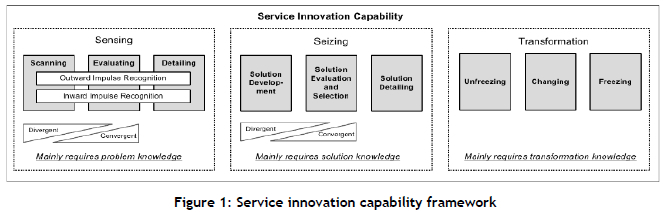
Service innovation capability is structured into three groups of activity: sensing, seizing, and transformation [34]. These are shown in the service innovation capability framework (Figure 1), which enables analysis of service innovation capability [7]. However, this framework does not include the process through which a service company moves from operating at ordinary capabilities to dynamic capabilities in order to increase productivity and to provide better services to customers when the environment changes. Furthermore, the framework maps out only when the service company is operating in a changing environment with dynamic capability. This is a gap in the framework, which means that, when the environment shifts, it could be difficult for service providers operating at ordinary capabilities to switch to operating at dynamic capabilities; and this could result in inferior output and customer service quality.
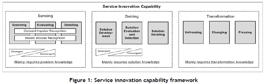
The gap in studies of service innovation capability is that a solid theoretical underpinning is often missing in related studies [7]. As a theoretical model, the framework raises the following questions that have to be addressed in future empirical studies:
• What is the impact of every single capability area on service innovation capability as a whole?
• How could the success of service innovation as a dynamic capability be adequately measured?
• What is the impact of dynamic capability on the business success of service organisations [7]?
2.2.1. Managerial capabilities for service innovation dynamic capabilities
There are six managerial capabilities that could be used to create service innovation dynamic capabilities or novel service experiences and solutions in a service company [35]. These managerial capabilities are: sensing user requirements and technological options; conceptualising, bundling, and unbundling; co-producing and orchestrating; scaling and stretching; and learning and adapting [1]. The sensing user requirements and technological options capability are about keeping abreast with market changes [3]; and both capabilities are more appropriate in changing markets [36]. [37] defined this capability as external environment scanning and as a capability that facilitates agile services in the internal environment. This is the capability to identify emerging opportunities and threats in the company environment [38]. Therefore, this capability corresponds to the foresight capability.
There are a number of skills or capabilities that middle managers need to have or for which they need to be trained if the strategic foresight is to improve the firm's performance. These skills or capabilities are called managerial dynamic capabilities [39], and consist of sensing new business opportunities; seizing actions to organise resources; and rearranging resources. These managerial dynamic capabilities are divided into three types: managerial human capital; managerial social capital; and managerial cognition [40]. There are two further roles that managers have that support dynamic capabilities: leadership and entrepreneurial roles [41]. These two roles jointly constitute entrepreneurial management, which represents the tasks of a dynamic capability called managerial dynamic capabilities [42].
Conceptualising is the company's ability to conceptualise, design, prototype, and examine novel ideas [43]. Bundling and unbundling is the capability of a firm to develop a combination by bringing together resources or developing additional value by breaking down resources; and the bundling and unbundling of resources should result in novel resource contributions for the client [44]. Conceptualising and bundling and unbundling together address the capabilities through which an idea is selected and developed into a comprehensive proposition [1].
Co-producing and orchestrating is the capability to co-design and co-produce a service innovation hand-in-hand with other value network associates and to manage and arrange the collaboration with value network associates. It is also about investing in a set of prospective associates who could develop novel service occurrences and solutions [3]. Scaling and stretching is the company's ability to scale the main process of service innovation and to stretch the central service that is provided [43]. This capability is critical in initial market creation, which requires balancing the development of the product base with the expansion of the business network [45]. Learning and adapting is the capability that purposely learns from the ways in which service innovation is managed presently, and thereafter adapts the overall service innovation process [44]. This is in accordance with the common knowledge that learning is about a high-order capability that directs the development of dynamic capability [46].
2.3. Water utilities dynamic capability
The globe is experiencing societal problems such as climate change, population growth, and rapid urbanisation, all of which jeopardise water security, especially in developing countries [47] such as South Africa. These challenges also have a negative impact on African water quality and water quantity resources, as well as on water infrastructure capacity [48]. Furthermore, these problems have led to most of the natural water sources experiencing contamination, particularly by sewage and by emerging contaminants such as pharmaceuticals, pesticides, and personal care products that are harmful to human beings [49]. Most conventional water purification technologies are incapable of removing most of these contaminants in drinking water in order to meet strict water quality drinking standards [50].The complicated nature of these difficulties in water utilities has caused conventional water purification plants to be ineffective; thus water innovation is needed to make certain that these water purification plants are effective and deliver an efficient service, such as supplying good-quality drinking water and meeting consumer demand [51].
According to [52], despite some efforts between 2014 and 2016 to extend innovation research, there is a noticeable lack of academic studies on the dynamics of water utilities' capability. This is the gap that this study has discovered. [53] also argued that current research suggests that the global water sector is still considered less innovative in relation to other sectors. This gap, too, has been discovered during the course of this study. In order to address these challenges and to improve water service delivery, relevant organisations should be nimble, because organisational nimbleness helps to manage these problems and changes [54], which frequently act as drivers of innovativeness and could help to address this disaster [55]. The dynamic environments of water utilities include rapid population growth, rapid industrialisation, and climate-related variations in the natural environment such as metered rain changes and their perceived effect on the water network [56].
Numerous advanced water innovation technologies could be embraced to purify raw water that has been contaminated when they are added to conventional water technologies [57]. These advanced technologies include ozonation, sunscreen ultraviolet (UV), photocatalysis, fenton reaction, membrane filtration, and carbon adsorption, along with digital and artificial intelligence technology [58]. The emerging contaminants in the raw water are removed during the purification process when advanced water purification technologies are used with conventional water purification technologies [59]. The fenton reaction, carbon adsorption, photocatalysis, and membrane filtration belong to the generation of emerging technologies known as nanotechnologies [60]. However, very little research has considered the blending of such technologies with companies' older competencies for competitive advantage [61]; and this is a gap. It is advantageous when nanotechnologies are used to purify raw water, because they can quickly discern changes in raw water quality and eliminate emerging contaminants throughout the improved purification process [62]. Artificial intelligence technology is used in water purification plants to find the optimal dose of chemicals at the coagulation and flocculation phases, in line with variations in the incoming raw water and its limits, so that good potable water can be produced [63]. Similarly, digital technologies are used in water utilities to ensure that suitable and purified drinking water is produced when incoming raw water in the pipe and chemical doses with respect to the raw water limits are being tracked in real time using Internet of Things technologies [64].
3. METHODOLOGY
This study used a quantitative method to analyse the variables that contribute to either the deterioration or the improvement of water purification plants' service innovation and operational performance. These variables are the factors behind deteriorating service capabilities, managerial dynamic capabilities, and new and emerging water purification technologies. The quantitative questionnaire, developed with input from the literature review, was used to collect data for the analysis of the variables. The degree to which the respondents agreed or disagreed with the statements was measured using a five-point Likert scale [65]. The questionnaire was divided into two parts. Part A evaluated the employees' job titles and their number of years of working experience in water utilities, while Part B evaluated the operational and service performance of water utilities (service innovation dynamic capabilities), the factors behind deteriorating service capability, the opportunities offered by the managerial dynamic capabilities, and the opportunities offered by the new and emerging technologies to improve water purification plant service innovation capabilities and operational performance.
The employees (operators, technicians, engineers, scientists, middle managers, and senior managers) of different water utilities in South Africa were the target population. This study applied a random sample technique and a probability sampling method. Under this procedure, every participant in the population had an equal chance of being selected as a subject. This method was appropriate because it is less costly, less complex, and less time-consuming to implement. It also reduces unfairness by offering each participant an equal chance of being chosen. The study was conducted with South African water utility employees from various provinces. A total of 120 questionnaires were circulated to the employees, and 113 fully completed questionnaires were collected for statistical analysis. Those 113 were accurately completed, returned, examined, and interpreted, yielding a 94.16% response rate. The group with the highest number of respondents were the operators at 52.2%, followed by the technicians at 22.1%, middle managers at 11.5%, and engineers and senior managers at 5.3% each. The group with the lowest number of respondents was the scientists at 3.5%. The highest percentage of participating respondents had more than ten years of working experience in water utilities at 59.3%, followed by those that had between five and ten years at 26.5%; the lowest proportion of respondents had less than five years' working experience in water utilities at 14.2%.
The Statistical Package for the Social Sciences (SPSS) software version 27 for MS Windows was used to analyse the data. The perceived contributing variables to the deterioration and the improvement of water purification plant service innovation and operational performance used the following statistical analysis:
• Frequency distributions were used to give a visual representation of the dispersion of perception on the variables, as well as to give a convenient overview of the entire data.
• Mean values were used to measure the central tendency of the variables, and standard deviations were used to measure the data distribution.
• Cronbach's alpha coefficients were used to evaluate the internal consistency of each variable.
• Reliability was used to gauge the factors' internal consistency.
• The degree of association between the two variables' movements was assessed using the correlations. The reliability test's results demonstrated that every variable had a Cronbach's alpha coefficient of greater than 0.70, which complied with the reliability criteria set by [66].
4. RESULTS
It was observed that 58.4% of the respondents indicated that their water utilities did not meet daily consumer demand, while the balance of the respondents (41.6%) indicated that their water utilities did meet daily consumer demand. The highest number of respondents, 40.7%, indicated that the last time that their water utility plants had been augmented to meet consumer demand was during the previous five years; the second highest number of respondents, 26.5%, indicated that their water utilities plants had been augmented in the previous year; and 16.8% of the respondents indicated that the last time their water utilities had augmented their plants to meet water consumption demand had been in the previous fifteen years. Of the two lowest percentages, 10.6% of the respondents indicated that their water utilities had never augmented their plants to meet consumer demand, and 5.3% of the respondents indicated that their water utilities plants had been augmented in the previous ten years. Most of the respondents, 81.4%, indicated that their water utilities maintained their infrastructure according to planned maintenance; however, 18.6% of the respondents indicated that their water infrastructure was not maintained according to plan.
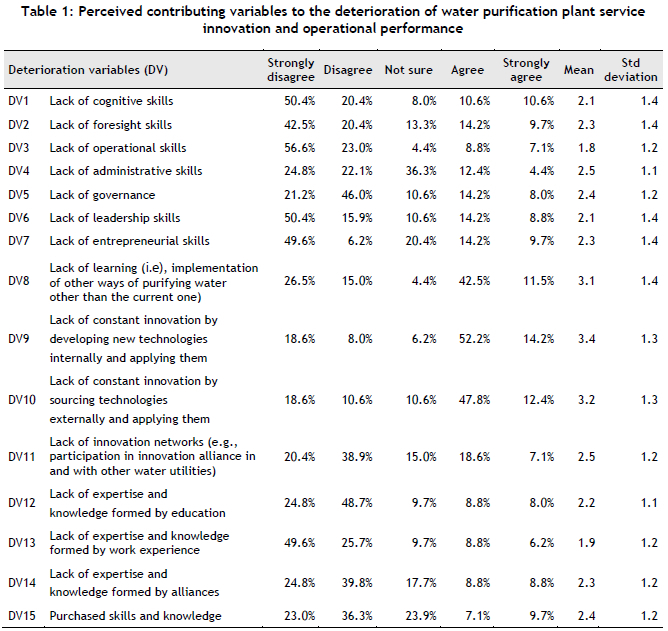
As may be seen in Table 1, the Cronbach's alpha coefficient for the fifteen variables measuring their contribution to the deterioration of water purification plant service innovation and operational performance was found to be 0.94. This result indicated that each variable was pertinent, meaning that all of the variables could be included in the analysis.
According to Table 1, the first variable that has the greatest influence on the deterioration of water purification plant service innovation and operational performance is the lack of constant innovation by developing new technologies internally and applying them (DV9). This variable has the highest mean of 3.4, as it is above the 'not sure' scale and close to the 'agreed' scale. Furthermore, at 52.2%, most of the respondents chose 'agree' for this variable, indicating that it contributes to the deterioration of water purification plant service innovation and operational performance.
The second-highest variable that influences the deterioration of water purification plant service innovation and operational performance is the lack of constant innovation by sourcing technologies externally and applying them (DV10). This variable has the second-highest mean of 3.2, as it is above the 'not sure' scale and closer to 'agree'. Furthermore, at 47.8%, most of the respondents chose 'agree' for this variable, indicating that it contributes to the deterioration of water purification plant service innovation and operational performance.
The third-highest variable that has an influence in contributing to the deterioration of water purification plant service innovation and operational performance is the lack of learning (DV8). This variable has the third-highest mean of 3.1, as it is above the 'not sure' scale and closer to 'agree'. Furthermore, at 42.5%, most of the respondents chose 'agree' for this variable, indicating that it contributes to the deterioration of water purification plant service innovation and operational performance. The remainder of the variables in Table 1 have a mean that is below 3.0; they were rated either 'strongly disagree' or 'disagree' that they contribute to the deterioration of water purification plant service innovation and operational performance.
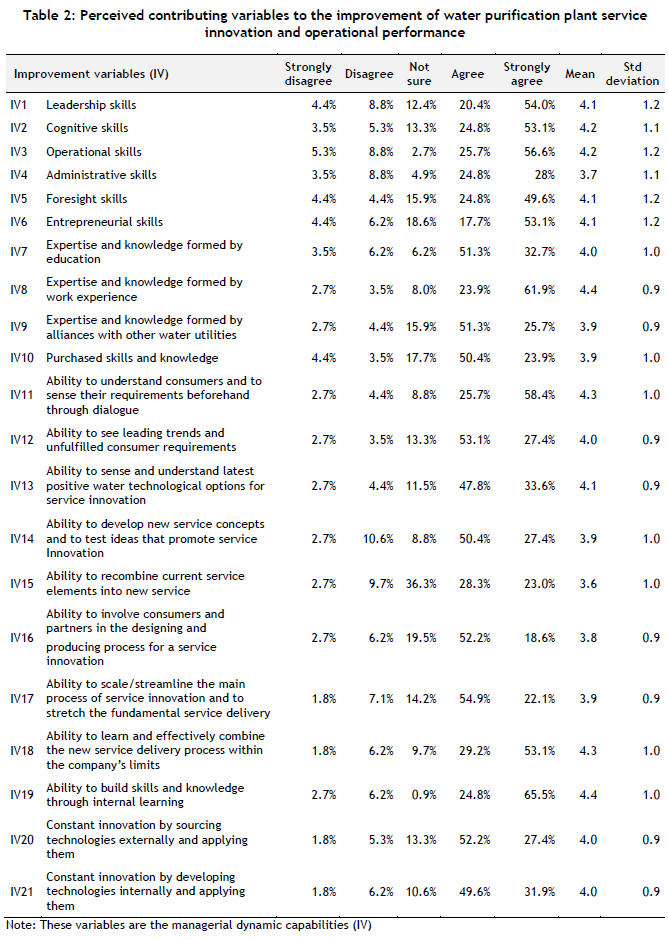
In Table 2, the Cronbach's alpha coefficient that measured the twenty-one variables' contribution to the improvement of water purification plant service innovation and operational performance was found to be 0.96. These results show that each variable was significant, indicating that all the variables could be included in the analysis.
The mean values in all the variables were above 3.0, and most respondents rated the variables between 'agree' and 'strongly agree' for their contribution to improving water purification plant service innovation and operational performance. Although the administrative skills variable (IV4) was rated above the 'not sure' scale and closer to the 'agree' scale (mean is 3.7), at 34.9%, most of the respondents rated this variable 'not sure' about its contribution to improving water purification plant service innovation and operational performance. The ability to recombine current service elements into a new service variable (IV15) was scored above 'not sure' and closer to 'agree' (mean is 3.6), although, at 36.3%, most of the respondents rated this variable 'not sure' about its contribution to improving water purification plant service innovation and operational performance . Because of the conflict between the mean of the administrative skills variable (3.7 - above 'not sure' and closer to 'agree') and the respondents (34.9% -'not sure'), this variable was not included as improving water purification plant service innovation and operational performance. The same applies to the ability to recombine current service elements into a new service variable.
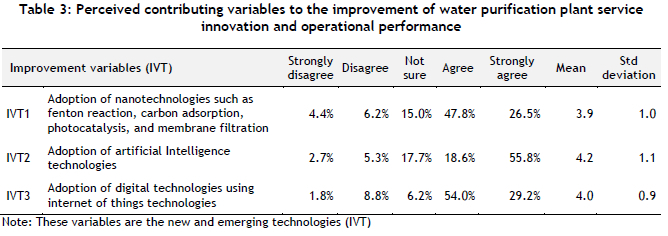
In Table 3, the Cronbach's alpha coefficient for the three variables for their contribution to improving water purification plant service innovation and operational performance was found to be 0.85. The results indicate that each variable was valid, meaning that all the variables could be included in the analysis. The mean values in all the variables were above 3.0, and most respondents rated all the variables between 'agree' and 'strongly agree' as contributing to improving water purification plant service innovation and operational performance.
4.1. Spearman's correlation on group variables
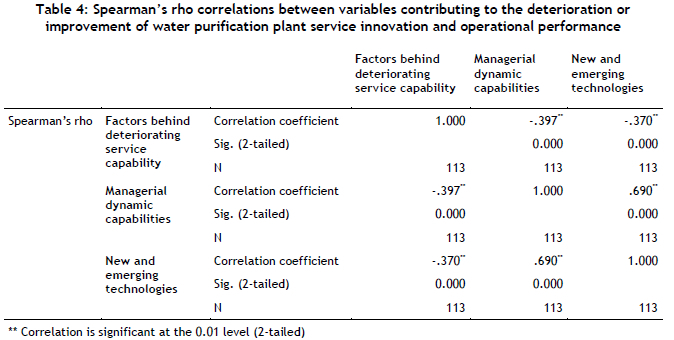
In Table 4, the factors behind deteriorating service capability are the group of variables from DV1 to DV15 (as shown in Table 1); managerial dynamic capabilities are the group of variables from IV1 to IV21 (as shown in Table 2); and new and emerging technologies are the group of variables from IVT1 to IVT3. The correlation was used to compute the relationships between the groups of variables DV1 to DV15, IV1 to IV21, and IVT1 to IVT3 (as shown in Table 3).
There was a highly significant and strongly positive correlation between the managerial dynamic capabilities and new and emerging technologies to improve water purification plant service innovation and operational performance, r = 0.690. This means that, when the managerial dynamic capabilities increase, the new and emerging technologies capabilities also increase in order to improve water purification plant service innovation and operational performance. This is the expected correlation, because the two groups in Tables 2 and 3 were found to contribute to improving water purification plant service innovation and operational performance.
5. DISCUSSION
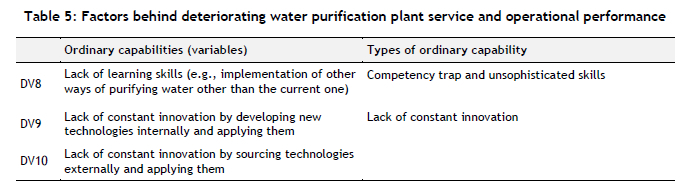
The results showed that the lack of learning, lack of constant innovation by developing new technologies internally and applying them, and lack of constant innovation by sourcing technologies externally and applying them are the leading variables that influence the deterioration of water purification plant service innovation and operational performance (service innovation dynamic capabilities) (see Table 5). Therefore, these are the factors behind the deteriorating service capability of South African water utilities.
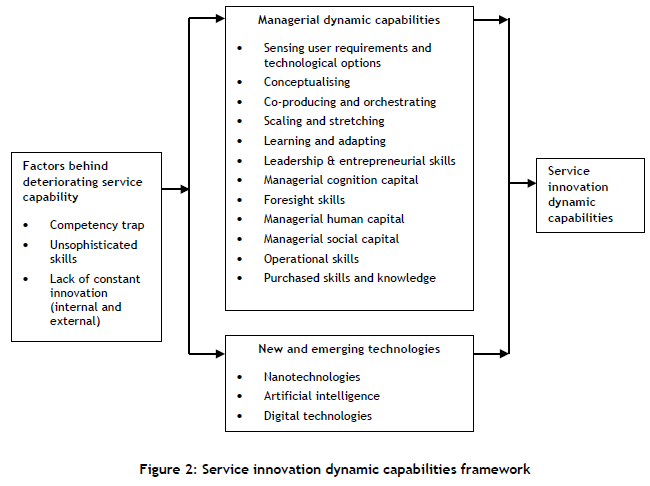
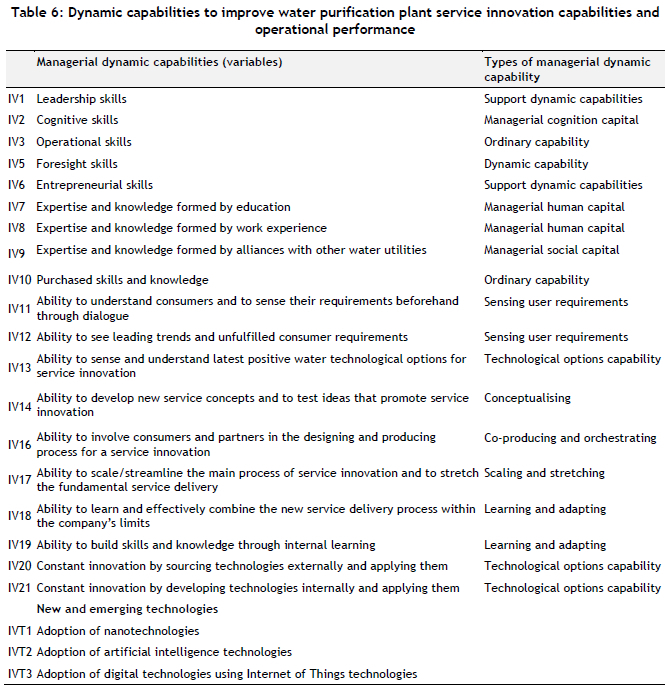
The results also showed that the nineteen variables (IV1-IV21, excluding IV4 and IV15) under the managerial dynamic capabilities influence the improvement of water purification plant service innovation and operational performance (service innovation dynamic capabilities) (see Table 6). This means that these nineteen variables could be used to improve the service innovation dynamic capability performance of South African water utilities. Note that the nineteen variables in Table 6 under 'Managerial dynamic capabilities' were rearranged into twelve variables, based on the managerial capabilities for service innovation dynamic capabilities from the literature review in section 2.2.1 (see Figure 2).
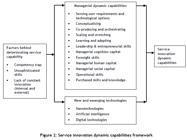
The results also showed that the three variables (adoption of nanotechnologies, adoption of artificial intelligence technologies, and adoption of digital technologies) under 'New and emerging technologies' influence the improvement of water purification plant service innovation and operational performance (service innovation dynamic capabilities) (see Table 6). This means that these three new and emerging technologies could be used to improve the service innovation dynamic capability performance of South African water utilities.
Therefore, the nineteen variables under 'Managerial dynamic capabilities' and the three variables under 'New and emerging technologies' could be used to improve the water purification plant service innovation and operational performance (service innovation dynamic capability) of South African water utilities in the face of deteriorating water purification plant service innovation and operational performance caused by the factors behind the deteriorating service capability. This finding could be confirmed by the negative relationship between the factors behind deteriorating service capability, managerial dynamic capabilities, and new and emerging technologies; when the factors behind the deteriorating service capability cause a deterioration in the service innovation dynamic capabilities, then the managerial dynamic capabilities and new and emerging technologies improve the service innovation dynamic capabilities. This is demonstrated in the framework shown in Figure 2 the framework transforms the water utilities that have deteriorating service capabilities owing to a lack of learning, a lack of constant innovation by developing new technologies internally and applying them, and a lack of constant innovation by sourcing technologies externally and applying them to improve service capabilities or service innovation dynamic capabilities. This framework addresses the deteriorating service capabilities of South African water utilities, which thus achieves the objective of this study. The framework has two important elements that improve the service capability - managerial dynamic capabilities and new and emerging technologies - which answer the study's research question.
6. CONCLUSION
The contribution of this study is the service innovation dynamic capabilities framework that integrates the ordinary capabilities concept, service innovation capability, managerial dynamic capabilities, and new and emerging technologies concepts reviewed in this study in order to address deteriorating service capabilities by improving the service innovation dynamic capabilities in South African water utilities. This framework seeks to transform service companies that use ordinary capabilities in a changing environment into using dynamic capabilities such as managerial dynamic capabilities and new and emerging technologies. These would empower the service innovation dynamic capabilities to improve the service performance of the service companies in a changing environment. The service innovation dynamic capabilities framework bridges the gap identified in the service innovation capability framework developed by [7]. Specifically, the service innovation dynamic capabilities framework addresses the absence of provisions for a service company to shift from operating with ordinary capabilities to adopting dynamic capabilities in response to changing environmental conditions, thereby enhancing their productivity and offering improved customer services.
The practical contribution of this study is the possible application of the service innovation dynamic capabilities framework by the management of water utilities to empower their service innovation capabilities by using dynamic capabilities such as managerial dynamic capabilities and new and emerging technologies to enhance water purification plant service innovation and operational performance and to keep up with consumer demand. It is recommended that future studies conduct an empirical study that seeks to integrate the ordinary capabilities concept, managerial dynamic capabilities, service innovation capabilities, and the new and emerging technologies concept in firms other than service firms to improve their performances, using this framework as a basis. The limitation of the study is that it applies only to companies that offer services to customers.
REFERENCES
2. LITERATURE REVIEW
-
[1] R. Žitkienè, E. Kazlauskienè, and M. Deksnys, "Dynamic capabilities for service innovation," in Management International Conference, Portoroz, Slovenia, 2015, pp. 269-278. [Online]. Available: https://ideas.repec.org/h/mgt/micp15/269-278.html [Accessed: 15-July-2024].
» https://ideas.repec.org/h/mgt/micp15/269-278.html - [2] I. O. Grediaga and D. Freshwater, Strategies to Improve Rural Service Delivery, no. March. (Rural Policy Reviews) OECD Publishing, 2010. doi: 10.1787/9789264083967-en
-
[3] D. J. Teece, "Explicating dynamic capabilities: the nature and microfoundations of (sustainable) enterprise performance," Strateg. Manag. J., vol. 28, no. 13, pp. 1319-1350, 2007, doi: 10.1002/smj.640
» https://doi.org/10.1002/smj.640 -
[4] R. Agarwal and W. Selen, "The incremental and cumulative effects of dynamic capability building on service innovation in collaborative service organizations," J. Manag. Organ., vol. 19, no. 5, pp. 521-543, 2013. doi: 10.1017/jmo.2014.5
» https://doi.org/10.1017/jmo.2014.5 -
[5] D. J. Teece, "The foundations of enterprise performance: Dynamic and ordinary capabilities in an (economic) theory of firms," Acad. Manag. Perspect., vol. 28, no. 4, pp. 328-352, 2014. doi: 10.5465/amp.2013.0116
» https://doi.org/10.5465/amp.2013.0116 -
[6] D. W. Vorhies, R. E. Morgan, and C. W. Autry, "Product-market strategy and the marketing capabilities of the firm: Impact on market effectiveness and cash flow performance," Strateg. Manag. J., vol. 30, no. 12, pp. 1310-1334, 2009. doi: 10.1002/smj.798
» https://doi.org/10.1002/smj.798 - [7] J. Pöppelbuβ et al., "Service innovation capability: Proposing a new framework," 2011 Fed. Conf. Comput. Sci. Inf. Syst. FedCSIS 2011, no. July 2014, pp. 545-551, 2011.
-
[8] D. J. Teece, G. Pisano, and A. Shuen, "Dynamic capabilities and strategic management," Strateg. Manag. J., vol. 18, no. 7, pp. 509-533, 1997, doi: 10.1093/0199248540.003.0013
» https://doi.org/10.1093/0199248540.003.0013 -
[9] Z. Samsudin and M. D. Ismail, "The Concept of Theory of Dynamic Capabilities in Changing Environment," Int. J. Acad. Res. Bus. Soc. Sci., vol. 9, no. 6, pp. 1071-1078, 2019, doi: 10.6007/ijarbss/v9-i6/6068
» https://doi.org/10.6007/ijarbss/v9-i6/6068 -
[10] M. S. Wambua and Y. Yahaya, "Effect of customer service practices on performance in the hospitality industry: a case study of hotels in Nairobi county," Int. J. Soc. Sci. Inf. Technol., vol. 4, no. 10, pp. 362-374, 2018. https://www.ijssit.com/main/wp-content/uploads/2018/10/Effect-Of-Customer-Service-Practices-On-Performance-In-The-Hospitality-Industry.pdf [Accessed: 15-March-2024].
» https://www.ijssit.com/main/wp-content/uploads/2018/10/Effect-Of-Customer-Service-Practices-On-Performance-In-The-Hospitality-Industry.pdf -
[11] Department of Water and Sanitation, "Blue drop report national," 2023. [Online]. Available: https://ws.dws.gov.za/iris/releases/BDN_2023_Report.pdf [Accessed: 12-April-2024].
» https://ws.dws.gov.za/iris/releases/BDN_2023_Report.pdf -
[12] P. Tshindane et al., "The occurrence of natural organic matter in South African water treatment plants," J. Water Process Eng., vol. 31, no. October 2018, 100809, 2019. doi: 10.1016/j.jwpe.2019.100809
» https://doi.org/10.1016/j.jwpe.2019.100809 -
[13] T. I. Nkambule, R. W. M. Krause, J. Haarhoff, and B. B. Mamba, "Natural organic matter (NOM) in South African waters: NOM characterisation using combined assessment techniques," Water SA, vol. 38, no. 5, pp. 697-706, 2012. doi: 10.4314/wsa.v38i5.7
» https://doi.org/10.4314/wsa.v38i5.7 -
[14] U. U. Swana, U. Feleni, T. J. Malefetse, B. B. Mamba, P. Schmitz, and T. T. I. Nkambule, "The status and quantification of de facto water reuse in South Africa: A review," Water Pract. Technol., vol. 15, no. 2, pp. 225-247, 2020. doi: 10.2166/wpt.2020.021
» https://doi.org/10.2166/wpt.2020.021 -
[15] D. J. Teece, "Towards a capability theory of (innovating) firms: Implications for management and policy," Cambridge J. Econ., vol. 41, no. 3, pp. 693-720, 2017. doi: 10.1093/cje/bew063
» https://doi.org/10.1093/cje/bew063 -
[16] P. L. Drnevich and A. P. Kriauciunas, "Clarifying the conditions and limits of the contributions of ordinary and dynamic capabilities to relative firm performance," Strateg. Manag. J., vol. 32, no. 3, pp. 254-279, 2011. doi: 10.1002/smj.882
» https://doi.org/10.1002/smj.882 -
[17] D. Jadhav and D. Shenoy, "Building dynamic capabilities of an academic library: A research agenda," Journal of Academic Librarianship, vol. 48, no. 4, 102502, 2022. doi: 10.1016/j.acalib.2022.102502
» https://doi.org/10.1016/j.acalib.2022.102502 -
[18] C. E. Helfat and S. G. Winter, "Untangling dynamic and operational capabilities: Strategy for the (n)ever-changing world," Strateg. Manag. J., vol. 32, no. 11, pp. 1243-1250, 2011. doi: 10.1002/smj.955
» https://doi.org/10.1002/smj.955 -
[19] G. S. Cumming, "A review of social dilemmas and social-ecological traps in conservation and natural resource management," Conserv. Lett., vol. 11, no. 1, pp. 1-15, 2018. doi: 10.1111/conl.12376
» https://doi.org/10.1111/conl.12376 -
[20] H. N. Nasution, F. T. Mavondo, M. J. Matanda, and N. O. Ndubisi, "Entrepreneurship: Its relationship with market orientation and learning orientation and as antecedents to innovation and customer value," Ind. Mark. Manag., vol. 40, no. 3, pp. 336-345, 2011. doi: 10.1016/j.indmarman.2010.08.002
» https://doi.org/10.1016/j.indmarman.2010.08.002 -
[21] C. C. Yang, P. B. Marlow, and C. S. Lu, "Assessing resources, logistics service capabilities, innovation capabilities and the performance of container shipping services in Taiwan," Int. J. Prod. Econ., vol. 122, no. 1, pp. 4-20, 2009. doi: 10.1016/j.ijpe.2009.03.016
» https://doi.org/10.1016/j.ijpe.2009.03.016 -
[22] L. Gryszkiewicz, E. Giannopoulou, and P. J. Barlatier, "Service innovation capabilities: What are they?" Int. J. Serv. Econ. Manag., vol. 5, no. 1-2, pp. 125-153, 2013. doi: 10.1504/IJSEM.2013.051857 [23] J.
» https://doi.org/10.1504/IJSEM.2013.051857 -
Spohrer and P. P. Maglio, "The emergence of service science: Toward systematic service innovations to accelerate co-creation of value," Prod. Oper. Manag., vol. 17, no. 3, pp. 238-246, 2008. doi: 10.3401/poms.1080.0027
» https://doi.org/10.3401/poms.1080.0027 -
[24] N. Nada and Z. Ali, "Service value creation capability model to assess the service innovation capability in SMEs," Procedia CIRP, vol. 30, pp. 390-395, 2015. doi: 10.1016/j.procir.2015.02.218
» https://doi.org/10.1016/j.procir.2015.02.218 -
[25] S. Y. Kuo, P. C. Lin, and C. S. Lu, "The effects of dynamic capabilities, service capabilities, competitive advantage, and organizational performance in container shipping," Transp. Res. Part A Policy Pract., vol. 95, pp. 356-371, 2017. doi: 10.1016/j.tra.2016.11.015
» https://doi.org/10.1016/j.tra.2016.11.015 -
[26] P. den Hertog, W. van der Aa, and M. W. de Jong, "Capabilities for managing service innovation: Towards a conceptual framework," J. Serv. Manag., vol. 21, no. 4, pp. 490-514, 2010. doi: 10.1108/09564231011066123
» https://doi.org/10.1108/09564231011066123 -
[27] M. Yaghoubi, E. Teymourzadeh, M. Bahadori, and F. Ghardashi, "Conceptual model of innovation capability in industrial and academic research centers: A systematic review," Iran. J. Manag. Stud., vol. 10, no. 3, pp. 609-640, 2017. doi: 10.22059/ijms.2017.238379.672756
» https://doi.org/10.22059/ijms.2017.238379.672756 -
[28] P. H. Fuchs, K. E. Mifflin, D. Miller, and J. O. Whitney, "Strategic integration: Competing in the age of capabilities," Calif. Manage. Rev., vol. 42, no. 3, pp. 118-147, 2000. doi: 10.2307/41166045
» https://doi.org/10.2307/41166045 -
[29] R. Agarwal and W. Selen, "Dynamic capability building in service value networks for achieving service innovation," Decis. Sci., vol. 40, no. 3, pp. 431-475, 2009. doi: 10.1111/j.1540-5915.2009.00236.x
» https://doi.org/10.1111/j.1540-5915.2009.00236.x -
[30] Y. Yang, Y. Q. Zhao, A. O. Babatunde, and P. Kearney, "Two strategies for phosphorus removal from reject water of municipal wastewater treatment plant using alum sludge," Water Sci. Technol., vol. 60, no. 12, pp. 3181-3188, 2009. doi: 10.2166/wst.2009.609
» https://doi.org/10.2166/wst.2009.609 -
[31] L. Heng, A. T. Ferdinand, N. Afifah, and R. Ramadania, "Service innovation capability for enhancing marketing performance: An SDL perspectives," Bus. Theory Pract., vol. 21, no. 2, pp. 623-632, 2020. doi: 10.3846/btp.2020.12163
» https://doi.org/10.3846/btp.2020.12163 -
[32] S. Durst, A. L. Mention, and P. Poutanen, "Service innovation and its impact: What do we know about?" Investigaciones Europeas de Direccion y Economia de la Empresa, vol. 21, no. 2, pp. 65-72, 2015. doi: 10.1016/j.iedee.2014.07.003
» https://doi.org/10.1016/j.iedee.2014.07.003 -
[33] D. Kindström, C. Kowalkowski, and E. Sandberg, "Enabling service innovation: A dynamic capabilities approach," J. Bus. Res., vol. 66, no. 8, pp. 1063-1073, 2013. doi: 10.1016/j.jbusres.2012.03.003
» https://doi.org/10.1016/j.jbusres.2012.03.003 -
[34] S. Balaji and C. Ranganathan, "Exploring the key capabilities for offshore IS sourcing," ICIS 2006 Proceedings, 37, 2006, Accessed: Aug. 13, 2021. [Online]. Available: https://aisel.aisnet.org/icis2006/37/
» https://aisel.aisnet.org/icis2006/37/ -
[35] Y. C. J. Cheng, C. Yang, and C. Sheu, "Interplay of strategic orientations, innovativeness, and industrial sectors in enhancing innovation performance," J. Bus. Manag., vol. 23, no. 2, pp. 25-46, 2017. doi.org/10.1504/jbm.2017.141257
» doi.org/10.1504/jbm.2017.141257 -
[36] M. Janssen, A. Alexiev, P. den Hertog, and C. Castaldi, "A multi-level multidimensional approach for measuring dynamic capabilities in service innovation management," Paper presented at the Druid 2012, Copenhagen, Denmark, pp. 1-26, 2012. Available:https://research.tue.nl/en/publications/a-multi-level-multidimensional-approach-for-measuring-dynamic-cap [Accessed: 15-May-2024].
» https://research.tue.nl/en/publications/a-multi-level-multidimensional-approach-for-measuring-dynamic-cap -
[37] A. Raman and S. S. Bharadwaj, "Dynamic service capabilities enabling agile services: Scale development and initial validation in Indian services industry," J. Enterp. Inf. Manag., vol. 30, no. 1, pp. 166-187, 2017. doi: 10.1108/JEIM-01-2016-0015/FULL/HTML
» https://doi.org/10.1108/JEIM-01-2016-0015/FULL/HTML - [38] M. Järvinen, "Co-creating an in-house service concept for boosting innovation and development," Master's thesis, Laurea University, Vantaa, Finland, 2019.
-
[39] J. O. Schwarz, R. Rohrbeck, and B. Wach, "Corporate foresight as a microfoundation of dynamic capabilities," Futur. Foresight Sci., vol. 2, no. 2, pp. 1-11, 2020. doi: 10.1002/ffo2.28
» https://doi.org/10.1002/ffo2.28 -
[40] R. Adner and C. E. Helfat, "Corporate effects and dynamic managerial capabilities," Strateg. Manag. J., vol. 24, no. 10 special issue, pp. 1011-1025, 2003. doi: 10.1002/smj.331
» https://doi.org/10.1002/smj.331 -
[41] V. Ambrosini and G. Altintas, "Dynamic managerial capabilities," Oxford Res. Encycl. Bus. Manag., no. June, pp. 1-18, 2019. doi: 10.1093/acrefore/9780190224851.013.20
» https://doi.org/10.1093/acrefore/9780190224851.013.20 -
[42] C. E. Helfat and M. A. Peteraf, "Managerial cognitive capabilities and the microfoundations of dynamic capabilities," Strateg. Manag. J., vol. 36, no. 6, pp. 831-850, 2015. doi: 10.1002/smj.2247
» https://doi.org/10.1002/smj.2247 -
[43] W. Y. Wu and P. T. Nguyen, "The antecedents of dynamic service innovation capabilities: The moderating roles of market dynamism and market orientation," Int. J. Innov. Manag., vol. 23, no. 7, 2019. doi: 10.1142/S136391961950066X
» https://doi.org/10.1142/S136391961950066X - [44] P. den Hertog, "Managing service innovation: Firm-level dynamic capabilities and policy options," PhD thesis, Amsterdam Business School Research Institute, Amsterdam, The Netherlands, 2010.
-
[45] C. Windahl and N. Lakemond, "Developing integrated solutions: The importance of relationships within the network," Ind. Mark. Manag., vol. 35, no. 7, pp. 806-818, 2006. doi: 10.1016/j.indmarman.2006.05.010
» https://doi.org/10.1016/j.indmarman.2006.05.010 -
[46] M. Zollo and S. G. Winter, "Deliberate learning and the evolution of dynamic capabilities," Organ. Sci., vol. 13, no. 3, pp. 339-351, 2002. doi: 10.1287/orsc.13.3.339.2780
» https://doi.org/10.1287/orsc.13.3.339.2780 -
[47] Asian Development Bank, Asian water development outlook 2013: Measuring water security in Asia and the Pacific. 2013. [Online]. Available: https://www.adb.org/sites/default/files/./img/revistas/sajie/v36n2/asian-water-development-outlook-2013.pdf [ Accessed: 02-March-2024].
» https://www.adb.org/sites/default/files/./img/revistas/sajie/v36n2/asian-water-development-outlook-2013.pdf -
[48] S. Mvulirwenande and U. Wehn, "Dynamics of water innovation in African cities: Insights from Kenya, Ghana and Mozambique," Environ. Sci. Policy, vol. 114, no. July, pp. 96-108, 2020. doi: 10.1016/j.envsci.2020.07.024
» https://doi.org/10.1016/j.envsci.2020.07.024 - [49] D. S. Maycock and C. D. Watts, "Pharmaceuticals in drinking water," in Encyclopedia of environmental health, J.O. Nriagu (ed.), Elsevier Science, pp. 472-484, 2011. doi: 10.1016/B978-0-444-52272-6.00457-8
- [50] X. Qu, J. Brame, Q. Li, and P. J. J. Alvarez, "Nanotechnology for a safe and sustainable water supply: Enabling integrated water treatment and reuse," Acc. Chem. Res., vol. 46, no. 3, pp. 834843, 2012.
- [51] S. Mvulirwenande and U. Wehn, "Promoting smart water systems in developing countries through innovation partnerships: Evidence from VIA water-supported projects in Africa," in The handbook of environmental chemistry, A. Scozzari, S. Mounce, D. Han, F. Soldovieri, and D. Solomatine (eds), vol. 102, Cham: Springer, pp. 167-207, 2021. doi: 10.1007/698_2019_422
-
[52] U. Wehn and C. Montalvo, "Exploring the dynamics of water innovation: Foundations for water innovation studies," J. Clean. Prod., vol. 171, pp. S1-S19, 2018. doi: 10.1016/j.jclepro.2017.10.118
» https://doi.org/10.1016/j.jclepro.2017.10.118 -
[53] N. K. Ajami, B. H. Thompson, and D. G. Victor, "The path to water innovation," The Hamilton Project, 2014, [Online]. Available: https://woods.stanford.edu/system/files/publications/path_to_water_innovation_thompson_paper_final.pdf [ Accessed: 28- March-2024].
» https://woods.stanford.edu/system/files/publications/path_to_water_innovation_thompson_paper_final.pdf - [54] G. Oakes and M. von Weissenberg, "Governance and agility in product development organizations," in Responsible governance: International perspectives for the new era, T. Cockburn, K. S. Jahdi, and E. G. Wilson (eds), New York: Business Expert Press, pp. 39-90, 2015.
- [55] M. N. Newaz, G. Brewer, and T. Gajendran, "What are the driving forces towards organizational innovativeness for service delivery in water utilities? A model in the Australian Context," Journal of Innovation & Knowledge, 2021.
-
[56] P. Hartman, T. Gliedt, J. Widener, and R. W. Loraamm, "Dynamic capabilities for water system transitions in Oklahoma," Environ. Innov. Soc. Transitions, vol. 25, pp. 64-81, 2017. doi: 10.1016/j.eist.2016.12.004
» https://doi.org/10.1016/j.eist.2016.12.004 -
[57] Y. Yang, Y. S. Ok, K. H. Kim, E. E. Kwon, and Y. F. Tsang, "Occurrences and removal of pharmaceuticals and personal care products (PPCPs) in drinking water and water/sewage treatment plants: A review," Sci. Total Environ., vol. 596-597, pp. 303-320, 2017. doi: 10.1016/j.scitotenv.2017.04.102G. Alam, I. Ihsanullah, M. Naushad, and M. Sillanpää, "Applications of artificial intelligence in water treatment for optimization and automation of adsorption processes: Recent advances and prospects," Chem. Eng. J., vol. 427, no. March 2021, 2022. doi: 10.1016/j.cej.2021.130011
» https://doi.org/10.1016/j.scitotenv.2017.04.102G -
[58] H. Dong et al., "Effective abatement of 29 pesticides in full-scale advanced treatment processes of drinking water: From concentration to human exposure risk," J. Hazard. Mater., vol. 403, no. February 2020, 123986, 2021. doi: 10.1016/j.jhazmat.2020.123986
» https://doi.org/10.1016/j.jhazmat.2020.123986 -
[59] M. P. Ajith, M. Aswathi, E. Priyadarshini, and P. Rajamani, "Recent innovations of nanotechnology in water treatment: A comprehensive review," Bioresour. Technol., vol. 342, no. August, 126000, 2021. doi: 10.1016/j.biortech.2021.126000
» https://doi.org/10.1016/j.biortech.2021.126000 -
[60] N. Côrte-Real, T. Oliveira, and P. Ruivo, "Assessing business value of big data analytics in European firms," J. Bus. Res., vol. 70, pp. 379-390, 2017. doi: 10.1016/j.jbusres.2016.08.011
» https://doi.org/10.1016/j.jbusres.2016.08.011 - [61] M. M. Doroodmand, Z. Tahvildar, and M. H. Sheikhi, "Multi-walled carbon nanotubes / polyacrylonitrile composite as novel semi-permeable mixed matrix membrane in reverse osmosis water treatment process," International Journal of Materials and Metallurgical Engineering, vol. 5, no. 12, pp. 779-782, 2011.
-
[62] S. Narges, A. Ghorban, K. Hassan, and K. Mohammad, "Prediction of the optimal dosage of coagulants in water treatment plants through developing models based on artificial neural network fuzzy inference system (ANFIS)," J. Environ. Health Sci. Eng., vol. 19, no. 2, pp. 1543-1553, 2021. doi: 10.1007/s40201-021-00710-0
» https://doi.org/10.1007/s40201-021-00710-0 -
[63] O. Mendoza-Cano et al., "Experiments of an loT-based wireless sensor network for flood monitoring in Colima, Mexico," J. Hydroinformatics, vol. 23, no. 3, pp. 385-401, 2021. doi: 10.2166/HYDRO.2021.126
» https://doi.org/10.2166/HYDRO.2021.126 - [64] M. N. K. Saunders, P. Lewis, A. Thornhill, and A. Bristow, "Understanding research philosophy and approaches to theory development," in Research methods for business students, M. N. K. Saunders, P. Lewis, and A. Thornhill (eds), Harlow: Pearson, pp. 122-161, 2015.
- [65] J. Fraenkel, N. Wallen, and H. Hyun, How to design and evaluate research in education, 10th ed. New York: McGraw-Hill, 2012.
Accepted for publication 7 May 2025
Available online 29 Aug 2025
ORCID® identifiers
L.Shabangu: https://orcid.org/0000-0001-9714-2192
P. Letaba: https://orcid.org/0000-0001-5799-6679