Smart Warehouse Management Using Digital Twins and Machine Learning
Abstract
In warehouse operations, digital twin technology integrates physical systems with software components, thereby improving overall productivity. In this study, we developed a digital twin system using the R programming language to analyse product demand patterns and support the slotting storage configuration of outbound processes in a warehouse. By integrating radio-frequency identification (RFID) tag data with Flexsim simulations, the system enhances productivity tracking by 42% - measured by the number of pallets processed per hour - and reduces the time required for dispatching products in the distribution centre by 41%.
Abstract
In pakhuisbedrywighede integreer digitale tweelingtegnologie fisiese stelsels met sagtewarekomponente en verbeter dit sodoende algehele produktiwiteit. In hierdie studie het ons 'n digitale tweelingstelsel ontwikkel met behulp van die R-programmeertaal om produk vraagpatrone te ontleed en voorraadliggingstoewysing vir uitgaande prosesse in 'n pakhuis te ondersteun. Deur radiofrekwensie identifikasie-etiketdata met FlexSim-simulasies te integreer, verbeter die stelsel produktiwiteitsnasporing met 42% - gemeet aan die aantal palette wat per uur verwerk word - en verminder dit die tyd wat benodig word vir die versending van produkte in die verspreidingsentrum met 41%.
1. INTRODUCTION
The increasing complexity of logistics networks, driven largely by the rapid expansion of e-commerce, has necessitated the integration of advanced operational technologies into supply chains to enhance storage and distribution efficiency [1]. To remain competitive in this dynamic environment, companies must continually improve process efficiency through strategies such as process redesign, operational optimisation, and time minimisation. Within the framework of Industry 4.0, the availability of real-time data enables a seamless integration of physical and digital systems, thereby facilitating more responsive and effective process management [2]. Despite these advancements, supply chains remain vulnerable to abrupt disruptions, which can lead to product shortages across markets. The inherent uncertainty of global sourcing highlights the critical need for agile decision-making and rapid adaptation to evolving conditions [3], [4].
Warehouse management is a key component of the distribution chain, encompassing all processes from inbound logistics to final product delivery. This includes planning and scheduling goods receipt and dispatch, task allocation, resource assignment (personnel, equipment, and vehicles), and transaction tracking. The objective is to reduce synchronisation failures while maximising operational efficiency and optimising the use of storage space [5].
Numerous technologies have been developed to optimise operations in distribution centres and last-mile delivery, with a strong focus on enhancing end-to-end traceability, from digital order placement to final product delivery. Effective management of distribution centres is critical to the overall performance of supply chains, particularly in achieving rapid delivery cycles with response times of only a few hours post order receipt. A key determinant of order fulfilment efficiency lies in the design of first-level slotting areas and the execution of picking operations. These processes influence the timely loading of delivery vehicles directly. Slot allocation is typically governed by a prioritisation algorithm that accounts for delivery zones and travel distances to ensure adherence to predefined delivery time windows [6]. Against this backdrop, the following research question arises: How could digital twins contribute to the operational efficiency of distribution warehouses?
To integrate physical and virtual warehouse environments, a range of technologies has been developed to enhance operational efficiency. Radio-frequency identification (RFID) tags are used to monitor and track item movement, thereby improving the productivity of picking operations [7], [8]. Digital twins are increasingly used to design and simulate operational workflows for product retrieval and storage [9]. In addition, augmented reality has been explored as a tool to aid in product location and streamline picking sequences, contributing to higher throughput and reduced error rates [10], [11]. The adoption of emerging technologies in warehouse management requires the careful integration of storage policies such as 'first in, first out' and 'last in, first out'. Assessing picking efficiency - particularly under space constraints - necessitates simulation methodologies that provide statistically validated performance indicators. These methods must account for stochastic variations in task durations and uncertainties in demand, as reflected in inventory turnover dynamics [12]. Smart warehouses, powered by advances in edge computing, have shown measurable improvements in outbound logistics efficiency when integrated with warehouse management systems [13], [14], [15]. Digital twins offer significant potential for evaluating infrastructure investments, analysing performance metrics under new scenarios, and assessing the impacts of transitioning to alternative storage configurations. Their ability to provide real-time visibility and simulate operational changes enables detailed analysis before committing to full-scale implementation [16], [17].
Despite the immediate benefits that digital twins offer to efficient warehouse management, recent research still explores strategies for the construction and validation of models [18], [19]. The limited number of existing implementations, mainly in specialised environments such as refrigerated warehouses [20], highlights a significant opportunity to explore technologies that bridge the gap between virtual and physical warehouse environments.
This study's novelty relies on investigating the application of digital twin technology, informed by patterns of market demand data, to support the development of space allocation strategies for order preparation using machine-learning models. It also examines how this approach might enable the formulation of optimised operational scenarios that are based on key performance indicators derived from dynamic warehouse activities. The remainder of this paper is structured as follows. Section 2 presents a review of the relevant literature. Section 3 outlines the research methodology, including data collection and processing procedures. Section 4 discusses the results and proposed improvements, and Section 5 concludes the study and offers recommendations for future research.
2. THEORETICAL FRAMEWORK
2.1. Digital twins
Digital twin technology was developed to bridge the gap between process design and implementation by establishing a bidirectional connection between virtual and physical systems [20]. This connection helps to mitigate the impact of unpredictable behaviours that may disrupt operations within complex production environments [21].
A digital twin is a virtual representation that replicates the behaviour and performance of real-world objects or processes, enabling continuous monitoring through real-time data processing [22], [23]. Effective integration of physical machinery with digital platforms that mirror operational reality is essential for ensuring the resilience and adaptability of production systems [24]. This integration depends on a bidirectional flow of information between physical and virtual layers, necessitating the development or adaptation of a communication infrastructure that is often not readily available [3], [25]. Among the various alternatives for product identification in warehouses is the barcode, which requires the use of optical scanners. This technology has a limitation in that, if the barcode label is damaged, the optical reader cannot recognise the information. Furthermore, optical readers are not cheap. RFID technology replaces barcodes because it has greater information storage capacity for product location, tracking, and traceability. The difficulty in storage work with this technology lies in the device's connectivity to send data from the network layer to the application layer [15]. This requires the use of middleware connectivity protocols, including message queuing telemetry transport (MQTT), the extensible messaging and presence protocol (XMPP), lightweight M2M (LwM2M), HTTP, or a data distribution service (DDS), which reliably connect to cloud application services.
Digital twins leverage core digital capabilities such as parallel processing and big data analytics to support this integration [26]. When digital representations are fed with data from interconnected physical devices, they enable seamless interaction among the applications involved in interdependent processes. Digital twin models not only facilitate the conceptualisation of systems during the design phase, but also allow for performance evaluation in multiple scenarios. This iterative feedback loop enhances design accuracy and supports data-driven decision-making throughout the lifecycle of the system [27].
2.2. Smart warehouses
In Industry 4.0-oriented systems, inbound and outbound logistics generate transactional data related to inventory levels and consumption patterns. This data must be available in real time and be used as a basis for defining operational scenarios in tactical-level management systems [28].
Effective warehouse organisation requires the design of optimal layouts, and typically uses shared storage policies to minimise the need for pallet relocation [29].
The implementation of automated warehouses with reconfigurable cell dimensions - tailored to technical constraints and system capabilities - offers a scalable solution to dynamic storage needs. To ensure the efficiency and adaptability of such systems, key performance indicators related to storage processes must be continually monitored and evaluated [30].
3. METHODOLOGY
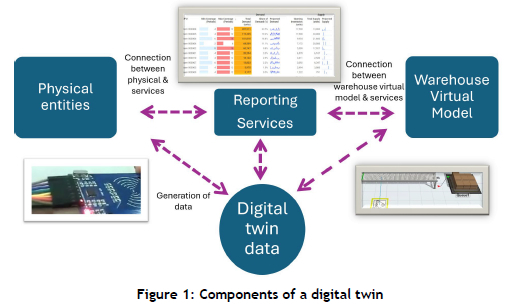
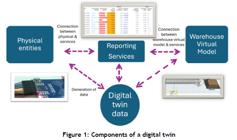
The development of a digital twin involves integrating information between the physical and virtual domains. To enable comprehensive functionality, the digital twin architecture must incorporate three essential layers: the physical layer, the virtual layer, and the communication layer [31]. Figure 1 illustrates the proposed design for integrating the physical warehouse environment with its virtual representation, emphasising the construction of the communication layer as a critical enabler of bidirectional data exchange.
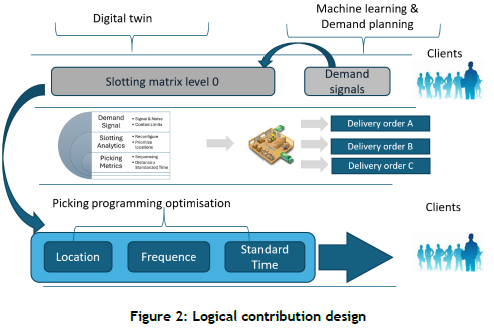
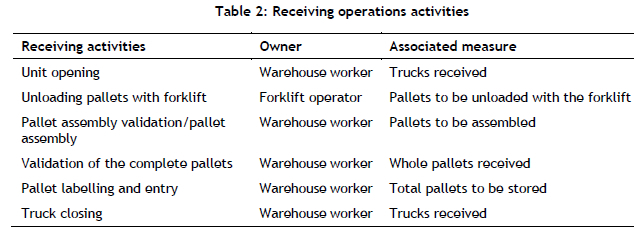
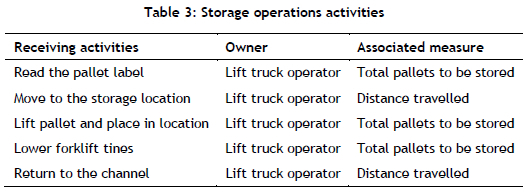
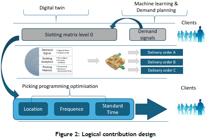
To construct the virtual layer, a digital tool was developed following the logical framework depicted in Figure 2. This model replicates the warehouse configuration and incorporates key input parameters related to inbound and outbound logistics flows. Productivity is quantified in respect of time efficiency, based on the task-specific activities involved in receiving operations (outlined in Table 2) and storage operations (outlined in Table 3).
A digital twin was developed to support a case study that aimed to analyse the operational complexity of a distribution centre managed by a company that specialises in supply chain services. The company oversees several prominent brands in the Peruvian market. The digital twin captures the operational intricacies of the retail business model in the modern trade channel, using case study guidelines as described in [32]. The analysis focused on the receiving, storage, and delivery systems of a distribution centre covering about 20,000 m2, operated by a leading supplier in the Peruvian distribution sector. The model also incorporated detailed information on the product categories managed in the facility.
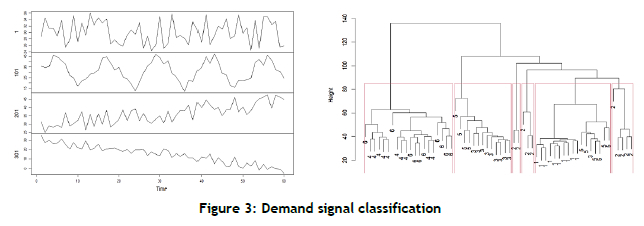
The virtual layer comprises two key components. The first consists of machine-learning models used to simulate scenarios that are based on varying daily demand levels. These models classify the cycle times (takt times) [33] required for receipt and storage operations. The second component consists of a digital twin that evaluates the key performance indicators associated with order preparation processes. Demand classification is performed using hierarchical clustering, based on Euclidean distance, which enables estimation of the personnel required to meet daily operational demands. Figure 3 illustrates distinct demand signal patterns: increasing, stable, decreasing, cyclical, positive cyclical, and negative cyclical trends [34].
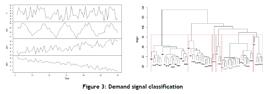
Given the dynamic nature of demand signal patterns, their analysis requires algorithms that are both flexible and robust in measuring sequence similarity. One such method is dynamic time warping (DTW), which accommodates variations in sequence length and temporal alignment. Although DTW is computationally intensive, several optimised variants have been developed to improve its efficiency. The Euclidean distance, often used as a baseline, could be considered a special case of DTW, in which sequences are aligned point by point without warping [35]. Figure 3 presents the dendrogram generated by applying hierarchical clustering to the identified signal patterns. Four distinct demand signal types were observed.
Euclidean distance (1) is generated between different moments of two time series to calculate the proximity between points and to use that distance in the hierarchical dendrogram. This dendrogram used average linkage between clusters.
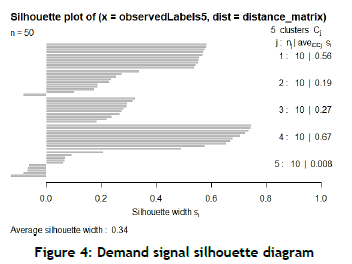
The DTW works by identifying shape similarity, based on the total reduction of the warping path. Figure 4 shows a reasonable structure within a silhouette score with demand signal values (2):
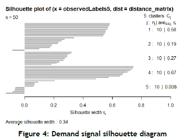

where
a average distance to points in the same cluster, and
b average distance to points in the nearest cluster.
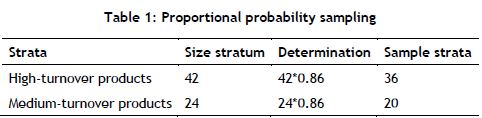
The study population consists of products from a leading Peruvian company in the national retail product distribution market. The population was divided into two categories: high-turnover products (42 items) and medium-turnover products (24 items). Proportional sampling was applied, based on the number of products in each category, resulting in a total sample size of 56 products. Stratified probabilistic sampling, proportional to the size of each category, was used to select the samples (Table 1). For sample selection, we used:

where
k number of standard deviations used in a normal distribution,
e error margin,
p expected proportion of selecting a product that meets specifications,
q complement of "p" (q=1- p), and
N number of total products.
A stratified probability sampling proportional to the size of each category was applied, as shown in Table 1. An adjustment factor of 0.86 was applied. Sampling was proportional to the size of the number of products in each category.
F = n/N, = 56/66 =0.86
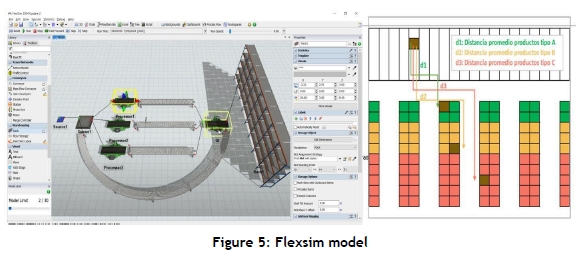
Products exhibiting an increasing demand trend require planning for additional personnel resources and the allocation of operational bays in distribution centres. Although unit operation times remain standardised, this type of demand is crucial for planning the replenishment of zero-level storage racks. In other words, it is essential to ensure that no products are missing from the first-level racks, as any need to move items from higher to lower levels leads to unproductive time during floor operations. Consequently, classifying products based on their demand patterns influences their placement relative to the nearest loading and unloading zones in the operational area. As shown in Figure 5, green zones are assigned stock keeping units (SKUs) with more inventory turnover, while other products with lower turnover ratios are located not so close to the receiving and dispatching areas.
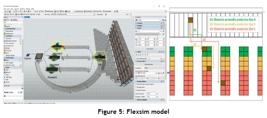
Flexsim 2024 simulation software was used to implement the memory logic in the virtual layer, as depicted in Figure 5. This simulation tool restricts the options for building the communication layer to protocols that support data transfer with the application. Several communication protocols were considered, including Modbus, object linking and embedding for process control (OPC), Siemens S7, Siemens programmable logic controller simulation, Allen-Bradley, Mitsubishi MC, and message queuing telemetry transport, all of which are supported by the simulator.
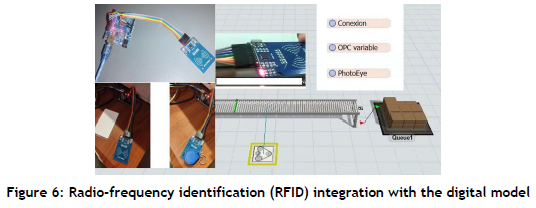
Slotting efficiency was evaluated by optimising the use of space and ensuring quick access to products, both of which are critical for real-time product tracking. To facilitate this, real-time tracking of product movement was required. RFID devices enable item flows to be tracked rapidly via radio waves, allowing access times to be calculated and corresponding performance indicators to be derived. For this purpose, an Arduino Uno, coupled with an RFID-RC522 card connected through a universal serial bus (USB) port, was used. Two types of passive RFID tags, proximity integrated circuit card MIFARE 1KB, were selected for testing, as RFID technology provides real-time visibility of products and supports the recording of inbound and outbound items from different storage areas.
The integration of RFID with the physical world relies on tagging physical products and tracking their movements in proximity to the RFID device (Figure 6).
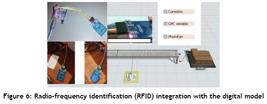
The communication layer facilitates information transfer between the physical and virtual worlds, which requires tracking RFID tags. In this study, the tags were read using the MFRC522 library (version 1.4.11) with C++ code compiled in Arduino IDE 2.3.2. This setup enabled the reading and registration of the unique identifier and select acknowledge stored on the tags. The Arduino transmitted the data using the ModbusRTUSlave library (version 2.0.6) for serial communication via a USB cable.
KEPServerEX version 6.17 was used to manage communication and to ensure interoperability between the software, data, and industrial systems, converting Modbus to OPC. To complete the communication layer, connectivity with Flexsim 2024 was established through the OPC protocol, linking to the KEPServerEX server.
The interaction between the RFID tracking equipment and Flexsim 2024 can be viewed at the following link: https://youtu.be/mWpE0v5nZMk.
4. RESULTS AND DISCUSSION
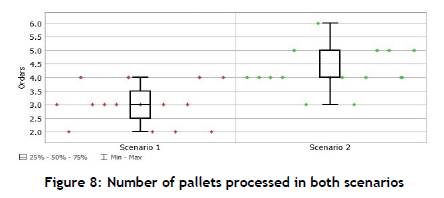
The weekly demand clustering configuration generates a modelled scenario in the flexsim simulator, which produces a report displaying the confidence interval for the difference in the number of pallets prepared between the initial scenario and the scenario incorporating RFID sensors for monitoring pallet placement.
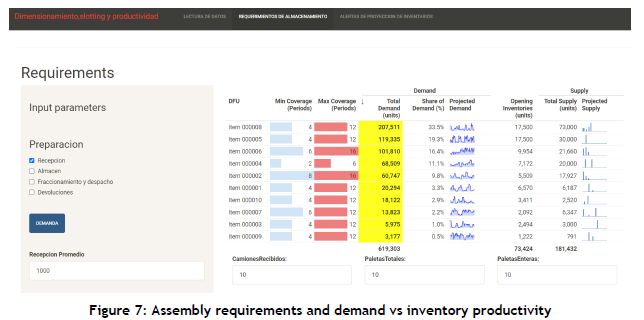
The productivity of receiving (processed pallets per hour and time required per pallet) served as the primary metric for evaluating the proposed system (Figure 7). This metric can be calculated using the R language syntax available at http://bit.ly/4lSZ0fT.

The placement of RFID tags significantly influences the measurement of operational productivity. In this study, passive tags were placed directly on product locations, in contrast to alternative approaches that attach sensors to parts of the forklift to identify the products being transported [12]. Digital twin models are valuable tools for planning manufacturing activities [7], [27].
Despite testing multiple configurations, libraries, and software solutions in the communication layer, full integration of all the components was not consistently achieved, resulting in partial connectivity. The most complex problem involved receiving data via the ModbusRTU protocol in Flexsim, which was resolved by integrating the KEPServerEX server using the OPC data access (DA) protocol. In contrast, communication between Flexsim 2024 and Arduino Uno via OPC DA proceeded without difficulties. The underlying causes of these technical problems fall outside the scope of this study, and should be addressed in future research. Similar to other studies, connectivity between Flexsim and the real world via OPC was successfully achieved. However, our proposal focuses on improving warehouse operability indicators, whereas others have focused on assessing the effectiveness of machinery interconnection [19].
Nonetheless, the successful integration of simple devices such as Arduino Uno and passive RFID tags demonstrates the feasibility of implementing digital twins for product tracking in warehouses using widely available low-cost devices. Supporting modular upgrades and continuous innovation, this architecture would be vital to meeting the evolving needs of intelligent warehouse management systems. This inherent flexibility ultimately drives the development of more agile, autonomous, and data-informed logistics networks.
Operational productivity in distribution centres aligns with the reduction of lead time reported by Jarašūnienė et al. [8], and incorporates the performance indicators proposed by Min [36].
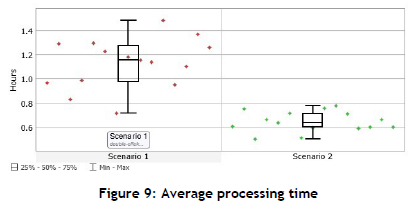
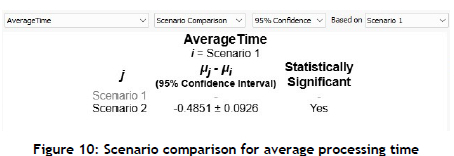
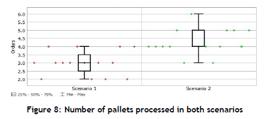
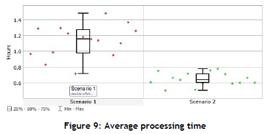
Two scenarios compared the number of pallets processed in an hour baseline (Figure 8) and average processing time (Figure 9) between sensor and non-sensor loading operations in the distribution centre. By leveraging the digital twin model, the facility achieved an increase of up to 40% to 42% in a confidence interval for processed pallets and a 38% to 44% decrease range in processing time.
In Figures 10 and 11 we present interval confidence comparisons, working with the Flexsim experimenter module.


5. CONCLUSIONS
This case study emphasises the continued need for software integration to ensure system interoperability. Importantly, a digital twin solution should be connected to cluster analysis for demand signals prioritisation to support slotting storage assignment, allowing real-time adjustments to be fed back into the physical model, thereby driving improvements in warehouse operational productivity. Consequently, these efficiencies contribute directly to reduced operational expenditure and enhanced responses to customers.
The findings indicate that the implementation of RFID technology, using low-cost tags and sensors integrated with open-source hardware platforms such as Arduino, provides a viable solution for the rapid and cost-efficient deployment of digital twins, aimed at product tracking within the framework of intelligent warehouse management.
ACKNOWLEDGEMENTS
This paper has received support from the Universidad de Lima-Scientific Research Institute (www.ulima.edu.pe/en/scientific-research).
REFERENCES
-
[1] A. A. Tubis and J. Rohman, "Intelligent warehouse in Industry 4.0 - Systematic literature review," Sensors, vol. 23, no. 8, 4105, Apr. 2023. https://doi.org/10.3390/s23084105
» https://doi.org/10.3390/s23084105 -
[2] Y. Zhu et al., "Production logistics digital twins: Research profiling, application, challenges and opportunities," Robotics and Computer-Integrated Manufacturing, vol. 84, 102592, 2023. doi: https://doi.org/10.1016/j.rcim.2023.102592
» https://doi.org/10.1016/j.rcim.2023.102592 -
[3] T. V. Le and R. Fan, "Digital twins for logistics and supply chain systems: Literature review, conceptual framework, research potential, and practical challenges," Computers & Industrial Engineering, vol. 187, 109768, 2024. doi: 10.1016/j.cie.2023.109768
» https://doi.org/10.1016/j.cie.2023.109768 -
[4] T. Nguyen, Q. H. Duong, T. V. Nguyen, Y. Zhu, and L. Zhou, "Knowledge mapping of digital twin and physical internet in supply chain management: A systematic literature review," International Journal of Production Economics, vol. 244, 108381, 2022. doi: 10.1016/j.ijpe.2021.108381
» https://doi.org/10.1016/j.ijpe.2021.108381 -
[5] R. Aiassi, S. M. Sajadi, S. M. Hadji-Molana, and A. Zamani-Babgohari, "Designing a stochastic multi-objective simulation-based optimization model for sales and operations planning in built-to-order environment with uncertain distant outsourcing," Simulation Modelling Practice and Theory, vol. 104, 102103, 2020. doi: 10.1016/j.simpat.2020.102103
» https://doi.org/10.1016/j.simpat.2020.102103 -
[6] P. Viveros, K. González, R. Mena, F. Kristjanpoller, and J. Robledo, "Slotting optimization model for a warehouse with divisible first-level accommodation locations," Applied Sciences, vol. 11, no. 3, 936, 2021. doi: 10.3390/app11030936
» https://doi.org/10.3390/app11030936 -
[7] J. S. Félix-Cigalat and R. Domingo, "Towards a digital twin warehouse through the optimization of internal transport," Applied Sciences, vol. 13, no. 8, 4652, 2023. doi: https://doi.org/10.3390/app13084652
» https://doi.org/10.3390/app13084652 -
[8] A. Jarašūnienė, K. Čižiūnienė, and A. Čereška, "Research on impact of IoT on warehouse management," Sensors, vol. 23, no. 4, 2213, 2023. doi: 10.3390/s23042213.
» https://doi.org/10.3390/s23042213 -
[9] T. Petković, D. Puljiz, I. Marković, and B. Hein, "Human intention estimation based on hidden Markov model motion validation for safe flexible robotized warehouses," Robotics and Computer-Integrated Manufacturing, vol. 57, pp. 182-196, 2019. doi: 10.1016/j.rcim.2018.11.004
» https://doi.org/10.1016/j.rcim.2018.11.004 -
[10] G. Garg, V. Kuts, and G. Anbarjafari, "Digital twin for FANUC robots: Industrial robot programming and simulation using virtual reality," Sustainability, vol. 13, no. 18, 10336, 2021. doi: 10.3390/su131810336
» https://doi.org/10.3390/su131810336 -
[11] V. Kuts, J. A. Marvel, M. Aksu, S. L. Pizzagalli, M. Sarkans, Y. Bondarenko, and T. Otto, "Digital twin as industrial robots manipulation validation tool," Robotics, vol. 11, no. 5, 113, 2022. doi: 10.3390/robotics11050113
» https://doi.org/10.3390/robotics11050113 -
[12] A. Frankó, G. Vida, and P. Varga, "Reliable identification schemes for asset and production tracking in Industry 4.0," Sensors, vol. 20, no. 13, 3709, 2020. doi: 10.3390/s20133709
» https://doi.org/10.3390/s20133709 -
[13] A. A. Alajami, G. Moreno, and R. Pous, "Design of a UAV for autonomous RFID-based dynamic inventories using stigmergy for mapless indoor environments," Drones, vol. 6, no. 8, 208, 2022. doi: 10.3390/drones6080208
» https://doi.org/10.3390/drones6080208 -
[14] L. Belli, L. Davoli, A. Medioli, P. L. Marchini, and G. Ferrari, "Toward Industry 4.0 with IoT: Optimizing business processes in an evolving manufacturing factory," Frontiers in ICT, vol. 6, 2019. doi: 10.3389/fict.2019.00017
» https://doi.org/10.3389/fict.2019.00017 -
[15] B. S. S. Tejesh and S. Neeraja, "Warehouse inventory management system using IoT and open source framework," Alexandria Engineering Journal, vol. 57, no. 4, pp. 3817-3823, 2018. doi: 10.1016/j.aej.2018.02.003
» https://doi.org/10.1016/j.aej.2018.02.003 -
[16] L. Fang, Q. Liu, and D. Zhang, "A digital twin-oriented lightweight approach for 3D assemblies," Machines, vol. 9, no. 10, 231, 2021. doi: 10.3390/machines9100231
» https://doi.org/10.3390/machines9100231 -
[17] Y. An, Y. Han, Y. Xu, S. Ouyang, M. Zhang, and S. Chen, "An auxiliary model of intelligent logistics distribution management for manufacturing industry based on refined supply chain," IEEE Access, vol. 11, pp. 47098-47111, 2023. doi: 10.1109/ACCESS.2023.3275010
» https://doi.org/10.1109/ACCESS.2023.3275010 -
[18] A. Ferrari, A. Carlin, C. Rafele, and G. Zenezini, "A method for developing and validating simulation models for automated storage and retrieval system digital twins," The International Journal of Advanced Manufacturing Technology, vol. 131, no. 11, pp. 5369-5382, 2024. doi: 10.1007/s00170-023-12660-y
» https://doi.org/10.1007/s00170-023-12660-y -
[19] Z. U. Rizqi, S.-Y. Chou, and W. N. Cahyo, "A simulation-based digital twin for smart warehouse: Towards standardization," Decision Analytics Journal, vol. 12, 100509, 2024. doi: 10.1016/j.dajour.2024.100509
» https://doi.org/10.1016/j.dajour.2024.100509 -
[20] S. Zaragoza Fernandez, S. Gomez Vazquez, J. Barreiro Montes, and S. Caeiro Oliveira, "Digital twin modeling of refrigerated warehouses," Dyna (Medellin), vol. 98, no. 3, pp. 234-439, 2023. doi: 10.6036/10736
» https://doi.org/10.6036/10736 - [21] M. Grieves and J. Vickers, "Digital twin: Mitigating unpredictable, undesirable emergent behavior in complex systems," in Transdisciplinary perspectives on complex systems, Cham: Springer, 2017, pp. 85-113. doi: 10.1007/978-3-319-38756-7_4
-
[22] T. D. Nguyen and S. Adhikari, "The role of BIM in integrating digital twin in building construction: A literature review," Sustainability, vol. 15, no. 13, 10462, 2023. doi: 10.3390/su151310462
» https://doi.org/10.3390/su151310462 - [23] P. Zuhr, L. Rissmann, and S. Meißner, "Framework for planning and implementation of digital process twins in the field of internal logistics," in IFAC-PapersOnLine, Elsevier, 2022, pp. 2221-2227. doi: 10.1016/j.ifacol.2022.10.038
-
[24] J. Lee, E. Lapira, B. Bagheri, and H. Kao, "Recent advances and trends in predictive manufacturing systems in big data environment," Manufacturing Letters, vol. 1, no. 1, pp. 38-41, Oct. 2013. doi: 10.1016/j.mfglet.2013.09.005
» https://doi.org/10.1016/j.mfglet.2013.09.005 -
[25] Q. Qi, F. Tao, Y. Zuo, and D. Zhao, "Digital twin service towards smart manufacturing," Procedia CIRP, vol. 72, pp. 237-242, 2018. doi: 10.1016/j.procir.2018.03.103
» https://doi.org/10.1016/j.procir.2018.03.103 -
[26] V. Makarov, A. Bakhtizin, G. Beklaryan, and A. Akopov, "Digital plant: Methods of discrete-event modeling and optimization of production characteristics," Business Informatics, vol. 15, no. 2, pp. 7-20, 2021. doi: 10.17323/2587-814X.2021.2.7.20
» https://doi.org/10.17323/2587-814X.2021.2.7.20 - [27] S. Dai, G. Zhao, Y. Yu, and Q. Bao, "The evolution from digital mock-up to digital twin," in Machine Learning and Artificial Intelligence: Proceedings of MLIS 2020, pp. 184-191. Frontiers in Artificial Intelligence and Applications, vol. 332, 2020. doi: 10.3233/FAIA200781
-
[28] H. R. Ganesh, P. S. Aithal, and P. Kirubadevi, "Integrated inventory management control framework," International Journal of Management, Technology, and Social Sciences, vol. 5, no. 1, pp. 147-157, 2020. doi: https://doi.org/10.47992/IJMTS.2581.6012.0087
» https://doi.org/10.47992/IJMTS.2581.6012.0087 -
[29] K. J. Roodbergen, I. F. A. Vis, and G. D. Taylor, "Simultaneous determination of warehouse layout and control policies," International Journal of Production Research, vol. 53, no. 11, pp. 3306-3326, 2015. https://doi.org/10.1080/00207543.2014.978029
» https://doi.org/10.1080/00207543.2014.978029 -
[30] L. N. Borisoglebskaya, E. N. Provotorova, S. M. Sergeev, and A. P. Khudyakov, "Automated storage and retrieval system for Industry 4.0 concept," IOP Conference Series: Material Science and Engineering, vol. 537, no. 3, 032036, 2019. doi: 10.1088/1757-899X/537/3/032036
» https://doi.org/10.1088/1757-899X/537/3/032036 -
[31] W. AlBalkhy, D. Karmaoui, L. Ducoulombier, Z. Lafhaj, and T. Linner, "Digital twins in the built environment: Definition, applications, and challenges," Automation in Construction, vol. 162, 105368, 2024. doi: https://doi.org/10.1016/j.autcon.2024.105368
» https://doi.org/10.1016/j.autcon.2024.105368 - [32] R. K. Yin, Case study research and applications: Design and methods, 6th ed., Sage, 2018.
-
[33] L. Gong, B. Zou, and Z. Kan, "Modeling and optimization for automobile mixed assembly line in Industry 4.0," Journal of Control Science and Engineering, vol. 2019, 3105267, 2019. doi: https://doi.org/10.1155/2019/3105267
» https://doi.org/10.1155/2019/3105267 - [34] P. E. Tsinaslanidis and A. D. Zapranis, "Dynamic time warping for pattern recognition," in Technical analysis for algorithmic pattern recognition, Cham: Springer, 2016, pp. 193-204. doi: 10.1007/978-3-319-23636-0_9
-
[35] H. Huang, Y. Li, and H. Liu, "Collaborative optimization strategy of source-grid-load-storage considering dynamic time series complementarity of multiple storages," IET Generation, Transmission & Distribution, vol. 17, no. 18, pp. 4007-4023, 2023. doi: 10.1049/gtd2.12862
» https://doi.org/10.1049/gtd2.12862 -
[36] H. Min, "Smart warehousing as a wave of the future," Logistics, vol. 7, no. 2, 30, 2023. doi: 10.3390/logistics7020030
» https://doi.org/10.3390/logistics7020030
Accepted for publication 8 Apr 2026
Available online 22 May 2026
ORCID® identifiers
J.A. Taquía Gutiérrez: https://orcid.org/0000-0002-1711-6603
J.M. Machuca de Pina: https://orcid.org/0000-0002-9284-6382