UTAUT and Technology Adoption in Construction: An Examination of Existing Applications
Abstract
This study investigates the application of the unified theory of acceptance and use of technology (UTAUT) in construction industry research. The synthesis reveals that many studies use extended UTAUT models to examine the adoption of information systems technologies in stable organisational settings, for which UTAUT was originally developed. The study confirms UTAUT's strong explanatory power: behavioural intention consistently predicts use behaviour, and performance expectancy remains the dominant determinant of intention. The study recommends prioritising further testing of the baseline model, investigation of the adoption of construction materials and systems, and explicitly accounting for construction's project-based context.
Abstract
Hierdie studie ondersoek die toepassing van die verenigde teorie van aanvaarding en gebruik van tegnologie (UTAUT) binne navorsing oor die konstruksiebedryf. Die sintese toon dat baie studies uitgebreide UTAUT-modelle gebruik om die aanvaarding van inligtingstelseltegnologieë in stabiele organisatoriese omgewings te ondersoek, waarvoor UTAUT oorspronklik ontwikkel is. Die studie bevestig UTAUT se sterk verklaringsvermoë: gedragsvoorneme voorspel konsekwent gebruiksgedrag, terwyl prestasieverwagting die belangrikste bepaler van voorneme bly. Die studie beveel aan dat verdere toetsing van die basismodel geprioritiseer word, dat die aanvaarding van boumateriale en -stelsels ondersoek word, en dat die projekgebaseerde aard van die konstruksiebedryf uitdruklik in berekening gebring word.
1. INTRODUCTION
The importance of technology and innovation adoption for managers in industries has become increasingly evident, particularly as organisations operate in highly competitive and rapidly changing environments. Effective managers recognise that the adoption of innovative technologies is essential not only for maintaining competitiveness but also for improving efficiency and driving organisational growth [1]. In the manufacturing industry, for instance, robotics and automation have positively transformed factory floor processes [2], and the adoption of advanced manufacturing techniques is resulting in shorter value chains, fewer production inputs, lower product costs, and more sustainable outputs and processes [3]. Healthcare facilities have also adopted innovative technologies, including security programs to protect patient privacy and barcoding to ensure accurate medication administration [4]. In the agricultural industry, the Internet of Things (loT) equips farmers with decision-making tools and technologies to enhance productivity [4].
Unlike the industries mentioned above, the construction industry is perceived as slow to adopt new technologies and innovation [5]. Management resistance to change, lack of awareness of new technologies, implementation costs, lack of expertise, lack of user demand, project complexities, and fragmentation in the industry are just some of the factors identified in the literature as limiting the adoption of various technologies in the construction industry [6], [7], [8]. Still, research suggests that new technologies could improve performance, productivity, and efficiency in the construction industry [9]. Investigations into the factors that affect technology adoption have been conducted in other fields. In the information systems field, these investigations have led to the development of several models, frameworks, and theories to explain adoption phenomena among individuals and organisations [10], [11], [12]. In 2021, [13] identified a growing trend towards using technology acceptance models to investigate technology adoption in the construction industry.
Several theories have been proposed to explain user adoption and acceptance of technologies. The theory of reasoned action [14], the theory of planned behaviour [15], and the diffusion of innovations [16] are among the most common frameworks [12]. However, choosing the right framework for the right context is not a straightforward process, and has long been difficult for adoption researchers [11]. Venkatesh [17] tackled that challenge by developing the unified theory of acceptance and use of technology (UTAUT), which combines elements from eight previous theories into a single framework. UTAUT was more accurate than the previous methods in explaining technology adoption, and has since been widely used in adoption studies in various industries [13], [17], [18]. Since its inception, several reviews have been conducted on the application of UTAUT, including its general use [10], [18], [19], in the education sector [20], [21], in mobile payments [22], and in government [23]. No dedicated review of UTAUT's application in the construction industry has been identified in the literature [13], [24]. This study, therefore, seeks to investigate the use of UTAUT in the construction industry. The significance of the study lies in its interrogation of the operationalisation of UTAUT in the construction industry, an environment that is structurally different from UTAUT's foundational context. The results demonstrate that studies have repeatedly investigated adoption among individuals in stable organisational contexts with several additional variables and extensions, with limited recourse to the unique factors that differentiate the construction industry from others.
The remainder of this paper is structured as follows. Section 2 reviews the literature on technology adoption theories and their application in the construction industry. Section 3 describes the systematic review methodology. Section 4 presents the results, and Section 5 discusses the findings. Section 6 concludes with recommendations for future research.
The construction industry is widely regarded as risk-averse and resistant to technology and innovation adoption [25]. However, improved outputs from other industries, the rise of digitalisation, and the growing need to improve construction processes to meet modern demands for cost efficiency, faster delivery, greater value, and sustainability goals have driven the industry to invest in technology and innovation [26], [27]. Despite these efforts, the construction industry has a reputation for slow technology adoption. Several studies have investigated the adoption of recent technologies, proffered reasons for limited adoption, and suggested solutions to improve adoption [28], [29]. In the absence of a unified theory of innovation adoption in the construction industry, researchers have begun to recognise the utility of established behavioural and organisational theories that are proposed to explain adoption behaviour, and are using these frameworks to investigate the uptake of innovation and technology in construction [13].
One such framework is the theory of reasoned action (TRA), developed by Martin Fishbein and Icek Ajzen. TRA prescribes that behavioural intention is a function of an individual's evaluation of the outcomes of behaviour in the light of their attitudes and beliefs about what significant others think and expect [14]. Ajzen extended TRA by including an individual's perception of their ability to perform an action, termed "perceived behavioural control", to then form the theory of planned behaviour (TPB) [30]. Building on the foundations of behavioural research, researchers in the field of information systems (IS) began developing theories of technology adoption. The technology acceptance model (TAM) is one of the earliest frameworks used in IS research, and proposes that users' acceptance of technology is based on perceived usefulness and ease of use [31]. Just like TRA, TAM has also been extended by several researchers. Some of the extended TAM frameworks include the combined TAM and TPB (C-TAM-TPB), TAM2, and TAM3. Beyond these theories, the innovation diffusion theory (IDT), the theory of task-technology fit (TTF), and the social cognitive theory (SCT) are some other well-researched theories of technology adoption [32], [33].
Another TAM extension, UTAUT, was developed by combining several constructs from some of the aforementioned theories and from others to create a unified model for explaining technology acceptance. Venkatesh et al. [17] developed UTAUT by examining eight existing models that explained why people adopt new technology. They compared these models, identified common patterns, and combined the strongest elements into a unified theory. They tested this new model using real data, and found that it explained technology adoption more effectively than any of the original models. UTAUT simplified the process by focusing on four main factors that influence the adoption of a system: performance expectancy (PE) - how useful people think the technology is; effort expectancy (EE) - how easy it is to use; social influence (SI) -whether others encourage them to use it; and facilitating conditions (FC) - whether they have the right support to use it [11]. These four factors determine an individual's behavioural intention (BI) to adopt a technology, which in turn predicts actual use behaviour [17]. Since its introduction, UTAUT has been applied in various industries to investigate the adoption of multiple technologies, including traditional IS technologies and non-IS technologies. Its ability to explain adoption has consistently been established as superior to that of existing theories [18]. UTAUT has also been extended and adapted, with the latest iteration being UTAUT2 [34].
A growing body of research has applied these technology adoption theories to the construction industry. A recent review of articles published up to 2023 on technology adoption in the construction industry identified over 100 studies in this research domain [24]. Of these, TAM and its extensions are the most widely used theories, with TPB and TRA among the least used [13], [24]. UTAUT has achieved moderate uptake. Separate syntheses of technology adoption studies in the construction industry conducted by [13] and [24] have identified only seven applications of UTAUT or its variations and extensions in construction research. However, the present review identified 33 studies that applied UTAUT in construction research, indicating that the framework has been used more broadly than those syntheses suggest, although in a fragmented and inconsistent way. In contrast to existing reviews that explore construction technology adoption more generally, typically aggregating findings from multiple theories of technology adoption, this paper presents a focused synthesis centred on a single theory. In doing so, it addresses a significant gap in the literature: while overall trends in construction innovation have been well reviewed, the specific role, evolution, and theoretical boundaries of UTAUT remain underexplored. No comprehensive synthesis currently examines how UTAUT has been adapted, extended, or validated in the construction context, and there is limited understanding of how frequently researchers modify core constructs, how consistently these constructs are defined and measured, and which adoption settings or technologies are most commonly studied. This review clarifies how UTAUT has been applied in construction studies to identify key factors, themes, and modifications to the theory in the field.
3. METHODOLOGY
To achieve the study's aim, a systematic literature review (SLR) of studies investigating technology adoption in the construction industry using the UTAUT model was conducted. Linnenluecke's framework for conducting SLRs [35] was adopted for this study. It involves identifying the relevant literature, data cleaning, analysing and synthesising the data, and finally presenting the results. The preferred reporting items for systematic reviews and meta-analyses (PRISMA) framework [36] was also used to model the process. A comprehensive search strategy to locate relevant studies on the Scopus and Web of Science (WoS) databases was first developed. Both databases are established repositories for journal indexing [37]. The search strategy involved developing and testing several combinations of terms related to the investigation of technology adoption in the construction industry using UTAUT. After several iterations using different search terms, "UTAUT", "unified theory of acceptance and use of technology", "construction industry", "construction sector", "building industry", "building sector", and "built environment" were selected as the final search terms based on the comprehensiveness of the relevant literature they covered. The search was conducted in March 2025, and the terms, results, and links have been documented to facilitate potential reproducibility by other authors.
The combined search results numbered 71. Data from the results, including titles, author names, and abstracts, were retrieved from the databases and imported into EndNote referencing software for data cleaning. In the first step, 26 studies were identified as duplicates and removed from further analysis. This left 45 records whose titles and abstracts were then reviewed against the inclusion and exclusion criteria. Records were selected for analysis if they addressed the adoption of a specific technology or innovation in the construction industry and used the UTAUT model. A total of 33 initial studies met the inclusion criteria. These studies were then uploaded onto ATLAS.ti for further analysis. The articles were grouped according to a classification scheme adapted from Venkatesh [18]: general citation, UTAUT application, UTAUT integration, and UTAUT extension. General citation comprised papers that cited UTAUT in passing and studies that proposed to apply, integrate, or extend UTAUT but had not yet tested the model [18]. UTAUT application comprised papers that applied UTAUT in whole or in part as its research model in a particular setting. UTAUT integration comprised empirical studies that integrated part of or the complete UTAUT with at least one other theory of theoretical significance in its research model; and UTAUT extension comprised empirical studies that used UTAUT, in whole or in part, as the baseline model and extended it with new variables, whether exogenous, endogenous, moderating, or outcome mechanisms [18].
4. RESULTS
4.1. Overview of the evidence base
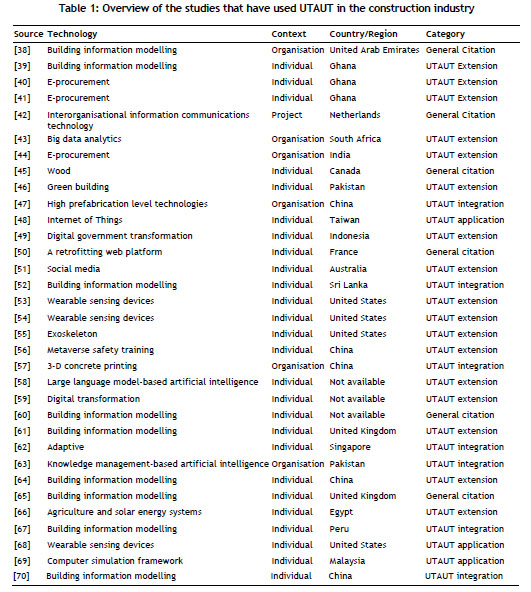
In total, 33 articles were reviewed and analysed for this study. Several data points, including the type of technology, the investigation's context, and the country or region, were coded and retrieved from the articles, and are presented in Table 1. The majority of the articles were extension studies (17), followed by integration studies (7), general citation studies (6), and application studies (3). The investigations typically targeted individuals, although some studies provided organisational implications. The majority of technologies studied were IS-type technologies, such as building information modelling (BIM), the Internet of Things (IoT), and artificial intelligence (AI). Only one study investigated a building material.
Several articles straddled classification boundaries. For instance, [49] combined UTAUT with the IS success model and other constructs in their study to investigate factors influencing the adoption of digital construction software and its likelihood of success. In this case, each framework served a different purpose: the IS success model for the system's success and specifically for influencing PE, and UTAUT for technology acceptance. Further, the authors extended UTAUT to include digital literacy, trust, and technology readiness to reflect individual differences among potential adopters and the influence of these factors on BI [49]. In this review, the article is classified as an extension study because the extension constructs, rather than the IS model, were used to measure BI directly. On the other hand, [70], which used TTF and trust as additional constructs influencing BI, was classified as an integration study based on the proposed link between TTF and BI. Fathima [52] examined the factors influencing the adoption of BIM in the Sri Lankan construction industry using a conceptual model that replaced PE and EE with their TAM antecedents. Although replacing the former with the latter does not introduce new theoretical mechanisms or explanatory power, the presence of constructs from a different framework led to the classification of the article as an integration study. Some articles, such as [42], [45] and [50], are classified as general citation papers despite collecting empirical data, because the data were not used to test the UTAUT-based framework.
Methodologically, the reviewed articles primarily used the individual as the unit of analysis to investigate adoption intentions. Most studies surveyed individual practitioners, such as quantity surveyors, architects, and engineers, to gauge their acceptance of technology. For instance, [39] focused on individual quantity surveyors in Ghana, while [67] examined the intentions of architects, engineers, and construction professionals in Peru. Similarly, [48] focused on construction personnel's willingness to adopt IoT, whereas studies focusing on safety technologies specifically targeted field workers [53], [54], [68]. A minority of studies shifted the unit of analysis to the organisation or enterprise. Khan [63] explicitly examined small and medium organisations as a unit of analysis, while [57] investigated organisational adoption of 3D printing, noting that organisational decisions are often measured through individual assessments. Cai [47] explored adoption from an organisational perspective. While authors consistently contextualised their findings in the volatile nature of the construction industry, these were rarely factored into the development or testing of models.
4.2. General citation
Six studies were classified under the general citation category. Abdulrahim [38] evaluated the determinants of BIM adoption in the UAE construction industry and their impact on organisational performance. In the paper, a conceptual framework is presented that maintains the direct link between PE, BI, and use behaviour, as per UTAUT, and adds organisational performance as an outcome mechanism of use behaviour. Other constructs and relationships in UTAUT were excluded from the model, with only PE and BI retained because they are the best predictors of new technology use, according to the author. A conceptual model for the adoption of BIM in facilities management was also developed by [60], combining UTAUT with the TTF. The TTF was proposed as an extension of UTAUT because it argues that technology will be adopted only when it fits users' actual job tasks. According to [60], if the TTF of BIM is good, facilities management practitioners are more likely to adopt BIM; if the fit is poor, they revert to traditional methods despite BIM's theoretical benefits. On this basis, the study proposed that TTF increases BIM adoption in facilities management and that TTF enhances PE. Another conceptual model for BIM adoption was developed by [65] for the construction supply chain. UTAUT was used as the core because it captures individual-level determinants of acceptance, while security expectancy was introduced as an extension to address the high transactional and relational risk inherent in supply-chain collaboration. The Technology-Organisation-Environment (TOE) framework was then layered onto this structure to explain how technological, organisational, and environmental antecedents shape these UTAUT constructs rather than treating acceptance solely as an individual-level cognitive process. Finally, technology readiness was added to capture users' affective preparedness to adopt BIM.
Beyond BIM, Adriaanse [42] used ethnography and grounded theory to explain why actors in a construction project did not use interorganisational information and communications technology (ICT) as intended. They developed a theoretical model based on personal motivation, external motivation, knowledge and skills, and opportunities to act to explain changes in usage barriers over time. They then compared this theoretical model with established frameworks, including UTAUT. Personal motivation was associated with PE and EE, while external motivation was associated with SI. Knowledge, skills, and acting opportunities were linked to FC. Barrane [45] proposed an extended UTAUT framework that includes resistance to change and limited availability as exogenous variables influencing the intention to use wood in non-residential construction. Resistance to change, conceptualised as negatively affecting adoption intention, was attributed to two factors: a preference for longstanding materials and negative societal prejudices about wood. Finally, [50] evaluated a renovation-management platform using a questionnaire structured around the four core UTAUT constructs. Through simple majority calculations of survey responses, the study indicated that most users believed the platform would improve project management and found it easy to use. Doukari [50] borrowed UTAUT constructs to structure a user-acceptance questionnaire, but did not operationalise UTAUT as a research model, test UTAUT relationships, nor position its analysis within the UTAUt theoretical framework.
4.3.
UTAUT applicationThree studies were classified under the application category. Chen [48] used UTAUT to examine construction workers' willingness to adopt IoT. Notably, this study measured the framework in its entirety, including the effects of the moderating variables. Venkatesh [18] previously noted the tendency for empirical UTAUT studies to exclude moderating variables, and argued that this limits the framework's generalisability and obscures its boundary conditions. The results of the investigation by [48] showed that PE, EE, and SI each had a significant impact on workers' intentions to adopt IoT applications. Gender (EE and SI), voluntariness (SI), and experience (FC) also had significant moderating effects. However, FC and BI were not deemed to have a significant impact on actual IoT use, which deviates from the established consensus on their influence. BI, in particular, has been shown to be the dominant predictor of actual use by many studies [10]. Okpala [68] tested TPB, TAM, and UTAUT to investigate construction workers' intention to adopt wearable sensing devices (WSDs) and proposed a hybrid conceptual model to explain their adoption in the construction industry. Their study found that UTAUT had the highest predictive power for intention to use WSDs, supporting previous claims that UTAUT is the best predictor of technology adoption [17], [18]. SI, in particular, was observed to be the strongest predictor of BI and, along with PE and EE, explained over 90% of the model's variance [68]. The final study in this subsection was more limited in scope; it used a purely descriptive approach, reporting only the percentages for each UTAUT construct that affected the use of computer simulation framework technology [69]. The study did not perform any statistical analysis to assess the validity of these constructs.
4.4.
UTAUT integrationThe integration of other technology adoption models with UTAUT and its extensions, incorporating other constructs as described in the next subsection, accounted for 73% of the studies reviewed in this paper. Cai [47] developed and tested a conceptual model that combined UTAUT with TTF to explain the adoption of high prefabrication level technologies. Their model had several interrelationships between the combined models. Task characteristic, an independent construct of TTF, was proposed to influence adoption intention, while technology characteristic, the other independent construct in TTF, was proposed to influence PE. TTF acted both as a dependent variable for task and technology characteristics and an independent variable influencing BI, actual use, and PE. Furthermore, FC was proposed to influence EE, which in turn influenced PE [47]. A simpler integration of UTAUT and TTF was provided by [70], with TTF acting as an independent variable influencing both PE and BI. In [57], UTAUT was combined with TOE to explore the factors having an impact on the adoption of 3D concrete printing in construction organisations. The authors hypothesised that individual perceptions of a technology have an impact on organisational adoption; thus, UTAUT was used to investigate individual perceptions, with organisational effects measured using TOE and serving as moderators of the effect on individual perceptions on organisational adoption [57]. While the results showed that individual assessments of the technology had a significant impact on organisations' intention to adopt, the effect of singular UTAUT constructs was not measured [57].
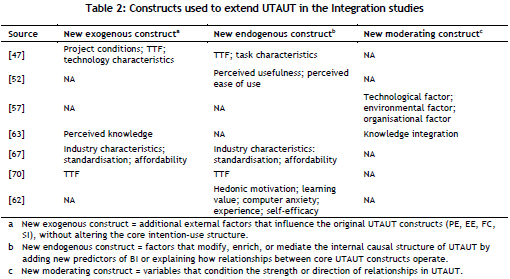
Similarly, [67] measured the core constructs of UTAUT as a singular factor in their study investigating BIM adoption in Peru. Their multi-level approach identified industry-level elements - industry characteristics, standardisation, and affordability, collectively referred to as cultural-cognitive elements - as influencing both user perceptions (PE, EE, and SI) and BI. The relationship between user perceptions as a unit and BI was established, but, as in [58], the effects of the individual UTAUT constructs were not delineated. Khan et al. [63] integrated elements of UTAUT and knowledge management theory to investigate the factors affecting the adoption of AI-based technology in construction SMEs. In their model, BI was influenced by PE and EE, which in turn were affected by perceived knowledge. They proposed that the effect of BI on actual AI use was moderated by knowledge integration. These relationships were validated by their results, with high knowledge integration strengthening the link between BI and actual use [63]. The final article in this sub-section was [62], which investigated the adoption of adaptive learning among construction professionals in Singapore. Their model combined an extended UTAUT (UTAUT2) with the general extended technology acceptance model for e-learning to account for e-learning-specific factors. Of the core UTAUT constructs, only PE's influence on BI was supported [62]. Table 2 presents the constructs used in the integration studies and their conceptualisations to influence UTAUT. The definitions of exogenous, endogenous, moderating, and outcome constructs are based on [18].
4.5. UTAUT extension
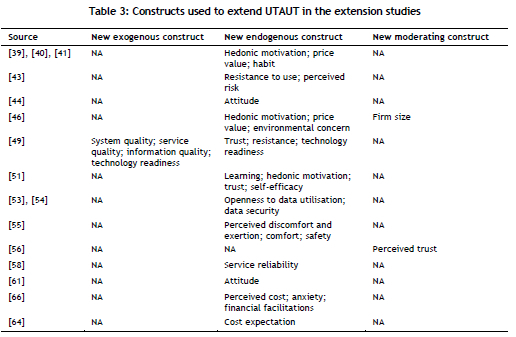
Venkatesh [18], [34] observed that UTAUT has often been extended in empirical studies to expand understanding of technology acceptance beyond the organisational context. In this vein, [34] extended UTAUT with three constructs - hedonic motivation (HM), price value (PV), and habit - to develop UTAUT2 as an extended UTAUT for consumer use contexts. In this review, [39], [40], [41] used UTAUT2 to investigate technology adoption in the Ghanaian construction industry. In [39], the authors found that the influence of EE, FC, and the extended construct HM on the intention to use BIM was supported, while PE and SI were not. This result was reversed in [40] and [41]. PE and SI were influential in construction professionals' intention to adopt e-procurement in both studies [40], [41]; in addition, FC was observed to influence adoption in [41]. Beyond UTAUT2's extensions, this sub-section saw the most UTAUT extensions. Anxiety influenced BI in [66]; so did attitude [44], comfort [55], cost [46], [64], data security [54], environmental concern [46], openness to data utilisation [54], service reliability [58], trust [49], resistance to use, and perceived risk [43]. Knowledge-sharing was found to influence actual use [51]; as did attitude [61], environmental concern, and cost [46]. Other non-significant extensions were financial facilitations [66], learning [51], and safety [55]. Anxiety in [66] was defined as the sense of apprehension an individual feels when using a technology; however, its inclusion as a direct determinant of BI presents a theoretical redundancy. As [17] established, anxiety acts as an antecedent to EE and poses no direct effect on intention beyond EE. Attitude, derived from TRA and used in [44], refers to beliefs about the benefit of using a technology. Again, [17] argued that attitude is significant only when PE and EE are excluded, as these constructs account for both positive and negative evaluations of a technology. However, [61] found a significant relationship between attitude and user adoption, arguing for the importance of attitude in mandatory contexts.
4.6. Relationship analysis
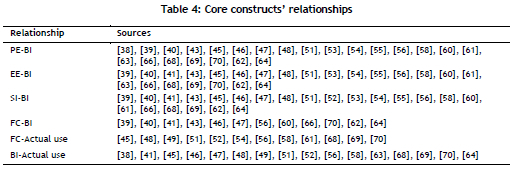
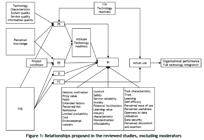
Using the studies included in this review, several relationships were proposed and tested. The most common relationships to be tested were the effects of PE, EE, and SI on BI, and the effect of BI on actual use. FC relationships were split between BI and actual use. While the original conceptualisation of UTAUT proposed a relationship between FC and actual use [17], the effect of FC on BI has become a common proposition [10], [18]. These relationships are outlined in Table 4.
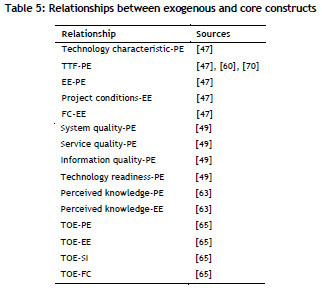
Several extensions were also introduced to influence the original UTAUT constructs, as outlined in Table 5.
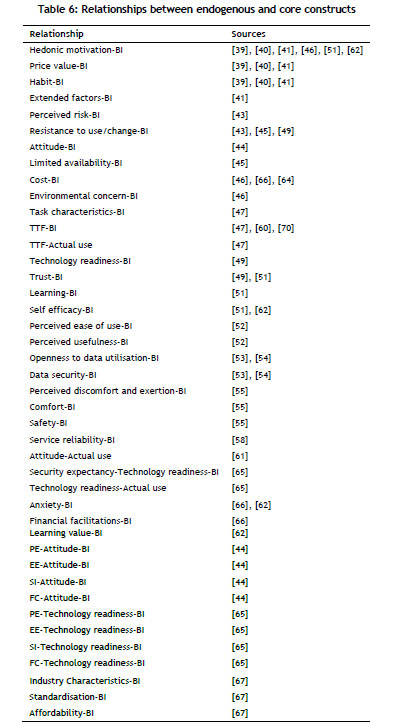
The majority of extensions were endogenous, modifying, enriching, or mediating relationships among the core UTAUT constructs. These relationships are outlined in Table 6.
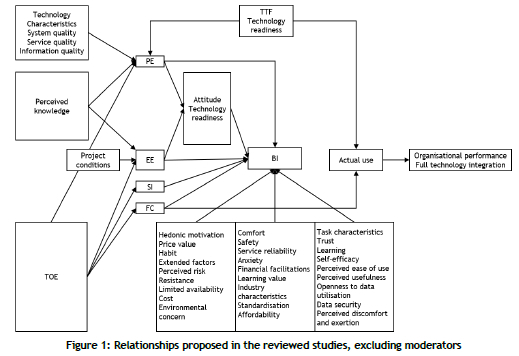
The fewest relationships were those involving outcome and moderating constructs. Organisational performance [38] and full technology integration [65] were two outcome constructs deriving from actual use behaviour. The relationship between BI and actual use was moderated by firm size [46], perceived trust [56], and knowledge integration [63]. The relationships conceptualised in the reviewed studies are modelled in Figure 1. The figure was compiled by the authors from the conceptual models and the empirical results reported in the reviewed studies.
4.7. Weight analysis
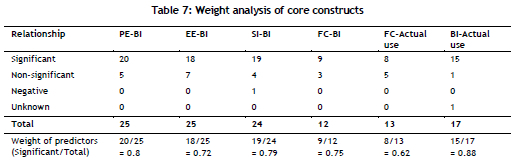
The operationalisation of UTAUT in construction was evaluated using a weighted analysis approach developed by [71] and previously used in a UTAUT review by [10]. This was derived by determining the ratio of statistically significant findings to the total number of times the variable was tested, distinguishing between variables that are merely popular and those that are consistently effective. Following the caution raised by [71] regarding the reliability of experimental variables, the analysis focused exclusively on the core UTAUT constructs. This approach mirrored the analysis by [10], and mitigated the risk of inflating success rates based on variables that have not been repeatedly empirically validated. Table 7 provides the weight analysis of the core constructs.
The results show that BI is an excellent predictor of actual technology use in the construction industry, based on the guideline by [71] that the best predictors have a weight rating greater than 0.8. On the other hand, FC with a weight of 0.62 has a marginal effect on actual technology use. Regarding BI as a dependent variable, PE, EE, SI, and FC each have high weight scores, all above 0.7. PE is the best predictor of BI, supporting the established trend in UTAUT research [10].
5. DISCUSSION
A key finding of this review is the extensive and largely unstructured use of additional constructs to extend UTAUT in construction studies. From the reviewed articles, over 30 additional constructs were introduced, which, on face value, might suggest the need for additional explanations for technology adoption in the construction industry. In many cases, however, additional constructs were introduced without a clear explanation of why the original UTAUT mechanisms were insufficient or how the new constructs conceptually differed from existing ones. This raises legitimate questions about construct redundancy and model inflation, a critique already levelled at UTAUT extensions [72]. Furthermore, the review reveals a scarcity of research on UTAUT beyond IS technologies. With few exceptions, such as [46] and [45], the theory has not been meaningfully adapted for non-IS technologies, such as construction materials, methods, or systems. This represents a missed opportunity to test the theory beyond its traditional IS context, which limits both the empirical scope of UTAUT applications and the theoretical learning that could emerge from testing its assumptions in fundamentally different adoption contexts. This also raises questions about the validity of the extensions, given that most of the studies reviewed investigated the adoption of IS technologies among individuals or in organisational settings - the precise context for which UTAUT was designed.
Moreover, only three studies have tested the original model, and just one has accounted for the full range of constructs and moderators mandated by the original framework. Without establishing a baseline, it is difficult to confirm whether UTAUT's core logic holds true for the construction industry. It also fragments the literature into isolated findings rather than building a cumulative body of knowledge about technology adoption in the construction industry. Specifically, contextual factors, such as the construction industry's adoption of a project-based delivery model and its reliance on temporary multidisciplinary teams, were rarely considered. Previous studies have explored the complexity of change management in project-based industries [73], and in this review, only [42] explicitly included the complexity of project-based work in their investigation of the mechanisms that shape how actors in a project adopt a new technology. According to [42], adoption cannot be viewed simply as a static decision in construction contexts but as dynamic and situational. Moreover, they contend that the project-based, temporary, and fragmented nature of construction fundamentally reshapes adoption decisions: short project timeframes, inter-organisational collaboration, and misaligned objectives intensify barriers to technology use in ways that individual attitude-based models such as UTAUT cannot fully explain [42]. Instead, many studies in this review default to individual adoption intent in stable organisational settings, which mirrors IS adoption research. The effect of this approach is that project-level dynamics are rarely established or tested.
Despite these limitations, the analysis reveals UTAUT's consistent ability to explain individual adoption intent in stable organisational settings. BI is the strongest predictor of actual use, a finding that aligns closely with the original model and subsequent reviews. Similarly, PE emerged as the most influential determinant of BI, outperforming other constructs, and consistent with previous studies. Since the major constructs of UTAUT demonstrate sufficient explanatory power, the necessity for the model's continued expansion is questionable. The literature is currently characterised by several variables that have been proposed or tested only once, making it difficult to ascertain their broader theoretical validity. Consequently, future research should prioritise consolidating knowledge by re-testing these existing extensions, rather than further diluting the theory with additional, isolated constructs. Williams [10] observed the dominance of cross-sectional studies in UTAUT research, a pattern also evident in this review. Therefore, there is scope for future research to adopt more longitudinal research designs, collecting data at multiple points over time, in their investigations.
6. CONCLUSION
This study aimed to investigate the operationalisation of the unified theory of acceptance and use of technology in the construction industry to identify key factors, themes, and modifications to the theory. Following a screening process of relevant available literature, thirty-three studies were identified for review. The review revealed that the most common application of UTAUT is in the adoption of information systems technologies among individuals in stable organisational contexts, the precise context for which UTAUT was designed. However, several extensions were proposed without a clear rationale, failing to demonstrate why the baseline UTAUT constructs were inadequate to explain these additional factors. Further, there is a distinct lack of articles that test UTAUT as originally conceptualised, the effect of the project-based nature of construction work, and the adoption of construction materials, methods, and systems. Therefore, it is recommended that future studies test the baseline UTAUT and existing conceptual frameworks to establish their explanatory strength, investigate the adoption of material technologies and systems, and account for the project-based nature of the construction industry. The significance of this study lies in its critical synthesis of how UTAUT has been adapted and applied in construction research, and in what these adaptations reveal about the framework's suitability beyond its original context. The review also clarifies the current state of UTAUT-based research on construction adoption, and provides a more coherent foundation for future theory development and application in the discipline.
REFERENCES
2. LITERATURE REVIEW
-
[1] M. Dasgupta, R. K. Gupta, and A. Sahay, "Linking technological innovation, technology strategy and organizational factors," Global Business Review, vol. 12, no. 2, pp. 257-277, Jun. 2011. doi: 10.1177/097215091101200206
» https://doi.org/10.1177/097215091101200206 -
[2] A. Stornelli, S. Ozcan, and C. Simms, "Advanced manufacturing technology adoption and innovation: A systematic literature review on barriers, enablers, and innovation types," Research Policy, vol. 50, no. 6, 104229, Jul. 2021. doi: 10.1016/j.respol.2021.104229
» https://doi.org/10.1016/j.respol.2021.104229 -
[3] M. Gebler, A. J. M. Schoot Uiterkamp, and C. Visser, "A global sustainability perspective on 3D printing technologies," Energy Policy, vol. 74, pp. 158-167, Nov. 2014. doi: 10.1016/j.enpol.2014.08.033
» https://doi.org/10.1016/j.enpol.2014.08.033 -
[4] R. Abbasi, P. Martinez, and R. Ahmad, "The digitization of agricultural industry - A systematic literature review on agriculture 4.0," Smart Agricultural Technology, vol. 2, 100042, Dec. 2022. doi: 10.1016/j .atech.2022.100042
» https://doi.org/10.1016/j .atech.2022.100042 -
[5] T. O. Olawumi, S. Ojo, D. W. M. Chan, and M. C. H. Yam, "Factors influencing the adoption of blockchain technology in the construction industry: A system dynamics approach," in Proceedings of the 25th International Symposium on Advancement of Construction Management and Real Estate, Singapore: Springer Singapore, 2021, pp. 1235-1249. doi: 10.1007/978-981-16-3587-8_84
» 10.1007/978-981-16-3587-8_84 - [6] K. Ullah, I. Lill, and E. Witt, "An overview of BIM adoption in the construction industry: Benefits and barriers," in 10th Nordic Conference on Construction Economics and Organization (Emerald Reach Proceedings Series), vol. 2, I. Lill and E. Witt, eds., Leeds: Emerald Publishing Limited, 2019, pp. 297-303. doi: 10.1108/S2516-285320190000002052
-
[7] W. Albalkhy and R. Sweis, "Barriers to adopting lean construction in the construction industry: A literature review," International Journal of Lean Six Sigma, vol. 12, no. 2, pp. 210-236, Mar. 2021. doi: 10.1108/IJLSS-12-2018-0144
» https://doi.org/10.1108/IJLSS-12-2018-0144 -
[8] D.-G. J. Opoku, S. Perera, R. Osei-Kyei, M. Rashidi, K. Bamdad, and T. Famakinwa, "Barriers to the adoption of digital twin in the construction industry: A literature review," Informatics, vol. 10, no. 1, 14, Jan. 2023. doi: 10.3390/informatics10010014
» https://doi.org/10.3390/informatics10010014 -
[9] S. M. E. Sepasgozar and S. Davis, "Construction technology adoption cube: An investigation on process, factors, barriers, drivers and decision makers using NVivo and AHP analysis," Buildings, vol. 8, no. 6, 74, 2018. doi: 10.3390/buildings8060074
» https://doi.org/10.3390/buildings8060074 -
[10] M. D. Williams, N. P. Rana, and Y. K. Dwivedi, "The unified theory of acceptance and use of technology (UTAUT): A literature review," Journal of Enterprise Information Management, vol. 28, no. 3, pp. 443-488, Apr. 2015. doi: 10.1108/JEIM-09-2014-0088
» https://doi.org/10.1108/JEIM-09-2014-0088 -
[11] D. Marikyan and S. Papagiannidis, "Unified theory of acceptance and use of technology," in TheoryHub book, S. Papagiannidis, ed., Newcastle upon Tyne: Newcastle University, 2022. Accessed: Mar. 18, 2025. [Online]. Available: https://open.ncl.ac.uk/theories/2/unified-theory-of-acceptance-and-use-of-technology/
» https://open.ncl.ac.uk/theories/2/unified-theory-of-acceptance-and-use-of-technology/ -
[12] S. Koul and A. Eydgahi, "A systematic review of technology adoption frameworks and their applications," Journal of Technology Management & Innovation, vol. 12, no. 4, pp. 106-113, 2017. doi: 10.4067/S0718-27242017000400011
» https://doi.org/10.4067/S0718-27242017000400011 -
[13] C. Nnaji, I. Okpala, I. Awolusi, and J. Gambatese, "A systematic review of technology acceptance models and theories in construction research," Journal of Information Technology in Construction, vol. 28, pp. 39-69, 2023. doi: 10.36680/j.itcon.2023.003
» https://doi.org/10.36680/j.itcon.2023.003 - [14] M. Fishbein and I. Ajzen, "Predicting and understanding consumer behavior: Attitude-behavior correspondence," Understanding Attitudes and Predicting Social Behavior, vol. 1, no. 1, pp. 148-172, 1980.
- [15] I. Ajzen, "From intentions to actions: A theory of planned behavior," in Action Control, Berlin, Heidelberg: Springer, 1985, pp. 11-39. doi: 10.1007/978-3-642-69746-3_2
-
[16] E. M. Rogers, Diffusion of innovations, 5th ed. New York: Simon and Schuster, 2010. Accessed: Mar. 18, 2025. [Online]. Available: https://books.google.co.za/books?id=9U1K5LjUOwEC
» https://books.google.co.za/books?id=9U1K5LjUOwEC -
[17] V. Venkatesh, M. G. Morris, G. B. Davis, and F. D. Davis, "User acceptance of information technology: Toward a unified view," MIS Quarterly, vol. 27, no. 3, p. 425, 2003. doi: 10.2307/30036540
» https://doi.org/10.2307/30036540 -
[18] V. Venkatesh, J. Y. L. Thong, and X. Xu, "Unified theory of acceptance and use of technology: A synthesis and the road ahead," Journal of the Association for Information Systems, vol. 17, no. 5, pp. 328-376, May 2016. [Online]. Available: https://www.proquest.com/scholarly-journals/unified-theory-acceptance-use-technology/docview/1794948207/se-2?accountid=14717
» https://www.proquest.com/scholarly-journals/unified-theory-acceptance-use-technology/docview/1794948207/se-2?accountid=14717 - [19] M. D. Williams, N. P. Rana, and Y. K. Dwivedi, "A bibliometric analysis of articles citing the unified theory of acceptance and use of technology," in Information Systems Theory. Integrated Series in Information Systems, vol. 28, Y. Dwivedi, M. Wade, and S. Schneberger, eds., New York: Springer, 2012, pp. 37-62. doi: 10.1007/978-1-4419-6108-2_3
-
[20] M. L. S. Yee and M. S. Abdullah, "A review of UTAUT and extended model as a conceptual framework in education research," Jurnal Pendidikan Sains dan Matematik Malaysia, vol. 11, no. Sp, pp. 1-20, Feb. 2021. doi: 10.37134/jpsmm.vol11.sp.1.2021
» https://doi.org/10.37134/jpsmm.vol11.sp.1.2021 -
[21] L. Xue, A. M. Rashid, and S. Ouyang, "The unified theory of acceptance and use of technology (UTAUT) in higher education: A systematic review," Sage Open, vol. 14, no. 1, Jan. 2024. doi: 10.1177/21582440241229570
» https://doi.org/10.1177/21582440241229570 - [22] K. Al-Saedi, M. Al-Emran, E. Abusham, and S. A. El Rahman, "Mobile payment adoption: A systematic review of the UTAUT model," in 2019 International Conference on Fourth Industrial Revolution (ICFIR), H. Qahtani, ed., Manama, Bahrain: IEEE, Feb. 2019, pp. 1-5. doi: 10.1109/ICFIR.2019.8894794
-
[23] K. I. A. Amrouni, R. A. Arshah, and A. J. Kadi, "A systematic review: Factors affecting employees' adoption of e-government using an integration of UTAUT & TTF theories," KnE Social Sciences, vol. 3, no. 22, pp. 54-65, Aug. 2019. doi: 10.18502/kss.v3i22.5044
» https://doi.org/10.18502/kss.v3i22.5044 -
[24] Y. Elkhayat, K. Adel, and M. Marzouk, "Technology adoption in the construction industry (1999-2023): Science mapping and visualization," Automation in Construction, vol. 165, 105491, Sep. 2024. doi: 10.1016/j.autcon.2024.105491
» https://doi.org/10.1016/j.autcon.2024.105491 -
[25] C. Harty, "Implementing innovation in construction: Contexts, relative boundedness and actor-network theory," Construction Management and Economics, vol. 26, no. 10, pp. 1029-1041, 2008. doi: 10.1080/01446190802298413
» https://doi.org/10.1080/01446190802298413 -
[26] N. Yusof, E. Mustafa Kamal, L. Kong-Seng, and M. Iranmanesh, "Are innovations being created or adopted in the construction industry? Exploring innovation in the construction industry," Sage Open, vol. 4, no. 3, Jul. 2014. doi: 10.1177/2158244014552424
» https://doi.org/10.1177/2158244014552424 -
[27] M. V. Kuklina, V. Y. Rogov, S. N. Erdinieva, and I. S. Urazov, "Innovation in the construction industry," IOP Conference Series: Earth and Environmental Science, vol. 751, no. 1, 012101, Apr. 2021. doi: 10.1088/1755-1315/751/1/012101
» https://doi.org/10.1088/1755-1315/751/1/012101 -
[28] J. A. Gambatese and M. Hallowell, "Factors that influence the development and diffusion of technical innovations in the construction industry," Construction Management and Economics, vol. 29, no. 5, pp. 507-517, May 2011. doi: 10.1080/01446193.2011.570355
» https://doi.org/10.1080/01446193.2011.570355 -
[29] X. Chen et al., "Implementation of technologies in the construction industry: A systematic review," Engineering, Construction and Architectural Management, vol. 29, no. 8, pp. 3181-3209, 2022. doi: 10.1108/ECAM-02-2021-0172
» https://doi.org/10.1108/ECAM-02-2021-0172 -
[30] I. Ajzen, "The theory of planned behavior," Organizational Behavior and Human Decision Processes, vol. 50, no. 2, pp. 179-211, Dec. 1991. doi: 10.1016/0749-5978(91)90020-T
» https://doi.org/10.1016/0749-5978(91)90020-T -
[31] F. D. Davis, "Perceived usefulness, perceived ease of use, and user acceptance of information technology," MIS Quarterly, vol. 13, no. 3, pp. 319-340, Sep. 1989. doi: 10.2307/249008
» https://doi.org/10.2307/249008 -
[32] P. Lai, "The literature review of technology adoption models and theories for the novelty technology," Journal of Information Systems and Technology Management, vol. 14, no. 1, pp. 21-38, Jun. 2017. doi: 10.4301/S1807-17752017000100002
» https://doi.org/10.4301/S1807-17752017000100002 -
[33] M. Yadegari, S. Mohammadi, and A. H. Masoumi, "Technology adoption: An analysis of the major models and theories," Technology Analysis & Strategic Management, vol. 36, no. 6, pp. 1096-1110, Jun. 2024. doi: 10.1080/09537325.2022.2071255
» https://doi.org/10.1080/09537325.2022.2071255 -
[34] V. Venkatesh, J. Y. L. Thong, and X. Xu, "Consumer acceptance and use of information technology: Extending the unified theory of acceptance and use of technology," MIS Quarterly, vol. 36, no. 1, pp. 157-168, 2012. doi: 10.2307/41410412
» https://doi.org/10.2307/41410412 -
[35] M. K. Linnenluecke, M. Marrone, and A. K. Singh, "Conducting systematic literature reviews and bibliometric analyses," Australian Journal of Management, vol. 45, no. 2, pp. 175-194, May 2020. doi: 10.1177/0312896219877678
» https://doi.org/10.1177/0312896219877678 -
[36] M. J. Page et al., "The PRISMA 2020 statement: An updated guideline for reporting systematic reviews," Systematic Reviews, vol. 10, no. 1, 89, Dec. 2021. doi: 10.1186/s13643-021-01626-4
» https://doi.org/10.1186/s13643-021-01626-4 -
[37] V. K. Singh, P. Singh, M. Karmakar, J. Leta, and P. Mayr, "The journal coverage of Web of Science, Scopus and Dimensions: A comparative analysis," Scientometrics, vol. 126, no. 6, pp. 5113-5142, Jun. 2021. doi: 10.1007/s11192-021-03948-5
» https://doi.org/10.1007/s11192-021-03948-5 - [38] A. Abdulrahim, "The impact of key determinants of BIM technology adoption on organizational performance within the UaE construction industry," in BUiD Doctoral Research Conference 2023. Lecture Notes in Civil Engineering, vol. 473, K. Al Marri, F. A. Mir, S. A. David, and M. Al-Emran, eds., Cham: Springer, 2024, pp. 472-480. doi: 10.1007/978-3-031-56121-4_45
-
[39] M. Addy, E. Adinyira, and J. Ayarkwa, "Antecedents of building information modelling adoption among quantity surveyors in Ghana," Journal of Engineering, Design and Technology, vol. 16, no. 2, pp. 313-326, Apr. 2018. doi: 10.1108/JEDT-06-2017-0056
» https://doi.org/10.1108/JEDT-06-2017-0056 -
[40] M. N. Addy, E. T. Addo, T. E. Kwofie, and J. E. Yartey, "Predicting the adoption of e-procurement in construction project delivery in sub-Saharan Africa: An application of UTAUT2," Construction Innovation, vol. 23, no. 5, pp. 1038-1053, 2023. doi: 10.1108/CI-09-2021-0174
» https://doi.org/10.1108/CI-09-2021-0174 -
[41] M. N. Addy, E. T. Addo, S. F. Abdulai, T. E. Kwofie, C. O. Aigbavboa, and A. O. Adade-Boateng, "E-procurement acceptance in the Ghanaian public sector: An application of an extended technology acceptance model (TAM) in the construction industry," Journal of Engineering, Design and Technology, vol. 24, no. 2, pp. 494-515, Feb. 2026. doi: 10.1108/JEDT-08-2023-0373
» https://doi.org/10.1108/JEDT-08-2023-0373 -
[42] A. Adriaanse, H. Voordijk, and G. Dewulf, "Adoption and use of interorganizational ICT in a construction project," Journal of Construction Engineering and Management, vol. 136, no. 9, pp. 1003-1014, 2010. doi: 10.1061/(ASCE)CO.1943-7862.0000201
» https://doi.org/10.1061/(ASCE)CO.1943-7862.0000201 -
[43] D. O. Aghimien, M. Ikuabe, C. Aigbavboa, A. Oke, and W. Shirinda, "Unravelling the factors influencing construction organisations' intention to adopt big data analytics in South Africa," Construction Economics and Building, vol. 21, no. 3, Aug. 2021. doi: 10.5130/AJCEB.v21i3.7634
» https://doi.org/10.5130/AJCEB.v21i3.7634 -
[44] H. Amal Jishnu, K. Anjitha, and V. Hareendrakumar, "Technology adoption in material procurement: An empirical study applying the UTAUT model among construction companies in India," Global Business Review, May 2024. doi: 10.1177/09721509241244989
» https://doi.org/10.1177/09721509241244989 -
[45] F. Z. Barrane, G. E. Karuranga, and D. Poulin, "Technology adoption and diffusion: A new application of the UTAUT model," International Journal of Innovation and Technology Management, vol. 15, no. 6, 9500044, 2018. doi: 10.1142/S0219877019500044
» https://doi.org/10.1142/S0219877019500044 -
[46] K. Batool, G. Ali, K. Ullah Khan, M. Asif Kamran, and N. Yan, "Integrating role of green buildings in achieving carbon neutrality in an era of climate emergency," Sustainable Development, vol. 32, no.4, pp. 4186-4201, 2024. doi: 10.1002/sd.2883
» https://doi.org/10.1002/sd.2883 -
[47] J. Cai, Z. Li, Y. Dou, and T. Li, "Investigating adoption of high prefabrication level technologies for enterprises: An integrated model," Building Research and Information, vol. 51, no. 6, pp. 648-666, 2023. doi: 10.1080/09613218.2023.2187748
» https://doi.org/10.1080/09613218.2023.2187748 -
[48] J.-H. Chen, N. T. T. Ha, H.-W. Tai, and C.-A. Chang, "The willingness to adopt the Internet of Things (IOT) conception in Taiwan's construction industry," Journal of Civil Engineering and Management, vol. 26, no. 6, pp. 534-550, Jun. 2020. doi: 10.3846/jcem.2020.12639
» https://doi.org/10.3846/jcem.2020.12639 -
[49] D. Chomistriana, A. T. Mulyono, N. Najid, and T. H. Bagio, "The impact of construction stakeholder's readiness and acceptance of technology on the success of Indonesian digital government transformation in construction sector," Uncertain Supply Chain Management, vol. 12, no. 2, pp. 841-856, 2024. doi: 10.5267/j.uscm.2024.1.003
» https://doi.org/5267/j.uscm.2024.1.003 -
[50] O. Doukari, M. Kassem, and D. Greenwood, "A distributed collaborative platform for multi-stakeholder multi-level management of renovation projects," Journal of Information Technology in Construction, vol. 29, pp. 219-246, Mar. 2024. doi: 10.36680/j.itcon.2024.011
» https://doi.org/10.36680/j.itcon.2024.011 -
[51] R. Etemadi, C. K. H. Hon, G. Murphy, and K. Manley, "The use of social media for work-related knowledge sharing by construction professionals," Architectural Engineering and Design Management, vol. 16, no. 6, pp. 426-440, 2020. doi: 10.1080/17452007.2019.1688637
» https://doi.org/10.1080/17452007.2019.1688637 - [52] F. Fathima, S. Jayasinghe, J. Prasadika, and S. Wijerathna, "Drivers of actual usage of building information modelling tools by civil engineering professionals in construction industry of Sri Lanka," in 2024 International Research Conference on Smart Computing and Systems Engineering (SCSE), C. A. Kavirathna, Y. Jayatissa, and Y. Jayatilake, eds., IEEE, Apr. 2024, pp. 1-7. doi: 10.1109/SCSE61872.2024.10550677
-
[53] H. Fugate and H. Alzraiee, "Quantitative analysis of construction labor acceptance of wearable sensing devices to enhance workers' safety," Results in Engineering, vol. 17, 100841, Mar. 2023. doi: 10.1016/j.rineng.2022.100841
» https://doi.org/10.1016/j.rineng.2022.100841 - [54] H. Fugate and H. Alzraiee, "Factors preventing construction management from adopting wearable sensing devices in construction safety," in Construction Research Congress 2024, J. Shane, K. Madson, Y. (Leah) Mo, C. Poleacovschi, and R. Sturgill Jr, eds., Reston, VA: American Society of Civil Engineers, Mar. 2024, pp. 936-944. doi: 10.1061/9780784485293.093
- [55] N. J. Gonsalves, A. A. Akanmu, A. Shojaei, and P. Agee, "Construction workers' behavioral intention toward a passive back-support exoskeleton: Application and extension of UTAUT model," in Construction Research Congress 2024, J. Shane, K. Madson, Y. (Leah) Mo, C. Poleacovschi, and R. Sturgill Jr, eds., Reston, VA: American Society of Civil Engineers, Mar. 2024, pp. 738-747. doi: 10.1061/9780784485293.074
-
[56] Z. Guo, Q. Wang, C. Peng, S. Zhuang, and B. Yang, "Willingness to accept metaverse safety training for construction workers based on extended UTAUT," Frontiers in Public Health, vol. 11, 1294203, Jan. 2024. doi: 10.3389/fpubh.2023.1294203
» https://doi.org/10.3389/fpubh.2023.1294203 -
[57] Y. Han, L. Zhu, R. Xue, C. Liu, and T. Ding, "Unpacking the dynamics of 3-D concrete printing adoption: An integrated UTAUT-TOE approach," IEEE Transactions on Engineering Management, vol. 71, pp. 10716-10726, 2024. doi: 10.1109/TEM.2024.3399227
» https://doi.org/10.1109/TEM.2024.3399227 -
[58] S. Heo and S. Na, "Ready for departure: Factors to adopt large language model (LLM)-based artificial intelligence (AI) technology in the architecture, engineering and construction (AEC) industry," Results in Engineering, vol. 25, 104325, Mar. 2025. doi: 10.1016/j.rineng.2025.104325
» https://doi.org/10.1016/j.rineng.2025.104325 -
[59] T. Hewavitharana, S. Nanayakkara, A. Perera, and P. Perera, "Modifying the unified theory of acceptance and use of technology (UTAUT) model for the digital transformation of the construction industry from the user perspective," Informatics, vol. 8, no. 4, 81, Nov. 2021. doi: 10.3390/informatics8040081
» https://doi.org/10.3390/informatics8040081 -
[60] M. Hilal, T. Maqsood, and A. Abdekhodaee, "A hybrid conceptual model for BIM in FM," Construction Innovation, vol. 19, no. 4, pp. 531-549, 2019. doi: 10.1108/CI-05-2018-0043
» https://doi.org/10.1108/CI-05-2018-0043 -
[61] R. Howard, L. Restrepo, and C.-Y. Chang, "Addressing individual perceptions: An application of the unified theory of acceptance and use of technology to building information modelling," International Journal of Project Management, vol. 35, no. 2, pp. 107-120, Feb. 2017. doi: 10.1016/j.ijproman.2016.10.012
» https://doi.org/10.1016/j.ijproman.2016.10.012 -
[62] X. Hu, Y. M. Goh, and J. Tay, "Construction professionals' perspectives of adaptive learning adoption: An SEM-machine learning approach," Engineering, Construction and Architectural Management, vol. 33, no. 2, pp. 1452-1480, Dec. 2024. doi: 10.1108/ECAM-07-2024-0896
» https://doi.org/10.1108/ECAM-07-2024-0896 -
[63] A. N. Khan, K. Mehmood, and M. A. Soomro, "Knowledge management-based artificial intelligence (AI) adoption in construction SMEs: The moderating role of knowledge integration," IEEE Transactions on Engineering Management, vol. 71, pp. 10874-10884, 2024. doi: 10.1109/TEM.2024.3403981
» https://doi.org/10.1109/TEM.2024.3403981 - [64] Y. Le, X. Zhang, and M. Liu, "Study on influencing factors of BIM adoption in China's construction industry based on FA-SEM model," in ICCREM 2019: Innovative Construction Project Management and Construction Industrialization, Y. Wang, M. Al-Hussein, and G. Q. P. Shen, eds., Banff, Alberta: American Society of Civil Engineers, Aug. 2019, pp. 93-100.
-
[65] A.-M. Mahamadu, L. Mahdjoubi, and C. A. Booth, "Determinants of building information modelling (BIM) acceptance for supplier integration: A conceptual model," in Proceedings 30th Annual Association of Researchers in Construction Management Conference, ARCOM 2014, A. Raiden and E. Aboagye-Nimo, eds., Association of Researchers in Construction Management, 2014, pp. 723-732. [Online]. Available: https://www.scopus.com/inward/record.uri?eid=2-s2.0-84911363823 & partnerID=40 & md5=d1bca5c2491761593da2b1e65447ca08
» https://www.scopus.com/inward/record.uri?eid=2-s2.0-84911363823 & partnerID=40 & md5=d1bca5c2491761593da2b1e65447ca08 -
[66] M. A. Marzouk, L. K. Fischer, and M. A. Salheen, "Factors affecting the social acceptance of agricultural and solar energy systems: The case of new cities in Egypt," Ain Shams Engineering Journal, vol. 15, no. 6, 102741, Jun. 2024. doi: 10.1016/j.asej.2024.102741
» https://doi.org/10.1016/j.asej.2024.102741 -
[67] D. Murguia, P. Demian, and R. Soetanto, "The role of the industry's cultural-cognitive elements on actors' intention to adopt BIM: An empirical study in Peru," Engineering, Construction and Architectural Management, vol. 30, no. 3, pp. 1183-1200, 2023. doi: 10.1108/ECAM-08-2021-0743
» https://doi.org/10.1108/ECAM-08-2021-0743 -
[68] I. Okpala, C. Nnaji, and I. Awolusi, "Wearable sensing devices acceptance behavior in construction safety and health: Assessing existing models and developing a hybrid conceptual model," Construction Innovation, vol. 22, no. 1, pp. 57-75, 2022. doi: 10.1108/CI-04-2020-0056
» https://doi.org/10.1108/CI-04-2020-0056 -
[69] Z. Zakaria, S. Ismail, and A. M. Yusof, "Modelling the determinants influencing the need of computer simulation framework in improving the closing of final account in construction projects," Advanced Science Letters, vol. 20, no. 1, pp. 321-325, 2014. doi: 10.1166/asl.2014.5289
» https://doi.org/10.1166/asl.2014.5289 -
[70] W. Zhang, J. Li, and Z. Liang, "Barriers to building information modeling from an individual perspective in the Chinese construction industry: An extended unified theory of acceptance and use of technology," Buildings, vol. 13, no. 7, 1881, 2023. doi: 10.3390/buildings13071881
» https://doi.org/10.3390/buildings13071881 -
[71] A. Jeyaraj, J. W. Rottman, and M. C. Lacity, "A review of the predictors, linkages, and biases in IT innovation adoption research," Journal of Information Technology, vol. 21, no. 1, pp. 1 -23, Feb. 2006. doi: 10.1057/palgrave.jit.2000056
» https://doi.org/10.1057/palgrave.jit.2000056 -
[72] A. Shachak, C. Kuziemsky, and C. Petersen, "Beyond TAM and UTAUT: Future directions for HIT implementation research," Journal of Biomedical Informatics, vol. 100, p. 103315, Dec. 2019. doi: 10.1016/j.jbi.2019.103315
» https://doi.org/10.1016/j.jbi.2019.103315 -
[73] X. Zhang, Y. Wu, and L. Shen, "Embedding 'green' in project-based organizations: The way ahead in the construction industry?" Journal of Cleaner Production, vol. 107, pp. 420-427, Nov. 2015. doi: 10.1016/j.jclepro.2014.10.024
» https://doi.org/10.1016/j.jclepro.2014.10.024
Accepted for publication 6 May 2026
Available online 31 Aug 2026
ORCID® identifiers
F.S. Hassan https://orcid.org/0009-0005-2171-1332
S. Grobbelaar https://orcid.org/0000-0001-8148-2440