Development of a Prototype Embedded 3D Printer with Dual Ink-Gel Extrusion Capability
Abstract
3D printing has advanced significantly, enabling new applications such as embedded 3D printing for materials that solidify slowly. This method prints liquid materials into a support gel that holds their shape while curing. This project developed the dual ink-gel extruder (DIGEX) to address the limitations in the print volume seen in previous projects and to enable the simultaneous extrusion of material and support gel. Various sub-assemblies and deposition techniques were tested to optimise performance. While DIGEX successfully demonstrated the concept, difficulties remain in scaling for large-format printing, requiring further refinement in hardware, software, and process configurations.
Abstract
3D-drukwerk het aansienlik gevorder, wat nuwe toepassings moontlik maak, soos ingebedde 3D-drukwerk vir materiale wat stadig stol. Hierdie metode druk vloeibare materiaal in 'n ondersteuningsgel wat hul vorm behou totdat dit uitgehard word. Hierdie projek het die "dual ink-gel extruder" (DIGEX) ontwikkel om die beperkings in die drukvolume wat in vorige projekte gesien is, aan te spreek en die gelyktydige ekstrusie van materiaal en ondersteuningsgel moontlik te maak. Verskeie subsamestellings en afsettingstegnieke is getoets om werkverrigting te optimeer. Alhoewel DIGEX die konsep suksesvol gedemonstreer het, bly daar uitdagings in skaal vir grootformaat drukwerk, wat verdere verfyning in hardeware, sagteware en proseskonfigurasies vereis.
1. INTRODUCTION
3D printing or additive manufacturing is the process of creating a three-dimensional object from a digital file by laying down material layer-by-layer until the 3D object is complete. This approach allows an individual with computer-aided design skills and a 3D printer to design and produce unique parts quickly. In addition, additive manufacturing allows a user to create geometries that are impossible when using techniques such as casting, forming, or material removal [1].
Fused deposition modelling (FDM) is a method of 3D printing in which heated thermoplastic is extruded from a nozzle and deposited in a layer-wise manner. Usually, an FDM machine will accept a thermoplastic filament of a specific diameter to push through a motor assembly called the extruder. The extruder drives the filament to the hot end assembly, where the thermoplastic filament is softened and extruded from the nozzle [2]. Following extrusion on to the build plate or material deposited earlier, the extruded filament rapidly cools, becoming stiffer and capable of supporting its own weight and subsequent layers of filament.
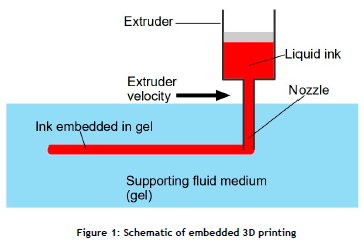
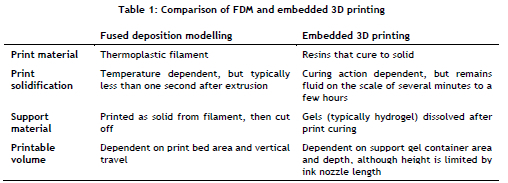
Embedded 3D printing uses a similar principle to FDM, but an ink that is liquid at room temperature is extruded, instead of a semi-solid thermoplastic. As the liquid ink is not self-supporting, the ink is extruded into a gel support bath that holds the ink in place (shown in Figure 1). The ink cures over a much longer time, largely because of chemical reactions rather than thermal processes. Once all the layers of ink are deposited, the print job is complete and may be left to cure. Later, the part can be removed from the gel or the excess gel can be dissolved, washed away, or cured to make the support gel part of the finished part [3], [4].
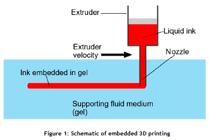
It is desirable to choose a support gel that displays a well-defined yield stress, such that the gel yields to move aside as the nozzle traverses or ink is deposited. Once the shear stress from the moving nozzle is removed, the gel remains deformed, capturing the embedded ink material [3]. The gel yield stress needs to be low enough that the forces required to move the nozzle and deposit ink are manageable, but high enough that once the nozzle moves on, the gel retains its shape and prevents further flow of the ink.
The benefit of embedded 3D printing is that parts may be made of materials that are liquids at room temperature or that remain soft and flexible once solidified. This method does not need printed supports for the printed parts, since the part is printed entirely in a gel that supports it from every side. These benefits allow parts to be created that are impossible to make using any other manufacturing method. Embedded 3D printing can even print soft silicone parts, biomedical implants, or tissue constructs [5] by incorporating live cells into the ink (bio-printing). The major differences between embedded 3D printing and FDM 3D printing are summarised in Table 1.
The pairing of ink and support gel requires careful consideration of various parameters, largely related to their rheology. The density of the ink and the support gel should be closely matched to ensure that the ink raster is neutrally buoyant when deposited in the gel. If the ink density exceeds that of the gel, the deposited ink will slowly sink in the support bath [6]; conversely, a less dense ink will slowly float towards the surface. The ink and gel should not be readily soluble, or the deposited ink will diffuse into the adjacent gel instead of retaining the desired geometry [7]. However, if the ink and gel are highly immiscible, this leads to increased surface tension of the ink. When the surface tension of the ink exceeds the restraint offered by the yield strength of the gel, the originally cylindrical raster of ink may break up into elliptical and ultimately spherical droplets, which have a reduced surface energy [6], [8]. The droplet break-up may be suppressed by a support gel with a high yield strength. However, an excessive yield strength means that the drag forces on the nozzle increase, and the crevasse that trails behind the nozzle will take longer to close [6]. This project aimed to design and build a prototype of an embedded 3D printer capable of controlled deposition of both ink and gel, to address some of the difficulties encountered by other developers of embedded 3D printing. Section 2 explores these difficulties in more detail, which in turn informed the design requirements of this project. Section 3 describes the design of the dual-ink gel 3D printer that was developed during this project. Section 4 describes the testing and refinement of the dual ink-gel printing system, and is followed by the discussion and conclusions (Section 5) and recommendations (Section 6).
2. PROBLEMS WITH EXISTING EMBEDDED 3D PRINTERS
2.1.
Support gel volume limitationsEmbedded 3D printing involves a container of support gel that moves with the build plate, leading to limitations on the size of prints and the printing speed. The size of the print is inherently limited by the volume of the support bath. Moving the support gel container too quickly may cause disturbances in the gel, negatively affecting print quality. The inertia of the support gel may also overwhelm the motors, causing skipping and shifted layers in the printed part [9].
Prior examples of embedded 3D printers were developed by modifying desktop FDM printers [7], [10], [11]. These FDM printers were "bed-slinger" platforms, as these cost less and are easily accessible; but the entire build plate and print moves in one lateral direction (y-axis) while the nozzle moves in the vertical direction (z-axis). In all of these studies, the entire volume of support gel for the print was filled into a container on the build plate at the start of printing, with the intent of minimising voids or other defects. However, combined with the bed-slinger motion system, this means that a larger mass of support gel bath needs to be moved horizontally at non-trivial speeds for the duration of the print.
2.2.
Needle lengthIn embedded printing, the height of potential printed parts is often limited by the length of the ink deposition needle. If the larger parts of the print head assembly are submerged while moving laterally, this disturbs the support gel substantially and leads to print defects. This has motivated some designs [11], [12] to use much longer ink deposition needles of around 150mm in length.
As the ink deposition needle can be modelled as a cantilever that is subject to transverse forces, the bending stiffness is inversely proportional to the cube of the length. This is compounded by the greater wetted area of the needle, leading to increased viscous drag forces. Thus, a longer needle is more susceptible to transverse vibrations at any change in velocity as it translates through the support gel, reducing control of the needle tip location and leading to inaccuracies in the printed part [11]. The increased drag of a longer needle can cause more disturbance in the support gel that may lead to localised voids in the gel. Ink deposited near a void will flow towards the void, having a negative impact on part accuracy [12], [6]. Longer needles also experience more significant pressure drops in the ink delivery system and can experience clogs more often [11].
3. PROPOSED SOLUTION: DUAL INK GEL EXTRUSION
Some of the problems described earlier may be addressed by sequentially printing layers of ink and support gel. The ink deposition needle can be significantly shortened, as the needle length is no longer tied to the print vertical dimension. The reduced needle length results in reduced viscous drag between the needle and the support bath. Thus, problems associated with needle bending are reduced, and faster printing speeds may be achieved. As the support bath starts with a smaller mass of gel, the inertial load of earlier layers is reduced. This project modified an existing FDM 3D printing platform so that the print head could switch between depositing the ink or the support gel on demand.
The dual ink gel extrusion (DIGEX) was realised by modifying a commercial FDM printer, specifically the Creality Ender 5. The bed of the Ender 5 moves vertically, and the print head moves in a fixed horizontal plane, in contrast to the bed-slinger platform that was popular in earlier embedded 3D printer designs. As the bed vertical movement on this platform is at least an order of magnitude slower than the horizontal bed motion of a bed-slinger platform, this permits a larger volume for the support bath without the additional mass negatively affecting print speeds.
Some multi-material extrusion designs have been built and tested for use in embedded 3D printing [13], [14]. These have typically deposited inks and gels in similar volumes or positioned the nozzles and needles adjacent to one another on the print head. The DIGEX design places the gel nozzle co-axially with the ink deposition needle, making the design compact. The co-axial design is made possible by using an annular nozzle design for gel deposition. The co-axial design permits more of the build volume defined by the printer frame to be used, in comparison with nozzles placed side-by-side. The gel nozzle was designed for a deposition rate an order of magnitude faster than ink deposition, as gel deposition has lower accuracy requirements.
In previous studies, syringe pumps have been used with great success in depositing ink material on demand [7], [15]. The ink deposition system designed in this project also used a similar pump design with a 10cc syringe, as no additional innovation in the ink deposition system was deemed necessary at the time. The gel deposition system presented in this paper delivers gel via a 60cc syringe pump, configured to refill passively after a complete delivery stroke, which is described in Section 3.1. An earlier attempt investigated a peristaltic pump for gel delivery, but found the delivery volumes to be very inconsistent. This was attributed to the much higher viscosity of the gel than usually delivered by the peristaltic pump.
Carbopol 980, a poly-acrylic acid, was selected for this project, as hydrogels based on Carbopol have been shown to work well as support gels with a well-defined yield stress [7], [16].
As for the ink selection, an ink that would not dissolve in the Carbopol support gel and had a very similar density to the Carbopol gel needed to be selected. For these reasons, a silicone-based ink was selected, as silicone-based inks have been shown to perform well in combination with Carbopol gels [7] and are hydrophobic. Ultimately, Sylgard 184 was used as the liquid ink material, as it has a working life of 90 minutes; this allowed enough time for testing, and it had a very similar density to Carbopol gel, which prevented density-based instability that would cause sagging or floating of the ink material [17].
The details of preparing the gel and ink are omitted for brevity, as these are described well in the manufacturer's data sheets.
3.1. Mechanical hardware description
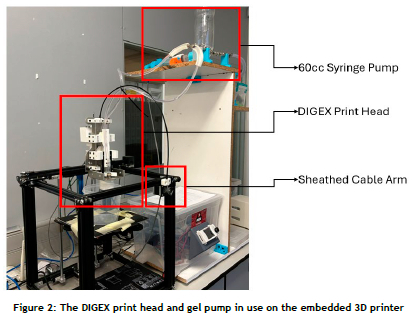
A 10cc syringe pump was mounted on the print head to extrude the ink. The 60cc syringe pump for gel extrusion was mounted on a frame adjacent the printer, to reduce the mass of components that needed to move with the print head. Switching between the ink extrusion and gel extrusion modes involved a vertical movement of the gel nozzle. This was actuated via a sheathed cable, driven by a stepper motor mounted to the frame. Figure 2 shows the relative positions of these sub-assemblies.
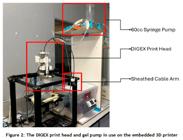
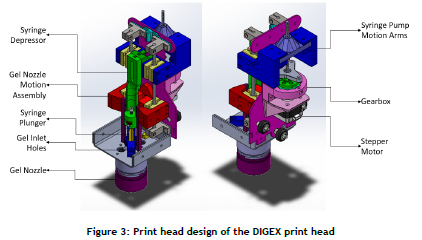
The print head is a complicated sub-assembly containing the ink syringe pump, the gel nozzle, and the hardware that enables the switch between gel and ink deposition modes. The syringe pump is mounted on both sides of the backplate, with the heavy stepper motor mounted behind the backplate above the X-axis gantry along with the planetary gearbox. Moving these heavier components over the gantry should reduce vibrations during print head moves and the print head size in the X-Y plane. The arrangement of these components is shown in Figure 3.
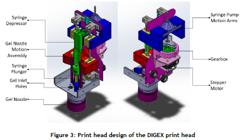
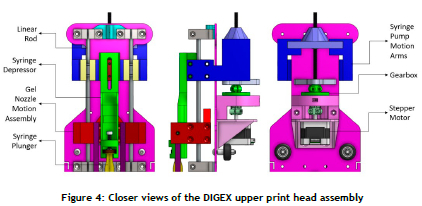
The syringe pump motion arms transfer the stepper motor and gearbox's rotational motion to linear motion along two linear rods, and use the syringe depressor to move the syringe plunger to extrude material from the ink syringe. Figure 4 shows a closer view of the upper sub-assemblies of the print head - specifically, how the stepper motor's movement is connected to the movement of the syringe plunger.
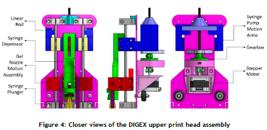
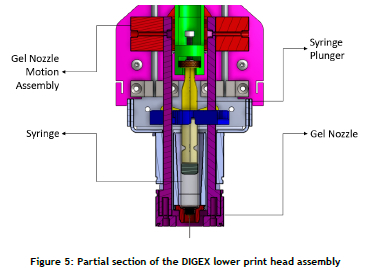
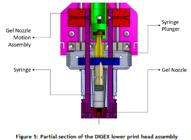
The gel nozzle is moved up and down using the gel nozzle motion assembly that uses the same linear rods to move the syringe depressor up and down. Using the same linear rods in the syringe pump and in the gel motion assembly reduces the size and mass of the print head. Figure 5, a partial sectional view of the lower assemblies, shows how the gel nozzle connects to the gel nozzle motion assembly.
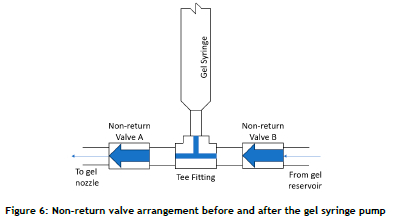
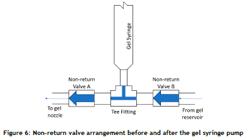
The gel syringe pump uses two non-return valves, configured as shown in Figure 6. On the suction stroke of the syringe, the gel flows from a gel reservoir through non-return valve B, while non-return valve A prevents backwards flow from the gel nozzle. On the extrusion stroke, the gel is pushed through non-return valve A and on to the gel nozzle, and non-return valve B shuts, preventing flow back into the reservoir.
3.2.
Control System and softwareThe finer details of the electronics and software are omitted from this paper for the sake of brevity; the key features are summarised here.
The stock control board of the Ender 5 was replaced with a Big Tree Tech SKR Pro control board. This was necessary because the ink and gel extrusion systems needed independent stepper motor controls, and the SKR Pro allowed for additional stepper motor drivers. Klipper firmware was preferred over the more ubiquitous Marlin firmware, as Klipper offloads some of the processing to a PC, and enables configuration edits without re-flashing the microcontroller.
A methodology was developed to prepare the embedded 3D printing part. The multi-material portion of Cura was not used to ensure better flexibility and control of the output. The gel part was sliced normally, but the ink part needed prime and dwell towers that were offset from the part to increase part quality. Separate GCODE was generated for both gel and ink deposition. A Python script then merged these, first inserting the GCODE needed to deposit gel to a specific height, then inserting the GCODE for ink deposition to slightly below this height, before alternating between gel and ink deposition. This ensured that ink was always deposited below the gel surface. The Cura and Klipper profiles, as well as the Python script for merging the gel and ink GCODE, are provided in detail in [18].
3.3.
Printing procedureUsing the embedded printer is a non-trivial process, and is summarised here. (The reader is referred to [18] for a more detailed description of the operating procedures, and for further explanation of the mechanical hardware and functionality.) The reservoir was filled with support gel, while taking care to avoid introducing air bubbles into the gel. The ink syringe was removed shortly before printing and filled with the ink material. While preparing the ink material and filling the syringe, the gel pump made repeated suction and delivery strokes to prime and fill the entire gel deposition system with gel. Once the ink syringe and the gel deposition system were prepared, the ink syringe could be placed back into the ink deposition system and the container holding the print was prepared. After the container had been prepared, it was placed in the middle of the build plate. The gel nozzle was prepared, and the ink needle was attached to the ink syringe before starting the print job.
4. SYSTEM TESTING AND PRINT RESULTS
The testing focused on two sub-systems, namely the ink and gel deposition systems. In the majority of tests in which ink and gel extrusion were tested simultaneously, the ink part was a hollow cylinder of 20mm diameter, 20mm height, and 1.6mm wall thickness. The ink deposition used a 14 gauge needle (1.60 mm bore diameter) with a 0.8mm layer height, and nozzle speeds of 20mm/s.
The testing relied primarily on visual inspection of the print results. As this was a first prototype for a dual ink-jet extrusion system, most flaws were easily visible, and did not warrant precise quantification.
During the initial testing, the ink deposition system appeared to perform well, while the gel deposition system appeared to extrude less gel than desired. The rheology of the Carbopol gel was investigated, as the under-extrusion would be related to the gel's flow properties.
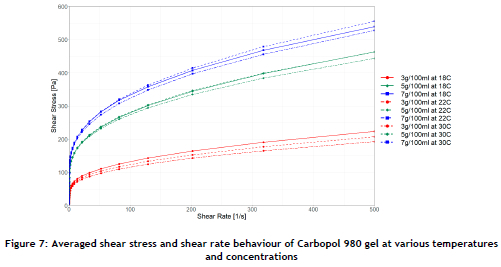
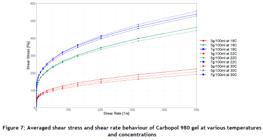
Carbopol gels are non-Newtonian, Herschel-Bulkley fluids [16]. Rheology measurements were performed using an Anton Paar RheoLab QC rheometer and parallel cylinder impellers to understand better the flow properties of the support gel and how to adjust print settings accordingly. Tests were conducted for gels with concentrations of 3, 5, and 7 g/1000ml and at temperatures of 18, 22 and 30 °C. The flow curves obtained from the rheometer are illustrated in Figure 7. The gel's large variation in resistance to flow over a range of flow rates manifested in the pump's performance worsened as the desired amount of gel required to be deposited was reduced. Small extrusions are common in 3D printing, resulting in some adjustments being done to account for the varying properties of the Carbopol gel as shear stresses are applied. The relationship between the extrusion amount and the actual amount of gel output was found to be linear in the range of 5mm and 30mm syringe plunger distance. This relationship was used to correct the flow of gel and to prevent under- and over-extrusion.
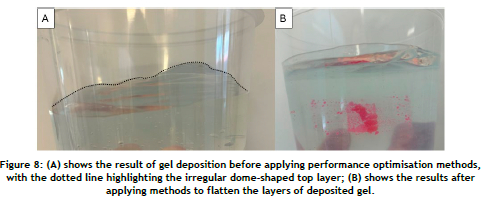
After correcting for the under-extrusion, the gel deposition was still not satisfactory. The top layer of gel had a noticeable dome, as can be seen in Figure 8(A), and lower layers had voids, despite the gel reservoir being largely free of bubbles. The most probable causes were nozzle shape, void and bubble formation in the pump, and inconstant flow.
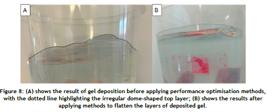
The solution for the nozzle shape was to switch to an annular nozzle to deposit material throughout the print volume in a way that could not be done with a traditional nozzle design. The gel pump was programmed to have a longer pause at the end of the suction stroke, allowing more time for voids to collapse and the non-return valves to move to the desired state. The result of these refinements are shown in Figure 8(B), where the last layer of gel was much smoother and with fewer and smaller volume voids.
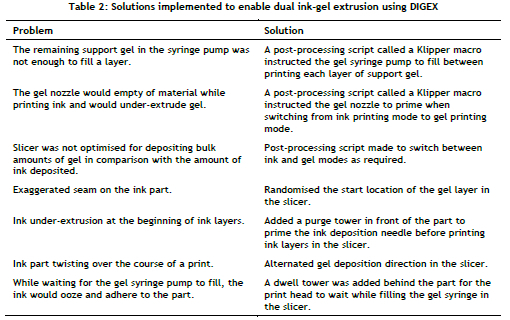
Once the ink and gel deposition systems were performing adequately, some work was done to use the DIGEX print head system better, primarily by refining the 3D printer slicer profile, the post-processing scripts of the GCODE output of the slicer, and the custom Klipper macros. These refinements are briefly discussed in Table 2.
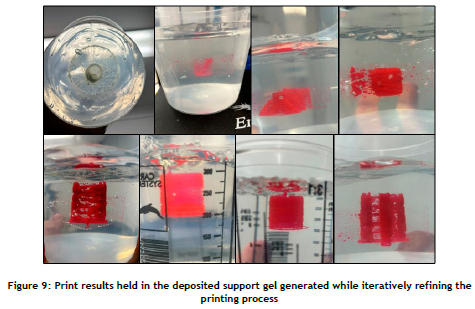
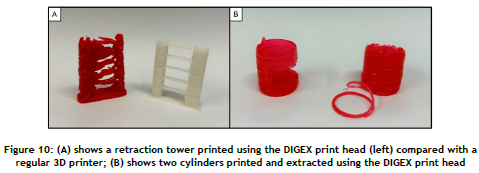
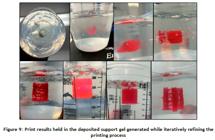
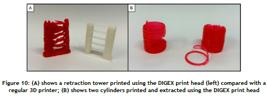
Figure 9 shows some print results still in the support gel, showing the performance of the DIGEX print head. Some print results extracted from the gel are shown in Figure 10. While the gross geometry of the prints matches that of the inputs (A: retraction tower, B: hollow cylinder), there is clearly room for improvement. The retraction tower shows malformed bridges between the towers, indicating over-extrusion of ink. The non-linear rheology of the Sylgard 184 ink may require fine tuning of pressure advance settings to address this. The two cylinders both exhibited poor intra-layer adhesion. Observation of the prints suggested that ink was being drawn into the wake caused by the nozzle, and was only firmly pressed into the lower layer on the next passage of the nozzle. The detailed investigation of these flaws and refinement of print parameters to correct these is intended for future investigations.
5. DISCUSSION AND CONCLUSIONS
This project aimed to build the first prototype of an embedded 3D print system that could print larger parts by using alternating support gel/ink deposition to overcome specific problems that previous embedded 3D printers have encountered.
Prior investigations of embedded 3D printers used "bed slinger" motion systems, which limited the useful print volume because of the large mass being accelerated. This problem was addressed by using a Creality Ender 5 as the base motion control system for the embedded 3D printer. The print bed in the Ender 5 moves only along the z-axis, at much lower speeds, while the print head moves in the x-y plane at higher speeds. This immediately reduces the forces associated with the motion of the support gel bath.
Previous embedded 3D printer designs required the user to select a needle that was at least as long as the shortest axis of the part being printed. Investigations using longer needles to enable larger print volumes reported various difficulties with print accuracy and reliability. To solve this, the DIGEX was designed and tested to eliminate the need to consider the part's dimensions and to allow the user to select a needle size that best suits the accuracy required by the part. The DIGEX embedded printing system prints gel on demand, as one prints a liquid ink part. The system could reliably alternate between ink and gel deposition after some iterative hardware, software, and firmware improvements. The DIGEX system can deposit ink and gel using a co-axial nozzle arrangement, with the ink needle centred in the annular gel nozzle. The annular nozzle reduces the size of the print head assembly and allows the gel to be deposited to the edge of the container being printed in. The development of the DIGEX system has realised the high-level goal of an alternating ink/gel deposition system for embedded 3D printing.
Operating the DIGEX printer is non-trivial. One could conservatively expect to spend 20-30 minutes setting up the 3D printer for a single print job, if the ink and gel materials are pre-mixed. If one needs to prepare an ink as well, that time can be increased to nearer an hour.
The initial test prints were disappointing, showing significant droplet break-up of the ink and poor inter-and intra-layer adhesion. It was also discovered that the gel syringe pump performed poorly at the low volumes of gel requested during typical printing jobs. Several changes to the slicer configuration, as well as investigating and making a model that accounts for the gel syringe pump's low-flow behaviour, significantly improved the printed parts' quality. While the printed part quality leaves room for improvement, this investigation has shown that it is possible to print both ink and gel on demand during embedded 3D printing, using hardware from the hobbyist 3D printer market that is inexpensive and accessible. Further iterations of this design and slicer setup that lead to improved print quality would allow future users of this technology to print much larger prints than has been possible.
6. RECOMMENDATIONS
Before embarking on revisions to the dual ink-gel deposition system, it is recommended that the ink-gel pairing receive more detailed investigation. Droplet break-up has been a consistent problem in this work, resulting in the use of larger needle sizes than may be initially desirable to keep the feature size large enough to avoid most droplet break-up. A broader investigation of this topic with a wide range of ink-gel pairing candidates could be helpful in further research of embedded 3D printing. Investigating whether slightly higher miscibility of ink and gel leads to reduced interfacial tension has potential benefits. Reduced interfacial tension may improve inter- and intra-layer adhesion and enable finer features.
Some design improvements could be made to the gel deposition system. The most significant gel deposition problems were the presence of voids and an extrusion volume that was less accurate than desired. One could mount the syringe pump vertically with the tip upwards, instead of horizontally, making it easier for the pump to purge air trapped inside it and so to reduce void formation in the pump. Another solution would be to change the reservoir to allow it to be put inside a vacuum chamber before a print to remove the remaining trapped air before taking it out of the chamber and reconnecting the reservoir to the gel pump. The gel degassing process could be improved by using a centrifuge over a vacuum chamber, as this would apply greater pressure differentials; but this would require a custom centrifuge. Finally, the adapter between the tubing and the syringe is 3D printed. This part, being 3D printed, causes some problems under pressure: the preload required by the fittings to prevent air ingress during suction strokes can damage the 3D printed adapter, allowing air into the pump anyway. Changing this design to use aluminium or resin-printed parts could improve the performance of the part. A further improvement would be to investigate using more appropriate valves for this application. Non-return valves with faster reaction times or solenoid valves might reduce bubble formation.
Some slicer optimisations could be found and implemented in the slicing process with further testing. Optimising for reduced stringing could be done, for example, in the slicer by testing different retraction settings, noting that this would need to be done separately for each ink-gel combination. Another optimisation would be to increase the wall overlap percentage to ensure better intra-layer adhesion. Similarly, offsetting every other printed wall except the outer-most walls could improve inter-layer adhesion.
REFERENCES
-
[1] N. Shahrubudin, T. C. Lee, and R. Ramlan, "An overview on 3D printing technology: Technological, materials, and applications," Procedia Manufacturing, vol. 35, pp. 1286-1296, 2019. doi: 10.1016/j.promfg.2019.06.089
» https://doi.org/10.1016/j.promfg.2019.06.089 - [2] S. S. Crump, "United States Patent 5121329A: Apparatus and method for creating three-dimensional objects," 1989.
-
[3] J. Zhao and N. He, "A mini-review of embedded 3D printing: Supporting media and strategies," Journal of Materials Chemistry B, vol. 8, pp. 10474-10486, Dec. 2020. doi: 10.1039/d0tb01819h
» https://doi.org/10.1039/d0tb01819h -
[4] A. K. Grosskopf, R. L. Truby, H. Kim, A. Perazzo, J. A. Lewis, and H. A. Stone, "Viscoplastic matrix materials for embedded 3D printing," ACS Applied Materials & Interfaces, vol. 10, no. 27, pp. 23353-23361, Jul. 2018. doi: 10.1021/acsami.7b19818
» https://doi.org/10.1021/acsami.7b19818 - [5] J.-J. Choi et al., "A 3D cell printed muscle construct with tissue-derived bioink for the treatment of volumetric muscle loss," Biomaterials, vol. 206, pp. 160-169, 2019.
-
[6] C. S. O'Bryan et al., "Three-dimensional printing with sacrificial materials for soft matter manufacturing," MRS Bulletin, vol. 42, no. 8, pp. 571-577, Aug. 2017. doi: 10.1557/mrs.2017.167
» https://doi.org/10.1557/mrs.2017.167 -
[7] T. J. Hinton, A. Hudson, K. Pusch, A. Lee, and A. W. Feinberg, "3D printing PDMS elastomer in a hydrophilic support bath via freeform reversible embedding," ACS Biomaterials Science & Engineering, vol. 2, no. 10, pp. 1781-1786, Oct. 2016. doi: 10.1021/acsbiomaterials.6b00170
» https://doi.org/10.1021/acsbiomaterials.6b00170 -
[8] M. E. Cooke and D. H. Rosenzweig, "The rheology of direct and suspended extrusion bioprinting," APL Bioengineering, vol. 5, no. 1, Mar. 2021. doi: 10.1063/5.0031475
» https://doi.org/10.1063/5.0031475 -
[9] J. Zhao, M. Hussain, M. Wang, Z. Li, and N. He, "Embedded 3D printing of multi-internal surfaces of hydrogels," Additive Manufacturing, vol. 32, 10197, Mar. 2020. doi: 10.1016/j.addma.2020.101097
» https://doi.org/10.1016/j.addma.2020.101097 -
[10] T. J. Hinton et al., "Three-dimensional printing of complex biological structures by freeform reversible embedding of suspended hydrogels," Science Advances, vol. 1, no. 9, e1500758, 2015. doi: 10.1126/sciadv.1500758
» https://doi.org/10.1126/sciadv.1500758 -
[11] K. Pusch, T. J. Hinton, and A. W. Feinberg, "Large volume syringe pump extruder for desktop 3D printers," HardwareX, vol. 3, pp. 49-61, Apr. 2018. doi: 10.1016/j.ohx.2018.02.001
» https://doi.org/10.1016/j.ohx.2018.02.001 -
[12] E. Mirdamadi, J. W. Tashman, D. J. Shiwarski, R. N. Palchesko, and A. W. Feinberg, "FRESH 3D bioprinting a full-size model of the human heart," ACS Biomaterials Science & Engineering, vol. 6, no. 11, pp. 6453-6459, Nov. 2020. doi: 10.1021/acsbiomaterials.0c01133
» https://doi.org/10.1021/acsbiomaterials.0c01133 -
[13] J. W. Tashman et al., "In situ volumetric imaging and analysis of FRESH 3D bioprinted constructs using optical coherence tomography," Biofabrication, vol. 15, 36195056, Oct. 2023. doi: 10.1088/1758-5090/ac975e.
» https://doi.org/10.1088/1758-5090/ac975e -
[14] J. S. S. Masters, "Support bath deposition for embedded 3D printing," Final year research project, University of Cape Town, 2020. Accessed: Jan. 08, 2025. [Online]. Available: http://hdl.handle.net/11427/40797
» http://hdl.handle.net/11427/40797 -
[15] K. Ioannidis et al., "A custom ultra-low-cost 3D bioprinter supports cell growth and differentiation," Frontiers in Bioengineering and Biotechnology, vol. 8, 580889, Nov. 2020. doi: 10.3389/fbioe.2020.580889
» https://doi.org/10.3389/fbioe.2020.580889 - [16] S. J. Curran, R. E. Hayes, A. Afacan, M. C. Williams, and P. A. Tanguy, "Properties of Carbopol solutions as models of yield-stress fluids," Journal of Food Science, vol. 67, no. 1, pp. 176-180, 2002.
- [17] C. S. O'Bryan et al., "Three-dimensional printing with sacrificial materials for soft matter manufacturing," Materials Research Society Bulletin, vol. 42, pp. 571-577, 2017.
-
[18] A. van Driel, "Ink-gel simultaneous embedded 3D printing," MSc thesis, University of Cape Town, 2025. Accessed: Sep. 10, 2025. [Online]. Available: http://hdl.handle.net/11427/41552
» http://hdl.handle.net/11427/41552
Accepted for publication 25 Oct 2025
Available online 12 Dec 2025
ORCID® identifiers
A. van Driel
https://orcid.org/0000-0002-9842-8835
R.A. Govender
https://orcid.org/0000-0002-1428-4142