Critical Analyses of Cost Models used in Metal Additive Manufacturing
Abstract
To increase the adoption of metal additive manufacturing, reliable and standardised cost estimation models are required to guide decision-making during the product development process. Currently a multitude of cost and business models are available that have been developed for specific components, specific applications, and the different types of additive manufacturing processes. Given the specific nature of these models, they are often unsuitable for use by companies that are considering the application of additive manufacturing beyond the boundaries of the models. This study provides a critical analysis of existing cost modelling approaches in the field of metal additive manufacturing and aims to increase understanding of how cost contributors are identified and cost significance is attributed.
Abstract
Om die aanvaarding van metaaladditiewe vervaardiging te verhoog, is betroubare en gestandaardiseerde kosteberamingsmodelle nodig om besluitneming tydens die produkontwikkelingsproses te lei. Tans is 'n menigte koste- en besigheidsmodelle beskikbaar wat ontwikkel is vir spesifieke komponente, spesifieke toepassings en die verskillende tipes additiewe vervaardigingsprosesse. Gegewe die spesifieke aard van hierdie modelle, is hulle dikwels ongeskik vir gebruik deur maatskappye wat die toepassing van additiewe vervaardiging buite die grense van die modelle oorweeg. Hierdie studie bied 'n kritiese analise van bestaande kostemodelleringsbenaderings op die gebied van metaal-additiewe vervaardiging en beoog om begrip te verhoog van hoë kostebydraers geïdentifiseer word en kostebetekenis toegeskryf word.
1. INTRODUCTION
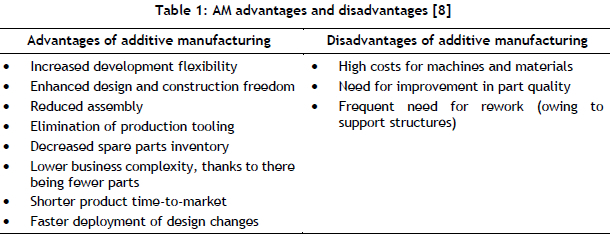
Additive manufacturing (AM) is a transformative technology that creates three-dimensional objects by adding material layer by layer, allowing for complex geometries and intricate designs that traditional manufacturing methods cannot achieve [1]. Over the years, customer demands and specifications have become increasingly complex - a challenge that AM is uniquely positioned to address. In today's manufacturing landscape, shaped by globalisation, intense competition, and rapidly changing market dynamics [2], manufacturers are constantly seeking innovative solutions to enhance efficiency and reduce costs. Despite AM's potential to revolutionise production processes in various industries and to address these challenges, as summarised in Table 1, the adoption of metal AM remains limited owing to uncertainties about cost estimation and financial viability [3].
Reliable, standardised cost estimation models are vital for effective decision-making in product development [4]. Various models exist, each tailored to specific AM processes, such as powder bed fusion, directed energy deposition, or selective laser sintering, or for specific components [4]. Robust cost models enable informed decisions, with parametric and analytical methods preferred during the design phase owing to accessible product and process data [5]. Experience-based intuitive and analogy methods are better suited for early conceptualisation [5]. Analytical methods, commonly used in case studies with well-defined product and Am process parameters, provide valuable insights into cost drivers [6], [7]. However, these methods require significant effort to characterise detailed system and process parameters, such as energy consumption and equipment costs. When only aggregate costs are needed, alternative approaches may be more practical [6].
Although insightful, these models' specificity often makes them impractical for organisations exploring broader AM applications, causing investment hesitancy. This study explores cost modelling in metal AM, focusing on key cost drivers' identification and significance. It addresses complexities such as material variability and energy costs to improve cost estimations. The aim is to create reliable, flexible, comprehensive cost models for informed decisions and wider AM adoption, offering manufacturers insights to overcome cost estimation problems and to maximise AM's benefits.
The introduction has highlighted the need for standardised cost models to boost metal AM adoption. A comprehensive literature review is crucial, as it examines existing models to identify their strengths and gaps. Well-defined search strings and systematic paper selection (using inclusion/exclusion criteria) ensure a comprehensive, reproducible, and valid review. This identifies research gaps, synthesises the findings, and enables novel contributions. Without this, the review risks bias, incompleteness, and reduced value. In this study a scoping review was undertaken.
2.1. Scoping review
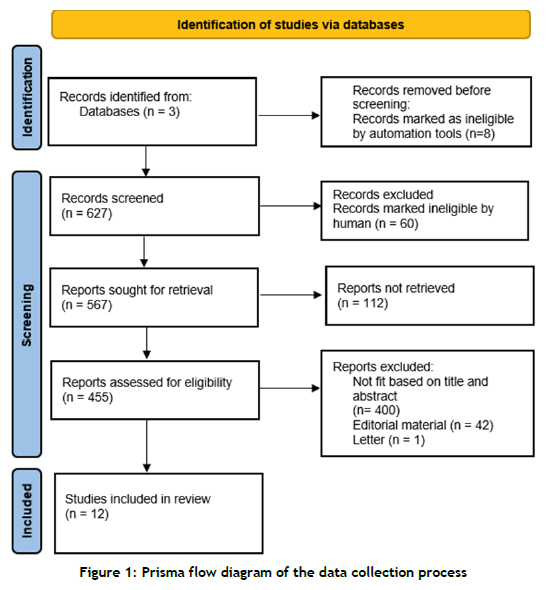
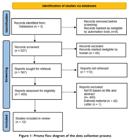
The PRISMA-ScR flow diagram in Figure 1 was used in this study. The Scopus, Google Scholar, and Web of Science databases were used to identify the research papers. The analysis followed an iterative trial-and-error process, focusing on influential and recognised papers. In Figure 1, "n" represents the count of records or databases included or excluded at each stage of the data collection process.
The keywords and search strings used are listed below:
Keywords
• Core focus: "Cost models", "Cost analysis", "Economic models", "Costing methodologies"
• Technology: "Metal additive manufacturing", "Metal 3D printing",
• Analysis type: "Critical analysis", "Comparative analysis", "Evaluation", "Assessment", "Review"
Search strings
• "Cost model" AND "metal additive manufacturing"
• "Life cycle assessment" AND "Metal 3D printing" AND "Cost model" AND "sustainability"
• "Economic analysis" AND "Metal additive manufacturing" AND "Environmental impact"
• "Cost estimation" AND "Additive manufacturing" AND "Sustainability assessment"
• "Cost evaluation" AND "Additive manufacturing"
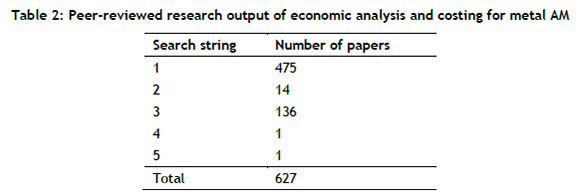
After removing duplicate and irrelevant papers, 627 studies were identified; Table 2 shows the number of papers per search string. These were mostly in energy, engineering, and operations research. It was observed that recently the interests of researchers have been inclined towards economic analysis and costing in metal AM.
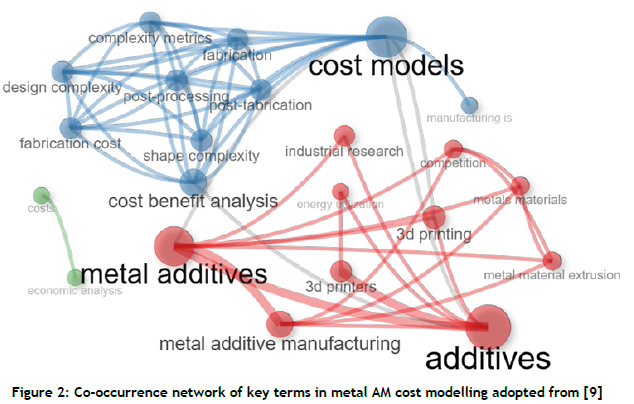
Applying the screening and exclusion criteria detailed in Figure 1, an automation tool in R was used to remove duplications and eligibility criteria, resulting in 12 studies. Studies were included if they addressed cost models, economic analysis, or sustainability in metal AM, with a clear methodology, validated models, and transparent data. All the data was managed and stored in Zotero. The co-occurrence network of the literature statistics, as shown in Figure 2, was obtained from the screening process implemented in R-studio, where the three databases (Scopus, Google Scholar, and Web of Science) were used. Figure 2 shows the relationships between the keywords.
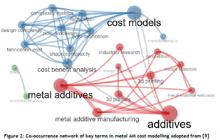
The co-occurrence network, as shown in Figure 2, has nodes that represent the entities, while the edges indicate the strength or frequency of their co-occurrence. Thicker lines often signify stronger connections. This data helps to reveal the prevalent trends in a specific field, including the hierarchy of additives - the broadest category, encompassing substances that enhance material properties. Within this framework, metal additives specifically relate to metals, leading to metal additive manufacturing, which involves creating objects through techniques such as 3D printing. The network thus highlights key concepts and facilitates gap analysis, revealing areas for further exploration and fostering interdisciplinary collaboration by illustrating how diverse fields intersect, ultimately providing data-driven insights that enhance understanding and inform decision-making in research. The cost models from the final 12 selected papers are reviewed in the next section.
2.2. Cost model case studies
2.2.1. Hopkinson and Dickens model
This study offers a cost estimation approach that is a relatively straight-forward framework for comparing traditional manufacturing methods, such as injection moulding with additive manufacturing processes [10]. The model categorises cost contributors into three primary components: material costs, machine costs, and labour costs, as reflected in Equations 1 to 3. Although the model is simple and easy to implement, its limitations include a lack of consideration for indirect costs, process failures, and material waste, which restricts its accuracy and applicability. In addition, the model does not account for the recycling of non-sintered powder, an important aspect of AM's sustainability, and it assumes that production volume is driven solely by machine uptime, which may not accurately reflect market demands.

The model's focus on the continuous production of a single component for a year undermines the flexibility of AM technologies, which can produce different parts simultaneously. While it suggests that layer manufacturing is advantageous at high volumes, it overlooks economies of scale and cost variations when machines are underused. Power consumption is excluded from cost calculations owing to its perceived low impact, and the model neglects necessary post-processing such as surface finishing. The assumed 90% machine uptime is likely overestimated, and the unit cost calculations for injection moulding lack clarity, ignoring key factors such as energy and machine depreciation. Incorporating indirect costs, failure rates, material waste, and real-time analytics would enhance the model's cost estimations, improving its relevance in modern manufacturing.
2.2.2. Ruffo and Hague model
The cost model developed in [23] offers a structured framework for estimating production costs in rapid manufacturing processes such as laser sintering. It meticulously breaks down expenses into direct costs (materials and energy) and indirect costs (machine utilisation and labour). Activity cost rates are calculated using Equation 4 to allow for a precise cost allocation, based on job-specific parameters such as geometry and weight. Key cost contributors include material costs, energy costs, machine costs, and labour costs (Equation 5). The strength of this analytical approach lies in its ability to provide a clear, structured estimation of production costs, enabling precise allocation based on specific job requirements. This model has its benefits, but can improve time estimations for complex geometries. Incorporating real-time data analytics would refine cost estimations. These equations are essential for understanding cost dynamics in mixed production.

2.2.3. Atzeni and Salmi model
These authors developed a cost estimation framework to assess the economic viability of additive manufacturing using selective laser sintering (SLS) compared with high-pressure die-casting for an aeronautical component [12]. The cost model encompassed three primary contributors: equipment costs, material costs, and post-processing costs. Equipment costs dominate owing to the substantial capital investment in AM systems, while material costs vary, based on the type and properties of the powder used. Material costs were calculated as the product of the material mass and its cost per unit mass (kg). Preprocessing costs were estimated on the basis of setup time and the operator's hourly wage. Processing costs were derived from equipment operational costs and the number of components produced per build cycle. Post-processing costs incorporated factors such as post-processing duration, operator's wage, and expenses related to heat treatment or secondary operations. A comparative analysis revealed that SLS is cost-competitive for small to medium batch production, including for metallic components, with equipment costs constituting the largest proportion of total costs, followed by material costs.
These authors proposed a cost estimation model using a bottom-up approach, combining four components: capital equipment, and operational, material, and labour costs. Equipment cost was amortised over the machine's lifespan, based on build time relative to total operation. Operational costs were calculated as operational rate multiplied by build time, including recoating, processing, and idle periods. Material costs were based on component volume, including supports multiplied by unit cost. Labour costs used labour rate and operation time. Models for stereolithography (SLA) and fused deposition modelling (FDM) were validated against quoted prices, showing accurate predictions for selecting suitable AM technologies.
2.2.4. Rickenbacher et al. model
This model introduced a comprehensive cost framework to estimate the costs of individual parts produced via additive manufacturing, even when manufactured concurrently with others [14]. Key cost contributors included material, labour, and machine costs, with the build time allocation based on part geometry and layers. Machine costs and build time are major drivers, while material costs are significant for high-value metals. A notable feature is its detailed analysis of all the process steps, including pre- and post-processing activities. To allocate build time, the model used an algorithm that considered factors such as the cross-sectional area and number of layers of each part, optimising the build space by simultaneously producing geometries with similar heights. To estimate build time, a linear regression model derived from 24 different build jobs was used. The model incorporates factors to account for material changes and the use of inert gas in the machine setup costs and operates under the assumption that increasing the number of parts being built simultaneously reduces the individual unit cost. Despite its comprehensiveness, the cost model faces criticism for several reasons: it ignores post-build material removal, it assumes a uniform labour cost regardless of skill, it neglects energy consumption, it lacks clarity about machine cost components, and it relies on questionable parameters for estimating build time. It also omits warm-up and cool-down times and lacks validation for its build time estimation.
To estimate build time, the authors developed a linear regression model derived from the 24 different build jobs. Equation 6 calculated the regression coefficients with the nomenclature shown in Table 3.
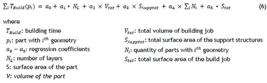
Regression coefficients a_0 to a_5, which are used to calculate the total build time, are from Equation 7:

2.2.5. Schröder et al. model
This model provides a structured approach to financial evaluation in AM using time-driven activity-based costing (TDABC) [15]. This allows for a detailed breakdown of expenses in various technologies such as SLA, SLM, and FDM by identifying the cost drivers in each production phase - i.e., design and planning, material processing, machine preparation, manufacturing, post-processing, administration, sales, and quality. The methodology follows three steps: identifying activities, grouping them into sub-processes, and condensing these into the main process steps. Key cost contributors included quality investments, cost rates, machine parameters, product volume, layer thickness, and rejection rates. This framework enhances financial evaluation, enabling informed investment decisions in AM technologies.
This cost model, while robust, can be enhanced with real-time data analytics to improve time estimates, especially for variable preparation and post-processing phases. Using actual operational data instead of estimates would increase its accuracy. Equations 8 and 9 are key. In SLM, costs for mixed build jobs are estimated by analysing process steps (preparation, building, removal, post-processing) and allocating material, labour, and machine costs. Real-time analytics and machine learning can dynamically refine estimates using historical data.

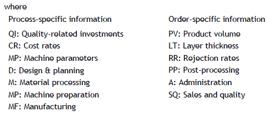
The total cost (TC) reflects the comprehensive expenses of manufacturing, including fixed and variable costs, and is essential for evaluating production efficiency. Output is the total monetary value of products produced. PF is the profit factor in relation to the machine utilisation rate (MUR) and cost per unit (CPU), as in Equation 10.

2.2.6. Mahadik and Masel model
This model uses a breakdown approach to estimate the total cost of production in AM, focusing on four key components: machine, material, labour, and post-processing costs [16]. Cost contributors include machine costs, material costs, and post-processing costs. Machine and material costs are primary because of equipment and powder expenses. This analytical estimation technique provides a structured framework for cost assessment, allowing users to input key parameters for each cost component. The methodology calculates machine operating costs, based on the equivalent annual purchase cost divided by expected operating hours, while the labour costs are based on the time operators spend during manufacturing. Key cost drivers include machine, material, labour, and post-processing costs, which are essential for generating detailed cost estimates.
The model effectively structures cost estimation but needs to incorporate real-time data analytics to refine the time estimates for machine operation and labour, addressing variability. Adding a yield factor would enhance its accuracy by accounting for defects in printed parts. This would provide a better understanding of the economic implications of different AM technologies, helping decision-makers to optimise production efficiency and to reduce costs. Key equations are machine cost (Cmc) (Equation 11), material cost (C_mt) (Equation 12), labour cost (Clb) (Equation 13), post-processing cost [(C) _(pp )) (Equation 14), and total cost [(C)]_t) (Equation 15).
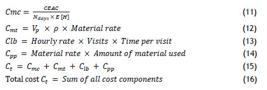
where
CEAC: Total cost estimation and analysis costs associated with the project or process
Ε [Η]: Expected value of hourly production
Vp : Value of the product
p: Density
Ndays : Number of days in the manufacturing period
This is a robust framework for estimating production costs in AM by leveraging a breakdown approach. By enhancing the model with real-time data analytics and yield factors, manufacturers could achieve more accurate cost assessments, leading to improved decision-making and optimised production processes.
2.2.7. Baumers' model
This model offers a structured framework for evaluating production costs in AM by systematically integrating direct and indirect expenses [17]. Cost contributors are material costs, energy costs, and indirect costs, with the indirect costs being significant owing to often-underestimated labour and overhead costs. This analytical methodology distinguishes between direct costs (material and energy) and indirect costs (labour and overhead). A key feature is the voxel-based estimator, which assesses multiple parts in a single build, leveraging the parallel production capabilities of additive manufacturing. Direct costs are calculated by adding together the material and energy costs, with energy costs being determined by the energy rate multiplied by total energy consumed during the build. Total build time, defined as the sum of setup and build time, significantly influences indirect costs. The primary cost drivers are direct costs (material and energy), indirect costs (labour and overhead), and total build time. While the model systematically integrates these components, there is still a need to incorporate real-time monitoring of energy consumption and labour efficiency to enhance the accuracy of cost predictions and to facilitate better resource allocation. Key equations are direct cost (Equation 17), energy cost (Equation 18), and indirect cost (Equation 19). By adopting real-time monitoring techniques in its analytical methodology, manufacturers could further refine their cost estimations and improve operational efficiency.

2.2.8. Ding et al. model
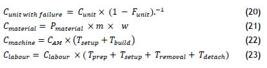
This model that was developed for AM comprehensively estimates total build costs by integrating key process parameters, material characteristics, and operational metrics [18]. Cost contributors include material costs, machine costs, and failure-related costs. Failure rates have a significant impact on costs, often overlooked in simpler models. The model breaks down total manufacturing costs into material costs (Equation 21), machine operation costs (Equation 22), setup costs, and post-processing costs, calculated using established formulas. The activity-based costing (ABC) methodology allocates both direct and indirect costs to AM processes. Direct costs, such as materials, labour, and energy, are traced to production, while indirect costs, including equipment depreciation, administrative expenses, and facility overhead, are allocated on the basis of activity time. A significant feature of the ABC methodology is its focus on ill-structured costs related to process failures and product rejections, estimating their probability and consequences (Equation 20). Key identified cost drivers are material costs, machine costs (including depreciation), labour costs (Equation 23), energy consumption, and ill-structured costs (failure rates), with total manufacturing costs represented by Equation 24. The cost model and the ABC methodology are valuable frameworks, but they could be improved for accuracy and applicability. Incorporating real-time data analytics for dynamic adjustments, enhancing material cost estimations with waste factors, and including costs for post-processing and quality control would be essential. Expanding the model's scope to cover various AM technologies and integrating design considerations would significantly enhance its versatility and effectiveness in real-world scenarios.

2.2.9. Abattouy et al. model
This study presents a cost estimation model for SLM of stainless steel using an activity-based costing approach [19]. The model breaks down the SLM process into several activities: CAD design (Cd), build planning, machine preparation, powder handling (Cmt), part removal, post-processing (Cpp), and heat treatment, and assigns costs to each step. The working principle involves adding together the costs of materials, design, machine usage (Cmc), post-processing, and labour (Cl) to arrive at the total cost per part (Cpart), using Equation 25. The model incorporates factors such as machine purchase cost, build time, machine lifespan, post-processing time, and labour rates. While the model provides a detailed breakdown, an area for improvement is to refine the estimation of indirect costs, particularly overheads such as electricity usage and space renting, which the authors acknowledge are excluded but could contribute significantly (1 -10%) to the total cost. Furthermore, the model assumes a fixed machine utilisation rate and material recycling percentage. Incorporating variability or uncertainty into these parameters through sensitivity analysis or stochastic modelling could enhance the model's robustness and predictive accuracy. Gathering more granular data on the time required for each activity, as well as the specific energy consumption of each machine involved, would allow for a more precise and comprehensive cost assessment.

2.2.10. Yi et al. model
This cost model for AM provides a comprehensive framework for estimating the total build cost by integrating various machine parameters, material properties, and operational data. The model decomposes the total build cost into several key components: machine cost (Cmac), material cost (Cmat), electricity cost (Cele), labour cost (Clab), and protective gas cost (Cam). The key cost drivers identified in this model were machine parameters, material properties, and operational data, which are essential for accurately estimating the costs associated with the additive manufacturing process. The methodology used is analytical, allowing for a structured assessment of costs. The model's strength lies in its ability to provide a detailed breakdown of the total build cost, which is calculated using specific equations for each cost component. For instance, the machine cost is calculated from Equation 26, the material cost from Equation 27, electricity from Equation 28, labour from Equation 29, and the total build cost from Equation 30.

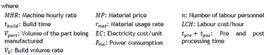
Despite its robustness, the model could be improved by reducing its reliance on default parameters, allowing for customisation based on actual usage scenarios. Incorporating post-processing and quality control costs are essential for a comprehensive assessment, while integrating real-time data analytics would enhance the accuracy of the cost estimates. Expanding the model to encompass a broader range of metal AM processes and materials would increase further its versatility and applicability across different user contexts.
2.2.11. Sæterbø and Solvang model
Here, a comprehensive cost model for metal material extrusion (MEX), encompassing material, machine, labour, consumables, and post-processing costs was developed [21]. The model, as may be seen in Equation 31, showed that optimised metal MEX can be 13.68% cheaper than CNC machining, underscoring the importance of design optimisation in achieving cost competitiveness. This cost model serves as a valuable tool for assessing the feasibility of adopting MAM technologies, while future research should focus on expanding the model to include various MAM processes and optimising post-processing costs.

where
Cm: Cost of material per unit volume
Cs: Cost of support per unit volume
Cl: Labour rate
Cc: Consumable cost
Cw Washing costs
Cmach' Machine costs
2.2.12. Cost model comparisons
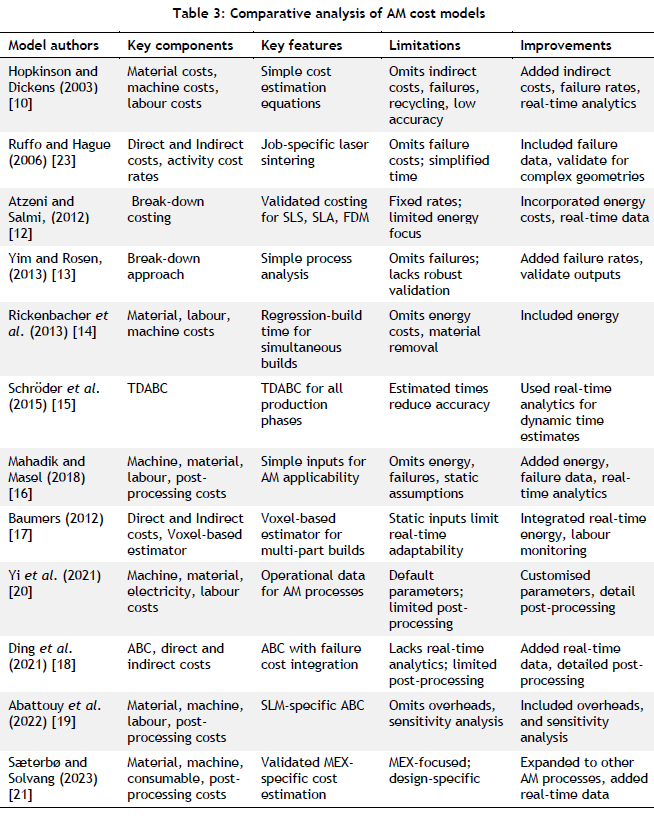
In this section the cost models from sections 2.2.1 to 2.2.11 are analysed, with Table 3 showing a high-level comparison. Overall, these models reflect ongoing efforts to enhance cost estimations in metal AM.
Metal AM cost models have evolved, building on prior frameworks. Hopkinson and Dickens (2003) introduced basic inputs (material, machine, labour), yielding low-accuracy outputs by omitting indirect costs and failures; this was ideal for single-component production. Ruffo and Hague (2006) extended this with job-specific data (geometry, weight) for laser sintering, but static rates ignored failure costs, limiting its accuracy. Atzeni and Salmi (2012) advanced Ruffo and Hague's model, using detailed inputs (equipment, build cycles) with validated high accuracy for SLS, SLA, and FDM, although the fixed rates neglected energy. Yim and Rosen (2013) reverted to Hopkinson and Dickens's simplicity, using basic process data, missing failures, with moderate accuracy. Rickenbacher et al. (2013) built on Ruffo and Hague, adding complex geometric inputs and regression for multi-part builds, but unvalidated parameters reduced its accuracy. Schröder et al. (2015) refined Atzeni and Salmi's approach with TDABC and granular inputs for SLA, SLM, and FDM, although estimated times lowered its precision.
Mahadik and Masel (2018) echoed Hopkinson and Dickens's simplicity, omitting energy and failures. Baumers (2012) extended Rickenbacher et al.'s multi-part focus with voxel-based data but limited by static inputs. Ding et al. (2021) advanced Schröder et al.'s (2015) ABC by including failure rates but lacking real-time analytics. Abattouy et al. (2022) specialised in SLM, building on Schröder et al., but excluded overheads. Yi et al. (2021) used operational data like Yim and Rosen, but default parameters reduced accuracy. Sæterbø and Solvang (2023) refined Atzeni and Salmi's validation for MEX, achieving high accuracy but remaining design specific. No models use real-time analytics or fully address failures and energy. Atzeni and Sæterbø excel in validation, Rickenbacher et al. (2013) and Baumers suit complex builds, and Hopkinson and Dickens and Mahadik and Masel prioritise simplicity. Future models need dynamic data. The analysis of the cost models revealed both strengths and gaps in addressing key cost drivers.
The next section explores simulation and sustainability to address these gaps.
2.3. Aspects of MAM that have an impact on process efficiency
Simulation and sustainability are essential in the cost modelling of metal AM, focusing on process efficiency, resource optimisation, and environmental impact. Simulation helps to predict and mitigate process failures, such as geometric distortion or material inconsistencies, which can significantly hinder cost-effectiveness and scalability in AM [18]. By modelling failure probabilities and their associated costs, simulations offer insights for optimising process parameters and improving yield rates, ultimately reducing waste and enhancing economic viability. Sustainability is also a key aspect of AM's value proposition, enabling the resource-efficient production of customised, high-value products at low volumes, which minimises material waste and energy consumption compared with traditional manufacturing [18, 24]. Incorporating sustainability into cost models ensures that environmental considerations are aligned with economic objectives, promoting AM asa viable, eco-friendly manufacturing solution [18]. Simulation and sustainability highlight the gaps in cost models.
The next section maps the deficiencies to the AM production stages through gap analysis.
3. GAP ANALYSES
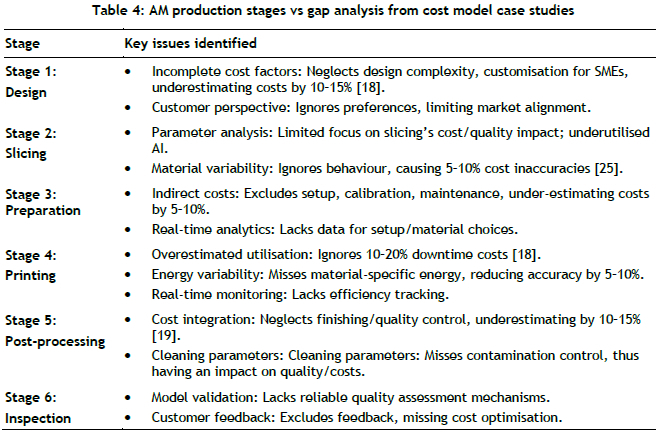
Metal AM offers significant cost reductions and design flexibility, but existing cost models often fail to provide reliable, standardised estimations, hindering their adoption. This gap analysis identifies the limitations in current models and their implications for stakeholders, linking directly to the study's focus on cost contributor identification and significance. Understanding the stages in the manufacturing process of AM is essential to appreciate where these gaps occur. As shown in Figure 3, the manufacturing process has several stages that contribute to the overall cost structure. Table 4 contrasts the production stages of AM with the findings from the cost model case studies, showing the discrepancies and limitations in the current cost models. By conducting this gap analysis, valuable insights are gained that may enhance the adoption and optimisation of metal additive manufacturing.

Additional gaps (across stages)
• Most metal AM cost models, such as those by [10], [23], [20], use static parameters, ignoring simulation tools such as probabilistic modelling or machine learning, which leads to inaccurate cost data. They miss process variability, failure rates, and energy fluctuations, underestimating costs by 15-30% owing to unmodeled defects and rework in processes such as powder bed fusion [18], [25]. Lack of real-time simulations limits adaptability to market changes, which is vital for SMEs, and overlooks sustainability metrics such as energy efficiency [26]. Using Monte Carlo methods or loT monitoring could improve accuracy and support flexible cost models for AM adoption.
• Limited applicability and flexibility of models: Current additive manufacturing cost models are often designed for specific technologies, rely on default parameters, and lack adaptability to diverse SME scenarios or varying material types, which reduces their effectiveness in different manufacturing contexts.
• Neglect of sustainability and market dynamics: Many models fail to integrate sustainability factors such as recycling and environmental impact, which are critical for SMEs; they also do not account for market demand fluctuations or lead time requirements, limiting their practicality in dynamic real-world settings.
• Management problems in cloud-based platforms: The existing models inadequately address management issues in service-oriented and cloud-based additive manufacturing platforms, underscoring the need for more comprehensive, flexible, and customer-oriented approaches to enhance decision-making and to promote broader adoption among SMEs.
4. CONCLUSIONS AND RECOMMENDATIONS
This paper critically evaluates cost models in metal AM, highlighting the need for reliable, standardised cost estimation to aid decision-making in product development. A systematic review traces three decades of AM cost estimation, noting that, while many models exist, their specificity limits broader adoption. Models are categorised by focus (direct vs indirect costs) and approach (method-based vs system-based), identifying key cost drivers such as material and labour expenses. Despite progress, gaps remain in integrating indirect costs and real-time analytics, which are critical for accuracy. This study emphasises developing flexible, comprehensive models to address metal AM complexities, thus promoting wider industrial adoption. Key recommendations are the following: (a) using simulation tools (e.g., Monte Carlo, IoT) to capture variability and failure rates; (b) creating universal models for diverse AM technologies and SMEs; (c) incorporating sustainability metrics such as energy efficiency and material recycling; and (d) leveraging real-time analytics for improved cost accuracy and market adaptability. These enhancements aim to improve model applicability and to support long-term organisational success in AM adoption.
REFERENCES
ACKNOWLEDGEMENTS
The authors acknowledge the funding of the research study by the Collaborative Programme in Additive Manufacturing (CPAM) and the Council for Scientific and Industrial Research (CSIR) (grant no. CPAM-25-PGS-09). The opinions expressed and the conclusions arrived at are those of the authors and are not necessarily to be attributed to the CPAM or the CSIR.
2. LITERATURE REVIEW
-
[1] M. Munsch and E. Wycisk, "Metal additive manufacturing's journey to industrialization: Are we there yet? And what does the destination even look like?" Metal AM: For Metal 3D Printing / additive manufacturing. Accessed: Apr. 16, 2025. [Online]. Available: https://www.metal-am.com/articles/metal-additive-manufacturing-journey-to-industrialisation-are-we-there-yet/
» https://www.metal-am.com/articles/metal-additive-manufacturing-journey-to-industrialisation-are-we-there-yet/ -
[2] M. Armstrong, H. Mehrabi, and N. Naveed, "An overview of modern metal additive manufacturing technology," Journal of Manufacturing Processes, vol. 84, pp. 1001-1029, Dec. 2022. doi: 10.1016/j.jmapro.2022.10.060
» https://doi.org/10.1016/j.jmapro.2022.10.060 -
[3] A. Vafadar, F. Guzzomi, A. Rassau, and K. Hayward, "Advances in metal additive manufacturing: A review of common processes, industrial applications, and current challenges," Applied Sciences, vol. 11, no. 3, 1213, Jan. 2021. doi: 10.3390/app11031213
» https://doi.org/10.3390/app11031213 -
[4] L. Yi, M. Werrel, S. Ehmsen, M. Glatt, and J. C. Aurich, "A specific manufacturing cost model for fast cost estimation in additive manufacturing," Procedia CIRP, vol. 120, pp. 21-26, Jan. 2023. doi: 10.1016/j.procir.2023.08.005
» https://doi.org/10.1016/j.procir.2023.08.005 -
[5] A. Niazi, J. S. Dai, L. Seneviratne, and S. Balabani, "Product cost estimation: Technique classification and methodology review," Journal of Manufacturing Science and Engineering, vol. 128, no. 2, pp. 563-575, 2006, doi: 10.1115/1.2137750
» https://doi.org/10.1115/1.2137750 -
[6] P. Alexander, S. Allen, and D. Dutta, "Part orientation and build cost determination in layered manufacturing," Computer-Aided Design, vol. 30, no. 5, pp. 343-356, Apr. 1998. doi: 10.1016/S0010-4485(97)00083-3
» https://doi.org/10.1016/S0010-4485(97)00083-3 -
[7] H. Singh, F. Rayegani, and G. Onwubolu, "Cost optimization of FDM additive manufactured parts." Proceedings of the ASME 2014 International Mechanical Engineering Congress and Exposition. Volume 2A: Advanced Manufacturing. Montreal, Quebec, Canada. November 14-20, 2014. Accessed: May 08, 2025. [Online]. Available: https://www.researchgate.net/publication/287539141_Cost_Optimization_of_FDM_Additive_Manufactured_Parts
» https://www.researchgate.net/publication/287539141_Cost_Optimization_of_FDM_Additive_Manufactured_Parts -
[8] A. Vranic, N. Bogojevic, S. Ciric-Kostic, D. Croccolo, and G. Olmi, "Advantages and drawbacks of additive manufacturing," IMK-14 - Research & Development in Heavy Machinery, vol. 23, no. 2, pp. 57-62, 2017. Accessed: May 08, 2025. [Online]. Available: https://www.researchgate.net/publication/342332023_Advantages_and_drawbacks_of_additive_manufacturing
» https://www.researchgate.net/publication/342332023_Advantages_and_drawbacks_of_additive_manufacturing -
[9] M. Aria, T. Le, C. Cuccurullo, A. Belfiore, and J. Choe, "openalexR: An R-Tool for collecting bibliometric data from OpenAlex," The R Journal, vol. 15, no. 4, pp. 167-180, Apr. 2024. doi: 10.32614/RJ-2023-089
» https://doi.org/10.32614/RJ-2023-089 - [10] N. Hopkinson and P. Dickens, "Analysis of rapid manufacturing - using layer manufacturing processes for production." Proceedings of the Institution of Mechanical Engineers, Part C: Journal of Mechanical Engineering Science, vol. 217, no. 1, pp. 31-39, 2003.
- [11] M. Ruffo and R. Hague, "Cost estimation for rapid manufacturing simultaneous production of mixed components using laser sintering." Proceedings of the Institution of Mechanical Engineers, Part B: Journal of Engineering Manufacture, 221(11), 1585-1591, 2020.
-
[12] E. Atzeni and A. Salmi, "Economics of additive manufacturing for end-usable metal parts," International Journal of Advanced Manufacturing Technology, vol. 62, no. 9, pp. 1147-1155, Oct. 2012. doi: 10.1007/s00170-011-3878-1
» https://doi.org/10.1007/s00170-011-3878-1 - [13] S. Yim and D. Rosen, "Build time and cost models for additive manufacturing process selection," ASME 2012 International Design Engineering Technical Conferences and Computers and Information in Engineering Conference, Sep. 2013, pp. 375-382. doi: 10.1115/DETC2012-70940
-
[14] L. Rickenbacher, A. Spierings, and K. Wegener, "An integrated cost-model for selective laser melting (SLM)," Rapid Prototyping Journal, vol. 19, no. 3, pp. 208-214, Jan. 2013. doi: 10.1108/13552541311312201
» https://doi.org/10.1108/13552541311312201 -
[15] M. Schröder, B. Falk, and R. Schmitt, "Evaluation of cost structures of additive manufacturing processes using a new business model," Procedia CIRP, vol. 30, pp. 311-316, Jan. 2015. doi: 10.1016/j.procir.2015.02.144
» https://doi.org/10.1016/j.procir.2015.02.144 -
[16] A. Mahadik and D. Masel, "Implementation of additive manufacturing cost estimation tool (AMCET) using break-down approach," Procedia Manufacturing, vol. 17, pp. 70-77, Jan. 2018. doi: 10.1016/j.promfg.2018.10.014
» https://doi.org/10.1016/j.promfg.2018.10.014 -
[17] M. Baumers, "Economic aspects of additive manufacturing: Benefits, costs and energy consumption," PhD thesis, Loughborough University, Loughborough, 2012. Retrieved from https://dspace.lboro.ac.uk/dspace-jspui7handle/2134/10768?sequence=3
» https://dspace.lboro.ac.uk/dspace-jspui7handle/2134/10768?sequence=3 -
[18] J. Ding, M. Baumers, E. A. Clark, and R. D. Wildman, "The economics of additive manufacturing: Towards a general cost model including process failure," International Journal of Production Economics, vol. 237, 108087, Jul. 2021. doi: 10.1016/j.ijpe.2021.108087
» https://doi.org/10.1016/j.ijpe.2021.108087 - [19] M. Abattouy, M. Ouardouz, and H. Azzouzi, "Toward SLM cost model estimation: Stainless steels case study," International Journal of Engineering and Applied Physics, vol. 2, no. 1, pp. 381-393, Jan. 2022.
-
[20] L. Yi, S. Ehmsen, M. Glatt, and J. C. Aurich, "Modelling and software implementation of manufacturing costs in additive manufacturing," CIRP Journal of Manufacturing Science and Technology, vol. 33, pp. 380-388, May 2021. doi: 10.1016/j.cirpj.2021.04.003
» https://doi.org/10.1016/j.cirpj.2021.04.003 - [21] M. Sæterbø and W. D. Solvang, "Evaluating the cost competitiveness of metal additive manufacturing - a case study with metal material extrusion," CIRP Journal of Manufacturing Science and Technology, vol. 45, pp. 113-24, 2023.
-
[22] A. Z. A. Kadir, Y. Yusof, and M. S. Wahab, "Additive manufacturing cost estimation models - a classification review," International Journal of Advanced Manufacturing Technology, vol. 107, no. 9, pp. 4033-4053, Apr. 2020. doi: 10.1007/s00170-020-05262-5
» https://doi.org/10.1007/s00170-020-05262-5 -
[23] M. Ruffo and R. Hague, "Cost estimation for rapid manufacturing simultaneous production of mixed components using laser sintering," Proceedings of the Institution of Mechanical Engineers, Part B: Journal of Engineering Manufacture, vol. 221, no. 11, pp. 1585-1591, Nov. 2007. doi: 10.1243/09544054JEM894
» https://doi.org/10.1243/09544054JEM894 -
[24] S. A. M. Tofail, E. P. Koumoulos, A. Bandyopadhyay, S. Bose, L. O'Donoghue, and C. Charitidis, "Additive manufacturing: Scientific and technological challenges, market uptake and opportunities," Materials Today, vol. 21, no. 1, pp. 22-37, Jan. 2018. doi: 10.1016/j.mattod.2017.07.001
» https://doi.org/10.1016/j.mattod.2017.07.001 -
[25] M. Baumers, L. Beltrametti, A. Gasparre, and R. Hague, "Informing additive manufacturing technology adoption: Total cost and the impact of capacity utilisation," International Journal of Production Research, vol. 55, no. 23, pp. 6957-6970, Dec. 2017. doi: 10.1080/00207543.2017.1334978
» https://doi.org/10.1080/00207543.2017.1334978 -
[26] H. Oh, T. Im, J. Pyo, J. Lee, and C. S. Lee, "Study of solid loading of feedstock using trimodal iron powders for extrusion based additive manufacturing," Scientific Reports, vol. 13, no. 1, 4819, Mar. 2023. doi: 10.1038/s41598-023-32095-5
» https://doi.org/10.1038/s41598-023-32095-5
ORCID® identifiers
T.G. Zinzombe
https://orcid.org/0009-0000-4910-4634
N. Sacks
https://orcid.org/0000-0001-7769-7588
T. Dirkse van Schalkwyk
https://orcid.org/0000-0003-4565-8765