The Development of an Adapted Agile-Stage Model for Application in Timber Building Design: A South African Study
Abstract
The timber construction industry lacks innovation, favouring traditional materials such as concrete. The global drive towards sustainability is increasing. Timber is an alternative sustainable building material, requiring diffusion into the South African industry. This study presents a conceptual Agile Stage-Gate model (ASGM) and the possible benefits and limitations of the model's application. Qualitative interviews and quantitative surveys with South African timber construction industry experts were used. By exploiting the diffusion of innovation theory in the form of an adapted ASGM, this research could positively shift the perception of timber as a construction material, potentially increasing its acceptance in South African society.
Abstract
Die houtboubedryf toon beperkte innovasie en gee steeds voorkeur aan tradisionele materiale soos beton. Die wêreldwye strewe na volhoubaarheid neem egter toe. Hout bied 'n alternatiewe, volhoubare boumateriaal wat wyer in die Suid-Afrikaanse bedryf aanvaar en toegepas moet word. Hierdie studie stel 'n konseptuele Agile Stage-Gate-model (ASGM) voor en ondersoek die moontlike voordele en beperkings van die toepassing daarvan. Kwalitatiewe onderhoude en kwantitatiewe opnames is met kundiges uit die Suid-Afrikaanse houtboubedryf uitgevoer. Deur die teorie van innovasieverspreiding in die vorm van 'n aangepaste ASGM toe te pas, kan hierdie navorsing die persepsie van hout as boumateriaal positief beïnvloed en moontlik die aanvaarding daarvan in die Suid-Afrikaanse samelewing bevorder.
1. INTRODUCTION
The construction industry is among the most significant contributors to greenhouse gas emissions, emitting approximately 40% of the CO2 [1]. There is a lack of innovation effort in this industry and an inclination towards "traditional" construction methods [2], [3]. This situation presents itself as a need to modernise the construction industry and to change the approach towards more sustainable building methods. Timber is a sustainable building alternative to traditional brick-and-mortar [4] with the potential to lower the emissions of construction [5]. In South Africa, timber building is still a developing market [6] with evolving needs.
The Stage-Gate model (SGM) and ASGM help to manage the product development process using stages and gates [7]. A benefit of the ASGM is constant consideration for the voice of the customer and a quick response to changing technological and market conditions [8], [9]. This is well-suited to the timber construction market in South Africa. The ASGM and SGM and their application are well-documented. A research gap was identified when applying ASGM to the timber construction industry. Applying this model to develop timber building designs could provide a viable method to modernise the traditional construction industry. Therefore, this study aimed to perform an investigation of the ASGM through the literature and expert interactions in order to determine the best practices in each gate and stage. The objective was to develop an adapted conceptual ASGM for evolution through further research, that could be applied to timber building design.
A literature survey established best practices, which were evaluated through interviews and surveys. Finally, through data gathering and analysis, three research questions were formulated to achieve the research objective:
a. What are the potential benefits of applying the ASGM to develop timber building designs?
b. What are the potential limitations of applying the ASGM to develop timber building designs?
c. What adaptations to the ASGM would be required for its application in timber building designs?
The ASGM is a project management (PM) methodology that facilitates new product development (NPD) [10]. Both topics - PM and new product development - are prominent themes in engineering management curricula [11], therefore creating a relationship between the ASGM and engineering management. This exploratory study has expanded the plausible application contexts of a theoretical ASGM, furthering the knowledge of the field of engineering management.
2.1.
Pre-manufactured timber buildingsThe integration of timber into construction differs between regions. For example, Europe is more accustomed to timber building [12], while in countries such as Singapore [12] and South Africa [6], the building material is still being diffused.
Timber construction elements can be pre-manufactured and assembled onsite. This is the modular nature of timber building [4]. The benefits of modular construction can thus be transferred and realised through timber construction. Some of these benefits are (a) design flexibility, (b) fast design and fabrication times, (c) being less labour intensive, and (d) lower resource costs and waste generated [5], [13].
However, in countries where timber is less commonly used, such as South Africa [14], it could be considered a "new" technology. It is exposed to various barriers to adoption, such as (a) lack of design and building guidelines, (b) lack of knowledge, skills and expertise, (c) limited investment, (d) high capital requirements, and (e) uncertainty about the risks and its suitability as a building material [13], [15], [16], [17].
2.2.
Diffusion of innovationAs previously described, the "newness" of timber in construction creates barriers to adoption. Thus, it is beneficial to consider aspects of the diffusion of innovation when developing an idea-to-launch model in this context. Four main elements constitute the diffusion of innovation [18]:
2.2.1. Innovation
Innovation relates to the implementation of a new or improved product, process, marketing method, or business practice [19]. Characteristics of an innovation, such as relative advantage and compatibility, influence the rate of adoption of an innovation [18], [20].
2.2.2. Communication channels
Communication channels are those through which information and opinions about innovations are shared [21]. A strong relationship exists between the rate of adoption and the source of communication about an innovation [22].
2.2.3. Social system
A social system involves a cluster of units that engage in problem-solving to reach a common goal [18]. Diffusion always occurs within the boundaries of a social system [22]. Opinion leaders have a substantial influence on actors in a social system, and thus they play an essential role when considering innovation adoption [21].
2.2.4. Time
Time is vital to consider in the diffusion of innovation topic, as it indicates the rate of adoption [18].
2.3. Stage-Gate model
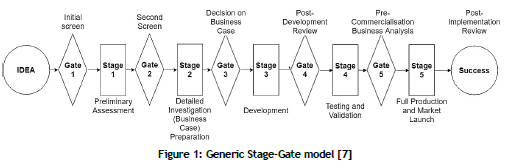
The SGM is made up of stages and gates. Activities are executed during the stages and evaluated against specific criteria at the preceding gates. The gates can be characterised by inputs (deliverables from the previous stage), exit criteria, and outputs (the go/kill decision). The model manages the process of new product development [7]. The traditional Stage-Gate model is shown in Figure 1.
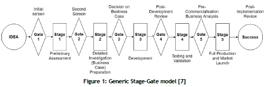
Idea (strategy formulation and ideation): The activity of product innovation strategy formulation is a vital pre-requisite [23]. Developing a clear product development strategy is crucial when considering new product outcomes. The strategy includes:
• Goals for product development efforts
• Strategic focus arenas
• A plan of action
• Resource allocation [24].
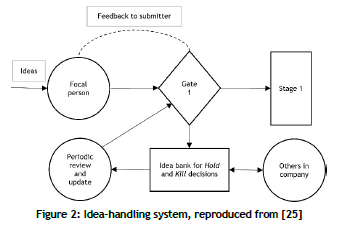
Methods of ideation include (a) the voice of the customer, (b) ethnographic research, (c) the involvement of lead customers, and (d) open and closed innovation [25], [26]. Ideas can be articulated and managed through an idea-handling system, as shown in Figure 2.
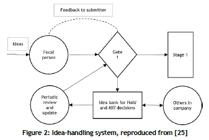
Gate 1: Initial screen - This gentle screen serves as the project's conception, scrutinising the idea against the chosen evaluation criteria. If an idea is selected, the gatekeeping team must be able to allocate resources to the project. The gatekeeping team is typically middle to senior management [25].
Stage 1: Idea scoping - This stage is inexpensive and fast-paced. Activities executed here may include preliminary market and technical assessments to evaluate the project's merit [27]. This stage typically has one to two team members assigned, with a stand-in team leader [23].
Gate 2: Second screen - This screen is similar to Gate 1 but is more rigorous [7]. A visual or verbal product concept should be presented so that its market potential and technical feasibility can be assessed [28]. Simple financial calculations can also be done, keeping in mind that these are estimates at this stage [7], [23].
Stage 2: Business case - The definition of the project must be clarified during this stage, and a business case for presentation to the gatekeeping team must be compiled. This is critical, as it is the last stage before significant resources are invested in the project [7], [23].
Gate 3: Decision on business case - The evaluation criteria of this gate are similar to those of Gate 2, but a stronger emphasis is placed on financial criteria [28]. It provides the green light for larger investments. Various project aspects are also finalised, such as the definition of the target market and the product concept [7].
Stage 3: Development - This stage entails the practical development of the prototype and formulation of detailed testing, marketing, and operations plans [29]. Typically, Agile methods, such as Scrum, are incorporated into this stage of the project, which includes sprints, stand-up meetings, and spiral development [23].
Gate 4: Post-development review - An evaluation of the market need for the product is conducted. Financial calculations are re-evaluated, and the development process is reviewed to ensure the quality of the execution of tasks [28]. The testing and validation plans are also typically reviewed at this gate [7].
Stage 4: Testing and validation - This stage tests the overall project viability, product functionality, manufacturing process, market adoption, and financial feasibility. If negative results are obtained here, the development reverts to Stage 3 for improvements [7], [23].
Gate 5: Pre-commercialisation business analysis - This gate focuses on the quality and results of the activities conducted in Stage 4. It is essential to assess the customer feedback on the prototype. This enables product flaws to be detected. This stage serves as the final readiness check before commercialisation and the final opportunity to kill the project if it is deemed infeasible [7], [23].
Stage 5: Commercialisation - Implementation of operations and marketing plans for full commercialisation [7], [23].
Post-launch review (PLR) - Assessment of product performance on a short- and long-term scale [28]. A project reflection and close-out meeting for knowledge management is also essential. Knowledge management is vital to enable the incorporation of current knowledge into future ideas/products [7], [30], and to share expertise.
2.4. Agile Stage-Gate
The original SGM has been criticised for its bureaucracy, linearity, and inability to adapt to dynamic projects [31]. The ASGM adaptation of the SGM is part of the "Triple A system", defined by Cooper (2014) [32] as:
• A1 - Adaptive - spiral development.
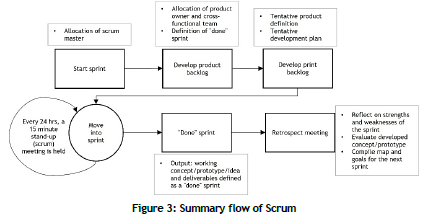
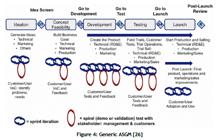
• A2 - Agile - typically using the Scrum methodology. A detailed summary flow of the Scrum model is shown in Figure 3.
• A3 - Accelerated - reducing the time length of the development process.
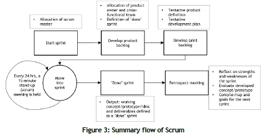
The product backlog details a list of attributes the final developed product may have. It is compiled through collaboration with internal and external stakeholders [33].
The sprint backlog comprises selected features that should be completed during a sprint [34]. The sprint tasks are tracked using a Kanban board. The progress of a sprint is monitored using a burndown chart [33].
Stand-up meetings with the project team are typically held every 24 hours, to follow up quickly on the project's progress and to define goals for the next meeting [34]. On completion of a sprint, a retrospective meeting is held to review project successes and failures and to evaluate the teamwork [8], [9], [33]. Typically, after each sprint a working product demonstration must be presented to stakeholders [32]. However, in a manufacturing environment, a prototype may be presented instead to obtain feedback [35].
It is important to note that the overall time taken to complete the product development process, even using the ASGM, is longer in the manufacturing environment than in the software environment [8], [9].
A clear product definition may be difficult in a dynamic environment. The product definition solidifies throughout the development cycle and market interactions [31]. This approach is called spiral development, and comprises four aspects: build, test, feedback, and revise. Spiral development allows for fast, cheap failure and encourages experimentation [31].
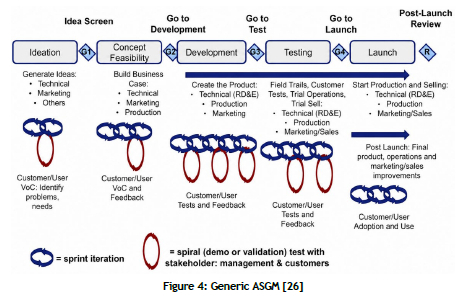
The generic ASGM is shown in Figure 4. This model incorporates spiral development and Scrum methods into the original SGM. This figure served as the basis for the conceptual model.
2.5. Application of ASGM
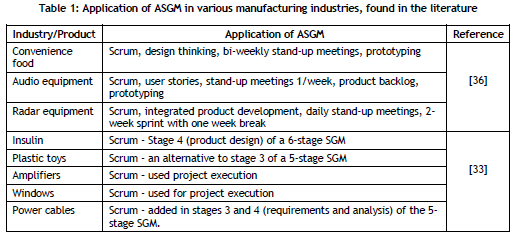
In manufacturing firms, the application of Scrum is typically done in the technical phases (such as development and testing) of the ASGM [36], [37]. However, it may also be applied in earlier stages, such as ideation.
Table 1 describes how manufacturing firms have applied Agile principles to their gated processes. These firms were used as the basis for the conceptual model, as they were closely related to the study through a similar product design and development cycle.
3. RESEARCH METHOD
The research methodology in this paper was based on two previously conducted studies. Study 1 was based on the vaccination development industry [38], which was developing a vaccine innovation cycle. Study 2 aimed to define gate evaluation criteria used by experienced new product development managers [28]. The decision to conduct interviews and surveys was based on Study 1 [38]. The choice to rate gate evaluation criteria was based on Study 2 [28]. The choice to determine critical success factors (CSFs) was based on previous work by E.P. Preis [39].
The research philosophy applicable to this exploratory research study was interpretivism. This paradigm of interpretivism seeks to create rich new understandings of the world and the context in which the paradigm exists [40]. The researcher aimed to understand how the ASGM model may be adapted to the context of an emerging market in a relatively uninformed (on the topic of timber construction) social system and the willingness of experts to apply such a model based on the benefits and limitations.
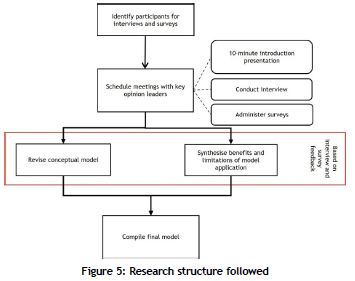
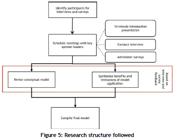
A mixed approach of qualitative and quantitative methods was used in this study through interviews and surveys. The research structure followed is shown in Figure 5.
3.1. Sampling techniques
Purposive and snowball sampling were used, as specific inputs relating to the timber industry were required. Key opinion leaders (KOLs) in the timber construction industry were the targeted sample. The participants were identified through social media, website searches, and the researcher's network. First contact was made via e-mail, introducing the topic to participants and informing them about the study's objective, the interview, and the survey's structure.
The sample size for this study was small, as the timber construction industry in South Africa is a developing market. Therefore, as experts were explicitly targeted for participation, valuable responses were prioritised over the volume of responses.
3.2.
Compilation of interview questions and the surveyInterview questions were formulated based on the research questions and the literature that had been studied. The survey choices were formulated based on the CSFs and gate evaluation criteria that had been gathered and synthesised from the literature.
3.3.
Data analysisThe relevant analysis methods included thematic and simple modal quantitative analysis using a Likert scale. The time horizon for the study was cross-sectional. This implied that the findings were taken at a single moment in time. This could be likened to a "photograph" of the data [41].
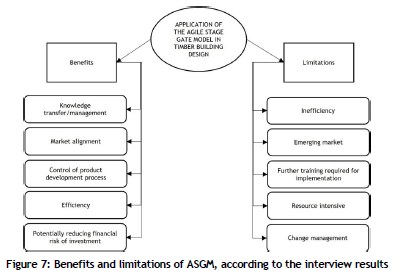
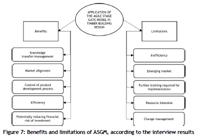
Thematic analysis uses qualitative data sets to identify repetitive patterns through code selection and theme construction [42], [43]. The qualitative data analysis software Atlas.ti was used to analyse the interview responses that informed the research questions. The codes used corresponded to the benefits and limitations illustrated in Figure 7.
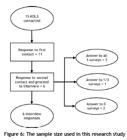
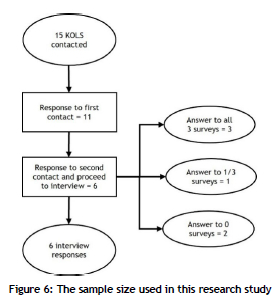
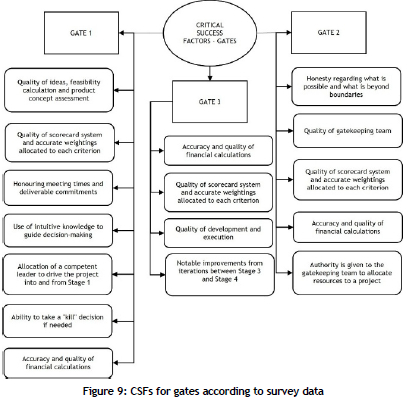
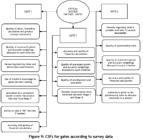
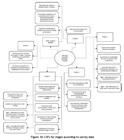
A Likert scale was used to measure the participants' opinions on the validity of the CSFs in a scientifically valid way [44]. A three-point scale ranging from "not important" to "very important" was selected. The "very important" factors are shown in Figures 9 and 10. For the gate evaluation criteria, participants selected the criteria they deemed most relevant to each gate, based on their expertise. A representation of the sampling process is shown in Figure 6.
3.4. Validity and repeatability
Two types of validity may be considered: internal and external. Internal validity evaluates the extent to which bias is present in the design, execution, and analysis of a study. External validity evaluates the generalisability of the study's findings to other contexts. Both internal and external validity are based on judgement rather than on computed statistics [45].
The study was not generalisable and was subject to selection bias during sampling. Further, the repeatability of the research findings was low. The main contributors to the reduction of internal and external validity were the small sample size and the purposive sampling technique. However, within the paradigm of interpretivism, small and purposive samples are appropriate [40], and generalisability is a limitation associated with exploratory [46] and interpretive studies [47]. This study aimed not to develop a generalisable model at this stage but to explore how the ASGM could be adapted to fit the context of the South African timber construction industry.
4. RESULTS AND DISCUSSION
The administration of the interviews and surveys had two aims. The first was to determine whether value could be added to the timber building design process by applying the ASGM. The second was to decide which adaptations were needed for hypothetical application to the participants' businesses if available resources existed.
4.1. Benefits and limitations of application of the ASGM
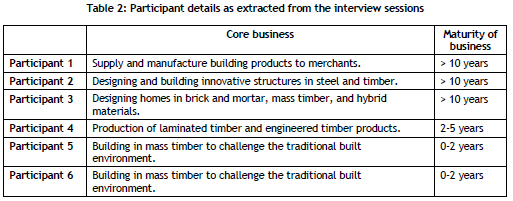
Table 2 displays the profile of the sample used. It was found that the maturity of the businesses did not play a substantial role in their eagerness to implement the conceptual ASGM. The core business was linked to the willingness to implement: businesses involved in innovative construction were more likely, and businesses offering specific product ranges were less likely. A reason for this could be that the core business defines the strategy and priorities of the business and where resources may be allocated. The ASGM demands intense resource allocation [31], and if product development is a low priority, resources will be allocated accordingly.
According to the interview responses, the benefits and limitations of applying the ASGM are summarised in Figure 7. Each participant described a form of the SGM applied in their business; however, it was not explicitly named that. While the knowledge of the ASGM was limited, knowledge of Agile was present among the majority. This allowed for well-considered responses from the participants.
The limitation of training requirements for model implementation was linked to change management. Sufficient investment must be made into staff training, structure changes, and capabilities translation. Without this, it is unlikely that all the benefits of the ASGM will be realised [48]. Cultivating an Agile culture in the business is also required [33]. The ASGM must be adapted to existing business processes and clearly explained to the teams involved to avoid possible inefficiencies.
Efficiency was a benefit mentioned by Participants 4 and 5.
"...steps are beneficial to our operations function and keep people efficient in their work..."
Participant 4
It was likened to process efficiency [10] and efficient planning [9], as noted in the literature. The rationale was that people can efficiently move a design through development. However, this is accompanied by the limitation of inefficiencies resulting from inadequate change management and training.
" ...one of the cautions. could lengthen the design or development process. if you Stage-Gate too much. frustration factor..."
Participant 6
The potential reduction of the financial risk of investment and control of the development process were benefits extracted from the interviews. They could be likened to the literature related to adaptability and spiral development [9], [10], [49]. The adaptability of the ASGM enables quick responses to changing needs and continual market alignment [9], [10]. This is supported by spiral (iterative) development, allowing fast, cheap failure [31]. Furthermore, this enables an infeasible project to be killed before significant financial investment. The potential reduction in economic and project risk could increase the number of willing investors in timber buildings. Through spiral development, knowledge could be shared, facilitating the diffusion of timber building materials. This would have an impact on the inhibitors related to a lack of knowledge, skills, and public perception [50].
"...You know, it's that we are at 99% of people go with what they know and what South Africa knows is concrete bricks... So we're not as trusting of the timber markets..."
Participant 2
"Knowledge management" was mentioned by 2/6 participants as a benefit, and was present in the literature as part of the PLR stage [35].
"...every time that we review a completed project, that's a notch or a bit of experience that we gained... experience is a foundation for the next project..."
Participant 6
This benefit could be realised through knowledge sharing between teams in the business and with the users engaged in the design process through market analysis and voice-of-customer work. This process of sharing is vital to strengthen the business case of unfamiliar projects [5]. Knowledge management is also integral to skill development, especially the transfer of tacit knowledge and expertise in the emerging timber construction industry.
The ASGM is "resource intensive". This fact is widely detailed in the literature as a limitation. Participant 1 noted that a method to curb the high resource requirement of the ASGM is to use Agile allocation of resources. By adding and subtracting expertise as needed, resources can be balanced between project activities and daily business tasks in the organisation.
The timber construction industry in South Africa is an emerging market [14]. It was mentioned that smaller businesses would likely overlook the value of implementing a dynamic and resource-intensive development model because there is no financial argument to justify it.
"...could be something relevant to a company in the future... don't know if anyone right now... put a little resource into checking this..."
Participant 3
4.2. Conceptual model
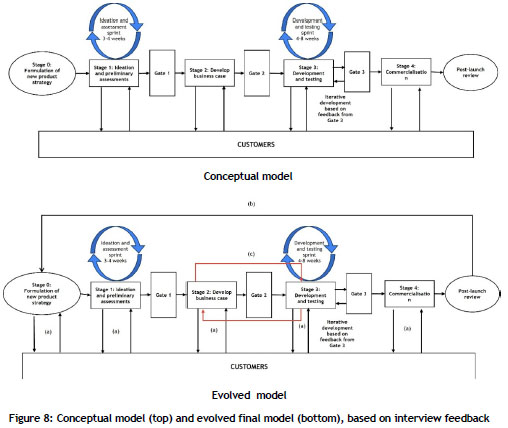
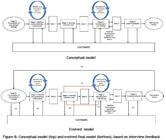
The first version of the conceptual model was based on the generic model (shown in Figure 4) and the literature related to the ASGM application in the manufacturing industry. The initial and evolved versions of the conceptual model are shown in Figure 8. Based on the feedback from the initial, the following changes were made according to the alphabetically numbered loops in Figure 8:
a. A feedback loop between Stage 0 and the customers, as is present in other stages. This loop correlates with the evaluated critical success factor for Stage 0 of strategic alignment with business goals. Market needs must be understood to develop a new product strategy. This research will further flow into Stage 1.
b. A feedback loop between the post-launch review and Stage 0. This allows for knowledge sharing and evaluation of the initial new product strategy. If the design has potential, further improvement on the developed design can also take place.
c. A feedback loop between Stages 2 and 3 to ensure that the business case is continuously updated and valid, according to changes made in Stage 3. This is crucial, as each time the business case is altered, it must be re-evaluated and approved to ensure that the product remains aligned with the strategy and may continue.
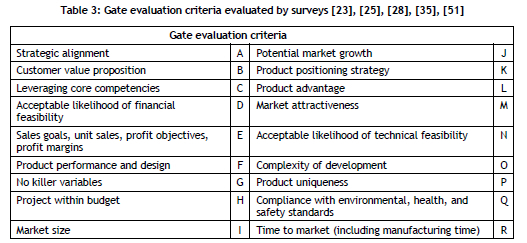
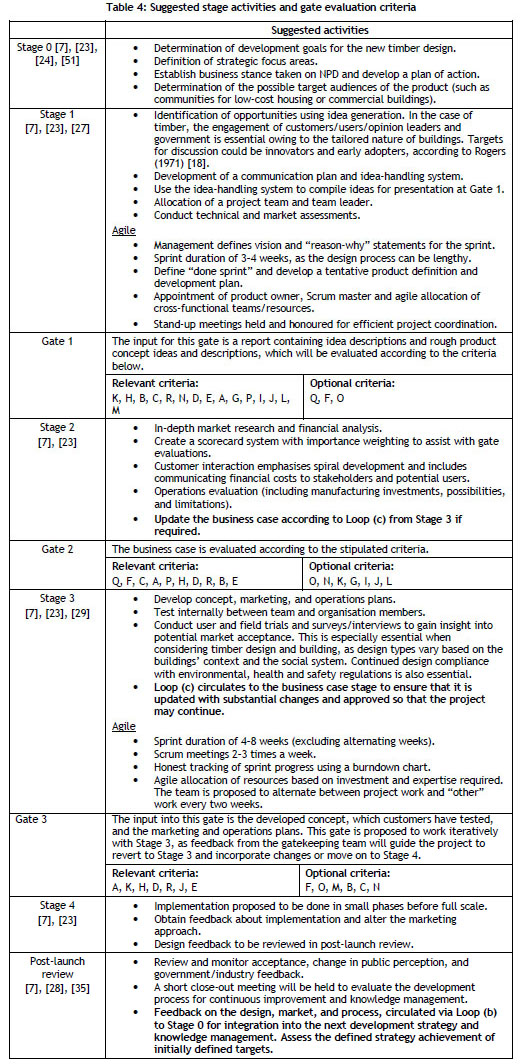
The gate evaluation criteria shown in Table 3 were evaluated by three participants. If there was a majority vote (3/3) for a criterion, it was considered relevant. If the criterion received a count of one or two out of three votes, the criterion was considered optional. If the criterion received zero votes, it was not considered for the corresponding gate. This split in criteria is shown in Table 4. When considering the CSFs, shown in Figures 9 and 10, the survey data was analysed according to the following modal rules:
• If the majority voted for any importance level, the critical success factor took on that level of importance.
• If there was a draw between any two importance levels, the critical success factor took on the higher level of importance.
The CSFs were derived from a range of the literature and synthesised into the lists of essential success factors that were evaluated during the surveys. According to the interview responses, Figures 9 and 10 present only the "very important" factors.
The factors displayed in Figures 9 and 10 serve as a generic starting point for case studies in further research, and could be altered as required for the business application.
5. CONCLUSIONS AND RECOMMENDATIONS
This research explored the extension of ASGM to the timber construction industry, a new application of the model. It used existing ASGM studies, thus expanding the literature and the applicability of the ASGM. Experts in the timber construction field assessed the adaptations, evaluation criteria, and success factors. This enabled the creation of a framework that could be further researched and applied to timber building design and formalise the development process. As the model evolves, it will be generalised for application outside the South African context.
The study showed that businesses involved in innovative timber design would be more likely to implement such a model. However, significant change management must be done. While the process may not be as fast-paced as the traditional ASGM, the benefits of the model could still be realised.
The benefits of applying the ASGM to timber building design development included knowledge management, market alignment, control over the development process, efficiency, and reduced investment risk. The limitations were change management, further training, potential inefficiencies, resource intensity, and an emerging market.
The small sample size and the use of purposive sampling had a negative impact on the internal and external validity of the research findings. Given the study's explorative nature and the geographical context, the absence of generalisable conclusions and biases was anticipated at the conception of the research project. Incomplete data had a further impact on the reliability and repeatability of the study. Nonetheless, consistent themes were identified among the responses that correlated with the literature, which increased the coherence of this study with other studies.
5.1.
Limitations• This study was specific to the timber industry in South Africa. This is an emerging market with a limited number of experts. Therefore, the sample size used for this research was small. This reduced the generalisability of the study.
• The presence of incomplete data further affected the study's findings.
• Participants with valuable inputs may have unintentionally been excluded through purposive sampling.
• The participants' knowledge related to the ASGM was a recognised limitation. However, all the participants were knowledgeable about a form of the SGM, and four out of six were familiar with Agile/Scrum, reducing the effect of this limitation.
5.2.
RecommendationsUpon completion of the study, further research paths could be proposed, based on the study's methods and findings.
The first path was to evaluate the revised conceptual model using a similar research approach to this study: first, in the South African timber construction industry and, after that, in the global construction industry, to increase generalisability. This study proposes the following: (a) interviews with South African timber construction experts, followed by surveys administered to the global industry experts; (b) the specific target sample of experts should be involved in innovative timber building design; and (c) eligibility criteria specifying that understanding of Agile/SGM/ASGM must be prevalent in participants, to avoid having to explain the concept and possibly introduce a personal bias in responses.
The second path proposed is the development of case studies in timber building design firms. The case studies could entail the implementation of the proposed ASGM on a trial basis or for a specific design. The approach to addressing the limitations and realised benefits of the model could be noted, and the model could be evolved further through case studies. If this path were followed, it would be valuable to consider whether it would be possible to shift from being based on "design per customer" to designing based on the overall needs of the construction market. In addition, the behaviour of investors towards projects following this trial implementation could also be monitored to verify whether increased trust in the development process was received.
The generic ASGM, when applied in different industry contexts, is not standardised, but tailored according to the operational, technical, and strategic requirements of the business, ensuring successful implementation. The proposed ASGM may be applied in the same fashion.
Typically, stages and gates remain unchanged and retain their underlying definitions. The following characteristics are typically adapted to suit the specific development process: the sprint duration, the CSFs for stages and gates, the gate evaluation criteria, and the stage of Scrum implementation.
REFERENCES
ACKNOWLEDGEMENTS
This project was funded by the York Timbers Chair in Data-Driven, Wood Structural Engineering for a Sustainable Built Environment and African Bio-Economy, a collaboration between York Timbers (Pty) Ltd and the University of Pretoria, South Africa.
2. LITERATURE REVIEW
-
[1] A. Younis and A. Dodoo, "Cross-laminated timber for building construction: A life-cycle-assessment overview," Journal of Building Engineering, vol. 52, 104482, 2022. doi: 10.1016/j.jobe.2022.104482
» https://doi.org/10.1016/j.jobe.2022.104482 -
[2] L. E. Bygballe and M. Ingemansson, "The logic of innovation in construction," Industrial Marketing Management, vol. 43, no. 3, pp. 512-524, 2014. doi: 10.1016/j.indmarman.2013.12.019
» https://doi.org/10.1016/j.indmarman.2013.12.019 -
[3] J. Thinley and S. Hengrasmee, "Innovating Bhutan's residential construction with mass timber for economic and environmental sustainability," Journal of Building Engineering, vol. 78, 107763, 2023. doi: 10.1016/j.jobe.2023.107763
» https://doi.org/10.1016/j.jobe.2023.107763 -
[4] N. Ahn, A. Dodoo, M. Riggio, L. Muszynski, L. Schimleck, and M. Puettmann, "Circular economy in mass timber construction: State-of-the-art, gaps and pressing research needs," Journal of Building Engineering, vol. 53, 104562, 2022. https://doi.org/10.1016/j.jobe.2022.104562
» https://doi.org/10.1016/j.jobe.2022.104562 - [5] D. H. Dorrah and T. E. El-Diraby, "Mass timber in high-rise buildings: Modular design and construction: Permitting and contracting issues," Modular and Offsite Construction (MOC) Summit Procedures, pp. 520-527, 2019.
- [6] M. Pröller, "An investigation into the edge gluing of green Eucalyptus grandis lumber using an one-component polyurethane adhesive," Master's thesis, Stellenbosch University, 2017.
-
[7] R. G. Cooper, "Stage-Gate systems: A new tool for managing new products," Business Horizons, vol. 33, no. 3, pp. 44-53, 1990. [Online]. Available: http://www.carlosmello.unifei.edu.br/Disciplinas/Mestrado/PQM-21/Textos
» http://www.carlosmello.unifei.edu.br/Disciplinas/Mestrado/PQM-21/Textos - [8] R. Cooper and A. Sommer, "The Agile-Stage-Gate hybrid model: A promising new approach and a new research opportunity," Journal of Product Innovation Management, vol. 33, no. 5, pp. 513-526, 2016.
- [9] R. Cooper and A. Sommer, "Agile-Stage-Gate: New idea-to-launch method for manufactured new products is faster, more responsive," Industrial Marketing Management, vol. 59, pp. 167-180, 2016.
- [10] A. Eljayar and J. S. Busch, "Agile-Stage-Gate approach: Exploratory research on the structure, roles, and responsibilities," Athens Journal of Technology and Engineering, vol. 8, no. 1, pp. 39-90, 2021.
- [11] R. Oosthuizen and S. Grobbelaar, "Implementing bibliometric analysis and topic modelling to inform curriculum development for engineering management," in 2021 ASEM Virtual International Annual Conference "Engineering Management and The New Normal," 2021, pp. 145-154.
-
[12] S. P. Low, S. Gao, and S. K. Ng, "The adoption of mass-engineered timber (MET) in the Singapore construction industry: Barriers and drivers," Journal of Cleaner Production, vol. 327, 129430, 2021. https://doi.org/10.1016/j.jclepro.2021.129430
» https://doi.org/10.1016/j.jclepro.2021.129430 -
[13] W. Ferdous, Y. Bai, T. D. Ngo, A. Manalo, and P. Mendis, "New advancements, challenges and opportunities of multi-storey modular buildings: A state-of-the-art review," Engineering Structures, vol. 183, pp. 883-893, 2019. https://doi.org/10.1016/j.engstruct.2019.01.061
» https://doi.org/10.1016/j.engstruct.2019.01.061 -
[14] P. L. Crafford and C. B. Wessels, "South African log resource availability and potential environmental impact of timber construction," South African Journal of Science, vol. 116, no. 7, 6419, 2020. https://doi.org/10.17159/sajs.2020/6419
» https://doi.org/10.17159/sajs.2020/6419 -
[15] M. F. Laguarda Mallo and O. Espinoza, "Awareness, perceptions and willingness to adopt cross-laminated timber by the architecture community in the United States," Journal of Cleaner Production, vol. 94, pp. 198-210, 2015. doi: 10.1016/j.jclepro.2015.01.090
» 10.1016/j.jclepro.2015.01.090 -
[16] Z. Zhong and Z. Gou, "Adopting cross-laminated timber in architectural design to reduce embodied carbon emission in China based on the diffusion of innovation theory," Building Research & Information, vol. 51, no. 7, pp. 834-852, 2023. doi: 10.1080/09613218.2023.2212087
» https://doi.org/10.1080/09613218.2023.2212087 -
[17] J. Abed, S. Rayburg, J. Rodwell, and M. Neave, "A review of the performance and benefits of mass timber as an alternative to concrete and steel for improving the sustainability of structures," Sustainability, vol. 14, no. 9, 5570, 2022. doi: 10.3390/su14095570
» https://doi.org/10.3390/su14095570 - [18] E. M. Rogers, Diffusion of innovations, 3rd ed. New York: The Free Press, 1971. doi: 10.4324/9781315263434-16
-
[19] G. Zanello, X. Fu, P. Mohnen, and M. J. Ventresca, "The creation and diffusion of innovation in developing countries: A systematic literature review," Journal of Economic Surveys, vol. 30, no. 5, pp. 884-912, 2016. [Online]. Available: https://api.semanticscholar.org/CorpusID:154755782
» https://api.semanticscholar.org/CorpusID:154755782 -
[20] A. A. Abdalla, M. A. Bhat, C. K. Tiwari, S. T. Khan, and A. D. Wedajo, "Exploring ChatGPT adoption among business and management students through the lens of diffusion of innovation theory," Computers and Education: Artificial Intelligence, vol. 7, 100257, 2024. doi: 10.1016/j.caeai.2024.100257
» https://doi.org/10.1016/j.caeai.2024.100257 -
[21] J. MacVaugh and F. Schiavone, "Limits to the diffusion of innovation: A literature review and integrative model," European Journal of Innovation Management, vol. 13, pp. 197-221, 2010. doi: 10.1108/14601061011040258
» https://doi.org/10.1108/14601061011040258 - [22] J. P. Lundblad, "A review and critique of Rogers' diffusion of innovation theory as it applies to organizations," Organization Development Journal, vol. 21, no. 4, pp. 50-64, 2003.
-
[23] R. G. Cooper, "The Stage-Gate® system: A road map from idea to launch-An intro & summary," 2023. [Online]. Available: https://www.researchgate.net/publication/369374297_The_Stage-Gate_R_System_A_Road_Map_from_Idea_to_Launch_-_An_Intro_Summary_The_Stage-Gate_R_System_A_Road_Map_from_Idea_to_Launch
» https://www.researchgate.net/publication/369374297_The_Stage-Gate_R_System_A_Road_Map_from_Idea_to_Launch_-_An_Intro_Summary_The_Stage-Gate_R_System_A_Road_Map_from_Idea_to_Launch -
[24] R. Cooper and S. Edgett, "Developing a product innovation and technology strategy for your business," IEEE Engineering Management Review, vol. 38, no. 4, pp. 101-109, 2010. doi: 10.1109/EMR.2010.5645762.
» https://doi.org/10.1109/EMR.2010.5645762 -
[25] R. G. Cooper, S. J. Edgett, and E. J. Kleinschmidt, "Optimizing the Stage-Gate process: What best-practice companies Do - II," Research-Technology Management, vol. 45, no. 6, pp. 43-49, 2002. doi: 10.1080/08956308.2002.11671532
» https://doi.org/10.1080/08956308.2002.11671532 -
[26] R. G. Cooper, "The drivers of success in new-product development," Industrial Marketing Management, vol. 76, pp. 36-47, 2019. doi: https://doi.org/10.1016/j.indmarman.2018.07.005
» https://doi.org/10.1016/j.indmarman.2018.07.005 -
[27] R. G. Cooper and S. J. Edgett, "Maximizing productivity in product innovation," Research-Technology Management, vol. 51, no. 2, pp. 47-58, 2008. doi: 10.1080/08956308.2008.11657495
» 10.1080/08956308.2008.11657495 -
[28] N. Tzokas, E. J. Hultink, and S. Hart, "Navigating the new product development process," Industrial Marketing Management, vol. 33, no. 7, pp. 619-626, 2004. https://doi.org/10.1016/j.indmarman.2003.09.004
» https://doi.org/10.1016/j.indmarman.2003.09.004 - [29] R. G. Cooper, Winning at new products: Creating value through innovation, 5th ed. New York: Basic Books, 2017.
-
[30] H. Idrees, J. Xu, S. A. Haider, and S. Tehseen, "A systematic review of knowledge management and new product development projects: Trends, issues, and challenges," Journal of Innovation & Knowledge, vol. 8, no. 2, 100350, 2023. doi: 10.1016/j.jik.2023.100350
» https://doi.org/10.1016/j.jik.2023.100350 -
[31] R. Cooper, "Idea-to-launch gating systems: Better, faster, and more agile," Research-Technology Management, vol. 60, no. 1, pp. 48-52, 2017. doi: 10.1080/08956308.2017.1255057
» https://doi.org/10.1080/08956308.2017.1255057 - [32] R. Cooper, "What's next? After Stage-Gate," Research-Technology Management, vol. 57, no. 1, pp. 20-31, 2014.
- [33] A. F. Sommer, C. Hedegaard, I. Dukovska-Popovska, and K. Steger-Jensen, "Improved product development performance through Agile/Stage-Gate hybrids: The next-generation Stage-Gate process?" Research-Technology Management, vol. 58, no. 1, pp. 34-45, 2015.
-
[34] A. Rahman, E. Indrajit, A. Unggul, and E. Dazki, "Agile project management impacts software development team productivity," Sinkron, vol. 8, no. 3, pp. 1847-1858, 2024. doi: 10.33395/sinkron.v8i3.13853
» https://doi.org/10.33395/sinkron.v8i3.13853 -
[35] R. Cooper, "Perspective: The Stage-Gate® idea-to-launch process - update, what's new, and NexGen systems," Journal of Product Innovation Management, vol. 25, pp. 213-232, 2008. doi: 10.1111/j.1540-5885.2008.00296.x
» https://doi.org/10.1111/j.1540-5885.2008.00296.x -
[36] K. Edwards, R. G. Cooper, T. Vedsmand, and G. Nardelli, "Evaluating the Agile-Stage-Gate hybrid model: Experiences from three SME manufacturing firms," International Journal of Innovation and Technology Management, vol. 16, no.8, pp. 229-263, 2019. doi: 10.1142/S0219877019500482
» https://doi.org/10.1142/S0219877019500482 - [37] T. Vedsmand, S. Kielgast, and R. Cooper, "Integrating Agile with Stage-Gate®: How new Agile-Scrum methods lead to faster and better innovation," InnovationManagement.se, 2016.
-
[38] L. H. M. Van de Burgwal, C. D. S. Ribeiro, M. B. Van der Waal, and E. Claassen, "Towards improved process efficiency in vaccine innovation: The vaccine innovation cycle as a validated, conceptual Stage-Gate model," Vaccine, vol. 36, no. 49, pp. 7496-7508, 2018. doi: 10.1016/j.vaccine.2018.10.061
» https://doi.org/10.1016/j.vaccine.2018.10.061 -
[39] E.P. Preis, "Investigating the Stage-Gate model as a research and development implementation process in modernising the mining Industry," Master's thesis, University of Pretoria, 2017. [Online]. Available: https://www.researchgate.net/publication/313506059
» https://www.researchgate.net/publication/313506059 - [40] A. Thornhill, P. Lewis, and M. N. K. Saunders, "Understanding research philosophy and approaches to theory development." Chapter 4 in Research methods for business students, 9th ed., Harlow: Pearson Education Limited, 2023, pp. 128-174.
-
[41] J. Zangirolami-Raimundo, J. Echeimberg, and C. Leone, "Research methodology topics: Cross-sectional studies," Journal of Human Growth and Development, vol. 28, no. 3, pp. 356-360, 2018. doi: 10.7322/jhgd.152198
» https://doi.org/10.7322/jhgd.152198 -
[42] A. Castleberry and A. Nolen, "Thematic analysis of qualitative research data: Is it as easy as it sounds?" Currents in Pharmacy Teaching and Learning, vol. 10, no. 6, pp. 807-815, 2018. https://doi.org/10.1016/j.cptl.2018.03.019
» https://doi.org/10.1016/j.cptl.2018.03.019 - [43] M. E. Kiger and L. Varpio, "Thematic analysis of qualitative data: AMEE Guide No. 131," Medical Teacher, vol. 42, no. 8, pp. 846-854, 2020.
-
[44] A. Joshi, S. Kale, S. Chandel, and D. Pal, "Likert scale: Explored and explained," British Journal of Applied Science & Technology, vol. 7, pp. 396-403, 2015. doi: 10.9734/BJAST/2015/14975
» https://doi.org/10.9734/BJAST/2015/14975 -
[45] C. Andrade, "Internal, external, and ecological validity in research design, conduct, and evaluation," Indian Journal of Psychological Medicine, vol. 40, no. 5, pp. 498-499, 2018. doi: 10.4103/IJPSYM.IJPSYM_334_18
» https://doi.org/10.4103/IJPSYM.IJPSYM_334_18 -
[46] R. S. Olawale, G. O. Chinagozi, and N. O. Joe, "Exploratory research design in management science: A review of literature on conduct and application," International Journal of Research and Innovation in Social Science, vol. VII, no. IV, pp. 1384-1395, 2023. doi: 10.47772/IJRISS.2023.7515
» https://doi.org/10.47772/IJRISS.2023.7515 - [47] L. T. M. Pham, "Qualitative approach to research: A review of advantages and disadvantages of three paradigms: Positivism, interpretivism and critical inquiry," University of Adelaide, 2018. [Online]. Available: doi: 10.13140/RG.2.2.13995.54569
- [48] J. J. Salvato and A. O. Laplume, "Agile Stage-Gate management (ASGM) for physical products," R & D Management, vol. 50, no. 5, pp. 631-647, 2020.
- [49] S. Ahmed-Kristensen and J. Daalhuizen, "Pioneering the combined use of Agile and Stage-Gate models in new product development: Cases from the manufacturing industry," in Proceedings of the 22nd Innovation and Product Development Management Conference (IPDMC), Kopenhagen, 2015, pp. 1-13.
- [50] C. Singh and S. Grobbelaar, "Innovation patterns in timber design," in Z. Paulo Antônio, N. Breno, R. Fernanda, F. Kadígia, and C. Netto, eds, Brave smart world: Capabilities and ecosystems for innovation, IAMOT, 2023, pp. 379-397.
-
[51] R. G. Cooper, "How companies are reinventing their idea-to-launch methodologies," Research-Technology Management, vol. 52, no. 2, pp. 47-57, 2009. doi: 10.1080/08956308.2009.11657558
» https://doi.org/10.1080/08956308.2009.11657558
Accepted for publication 18 Jun 2026
Available online 31 Aug 2026
ORCID® identifiers
C. Singh https://orcid.org/0009-0009-5316-0810
S. Grobbelaar https://orcid.org/0000-0001-8148-2440