Industry 4.0 Readiness and Maturity in Indonesia's Manufacturing Industries: An Empirical Study of Key Success Factors
Abstract
This study assesses the readiness and maturity of Industry 4.0 in Indonesia's manufacturing industries by identifying and empirically validating key success factors. A measurement model was developed through a systematic literature review and expert interviews, and validated using survey data from manufacturing practitioners. Confirmatory factor analysis (CFA) was used to evaluate construct validity and model fit. The findings establish a concise framework comprising organisational and managerial, people, process, product and service, technological, and external factors influencing Industry 4.0 readiness and maturity. The model should support industrial engineering decision-making for digital transformation in manufacturing systems in developing economies.
Abstract
Hierdie studie beoordeel die gereedheid en volwassenheid van Industrie 4.0 in Indonesië se vervaardigingsbedrywe deur sleutel-suksesfaktore te identifiseer en empiries te valideer. 'n Metingsmodel is ontwikkel deur 'n sistematiese literatuuroorsig en onderhoude met kundiges, en is gevalideer met behulp van opnamedata van praktisyns in die vervaardigingsbedryf. Bevestigende faktoranalise is gebruik om konstrukgeldigheid en modelpassing te evalueer. Die bevindinge stel 'n samevattende raamwerk daar wat organisatoriese en bestuursverwante, menslike, proses-, produk- en diens-, tegnologiese, asook eksterne faktore insluit wat Industrie 4.0-gereedheid en -volwassenheid beïnvloed. Die model behoort besluitneming in bedryfsingenieurswese te ondersteun vir digitale transformasie in vervaardigingstelsels in ontwikkelende ekonomieë.
1. INTRODUCTION
Industry 4.0 represents a transformative shift in manufacturing as digital and physical systems become increasingly integrated, interconnected, and autonomous[1, 2]. Its adoption enhances organisational transformation, increases digital skill demands, and improves environmental and operational performance through greater automation and system integration[3]. Recent studies have further demonstrated that digital technologies enhance operational visibility, coordination, and innovation, enabling firms to compete more effectively in increasingly dynamic markets[4, 5].
Despite these benefits, many manufacturers continue to struggle with several significant problems in implementing Industry 4.0. Key recurring obstacles, such as a shortage of digital skills, limited human resources capabilities, inadequate technological infrastructure, weak system integration, financial constraints, and a traditional organisational culture, reinforce the resistance to change[6-9]. Furthermore, inconsistent regulations, limited policy support, and the absence of unified standards hinder digitalisation initiatives and impede the broader adoption of Industry 4.0 technologies[10].
The Indonesian context reflects these realities, which are intensified by ongoing structural economic shifts. Historically, the manufacturing sector has been a major contributor to national gross domestic product and employment. However, over the past two decades, Indonesia has gradually transitioned towards a service-oriented economy, with the manufacturing sector experiencing stagnation or slight decline. This transition raises concerns about future competitiveness, especially in the light of global industrial changes. To enhance its competitiveness, the Indonesian manufacturing sector needs to be revitalised, particularly as global industries increasingly adopt digital and smart manufacturing systems. Recognising this, the Indonesian government introduced the "Making Indonesia 4.0" initiative to increase productivity, strengthen competitiveness, and accelerate digital transformation across priority manufacturing sectors[11]. However, realising this vision requires an evidence-based understanding of the factors that shape Industry 4.0 readiness in Indonesia's diverse and resource-constrained manufacturing landscape.
Many studies have investigated the determinants of Industry 4.0 readiness and maturity; however, they are limited to conceptual analyses and systematic literature reviews. Empirical validation remains limited to and concentrated in technologically advanced regions, where technological infrastructure and financial capacity are significantly more mature. In contrast, research in the Asian context, particularly in Indonesia, a developing country with limited resources, remains very limited. To address this gap, this study aims to identify and to validate empirically the key factors influencing the implementation of Industry 4.0 in the Indonesian context. The study aims to develop a context-specific framework that could guide policymakers and industry leaders in strengthening national readiness. Accordingly, the research examines these questions:
1. What are the key factors that significantly influence the implementation of Industry 4.0 in Indonesian manufacturing industries?
2. How well do these factors fit a multidimensional CFA-based measurement model?
As one of the first comprehensive empirical studies conducted in Indonesia, this research provides an evidence-based framework tailored to the characteristics of a developing economy. The findings offer practical insights for policymakers and industry leaders, while also serving as a reference model for other developing countries that undertake assessments of Industry 4.0 readiness and maturity.
The remainder of this paper is structured as follows. Section 2 provides a comprehensive review of the relevant literature and theoretical foundations. Section 3 outlines the research methodology used in this study, including data collection and analytical procedures. Section 4 presents the empirical results, while Section 5 discusses the key findings along with their implications. Section 6 concludes the paper by summarising the main contributions and limitations, and outlining directions for future research.
2.1. The adoption of Industry 4.0 in the manufacturing sector
Industry 4.0 represents a new era of industrial transformation that is distinguished by advanced automation and the integration of state-of-the-art digital technologies. Its successful implementation depends on the ability of manufacturing systems to adapt rapidly to dynamic industrial conditions by leveraging real-time digital information and interconnected communication networks. The faster the adaptation, the closer the process moves towards Industry 4.0. Through the integration of cyber-physical systems, the Internet of Things (IoT), big data analytics, automation, and artificial intelligence, Industry 4.0 enables significant improvements in process efficiency, product quality, operational flexibility, and overall competitiveness[1, 6]. Moreover, digital transformation enhances resource optimisation and data-driven decision-making, while also supporting sustainability through waste reduction, energy efficiency, and greater supply chain transparency[12]. Collectively, these advances position Industry 4.0 not merely as a technological initiative but also as a strategic foundation for business model innovation, value creation, and long-term transformation throughout the manufacturing sector.
Industry 4.0 adoption varies significantly among manufacturing sectors, owing to variations in technological intensity, production complexity, and strategic priority. Empirical studies consistently demonstrate that the automotive, electronics, and machinery industries attain higher digital maturity, supported by widespread automation, advanced precision engineering, and tightly integrated supply chains structures[8]. Meanwhile, low-technology sectors such as textiles, apparel, and food processing tend to adopt more basic digital tools, focusing mainly on simple automation or traceability rather than on advanced analytics or cyber-physical integration[13]. Despite widespread IoT adoption, advanced technologies such as big data analytics, artificial intelligence, and blockchain remain at early or pilot stages, especially in the textiles and food-related sectors[14].
In this context, the automotive industry stands out as a leading example of digitally mature Industry 4.0 implementation. It is the world's largest user of industrial robots, representing nearly one-third of global installations, with more than one million units operating in 2021. Furthermore, more than 50% of new vehicles produced in 2022 were enabled by IoT technology for enhanced digital connectivity[15]. These advancements position automotive manufacturing at the forefront of digital transformation, well ahead of most other sectors. Overall, these sectoral differences indicate that the pace of Industry 4.0 transformation is influenced not only by technology but also by a broader set of organisational, people, process, technological, and external environmental enablers, as examined in the next section.
2.2. The key success factors of Industry 4.0 adoption in manufacturing
An earlier systematic literature review (SLR), based on PRISMA guidelines, analysed 45 peer-reviewed articles and identified 74 potential factors influencing Industry 4.0 readiness and maturity. Frequently cited factors were retained, while others were thematically consolidated, resulting in 22 factors grouped into six dimensions: organisation and management (seven factors), people (two factors), processes (five factors), technology (three factors), products and services (two factors), and external factors (three factors). These dimensions and factors formed the theoretical foundation of this study[16].
Existing Industry 4.0 readiness and maturity models (RMMs), including INDI 4.0, were systematically reviewed to develop the conceptual framework. The analysis of 21 RMMs revealed overlapping terminologies, which were consolidated into broader dimensions. The resulting RMM comprises seven dimensions that encompass strategy and leadership[17-34], people[18, 20, 21, 23, 25, 27-29, 32, 34], product and service[17-19, 21, 25, 26, 28, 32-34], operational excellence[17-30, 32-35], technological capability[18, 19, 21, 22, 24, 26, 27, 29, 30, 32-34], customer orientation[25, 33], and cultural readiness[20, 25, 26, 30, 32-34].
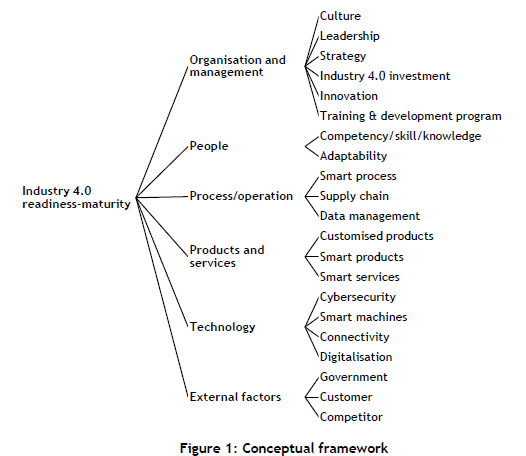
These perspectives demonstrate substantial conceptual overlap, suggesting that some categories in the RMM, such as culture and customer, serve more appropriately as subfactors within the broader six-dimensional structure identified in the literature. Thus, the integration process involves aligning conceptually equivalent elements in multiple sources. Under the organisation and management dimension, the key factors included strategic orientation, investment, innovation, culture, and training and development. The people dimension comprises competencies, skills, and adaptability. The operations dimension encompasses intelligent processes, supply chain performance, and data management. Products and services covers intelligent products, intelligent services, and product customisation. The technology dimension covers cybersecurity, intelligent machines, connectivity, digitalisation, and infrastructure. Finally, the external factors were government support and regulation, customer, and competitive pressures.
This integrative assessment yielded a coherent and parsimonious framework consisting of six dimensions and 21 factors, providing a robust foundation for assessing Industry 4.0 readiness and maturity in the manufacturing sector. The resulting set of factors was then verified and refined through interviews with four industry leaders who were key practitioners in implementing Industry 4.0 in Indonesia. Together, these three stages shaped the research conceptual framework, as shown in Figure 1.
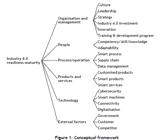
The sections that follow provide an explanation of each dimension and its contributing factors.
2.2.1. Organisation and management
The organisation and management dimension represents the strategic and managerial capabilities that enable firms to adopt Industry 4.0 technologies effectively. Core factors are strategy, leadership, and organisational culture, which provide governance and direction for digital transformation by aligning technological initiatives with long-term business objectives through structured planning, clear roadmaps, and coordinated decision-making[1, 8, 22, 36]. An adaptive and innovation-oriented culture strengthens organisational readiness by supporting continuous improvement and reducing resistance to change[32, 33]. This strategic foundation is driven by investments in Industry 4.0, innovation, and training and development programmes, which jointly support sustainable implementation. Investment determines the feasibility and scalability of digital initiatives; innovation facilitates the integration of advanced technologies into processes and offerings; and training programmes enhance the workforce competencies required to operationalise Industry 4.0 solutions[6, 37, 38].
2.2.2. People
The people capabilities that enable effective Industry 4.0 adoption are employee competence and adaptability. Competence encompasses the knowledge, technical skills, and digital capabilities required to operate, integrate, and use advanced manufacturing technologies, and is consistently identified as a key determinant of Industry 4.0 readiness[39-41]. Conversely, limited competence has been widely reported as a barrier that constrains the ability to realise the benefits of digital transformation[6, 42, 43].
Adaptability is the ability to adjust skills, behaviours, and work practices in response to technological and organisational changes. Resistance to change impedes implementation[30, 44]. Together, competence and adaptability represent the core individual capabilities in the people dimension, whereas training and development initiatives are more appropriately positioned in the organisation and management dimension, as they reflect organisational mechanisms for capability development rather than individual attributes.
2.2.3. Process
Smart processes in Industry 4.0 refers to the integration of advanced digital technologies such as IoT, artificial intelligence (AI), automation, and real-time analytics into industrial operations to enable autonomous or semi-autonomous systems that are capable of self-monitoring, self-optimisation, and self-correction[30, 40, 45]. These capabilities include process automation, integrated manufacturing technologies, and process redesign. Inadequate process maturity and delayed transformation remain key barriers to implementation[38, 46, 47]. In parallel, integrating production processes with supply chain and logistics systems is essential for enhancing operational efficiency. Smart supply chains and Logistics 4.0, enabled by condition monitoring, goods-tracking technologies, and logistics automation, are widely recognised as critical components of Industry 4.0 readiness[23, 36, 40, 41, 48]. Data management, encompassing data storage, transfer, governance, and utilisation, serves as a key indicator of digital maturity and underpins process integration and decision-making[39, 49, 50]. However, problems related to data security and infrastructure limitations continue to constrain effective Industry 4.0 implementation[6].
2.2.4. Product and service
Intelligent products and services constitute a core dimension of Industry 4.0 readiness, encompassing three interrelated capabilities: customised products, smart products, and smart services. The ability to deliver customised products, enabled by flexible manufacturing systems, additive manufacturing, CAD/CAM, and real-time analytics, reflects organisational agility and technological capability, and is widely recognised as a prerequisite for mass personalisation in Industry 4.0 environments[1, 51]. Smart products are characterised by embedded sensors, connectivity, and data-processing capabilities that enable real-time monitoring, customisation, and predictive maintenance, thereby supporting data-driven business models and lifecycle-oriented value creation[51]. These capabilities are complemented by smart services, which leverage digital platforms, remote monitoring, and predictive analytics to enhance customer interaction and support servitisation strategies, requiring robust digital infrastructure and innovation-oriented capabilities[52]. Collectively, customised products, smart products, and smart services are key drivers of Industry 4.0 readiness and transformation success.
2.2.5. Technology
The technology dimension of Industry 4.0 has four core factors - cybersecurity, intelligent machinery, connectivity, and digitalisation - that collectively determine an organisation's digital readiness and transformation capability. Cybersecurity plays a critical role in protecting interconnected manufacturing environments and ensuring the secure storage, transmission, and processing of data, while cybersecurity risks and data governance issues remain barriers to adoption[6, 45, 46]. Intelligent machinery, such as cyber-physical systems, AI-enabled equipment, and IoT-based devices, enables autonomous optimisation, real-time control, and human-machine collaboration, and is consistently identified as a key technological enabler of Industry 4.0[10, 53]. Connectivity in and between factories and supply-chain partners facilitates real-time information exchange and system integration. It is widely regarded as a primary determinant of Industry 4.0 readiness, whereas limited interoperability constrains effective implementation[37, 38]. Finally, digitalisation that encompasses digital twins, digital factories, and data-driven decision-making serves as a key indicator of digital maturity, supported by robust digital infrastructure and technological capability, while limited digital vision and resources continue to hinder adoption[29, 42]. Together, these four technological factors form the backbone of effective and sustainable Industry 4.0 implementation.
2.2.6. External factors
External factors are the conditions beyond a firm's direct control, namely government support, customer expectations, and competitive pressure, which significantly influence Industry 4.0 readiness and implementation outcomes. Government support, manifested through regulatory frameworks, fiscal incentives, infrastructure provision, and national initiatives such as Making Indonesia 4.0, plays a pivotal role in facilitating digital transformation, and is consistently identified as a key driver of organisational readiness and maturity[11, 12, 37, 38]. Conversely, insufficient policy support and regulatory uncertainty are barriers to adoption[42, 44]. Customer-driven pressures, such as increasing demands for customisation, responsiveness, and transparency, encourage firms to adopt flexible and data-driven production systems, positioning customer orientation as a critical external determinant of Industry 4.0 readiness[1, 54]. Competitive pressure accelerates adoption, as firms seek to maintain efficiency and innovation parity with rivals; awareness of competitors' digital advancements therefore acts as a strong motivator for implementing Industry 4.0 technologies[9, 46]. Collectively, these external forces shape strategic priorities and act as powerful drivers of Industry 4.0 transformation.
3. RESEARCH METHODOLOGY
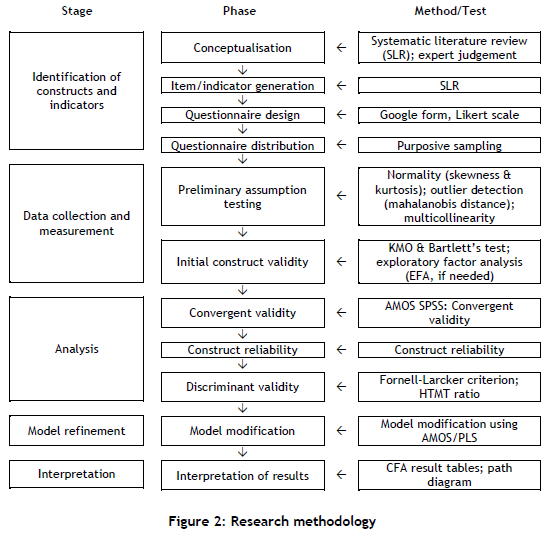
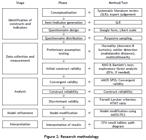
This study uses a quantitative research design to validate the key success factors that influence Industry 4.0 readiness and maturity in the Indonesian manufacturing sector. A structured questionnaire developed from indicators established in previous stages, and using a Likert scale (1-5), was administered to manufacturing companies. Before analysis, the dataset underwent initial screening, including tests for normality, outlier detection, and multicollinearity. The measurement structure was then evaluated through a multi-stage structural equation modelling (SEM) procedure that began with construct validity testing using the Kaiser-Meyer-Olkin (KMO) measure and Bartlett's test, followed by assessing convergent validity, construct reliability, and discriminant validity through confirmatory factor analysis (CFA) in AMOS[55].
Model modifications were necessary to improve the model fit indices, in accordance with established SEM guidelines. The final model provided an empirical basis for interpreting key factors that influenced Industry 4.0 readiness. The complete sequence of methodological stages is presented in Figure 2.
4. DATA COLLECTION AND MEASUREMENT
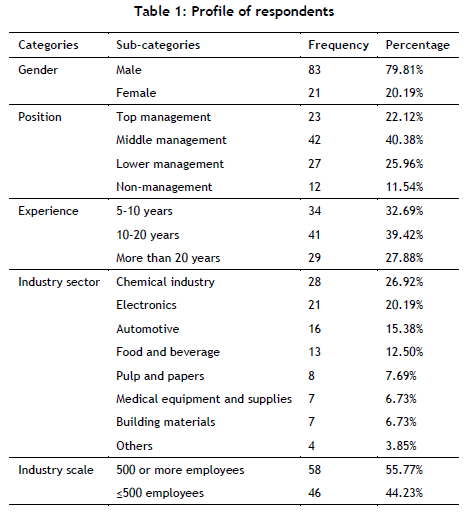
The primary data were collected through a structured questionnaire using a Likert scale, which is widely used to capture managerial perceptions thanks to its simplicity and interpretability[55]. Respondents were Industry 4.0 experts in manufacturing, such as chief technology officers (CTOs), information and communication technology/information technology (ICT/IT) managers, and technical specialists, with a minimum of five years' experience and direct involvement in Industry 4.0-related decision-making. A two-stage sampling strategy was used: purposive sampling to target individuals who met the criteria, followed by snowball sampling to broaden access to senior manager - a group that is typically difficult to reach through conventional sampling methods. Purposive sampling is appropriate for studies that require expert-informed judgements. A total of 125 questionnaires were collected, and after screening for relevance and eligibility, 104 were found to be valid. The exclusion of 21 cases because of insufficient experience or employment outside the manufacturing sector ensured that the dataset accurately represented qualified Industry 4.0 practitioners. The recommended minimum sample size for CFA requires at least 100-150 samples or a ratio of 5-10 respondents per estimated parameter to ensure adequate statistical power and model stability[55]. Similarly, Sekaran[56] suggested an appropriate sample size to be between 30 and 500. Therefore, the minimum sample size required was satisfied in this study. A detailed profile of the respondents is presented in Table 1.
The respondents' profiles indicate that the study primarily involved experienced managers from manufacturing companies, many of whom had been in the industry for over a decade. The strong representation of the chemical, electronics, automotive, and food and beverage sectors strengthened this finding, as these industries are at the forefront of digital transformation. Interestingly, nearly half of the companies had started to adopt Industry 4.0 in the previous three years, suggesting that the perspectives that were captured reflected organisations still in transition, rather than those with fully mature systems.
5. DATA ANALYSIS AND FINDINGS
Following the completion of the data collection and screening, the next stage of this study focused on the analysis and interpretation of the data. This section presents the results of the statistical tests that were conducted to evaluate the validity and reliability of the measurement model, and to examine the relationships among the key constructs of Industry 4.0 readiness. The findings are reported systematically, beginning with the preliminary assumption testing, followed by CFA to assess convergent and discriminant validity, and concluding with the refinement of the final model.
5.1.1. Preliminary assumption testing
Before conducting CFA, a series of preliminary assumption tests was performed to ensure that the data met the requirements for multivariate analysis. The assessment of univariate normality showed that all indicators fell within acceptable thresholds, with skewness values ranging from -2.08 to -0.28 and kurtosis values ranging from -0.77 to 4.74, all well below the recommended limits for Likert-scale data treated as continuous variables (|skewness| < 3; |kurtosis| < 7) (Hair et al., 2019). Outlier detection using standardised Z-scores, and Mahalanobis distance (p < 0.001) revealed no severe univariate or multivariate outliers among the 104 valid cases, indicating that the dataset was stable and free from influential anomalies. Multicollinearity diagnostics further confirmed that no indicators revealed problematic intercorrelations.
5.1.2. Initial construct validity
Following the assumption tests, preliminary construct validity was evaluated using the KMO measure and Bartlett's test of sphericity. Sampling adequacy was confirmed, as indicated by a KMO value of 0.780 exceeding the recommended threshold of 0.50 (Kaiser, 1974). In addition, Bartlett's test of sphericity yielded a statistically significant result (χ2 = 7067.170, df = 2346, p < 0.001), indicating the presence of sufficient inter-item correlations to justify factor analysis[57]. Collectively, these results confirmed that the dataset was appropriate for proceeding with confirmatory factor analysis.
5.1.3. Validity and reliability test
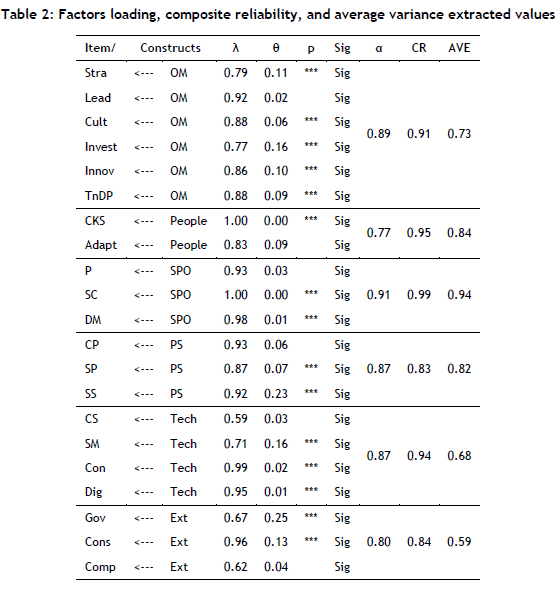
This study assessed convergent and discriminant validity by examining indicator loadings (λ), average variance extracted (AVE), the Fornell-Larcker criterion, and the heterotrait-monotrait (HTMT) ratio. All the indicators exceeded the minimum factor loading threshold of 0.55, which is acceptable for newly developed measurement models[55]. In addition, all AVE values were above the recommended criterion of 0.50, confirming adequate convergent validity[58]. Discriminant validity was also confirmed, as the square root of each construct's AVE exceeded its correlations with other constructs, and all HTMT values remained below the conservative threshold of 0.85, indicating sufficient conceptual distinction among latent variables[58, 59]. Construct reliability was assessed separately using Cronbach's alpha (α) and composite reliability (CR). All validity and reliability results, along with their corresponding benchmark criteria, are presented in Tables 2 and 3.
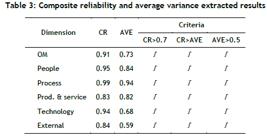
All constructs exceeded the recommended minimum threshold of 0.70, demonstrating strong internal consistency[55]. The overall measurement instrument exhibited high reliability, reflected in a Cronbach's alpha coefficient of 0.964, while the CR values for the constructs ranged from 0.797 to 0.978. Collectively, these results indicated that the measurement model demonstrated satisfactory validity and reliability, making it appropriate for subsequent evaluation of overall model fit and structural relationships.
5.2. Model feasibility test (chi-square, RMSEA, GFI, AGFI, CFI)
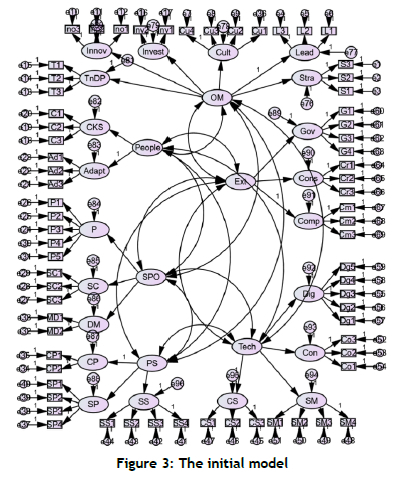
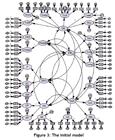
After establishing the validity and reliability of the measurement model, the analysis proceeded to the testing of the overall model fit. The model feasibility test used commonly reported goodness-of-fit indices, such as the chi-square statistic, the root mean square error of approximation (RMSEA), the goodness-of-fit index (GFI), and the adjusted goodness-of-fit index (AGFI). These indices are widely used in CFA to evaluate the adequacy of a proposed measurement model. The initial measurement model illustrated in Figure 3 was then assessed using these criteria, with the support of AMOS software.
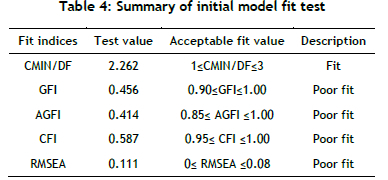
The results of the model fit assessment are summarised in Table 4 below.
The results of the model fit evaluation indicated that only the CMIN/DF index met the acceptable threshold (2.262, where 1 ≤ CMIN/DF ≤ 3). According to the model fit evaluation results, the overall model complexity was within an acceptable range. However, the other indices - GFI (0.456), AGFI (0.414), CFI (0.587), and RMSEA (0.111) - fell outside their respective acceptable ranges, indicating that the model did not achieve an adequate fit. The low values of the GFI and AGFI, which should ideally have been ≥ 0.90 and ≥ 0.85 respectively, indicated that the model was unable to replicate the observed data sufficiently. Poor comparative fit versus a baseline model was also indicated by the CFI, which had a value of 0.587 (< 0.95). The RMSEA exceeded the recommended upper limit of 0.08, also indicating model misfit.
5.3. Refinement of model
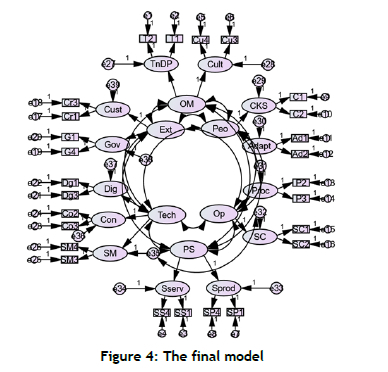
To improve the model's fit indices, modifications were systematically carried out. Initially the model was assessed and refined at the dimension level, and subsequently the well-fitting dimensions were reintegrated into the overall model. The model resulting from the integration of the six dimensions that achieved an acceptable fit was then subjected to further model fit testing. This modification resulted in six dimensions comprising sixteen factors: organisation and management (culture, training and development, and innovation); people (competency, knowledge and skills, and adaptability); process (smart processes, supply chain, and data management); product and service (smart products and smart services); technology (digitalisation, connectivity, and smart machines); and external factors (government, customers, and competitors). Following the model fit evaluation, the initial model was found to have not yet achieved an adequate level of fit. Consequently, iterative modifications were performed until all model fit criteria were satisfactorily met. The final model, which fulfilled all goodness-of-fit requirements, is presented in Figure 4.
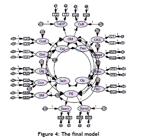
This figure illustrates that the final structural model successfully identified thirteen latent factors that significantly contribute to the implementation of Industry 4.0 in the manufacturing sector. The attainment of adequate model fit confirms that the retained factors exhibit strong construct validity and reliably explain the underlying structure of Industry 4.0 readiness.
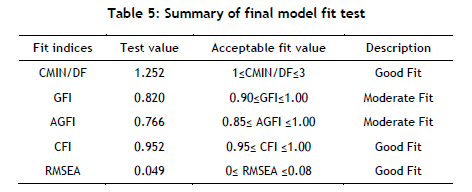
The results of the final model fit evaluation, including the statistical indices used to assess both absolute and incremental fit, are presented in Table 5. The overall goodness-of-fit results indicated that the proposed measurement model demonstrated an acceptable to good fit with the empirical data. The chi-square to degrees of freedom ratio (CMIN/DF = 1.252) fell well within the recommended range of 1 to 3, indicating a parsimonious model with minimal discrepancy between the observed and the estimated covariance matrices. Consistent with Bentler's combination rule, model adequacy is primarily supported when the criteria of CFI ≥ 0.95 and RMSEA ≤ 0.08 are jointly satisfied[60]. In this study, the final measurement model met these criteria, reflected in a CFI value of 0.952 and an RMSEA value of 0.049, indicating a close approximate fit to the population covariance matrix.
Although the absolute fit indices (GFI = 0.820 and AGFI = 0.766) fell below conventional cut-off values, prior methodological research has consistently shown that these indices are highly sensitive to sample size, model complexity, and the number of estimated parameters. Several studies suggest that GFI and AGFI values in the range of 0.70-0.89 may still be considered acceptable or marginal, particularly in complex structural equation models[61, 62]. Moreover, contemporary SEM guidelines emphasise that absolute fit indices should not be used as the sole criterion for evaluating model adequacy, especially when incremental and parsimony-adjusted indices demonstrate strong fit[60, 63]. In line with this perspective, Hair et al. (2019) note that lower GFI and AGFI values do not invalidate a model when key indices, CFI, and RMSEA provide strong evidence of model adequacy. Taken together, the strong performance of the primary fit indices and the recognised limitations of GFI and AGFI support the conclusion that the final measurement model achieved an acceptable and theoretically defensible level of fit, making it suitable for subsequent structural analysis.
6. DISCUSSION
This study contributes to the Industry 4.0 literature by empirically validating the supporting factors for the readiness and maturity of Industry 4.0 implementation in the Indonesian manufacturing industry. A survey of Industry 4.0 practitioners, and validation using CFA, yielded six dimensions and thirteen supporting factors. These findings strengthen the theoretical foundation of Industry 4.0 readiness research and provide strong empirical evidence that successful implementation is influenced by the interaction of organisational and management factors, human resources, processes, products and services, technology, and external factors. These findings reinforce the view that digital transformation is not just a technological endeavour but also a comprehensive organisational change process.
The results of this study show that the readiness and maturity of Industry 4.0 adoption is a combination of internal and external factors. The effective adoption in Indonesia's manufacturing sector could be attributed to elements found in the human resource and organisational aspects, such as training and development, organisational culture, employee competencies, digital skills, and adaptability. These results are consistent with earlier studies that highlight the critical role of culture and human resources in driving digital transformation[54, 64, 65]. Adaptability shows that businesses need to constantly improve their knowledge, ability, and routines in order to deal with rapidly evolving digital technologies.
The validation of smart machines, digitalisation, connectivity, supply chain integration, and smart processes in the technology and process domain shows that end-to-end digital integration in production and logistics systems is necessary to enable technological preparedness. These results support previous studies that highlight IoT-enabled connectivity, cyber-physical systems, and data-driven process optimisation as key Industry 4.0 enablers[13, 66, 67]. This finding is significant because it shows that investment in technology on its own is insufficient unless it is incorporated into digitally connected operational processes throughout the value chain.
Beyond internal processes, the concept of Industry 4.0 readiness is expanded by the product and service dimension. Real-time monitoring, predictive maintenance, and service customisation are some of the customer-facing digital innovations that are enabled by the validation of smart products and services[68]. This result lends support to the view that enterprises' ability to leverage digital technologies in order to develop new value propositions and service-based business models is a key determinant of Industry 4.0 readiness and maturity.
Finally, the external dimension emphasises how the broader ecosystem shapes Industry 4.0 readiness. Customer demand and government support were confirmed as important external enablers, supporting earlier findings that market expectations, national initiatives, and regulatory frameworks have a significant impact on digital adoption, particularly in developing economies[8, 37]. This finding emphasises that Industry 4.0 readiness is not only an organisational trait, but is also co-shaped by institutional and market dynamics.
7. CONCLUSION
In response to the research objectives, this study empirically validated thirteen key success factors that collectively determine Industry 4.0 readiness and maturity in Indonesia's manufacturing sector. Using CFA, the findings confirm that the proposed multidimensional model demonstrates good fit and effectively captures the interrelated organisational, people, technological, process, product and service, and external capabilities required for digital transformation in a developing economy context. These results reinforce the view that Industry 4.0 readiness is not driven by technology alone, but emerges from the coordinated development of internal capabilities and external enablers.
This study offers important implications for multiple stakeholders. For manufacturing practitioners, the validated model underscores the need to complement technological investments with sustained efforts in workforce development, organisational culture, adaptability, and competency building. For policymakers, the significance of government-related factors highlights the continued importance of coherent policy frameworks, regulatory support, and digital infrastructure development to accelerate Industry 4.0 adoption. For researchers, the thirteen-factor model provides a robust and empirically grounded framework that complements existing global reference models such as INDI 4.0 and IMPULS, while offering greater contextual relevance for manufacturing firms in developing economies.
Despite its contributions, this study is subject to several limitations. The empirical analysis is confined to the manufacturing sector, which may limit the generalisability of the findings to other industries; and the cross-sectional research design captures Industry 4.0 readiness at a single point in time. Future research could extend this work by conducting cross-country comparative studies, applying longitudinal designs to examine the evolution of readiness and maturity over time, and undertaking in-depth case studies to explore implementation dynamics at the firm level. In addition, the validated measurement model may be applied to assess and map Industry 4.0 readiness and maturity in different manufacturing subsectors, providing valuable insights for both strategic decision-making and national industrial policy.
REFERENCES
2. LITERATURE REVIEW
-
[1] A. G. Frank, L. S. Dalenogare, and N. F. Ayala, "Industry 4.0 technologies: Implementation patterns in manufacturing companies," International Journal of Production Economics, vol. 210, pp. 15-26, 2019. https://doi.org/10.1016/j.ijpe.2019.01.004
» https://doi.org/10.1016/j.ijpe.2019.01.004 - [2] K. Schwab, The fourth industrial revolution. Penguin, 2017.
-
[3] G. Beier et al., "Implications of Industry 4.0 on industrial employment: A comparative survey from Brazilian, Chinese, and German practitioners," Technology in Society, vol. 70, 102028, 2022. https://doi.org/10.1016/j.techsoc.2022.102028
» https://doi.org/10.1016/j.techsoc.2022.102028 -
[4] M. Sousa, D. Alencar, J. Leite, and H. Júnior, "Integration of Industry 4.0 technologies in industrial manufacturing processes," Revista de Gestão e Secretariado, vol. 15, e3844, 2024. doi: 10.7769/gesec.v15i7.3844
» https://doi.org/10.7769/gesec.v15i7.3844 -
[5] Z. Tao and J. Chao, "Unlocking new opportunities in the Industry 4.0 era, exploring the critical impact of digital technology on sustainable performance and the mediating role of GSCM practices," Innovation and Green Development, vol. 3, no. 3, 100160, 2024. doi: https://doi.org/10.1016/j.igd.2024.100160
» https://doi.org/10.1016/j.igd.2024.100160 -
[6] M. Sony, "Pros and cons of implementing Industry 4.0 for the organizations: A review and synthesis of evidence," Production & Manufacturing Research, vol. 8, no. 1, pp. 244-272, 2020. doi: 10.1080/21693277.2020.1781705
» https://doi.org/10.1080/21693277.2020.1781705 -
[7] A. Raj, G. Dwivedi, A. Sharma, A. B. Lopes de Sousa Jabbour, and S. Rajak, "Barriers to the adoption of Industry 4.0 technologies in the manufacturing sector: An inter-country comparative perspective," International Journal of Production Economics, vol. 224, 107546, 2020. https://doi.org/10.1016/j.ijpe.2019.107546
» https://doi.org/10.1016/j.ijpe.2019.107546 -
[8] J. Stentoft, K. Adsbøll Wickstrøm, K. Philipsen, and A. Haug, "Drivers and barriers for Industry 4.0 readiness and practice: Empirical evidence from small and medium-sized manufacturers," Production Planning & Control, vol. 32, no. 10, pp. 811-828, 2021. doi: 10.1080/09537287.2020.1768318
» https://doi.org/10.1080/09537287.2020.1768318 -
[9] S. Mittal, M. A. Khan, D. Romero, and T. Wuest, "A critical review of smart manufacturing & Industry 4.0 maturity models: Implications for small and medium-sized enterprises (SMEs)," Journal of Manufacturing Systems, vol. 49, pp. 194-214, 2018. https://doi.org/10.1016/j.jmsy.2018.10.005
» https://doi.org/10.1016/j.jmsy.2018.10.005 -
[10] Y. Liao, F. Deschamps, E. d. F. R. Loures, and L. F. P. Ramos, "Past, present and future of Industry 4.0 - A systematic literature review and research agenda proposal," International Journal of Production Research, vol. 55, no. 12, pp. 3609-3629, 2017. doi: 10.1080/00207543.2017.1308576
» https://doi.org/10.1080/00207543.2017.1308576 -
[11] Making Indonesia 4.0. [Online], (2018). Available: https://www.kemenperin.go.id/artikel/19046/Making-Indonesia-4.0-Bikin-Industri-Nasionalberdaya
» https://www.kemenperin.go.id/artikel/19046/Making-Indonesia-4.0-Bikin-Industri-Nasionalberdaya -
[12] S. Bag, A. Telukdarie, J. H. C. Pretorius, and S. Gupta, "Industry 4.0 and supply chain sustainability: Framework and future research directions," Benchmarking: An International Journal, vol. 28, no. 5, pp. 1410-1450, 2018. doi: 10.1108/BIJ-03-2018-0056
» https://doi.org/10.1108/BIJ-03-2018-0056 -
[13] G. L. Tortorella, R. Giglio, and D. H. van Dun, "Industry 4.0 adoption as a moderator of the impact of lean production practices on operational performance improvement," International Journal of Operations & Production Management, vol. 39, no. 6/7/8, pp. 860-886, 2019. doi: 10.1108/IJOPM-01-2019-0005
» https://doi.org/10.1108/IJOPM-01-2019-0005 -
[14] J.-P. Schöggl, M. Rusch, L. Stumpf, and R. J. Baumgartner, "Implementation of digital technologies for a circular economy and sustainability management in the manufacturing sector," Sustainable Production and Consumption, vol. 35, pp. 401-420, 2023. https://doi.org/10.1016/j.spc.2022.11.012
» https://doi.org/10.1016/j.spc.2022.11.012 -
[15] ABI-Research, "Vehicle connectivity is surging, but consumer paid subscription share is in sharp decline." https://www.abiresearch.com/press/vehicle-connectivity-is-surging-but-consumer-paid-subscription-share-is-in-sharp-decline (accessed: Nov. 30, 2025).
» https://www.abiresearch.com/press/vehicle-connectivity-is-surging-but-consumer-paid-subscription-share-is-in-sharp-decline -
[16] M. Ginting and T.Y.M. Zagloel, "Defining the key factors of Industry 4.0 adoption in the manufacturing industry: A systematic literature review," in International Conference on Industrial, Enterprise, and System Engineering, N. I. Saragih and S. A. Salma, Eds., 2023, vol. 2693. https://doi.org/10.1063/5.0119019 [Online].
» https://doi.org/10.1063/5.0119019 - [17] K. Y. Akdil, A. Ustundag, and E. Cevikcan, "Maturity and readiness model for Industry 4.0 strategy," in Industry 4.0: Managing the digital transformation, A. Ustundag and E. Cevikcan, Eds. Cham: Springer, 2018, pp. 61-94.
-
[18] A. Amaral and P. Peças, "A framework for assessing manufacturing SMEs Industry 4.0 maturity," Applied Sciences, vol. 11, no. 13, 6127, 2021. [Online]. Available: https://www.mdpi.com/2076-3417/11/13/6127
» https://www.mdpi.com/2076-3417/11/13/6127 -
[19] A. Benešová, J. Basl, J. Tupa, and F. Steiner, "Design of a business readiness model to realise a green Industry 4.0 company," International Journal of Computer Integrated Manufacturing, vol. 34, no. 9, pp. 920-932, 2021. https://doi.org/10.1080/0951192X.2021.1946858
» https://doi.org/10.1080/0951192X.2021.1946858 -
[20] L. Bibby and B. Dehe, "Defining and assessing Industry 4.0 maturity levels - Case of the defence sector," Production Planning & Control, vol. 29, no. 12, pp. 1030-1043, 2018. doi: 10.1080/09537287.2018.1503355
» https://doi.org/10.1080/09537287.2018.1503355 - [21] L. Canetta, A. Barni, and E. Montini, "Development of a digitalization maturity model for the manufacturing sector," in 2018 IEEE International Conference on Engineering, Technology and Innovation (ICE/ITMC), 17-20 June 2018, pp. 1-7. doi: 10.1109/ICE.2018.8436292
- [22] N. Chonsawat and A. Sopadang, "Defining SMEs' 4.0 readiness indicators," Applied Sciences, vol. 10, no. 24, 8998, 2020.
-
[23] Z. M. Çınar, Q. Zeeshan, and O. Korhan, "A framework for Industry 4.0 readiness and maturity of smart manufacturing enterprises: A case study," Sustainability, vol. 13, no. 12, 6659. https://doi.org/10.3390/su13126659
» https://doi.org/10.3390/su13126659 - [24] E. Gökalp, U. Şener, and P. E. Eren, "Development of an assessment model for Industry 4.0: Industry 4.0-MM," in Software process improvement and capability determination, A. Mas, A. Mesquida, R. V. O'Connor, T. Rout, and A. Dorling, Eds., 2017. Cham: Springer, pp. 128-142.
- [25] V. Majstorovic, J. Macuzic, T. Sibalija, and S. Zivkovic, "Cyber-physical manufacturing systems - Manufacturing metrology aspects," Proceedings in Manufacturing Systems, vol. 10, no. 1, pp. 9-14, 2015.
-
[26] I. Mayusda and I. I. Wiratmadja, "The development of Industry 4.0 readiness model. Case study in Indonesia's priority industrial sector of chemical," Lecture Notes in Mechanical Engineering, 2019. https://doi.org/10.1007/978-981-15-0950-6_22
» https://doi.org/10.1007/978-981-15-0950-6_22 -
[27] F. Pirola, C. Cimini, and R. Pinto, "Digital readiness assessment of Italian SMEs: A case-study research," Journal of Manufacturing Technology Management, vol. 31, no. 5, pp. 1045-1083, 2019. https://doi.org/10.1108/JMTM-09-2018-0305
» https://doi.org/10.1108/JMTM-09-2018-0305 -
[28] L. D. Rafael, G. E. Jaione, L. Cristina, and S. L. Ibon, "An Industry 4.0 maturity model for machine tool companies," Technological Forecasting and Social Change, vol. 159, 120203, 2020. https://doi.org/10.1016/j.techfore.2020.120203
» https://doi.org/10.1016/j.techfore.2020.120203 -
[29] S. Rakic, M. Pavlovic, and U. Marjanovic, "A precondition of sustainability: Industry 4.0 readiness," Sustainability, vol. 13, no. 12, 6641, 2021. [Online]. Available: https://www.mdpi.com/2071-1050/13/12/6641
» https://www.mdpi.com/2071-1050/13/12/6641 -
[30] E. Rauch, P. Dallasega, and M. Unterhofer, "Requirements and barriers for introducing smart manufacturing in small and medium-sized enterprises," IEEE Engineering Management Review, vol. 47, no. 3, pp. 87-94, 2019. https://doi.org/10.1109/EMR.2019.2931564
» https://doi.org/10.1109/EMR.2019.2931564 -
[31] S. M. Saad, R. Bahadori, and H. Jafarnejad, "The smart SME technology readiness assessment methodology in the context of Industry 4.0," Journal of Manufacturing Technology Management, vol. 32, no. 5, pp. 1037-1065, 2021. https://doi.org/10.1108/JMTM-07-2020-0267
» https://doi.org/10.1108/JMTM-07-2020-0267 -
[32] R. C. Santos and J. L. Martinho, "An Industry 4.0 maturity model proposal," Journal of Manufacturing Technology Management, vol. 31, no. 5, pp. 1023-1043, 2020. doi: https://doi.org/10.1108/JMTM-09-2018-0284
» https://doi.org/10.1108/JMTM-09-2018-0284 -
[33] A. Schumacher, S. Erol, and W. Sihn, "A maturity model for assessing Industry 4.0 readiness and maturity of manufacturing enterprises," Procedia CIRP, vol. 52, pp. 161-166, 2016. https://doi.org/10.1016/j.procir.2016.07.040
» https://doi.org/10.1016/j.procir.2016.07.040 -
[34] A. A. Wagire, R. Joshi, A. P. S. Rathore, and R. Jain, "Development of maturity model for assessing the implementation of Industry 4.0: Learning from theory and practice," Production Planning & Control, vol. 32, no. 8, pp. 603-622, 2021. https://doi.org/10.1080/09537287.2020.1744763
» https://doi.org/10.1080/09537287.2020.1744763 -
[35] R. G. G. Caiado, L. F. Scavarda, L. O. Gavião, P. Ivson, D. L. d. M. Nascimento, and J. A. Garza-Reyes, "A fuzzy rule-based Industry 4.0 maturity model for operations and supply chain management," International Journal of Production Economics, vol. 231, 107883, 2021. https://doi.org/10.1016/j.ijpe.2020.107883
» https://doi.org/10.1016/j.ijpe.2020.107883 -
[36] M. Sony, "Industry 4.0 and lean management: A proposed integration model and research propositions," Production & Manufacturing Research, vol. 6, no. 1, pp. 416-432, 2018. https://doi.org/10.1080/21693277.2018.1540949
» https://doi.org/10.1080/21693277.2018.1540949 -
[37] S. S. Kamble, A. Gunasekaran, A. Ghadge, and R. Raut, "A performance measurement system for Industry 4.0 enabled smart manufacturing system in SMMEs - A review and empirical investigation," International Journal of Production Economics, vol. 229, 107853, 2020. https://doi.org/10.1016/j.ijpe.2020.107853
» https://doi.org/10.1016/j.ijpe.2020.107853 -
[38] A. Stornelli, S. Ozcan, and C. Simms, "Advanced manufacturing technology adoption and innovation: A systematic literature review on barriers, enablers, and innovation types," Research Policy, vol. 50, no. 6, 104229, 2021. https://doi.org/10.1016/j.respol.2021.104229
» https://doi.org/10.1016/j.respol.2021.104229 -
[39] D. Adebanjo, T. Laosirihongthong, P. Samaranayake, and P. L. Teh, "Key enablers of Industry 4.0 development at firm level: Findings from an emerging economy," IEEE Transactions on Engineering Management, vol. 70, no. 2, pp. 400-416, 2023. https://doi.org/10.1109/TEM.2020.3046764
» https://doi.org/10.1109/TEM.2020.3046764 -
[40] S. Narula, S. Prakash, M. Dwivedy, V. Talwar, and S. P. Tiwari, "Industry 4.0 adoption key factors: An empirical study on manufacturing industry," Journal of Advances in Management Research, vol. 17, no. 5, pp. 697-725, 2020 https://doi.org/10.1108/JAMR-03-2020-0039
» https://doi.org/10.1108/JAMR-03-2020-0039 -
[41] G. Rejikumar, P. Arunprasad, and K. M. Sreeraj, "Industry 4.0: Key findings and analysis from the literature arena," Benchmarking: An International Journal, vol. 26, no. 8, pp. 2514-2542, 2019. https://doi.org/10.1108/BIJ-09-2018-0281
» https://doi.org/10.1108/BIJ-09-2018-0281 -
[42] C. Chauhan, A. Singh, and S. Luthra, "Barriers to Industry 4.0 adoption and its performance implications: An empirical investigation of emerging economy," Journal of Cleaner Production, vol. 285, 124809, 2021. https://doi.org/10.1016/j.jclepro.2020.124809
» https://doi.org/10.1016/j.jclepro.2020.124809 -
[43] S. S. Kamble, A. Gunasekaran, and R. Sharma, "Analysis of the driving and dependence power of barriers to adopt Industry 4.0 in Indian manufacturing industry," Computers in Industry, vol. 101, pp. 107-119, 2018. https://doi.org/10.1016/j.compind.2018.06.004
» https://doi.org/10.1016/j.compind.2018.06.004 -
[44] G. Orzes, E. Rauch, S. Bednar, and R. Poklemba, "Industry 4.0 implementation barriers in small and medium sized enterprises: A focus group study," in 2018 IEEE International Conference on Industrial Engineering and Engineering Management (IEEM), 16-19 Dec. 2018, pp. 1348-1352. https://doi.org/10.1109/IEEM.2018.8607477
» https://doi.org/10.1109/IEEM.2018.8607477 -
[45] M. Ghobakhloo, M. Iranmanesh, M. Vilkas, A. Grybauskas, and A. Amran, "Drivers and barriers of Industry 4.0 technology adoption among manufacturing SMEs: A systematic review and transformation roadmap," Journal of Manufacturing Technology Management, vol. 33, no. 6, pp. 1029-1058, 2022. https://doi.org/10.1108/JMTM-12-2021-0505
» https://doi.org/10.1108/JMTM-12-2021-0505 -
[46] D. Horváth and R. Z. Szabó, "Driving forces and barriers of Industry 4.0: Do multinational and small and medium-sized companies have equal opportunities?" Technological Forecasting and Social Change, vol. 146, pp. 119-132, 2019. https://doi.org/10.1016/j.techfore.2019.05.021
» https://doi.org/10.1016/j.techfore.2019.05.021 -
[47] S. Karadayi-Usta, "An interpretive structural analysis for Industry 4.0 adoption challenges," IEEE Transactions on Engineering Management, vol. 67, no. 3, pp. 973-978, 2020. https://doi.org/10.1109/TEM.2018.2890443
» https://doi.org/10.1109/TEM.2018.2890443 -
[48] T. Khan and M. M. H. Emon, "Supply chain performance in the age of Industry 4.0: Evidence from manufacturing sector," Brazilian Journal of Operations & Production Management, vol. 22, no. 1, 2434, 2025. https://doi.org/10.14488/BJOPM.2434.2025
» https://doi.org/10.14488/BJOPM.2434.2025 -
[49] P. Kumar, J. Bhamu, and K. S. Sangwan, "Analysis of barriers to Industry 4.0 adoption in manufacturing organizations: An ISM approach," Procedia CIRP, vol. 98, pp. 85-90, 2021. https://doi.org/10.1016/j.procir.2021.01.010
» https://doi.org/10.1016/j.procir.2021.01.010 -
[50] A. C. Shinohara, E. H. D. R. da Silva, E. P. de Lima, F. Deschamps, and S. E. G. da Costa, "Critical success factors for digital manufacturing implementation in the context of industry 4.0," Proceedings of the 2017 Industrial and Systems Engineering Conference (IISE), pp. 199-204. https://www.researchgate.net/publication/319830521_Critical_Success_Factors_for_Digital_Manufacturing_Implementation_in_the_Context_of_Industry_40#fullTextFileContent
» https://www.researchgate.net/publication/319830521_Critical_Success_Factors_for_Digital_Manufacturing_Implementation_in_the_Context_of_Industry_40#fullTextFileContent -
[51] P. Zheng, Z. Wang, C.-H. Chen, and L. Pheng Khoo, "A survey of smart product-service systems: Key aspects, challenges and future perspectives," Advanced Engineering Informatics, vol. 42, 100973, 2019. https://doi.org/10.1016/j.aei.2019.100973
» https://doi.org/10.1016/j.aei.2019.100973 -
[52] W. Coreynen, P. Matthyssens, and W. van Bockhaven, "Boosting servitization through digitization: Pathways and dynamic resource configurations for manufacturers," Industrial Marketing Management, vol. 60, pp. 42-53, 2017. https://doi.org/10.1016/j.indmarman.2016.04.012
» https://doi.org/10.1016/j.indmarman.2016.04.012 -
[53] H. Fatorachian and H. Kazemi, "A critical investigation of Industry 4.0 in manufacturing: Theoretical operationalisation framework," Production Planning & Control, vol. 29, no. 8, pp. 633-644, 2018. https://doi.org/10.1080/09537287.2018.1424960
» https://doi.org/10.1080/09537287.2018.1424960 -
[54] J. M. Müller, D. Kiel, and K.-I. Voigt, "What drives the implementation of Industry 4.0? The role of opportunities and challenges in the context of sustainability," Sustainability, vol. 10, no. 1, 247. https://doi.org/10.3390/su10010247
» https://doi.org/10.3390/su10010247 - [55] J. F. Hair, W. C. Black, B. J. Babin, and R. E. Anderson, Multivariate data analysis. Pearson Education Limited, 2019.
- [56] U. Sekaran and R. Bougie, Research methods for business: A skill building approach. Wiley, 2016.
-
[57] M. S. Bartlett, "A note on the multiplying factors for various χ2 approximations," Journal of the Royal Statistical Society. Series B (Methodological), vol. 16, no. 2, pp. 296-298, 1954. [Online]. Available: http://www.jstor.org/stable/2984057
» http://www.jstor.org/stable/2984057 -
[58] C. Fornell and D. F. Larcker, "Evaluating structural equation models with unobservable variables and measurement error," Journal of Marketing Research, vol. 18, no. 1, pp. 39-50, 1981. https://doi.org/10.2307/3151312
» https://doi.org/10.2307/3151312 -
[59] J. Henseler, C. M. Ringle, and M. Sarstedt, "A new criterion for assessing discriminant validity in variance-based structural equation modeling," Journal of the Academy of Marketing Science, vol. 43, no. 1, pp. 115-135, 2015. https://doi.org/10.1007/s11747-014-0403-8
» https://doi.org/10.1007/s11747-014-0403-8 -
[59] L.-t. Hu and P. M. Bentler, "Cutoff criteria for fit indexes in covariance structure analysis: Conventional criteria versus new alternatives," Structural Equation Modeling: A Multidisciplinary Journal, vol. 6, no. 1, pp. 1-55, 1999. https://doi.org/10.1080/10705519909540118
» https://doi.org/10.1080/10705519909540118 -
[60] H. Baumgartner and C. Homburg, "Applications of structural equation modeling in marketing and consumer research: A review," International Journal of Research in Marketing, vol. 13, no. 2, pp. 139-161, 1996. https://doi.org/10.1016/0167-8116(95)00038-0
» https://doi.org/10.1016/0167-8116(95)00038-0 -
[61] W. J. Doll, W. Xia, and G. Torkzadeh, "A confirmatory factor analysis of the end-user computing satisfaction instrument," Management Information Systems Quarterly, vol. 18, no. 4, pp. 453-461, 1994. https://doi.org/10.2307/249524
» https://doi.org/10.2307/249524 -
[62] H. W. Marsh, K.-T. Hau, and Z. Wen, "In search of golden rules: Comment on hypothesis-testing approaches to setting cutoff values for fit indexes and dangers in overgeneralizing Hu and Bentler's (1999) findings," Structural Equation Modeling: A Multidisciplinary Journal, vol. 11, no. 3, pp. 320-341, 2004. https://doi.org/10.1207/s15328007sem1103_2
» https://doi.org/10.1207/s15328007sem1103_2 -
[63] A. Moeuf, S. Lamouri, R. Pellerin, S. Tamayo-Giraldo, E. Tobon-Valencia, and R. Eburdy, "Identification of critical success factors, risks and opportunities of Industry 4.0 in SMEs," International Journal of Production Research, vol. 58, no. 5, pp. 1384-1400, 2020. https://doi.org/10.1080/00207543.2019.1636323
» https://doi.org/10.1080/00207543.2019.1636323 -
[64] M. Sony and S. Naik, "Industry 4.0 integration with socio-technical systems theory: A systematic review and proposed theoretical model," Technology in Society, vol. 61, 101248, 2020. https://doi.org/10.1016/j.techsoc.2020.101248
» https://doi.org/10.1016/j.techsoc.2020.101248 -
[65] M. Ghobakhloo and N. T. Ching, "Adoption of digital technologies of smart manufacturing in SMEs," Journal of Industrial Information Integration, vol. 16, 100107, 2019. https://doi.org/10.1016/j.jii.2019.100107
» https://doi.org/10.1016/j.jii.2019.100107 -
[66] D. Ivanov, A. Dolgui, and B. Sokolov, "The impact of digital technology and Industry 4.0 on the ripple effect and supply chain risk analytics," International Journal of Production Research, vol. 57, no. 3, pp. 829-846, 2019. https://doi.org/10.1080/00207543.2018.1488086
» https://doi.org/10.1080/00207543.2018.1488086 -
[67] M. Ardolino, M. Rapaccini, N. Saccani, P. Gaiardelli, G. Crespi, and C. Ruggeri, "The role of digital technologies for the service transformation of industrial companies," International Journal of Production Research, vol. 56, no. 6, pp. 2116-2132, 2018. https://doi.org/10.1080/00207543.2017.1324224
» https://doi.org/10.1080/00207543.2017.1324224
Accepted for publication: 9 Mar 2026
Available online: 22 May 2026
ORCID® identifiers
M. Ginting: https://orcid.org/0000-0002-8778-2986
T.Y.M. Zagloel: https://orcid.org/0000-0002-0261-4837
Zulkarnain: https://orcid.org/0000-0001-7642-5150