Strategies for Gaining a Competitive Edge: A Look into the South African Sawmilling Industry
Abstract
Firms must constantly adjust to changing market conditions. Understanding the firm and its strategies is an important component of strategic management. The study used a survey approach to gather the views of individuals working in South African sawmills on strategy and competitive advantages. The results highlighted that the participants saw the availability of wood resources as essential for the sawmill industry to function competitively. The participants also indicated that they used differentiation as a strategy in their sawmills. Future research should focus on globally competitive sawmills to assess how their competitive advantage and strategy differ from those of sawmills in South Africa.
Abstract
Ondernemings moet voortdurend by veranderende marktoestande aanpas. Om die onderneming en sy strategieë te verstaan, is 'n belangrike komponent van strategiese bestuur. Die studie het 'n opname gebruik om menings in te samel oor strategie en mededingende voordele van individue wat in saagmeulens in Suid-Afrika werk. Die resultate het die belangrikheid van beskikbare houtbronne beklemtoon om 'n leidende mededingende voordeel vir saagmeulens te verkry. Deelnemers het ook aangedui dat hulle differensiasie as 'n strategie in hul saagmeule gebruik het. Toekomstige navorsing moet fokus op vergelykende studies met wêreldwye saagmeulens om te bepaal hoe hul mededingende voordeel en strategie verskil van dié van saagmeulens in Suid-Afrika.
1. INTRODUCTION
1.1. Competitiveness and competitive advantages
The competitiveness of the sawmill sector has been described as dependent on the efficient operation of timber supply alongside operational performance. This implies competitively priced, uninterrupted, and consistent flows of raw materials from forests [1]. Kovačič [2] mentioned that competitiveness is a dynamic process of obtaining resources and assets, turning them into ownership advantages, and managing them by using a plan to establish a stronger competitive position. Kovacic added that it might be considered competitive if a company could generate goods and services of a higher calibre while spending less than its rivals, and that it could achieve a competitive advantage by acquiring novel skills, expertise, and capacities. A corporation could gain an advantage over its competitors if its R&D, marketing, and manufacturing departments communicated well with one another and used effective data systems. To acquire a competitive advantage, manufacturing enterprises need to have procedures in place for sharing expertise with collaborators and learning about new offerings from competitors [3]. A firm's competitiveness is affected by many government decisions about amenities, academic and research facilities, and regulations; yet the government frequently lacks knowledge of the unique requirements of different clusters [4]. Manufacturing companies gain a competitive edge by promoting technical innovation that is based on research findings, by aggressively seeking out novel products or service concepts, and by embracing innovation in programme administration [3].
1.2.
StrategiesCompanies must establish and uphold a high degree of harmony between their strategy, execution, processes, and outcomes to survive the difficulties of today's market and competition [5]. Manufacturing businesses must constantly adjust to changing demands for affordability, quality, speed, and adaptability.
Understanding the organisation's and its strategies' strengths and levels of success, and how to increase the strategies' efficacy and to adapt to changing conditions, are all critical components of strategic management [6]. A strategy, by its very nature, is an intention that expresses the goals and paths that an organisation wishes to take; and so, when examining strategies, it is critical to remember that the intended objective of one strategy may not be the one that is adopted for a variety of reasons [7]. It mobilises individuals through objectives and decisions, and is frequently associated with tangible prizes for reaching targets or with penalties for not meeting them. In addition, it has to contain flexible parts that can monitor the external environment, evaluate it, and determine when changes are required to guarantee improvement and continuity [8].
Michael Porter created generic strategies to reflect the multiple strategic perspectives in a sector, including cost leadership, differentiation, and focus. At the most basic and comprehensive level, generic strategies are still helpful in characterising strategic situations [9]. The low-cost strategy involves providing clients with value that is equivalent to other items at a reduced cost. Firms that follow this strategy can cut prices to compete with those of their most successful rivals while still making higher profits and yielding high returns.
To implement the differentiation strategy and to charge higher-than-average costs, the company must either develop a product or offer exceptional service. The need for a product made in a particular firm is price inelastic owing to brand loyalty, which results in better profit margins.
A focus strategy is when a business outperforms its more general rivals by catering to a niche market in a specific geographic area, a particular type of customer base, or a limited product offering. This approach, however, calls for either distinction or low cost, or for both [9],[10].
Rehman's [3] findings showed that a differentiation strategy gives manufacturing companies a competitive edge by helping them to realise many possibilities for innovation. Differentiation results from the selection of operations carried out in the firm and their execution. Thus, those operations are fundamental building blocks of competitive advantage [9].
Makkonen [1] mentioned that the wood products industry uses customer focus as a strategic method to identify restructuring options and to achieve long-term competitive advantage. A business will succeed over its competitors if it can establish and hold onto a unique edge. It needs to bring greater value to customers, offer the same value at a lower cost, or do both simultaneously [9]. Irrespective of how good an organisation's strategy is, it will have little impact if it cannot master the operational fundamentals [8].
1.3.
Strategic moves performed by firmsPorter [11] says that there are several ways to help a business to realign its strategy. Knowing what decisions are significant is a prerequisite for making wise choices [12]. Rogers and Blenko [12] highlighted that the first is a thorough examination of its current capabilities. Most reputable businesses have a fundamental element of originality. It is determined by providing answers to inquiries such as the ones below:
• Which of our goods or services offerings is unique?
• Which of our company's services or goods offerings is the most lucrative?
• Which of our clients is the happiest?
• Which clients, sales events, or distribution routes yield the highest profits?
• Which of the components of the value chain's operations is both unique and the most productive?
Papulova and Papulova [6] highlighted that strategy directs a firm to endure, expand, and turn a profit in the long term. The primary factors concerned with business strategy over an extended period are [6]:
• The growth and diversification of customers;
• The recognition of suitable market niches in which there is no competition;
• The assessment of what consumers want and the most effective ways of meeting them;
• The use of technology and its potential advancement or replacement;
• An understanding of rivals and strategies to avoid direct competition; and
• The drive of individuals to focus their attention and energy on the organisation's strategic goals.
The following were some guidelines for developing and putting into practice a winning regional strategy that Porter et al. [13] covered in their more extensive research of regional competitiveness in the United States:
• An agreed-upon economic goal and strategy for the area helps to mobilise support and to direct efforts.
• If economic growth is to be maintained throughout the years, robust public and private leadership with backing from the private sector is required.
• A critical initial phase in implementing a regional plan is to have a solid database and to conduct a thorough strategic assessment.
• Prosperous economic growth leverages its advantages instead of trying to imitate the practices followed by other regions.
• The main areas for engagement and the advantages and disadvantages of a plan for economic growth must be determined.
• When involving private companies in matters in which they would see value and for which they would assume responsibility, a cluster-based strategy is crucial.
• To tackle problems that affect competitiveness, economic growth entities must collaborate broadly with their constituency and with entities.
Competitive advantage and its long-term viability largely depend on the strategic alignment of numerous operations [9]. Analysing the existing culture is an excellent first step in developing a new one, much like when creating a new strategy [8]. Regarding strategy and firm culture, Williams and Lebsock [8] have made the following vital points about how culture affects business success:
• A strong culture produces positive organisational outcomes when it aligns with the strategy and is led by example.
• A forward-thinking approach and culture are necessary for choosing or training future leaders.
• Learning becomes increasingly significant in an uncertain and dynamic atmosphere, and requires organisations to be more adaptable.
• When a solid culture and the strategy diverge, it may become a severe problem.
1.4. The sawmill industry
Over the past ten years the sawmilling industry in South Africa has stayed relatively stable; but over the previous twenty to thirty years it has grown very little [14]. Heyl et al. [14] argued that the market could increase significantly if more sawlogs were accessible. It is well known that the single most significant expense for the producers of wood products is wood as a raw material [15]. A sawmill with excellent control over incoming sawlogs will always have an advantage over its rivals, since it can manufacture and market its goods more efficiently [16]. Maintaining a competitive edge is one of the fundamental requirements for surviving in the competitive global market [17]. In the past, the sawmilling industry's competitive strategy has mainly focused on staying up to date with technological advancements and mill output[16]. In their study, Välimäki et al. [18] indicated that investments in research and development, the creation of new goods and procedures, and the quantity of new patent applications were the most significant indicators of competitiveness in the sawmill industry.
2. JUSTIFICATION OF THE STUDY
Firm-level strategy choices and using internal resources and competencies were shown to be the main contributors to driving competitiveness [19]. Different studies have been conducted to try to understand the factors that lead to the competitiveness of firms in different industries in different countries. Such studies have looked at sawmilling industries outside South Africa [1], [20], [21], [22] and in South Africa [23]. The results of these studies have been instrumental in understanding the competitive advantages used by sawmills and the factors that lead to competitiveness. Niemelä and Smith [24] undertook a global analysis of sawmills' competitive strategies, examining nations such as Finland, the United States, and Canada. They highlighted that, because the raw material (wood resource) is a natural product and therefore not homogeneous, and because the production process yields a wide range of finished products that suit numerous markets, it is particularly difficult to focus on a single competitive strategy type in the sawmill business.
This study expands on the previous studies by focusing on the primary data collected in South African sawmill companies. Thus, this study aims to gather the views of individuals working in the sawmill industry in South Africa on sawmill strategy and competitive advantages. The specific objectives of the study were:
• To review the literature on the strategies for firms to gain a competitive advantage.
• To gather the opinions of management-level personnel in the South African sawmilling industry.
• To identify what makes South African sawmills competitive.
• To evaluate the current strategies used in sawmills.
3. METHODOLOGY
An online survey form was sent to individuals working at different senior-level positions in structural sawmills in South Africa. A survey was chosen as the best way to gather a range of opinions from people in the industry. A growing number of research studies use surveys to collect and examine the views of various subject groups at particular times [25].
A survey with multiple-choice questions was used for this study. The population of the survey was structural sawmills in South Africa. The survey link was sent to 73 people working at different sawmills. The survey host site showed that 47 people opened the link, 23 started the survey, and 19 people responded fully to all the questions. The responses could be deemed sufficient, as there are only a few structural sawmills in South Africa. The data was collected and analysed using Excel to visualise the responses graphically.
4. RESULTS
4.1. Sawmill profiling
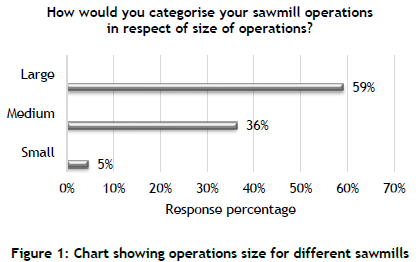
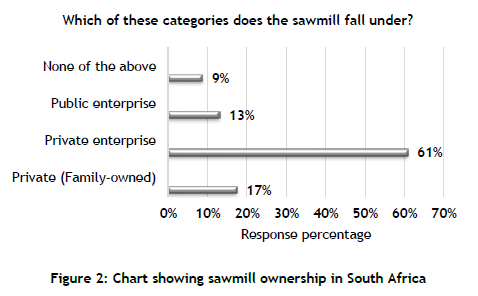
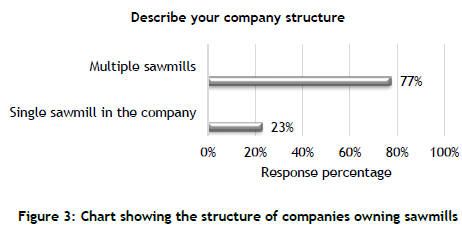
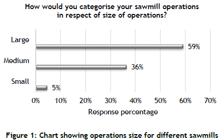
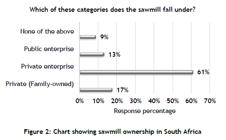
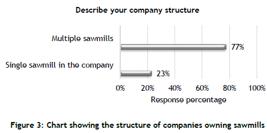
The sawmill industry in South Africa comprises privately owned and public companies with sawmills of different production capacities that are structured differently, as demonstrated by Figures 1 to 3. The survey participants were asked to categorise their sawmill operations according to the size of the operations. of the respondents, 59% categorised their sawmill operations as 'significant', 36% chose 'medium', and 5% chose 'small'. Regarding the sawmill classification, 17 per cent of the respondents were from private (family-owned) businesses, 61 per cent were from private enterprises, and 13 per cent were from public enterprises. Nine per cent of the respondents opted not to answer. Regarding company structure, 77 per cent of the participants said that their company had multiple sawmills, while 23 per cent of them said that their sawmills had a single mill. The data correspond to what is expected when looking at the composition of the sawmill industry in South Africa.
4.2. Strategies used in sawmills
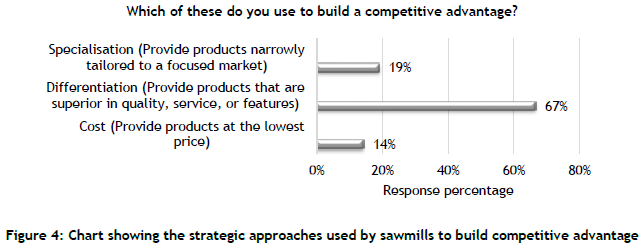
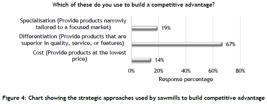
The literature highlighted that a firm's strategy can be categorised as specialisation, differentiation, or cost. The respondents were asked to describe their sawmill's strategy to build a competitive advantage, choosing specialisation, differentiation, or cost. Figure 4 shows that 67% of the respondents said that they used differentiation (offering products that are higher in quality, service, or features), 19% used specialisation (offering products that are narrowly tailored to a focused market), and 14 % used cost (offering products at the lowest price). The results showed that most sawmills valued product differentiation in their sawmills and saw that as a way to build competitive advantage. Only a tiny percentage chose cost as a strategy for acquiring a competitive advantage.
4.3. Competitive advantages used in sawmills
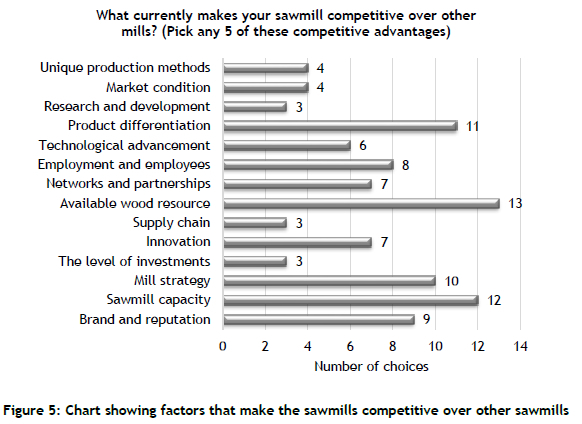
The survey's participants were asked first to pick any five competitive advantages that currently made their sawmills competitive over other mills. The participants were given a choice of five, as it was understood that different competitive advantages would be involved in sawmilling operations. Figure 5 shows that the available wood resource was ranked first as the aspect that gives the sawmills their competitive advantage. According to the respondents, sawmill capacity, product differentiation, mill strategy, brand, and reputation were the other competitive advantages that were picked the most. The increase in sawmill capacity would enable sawmills to process more logs, subject to the availability of wood resources.
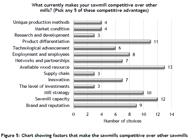
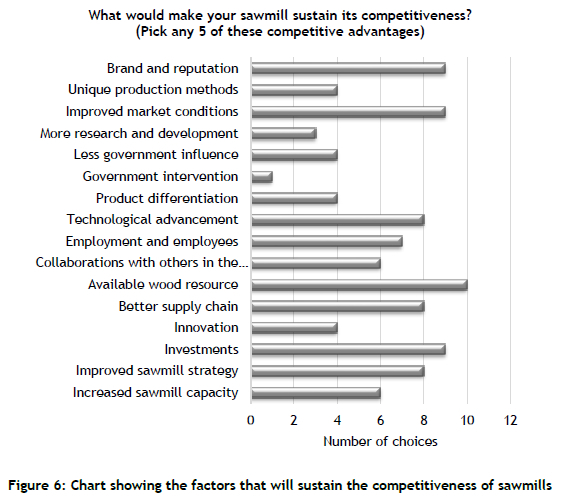
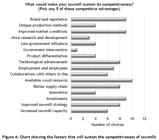
The competitive advantages rated the lowest were research and development, supply chain, and the level of investment in respect of what currently makes their sawmill competitive. The competitive advantage that was not selected was the firm's patents. The participants were then asked to pick five competitive advantages to sustain their sawmill's competitiveness. Figure 6 shows that the available wood resource was ranked first, followed by a better supply chain, improved market conditions, and brand and reputation. Technological advancement, Investments, and improved sawmill strategy were tied as the third options. The least often picked aspect was government intervention, followed by research and development. The competitive advantages not selected were revised policies and industry standards and firm patents.
4.4. Determinants of national advantage
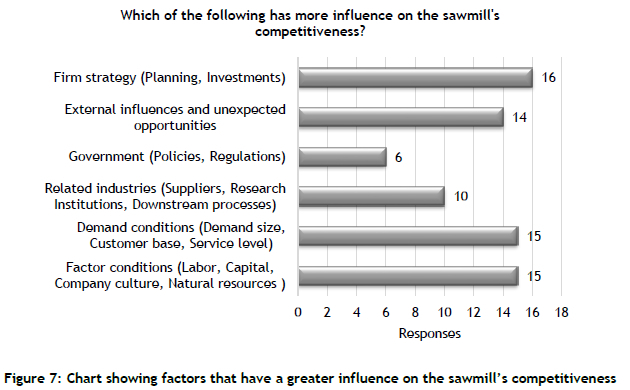
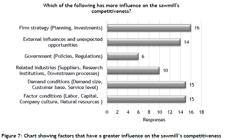
Recognising that sawmills operate in an environment in which several external influences have an impact on the sawmill's competitiveness, the participants were asked which of Porter's determinants (firm's strategy, factor conditions, demand conditions, related and supporting industries, government, chance) had a greater influence on the sawmill's competitiveness. Figure 7 shows that the participants said that firm strategy had a greater influence on sawmills' competitiveness, followed by a tie between demand and factor conditions. External influences were ranked above government and related and supporting industries. The influence of government was deemed last.
5. DISCUSSION
The sawmilling industry specialises in the processing of logs into different lumber products. The survey highlighted how securing a constant supply of logs is vital to ensuring a competitive advantage in the sawmill industry. This corresponds with a study by Porter [11], who highlighted that fundamental factors such as inexpensive labour and quick access to raw materials are the primary sources of competitive advantage during the initial factor-driven period of economic development.
Sawmill capacity, product differentiation, mill strategy, and brand and reputation were some of the competitive advantages that the study's participants ranked highly in respect of what makes their sawmills competitive over others in South Africa. In a study describing the tactics used by Swedish sawmilling companies, Nashr [7] found that the companies all displayed similar patterns of securing a supply of wood, internationalising and market focus, maintaining current technology, developing lean innovation and technological capabilities to promote the optimal uses of wood material, emphasising the development of internal human resources, and carrying out ethical duties within the bounds of long-term ecology, economy, and social sustainability for competitive advantage.
Concerning which competitive advantages would sustain the competitiveness of their sawmills, participants in the South African sawmill industry indicated that available wood resources, a better supply chain, improved market conditions, brand and reputation, technological advancement, Investments, and improved sawmill strategy were the competitive advantages that would ensure the competitiveness of their sawmills. In the study of Swedish sawmilling companies, Nashr [7] concluded that the technological manufacturing method, ownership, raw materials, location in distribution and manufacturing, and social standards all contributed to a long-term competitive advantage. Rusko [26] noted that a plentiful supply of raw materials, inventiveness in production techniques, deep-water harbours for export purposes, and cooperative marketing through marketing associations were among the factors contributing to the Finnish forest industry's success in foreign markets.
In this study, the respondents chose a firm strategy, factor conditions, and demand conditions as the factors that most affected the competitiveness of sawmilling firms in South Africa. In respect of demand conditions, Kovačič [2] mentioned that customers' demands could encourage businesses to develop innovative products and manufacturing technologies, expand their resources, and boost organisational effectiveness. Smallbone's [27] study found that product innovation was not consistently associated with high-growth organisations, even though the managers of high-growth firms were substantially more likely than those of other firms to have goods that they considered in some sense innovative.
Most sawmills in South Africa use differentiation as a strategy to build a competitive advantage. Cost as a strategy was selected as the least used strategy. This is probably because strategies that focus primarily on low prices tend to lose out on sales to clients who are particular about the features or the quality of the service they receive [11]. Tshavhungwe and Grobbelaar [11] also noted that differentiators lose revenue from price-conscious consumers. Smallbone's [27] study found that businesses with significant growth emerged from industries with divergent prospects for expansion and company development.
Although a single strategy is sometimes linked to success, their [27] study's top-performing companies were significantly engaged in controlling their markets and products across various dimensions. The evidence suggests that hybrid strategy pairings outperform narrow strategies [10]. Rehman [3] found that a differentiation approach strengthens the relationship between innovation and competitive advantage, and showed that developing a company strategy is essential to gaining an advantage over rivals. A strategy helps individuals to understand the company's objectives, and provides an organised framework for achieving those objectives [8].
In an analysis of sawmill industries in Finland and Sweden, Hietala [19] revealed that a focus on market value-added manufacturing, consumer relationships, and innovation are critical strategies. Value-adding tactics could provide a long-lasting competitive advantage if the value contributed is difficult for rivals to copy [19] . In practically any industry, a firm's capacity for innovation is often seen as a way to attain a long-term competitive edge. A competitive advantage and its longevity depend critically on numerous activities having a strategic fit. This is because competitors find it more difficult to match a variety of interconnected operations than simply copying a specific selling strategy, manufacturing technology, or set of product attributes [9].
A company's future depends more on its potential than on its performance alone [2]. Leaders need to understand the results that their culture generates and whether or not it conforms to the present and the projected market and commercial environments [8]. As noted from the discussion, the availability of wood resources plays a crucial role in sawmilling. Therefore, sawmills must secure a supply of logs or find effective ways to recover as much as possible from the logs that they process. Esty and Porter [28] pointed to numerous approaches that enhance resource productivity by identifying and removing waste, thereby reducing the costs associated with manufacturing.
6. CONCLUSION
The use of a survey was significant in ensuring that we obtained an understanding of the competitive advantages that are valued in the South African sawmill industry. The study's results correspond with those of other studies of competitive advantages and competitiveness. Although each sawmill will have its own operational strategy, the study showed that most sawmills use differentiation as a strategy, and that the brand and reputation of the company or sawmill were regarded as one of the top-ranked competitive advantages.
Interestingly, the role of government as a factor affecting competitiveness and as a competitive advantage to sustain sawmill competitiveness was rated the lowest, while the available wood resource was ranked high. However, it could be argued that the government plays a crucial role in ensuring that the country's strategy favours the afforestation of land for commercial forestry, which would positively align with individual companies' strategy to secure logs long term. The results also indicated that the survey's participants chose competitive advantages that were central to their firm's characteristics or operations as those that bring them competitiveness. Aspects outside the sawmills' operations and characteristics, such as research and development, government, and supply chain, were regarded less. This was also the case with the factors affecting competitiveness, in which related and supporting industries and government were rated lowest.
The study showed similarities in the strategies used by sawmills in South Africa. However, it would be essential to look at ways to ensure that sawmills are not just better than other local sawmills, but are also more competitive globally. Future studies could be expanded to include sawmills around the globe in order to guide the development of better strategies for them and for the South African sawmill industry.
7. LIMITATIONS OF THE STUDY
There are relatively few formal structural sawmills in South Africa, which were our target population for the survey. This contributed to the relatively low response rate for the survey. There was an expectation that not all the individuals who received the survey link would participate in it. There is limited research on the South African sawmill industry's competitiveness and competitive strategy - hence the narrow literature review being based on South Africa.
ACKNOWLEDGEMENTS
This work is based on research supported partly by the National Research Foundation of South Africa (grant number 128910) and the DHET-nGAP funding.
REFERENCES
- [1] M. Makkonen, Renewing the sawmill industry: Studies on innovation, customer value and digitalization, Dissertationes Forestales, 269. Helsinki, Finland, Finnish Society of Forest Science, 2019. doi: 10.14214/df.269
-
[2] A. Kovačič, "Benchmarking the Slovenian competitiveness by system of indicators," Benchmarking: An International Journal, vol. 14, no. 5, pp. 553-574, 2007. doi: 10.1108/14635770710819254
» https://doi.org/10.1108/14635770710819254 -
[3] S. U. Rehman, S. Bresciani, K. Ashfaq, and G. M. Alam, "Intellectual capital, knowledge management and competitive advantage: A resource orchestration perspective," Journal of Knowledge Management, vol. 26, no. 7, pp. 1705-1731, 2022. doi: 10.1108/JKM-06-2021-0453
» https://doi.org/10.1108/JKM-06-2021-0453 -
[4] M. Porter and C. Ketels, "Clusters and Industrial Districts: Common Roots, Different Perspectives," Edward Elgar Publishing eBooks, Aug. 2009, doi: https://doi.org/10.4337/9781781007808.00024.
» https://doi.org/10.4337/9781781007808.00024 -
[5] B. T. Laugen, N. Acur, H. Boer, and J. Prick, "Best manufacturing practices: What do the best-performing companies do?" International Journal of Operations and Production Management, vol. 25, no. 2, pp. 131-150, 2005. doi: 10.1108/01443570510577001
» https://doi.org/10.1108/01443570510577001 -
[6] E. Papulova and Z. Papulova, "Competitive strategy and competitive advantages of small and midsized manufacturing enterprises in Slovakia," E-Leader, Jan. 2006, [Online]. Available: http://www.g-casa.com/download/Papulova-CompetitiveStrategy.pdf
» http://www.g-casa.com/download/Papulova-CompetitiveStrategy.pdf - [7] F. Nashr, "Profiling the strategies of Swedish sawmilling firms," 2007.
- [8] J. C. Williams, T. H. Davenport, M. E. Porter, and M. Iansiti, HBR's 10 must reads: The definitive management ideas of the year from Harvard Business Review, Boston MA: Harvard Business Review Press, 2019.
- [9] M. Porter, "What is strategy?" Harv Bus Rev, no. December, pp. 61-78, 1996.
-
[10] H. Salavou, "Strategy types of service firms: Evidence from Greece," Management Decision, vol. 48, no. 7, pp. 1033-1047, 2010. doi: 10.1108/00251741011068752
» https://doi.org/10.1108/00251741011068752 - [11] M. E. Porter, "Enhancing the microeconomic foundations of prosperity: The current competitiveness index," The global competitiveness report 2001-2002, P. K. Cornelius and J. W. McArthur, Eds, Geneva: World Economic Forum, 2002, pp. 52-73.
-
[12] P. Rogers and M. Blenko, "The high-performance organization: Making good decisions and making them happen," Handbook of Business Strategy, vol. 7, no. 1, pp. 133-142, 2006. doi: 10.1108/10775730610618747
» https://doi.org/10.1108/10775730610618747 - [13] M. E. Porter, C. H. M. Ketels, K. Miller, and R. T. Bryden, Competitiveness in rural US regions: Learning and research agenda, Boston MA: Institute for Strategy and Competitiveness, Harvard Business School, 2004.
- [14] L. Heyl, G. von Maltitz, J. Evans, and R. Segoale, "Issues and opportunities for small scale sawmilling in South Africa: An Eastern Cape case study," London and Pretoria: International Institute for Environment and Development and CSIR-Environmentek, 2000.
-
[15] B. G. Lindner, P. J. Vlok, and C. B. Wessels, "Determining optimal primary sawing and ripping machine settings in the wood manufacturing chain," Southern Forests: A Journal of Forest Science, vol. 77, no. 3, pp. 191-201, 2015. doi: 10.2989/20702620.2014.1001678
» https://doi.org/10.2989/20702620.2014.1001678 -
[16] R. Björheden and K. Helstad, "Raw material procurement in sawmills' business level strategy: A contingency perspective," International Journal of Forest Engineering, vol. 16, no. 2, pp. 47-56, 2005. doi: 10.1080/14942119.2005.10702513
» https://doi.org/10.1080/14942119.2005.10702513 -
[17] S. B. Kapp, C. S. Price, P. Turner, and H. P. Vermaas, "A feasibility study on the development of an integrated manufacturing planning and control system in the South African sawmill industry," Southern African Forestry Journal, vol. 184, no. 1, pp. 80-87, 1999. doi: 10.1080/10295925.1999.9631215
» https://doi.org/10.1080/10295925.1999.9631215 -
[18] H. Välimäki, A. Niskanen, K. Tervonen, and I. Laurila, "Indicators of innovativeness and enterprise competitiveness in the wood products industry in Finland," Scandinavian Journal of Forest Research, vol. 19, no. 5, 2004. doi: 10.1080/02827580410017898
» https://doi.org/10.1080/02827580410017898 -
[19] J. Hietala, R. Hanninen, M. Kniivila, and A. Toppinen, "Strategic management towards competitive advantage: Patterns of internationalization in the Pinnish and Swedish sawmill industries," Current Forestry Reports, vol. 5, no. 4, pp. 199-209, 2019. doi: 10.1007/s40725-019-00100-8
» https://doi.org/10.1007/s40725-019-00100-8 -
[20] K. Lähtinen and A. Toppinen, "Pinancial performance in Pinnish large- and medium-sized sawmills: The effects of value-added creation and cost-efficiency seeking," Journal of Forest Economics, vol. 14, no. 4, pp. 289-305, 2008. doi: 10.1016/j.jfe.2008.02.001
» https://doi.org/10.1016/j.jfe.2008.02.001 - [21] N. Savić, V. Stojanovski, and M. Stojanovska, "Analyses of the competitiveness of forest industry in the Republic of Macedonia," South-East European Forestry, vol. 2, no. 1, pp. 13-21, 2011.
-
[22] A. Toppinen, K. Lahtinen, L. A. Leskinen, and N. Osterman, "Network co-operation as a source of competitiveness in medium-sized Finnish sawmills," Silva Fennica, vol. 45, no. 4, pp. 743-759, 2011. doi: 10.14214/sf.102
» https://doi.org/10.14214/sf.102 -
[23] S. Grobbelaar and J. K. Visser, "An analysis of South African sawmilling competitiveness," Southern Forests: A Journal of Forest Science, vol. 83, no. 1, pp. 28-37, 2021. doi: 10.2989/20702620.2020.1813646
» https://doi.org/10.2989/20702620.2020.1813646 -
[24] J. S. Niemelä and P. M. Smith, "A multinational analysis of competitive strategies of softwood sawmills," Scandinavian Journal of Forestry Research, vol. 12, no. 3, pp. 295-301, 1997. doi: 10.1080/02827589709355413
» https://doi.org/10.1080/02827589709355413 -
[25] O. Zimba and A. Y. Gasparyan, "Designing, conducting, and reporting survey studies: A primer for researchers," Journal of Korean Medical Science, vol. 38, no. 48, pp. 1-11, 2023. doi: 10.3346/jkms.2023.38.e403
» https://doi.org/10.3346/jkms.2023.38.e403 -
[26] R. Rusko, "Exploring the concept of coopetition: A typology for the strategic moves of the Finnish forest industry," Industrial Marketing Management, vol. 40, no. 2, pp. 311-320, 2011. doi: 10.1016/j.indmarman.2010.10.002
» https://doi.org/10.1016/j.indmarman.2010.10.002 -
[27] D. Smallbone, R. Leigh, and D. North, "The characteristics and strategies of high growth SMEs," International Journal of Entrepreneurial Behaviour & Research, vol. 1, no. 3, pp. 44-62, 1995. doi: 10.1108/13552559510100657
» https://doi.org/10.1108/13552559510100657 - [28] D. C. Esty and M. E. Porter, "Industrial ecology and competitiveness: Strategic implications for the firm," Journal of Industrial Ecology, vol. 2, no. 1, pp. 35-43, 1998.
Accepted for publication 16 Jan 2025
Available online 30 May 2025
V. Tshavhungwe
https://orcid.org/0000-0002-5567-098X
S. Gobbelaar
https://orcid.org/0000-0001-8148-2440
* Corresponding author: