Development of a Conceptual Framework and Management Guide for Sustainable Contract Manufacturing Companies in South Africa
Abstract
Articles on manufacturing outsourcing focus largely on providing guidance to brand owners on how to select the manufacturing partner, on the benefits of outsourcing manufacturing, and how to manage the contract manufacturing relationship. However, there is a lack of frameworks that offer guidance to contract manufacturing companies to help them to set up and run manufacturing organisations that achieve sustainable success as strategic supply chain partners to the brand owners. In this study, informed by the design science research methodology, an artefact, a critical success factors conceptual framework and management guide for contract manufacturing companies to achieve sustainable success is introduced.
Abstract
Artikels oor vervaardigingsuitkontraktering fokus grootliks op die verskaffing van leiding aan handelsmerkeienaars oor hoe om die vervaardigingsvennoot te kies, oor die voordele van uitkontraktering van vervaardiging, en hoe om die kontrakvervaardigingsverhouding te bestuur. Daar is egter 'n gebrek aan raamwerke wat leiding bied aan kontrakvervaardigingsmaatskappye om hulle te help om vervaardigingsorganisasies op te rig en te bedryf wat volhoubare sukses behaal as strategiese voorsieningskettingvennote vir die handelsmerkeienaars. In hierdie studie, ingelig deur die ontwerpwetenskapnavorsingsmetodologie, word 'n artefak, 'n konseptuele raamwerk vir kritieke suksesfaktore en 'n bestuursgids vir kontrakvervaardigingsmaatskappye om volhoubare sukses te behaal, bekendgestel.
1. INTRODUCTION
Outsourcing manufacturing services by brand owners to contract manufacturing companies (CMCs) is a growing practice that has many problems; in most cases it does not achieve its intended objectives, with a number of CMCs in South Africa failing and going out of business [1]. However, limited research focuses on CMCs. According to [2], there are essentially two research strands on contract manufacturing (CM). The first is concerned with the factors that influence the choice of CM, and includes outsourcing frameworks for guiding brand owners [3]; [4]; [5]. The second strand studies the benefits and impact of CM on the operational and financial performance of the brand owner, which include cost reduction, improved delivery, access to technology, improved quality, and improved productivity [6]; [7]; [8]; [9]; [10]; [2]. Other published research on CM focuses on highlighting the risks of CM to brand owners, with proposals and strategies to manage the risks [11]; [6]; [12]; [13]; [14]; [15]. Other researchers have published articles on CM relationships [16]. Fewer articles have been written on the supplier side of CM relationships, the CMC. Relatively few studies focus explicitly on the unique difficulties faced by CMCs and the critical success factors (CSFs) for CMCs to achieve sustainable success. [17] conducted research on the supplier side of CM relationships, and found that most of the literature on outsourcing focuses only on the buying (outsourcing) company. Their paper highlighted the supplier's side from a relational perspective, and stressed the importance of business relationships between suppliers of outsourced activities and their customers [17]. [18] concluded that in outsourcing research there has been much less discussion of the strategic issues for outsourcing service providers, although in reality there are major issues to be considered. They discussed the different types of outsourcing decisions and the drivers for both the brand owner and the outsourcing service provider. None of them proposed frameworks to provide guidance to the management of CMCs on how to build sustainable CMCs that can become strategic partners in the brand owners' supply chain [19]. In essence, the research on CM mainly studies and provides guidance on CM to the brand owners, with no guidance provided to the CMCs. [20] stated that ISO accreditation, good manufacturing practice (GMP), and adherence to guidelines are all crucial to running a successful CM business. However, they did not provide any guidance or framework on the steps to follow to achieve this and to become a sustainable CMC. The aim of this study is to close this gap by proposing a critical success factors (CSFs) conceptual framework to guide CMCs to implement these factors effectively and to build businesses that achieve sustainable success as strategic supply chain partners to brand owners. This work is situated in the industrial engineering discipline, where the problem is to design frameworks that help organisations to improve their efficiency, integration, and sustainability. The focus here is on CMCs, which play a critical role in modern supply chains but often face pressures to do with performance, coordination, and long-term competitiveness. The proposed framework is designed to guide their transformation by improving system performance, strengthening supply chain integration, and embedding operational sustainability in their practices.
The article progresses from the research methodology (Section 2) and literature-derived CSFs (Section 3) to the proposed framework (Section 4) and its implementation guide (Section 5), followed by an updated discussion of sustainable CMCs (Section 6), and concludes with final insights and next steps (Section 7).
2. RESEARCH METHODOLOGY FOR FRAMEWORK DEVELOPMENT
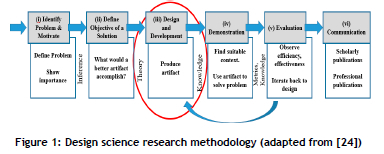
In this study, design science research (DSR) [21]; [22]; [23]; [24] was used as the methodological guideline to develop the critical success factors framework for sustainable CMCs. This paper describes step (iii) of the DSR process (Figure 1), the design and development of the artefact, the CSFs' conceptual framework, and a management guide for sustainable CMCs that have the potential to be strategic and long-term partners with their brand owner partners.
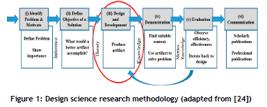
The main inputs into the framework design are the critical success factors identified in the Delphi study by [19] and those identified from the literature.
3. CRITICAL SUCCESS FACTORS
3.1. Critical success factors from Delphi study
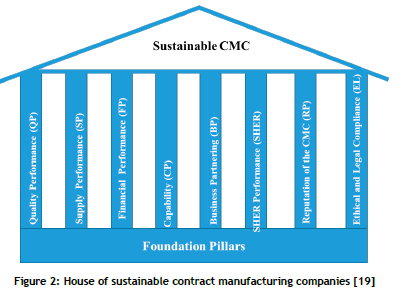
[19] empirically identified the CSFs for sustainable CMCs through a two-round Delphi study of 14 experts in Cm who had experience of working with CMCs in various areas, including quality, supply chain, procurement, and operations [19]. These CSFs were grouped into eight pillars [19], as shown in Figure 2.
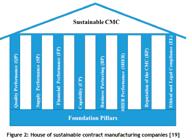
The foundation pillars are discussed later in this article. The CSFs under each pillar were categorised into three different categories, based on their level of consensus in the second round of the Delphi study [1] They categorised those factors that fully met the predetermined consensus criteria as "A"; those that partially met the consensus criteria were categorised as "B"; and those that did not meet the predetermined criteria but were not discarded, but that nevertheless were also taken into consideration in the final framework, were categorised as "C" [1].
3.2. Critical success factors from the literature review
To identify the CSFs for CM from the literature, a review was conducted using academic search websites (Scopus, Google Scholar, and the Stellenbosch University library). The search words were "manufacturing outsourcing", "contract manufacturing", "selection of contract manufacturing partner", "manufacturing outsourcing partner selection", "frameworks for contract manufacturing", "critical success factors for manufacturing outsourcing and contract manufacturing", and "manufacturing SMEs". The search range for articles was from 2000 to 2024.
3.2.1. Reasons for selecting contract manufacturing companies
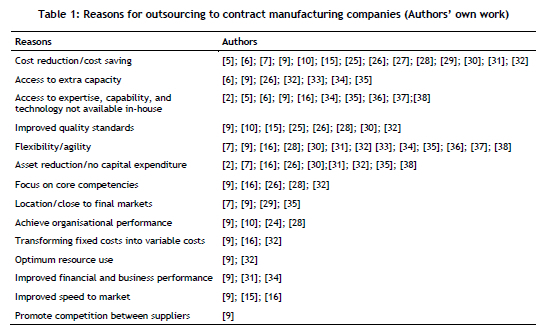
From the literature review, the reasons for selecting the CMCs that were cited by several authors are summarised in Table 1.
These reasons were taken into account in determining the CSFs and developing the framework.
3.2.2. Selecting a contract manufacturing company
To identify other CSFs for CMCs, the researchers also examined the selection criteria for suppliers identified by brand owners. Supplier selection is one of the critical decisions for any organisation owing to its direct impact on profitability and organisational competitive position maintenance [40]. [41]) reviewed the literature on manufacturing outsourcing decisions and partner selection criteria from 2010-2021, and summarised his findings on key criteria for selecting a supplier under the following classifications:
• Operational performance - Production and process capacity, product quality, on-time delivery.
• Agile performance - Service levels, flexibility, collaboration with partners, lead-time skills.
• Economic performance - Product price, resource consumption, financial stability
• Environmental performance - Green product, green manufacturing process, green research and development.
• Social performance - Employee welfare, organisational culture, leadership, occupational health and safety.
[30] concurred with [41]. The results of their research showed that green packaging and labelling, the relationship with the manufacturing brand, order flexibility, and product traceability are the most important criteria in retail private-label supplier selection.
[42] and [43] identified the followed factors as critical for strategic supplier selection: quality, pollution prevention, delivery/service, cost, occupational health and safety practices, and resource consumption. [43] added employment practices and waste management.
These are the success factors that were also taken into consideration in the design of the framework and management guide.
3.2.3. Risks and difficulties of outsourcing to a contract manufacturing company
The researchers also reviewed the literature on the risk of outsourcing manufacturing to a CMC in order to identify additional success factors to be incorporated into the framework design. Knowledge of the risks was valuable for CMCs and brand owners to be aware of so that the correct actions could be taken to mitigate them. Outsourcing comes with potential risks [44]; [45]: it could expose brand owners to significant risks that would need to be mitigated in order to reap collaborative benefits effectively [46]. The major risks that were identified are discussed below.
Encroachment - Encroachment was cited by several authors as a major risk from outsourcing manufacturing to a CMC [47]; [48]; [49]. Encroachment is the practice in which a CMC introduces their own products and competes with the brand owner [49]; [50]; [52]; [54]. In such a situation, the role of the CMC changes from just being an upstream partner to being both upstream partner and downstream competitor; and this could damage the CM's relationship with the brand owner [52].
Loss of control - Brand owners could lose control over the quality of purchased materials, which could in turn damage their brand name and market share [48]. This could be as a result of buying inferior quality materials to save costs. According to [11], in order to ensure that the supplier can produce products that meet the requirements of the manufacturer, the manufacturer needs to share their knowledge about product design. In manufacturing outsourcing among supply chain enterprises, the supplier could misappropriate the knowledge shared by the manufacturer [11]. Once CMs have built their reputation as reliable manufacturers, many of them start to enter the market with their own brands and compete directly with the original equipment manufacturers [11]. [13] added loss of flexibility and diminishing outsourcing advantages as risks of outsourcing to CMCs.
Quality non-compliance - CMCs could fail to comply consistently with the quality requirements of the brand owner [5]; [6]; [15]; [29]; [53]; [54]; [55], putting brand consumers and the brand owner's reputation at risk [28].
Dependence on the CMC - Brand owners run the risk of total dependence on the CMC [15]; [26]; [28] to the point where they risk losing their intellectual property and skills [13]; [31].
Hidden costs/cost increases - CMCs could incur additional costs that were not originally known or budgeted for, putting the brand owner's profitability at risk [5]; [13]; [26]; [28].
Unethical practices - CMCs could engage in unethical practices, including collusion with the brand owner's competitors [31], poaching the brand owner's customers or intellectual property [14]), and misappropriating knowledge [11]; [13]. When a supplier is involved in an issue that society deems unethical, not only that company but the whole supply chain could be affected [10], which could cause reputational damage.
Poor performance - The CMC could fail to deliver the expected performance, resulting in poor brand owner performance [56], thus putting the brand owner's supply chain at risk [13]; [29].
Other risks and difficulties
[57] highlighted several major causes for outsourcing failures:
• having an ambiguous contract;
• ignoring personnel, cultural, custom, and language issues;
• neglecting hidden costs;
• failure to have an exit strategy in place.
3.2.4. Critical success factors from frameworks and models
After outlining the key risks in outsourcing to CMCs in section 3.2.3, the review examined the CSFs in existing frameworks and models, highlighting the factors that support effective transformation in manufacturing. According to [58], in order to develop a new framework, a better understanding of existing frameworks is required. In order to identify other success factors not identified in the review above, and because we could not find any frameworks and management guides for CMCs, we reviewed the literature on frameworks, models, or guides for manufacturing SMEs, manufacturing excellence, and manufacturing in general to identify other CSFs for manufacturing companies that would be relevant to this research. The results are shown below, with the framework/model name and the selected factors:
• [59] Wilgor framework for manufacturing excellence: People involvement, leadership, culture, knowledge, and skills.
• [58] Manufacturing excellence: environment, flexibility, delivery, customer relations, quality, reliability, and leadership.
• [60] Framework for identifying CSFs for quality in manufacturing SMEs: customer focus, employee focus, quality strategy, supplier relationships, and employee involvement.
• [61] Successful outsourcing companies: strong relationships with suppliers, high level strategic reviews, and culture.
• [62] 12 principles of manufacturing excellence: good housekeeping, safety, maintenance, capability, and training.
• [63] Integrated manufacturing business excellence system (IMBES): customer focus, leadership, culture, and suppler quality management.
• [64] CSFs for manufacturing industries in India: management commitment, human resources, culture, and quality.
• [11] Outsourcing partner selection model: Process quality and manufacturing time.
• [65] Operational excellence assessment framework for manufacturing companies: culture, continuous improvement, enterprise alignment, and results.
• [66] Lean manufacturing framework for manufacturing companies: Shopfloor management and quality management
Most of the frameworks and models reviewed above focus on manufacturing organisations in general, with a particular emphasis on SMEs and manufacturing excellence initiatives. While these contributions might be valuable, they do not directly address the unique transformation difficulties of CMCs. CMCs operate under distinct conditions, such as limited control over product design, dependence on clients' specifications, and the need to balance efficiency with flexibility, all of which require a tailored approach. This paper responds to that gap by presenting a framework specifically developed for the transformation of CMCs. The frameworks above do provide valuable insights into success factors for manufacturing companies, which were useful input in the development of our CMC framework. However, they do not provide a guide to management of CMCs about the process to follow to implement the framework for sustainable success effectively.
3.2.5. Success factors from literature review
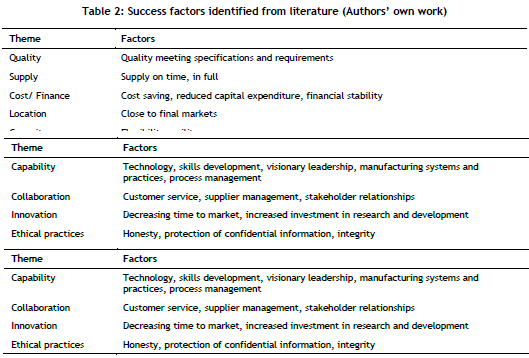
The success factors that were identified from the literature review are grouped under common themes and summarised in Table 2.
4. PROPOSED FRAMEWORK
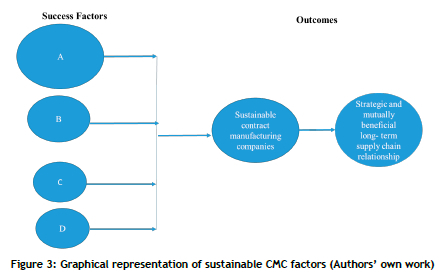
The CSFs identified in the Delphi study and in the literature review were incorporated into the development of the artefact, the framework for sustainable CM. The classification of success factors used by [1] was adopted. Figure 3 shows the graphical representation of the success factors. The framework provides guidance for the leaders of CMCs to transform their companies into sustainable CMCs that are strategic supply chain partners with their brand-owner customers.
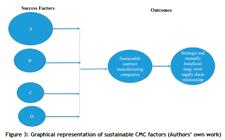
The A factors are the most critical, and are considered mandatory for sustainable CM. Successful implementation of these factors would therefore be a necessity for CMCs. B factors are the second-most critical, with the C factors also considered part of the implementation. D factors did not emerge from the Delphi survey or the literature review. These are additional factors that would emerge when the framework was tested and refined in different CMCs; but this was not in the scope of this article.
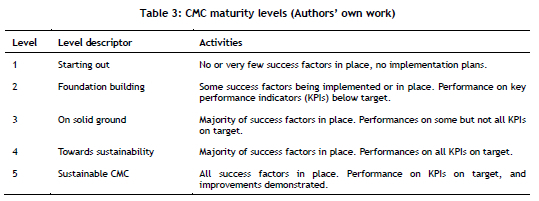
There is a need for methods to support CMCs in operationalising the implementation of the success factors to achieve their sustainability goals [66]. According to [67], in order to propose a new model it is usually not sufficient simply to define its content and a structure to frame it. To ensure their applicability and benefits, they have also to be tested - for instance, by proof of concept or by real life applications [66]. For them to be tested, they need to be implemented. A popular implementation method in the literature is the maturity model (MM) [68]; [69]; [70]. For this research, a five stage/level maturity model was proposed as the implementation method, taking guidance gleaned from the literature reviews on MM from [68]; [71]; [73]; [74] and [72], that five levels are the most common.
The dimensions of the proposed MM were made up of the eight pillars (dimensions) and the A and B factors (sub-dimensions) that emerged from the Delphi survey and the literature review. The reseachers named this framework the Mahove-Matope Sustainable Contract Manufacturing Company Maturity Model (SCMC-MM). Each pillar is assessed using a structured maturity assessment tool to assist the management team to identify performance gaps, prioritise interventions, and track progress through defined maturity levels
The proposed CMC maturity levels, including a description of each level and its performance criteria, are shown in Table 3.
A CMC at level 5 is considered to be at the highest level of the maturity model, and is classified as a sustainable CMC with which brand owners could partner with a high degree of confidence.
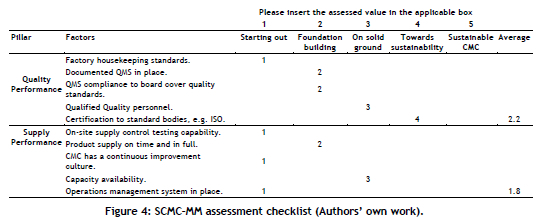
To assess the maturity level, the SMCM-Assessment checklist is used. This is shown in Figure 4, with the first two pillar assessments as examples.
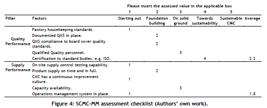
The assessment results can be visualised on a radar chart.
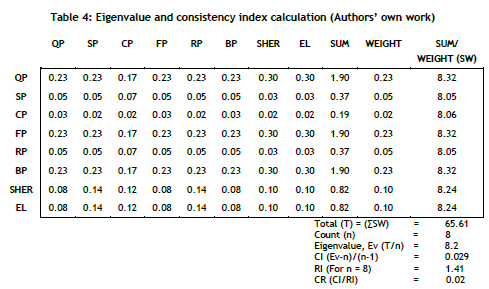
In this study, the analytical hierarchy process (AHP) was used to rank the identified success factors and to advise the management of CMCs about which pillars to focus attention on and to prioritise during implementation, based on the ratings of the experts. These priority pillars are the foundation pillars mentioned in section 3. The AHP was developed by Thomas L. Saaty in 1971, is a theory of measurement through pairwise comparisons, and relies on the judgements of experts to derive priority scales [75].
From the results of the AHP, the highest priority pillars for implementation are quality performance, financial performance and business partnering. The second-highest priority pillars are safety, health, environmental and risk (SHER) and ethical/ legal compliance, followed by supply performance and reputation. Capability emerged as the final pillar in this analysis.
The consistency ratio (CR) was calculated as 0.02, which represents acceptable consistency, being less than 0.1 (Table 4). This means that the pairwise comparisons were done consistently.
5. UPDATED HOUSE OF SUSTAINABLE CONTRACT MANUFACTURING COMPANIES, AND DISCUSSION
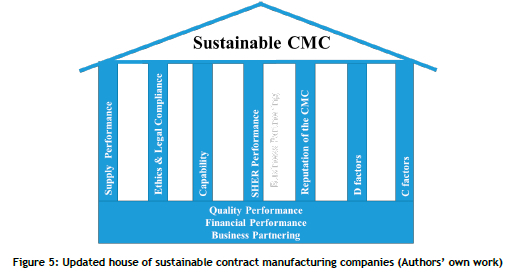
Based on the ranking process discussed above that highlighted the priority pillars, the "house of sustainable CMCs" figure is updated to reflect the priority pillars as the foundations of the house (Figure 5). Pillars C and D are added. The factors in the D pillar are those that emerged from the testing, validation, and refinement of the framework at selected CMCs.
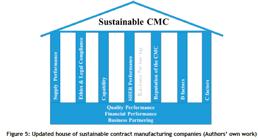
The house shows that brand owners are more likely to work with a CMC that can demonstrate a strong compliance with their quality requirements, can show strong financial performance, and can operate at a strategic partnership level. A CMC that demonstrates strong performance for each of these pillars at level 5 creates a strong base to attract the top brand owners as partners. To deliver the expected quality performance, the CMC must ensure that it fully understands the requirements of the brand owner, and is able consistently to deliver to expectations. Financial performance includes factors such as cashflow management, cost saving, and the ability to maintain contract costs. Brand owners would prefer not to work with a CMC that fails to deliver a product because of material shortages or that is at risk of closing down because of cashflow problems. A CMC that could maintain the contract cost or even offer a price reduction would have greater opportunities to attract more customers. Having cost-saving programmes also improves the CMC's profitability and sustainability. Business partnering includes success factors such as openness and transparency, joint problem-solving, regular performance reviews, and ownership. CMCs that position themselves as an extension of the brand owner, share the brand owner's vision, and treat the brand owner's products as their own have a better chance of attracting more business and reducing the risk of failure.
6. CONCLUSION, NEXT STEPS
In this article the design and development of the initial artefact, the CSFs conceptual framework for sustainable CMCs, was completed. A management guide was proposed for CMCs to implement the framework, and the AHP method was used to identify the priority pillars for implementation. The framework and management guide is a five-level and eight-dimension maturity model, named the Mahove-Matope Sustainable CMC Maturity Model (SCMC-MM), that should enable CMCs to assess their current level on the sustainability journey and to identify the areas that require improvement solutions to be able to move up to the sustainable CMC level as the CMC improves.
In conclusion, the proposed framework underscores the relevance of industrial engineering in enabling CFCs to enhance their system efficiency, strengthen supply chain integration, and embed operational sustainability. Much of the literature and its associated models focus on manufacturing more broadly - often with reference to SMEs or manufacturing excellence programmes - but do not adequately account for the structural and operational realities of CMCs. This framework addresses that gap by responding to the distinct constraints that CMCs face, including limited authority over product design, dependence on clients' specifications, and the need to remain both efficient and flexible. The framework and management guide should contribute to research and to the literature on manufacturing outsourcing and CM, and should provide a novel tool that researchers, brand owners, consultants, and managers of CMCs could apply to transform CMCs into sustainable and strategic partners in their brand owner customers' supply chains.
Beyond its immediate application, the SCMC-MM could also have relevance for South African industrial development and SMME policy: by strengthening the role of CMCs, it supports more competitive, resilient, and sustainable local and global supply chains, thus being aligned with national objectives for industrial growth, localisation, and enterprise development.
Future research could validate the SMCM-MM by engaging a sample of CMCs, applying the model to their transformation initiatives, and evaluating the outcomes through performance indicators, stakeholder insights, and longitudinal analysis, thereby testing its robustness and refining it further. Future research could also explore the impact of 4IR technologies on CMCs. While many of the CSFs identified by [19] build on earlier manufacturing excellence approaches, [76] noted that AI is actively reshaping South African manufacturing, reinforcing the need for a sustainability framework that integrates digital capabilities with traditional CSFs.
REFERENCES
- [1] Mahove, T. T. and Matope, S. (2024). Experts' consensus on critical success factors for contract manufacturing companies. Proceedings of the 5th African International Conference on Industrial Engineering and Operations Management, Johannesburg, South Africa, April 23-25, 2024, pp 1164-1176.
- [2] Wu, D., Tannen, M., Anyu, J. Ivanov, S. and Xu, F. (2022). Contract manufacturing, market competition, and labor productivity in US manufacturing industries. Operations Management Research, 16, pp. 377-390.
- [3] Fill, C. and Visser, E. (2000). The outsourcing dilemma: A composite approach to the make or buy decision. Management Decision, 38, pp. 43-50.
- [4] McIvor, R., Wall, A., Humphreys, P. and McKittrick, A. (2009). A study of performance measurement in the outsourcing decision. Oxford: Elsevier/CIMA Publishing.
- [5] Momme, J. (2002). Framework for outsourcing manufacturing: Strategic and operational implications. Computers in Industry, 49(1), pp. 59-75.
- [6] Contreras, C. E. (2020). Strategies to manage quality in outsourced manufacturing processes. PhD thesis, Walden University, Minneapolis, MN
- [7] Coyle, D. and Nguyen, D. (2020). No plant, no problem? Factoryless manufacturing, economic measurement and national manufacturing policies. Review of International Political Economy, 29(1), pp. 1-21.
- [8] Han, H.-S., Lee, J.-N. and Seo, Y.-W. (2008). Analyzing the impact of a firm's capability on outsourcing success: A process perspective. Information & Management, 45(1), pp. 31-42.
- [9] Prajapati, H., Kant, R. and Tripathi, S. M. (2019). An integrated framework for prioritizing the outsourcing performance outcomes. Journal of Global Operations and Strategic Sourcing, 13(4), pp. 301-325.
- [10] Shanmugan, M., Shaharudin, M. S., Ganesan, Y. and Fernando, Y. (2019). Manufacturing outsourcing to achieve organizational performance through manufacturing integrity capabilities. In FGIC 2nd Conference on Governance and Integrity 2019, KnE Social Sciences, pp. 858-871.
- [11] Chen, G., Zhang, L. and Zhong, Y. (2020). Selection of the manufacturing outsourcing contract considering knowledge misappropriation. In 2020 International Conference on Urban Engineering and Management Science, Zhuhai, China, pp. 508-512.
- [12] Lee, G., Shin, G. C., Hwang, D. W., Kuper, P., and Kang, M. (2018). How manufacturers' long-term orientation toward suppliers influences outsourcing performance. Industrial Marketing Management, 74, pp. 288-297.
- [13] Xie, C., Anumba, C. J., Lee, T., Hon Kam, B., Chen, L., and Wilding, R. (2011). Managing production outsourcing risks in China's apparel industry: A case study of two apparel retailers. Supply Chain Management: An International Journal, 16(6), pp. 428-445.
- [14] Skowronski, K. and Benton, W.C. (2017). The influence of intellectual property rights on poaching in manufacturing outsourcing. Production and Operations Management, 27(3), pp. 531-552.
- [15] Zhu, X. (2016). Managing the risks of outsourcing: Time, quality and correlated costs. Transportation Research Part E: Logistics and Transportation Review, 90, pp. 121-133.
- [16] Brandl, T. (2021). Managing contract manufacturing relationships: An explorative research framework. In Adapting to the future: How digitalization shapes sustainable logistics and resilient supply chain management. Proceedings of the Hamburg International Conference of Logistics (HICL), vol. 31, pp. 103-127.
- [17] Baraldi, E., Proença, J. F., Proença, T. and De Castro, L. M. (2014). The supplier's side of outsourcing: Taking over activities and blurring organizational boundaries. Industrial Marketing Management, 43(4), pp. 553-563.
- [18] Hussey, D. and Jenster, P. (2003). Outsourcing: The supplier viewpoint. Strategic Change, 12(1), pp. 7-20.
- [19] Mahove, T. T. and Matope, S. (2024). An empirical study to identify the critical success factors for sustainable contract manufacturing in the consumer products supply chain in South Africa. South African Journal of Industrial Engineering, 35(2), pp. 29-48.
- [20] Vorster, A. (2013). Compliance, success and service excellence: Contract manufacturing. South African Pharmaceutical & Cosmetic Review, 40(9), pp. 20-22.
- [21] Castillo-Martinez, A., Medina-Merodio, J.-A., Gutierrez-Martinez, J.-M., and Fernández-Sanz, L. (2021). Proposal for a maintenance management system in industrial environments based on ISO 9001 and ISO 14001 standards. Computer Standards and Interfaces, 73, pp. 1-13.
- [22] Dresch, A., Lacerda, D. P. and Antunes, J. A. V. (2016). Design science research: A method for science and technology advancement. Cham, Switzerland: Springer International.
- [23] Hevner, A. R., March, S. T., Park, J., and Ram, S. (2004). Design science in information systems. MIS Quarterly, 28(1), pp. 75-105.
- [24] Peffers, K., Tuunanen, T., Rothenberger, M. A., and Chatterjee, S. (2007). A design science research methodology for information systems research. Journal of Management Information Systems, 24(3), pp. 45-77.
- [25] Kabus, J., Dziadkiewicz, M., Miciuta, I., and Mastalerz, M. (2022). Using outsourcing services in manufacturing companies. Resources, 11(3), 34.
- [26] Chikuvuka, S. (2021). Addressing global manufacturing outsourcing problems using a hybrid AHP-TCO model. PhD dissertation, State University of New York, New York.
- [27] Labossiere-Auguste, C. (2020). Strategies for outsourcing manufacturing in the Caribbean. PhD dissertation, Walden University, Minneapolis, MN.
- [28] Franca, Y. N. and De Lima, A. A. (2023). Manufacturing outsourcing as a strategy for increasing production capacity and reducing production costs. IOSR Journal of Business and Management, 25(7), pp. 54-64.
- [29] Govender, I. (2007). An analysis of the key drivers, decision making and strategic issues with respect to outsourcing in the SA pharmaceutical manufacturing industry. Master's research report, University of South Africa, Pretoria, South Africa.
- [30] Zhang, J., Li, L., Zhang, J., Chen, L., and Chen, G. (2021). Private-label sustainable supplier selection using a fuzzy entropy-VIKOR-based approach. Complex and Intelligent Systems, 9, pp. 2361-2378.
- [31] Arrunada, B. and Vázquez, X. H. (2006). When your contract manufacturer becomes your competitor. Harvard Business Review, 84(9), pp. 135-145.
- [32] Akbari, M. 2013. Factors affecting outsourcing decisions in Iranian industries. Doctoral thesis, Victoria University, Melbourne, Australia.
- [33] Wu, C., Lin, Y., and Barnes, D. (2021). An integrated decision-making approach for sustainable supplier selection in the chemical industry. Expert Systems with Applications, 184, 115553.
- [34] Kaya, O. (2011). Outsourcing vs. in-house production: A comparison of supply chain contracts with effort dependent demand. Omega, 39(2), pp. 168-178.
- [35] Liaqait, R. A., Warsi, S. S., Agha, M. H., Zahid, T., and Becker, T. (2021). A multi-criteria decision framework for sustainable supplier selection and order allocation using multi-objective optimization and fuzzy approach. Engineering Optimization, 54(6), 928-948.
- [36] Tirkolaee, E. B., Mardani, A., Dashtian, Z., Soltani, M., and Weber, G.-W. (2020). A novel hybrid method using fuzzy decision making and multi-objective programming for sustainable-reliable supplier selection in two-echelon supply chain design. Journal of Cleaner Production, 250,119517.
- [37] Hu, K.-J. and Yu, V. F. (2016). An integrated approach for the electronic contract manufacturer selection problem. Omega, 62, pp. 68-81.
- [38] Haryono, N., Suhandini, Y., and Kannan, D. (2024). Exploring scientific publications for the development of relevant and effective supplier selection methods and criteria in the food industry: A comprehensive analysis. Cleaner Logistics and Supply Chain, 12, 100161.
- [39] Xu, J., Yu, C., Deng, S., Zhang, P., and Yu Tian, Y. (2024). A multinational firm's global manufacturing location and outsourcing strategies. Computers and Industrial Engineering, 194, 110386.
- [40] Memari, A., Dargi, A., Akbari Jokar, M. R., Ahmad, R., and Abdul Rahim, A. R. (2019). Sustainable supplier selection: A multi-criteria intuitionistic fuzzy TOPSIS method. Journal of Manufacturing Systems, 50, pp. 9-24.
- [41] Akhtar, M. (2022). Sustainable and agile manufacturing outsourcing partner selection: A literature review. International Journal of Production Management and Engineering, 10(2), pp. 143-158.
- [42] Gupta, A. K. (2022). Framework for the selection of stainable suppliers using integrated compensatory fuzzy AHP-TOPSIS multi-criteria approach. In IEEE International Conference on Industrial Engineering and Engineering Management (IEEM), Kuala Lumpur, Malaysia, 2022, pp. 0772-0775.
- [43] Chauhan, A. S., Badhotiya, G. K., Soni, G., and Prem Kumari, P. (2020). Investigating interdependencies of sustainable supplier selection criteria: An appraisal using ISM. Journal of Global Operations and Strategic Sourcing, 13(2), pp. 195-210.
- [44] Aigbavboa, S. and Mbohwa, C. (2020). The murky waters of outsourcing: Critical risks factors of outsourcing pharmaceutical outbound value chains. Procedia Manufacturing, 43, pp. 328-335.
- [45] Ghausi, N. (2002). Trends in outsourced manufacturing: Reducing risk and maintaining flexibility when moving to an outsourced model. Assembly Automation, 22(1), pp. 21-25.
- [46] Dekker, H., Sakaguchi, J., and Kawai, T. (2013). Beyond the contract: Managing risk in supply chain relations. Management Accounting Research, 24(2), 122-139.
- [47] Sun, X., Tang, W., Chen, J., Li, S., and Zhang, J. (2019). Manufacturer encroachment with production cost reduction under asymmetric information. Transportation Research Part E: Logistics and Transportation Review, 128, pp. 191-211.
- [48] Yang, F. X., Zhang, R. Q., and Zhu, K. (2017). Should purchasing activities be outsourced along with production? European Journal of Operational Research, 257(2), pp. 468-482.
- [49] Zhang, L. H., Li, W.-J., Zhang, C., And Wang, S. (2023). Outsourcing strategy of an original equipment manufacturer in a sustainable supply chain: Whether and how should a contract manufacturer encroach? Transportation Research Part E: Logistics and Transportation Review, 174, 103132.
- [50] Chen, J., Liang, L., and Yao, D. (2019). Factory encroachment and channel selection in an outsourced supply chain. International Journal of Production Economics, 215, pp. 73-83.
- [51] Gomez-Arias, T. J. and Bello-Acebron, L. (2008). Why do leading brand manufacturers supply private labels? Journal of Business and Industrial Marketing, 23(4), pp. 273-278.
-
[52] Luo, Z. and Chen, X. (2022). Production outsourcing analysis and partner selection under different power structures. SSRN Electronic Journal. https://doi.org/10.2139/ssrn.4308062
» https://doi.org/10.2139/ssrn.4308062 -
[53] Gray, J. and Tomlin, B. (2016). Contract manufacturing and quality risk: Theory and empirical evidence. SSRN Electronic Journal. https://doi.org/10.2139/ssrn.2815520
» https://doi.org/10.2139/ssrn.2815520 - [54] Handley, S. M. and Gray, J. V. (2013). Inter-organizational quality management: The use of contractual incentives and monitoring mechanisms with outsourced manufacturing. Production and Operations Management, 22(6), pp. 1540-1556.
- [55] Kaya, M. and Özer, Ö. (2009). Quality risk in outsourcing: Noncontractible product quality and private quality cost information. Naval Research Logistics, 56(7), pp. 669-685.
- [56] Kenyon, G. N., Meixell, M. J. and Westfall, P. H. (2016). Production outsourcing and operational performance: An empirical study using secondary data. International Journal of Production Economics, 171, pp. 336-349.
- [57] Barthelemy, J. and Geyer, D. (2001). IT outsourcing: Lessons from France and Germany. European Management Journal, 19(2), pp. 195-202.
- [58] Sharma, M. and Kodali, R. (2008). Development of a framework for manufacturing excellence. Measuring Business Excellence, 12(4), pp. 50-66.
- [59] Goriwondo, W. M. and Madzivire, A. B. (2015). Framework towards successful implementation of world class manufacturing principles: A multiple case study of the fast moving consumer goods (FMCG) in Zimbabwe. Zimbabwe Journal of Science and Technology, 10, pp. 163-175.
- [60] Sanjarifard, F., Naha, N., Mansor, A., and Mohamed, A. (2011). The critical success factors of performance measurement for Malaysian SMEs in manufacturing sectors: A proposed framework. In 2nd International Conference on Business and Economic research (2nd ICBER 2011) Proceedings.
- [61] Ehie, Ike. (2001). Determinants of success in manufacturing outsourcing decisions: A survey study. Production and Inventory Management Journal, 42(1), pp. 31-39.
- [62] Fast, L. E. (2016). The 12 principles of manufacturing excellence: A leader's guide to achieving and sustaining excellence. Hoboken, NY: CRC Press.
- [63] Paranitharan, K. P., Ramesh Babu, T., Päivi Iskanius, P., and Pal Pandi, A. (2019). An integrated model for achieving sustainability in the manufacturing industry: An empirical study. International Journal of Business Excellence, 16(1), pp. 82-109.
- [64] Siddique, S. N. and Ganguly, S. K. (2019). Critical success factors for manufacturing industries in India: A case study analysis. International Journal of Applied Engineering Research, 18(8), pp. 1898-1905.
- [65] Rusev, S. J. and Salonitis, K. (2016). Operational excellence assessment framework for manufacturing companies. Procedia CIRP, 55, pp. 272-277.
- [66] Colli, M., Berger, U., Bockholt, M., Madsen, O., Moller, C., and Vejrum Wœhrens, B. (2019). A maturity assessment approach for conceiving context-specific roadmaps in the Industry 4.0 era. Annual Reviews in Control, 48, pp. 165-177.
- [67] Wendler, R. (2012). The maturity of maturity model research: A systematic mapping study. Information and Software Technology, 54(12), pp. 1317-1339.
- [68] Spaltini, M., Acerbi, F., Pinzone, M., Gusmeroli, S., and Taisch, M. (2022). Defining the roadmap towards Industry 4.0: The 6Ps maturity model for manufacturing SMEs. Procedia CIRP, 105, pp. 631-636.
- [69] Fukas, P., Rebstadt, J., Remark, F., and Thomas, O. (2021). Developing an artificial intelligence maturity model for auditing. European Conference on Information Systems Research Papers, 133, 1713.
- [70] Maasouman, M. A. and Demirli, K. (2015). Development of a lean maturity model for operational level planning. The International Journal of Advanced Manufacturing Technology, 83(5-8), pp. 1171-1188.
- [71] Hansali, O., Elrhanimi, S., and El Abbadi, L. ( 2022). Supply chain maturity models: A comparative review. LogForum, 18(4), pp. 435-450.
- [72] Mendes, P., Leal, J. E., and Thomé, A. M. T. (2016). A maturity model for demand-driven supply chains in the consumer product goods industry. International Journal of Production Economics, 179, pp. 153-165.
- [73] Santos, R. C. and Martinho, J. L. (2019). An Industry 4.0 maturity model proposal. Journal of Manufacturing Technology Management, 31(5), pp. 1023-1043.
- [74] Schumacher, A., Erol, S., and Sihn, W. (2016). A maturity model for assessing Industry 4.0 readiness and maturity of manufacturing enterprises. Procedia CIRP, 52(1), pp. 161-166.
- [75] Saaty, T. L. (2008). Decision making with the analytic hierarchy process. International Journal of Services Sciences, 1(1), pp. 83-98.
- [76] Nzama, M. L., Epizitone, G. A., Moyane, S. P., Nkomo, N., and Mthalane, P. P. (2024). The influence of artificial intelligence on the manufacturing industry in South Africa. South African Journal of Economic and Management Sciences, 27(1), a5520.
Accepted for publication 2 Oct 2025
Available online 12 Dec 2025
ORCID® identifiers
T.T. Mahove
https://orcid.org/0009-0009-7787-210X
S. Matope
https://orcid.org/0000-0001-5598-1027