South African Sawmill Industry Clusters and Benchmarking Practices
Abstract
Sawmills tend to be concentrated where there is an adequate supply of logs for processing. The concentration of these sawmills presents an excellent opportunity to form successful industry clusters and for firms to be benchmarked against other firms in the industry. The study evaluated benchmarking practices in the South African sawmill industry. It used an online survey methodology to examine how cooperation between the industry players could enhance the industry's competitiveness. The results gave valuable insights into the views of individuals working in various sawmills. The study could assist sawmillers to evaluate their processes and to consider implementing various forms of benchmarking in order to improve their sawmills in collaboration with multiple stakeholders.
Abstract
Saagmeulens is geneig om te konsentreer rondom waar daar 'n voldoende voorraad stompe vir verwerking is. Die konsentrasie van hierdie saagmeulens bied 'n uitstekende geleentheid vir die vorming van suksesvolle bedryfsgroeperings en maak dit moontlik vir firmas om met mekaar te vergelyk. Die studie het vergelykende studiepraktyke in die Suid-Afrikaanse saagmeulebedryf geëvalueer. Dit het gekyk deur middel van 'n aanlyn opnamemetodologie na hoe samewerking tussen die bedryfspelers die bedryf se mededingendheid kan verbeter. Die resultate het waardevolle insigte gegee in die sienings van individue wat in verskeie saagmeulens werk. Die studie kan saagmeulens moontlik help om hul prosesse te evalueer en te oorweeg om verskeie vorme van maatstaftoetsing te implementeer om hul saagmeulens in samewerking met verskeie belanghebbendes te verbeter.
1. INTRODUCTION
Resource-dependent businesses are one type of sector in a local economy [1]. The primary place for those sectors to operate is where the necessary natural resources are found. This is the case with the sawmilling industry, whose mills are located where timber is grown. Sawmills in South Africa are concentrated in five provinces: Limpopo, Mpumalanga, Kwa-Zulu Natal, Eastern Cape, and Western Cape [2]. This means that mills are located relatively close to other mills. These resource-dependent sectors compete with those in various national and global markets in addition to serving regional ones [1]. Because rivalry and cooperation occur in tandem, coopetition emphasises the coexistence of the generation of value and exploitation for those involved [3].
Porter and Ketels [4] highlighted that clusters in resource-dependent areas in countries with limited resources typically have few supporting sectors and organisations. They added that, in addition to relying largely on imported parts, equipment, and technology, businesses in these clusters mainly compete on the basis of low labour costs or accessible natural resources. This is the case in South Africa, where most of the equipment used in the operations is not manufactured in South Africa and so is imported [5].
Porter and Ketels [4] also noted that, with the economy's growth, specific clusters typically expand to incorporate the providers of specialised supplies, equipment, parts, and services. Specialised facilities arise from government and private investments; and agencies that offer specialised knowledge, research and development (R&D), training, and guidance come into play. This means that, if the South African sawmill industry wants to improve its competitiveness, it will take more than just individual companies or sawmills working in isolation. Some sawmills in South Africa participate in sawmilling benchmarking to evaluate themselves against other sawmills, using the Crickmay Intermill comparison, which focuses on the assumption that competitiveness is measured by net margin [6].
This study aimed to evaluate benchmarking practices in the sawmill industry in South Africa and look at how cooperation between the industry players could enhance the industry's competitiveness. The study used an online survey to gather people's views of the South African sawmill industry. Although there are industry bodies conducting benchmarking in the South African sawmilling industry and globally, the objective of conducting a survey study was to gather opinions of people working in the industry to understand the various benchmarking practices in the industry. This ensured that we explored what is understood, prioritised and done in terms of benchmarking in the sawmill industry.
2. BACKGROUND
2.1. Lumber processing
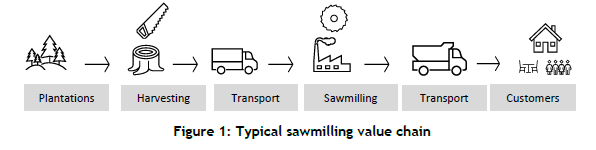
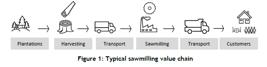
Lumber processing typically starts with the delivery of logs from plantations to the processing plant, the sawmill. Depending on the structure of the firms that own the sawmills, the mills will procure logs either from their own plantations or them from suppliers outside their firms. The logs are then processed into several different products with different end uses. Most processed lumber in South Africa is used in the building industry for roof trusses, while the rest is used for pulp and paper, furniture, and other uses [7]. Figure 1 shows the typical value chain in sawmilling.
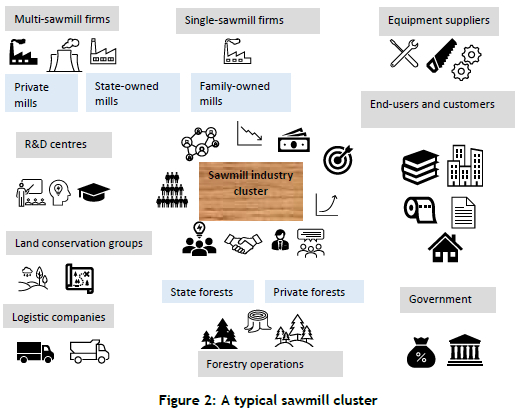
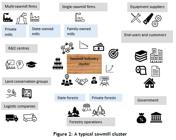
Several related and supporting industries directly or indirectly influence the operations of sawmills. Global economic cycles, changes in the prices of commodities, and swings in currency rates all affect factor-driven economies quite strongly [8]. Although many sawmills in South Africa run as individual businesses, they are still part of an industry. The numerous operations required to develop, produce, market, and deliver their goods or services ultimately cause all cost or price variances among firms, including making sales calls, manufacturing finished goods, and training staff members [9]. Figure 2 illustrates a sawmill cluster, showing the various key players and critical factors that affect the industry.
3.1. Industry clusters
Despite the common belief that having more local businesses in the same industry will lead to increased local competition, higher input prices, and more difficulty retaining staff, businesses can capitalise on having several regional businesses in the same industry [10]. Firms battle for materials and markets, assess their competitiveness through innovations, expansion, and comparative market shares, and use competitive strategies to outperform their rivals [11]. The formation of industry clusters has been discussed in several studies [12], [13], [14]. Clusters are described as geographical groupings of businesses, vendors, service providers, and related organisations in a specific industry, connected by different mutual benefits and outside factors [4]. Clusters show significant innovation effects that are exclusive to particular regions. A business inside a cluster can frequently find new equipment, services, supplies, and other elements that are needed to carry out innovations more quickly [15]. Improved knowledge of export markets, cooperative investments in testing or research centres, and developing other cooperative assets are all possible outcomes of cluster projects.
Smaller businesses, in particular, often cannot make these investments and are forced to compete at low prices [4]. Businesses are becoming increasingly involved in partnerships and collaborations to generate value that a company cannot obtain from operating independently [3]. Through clusters, businesses and institutions can collaborate to discover the obstacles and limitations that prevent higher levels of performance [10]. Some studies have highlighted collaboration and cooperation as ways to increase competitiveness [16]. Enhancing the performance of businesses through cooperative actions is one of the primary reasons that businesses cooperate with their rivals. The participating firms collaborate and compete with one another to achieve superior financial outcomes [17]. Companies could benefit from being part of a cluster if they recognised the possibility and necessity of innovation.
However, clusters' adaptability and quick decision-making abilities are just as crucial to bringing new concepts to life [15]. Clusters' importance implies that a large portion of the competitive advantage is found beyond the businesses and outside the industries in which their business units are located [10]. An industry's setup of strategic groupings, encompassing its accessibility obstacles, scale and design, geographic location, and the interconnectedness of the markets with one another, constitutes its structure. If the company is situated in a cluster with the finest attributes, it will reap greater rewards [18]. Introducing new enterprises in clustered areas is linked to many factors [19]. A country's manufacturing clusters and shared innovation infrastructure are mutually dependent because robust clusters enhance the nationwide infrastructure [15]. Businesses must consider the dynamics of relationships while developing their business plans [3]. However, the advantages of a specific collaborative connection may not perfectly align with individualised, company-specific strategic goals.
To stay competitive as separate entities, businesses must simultaneously pursue individual strategic value-appropriation goals and consider the "relational strategy" that optimises the value generated in their cooperative partnerships. High-performing firms dedicate their efforts to creating an integrated system that serves a high-achieving company [20]. Rogers and Blenko [20] also highlighted that their goal is to outperform their rivals on critical aspects:
• Robust leadership that offers an inspiring vision and guidance grounded in established sources of value in the company.
• Clearly defined liability for the most significant choices, supported by the organisational structure.
• Highly skilled people who are focused on essential metrics and assigned to positions where they can make the most significant difference.
• Excellent frontline performance that can be achieved through appropriate equipment and procedures.
• A performance-based atmosphere that inspires individuals to work hard and achieve greatness.
3.2.
BenchmarkingBenchmarking is the process of determining "best practice" for goods and the techniques used to produce and deliver them [21]. Benchmarking is a continual process that first identifies the crucial areas to benchmark before attempting to find best practices from around the world. Best practices must be constantly observed in a continually changing context and adjusted as necessary [11]. The three levels of benchmarking that can be done are firm, industry, and global market [11]. Benchmarking aims to determine areas and strategies for performance development by comprehending and assessing an organisation's or business's existing standing against best industry practice [21]. Benchmarking focuses on finding the company operations or processes that lead to market shares, profit margins, and excellent customer satisfaction percentages. Enterprise competitiveness is influenced by various elements, which must be thoroughly understood and well-maintained to achieve sustained competitiveness. However, just doing so will not ensure continued competitiveness because other nations might be advancing even further in the race for competitiveness [11].
Crickmay and Associates conduct industry benchmarking in South Africa through Intermill comparison by concentrating on the process of continuous improvement [22]. About thirty sawmills participate in the Intermill national benchmarking activity, which measures and compares the competitiveness (net margin) of sawmills in South Africa quarterly and annually [23]. Crickmay and Associates (2004) highlighted that, even though around 75 per cent of structural sawmills in the country have closed, many of the initial customers of intermill comparisons have survived and are still doing well. Globally, organisations such as the Forest Economic Advisors perform global sawmill benchmarking [24]. A benchmarking study conducted in Australia found that Australian mills would have to boost capacity utilisation, sawlog intake per employee, and a high-value sawnwood recovery to compete at a comparable level to competitive international sawmills [25].
3.3.
Management practicesAn analysis of Kosovo's softwood sawmill sector revealed that, to satisfy the industry's ongoing demand, one of the main objectives of that nation's forest management strategies should be the effective management of softwood resources [26]. The quest for speed, dependability, and efficiency has led to the development of various management tools and techniques [9]. Businesses with strong core principles of management can expand upon them by acquiring more complex skills such as statistical analysis, evaluating evidence, and interdepartmental collaboration, all of which are necessary for success in unpredictable, fluctuating markets [27].
In a study by Smallbone et al. [28], managers were questioned about their efforts to improve their goods' competitiveness with those of other companies. Typical reactions included cost-cutting measures, creating innovative products, modifying or enhancing current ones, and a noticeable boost in sales and marketing campaigns. Organisations with high performance push boundaries of expansion [20]. Williams and Lebsock [27] noted that businesses with an excellent record of comprehensive efficiency in operations typically maintain these principles well:
• Agile processes for managing operations;
• Monitoring efficiency through the use of key performance indicators along with documentation;
• Target setting that encompasses target selection, strategy linkage, and precise goal and monitoring formulation; and
• Personnel management, including training and retention.
The management decisions about these elements (goods and markets; manufacturing procedures; labour and workforce use; ownership shifts; change to the organisation and management) are described as adjustments that businesses make in response to shifts in the business's internal and external environments [28]. To stay competitive, manufacturing companies use cutting-edge procedures and operations management strategies. Manufacturing sectors use several technologies, including lean six sigma, total quality management, supply chain management, and innovation management, to sustain their competitive edge [29].
4. METHODOLOGY
Individuals in various senior-level roles in South African structural sawmills were sent an online survey. The most effective method for obtaining diverse viewpoints from industry participants was determined to be through surveys. The primary benefits of online surveys are their speed and cost savings compared with more conventional data-gathering techniques; there are also the benefits of self-administration, such as greater privacy, the ability to use a more intricate questionnaire routing, and overall increased involvement [25]. For this investigation, a survey containing multiple-choice questions was used. The survey's population consisted of South African structural sawmills. Convenience sampling was used in this study. Convenience sampling is a method of choosing individuals from the population being investigated based on their accessibility; it increases the sample's relevance and the research findings' generalisability [30]. A survey link was sent to seventy-three sawmill employees. According to the survey host website, 47 individuals clicked on the link, 23 started the survey, and 19 completed every question. The responses could be considered adequate, given that South Africa has a relatively small number of structural sawmills. Descriptive analytics was used to analyse the data. The survey data was exported to Excel, the data was plotted graphically, and conclusions were drawn from the responses.
5. RESULTS
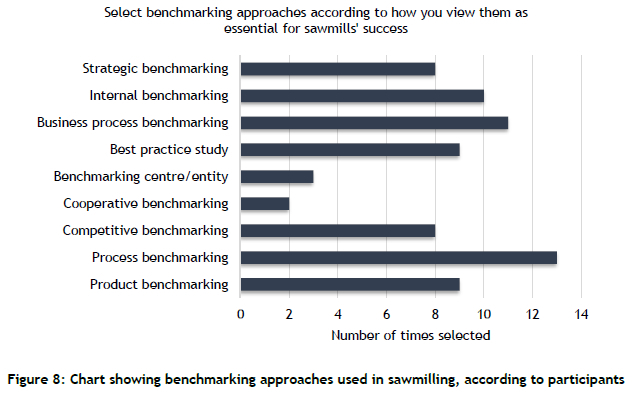
The survey participants were asked to indicate whether their sawmills participated in industry benchmarking. Eleven per cent answered "no", 68 per cent answered "yes", and 21 per cent indicated that they were unsure. This last percentage was interesting to note, seeing that the survey was sent to senior/supervisory employees in the sawmills. The expectation would be that results from such benchmarking studies would be discussed with most of the relevant employees in the sawmills so that they understood where their sawmill was compared with its competitors. Regarding the frequency with which the sawmills' strategy was evaluated, 16 per cent of the participants noted that their sawmill rarely evaluated their strategy, 68 per cent replied "often", and 16 per cent stated that they did not know. Regarding the frequency of the sawmills' strategy evaluation, it was interesting to note that strategy is often evaluated because the sawmill industry is complex: it relies on a natural resource that is susceptible to many natural threats and to a fluctuating market on the product side. Participants were asked whether it was part of their strategy to evaluate themselves against other sawmills. Eighty-four per cent of the respondents indicated that it is part of their strategy to evaluate themselves against other sawmills, while 15 per cent did not assess themselves against their competitors. The results suggest that most participants indicated that they evaluated their sawmills against others. This is elaborated on in Figure 8, which shows how participants outlined their approaches to benchmarking their performance. The results reported above are shown in Figures 3 to 5 below.
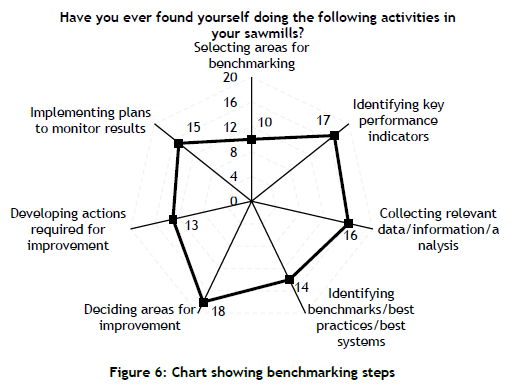
The benchmarking process typically follows a series of steps [31] that ideally are sequential. Figure 6 shows that the survey's participants were asked to indicate which activities they found themselves doing in their sawmills. The participants could select any number of items. The results show that the greater number of respondents indicated that they had found themselves deciding on areas for improvement (18), identifying key performance indicators (17), collecting relevant data/information/analysis (16), implementing plans to monitor results (15), identifying benchmarks/best practice/best systems (14), developing the actions required for improvement (13), and selecting areas for benchmarking (10).
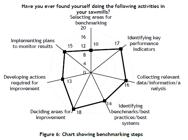
It is evident from the responses that the participants had performed at least some of the activities in the benchmarking process. The results also show that most of the steps taken to ensure that benchmarking was done were being followed in sawmill operations. The notable difference between deciding areas for improvement (18) and developing actions required for improvement (13) would suggest that not all identified areas for improvement were immediately improved, as some decisions had operational and financial consequences.
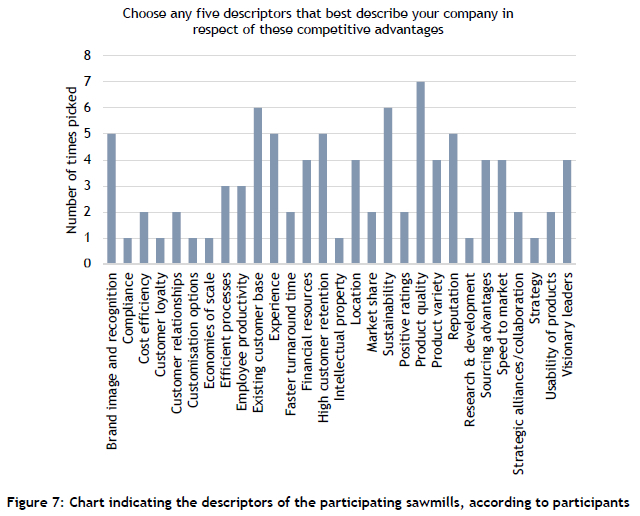
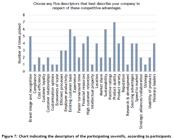
Respondents were asked to choose five descriptors that best described their sawmill's competitive advantages. Figure 7 shows that product quality (7), sustainability (6), high customer retention (6), existing customer base (5), brand image and recognition (5), and experience (5) were the most frequently chosen competitive advantages. Those that were chosen least often were intellectual property (1), research and development (1), economies of scale (1), customisation options (1), customer loyalty (1), compliance (1), and strategy (1). The size of operations would significantly influence the selection of the different factors. It would thus differ for each company and mill location in the sawmill industry, among other factors, as expected. This would explain why different individuals selected different descriptors, as the sawmills and their operating environments are distinct.
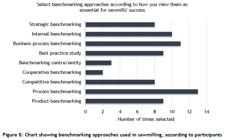
The respondents were asked to select the benchmarking approaches outlined by Sankar [32] according to whether they view them as essential for sawmills' success. The options given to them were as follows:
• Product benchmarking: Customer perception of products and services offered compared to competitors;
• Process benchmarking: Distinct processes compared with mills considered leaders in those processes;
• Competitive benchmarking: The study and measurement of competitors without their cooperation;
• Cooperative benchmarking: The benchmarking partner - the organisation being studied - assists with this;
• Benchmarking centre/entity: A company gathers relevant information on industry-wise key result areas of members;
• Best practice study: Companies learn from the experiences of others;
• Business process benchmarking: Comparing and analysing business processes with those considered the best practices in the industry;
• Internal benchmarking: Comparing activities internally to find best practices in the organisation. It attempts to identify the best practice by looking within its own company; and
• Strategic benchmarking: Evaluating the contrasts and possibilities between the company's strategy and the strategies of other prosperous businesses.
Figure 8 shows that process benchmarking was ranked the highest, followed by business process benchmarking and internal benchmarking. Cooperative benchmarking was ranked the lowest, closely followed by benchmarking centre/entity. The top three selected benchmarking processes suggest that the respondents prioritised their customers' perceptions of their lumber product offering to compare themselves against their competitors. This would involve understanding their product offering and that of their competitors in order to know why their customers preferred their products. Regarding the second most frequently selected benchmarking processes, the implication is that the respondents valued comparing and analysing their business processes with those considered the best practices in the industry. This would involve participating in industry benchmarking to understand their own mill's performance against that of other mills. Regarding internal benchmarking, sawmillers compared activities in their sawmill to find the best practices. Seeing that several sawmills in the country participate in industry benchmarking, it was interesting to see that the use of a benchmarking centre/entity was not highly ranked.
6. DISCUSSION AND CONCLUSIONS
The characteristics of sawmills, and how they are perceived, play a role in influencing other sawmills to want to benchmark themselves against those companies. Each sawmill will have unique characteristics that are based on the level of investments, customer base, reputation, strategies followed, brand awareness, research activities, market share, and several other competitive advantages the sawmill has. Other sawmills could look at the characteristics or descriptors of their competitors to see whether they could incorporate some of these aspects into their own sawmills. They could also see what is not working in other sawmills, based on the characteristics of their competitors. The difficulty is that, although certain characteristics are easy to observe and to understand in certain sawmills, other aspects are not as straightforward, as companies always try to keep certain information to themselves. This was noted by Asrofah et al. [21], who indicated that businesses have little interest in exchanging knowledge with rivals. From the sawmill descriptors chosen as being the top five (product quality, sustainability, high customer retention, existing customer base, and a tie between brand image and recognition, and experience) in this study, it is clear that those characteristics are inherent in the company/sawmill; however, they would not necessarily be hard for competitors to duplicate or copy.
The least often chosen descriptors or competitive advantages were intellectual property, research and development, economies of scale, customisation options, customer loyalty, compliance, and strategy. Some of these competitive advantages are harder to imitate. Strategic positioning aims to provide a long-lasting competitive advantage by maintaining what makes a company unique. It entails carrying out rivals' activities in entirely distinctive ways or doing comparable tasks differently [33]. The study's participants indicated that process benchmarking was essential for sawmills. This would indicate that sawmills regard having a distinct process in their sawmills as essential. Business process benchmarking was selected second most often. Interestingly, this form of benchmarking compares business processes with those considered the best practices in the industry. The third most often selected form of benchmarking was internal benchmarking; this meant that looking within one's sawmill to try to determine the best practice by examining internal operations was also regarded as essential for the sawmill.
Although most of the study's participants indicated that their sawmills participated in sawmill industry benchmarking, using benchmarking centres/entities that gather relevant information on the industry-wide key result areas of their members was ranked the least. It was interesting to note that, although participants were given the option to choose all the steps as being something they had done in their sawmills, seeing that benchmarking is a process that involves several steps, the results showed that some processes were selected more than other steps. This might indicate that that the benchmarking process is not being done fully. It could also indicate that the survey's respondents could not carry out some processes themselves.
The results showed that eighteen respondents had decided on areas for improvement in their sawmills. Seventeen of them said that they had identified key performance indicators. However, only 13 respondents indicated that they had developed the required actions for improvement, and ten said that they had selected areas for benchmarking. This would suggest that there needs to be a continuous system for finding solutions to problems rather than identifying problem areas without taking action. Establishing a culture of performance improvement fosters a no-blame mentality that eliminates cause-and-effect anxiety, leading to performance being perceived more as an organisational behaviour than an outcome [34]. This implies that every employee would work towards process improvement. Asrofah et al. [21] noted that limitations in respect of time, cost, competitiveness, absence of competent staff and leadership devotion, reluctance to change, insufficient preparation, and urgently desired outcomes are considered the primary issues that prevent benchmarking research from being successful. This might deter sawmill managers from seeing the need to invest in benchmarking.
The formation of industry clusters was discussed as a way for sawmills to work alongside other stakeholders in the industry. Porter and Ketels [4] stated that numerous cluster benefits are solely attributable to coexistence and do not require engagement from businesses in the cluster. They also highlighted that different ways of cooperation could improve cluster production by using complementary abilities and teamwork more effectively. Collaborative mechanisms can enhance knowledge-sharing among businesses, academic institutions, and other research centres, yielding economies of scale that isolated companies cannot match. If cluster members were coordinated to collaborate with the government, policies could be more effectively formulated. Using a survey enabled us to engage with people in the South African sawmill industry and to gather various views on industry benchmarking. The results emphasised that more could be done to facilitate benchmarking in South Africa's sawmill industry.
7. RECOMMENDATIONS
The recommendations emerging from the study are that there need to be further engagements between the various sawmilling stakeholders to discuss ways in which the industry could form active and intentional clusters that are focused on the prosperity of the South African sawmill industry. These discussions could be centred on identifying industry best practices. To realise the competitiveness of the entire South African sawmill industry, it is recommended that sawmills continually conduct various benchmarking processes to improve their standing in the industry. This would require sawmills in the industry clusters to benchmark their processes with other successful sawmills. Sawmills need to engage most of their personnel in the different benchmarking processes in order to identify areas of improvement, to act on improving their processes, and to be aware of how their sawmills fare compared with other mills. To deal with the complexity of the sawmill industry, as reflected in the varying responses, it is recommended that sawmills collaborate with their competitors to benchmark their processes effectively and to assist each other in building the South African sawmilling industry.
8. LIMITATIONS OF THE STUDY
South Africa, our survey's target demographic, has a comparatively small number of formal structural sawmills. This partially accounted for the survey's low response rate. It was anticipated that not everyone who was sent the survey link would participate.
REFERENCES
ACKNOWLEDGEMENTS
This work is based on research supported partly by the National Research Foundation of South Africa (grant number 128910) and by DHET-nGAP funding.
3. LITERATURE REVIEW
- [1] M. E. Porter, C. H. M. Ketels, K. K. Miller, and R. Bryden, "Competitiveness in Rural U.S. Regions: Learning and Research Agenda," U.S. Economic Development Administration, Feb. 25, 2004
-
[2] R. Godsmark and F. Oberholzer, *South African Forestry and Forest Products Industry 2018*, Forestry South Africa, Sept. 2019. Accessed: Aug. 19, 2025. [Online]. Available: https://forestry.co.za/wp-content/uploads/2022/11/South-African-Forestry-Forest-Products-Industry-2018.pdf.
» https://forestry.co.za/wp-content/uploads/2022/11/South-African-Forestry-Forest-Products-Industry-2018.pdf -
[3] P. Ritala and A. Tidström, "Untangling the value-creation and value-appropriation elements of coopetition strategy: A longitudinal analysis on the firm and relational levels," Scand. J. Manag., vol. 30, no. 4, pp. 498-515, 2014. http://dx.doi.org/10.1016/j.scaman.2014.05.002
» http://dx.doi.org/10.1016/j.scaman.2014.05.002 -
[4] M. Porter and C. Ketels, "Clusters and industrial districts: Common roots, different perspectives," A Handb. Ind. Dist., no. January 2009, 2013. https://doi.org/10.4337/9781781007808.00024
» https://doi.org/10.4337/9781781007808.00024 -
[5] D. Kaplan, "Manufacturing Performance and Policy in South Africa: A Review," presented at the TIPS Annual Forum, Trade and Industrial Policy Strategies (TIPS), South Africa, 2003. Accessed: Aug. 19, 2025. [Online]. Available: https://www.tips.org.za/research-archive/annual-forum-papers/2003/item/860-manufacturing-performance-and-policy-in-south-africa-a-review
» https://www.tips.org.za/research-archive/annual-forum-papers/2003/item/860-manufacturing-performance-and-policy-in-south-africa-a-review -
[6] S. Grobbelaar and J. K. Visser, "An analysis of South African sawmilling competitiveness," South. For. J. For. Sci., vol. 83, no. 1, pp. 28-37, 2021. https://doi.org/10.2989/20702620.2020.1813646
» https://doi.org/10.2989/20702620.2020.1813646 -
[7] P. L. Crafford, M. Blumentritt, and C. B. Wessels, "The potential of South African timber products to reduce the environmental impact of buildings," S. Afr. J. Sci., vol. 113, no. 9-10, pp. 1-8, 2017. doi: https://doi.org/10.17159/sajs.2017/20160354
» https://doi.org/10.17159/sajs.2017/20160354 - [8] M. E. Porter, "Enhancing the microeconomic foundations of prosperity: The current competitiveness index," Glob. Compet. Report. Geneva World Economic Forum, pp. 52-76, 2002.
-
[9] M. Porter, "What is strategy?" Harv. Bus. Rev., no. December, pp. 61-78, 1996. https://doi.org/10.1057/9780230378117_2
» https://doi.org/10.1057/9780230378117_2 - [10] M. E. Porter, ": Location, clusters, and the 'new' micro-economics of competition," Bus. Econ., vol. 33, no. 1, pp. 7-13, 1998.
-
[11] A. Kovačič, "Benchmarking the Slovenian competitiveness by system of indicators," Benchmarking An Int. J., vol. 14, no. 5, pp. 553-574, 2007. https://doi.org/10.1108/14635770710819254
» https://doi.org/10.1108/14635770710819254 -
[12] H. Salavou, "Strategy types of service firms: Evidence from Greece," Manag. Decis., vol. 48, no. 7, pp. 1033-1047, 2010. https://doi.org/10.1108/00251741011068752
» https://doi.org/10.1108/00251741011068752 -
[13] Y. K. A. A. Migdadi and A. A. Omari, "Identifying the best practices in green operations strategy of hospitals," Benchmarking, vol. 26, no. 4, pp. 1106-1131, 2019. https://doi.org/10.1108/BIJ-09-2017-0242
» https://doi.org/10.1108/BIJ-09-2017-0242 -
[14] V. Tshavhungwe and S. Grobbelaar, "Sawmilling competitiveness from the perspective of industry competitiveness models: A review," South. For. a J. For. Sci., vol. 86, no. 1, pp. 2-14, 2024. https://doi.org/10.2989/20702620.2023.2293906
» https://doi.org/10.2989/20702620.2023.2293906 -
[15] M. E. Porter and S. Stern, "National Innovative Capacity," in *The Global Competitiveness Report 2001-2002*, M. E. Porter, J. D. Sachs, P. K. Cornelius, J. W. McArthur, and K. Schwab, Eds. New York: Oxford University Press, 2002. https://doi.org/10.2307/1924589
» https://doi.org/10.2307/1924589 -
[16] J. Hietala, R. Hanninen, M. Kniivila, and A. Toppinen, "Strategic management towards competitive advantage-patterns of internationalization in the Finnish and Swedish sawmill industries," Curr. For. REPORTS, vol. 5, no. 4, pp. 199-209, 2019. https://doi.org/10.1007/s40725-019-00100-8
» https://doi.org/10.1007/s40725-019-00100-8 -
[17] R. Rusko, "Exploring the concept of coopetition: A typology for the strategic moves of the Finnish forest industry," Ind. Mark. Manag., vol. 40, no. 2, pp. 311-320, 2011. https://doi.org/10.1016/j.indmarman.2010.10.002
» https://doi.org/10.1016/j.indmarman.2010.10.002 - [18] M. E. Porter, "The Structure within Industries and Companies' Performance," The Review of Economics and Statistics, vol. 61, no. 2, pp. 214-227, May 1979.
-
[19] M. Delgado, M. E. Porter, and S. Stern, "Clusters and entrepreneurship," J. Econ. Geogr., vol. 10, no. 4, pp. 495-518, 2010. https://doi.org/10.1093/jeg/lbq010
» https://doi.org/10.1093/jeg/lbq010 -
[20] P. Rogers and M. Blenko, "The high-performance organization: Making good decisions and making them happen," Handb. Bus. Strateg., vol. 7, no. 1, pp. 133-142, 2006. https://doi.org/10.1108/10775730610618747
» https://doi.org/10.1108/10775730610618747 -
[21] T. Asrofah, S. Zailani, and Y. Fernando, "Best practices for the effectiveness of benchmarking in the Indonesian manufacturing companies," Benchmarking, vol. 17, no. 1, pp. 115-143, 2010. https://doi.org/10.1108/14635771011022343
» https://doi.org/10.1108/14635771011022343 -
[22] A. Bajraktari et al., "Forest resources and sawmill structure of Kosovo: State of the art and perspectives," Drv. Ind., vol. 65, no. 4, pp. 323-327, 2015. https://doi.org/10.5552/drind.2014.1343
» https://doi.org/10.5552/drind.2014.1343 -
[23] J. C. Williams and S. Lebsock, "Now What?," in 'HBR's 10 Must Reads 2019: The Definitive Management Ideas of the Year from Harvard Business Review*, Harvard Business Review Press, Nov. 6, 2018. Accessed: Aug. 19, 2025. [Online]. Available: https://hbsp.harvard.edu/product/10217-PDF-ENG
» https://hbsp.harvard.edu/product/10217-PDF-ENG -
[24] D. Smallbone, R. Leigh, and D. North, "The characteristics and strategies of high growth SMEs," Int. J. Entrep. Behav. Res., vol. 1, no. 3, pp. 44-62, 1995. https://doi.org/10.1108/13552559510100657
» https://doi.org/10.1108/13552559510100657 -
[25] H. H. Berhe, H. S. Gebremichael, and K. T. Beyene, "Development, validation and verification of innovative integrated Kaizen philosophy (CI) framework and its implementation procedure for enhancing manufacturing industries sustainable competitiveness," Int. J. Qual. Reliab. Manag., vol. 40, no. 10, pp. 2463-2518, 2023. https://doi.org/10.1108/IJQRM-08-2022-0258
» https://doi.org/10.1108/IJQRM-08-2022-0258 -
[26] V. Braun, V. Clarke, E. Boulton, L. Davey, and C. McEvoy, "The online survey as a qualitative research tool," Int. J. Soc. Res. Methodol., vol. 24, no. 6, pp. 641-654, 2021. https://doi.org/10.1080/13645579.2020.1805550
» https://doi.org/10.1080/13645579.2020.1805550 -
[27] M. Zairi, "Benchmarking: The best tool for measuring competitiveness," Benchmarking for Quality Management & Technology, vol. 1, no. 1, pp. 11-24, Apr. 1994, doi: https://doi.org/10.1108/14635779410056859
» https://doi.org/10.1108/14635779410056859 -
[28] M. R. Sankar, "Result benchmarking, process benchmarking, cooperative benchmarking, textile industry benchmarking," Fibre2Fashion, 2008. Accessed: Jul. 1, 2023. [Online]. Available: https://www.fibre2fashion.com/industry-article/3143/benchmarking-key-result-areas-of-textile-industry
» https://www.fibre2fashion.com/industry-article/3143/benchmarking-key-result-areas-of-textile-industry - [29] M. Porter, "HBR's Must-Reads on strategy," Harv. Bus. Rev., pp. 2-143, 2006.
-
[30] T. Cadden, D. Marshall, and G. Cao, "Opposites attract: Organisational culture and supply chain performance," Supply Chain Manag., vol. 18, no. 1, pp. 86-103, 2013. https://doi.org/10.1108/13598541311293203
» https://doi.org/10.1108/13598541311293203
Accepted for publication 12 Jun 2025
Available online 29 Aug 2025
ORCID® identifiers
V. Tshavhungwe: https://orcid.org/0000-0002-5567-098X
S. Grobbelaar: https://orcid.org/0000-0001-8148-2440