Exploring the use of computer-mediated video communication in engineering projects in South Africa
Abstract
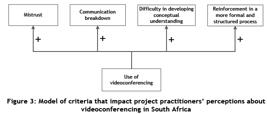
Globally-expanding organisations that are trying to capitalise on distributed skills are increasingly using virtual project teams to shorten product development time and increase quality. These virtual teams, which are distributed across countries, cultures, and time zones, are required to use faster and better ways of interacting. Past research has shown that virtual teams that use computer-mediated communication (CMC) instead of face-to-face communication are less cohesive because they struggle with mistrust, controlling behaviour, and communication breakdowns. This study aims to determine whether project practitioners in South Africa perceive virtual teams that use videoconferencing as suffering from the same CMC disadvantages described in past research in other environments; and if they do, what the possible causes could be. This paper reports on a survey of 106 project practitioners in South Africa. The results show that these project practitioners prefer face-to-face communication over CMC, and perceive virtual teams using videoconferencing to be less cohesive and to suffer from mistrust and communication breakdowns, but not from increased conflict and power struggles. The perceived shortcomings of videoconferencing might result from virtual teams that use this medium having less time to build interpersonal relationships.
 Thumbnail
 Thumbnail
 Thumbnail