Analysing organisational robustness in the application of project portfolio management
Abstract
Project portfolio management (PPM) has become a popular practice among organisations in effectively driving a collection of projects and/or programmes to align with and meet their strategic objectives. PPM is still considered a new concept, and is in the early days of its implementation. Even the best-performing organisations are still not excelling in executing best practices in PPM. This research reviews the literature on the robustness of portfolio governance controls. A semi-structured technique entailing a questionnaire and qualitative interviews to access best practices was used with a population of PPM professionals from various industries. The paper reviews the impact of higher levels of compliance on a model and/or framework in more mature environments in order to prevent or minimise the influence of external elements such as executive veto on PPM practices.
Abstract
Projekportefeuljebestuur (PPM) het 'n gewilde praktyk onder organisasies geword om effektief 'n versameling projekte en/of programme te inisieer ten einde hul strategiese doelstellings te belyn en te bereik. PPM word steeds as 'n nuwe konsep beskou en is in die vroeè stadium van implementering. Selfs die organisasies wat die beste presteer, beoefen steeds nie die beste praktyke in PPM nie. Hierdie navorsing ondersoek die literatuur rakende die robuustheid van portefeuljebestuurskontroles. 'n Semi-gestruktureerde vraelys en onderhoud tegniek was gebruik om insae te kry tot die beste praktyje in die industrie. Die navorsingsbevolking het bestaan uit PPM-professionele persone in verskillende industrieè. Die navorsing beoordeel die impak van hoèr vlakke van voldoening aan 'n model en/of raamwerk in meer volwasse omgewings en om die invloed van eksterne elemente soos uitvoerende veto op PPM-praktyke te voorkom of te verminder.
1. INTRODUCTION
Project portfolio management (PPM) has become a popular practice among organisations in effectively driving a collection of projects and/or programmes to meet their strategic objectives.
PPM is perceived to be a means to implement strategy through projects and programs ([1];[2])
About 57% of organisations are unsuccessful in executing their strategic initiatives, which links with the statistic of 66% of corporate strategies never being implemented ([4];[5]). In these ever-changing times, and with the increased drive for organisations to meet their organisational objectives through the implementation of projects, PPM has become the vehicle to drive higher success in managing project outputs [6]. PPM is also viewed as a tool or technique for the executional approach to strategy execution [3]. Levine [7] states that executives have realised that projects are becoming the drivers of profitability and return on investments, and that they assist the organisation to realise benefits. Beyond project management, executives need to know how best to balance the mix of projects to ensure that they optimise resource use, uplift strategic intent, and provide value or benefits to the shareholder.
PPM is now seen as more than a process - PPM is an organizational capability that also includes the organizational structure, the people, and the culture...." ([6] quoting Killen)
According to Martin [8], strategy-execution models often fail on multiple levels of an organisation. This failure could be attributed to executives being constrained by boards, shareholders, regulators, and countless others who dictate to them. In most organisations, from the top management of the organisation to the lowest level of supporting personnel, people are expected to make decisions under constraints and uncertainty. In a misguided metaphor, the accepted dogma holds that strategy is the output of senior managers or executives who, together with an outside consultant, formulate it and then hand it over to the rest of the organisation for execution [9]. Therefore, if the selection of what the strategy entails and the objectives is established at an executive level, to what extent does executive veto influence the effectiveness of PPM for the organisation?
Organisations devote immense effort to the development of their strategies. However, there are evident gaps in project alignment, portfolio balance, and the successful execution of projects to meet their objectives. Thus this study investigates whether the susceptibility of the so-called 'robustness' of PPM practices to external influences in the form of executive veto may result in the problem studied here.
The purpose of this study is two-fold: first, it is to determine what qualifies the robustness of PPM practices in organisations; and second, it is determine the extent to which executive veto permeates the PPM process. This translates into a review of the PPM lifecycle of selection, prioritisation, portfolio balance, projects in flight, and so on, and of the impact it might have on the overall performance of PPM in attaining organisational success. The questions that are answered through this study are the following:
• Have organisations adopted a formal PPM process to orientate their organisational strategy for organisational success?
• What are the qualifiers that organisations define as best practice for portfolio management?
• What has transpired in respect of a mature project portfolio management model?
• How has a governing portfolio management body aided in improving organisational successes in achieving strategic objectives?
• What are the influencing factors that enforce or validate executive veto over existing PPM processes?
After collating and analysing this information, it is used to determine whether key elements in a robust PPM model and/or framework are able to curb the influence of executive veto.
This literature review considers the current application and/or adaption of PPM processes as a framework to do the following:
• Align projects with the strategic intent of an organisation.
• Determine which processes have been applied to meet the strategic objectives.
• Identify what success there has been for organisations in applying PPM.
• Identify best practices and lessons learnt in adopting the process; and
• Identify what determines the robustness of a project portfolio management framework in respect of policy, procedures, and frameworks that prevent external elements such as executive veto from enforcing compliance while still meeting the organisation's results.
2.1.
Strategy and PPM linkA significant amount of research had been conducted on the link between corporate strategy and projects ([3];[6]). To illustrate the link, this literature review has been structured so that the strategic and PPM elements are clarified first; then an argument follows to establish the interconnections.
2.1.1. Strategy defined
According to Porter [10], strategies could be regarded as a way in which managers attempt to simplify and create a sense of order in a rather complex and chaotic world so that there is comprehension. Levin and Wyzalek [6] states that strategic alignment could be defined as "the link between the organisation's overall goals and the goals of each of the units that contributes to the success of those overall goals".
2.1.2. PPM defined
The PMI [11] defines a portfolio as a "collection of projects and/or programmes and other work that are grouped together to facilitate the effective management of that work to meet strategic organisation objectives". The portfolio should reflect the investments that the organisation has made or plans to make, but that are aligned with the organisation's strategic goals to meet its objectives ([4];[5];[10];[11];[12];[13];[14];[15];[16];[17]).
2.1.3. Strategy and PPM link
In some organisations, the link between project selection and strategy is not clear [16]. In order for PPM to be successful, the main link between strategy and PPM should be emphasised in projects and programmes being directly linked to the organisation's strategy ([5];[6];[18]).
2.1.4. PPM success in strategic results
Fidan and Bramwell [18] state that, even though PPM originated in the 1990s, it is becoming more popular only now, with around 23% of organisations practising PPM in its entirety and 25% practising it partially, with the emphasis being on the discipline of information technology. In a study conducted in the public sector, participants noted that they had seen an overall improvement of between 30% and 40% in project success after implementing PPM [18].
2.2.
Balancing the portfolio through project selectionA majority of organisations still use unscientific approaches to portfolio evaluation and selection, which could lead to wasting resources. Archer and Ghasemzadeg [19] define project portfolio selection as the activity that, through established iterations, selects proposed projects or reviews projects that are currently active that meet the organisation's objectives while allocating resources and not imposing constraints on these resources. Archer and Ghasemzadeg [19] identify more than 100 different techniques that are reviewed in the literature and that are only partially successfully categorised into two categories, namely benefit measure techniques and project selection/resource allocation techniques.
2.3.
PPM governanceResearch on project portfolio governance is not widely found, and is often represented as an extension of project governance [1]. Portfolio governance is rarely studied in its own right, which points to a need to study and understand it in more detail. Baker, in Levin and Wyzalek [6], defines governance as the framework for making decisions about projects or programmes. Levin and Wyzalek add that the elements of a well-structured governance model include clarifying roles and responsibilities and creating transparency specifically in the areas of scope definition, calendars, stakeholder management, financial approvals, clear frameworks, policies, processes, methods, and so on [6]. There are occasions when the governance of the organisation often infringes on the governance of the project, allowing for external influences to permeate the PPM processes. In ISO 21505 [20] it is stated that the overall governance of the organisation should support and enable the proper management of PPM, with the emphasis on 'enable'. In defining governance for PPM, a framework should be developed that includes all policies, processes, procedures, guidelines, boundaries, interfaces, roles, responsibilities, and accountabilities that are needed to implement and maintain the organisation's values and principles. Governance frameworks are to be reviewed at defined and established intervals as the organisation changes and as new insights are established [20].
Mosavi [1] identifies the engaging actors or roles in the context of PPM as portfolio managers, portfolio steering committees, portfolio offices, top or executive management, and middle management [21]. Given these actors, governance is not the responsibility of the organisation's top hierarchy alone, but should be applied to all levels ([1];[21]).
The Office of Government Commerce (OGC) (2011), cited in [1], suggests that, for effective portfolio governance, a two-committee governance structure with decision-making rights would be relevant for (a) direction for enlisting new projects and (b) progress in the delivery on existing projects. The definition of roles and responsibilities at the portfolio level is required for portfolio governance. PPM could be the responsibility of a project portfolio management office (PPMO) ([1 1];[22]) and/or a portfolio steering committee or review board ([1];[5];[7]).
2.4.
Maturity and value of PPMEven though there is no single solution to achieving maturity, many organisations realise the importance of improving their performance to curb costs, reduce risks, and earn acceptable returns on investment through the implementation of PPM [23]. PWC [23], citing Aberdeen Research, states that organisations can achieve as much as 25% and more in revenue from new products, should they employ a well-executed PPM strategy. A robust portfolio management model would be essential; but its robustness would lie in how rigorous the governance model was so as to elicit and enforce accountability, optimise alignment, escalate issues to the correct decision-makers, and align communications and strategies across the organisation [23]. Fidan and Bramwell [18] state that, to translate and deliver on strategy effectively, PPM would require a high level of maturity in several areas.
3. CONCEPTUAL MODEL AND METHODOLOGY
3.1. Conceptual model
A conceptual framework is the interlinking of concepts that, when combined, provide a "comprehensive understanding of a phenomenon or phenomena" ([24];[25]). The composition of a conceptual framework includes "ontological, epistemological and methodological assumptions", each playing a specific role [24]. Jabareen cites Guba and Lincoln (1994) [24] about what conceptual frameworks possess:
• The ontological assumptions refer to 'the way things are', the reality of the nature or the real existence or real action, which in this scenario refers to the current practices of PPM;
• The epistemological assumptions refer to 'how things really are', or 'how they really work'; in this context we review the literature and the research results as to what is perceived to create the gap between allowing external influences such as executive veto and PPM;
• The methodological assumption refers to the process of constructing the conceptual framework, what we are able to determine from the 'real' world, and what we refer to as the intended state of creating a balance that minimises the gap.
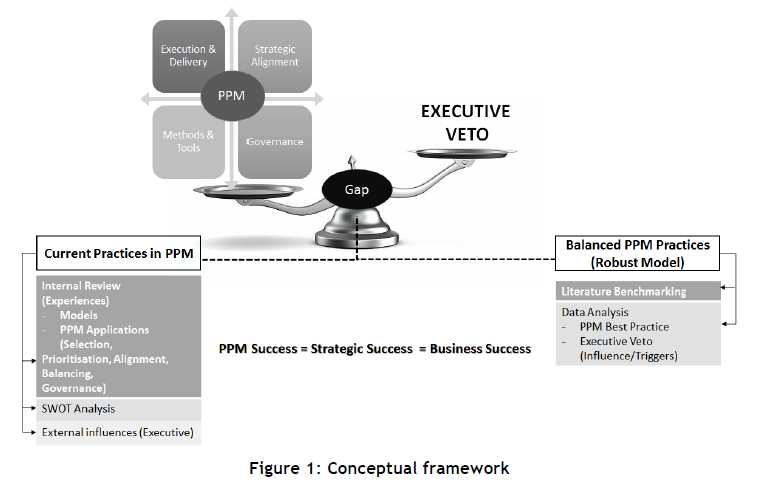
The proposed conceptual framework for the study is detailed in Figure 1.
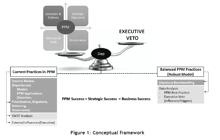
The authors' experience was a key attribute in the ontological referencing in respect of the following:
• Organisational experience (mining, industrial, banking, and information technology) in respect of the measures that were implied and established as a framework for executing or processing PPM.
• External influences such as executive veto being the main influence on successful implementation, and testing the robustness of the PPM model and/or framework.
• SWOT analysis, identifying how the strengths and opportunities in the various organisations were challenged by the identified weaknesses and threats.
• Supporting the models or approaches that were used in the various organisations.
The premise tested herein is that, even with the establishment of a PPM framework, external influences -specifically, executive veto - still have an impact on the robustness of PPM.
3.1.2. The gap
The study's epistemology reviewed the gap in PPM model and/or framework that tolerates the imbalance in sound PPM practices by first reviewing the literature, and second by analysing the data about the gap in respect of how things are perceived, in order to provide clarification on how best to 'close the gap'. The results identified the key success factors for ensuring a robust PPM framework, should the external influences - with specific reference to executive veto - be removed or controlled.
3.1.3. Balanced PPM practices (robust model)
The results of the research, based on data analysis, presented the methodological assumption of the study. It identified the opportunity for what the intended status should address after identifying the gap. Further recommendations are also presented on potential research studies for theory building towards a fit-for-purpose application to implement a robust PPM model and/or framework.
3.2. Methodology
The methodology consisted of conducting research first by reviewing the literature about various industries regarding the proposed practices in effective PPM in order to elicit or establish a robust PPM model and/or framework that would prevent the permeation of external influences such as executive veto. In addition, qualitative data was collected from a panel that was selected on the basis of a specific criterion by completing a semi-structured survey style questionnaire to correlate with the literature.
3.2.1. Qualitative data population
The population consisted of senior and executive PPM professionals from various industries. The following criteria were used in selecting the participants:
• The professional understood the merits of PPM, and while they did not necessarily have PPM in their title, they had experience of the concept.
• The person was a practising professional, or had practised in the discipline for longer than five years before the study.
• Their experience in PPM or a similarly descriptive concept was longer than five years.
• The professional formed part of a steering committee or similar body that oversaw PPM in the organisation, and the committee included executives and/or senior management.
• The professional was part of the team that established the framework, and had influence over changes that re-defined the framework when necessary.
• The professional dealt with projects or programmes that were valued at a minimum of ZAR10 million per project, and the portfolio basket and/or pipeline exceeded a minimum of ZAR10 million or contained more than 10 large or complex projects.
• An added advantage was if the professional had worked in different industries or departments in applying PPM.
3.2.2. The interview questions
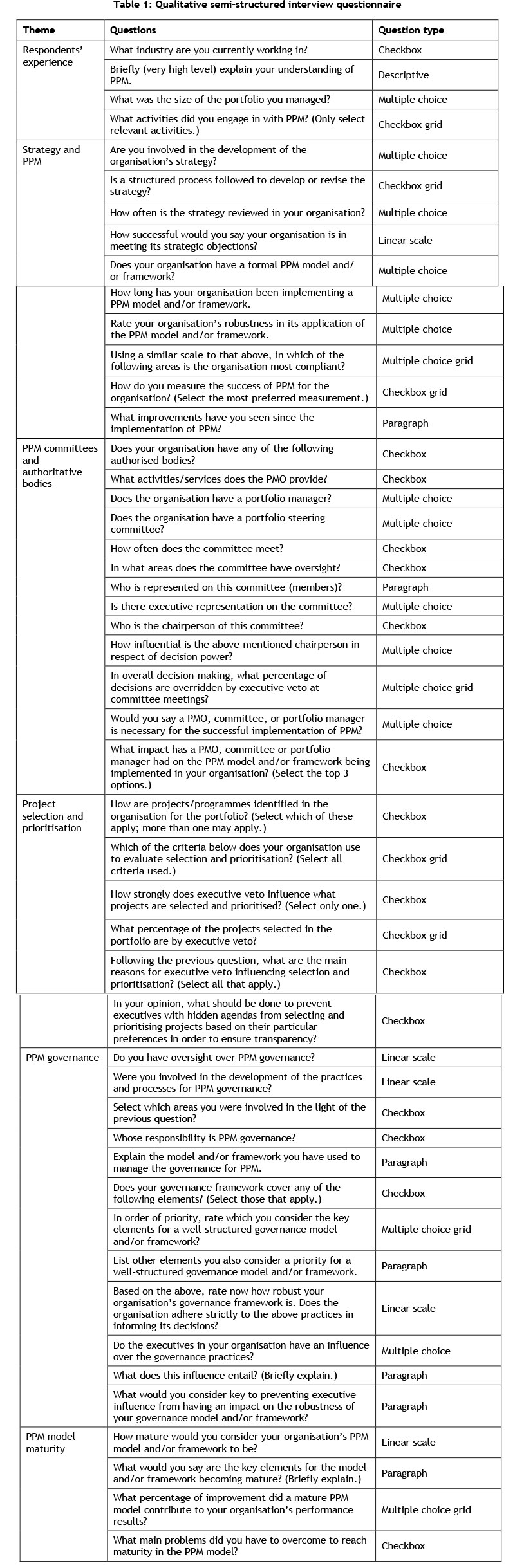
The questionnaire comprised a mixed answering approach and provided an opportunity to elaborate on certain questions. The method of answering provided for positive or negative feedback to obtain a consensus of opinion from the participants. Table 1 highlights how the questionnaire related to the themes linked to the research question (as elaborated in the results section):
The questionnaire was distributed via email by sending a link to the online questionnaire. The same link was also sent via direct messaging through a social media platform. The questionnaire was then completed on the online survey system to collect the participants' views for review in the central repository. The next section reviews the outcome of the questionnaire as answered by the respondents.
4. RESULTS
The questionnaire was sent to a sizeable population of 71 professionals in the PPM discipline. Twenty-one responses (30%) were received. The overall feedback from the respondents was that PPM requires a formalised model and/or framework to ensure its successful implementation. In areas where good governance is applied, higher levels of compliance with the PPM model and/or framework were found. More mature environments with structured or formalised bodies, clear role players, and guidelines helped organisations to prevent and/or minimise the influence of external elements such as executive veto. The feedback from the questions highlighted in the previous section is summarised according to the themed categories in the sub-section below.
4.1. Respondents' experience and background
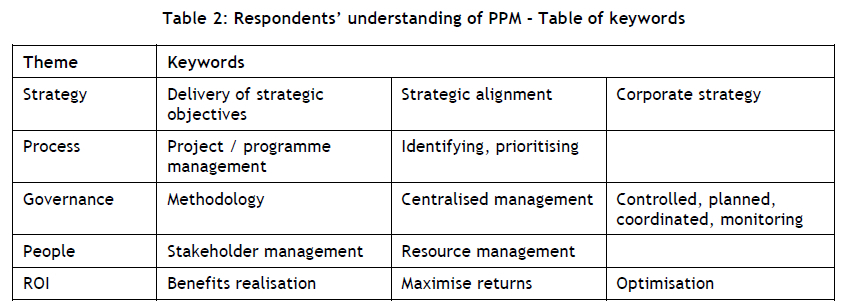
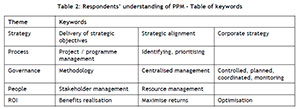
The respondents who were interviewed were considered from various industries. The industries that ranked the highest among the respondents were engineering (29.6%), petrochemical (24.5%), and IT and communications (24.5%). When asked to explain briefly their understanding of PPM, there was a general theme and consensus about the key words that were extracted (see Table 2 below):
The respondents' involvement in PPM activity covered most areas of PPM, which includes portfolio selection, portfolio balancing, and project and/or programme management.
4.2. Strategy and PPM
The literature has identified a strong link between the alignment of PPM with the corporate strategy and the attainment of the organisation's objectives. This section of the questionnaire considered the respondents' involvement in developing and structuring the organisation's strategy, the application of a model and/or framework, and the overall compliance with the application of PPM.
Significantly, 85.7% of the respondents were involved in the development of their organisation's strategy. When asked to rate the success of the organisations' achievements in meeting their strategic objectives, on average 48% were rated as meeting their strategic objectives, and 76% of the respondents' organisations were identified as 'successful' to 'very successful' in meeting those objectives. The results also reflected that 76.2% had a formal PPM model and/or framework in place. However, less than half (47.6%) of the respondents had been in the implementation phase of this model and/or framework for a period of more than five years (23.8%); were between two and five years in implementing the model and/or framework; and the remaining 28.6% were less than a year into the implementation. Of the respondents, 66.6% were robustly applying at least 50% of the model and/or framework elements in practice, with less than 10% of the respondents fully complying in the robust application of their PPM model and/or framework.
The areas in PPM where the respondents' organisations were the most compliant included project selection alignment with the strategic objectives and portfolio governance. The most preferred way of measuring the success of PPM resulted in 76.2% of the respondents selecting the "realisation of the organisation's strategy", which translated to the achievement of goals, realising business value, and so on.
The improvements that had been seen since the implementation of PPM included the following:
• Improved portfolio governance, the introduction of a framework, and robust governance processes.
• Project and/or programme visibility, project management methodologies valued.
• Accountability for projects and predictability in delivery.
• Heightened executive attention.
• Realisation of ROI/investment alignment.
• Improved capital expenditure and cost control.
• Standardisation/consistency.
• Collaboration.
• Resource management.
4.3.
PPM committees and authoritative bodiesAmong the respondents' organisations, 95.24% had an authorised body representing the organization, whether in the form of a project management office (47.6%), programme management office (9.5%), portfolio management office (42.9%), or all of these (19%). Of the organisations, 71.4% had a portfolio manager, with 85.7% also having a portfolio steering committee, of which 76.2% met each month with oversight in the areas of strategic alignment (71.4%), project selection and prioritisation (71.4%), and monitoring of projects and/or programmes 'in flight' (95.2%). Executives were represented on the committee for 90.5% of the respondents' organisations; for 66.7% of them, the chairperson of this committee was also an executive. A total of 57% of the respondents had at least a quarter of the committee decisions experiencing the impact of executive veto. For the successful implementation of PPM, 90.5% agreed that a steering committee or portfolio manager was necessary, as these would provide structure, leadership, and/or authority to PPM. For 71.4% of the respondents, the impact that a PMO, steering committee, or portfolio manager had on the PPM model and/or framework being implemented in their respective organisations was seen that they provided clearer guidelines and roles and responsibilities.
4.4.
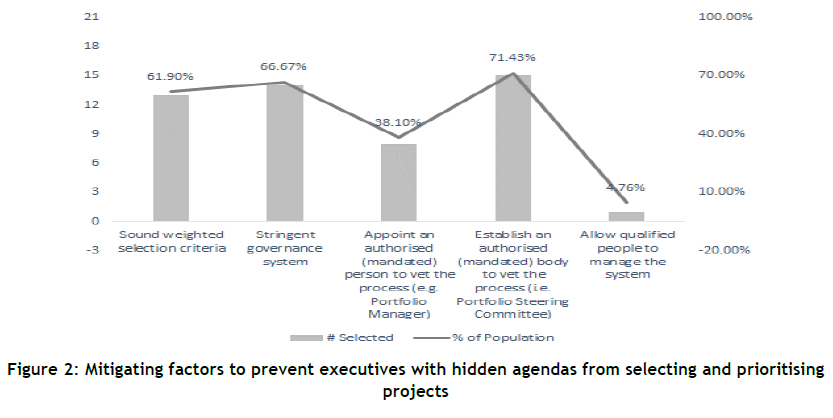
Project selection and prioritisationProjects and programmes for the portfolio were identified by executives (71.4%), management (66.7%), formal steering committees or similar (38.1%), project portfolio offices or PMOs (33.3%), or anyone in the organisation (19%). The criteria that organisations used to evaluate for selection and prioritisation included cost savings (61.9%), resource availability (42.86%), complexity (28.57%), customer satisfaction (52.38%), revenue generation (sales, market share) (85.71%), innovation/competition (38.1%), and executive preference (38.10%). In the selection and prioritisation of projects, executive veto strongly influenced the selection process (52.38%). However, fewer than 25% of the projects selected in the portfolio were overridden by executive veto either because of board pressures (33.33%) or hidden agendas or pet projects (19.05%). In the opinion of the participants, when asked what should be done to prevent executives with hidden agendas from selecting and prioritising projects, based on their particular preferences, in order to ensure transparency, the following proposals were made; they are detailed in Figure 2.
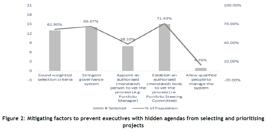
The participants highlighted that the most significant of these elements to prevent executives with hidden agendas from selecting and prioritising projects was the establishment of an authorised body (71.43%) to vet the process by means of a steering committee. This could be supported by a stringent governance system (66.67%) and sound weighting criteria for selection (61.90%). The mitigation through these elements could thus contribute to ensuring transparency.
4.5. PPM governance
PPM governance was one of the areas identified as one in which compliance was generally higher in the respondents' organisations. In respect of PPM governance oversight, at least 86% of the respondents had an average to total oversight of PPM governance, and 76% of the participants had an average involvement to total immersion into the development of the practices and processes for PPM governance for their organisations. The responsibility of PPM governance was regarded as the responsibility not just of one person but rather of all levels in the organisation.
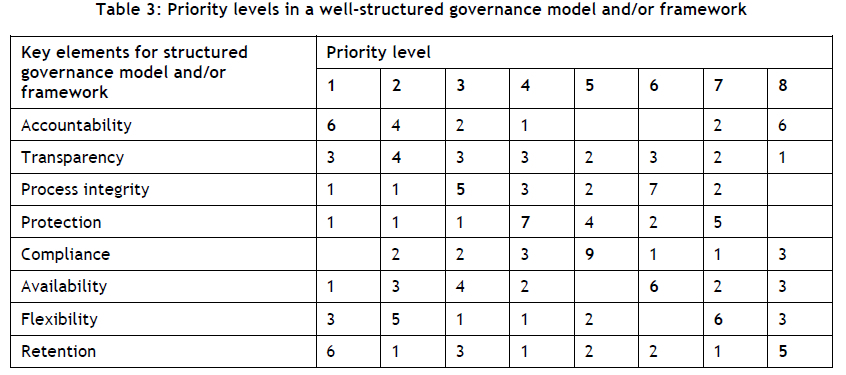
The participants ranked the key elements they considered to be included in a well-structured project governance model and/or framework, with '1' being the most important and '8' being the least important. To average the priority levels for each of the elements, the highest or second-highest score was used to create a ranking. This is detailed in Table 3.
Of the respondents, 67% had an average to very compliant robust framework, where the most robust of frameworks left no room for self-interpretation by persons in the system. However, 95.2% of the executives of these organisations had an influence over the governance practices. The respondents considered the following elements as key to preventing executive influence from having an impact on the robustness of their governance model and/or framework:
• Robust segregation of duties.
• Independence of governance structures.
• Clear roles and responsibilities.
• Unbiased decision-making committees.
• Proper authorisation and scheduling, then measuring and obtaining feedback.
• Alignment with strategic objectives.
• A clear understanding of the benefits of the PPM for the organisation.
• Clear policy and procedures with authority matrix.
4.6. PPM model maturity
The maturity of organisations' PPM models and/or frameworks was measured using a Likert scale with the values '1' - not mature, '2' - slightly mature, '3' - relatively mature, '4' - mature, and '5' - very mature. In total, 81% of the participants indicated slight maturity to relative maturity. The key elements that were commonly raised by the participants for the model and/or framework becoming mature were expressed as follows:
• Training and education on the value of PPM, experience.
• Broader implementation and stricter compliance, following a robust framework and processes.
• High-performance teams and effective leadership.
• Executive buy-in.
• Accountability, clarity and visibility throughout the organisation, and PPM to be embraced by the entire organisation.
• Constant review of the model and/or framework and improvement of the process and tools.
• Strategic alignment and governance.
• Improved communication.
• Clear benefit and cost measurements.
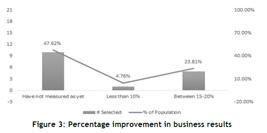
A mature PPM model and/or framework contributed the percentages represented in the figure below to these organisations' performance results:
To conclude the results, the respondents had the opportunity to reflect on difficulties that they would have to overcome for the organisation to reach maturity in its PPM model and/or framework:
• Organisational culture (lack of commitment, not engaged etc.) - 76.19%
• Slow adaptation to implementation - 57.14%
• Results on the bottom line not realised in the short to medium term - 14.29%
• Stakeholder buy-in - 47.62%
• Complexity of the model and/or framework (re-adjust iteratively to meet organisational fit) -23.81%
5. CONCLUSION
In concluding this article, we review whether the literature and the data adequately answered the study objectives:
Have organisations adopted a formal PPM process to orientate organisational strategy for organisational success?
PPM is still considered to be a fairly new discipline [11]. This was reflected in the results of the organisations that participated in the study in respect of the number of years that they had been implementing their PPM model and/or framework. These organisations had been implementing mainly hybrid models and/or frameworks, customising them as the industry or organisation required. The results of the research show a correlation with the literature's view that strategy is best driven with PPM as the vehicle in pursuit of the organisation's objectives [6]; more than 76% of the respondents confirmed that strategy alignment was an important element of PPM.
What are the qualifiers that organisations define as best practice for portfolio management?
The consolidation of the results shows that the qualifiers that define PPM best practice are the following:
• A formal PPM model and / or framework should implemented, whether hybrid or customised to the organisation's specific needs, and implemented for a significant period to test its maturity in achieving organisational benefits.
• PPM committees and authoritative bodies are key structures in providing clearer guidelines, roles, and responsibilities.
• Project selection and prioritisation should be vetted by an authorised body such as a steering committee with stringent governance systems and sound weighting criteria.
• PPM governance is the responsibility of all levels in an organization, and should be robustly engaged.
What has transpired in respect of a mature project portfolio management model and/or framework?
Key elements have been highlighted as addressing the achievement of a mature PPM model (section 4.6). More than 60% of the participants saw an improvement in organisational performance as a result. As with all changes in organisations, organisational culture plays a large role in the successful implementation and adoption of PPM. Governance frameworks should be reviewed at a defined and established interval as the organisation changes and as new insights are established [20].
How has a governing portfolio management body helped to improve organisational successes in achieving strategic objectives?
Levin and Wyzalek [6] identified that PPM alone was not sufficient in achieving success. Instead, it should be complemented by a governance board or a similar body because it would be the link between PPM, relevant stakeholders, and the organisation's objectives. The benefits of having a PPM body have been to help organisations to adopt a PPM model and/or framework, improving their maturity in overall governance, and thus elevating the robustness that would be required not to have the PPM process deterred by external forces such as executive veto.
What are the influencing factors that enforce or validate executive veto over existing PPM?
The results highlight the efficacy of implementing a robust governance process to support the maturity of PPM in organisations that ultimately leads to the successful execution of projects and/or programmes that are aligned with the achievement of strategic objectives.
6. RECOMMENDATIONS FOR FUTURE RESEARCH
In completing this study, the authors noted several research opportunities to enhance the current body of knowledge in the field of project portfolio management. The authors are of the opinion that, since it is a relatively new field, many research opportunities could still be explored, such as these:
• Reviewing hallmarks for industry-specific best practice.
• A comparative study of public and private entities that use the same PPM framework.
• Addressing organisational culture might be the initial driver for effecting a robust PPM discipline in an organisation for overall PPM success. Therefore, an industry or sector case study considering organisational culture's influence in PPM successful execution could be undertaken.
• An exploratory study of the full-circle perspective of PPM resources by engaging with lower-level PPM resources.
• An empirical review of PPM efficiencies and contributing success factors.
This study has made the authors more aware of the importance of the successful implementation of PPM and its far-reaching spheres in successfully completing strategic and organisational goals. The authors have benefitted greatly on a professional level by interrogating PPM through this academic review process.
REFERENCES
2. LITERATURE REVIEW
- [1] Mosavi, A. 2014. Exploring the roles of portfolio steering committees in project portfolio governance. International Journal of Project Management, 32(3), 388-399.
- [2] Belarbi, H. 2016. Improving project portfolio decision making in theory and practice. European Conference on Information Systems, Istanbul, Turkey.
- [3] Clegg, S., Killen, C.P., Biesenthal, C., & Sankaran, S. 2018. Practices, projects and portfolios: Current research trends and new directions. International Journal of Project Management, 36(5), 762-772.
- [4] Ramashala, P., Pretorius, M. and Steyn, H., 2016. The use of project portfolios in effective strategy execution. International Association for Management of Technology, pp.377-392.
- [5] Meskendahl, S. 2010. The influence of business strategy on project portfolio management and its success - a conceptual framework. International Journal of Project Management, 28(8), 807-817.
- [6] Levin, G. & Wyzalek, J. 2014. Portfolio management: A strategic approach. In (pp. 15-34). Boca Raton, FL: CRC Press.
- [7] Levine, H.A. 2005. Project portfolio management: A practical guide to selecting projects, managing portfolios, and maximizing benefits. San Francisco, CA: John Wiley.
- [8] Martin, R.L. 2009. The execution trap. Harvard Business Review, 88, 64-71.
- [9] Petro, Y. & Gardiner, P. 2015. An investigation of the influence of organizational design on project portfolio success, effectiveness and business efficiency for project-based organizations. International Journal of Project Management, 33(8), 1717-1729.
- [10] Porter, M.E. 1996. What is strategy? Harvard Business Review, 74(6), 61 -78.
- [11] PMI. 2013. The standard for portfolio management 3rd ed. Newtown Square, PA: Project Management Institute.
- [12] Filippov, S., Mooi, H., & Van der Weg, R. 2012. Strategic project portfolio management: An empirical investigation. Journal on Innovation and Sustainability, 3(1), 9-23.
- [13] Oosthuizen, C., Grobbelaar, S.S., & Bam, W. 2016. Exploring the link between PPM implementation and company success in achieving strategic goals: An empirical framework. South African Journal of Industrial Engineering, 27(3), 238-250.
- [14] Blichfeldt, B.S. & Eskerod, P. 2008. Project portfolio management: There's more to it than what management enacts. International Journal of Project Management, 26(4), 357-365.
- [15] Nicholas, J.M. & Steyn, H. 2017. Project management for engineering, business and technology. London: Taylor & Francis.
- [16] Steyn, H. 2015. Corporate strategy and projects - Mind the gap. IAMOT 2015 Conference Proceedings.
- [17] Petrinska-Labudovikj, R. 2014. Project portfolio management in theory and practice. Mest Journal, 2(2), 132-203.
- [18] Fidan, M. & Bramwell, A. 2013. In control: How project portfolio management can improve strategy deployment. 5(1).
- [19] Archer, N. & Ghasemzadeh, F. 2004. Project portfolio selection and management. In Morris, P.W.G. & Pinto, J.K. (eds), The Wiley guide to managing projects (pp. 237-255). Hoboken, NJ: John Wiley.
- [20] ISO. 2017. ISO 21505. Project, programme and portfolio management - Guidance on governance (pp. 20). Geneva, Switzerland: International Organization for Standardization.
- [21] Blomquist, T. & Müller, R. 2006. Practices, roles, and responsibilities of middle managers in program and portfolio management. Project Management Journal, 37(1), 52-66.
- [22] Unger, B.N., Gemünden, H.G., & Aubry, M. 2012. The three roles of a project portfolio management office: Their impact on portfolio management execution and success. International Journal of Project Management, 30(5), 608-620.
- [23] Moysey, S. & Finch, J.T. 2012. How governance and financial discipline can improve portfolio performance. Portfolio Management SEC809-RSC-12-0041. Price water House Coopers.
- [24] Jabareen, Y. 2009. Building a conceptual framework: Philosophy, definitions, and procedure. International Journal of Qualitative Methods, 8(4), 49-62.
- [25] Oosthuizen, C. 2017. Project portfolio management best practice and implementation: A South African perspective. MEng thesis. Stellenbosch: Stellenbosch University.
Accepted for publication 31 Oct 2024
Available online 13 Dec 2024
ORCID® identifiers
M.C. Bekker
https://orcid.org/0000-0002-4837-2677
D. Steenkamp
https://orcid.org/0009-0007-4532-1712
* Corresponding author