A Functional Systematic Review of Digital Supply Chain Technologies in Municipal Solid Waste Management with a Saudi Benchmark
Abstract
This study conducts a systematic literature review to examine the adoption of digital supply chain technologies in municipal solid waste management, comparing global practices with emerging initiatives in Saudi Arabia. A systematic literature review, supported by content analysis and functional classification, was conducted on 70 peer-reviewed studies to identify the dominant technological domains shaping digital transformation in municipal solid waste management. Global evidence reveals five primary technology clusters: Internet-of-Things-based monitoring, artificial-intelligence-driven optimisation, blockchain-based authentication, big data analytics, and geographic-information-systems-supported planning, which collectively enhance operational efficiency, enable real-time visibility, and support citizen engagement. International best practices further demonstrate how integrated architectures that combine digital twins, robotics, and predictive analytics facilitate circular-economy transitions. In contrast, digital municipal solid waste management initiatives in Saudi Arabia remain largely confined to small-scale pilot projects, conceptual studies, and simulation models, with limited system integration. Key constraints include weak platform interoperability, the absence of end-to-end lifecycle tracking, and limited adoption of automated operational technologies. The findings indicate that advancing circular-economy performance in Saudi municipalities would require a transition from fragmented experimentation towards coordinated, large-scale digital implementation supported by regulatory alignment, strategic investment, and robust national data-governance frameworks. Strengthening digital infrastructure, expanding advanced analytics capabilities, and institutionalising mechanisms for citizen engagement would be essential to achieving Vision 2030 circularity objectives and aligning Saudi municipal solid waste management practices with global standards.
Abstract
Hierdie studie doen 'n sistematiese literatuuroorsig om die aanvaarding van digitale voorsieningskettingtegnologieë in munisipale vasteafvalbestuur te ondersoek, deur wêreldwye praktyke met ontluikende inisiatiewe in Saoedi-Arabië te vergelyk. 'n Sistematiese literatuuroorsig, ondersteun deur inhoudsontleding en funksionele klassifikasie, is op 70 eweknie-geëvalueerde studies uitgevoer om die dominante tegnologiese domeine te identifiseer wat digitale transformasie in munisipale vasteafvalbestuur vorm. Wêreldwye bewyse toon vyf primêre tegnologieklusters: Internet-van-Dinge-gebaseerde monitering, kunsmatige-intelligensie-gedrewe optimalisering, blokkettinggebaseerde verifikasie, grootdata-analise, en beplanning wat deur geografiese inligtingstelsels ondersteun word. Gesamentlik verbeter hierdie tegnologieë bedryfsdoeltreffendheid, maak dit intydse sigbaarheid moontlik, en ondersteun dit gemeenskapsbetrokkenheid. Internasionale beste praktyke toon verder hoe geïntegreerde argitekture wat digitale tweelinge, robotika en voorspellende analise kombineer, oorgange na 'n sirkulêre ekonomie fasiliteer. Daarteenoor bly digitale munisipale vasteafvalbestuursinisiatiewe in Saoedi-Arabië grootliks beperk tot kleinskaalse loodsprojekte, konseptuele studies en simulasiemodelle, met beperkte stelselintegrasie. Sleutelbeperkings sluit swak platforminteroperabiliteit, die afwesigheid van lewensiklusnasporing van begin tot einde, en beperkte aanvaarding van geoutomatiseerde bedryfstegnologieë in. Die bevindinge dui daarop dat die bevordering van sirkulêre-ekonomieprestasie in Saoedi-munisipaliteite 'n oorgang van gefragmenteerde eksperimentering na gekoördineerde, grootskaalse digitale implementering sal vereis, ondersteun deur regulatoriese belyning, strategiese belegging en robuuste nasionale databeheerraamwerke. Die versterking van digitale infrastruktuur, die uitbreiding van gevorderde analitiese vermoëns, en die institusionalisering van meganismes vir gemeenskapsbetrokkenheid sal noodsaaklik wees om die sirkulariteitsdoelwitte van Visie 2030 te bereik en Saoedi-Arabië se munisipale vasteafvalbestuurspraktyke met wêreldstandaarde in ooreenstemming te bring.
1. INTRODUCTION
Municipal solid waste (MSW) has become a central problem in global sustainability debates as a result of rising waste generation, intensifying environmental pressures, and the limitations of linear systems of extraction, production, consumption, and disposal. The circular-economy framework offers an alternative model that promotes resource regeneration, longer product lifecycles, and material recycling, thereby decoupling economic development from resource depletion [1]. This transition has become urgent, as global environmental deterioration and increasing material consumption are projected to triple resource use by 2050 [2]. In 2018, global MSW totalled 2.01 billion tonnes, and it is expected to reach 3.4 billion tonnes by 2050 as populations and urbanisation expand [3-4]. Persistent reliance on landfilling and low recycling rates highlights systemic inefficiencies and substantial economic opportunities missed.
Digital technologies have emerged as critical tools for modernising MSW systems. The integration of the Internet of Things (IoT), artificial intelligence (AI), blockchain, geographic information systems (GIS), and big data analytics has enhanced real-time waste monitoring, optimised collection routes, strengthened coordination among stakeholders, and improved traceability throughout the waste supply chain [5];[2]. International examples, such as Taiwan's digitally enabled waste ecosystem, demonstrate the potential of digital infrastructure to increase recycling performance and reduce reliance on landfilling [4].
In Saudi Arabia, digital transformation in the waste sector is part of Vision 2030, which positions circular-economy principles as a foundation for national sustainability reforms. The National Waste Management Strategy aims to reduce landfill disposal by 90% by 2040 through recycling, composting, and waste-to-energy pathways [6]. Despite this strategic direction, evidence from the literature suggests that smart waste solutions in Saudi contexts are often demonstrated as prototypes and research-driven implementations (e.g., IoT-enabled smart bins and route-optimisation approaches), while full integration into routine municipal operations and large-scale city-management coordination remains under development [7].
Despite the global interest in digital municipal solid waste management (MSWM), several gaps persist in the literature. First, most international studies analyse individual technologies in isolation rather than as components of integrated digital ecosystems that enable circular-economy outcomes. Second, Saudi-based research remains largely conceptual, experimental, or geographically narrow, with no evidence of city-wide deployment or mature digital architectures. Third, no existing review provides a functional comparison between global digital MSWM practices and the emerging initiatives in Saudi Arabia, leaving the degree of alignment, readiness, and scalability unclear. These gaps highlight the need for a systematic assessment that maps global technological functions, evaluates international maturity, and identifies the structural and institutional barriers that hinder Saudi Arabia's digital transition.
To address these gaps, this study evaluates the current landscape of digital supply chain technologies in MSWM through two research questions:
RQ1: Which digital supply chain technologies are used internationally in MSWM, and what functional roles do they serve in circular-economy-aligned waste systems?
RQ2: How do current Saudi Arabian digital MSWM practices compare with global developments?
2. METHODOLOGY
2.1. Research design
This study adopts a systematic literature review (SLR) design, supported by structured content analysis and functional classification, to examine the application of digital supply chain technologies in MSWM. The review follows a transparent and reproducible process that is consistent with PRISMA reporting principles. The methodological framework consists of four sequential stages: (1) systematic identification of relevant peer-reviewed studies; (2) screening based on predefined inclusion and exclusion criteria; (3) quality appraisal to ensure methodological robustness; and (4) functional classification of digital technologies according to their operational roles in MSWM systems.
This design enables a structured comparison between globally documented digital MSWM practices and emerging initiatives reported in the Saudi Arabian context, while ensuring alignment with circular-economy objectives.
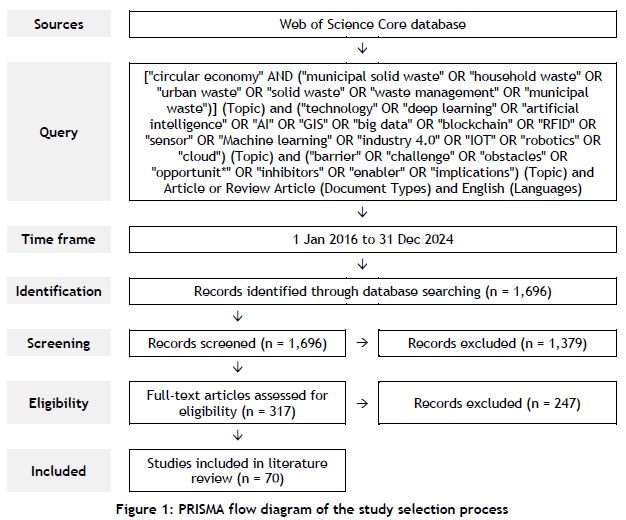
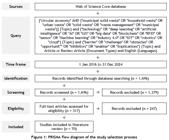
Figure 1 illustrates the study selection process following the PRISMA 2020 guidelines. The initial database search in the Web of Science Core Collection identified 1,696 records published between 2016 and 2024. After title and abstract screening, 1,379 records were excluded as irrelevant. A total of 317 full-text articles were assessed for eligibility, of which 247 were excluded on the basis of predefined criteria. Ultimately, 70 studies met all the inclusion requirements and were retained for the SLR.
2.2. Search strategy
The literature search was conducted in the Web of Science Core Collection on 25 January 2025. Topic-based search queries were developed by combining circular-economy-related terms with digital-technology keywords, including IoT, AI, GIS, big data analytics, blockchain, and sensors. The search was limited to peer-reviewed journal articles published in English between 2016 and 2024.
The initial search yielded 1,696 records, ensuring broad coverage of digital transformation research in MSWM and minimising the risk of omitting relevant studies.
2.3. Selection criteria and screening process
A multi-stage screening procedure was applied. Studies were included if they met all of the following criteria:
The study explicitly addressed MSWM.
The study examined at least one digital technology with operational relevance, such as monitoring, optimisation, sorting, authentication, or citizen engagement.
The study demonstrated a clear linkage to economic performance, operational efficiency, or material recovery outcomes.
Studies focusing on waste management that lacked a digital component or that relied solely on non-digital interventions were excluded. Duplicate records were removed first, followed by title screening to confirm scope relevance and abstract review to assess eligibility. Full-text articles were then assessed against the inclusion criteria. As a result of this process, 70 studies were retained for final analysis.
2.4. Quality appraisal
To ensure the reliability and rigour of the review, a quality appraisal was conducted for each included study. Four assessment dimensions were considered: relevance to MSWM, methodological rigour, transparency of reporting, data quality, and practical contribution. Each dimension was scored, and an aggregate score ranging from 0 to 10 was calculated. Only studies demonstrating adequate methodological clarity and empirical relevance were retained. This appraisal process enhanced the internal consistency of the review and ensured that the synthesised evidence was both robust and practically meaningful.
2.5. Data extraction and functional classification
A structured data extraction protocol was applied to all studies that met the inclusion and quality appraisal criteria. For each study, key information was systematically recorded, including bibliographic details, research context, type of digital technology, methodological approach, and the technology's reported role in MSWM systems. This process ensured consistency in capturing comparable evidence from heterogeneous study designs and application contexts.
Following data extraction, a qualitative content analysis was conducted to identify recurring patterns in how digital technologies are applied in MSWM operations. Rather than cataloguing technologies as isolated tools, the analysis focused on the operational role each technology performs in the waste management value chain. Through iterative coding and thematic aggregation, digital technologies were grouped on the basis of shared functional purposes that were identified from the reviewed literature.
Based on this process, five functional categories were identified:
(1) tracking and monitoring,
(2) optimisation and decision support,
(3) sorting and classification,
(4) identification and authentication, and
(5) engagement and awareness.
This functional classification framework differs from existing technology-centric typologies by shifting the analytical focus from the characteristics of individual tools to their system-level contribution in MSWM processes. By organising digital technologies according to their operational functions, the framework enables the integration of diverse technologies into a single analytical structure and supports comparative assessment of digital system maturity in different geographical and institutional contexts, including the Saudi Arabian case examined in this study.
The resulting functional categories are applied analytically and discussed in Section 3.2, which focuses on the methodological process used to develop the framework.
2.6. Limitations of the methodology
This review is constrained by its reliance on the Web of Science database, which might exclude relevant studies that are indexed elsewhere. Variability in the reporting quality of primary studies limited the depth of assessment in some cases. Despite harmonisation efforts in functional classification, which followed a systematic protocol, qualitative interpretation inherently involves subjective judgement. In addition, excluding grey literature and unpublished municipal reports intended to preserve academic rigour might limit insights into operational digital initiatives in Saudi municipalities.
The research presents structured content analysis findings that extend previous studies by developing systematic categories for adapting digital supply chain technology in MSWM and circular-economy practices. This research goes beyond previous studies by analysing 70 peer-reviewed articles to identify patterns and gaps, and by comparing Saudi Arabian results with global findings. The study combines bibliometric mapping with thematic classification to provide original empirical evidence on the most common implementations of digital supply chain technologies.
3. RESULTS
3.1. Bibliometric mapping
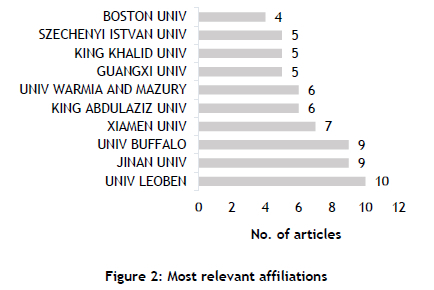
Figure 2 presents the most relevant institutional contributors to research on digital technologies and on circular-economy applications in MSWM. The University of Leoben ranks first with ten publications, followed by Jinan University and the University at Buffalo with nine publications each, reflecting strong interdisciplinary engagement in smart waste management and sustainability research. Xiamen University, King Abdulaziz University, and the University of Warmia and Mazury also demonstrate notable research output in this domain.
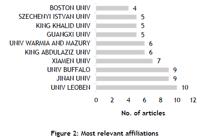
The observed concentration of publications in a limited number of institutions is analytically relevant. Such institutions often act as hubs of technical expertise, data access, and methodological capability, which can accelerate knowledge diffusion, shape dominant research agendas, and influence the maturity of technology-oriented studies. In applied fields such as digital MSWM, institutional concentration might also signal where research-to-practice linkages and implementation capacity are more likely to emerge.
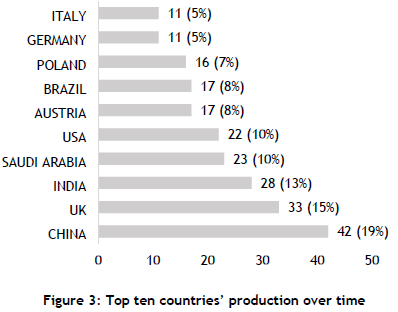
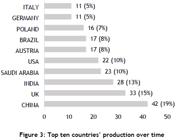
Figure 3 illustrates the publication output of the top ten countries over time. China leads with 42 studies, followed by the United Kingdom and India. Saudi Arabia ranks fourth with 23 publications, indicating a growing national research presence that is aligned with sustainability and Vision 2030 priorities. While this publication volume reflects increasing academic engagement, it does not, by itself, imply mature operational deployment - an issue examined further in the comparative analysis section.
Building on these publication patterns, the next section moves beyond bibliometric trends to examine how digital technologies are functionally deployed in MSWM systems, providing a structured basis for the subsequent technology classification.
3.2. Functional categorisation of digital technologies in municipal solid waste management
To address RQ1, this study developed a framework that groups technologies by their core functions in MSWM systems. The study does not examine each tool in isolation. The framework highlights the roles that digital technologies play in the waste management value chain. The framework identified five categories:
1. Tracking and monitoring - real-time data collection on waste quantities, bin fill levels, and logistics.
2. Optimisation and decision support - predictive analytics, routing, and strategic planning tools.
3. Sorting and classification - automated and semi-automated identification of waste materials.
4. Identification and authentication - verification and traceability of waste flows and lifecycles.
5. Engagement and awareness - citizen-facing tools that encourage participation and enhance transparency.
This functional classification provides a structured lens for interpreting how digital technologies contribute to circular-economy practices in MSWM, and serves as the basis for the detailed technology mapping that follows.
3.2.1. Tracking and monitoring
The primary objective of this category is to collect waste volume data, bin fill levels, and geolocation data to optimise collection vehicle routes and to acquire real-time field data.
The IoT is the core technology for tracking waste bin statuses and vehicle locations, as noted in [1,8-12]. Global system for mobile communications (GSM) and long range wide area network (LoRaWAN) communication protocols enable sensors to transmit data for display on cloud-based dashboards [13-16]. GIS systems enhance route-planning capabilities through spatial waste analysis [17-19] and operate with GPS to deliver real-time logistics optimisation [19-20-21]. The combination of mobile applications with citizen-reporting features and bin-level user interactions is documented [22-23]. For centralised monitoring, cloud computing platforms are used to gather data [24,25].
Collectively, these technologies shift tracking and monitoring from reactive schedule-based systems to proactive data-driven operations that are essential for circular resource management.
3.2.2. Optimisation and decision support
The technologies in this group analyse operational data to produce forecasts that enable strategic decision-making. AI, together with machine learning (ML), enables organisations to predict waste-generation patterns, develop adaptive routing systems, and support facility site selection [26-28]. Digital twins replicate complete waste networks to generate predictive outcomes through scenario analysis [9]. Big data analytics integrates spatial, temporal, and operational data to support macro-level planning [18,24,29]. GIS plays a critical role in identifying suitable locations for landfill construction and infrastructure development [17,30]. Cloud-based decision-support applications integrate predictive modelling and analytics to enable informed municipal investment decisions and service optimisation [5,31]. Furthermore, integrating IoT, AI, and blockchain technologies enables interoperable analytics platforms that support system-level decision-making [32].
3.2.3. Sorting and classification
Technologies in this category enable the automated and semi-automated identification of waste based on physical and chemical characteristics. Computer vision, combined with AI, enables image-based sorting by shape, colour, and texture [33-35]. Machine-learning-driven robotic systems enable high-speed material segregation [8,36]. Near-infrared (NIR) spectroscopy differentiates materials based on chemical composition [37], while deep learning algorithms support advanced classification tasks [38,39]. Hybrid facilities combining vision-based sorting with mechanical separation systems have been implemented to enhance operational performance [40,41]. These integrated systems improve recycling yields and reduce contamination by enabling precise separation of waste fractions [42,43].
3.2.4. Identification and authentication
Technologies in this category ensure traceability and transparency throughout the waste lifecycle. Blockchain-based systems support waste flow documentation, transaction verification, and recycling claim authentication [44-46]. RFID and QR code technologies enable tracking of waste materials from source to destination at the bin or item level [47-48]. Integrating blockchain with RFID enhances accountability in reverse logistics operations [49]. Digital product passports (DPPs) store material and lifecycle data, strengthening circular tracking and compliance capabilities [50-51]. Secure monitoring of recyclable materials is achieved through distributed tracking platforms [52-53]. Decentralised waste management networks benefit from authentication tools that improve regulatory compliance and reporting reliability [42,54].
3.2.5. Engagement and awareness
Technologies in this category focus on citizen involvement and behavioural change. Mobile applications enable real-time reporting, service requests, and feedback mechanisms [12,23,55]. Cloud-based dashboards displaying public key performance indicators and waste flow data enhance transparency and trust [21,24]. Interactive smart bins using gamification mechanisms provide immediate feedback and reward correct disposal behaviour [25,56]. Empirical evidence indicates that mobile platforms significantly increase public engagement and participation in recycling programmes [52,57]. Long-term community engagement is supported by digital literacy initiatives and continuous public education [17,58].
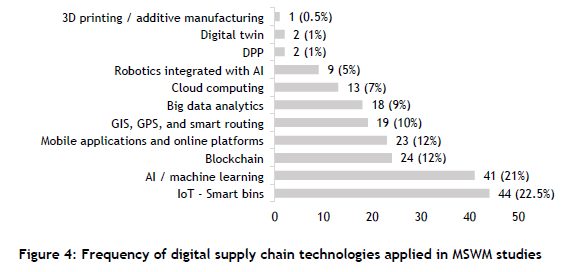
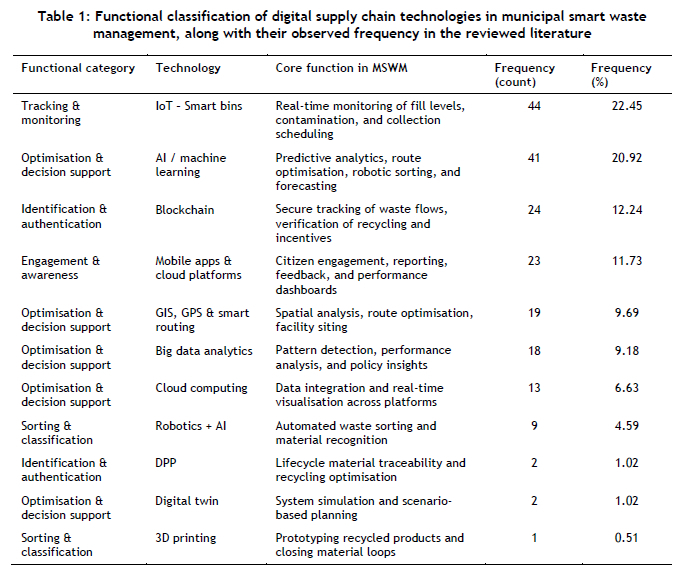
Table 1 presents the functional classification of digital supply chain technologies used in MSWM, along with their observed frequencies and relative prevalence in the reviewed studies. The table highlights the dominant technologies that support real-time monitoring and decision support, while indicating limited adoption of advanced systems such as digital twins and DPPs.
3.3. Mapping of digital technologies and supporting literature
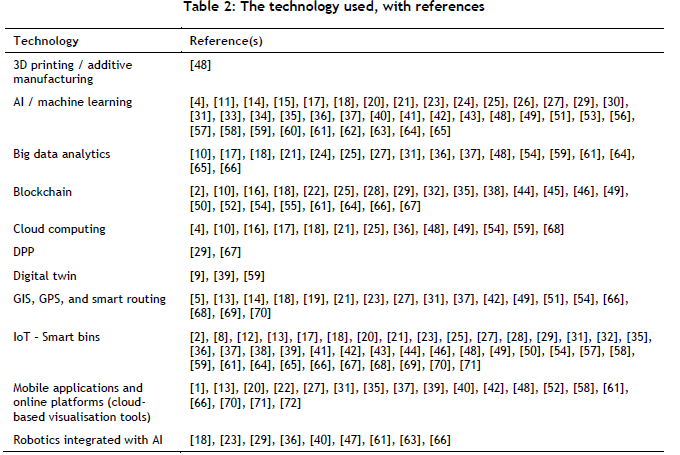
Table 2 maps the digital supply chain technologies examined in the reviewed studies in key stages of the MSWM lifecycle. The mapping illustrates how technologies such as AI, blockchain, cloud computing, IoT-enabled smart bins, robotics, and GIS-based systems are used to support monitoring, optimisation, traceability, citizen engagement, and automated sorting.
The reviewed literature demonstrates that digital technologies are deployed in multiple functional domains rather than as isolated solutions. IoT-based sensing infrastructures provide real-time data on waste generation, bin fill levels, and collection status, forming the foundation for downstream analytical applications. AI and machine-learning models build on these data streams to enable predictive routing, contamination detection, and automated sorting, particularly in material recovery facilities. At the same time, blockchain-based systems, often combined with RFID or QR technologies, enhance traceability, accountability, and verification of recycling activities in waste flows.
Supporting this ecosystem, big data analytics, cloud platforms, and GIS tools enable the integration of spatial, temporal, and operational information, facilitating system-level visibility and performance monitoring. Emerging applications such as DPPs and digital twins extend this integration by enabling lifecycle transparency and scenario-based planning, although their operational deployment remains limited in municipal contexts.
While this mapping confirms the breadth of digital technologies examined in MSWM research, it is important to note that research coverage does not necessarily equate to operational maturity. A substantial share of the reviewed studies remains focused on pilot projects, simulation models, or proof-of-concept applications. The implications of this gap between technological exploration and large-scale implementation are examined in greater detail in the comparative analysis in Section 3.4.
Research on digital technologies in MSWM consistently shows that data-driven tools have reshaped the way in which cities understand and manage their waste systems. As reflected in Table 1 and Figure 4, IoT and AI appear most frequently in the literature. IoT-based smart bins generate a steady stream of information on fill levels and usage patterns. At the same time, AI and machine-learning models turn this data into predictions, contamination assessments, and automated sorting decisions.
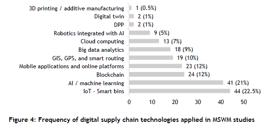
Through global studies, the shift is clear: waste operations are moving away from manual, reactive processes towards systems that anticipate needs and adjust in real time. Machine-learning models integrate data from vehicles, containers, and imaging systems to refine routing and allocate resources more intelligently. In sorting facilities, deep learning and computer vision support robotic systems that separate materials with an accuracy that is difficult to achieve manually, improving recovery rates and reducing worker exposure to hazardous environments. Insights extracted from mobile application interactions also help to shape targeted awareness campaigns and incentive programmes.
A broader digital ecosystem underpins these advances. Big data analytics, cloud platforms, GIS, and blockchain provide the architecture needed to combine spatial information, validate segregation practices, track materials, and monitor system performance. Tools such as DPPs and digital twins are emerging as mechanisms for lifecycle visibility and scenario testing, even if their deployment in operational MSWM remains limited. Mobile applications and dashboards continue to expand citizen participation and to give managers clearer real-time views of service performance.
As Section 3.4 illustrates, the main obstacles facing Saudi Arabia are structural rather than technological. The global trend is moving towards integrated digital ecosystems, whereas most Saudi initiatives remain small localised projects that operate independently of one another. This difference in system maturity forms a critical part of the study's conclusion, which reflects on the reforms required for Saudi Arabia to advance towards a cohesive and digitally enabled circular waste management framework.
3.4. Comparative analysis of digital technology deployment: Saudi Arabia vs global practices
A systematic review of studies conducted in Saudi Arabia reveals that current research efforts are either conceptual [11,13,19,51] or geographically limited to small-scale pilot sites [22,55,68]. No study has demonstrated the implementation of digital waste technologies at the municipal scale. This limited empirical scope contrasts with broader, integrated deployments observed internationally, and underscores the need for expanded field implementation to validate the technological potential in real-world waste management operations.
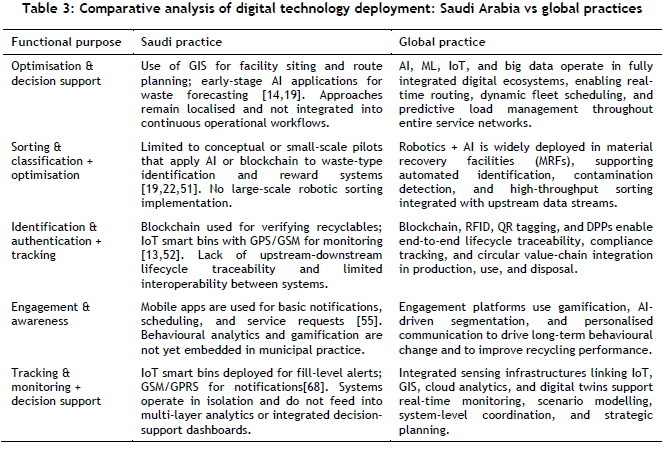
Table 3 provides an integrated comparison of the digital technologies used in MSWM. The development of MSWM depends on digital technologies that enable a shift from linear waste systems to circular data-driven systems. The depth of implementation and functional use of digital tools varies substantially between Saudi Arabian waste management practices and international approaches.
Optimisation and decision support
Saudi Arabia uses GIS-based planning and emerging AI tools for route optimisation and waste-generation forecasting [11,14,19]. While these tools improve operational visibility, they are applied primarily in isolated pilot projects rather than on a city-wide scale. Globally, optimisation technologies operate in integrated data ecosystems that combine IoT sensing, big data analytics, and AI-driven predictive modelling to support real-time routing, fleet scheduling, and dynamic resource allocation. This comparison reveals a structural limitation: Saudi systems generate operational data but lack the analytical frameworks and interconnected platforms that are required to convert these data into continuous operational intelligence.
Sorting and classification
Saudi applications explore AI and blockchain-based mechanisms for user-level classification and incentive schemes [19,22]. However, automated sorting technologies based on robotics and computer vision - which are widely deployed in advanced global material recovery facilities - are not yet operationally implemented. Automated sorting depends on stable, high-resolution data flows, consistent waste-stream composition, and dedicated infrastructure - conditions that are still evolving in the Saudi MSWM context. Consequently, most Saudi initiatives remain at the level of conceptual validation rather than integrated industrial deployment.
Identification and authentication / tracking and monitoring
Saudi pilot projects use blockchain-based verification mechanisms and IoT-enabled smart bins equipped with GPS and GSM/GPRS technologies to monitor fill levels and collection status [13,52,68]. In contrast, international systems embed these tools in end-to-end traceability architectures that integrate DPPs, RFID or QR tagging, and distributed ledgers to monitor materials throughout the entire product lifecycle. The principal analytical gap lies in the absence of upstream-downstream connectivity: monitoring is concentrated at the point of disposal, while lifecycle data spanning production, consumption, disposal, and recovery remain fragmented. This disconnect constrains the operationalisation of closed-loop circular-economy systems.
Engagement and awareness
Saudi mobile applications provide basic user-facing services, including pickup scheduling and limited feedback mechanisms [55]. Globally, engagement platforms integrate gamification, behavioural analytics, and personalised communication strategies systematically to influence recycling behaviour and participation rates. These systems leverage real-time data and behavioural insights to sustain long-term engagement. The gap in the Saudi context is therefore institutional and analytical rather than technological, reflecting the absence of behavioural modelling frameworks and governance mechanisms that embed citizen engagement in broader circular-economy strategies.
Overall, the comparative assessment indicates that Saudi Arabia's digital MSWM initiatives remain at an early experimental stage, characterised by fragmented pilot deployments, limited interoperability, and the absence of unified digital governance frameworks. By contrast, leading international systems use fully integrated architectures that enable real-time sensing, predictive analytics, automated sorting, and lifecycle traceability. Addressing these structural gaps through scalable, interoperable systems supported by national standards, regulatory alignment, and coordinated data infrastructures would be essential in advancing towards Vision 2030 targets and achieving parity with mature global MSWM practices.
4. CONCLUSION
This study has examined the role of digital supply chain technologies in enhancing MSWM and supporting circular-economy objectives. In addressing RQ1, the review of 70 peer-reviewed studies revealed that global digital adoption in MSWM is concentrated in five functional technology domains. These are: IoT-based monitoring systems that enable real-time visibility of waste flows; optimisation and decision-support tools that improve collection efficiency and resource allocation; machine-vision and robotic sorting technologies that enhance the accuracy and speed of material recovery; blockchain-based mechanisms that strengthen traceability and authentication in waste streams; and digital engagement platforms that promote citizen participation and behavioural change. Collectively, these technologies should contribute to higher operational efficiency, improved system transparency, and increased diversion of materials from landfills.
With respect to RQ2, the findings have indicated that Saudi Arabia has begun to adopt several digital solutions, including sensor-enabled bins, GIS-based planning tools, AI-supported routing systems, and blockchain-enabled incentive mechanisms. However, current implementations remain fragmented and are largely confined to pilot projects, proof-of-concept trials, or simulation-based research initiatives. The absence of an integrated digital architecture, limited interoperability among municipal platforms, and inconsistent performance metrics constrain the scalability and systemic impact of these efforts, thereby slowing progress towards the national target of 90% landfill diversion.
To make the transition from experimental deployments to fully operational systems, Saudi Arabia requires a coordinated national digital framework supported by standardised procedures, robust data governance, and sustained investment in digital capabilities. Priorities should include interoperable analytics platforms, advanced citizen engagement systems, and the integration of digital twins, behavioural modelling tools, and end-to-end lifecycle tracking of waste streams. Such an interoperable digital ecosystem should significantly enhance system readiness and accelerate progress towards Vision 2030 circular-economy objectives, while aligning Saudi municipal waste management practices with international best practices for sustainable smart MSWM.
ACKNOWLEDGEMENTS
This research project is supported by a grant from King Abdulaziz City for Science and Technology (KACST), represented by the Science, Technology and Innovation Unit at King Saud University (STU-KSU), Riyadh, Saudi Arabia (Grant No. STU-58).
REFERENCES
-
[1] Liu, Q.L., Trevisan, A.H., Yang, M., & Mascarenhas, J. 2022. A framework of digital technologies for the circular economy: Digital functions and mechanisms. Business Strategy and the Environment, 31(5):2171-2192. https://doi.org/10.1002/bse.3015
» https://doi.org/10.1002/bse.3015 -
[2] Schmidt, J.L., Sehnem, S., & Spuldaro, J.D. 2023. Blockchain and the transition to the circular economy: A literature review. Corporate Social Responsibility and Environmental Management, 30:1-23. https://doi.org/10.1002/csr.2674
» https://doi.org/10.1002/csr.2674 -
[3] Kaza, S., Yao, L., Bhada-Tata, P., Van Woerden, F., & Levine, D. 2018. What a waste 2.0: A global snapshot of solid waste management to 2050. Washington, DC: World Bank. https://doi.org/10.1596/978-1-4648-1329-0
» https://doi.org/10.1596/978-1-4648-1329-0 -
[4] Kurniawan, T.A., Lo, W., Singh, D., Othman, M.H.D., Avtar, R., Hwang, G.H., Albadarin, A.B., Kern, A.O., & Shirazian, S. 2021. A societal transition of municipal solid waste management in Xiamen (China) toward a circular economy through integrated waste recycling and technological digitization. Environmental Pollution, 277:116741. https://doi.org/10.1016/j.envpol.2021.116741
» https://doi.org/10.1016/j.envpol.2021.116741 - [5] Paul, M., & Bussemaker, M.J. 2020. A web-based geographic interface system to support decision-making for municipal solid waste management in England. Journal of Cleaner Production, 263:121461.
-
[6] National Center for Waste Management (MWAN). 2023. National Waste Management Strategy 2040. Riyadh: MWAN. Accessed: 12 May 2025. https://mwan.gov.sa/en/strategic-plan
» https://mwan.gov.sa/en/strategic-plan -
[7] Al Awadh, M., & Mallick, J. 2024. A decision-making framework for landfill site selection in Saudi Arabia using explainable artificial intelligence and multi-criteria analysis. Environmental Technology & Innovation, 33:103464. https://doi.org/10.1016/j.eti.2023.103464
» https://doi.org/10.1016/j.eti.2023.103464 -
[8] Franco-González, J., Gallardo, A., Carlos, M., & Edo-Alcón, N. 2023. A pilot project using sensors in a medium-sized city's municipal solid waste collection. Resources, 12:108. https://doi.org/10.3390/resources12090108
» https://doi.org/10.3390/resources12090108 -
[9] Delbari, S.A., & Hof, L.A. 2024. Glass waste circular economy enabled by Industry 4.0 and 5.0 technologies. Journal of Cleaner Production, 462:142629. https://doi.org/10.1016/j.jclepro.2024.142629
» https://doi.org/10.1016/j.jclepro.2024.142629 -
[10] Rejeb, A., Rejeb, K., Simske, S.J., & Keogh, J.G. 2022. Blockchain technology in the smart city: A bibliometric review. Quality & Quantity, 56:2875-2906. https://doi.org/10.1007/s11135-021-01251-2
» https://doi.org/10.1007/s11135-021-01251-2 -
[11] Alsabt, R., Alkhaldi, W., Adenle, Y.A., & Alshuwaikhat, H.M. 2024. Optimizing waste management strategies through artificial intelligence and machine learning: An economic and environmental impact study. Cleaner Waste Systems, 8:100158. https://doi.org/10.1016/j.clwas.2024.100158
» https://doi.org/10.1016/j.clwas.2024.100158 -
[12] Sandhi, A., & Rosenlund, J. 2024. Municipal solid waste management in Scandinavia and key factors for improved waste segregation: A review. Cleaner Waste Systems, 8:100144. https://doi.org/10.1016/j.clwas.2024.100144
» https://doi.org/10.1016/j.clwas.2024.100144 -
[13] Aloui, N., Almukadi, W., & Belghith, A. 2023. Towards an IoT approach for smart waste management based on context ontology: A case study. Engineering, Technology & Applied Science Research, 13:10186-10191. https://doi.org/10.48084/etasr.5530
» https://doi.org/10.48084/etasr.5530 -
[14] Sheng, T.J., Islam, M.S., Misran, N., Baharuddin, M.H., Arshad, H., & Islam, M.R. 2020. An Internet of Things based smart waste management system using LoRa and TensorFlow deep learning model. IEEE Access, 8:148793-148811. https://doi.org/10.1109/ACCESS.2020.3016255
» https://doi.org/10.1109/ACCESS.2020.3016255 -
[15] Runsewe, T., Damgacioglu, H., Perez, L., & Celik, N. 2023. Machine learning models for estimating contamination across different curbside collection strategies. Journal of Environmental Management, 338:117284. https://doi.org/10.1016/j.jenvman.2023.117285
» https://doi.org/10.1016/j.jenvman.2023.117285 -
[16] Bułkowska, K., Zielińska, M., & Bułkowski, M. 2024. Blockchain-based management of recyclable plastic waste. Energies, 17:2937. https://doi.org/10.3390/en17122937
» https://doi.org/10.3390/en17122937 -
[17] Fatimah, Y.A., Govindan, K., Murniningsih, R., & Setiawan, A. 2020. Industry 4.0-based sustainable circular economy approach for smart waste management systems. Journal of Cleaner Production, 269:122263. https://doi.org/10.1016/j.jclepro.2020.122263
» https://doi.org/10.1016/j.jclepro.2020.122263 -
[18] Leal, A.E.F., Costa, V.C.C., Fernandes, R.M., Melo, A.C.S., & Nagata, V.de M.N. 2024. Applications of digital technologies for overcoming challenges in municipal solid waste reverse logistics: A systematic literature review. Engenharia Sanitária e Ambiental, 29:e20240048. https://doi.org/10.1590/S1413-415220240048
» https://doi.org/10.1590/S1413-415220240048 -
[19] Radwan, N., Khan, N.A., & Elmanfaloty, R.A.G. 2021. Optimization of solid waste collection in Jeddah using RSM. Scientific Reports, 11:16612. https://doi.org/10.1038/s41598-021-96210-0
» https://doi.org/10.1038/s41598-021-96210-0 -
[20] Zaman, A.U. 2022. Waste management 4.0: Machine learning applications for household waste contamination. Sustainability, 14:3061. https://doi.org/10.3390/su14053061
» https://doi.org/10.3390/su14053061 -
[21] Franchina, L., Calabrese, A., Inzerilli, G., Scatto, E., Brutti, G., & Bonanni, M.V.A. 2021. Thinking green: Smart technologies in waste and supply chains. Cleaner Engineering and Technology, 2:100077. https://doi.org/10.1016/j.clet.2021.100077
» https://doi.org/10.1016/j.clet.2021.100077 -
[22] Saeedi, K. 2024. Promoting sustainable household engagement in recycling via blockchain-based loyalty programs. Sustainability, 16:9191. https://doi.org/10.3390/su16219191
» https://doi.org/10.3390/su16219191 -
[23] Singh, M., Singh, M., & Singh, S.K. 2024. Tackling the municipal solid waste crisis in India: Insights into cutting-edge technologies and risk assessment. Science of the Total Environment, 917:170453. https://doi.org/10.1016/j.scitotenv.2024.170453
» https://doi.org/10.1016/j.scitotenv.2024.170453 -
[24] Velis, C.A., Wilson, D.C., Gavish, Y., Grimes, S.M., & Whiteman, A. 2023. Socio-economic development drives solid waste management performance in cities: A global analysis using machine learning. Science of the Total Environment, 872:161913. https://doi.org/10.1016/j.scitotenv.2023.161913
» https://doi.org/10.1016/j.scitotenv.2023.161913 -
[25] Dantas, T.E.T., De-Souza, E.D., Destro, I.R., Hammes, G., Rodriguez, C.M.T., & Soares, S.R. 2021. How the combination of circular economy and Industry 4.0 can contribute towards achieving the sustainable development goals. Sustainable Production and Consumption, 26:213-227. https://doi.org/10.1016/j.spc.2020.10.005
» https://doi.org/10.1016/j.spc.2020.10.005 -
[26] Wang, D., Tang, Y.T., He, J., Robinson, D., & Yang, W. 2024. A mini-review identifying future directions in modelling heating values for sustainable waste management. Waste Management & Research, 43. https://doi.org/10.1177/0734242X241271042
» https://doi.org/10.1177/0734242X241271042 -
[27] Kurniawan, T.A., Liang, X., O'Callaghan, E., Goh, H.H., Othman, M.H.D., Avtar, R., & Kusworo, T.D. 2022. Transformation of solid waste management in China through digitalization-based circular economy. Sustainability, 14:2374. https://doi.org/10.3390/su14042374
» https://doi.org/10.3390/su14042374 -
[28] Jiang, P., Zhang, L., You, S., Fan, Y.V., Tan, R.R., Klemeš, J.J., & You, F. 2023. Blockchain technology applications in waste management: Overview, challenges and opportunities. Journal of Cleaner Production, 405:138466. https://doi.org/10.1016/j.jclepro.2023.138466
» https://doi.org/10.1016/j.jclepro.2023.138466 -
[29] Bernat, K. 2023. Post-consumer plastic waste management: From collection and sortation to mechanical recycling. Energies, 16:3504. https://doi.org/10.3390/en16083504
» https://doi.org/10.3390/en16083504 -
[30] Taneepanichskul, N., Purkiss, D., & Miodownik, M. 2022. Sorting and separating technologies for compostable and biodegradable plastic packaging: A review. Frontiers in Sustainibility, 3:901885. https://doi.org/10.3389/frsus.2022.901885
» https://doi.org/10.3389/frsus.2022.901885 -
[31] Menezes, J., Hemachandra, N., & Isidro, K. 2024. Role of big data analytics and hyperspectral imaging in waste management for circular economy. Discover Sustainability, 5:298. https://doi.org/10.1007/s43621-024-00483-0
» https://doi.org/10.1007/s43621-024-00483-0 -
[32] Rejeb, A., & Zailani, S. 2023. Blockchain technology and the circular economy: A systematic literature review. Journal of Sustainable Development of Energy, Water and Environment Systems, 11:1100436. https://doi.org/10.13044/j.sdewes.d10.0436
» https://doi.org/10.13044/j.sdewes.d10.0436 -
[33] Papagiannis, F., Gazzola, P., Burak, O., & Pokutsa, I. 2021. A European household waste management approach: Intelligently clean Ukraine. Journal of Environmental Management, 294:113015. https://doi.org/10.1016/j.jenvman.2021.113015
» https://doi.org/10.1016/j.jenvman.2021.113015 -
[34] Nnamoko, N., Barrowclough, J., & Procter, J. 2022. Solid waste image classification using deep convolutional neural networks. Infrastructures, 7(4):47. https://doi.org/10.3390/infrastructures7040047
» https://doi.org/10.3390/infrastructures7040047 -
[35] Islam, M.T., Iyer-Raniga, U., & Trewick, S. 2022. Recycling perspectives of circular business models: A review. Recycling, 7:79. https://doi.org/10.3390/recycling7050079
» https://doi.org/10.3390/recycling7050079 -
[36] Fasano, F., Addante, A.S., Valenzano, B., & Scannicchio, G. 2021. Variables influencing per capita production, separate collection, and costs of municipal solid waste in the Apulia Region (Italy): An experience of deep learning. International Journal of Environmental Research and Public Health, 18(2):752. https://doi.org/10.3390/ijerph18020752
» https://doi.org/10.3390/ijerph18020752 -
[37] Szpilko, D., De la Torre Gallegos, A., Jimenez Naharro, F., Rzepka, A., & Remiszewska, A. 2023. Waste management in smart cities: Current practices and future directions. Resources, 12:115. https://doi.org/10.3390/resources12100115
» https://doi.org/10.3390/resources12100115 -
[38] Chidepatil, A., Bindra, P., Kulkarni, D., Qazi, M., Kshirsagar, M., & Sankaran, K. 2020. From trash to cash: Blockchain and AI for plastic waste circular economy. Administrative Sciences, 10(2):23. https://doi.org/10.3390/admsci10020023
» https://doi.org/10.3390/admsci10020023 -
[39] Kroell, N., Maghmoumi, A., Dietl, T., Chen, X., Küppers, B., Scherling, T., Feil, A., & Greiff, K. 2024. Towards digital twins of waste sorting plants using machine learning and NIR monitoring. Resources, Conservation & Recycling, 200:107257. https://doi.org/10.1016/j.resconrec.2023.107257
» https://doi.org/10.1016/j.resconrec.2023.107257 -
[40] Sarc, R., Curtis, A., Kandlbauer, L., Khodier, K.E., & Pomberger, R. 2019. Digitalisation and intelligent robotics in circular economy-oriented waste management. Waste Management, 95:476-492. https://doi.org/10.1016/j.wasman.2019.06.035
» https://doi.org/10.1016/j.wasman.2019.06.035 -
[41] Sivakumar, M.S., Gurumekala, T., Rahul, H., Haldar, N., & Singh, H. 2022. Design and development of smart Internet of Things-based solid waste management system using computer vision. Environmental Science and Pollution Research, 29(48):64871-64885. https://doi.org/10.1007/s11356-022-20428-2
» https://doi.org/10.1007/s11356-022-20428-2 -
[42] Zoumpoulis, P., Konstantinidis, F.K., Tsimiklis, G., & Amditis, A. 2024. Smart bins for enhanced resource recovery in smart cities: A systematic review. Cities, 152:105150. https://doi.org/10.1016/j.cities.2024.105150
» https://doi.org/10.1016/j.cities.2024.105150 -
[43] Curtis, A., Küppers, B., Möllnitz, S., Khodier, K., & Sarc, R. 2020. Real-time material flow monitoring in mechanical waste processing and the relevance of fluctuations. Waste Management, 120:687-697. https://doi.org/10.1016/j.wasman.2020.10.037
» https://doi.org/10.1016/j.wasman.2020.10.037 -
[44] Steenmans, K., Taylor, P., & Steenmans, I. 2021. Blockchain technology for governance of plastic waste management. Social Sciences, 10:434. https://doi.org/10.3390/socsci10110434
» https://doi.org/10.3390/socsci10110434 -
[45] Gong, Y., Xie, S., Arunachalam, D., Duan, J., & Luo, J. 2022. Blockchain-based recycling and its impact on recycling performance. Business Strategy and the Environment, 31:3717-3741. https://doi.org/10.1002/bse.3028
» https://doi.org/10.1002/bse.3028 -
[46] Baralla, G., Pinna, A., Tonelli, R., & Marchesi, M. 2023. Waste management and the rise of blockchain technology: A comprehensive review. Computers in Industry, 143:103812. https://doi.org/10.1016/j.compind.2022.103812
» https://doi.org/10.1016/j.compind.2022.103812 -
[47] Wilts, H., Garcia, B.R., Garlito, R.G., Gómez, L.S., & Prieto, E.G. 2021. Artificial intelligence in municipal waste sorting as an enabler of the circular economy. Resources, 10:28. https://doi.org/10.3390/resources10040028
» https://doi.org/10.3390/resources10040028 -
[48] Silva, T.H.H., & Sehnem, S. 2022. Industry 4.0 and the circular economy: Integration opportunities generated by startups. Logistics, 6:14. https://doi.org/10.3390/logistics6010014
» https://doi.org/10.3390/logistics6010014 -
[49] Esmaeilian, B., Wang, B., Lewis, K., Duarte, F., Ratti, C., & Behdad, S. 2018. The future of waste management in smart and sustainable cities. Waste Management, 81:177-195. https://doi.org/10.1016/j.wasman.2018.09.047
» https://doi.org/10.1016/j.wasman.2018.09.047 -
[50] Leteane, O., & Ayalew, Y. 2024. Improving the trustworthiness of traceability data in food supply chain using blockchain and trust model. Journal of the British Blockchain Association, 7(1). https://doi.org/10.31585/jbba-7-1-(2)2024
» https://doi.org/10.31585/jbba-7-1-(2)2024 -
[51] Alqahtani, D., Mallick, J., Alqahtani, A.M., & Talukdar, S. 2024. Optimizing residential construction site selection using geospatial data and explainable AI. Sustainability, 16(10):4235. https://doi.org/10.3390/su16104235
» https://doi.org/10.3390/su16104235 -
[52] Alnuaimi, E., Alsafi, M., Alshehhi, M., Debe, M., Salah, K., Yaqoob, I., Zemerly, M.J., & Jayaraman, R. 2023. Blockchain-based system for tracking and rewarding recyclable plastic waste. Peer-to-Peer Networking and Applications, 16:328-346. https://doi.org/10.1007/s12083-022-01413-5
» https://doi.org/10.1007/s12083-022-01413-5 -
[53] Lubongo, C., & Alexandridis, P. 2022. Performance and challenges of automated plastic waste sorting technologies. Recycling, 7:11. https://doi.org/10.3390/recycling7020011
» https://doi.org/10.3390/recycling7020011 -
[54] Rejeb, A., Rejeb, K., Keogh, J.G., & Zailani, S. 2022. Barriers to blockchain adoption in the circular economy. Sustainability, 14:3611. https://doi.org/10.3390/su14063611
» https://doi.org/10.3390/su14063611 -
[55] Saeedi, K., Visvizi, A., Alahmadi, D., & Babour, A. 2023. Smart cities and households' recyclable waste management: The case of Jeddah. Sustainability, 15:6776. https://doi.org/10.3390/su15086776
» https://doi.org/10.3390/su15086776 -
[56] Magazzino, C., Mele, M., Schneider, N., & Sarkodie, S.A. 2021. Waste generation, wealth and GHG emissions from the waste sector in Denmark. Science of the Total Environment, 755:142510. https://doi.org/10.1016/j.scitotenv.2020.142510
» https://doi.org/10.1016/j.scitotenv.2020.142510 -
[57] Möllnitz, S., Khodier, K., Pomberger, R., & Sarc, R. 2020. Grain size-dependent distribution of plastics in mixed municipal waste. Waste Management, 103:388-398. https://doi.org/10.1016/j.wasman.2019.12.037
» https://doi.org/10.1016/j.wasman.2019.12.037 -
[58] Czekała, W., Drozdowski, J., & Łabiak, P. 2023. Modern technologies for waste management: A review. Applied Sciences, 13:8847. https://doi.org/10.3390/app13158847
» https://doi.org/10.3390/app13158847 -
[59] Cárdenas-León, I., Koeva, M., Nourian, P., & Davey, C. 2024. Urban digital twin-based solution using geospatial information for solid waste management. Sustainable Cities and Society, 115:105798. https://doi.org/10.1016/j.scs.2024.105798
» https://doi.org/10.1016/j.scs.2024.105798 -
[60] Gursch, H., Schlager, E., Thaler, F., Waltner, G., Ganster, H., Rinnhofer, A., Jaschik, M., Oberwinkler, C., Meisenbichler, R., Bischof, H., & Kern, R. 2024. Image capturing and data analysis of shredded refuse streams. Waste Management & Research, 42:738-746. https://doi.org/10.1177/0734242X241259661
» https://doi.org/10.1177/0734242X241259661 -
[61] Kurniawan, T.A., Othman, M.H.D., Hwang, G.H., & Gikas, P. 2022. Unlocking digital technologies for waste recycling in Industry 4.0. Journal of Cleaner Production, 357:131911. https://doi.org/10.1016/j.jclepro.2022.131911
» https://doi.org/10.1016/j.jclepro.2022.131911 -
[62] Lin, K., Zhao, Y., Gao, X., Zhang, M., Zhao, C., Peng, L., Zhang, Q., & Zhou, T. 2022. Deep residual networks with transfer learning for recyclable waste sorting. Environmental Science and Pollution Research, 29:91081-91095. https://doi.org/10.1007/s11356-022-20428-2
» https://doi.org/10.1007/s11356-022-20428-2 -
[63] Lubongo, C., Bin Daej, M.A.A., & Alexandridis, P. 2024. AI and robotics in plastic waste sorting technologies. Recycling, 9(4):59. https://doi.org/10.3390/recycling9040059
» https://doi.org/10.3390/recycling9040059 -
[64] Zhang, A., Venkatesh, V.G., Liu, Y., Wan, M., Qu, T., & Huisingh, D. 2019. Barriers to smart waste management for a circular economy in China. Journal of Cleaner Production, 240:118198. https://doi.org/10.1016/j.jclepro.2019.118198
» https://doi.org/10.1016/j.jclepro.2019.118198 -
[65] Zhang, A., Zhong, R.Y., Farooque, M., Kang, K., & Venkatesh, V.G. 2020. Blockchain-based life cycle assessment: Framework and system architecture. Resources, Conservation & Recycling, 152:104512. https://doi.org/10.1016/j.resconrec.2019.104512
» https://doi.org/10.1016/j.resconrec.2019.104512 -
[66] Ajwani-Ramchandani, R., & Bhattacharya, S. 2022. Moving towards a circular economy through Industry 4.0 to achieve the SDGs. Cleaner and Responsible Consumption, 7:100084. https://doi.org/10.1016/j.clrc.2022.100084
» https://doi.org/10.1016/j.clrc.2022.100084 -
[67] Bułkowska, K., Zielińska, M., & Bułkowski, M. 2023. Implementation of blockchain technology in waste management. Energies, 16:7742. https://doi.org/10.3390/en16237742
» https://doi.org/10.3390/en16237742 -
[68] Abdullah, N., Al-Wesabi, O.A., Mohammed, B.A., Al-Mekhlafi, Z.G., Alazmi, M., Alsaffar, M., Baklizi, M., & Sumari, P. 2022. IoT-based waste management systems in public areas of Mecca. International Journal of Environmental Research and Public Health, 19:13066. https://doi.org/10.3390/ijerph192013066
» https://doi.org/10.3390/ijerph192013066 -
[69] Cohen, J., & Gil, J. 2021. Entity-relationship modelling of waste and resource flows in city-regions. Resources, Conservation & Recycling Advances, 12:200058. https://doi.org/10.1016/j.rcradv.2021.200058
» https://doi.org/10.1016/j.rcradv.2021.200058 -
[70] Valai Ganesh, S., Suresh, V., Godwin Barnabas, S., & Rajakarunakaran, S. 2024. Innovative solid waste management strategies for smart cities in Tamil Nadu: Challenges, technological solutions, and sustainable prospects. Discover Applied Sciences, 6:660. https://doi.org/10.1007/s42452-024-06404-0
» https://doi.org/10.1007/s42452-024-06404-0 -
[71] Kurniawan, T.A., Maiurova, A., Kustikova, M., Bykovskaia, E., Othman, M.H.D., & Goh, HH. 2022. Accelerating sustainability transition through digitalization-based circular economy in St. Petersburg. Journal of Cleaner Production, 363:132452. https://doi.org/10.1016/j.jclepro.2022.132452
» https://doi.org/10.1016/j.jclepro.2022.132452 -
[72] De Almeida Oroski, F., & Da Silva, J.M. 2022. Understanding food waste-reducing platforms: A mini-review. Waste Management & Research, 41:816-827. https://doi.org/10.1177/0734242X221135248
» https://doi.org/10.1177/0734242X221135248
Accepted for publication: 16 Feb 2026
Available online: 22 May 2026
ORCID® identifiers
B. Al-Jabri: https://orcid.org/0009-0009-7226-9782
M. Alkahtani: https://orcid.org/0000-0001-7343-9098