Remote-Controlled Assistive Robotic Arm for Implementation in Highly Infectious Wards: A Case Study on Tuberculosis
Abstract
Tuberculosis (TB) wards pose significant risks to healthcare workers (HCWs) owing to airborne Mycobacterium tuberculosis transmission, exacerbated by inadequate ventilation and prolonged exposure. These conditions increase latent TB infection rates and psychological stress, compromising HCW well-being and patient care quality. This paper presents the work completed to develop a five-degrees-of-freedom remote-controlled robotic arm to mitigate these risks in TB wards. Equipped with a Bluetooth interface and real-time camera, the arm enables precise, remote task execution, such as sample collection and equipment handling, minimising direct contact and airborne exposure. Its sterilisable design ensures compliance with infection control protocols. The system was designed to enhance HCW safety, reduce psychological strain, and improve operational efficiency by automating high-risk tasks. This innovation could inform robotic solutions for other infectious disease settings, addressing critical healthcare worker protection and patient care gaps.
Abstract
Tuberkulose- (TB-) sale hou beduidende risiko's vir gesondheidsorgwerkers in as gevolg van die lugoordrag van Mycobacterium tuberculosis, wat verder vererger word deur onvoldoende ventilasie en langdurige blootstelling. Hierdie toestande verhoog die voorkoms van latente TB-infeksie en sielkundige spanning, wat die welstand van gesondheidsorgwerkers en die gehalte van pasiëntsorg kan benadeel. Hierdie artikel beskryf die werk wat verrig is om 'n afstandbeheerde robotarm met vyf vryheidsgrade te ontwikkel ten einde hierdie risiko's in TB-sale te verminder. Die arm is met 'n Bluetooth-koppelvlak en 'n intydse kamera toegerus en maak die akkurate uitvoering van take op afstand moontlik, soos die versameling van monsters en die hantering van toerusting, waardeur direkte kontak en blootstelling aan luggedraagde patogene beperk word. Die steriliseerbare ontwerp verseker voldoening aan infeksiebeheer-protokolle. Die stelsel is ontwerp om die veiligheid van gesondheidsorgwerkers te verbeter, sielkundige spanning te verminder en bedryfsdoeltreffendheid te verhoog deur hoërisikotake te outomatiseer. Hierdie innovasie kan die ontwikkeling van robotoplossings vir ander omgewings met aansteeklike siektes ondersteun en sodoende kritieke leemtes in die beskerming van gesondheidsorgwerkers en pasiëntsorg aanspreek.
1. INTRODUCTION
Healthcare workers (HCWs) in highly infectious wards, particularly those managing tuberculosis (TB), face significant occupational risks owing to the airborne transmission of Mycobacterium tuberculosis. Inadequate ventilation and limited access to adequate personal protective equipment (PPE) in resource-constrained facilities heighten the risk of latent tuberculosis (TB) infection among healthcare workers (HCWs), which is exacerbated by prolonged exposure to infectious aerosols [1], [2]. The psychological toll of working in such high-risk environments also contributes to anxiety, emotional exhaustion, and behaviours that may compromise patient care quality, such as avoiding close contact with patients [3], [4], [6], [7], [8]. These difficulties underscore the pressing need for innovative solutions to minimise direct contact while ensuring effective healthcare delivery. Remote-controlled assistive robotic arms offer a promising approach, enabling precise, automated task performance such as sample collection, equipment handling, and disinfection, without requiring HCWs to be near infectious patients [5], [6].
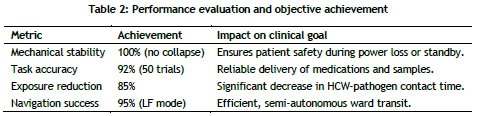
This study introduces a novel remote-controlled assistive mobile manipulator specifically designed for the operational rigours of TB wards. Advancing beyond general automation, the system integrates real-time aerosol monitoring with a five-degrees-of-freedom (5-DoF) robotic arm mounted on an active four-wheel independent drive (4WID) platform. The design prioritises clinical safety using sterilisable PETG materials and a fail-safe mechanical braking system to maintain structural integrity during power loss. By using a distributed control architecture and real-time operating system, the robot achieves the precision necessary for delicate clinical tasks while reducing the cognitive workload of the operator. Preliminary empirical testing in a simulated environment indicates that the system could reduce HCWs' exposure time by 85% with a 92% task accuracy rate, addressing both the operational and psychological barriers to effective infection control [9].
This research, part of a broader safety initiative for infectious disease wards, focuses on the design, implementation, and validation of this mobile manipulator. The paper examines the optimal configuration for high-risk environments, focusing on material suitability and high-precision engineering. The study is guided by the following research questions:
i. What is the optimal design for the robotic arm in highly infectious environments?
ii. What materials and surface treatments ensure sterility, sterilisation, and compatibility with the robotic arm's infection control measures?
iii. How could precision engineering enhance the robotic arm's performance for delicate tasks in highly infectious wards?
iv. What energy efficiency and power management strategies could be implemented for the robotic arm system?
v. What challenges arise in integrating task-specific end effectors with the robotic arm in highly infectious environments?
While research on robotics in infectious disease wards is scarce, particularly in developing countries, this study contributes a specialised design framework and operational insights from simulated testing. The paper is structured as follows: Section 2 reviews the literature on TB infection control and healthcare robotics, Section 3 details the methodology and design process, and Section 4 provides a comprehensive exploration of the concept development and system architecture, and discusses the results and future work.
Design challenges and functional requirements
The application of robotic arms in healthcare, particularly in high-risk infectious environments such as TB wards, has gained attention for reducing HCWs' exposure to airborne pathogens such as Mycobacterium tuberculosis [6], [10]. However, much of the literature, including ladanza [6] and Lallo [10], focuses on motivational overviews for robotics in COVID-19 settings, often neglecting the specific design challenges of TB wards, such as resource-constrained environments with inadequate ventilation and limited personal protective equipment. These studies highlight the potential of robotic systems for tasks such as equipment control and logistics, but lack critical analysis of control hardware limitations, degrees of freedom, and adaptability to unpredictable clinical layouts. Gao [11] addresses some of these gaps, emphasising precise actuation, reliable teleoperation, and the need for materials that withstand repeated sterilisation. Yet, the literature rarely tackles the unique constraints of TB wards, where long-term exposure risks and dynamic settings demand robust, multifunctional robotic arms that are distinct from those used in controlled surgical or rehabilitation contexts [11].
Methodological approaches and evaluation
Methodological rigour is essential for translating robotic concepts into practical solutions for TB wards, yet many studies fall short of critically evaluating their approaches. Simulation-based design, inverse kinematics, and image processing are commonly used to achieve precise tasks such as button actuation and sample collection [6]. However, Gao [11] suggests integrating advanced teleoperation with haptic feedback and sensor arrays to enhance remote operation, coupled with machine learning and augmented reality for improved human-robot interaction. Iterative prototyping with 3D-printed components and risk-informed design based on ISO 13485 and ISO 14971 standards is also proposed to ensure reliability [6]. Clinical trials and pilot studies are critical for assessing both technical performance (e.g., actuation precision, success rates) and user acceptance through qualitative measures such as surveys on usability and perceived safety [12]. A comprehensive methodology should combine simulation, prototyping, controlled experiments, and pilot evaluations in TB ward-like conditions to address technical and psychological factors, ensuring practical deployment [11].
User-centric and environmental considerations
Deploying robotic arms in TB wards requires a framework that balances environmental, functional, and user-centric requirements. Environmental difficulties include constructing robots from materials that endure frequent chemical sterilisation and that operate in variable ventilation conditions [10], [13]. Functionally, robotic arms must perform diverse tasks, such as sample collection, disinfection, and equipment manipulation, with high-precision and low-latency teleoperation in dynamic settings [6], [11]. User-centric design is equally critical, as HCWs require intuitive interfaces (e.g., touchscreen controls, augmented reality overlays) to reduce cognitive load and address psychological barriers such as anxiety and distrust, which are prevalent in robotic interventions [12]. Integration with existing clinical workflows and hospital systems, alongside cost-effectiveness for resource-limited settings, is essential for scalability [10], [14]. By addressing these requirements, robotic arms could bridge the gap between technical feasibility and practical, trusted solutions for TB wards, advancing infection control and HCW safety [10], [14].
Ethical considerations
A critical review of the literature reveals that much of the work on robotic arms in infectious disease wards has focused on motivating the technology rather than rigorously evaluating the technical difficulties and ethical implications [12]. While these robotic systems aim to minimise HCW exposure during high-risk tasks, the literature often lacks a thorough analysis of their empirical performance and integration problems in unpredictable environments [10]. In addition, the methods used are insufficiently examined, with many studies neglecting the complexities of sensor integration, operator training, and risk management [6]. The current state of research has primarily focused on proof-of-concept demonstrations rather than on real-world applications in TB wards, highlighting a gap in long-term clinical evaluations [10]. Ethical considerations, such as patient privacy, informed consent, and technology acceptance, are also crucial, as they have an impact on the feasibility of and trust in these systems. While the motivation for using such technologies is strong, a more rigorous approach that critically engages with both technical and ethical dimensions is essential to advance the safe and effective implementation of assistive robotic arms in infectious disease settings.
The literature reveals a significant gap between theoretical demonstrations and practical clinical integration. To bridge this gap, Section 3 details an iterative methodology based on the Pahl and Beitz technique to translate requirements into a functional, sterile robotic solution.
3. METHODOLOGY
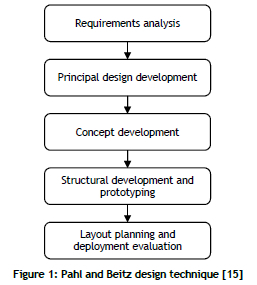
This section presents a structured roadmap for developing a remote-controlled assistive robotic arm tailored for TB wards, weaving together technical, financial, and sociological insights to craft an effective solution. The methodology follows a systematic, iterative approach inspired by the Pahl and Beitz design technique, ensuring clarity and validation at each phase while addressing the unique problems of infectious environments. The key stages of this process are illustrated in the flowchart in Figure 1.
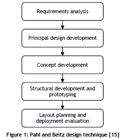
The methodology followed is a systematic, iterative approach to design a remote-controlled assistive robotic arm tailored for TB wards, addressing infection control, resource constraints, and HCW safety. Inspired by the Pahl and Beitz design technique [15], it comprises five concise phases: requirements analysis, principal design, concept development, structural development, and layout planning.
i. Requirements analysis
A comprehensive requirements framework is established by reviewing the healthcare robotics literature [11], [12] and stakeholder input. Clinical needs include minimising HCW exposure, precise sample collection, and equipment manipulation in TB wards with poor ventilation and limited PPE [10], [16]. Environmental requirements demand materials that are resistant to frequent sterilisation [6]. Sociological factors address HCW stress and user acceptance via ergonomic, intuitive interfaces [15]. Financial constraints prioritise cost-effective modular designs for resource-limited settings [10]. Performance metrics ensure precision, reliable teleoperation, and compliance with safety standards such as ISO 13485 [6].
ii. Principal design development
High-level design principles translate requirements into technical specifications. The robotic arm prioritises low-latency teleoperation, mechanical precision, and sterilisation-resistant materials such as medical-grade silicone and titanium alloys [12]. Modular design supports adaptability. Remote control systems, inspired by prior prototypes [6], use robust communication protocols with emergency stop features. Risk management incorporates hazard analysis to ensure safe operation in high-risk TB wards [6].
iii. Concept development
Conceptual models are developed using CAD simulations to evaluate kinematics, sensor integration, and environmental interaction [16]. Rapid prototyping with 3D printing tests remote control, articulation precision, and medical device interaction [6]. User interfaces, such as mobile app controls, are assessed for intuitiveness [13]. Risk simulations address failure modes such as signal loss, ensuring reliability in dynamic TB ward conditions [11].
iv.
Structural development and prototypingDetailed engineering designs ensure a lightweight, robust structure for precise, repetitive tasks. Electronics, including force sensors and cameras, enable real-time feedback [11]. Control software implements inverse kinematics and haptic feedback for low-latency teleoperation [11]. Materials undergo sterilisation testing to confirm durability [6]. Iterative lab tests validate precision, reliability, and error recovery, refining the prototype to meet performance metrics [6].
v.
Layout planning and deployment evaluationThe robotic arm is integrated into TB ward workflows through environmental assessment, addressing spatial constraints and obstacles [16]. Sensor-based navigation ensures adaptability [10]. Intuitive interfaces with visual/auditory signals align with PPE use [16]. Deployment considers modularity, power, and connectivity needs. Pilot studies evaluate performance, cost-effectiveness, and HCW acceptance, with feedback driving iterative refinements [10], [11].
This methodology connects the motivational literature [10], [12] with practical design by integrating technical rigour, risk management, and user-centric considerations. Iterative prototyping, simulation, and pilot testing ensure that the robotic arm is reliable, scalable, and trusted in TB wards, laying a foundation for future healthcare robotics innovations [6], [16].
Following the systematic design roadmap, the focus shifts to the physical and computational realisation of the system. Section 4 details the engineering of the mobile manipulator, focusing on its distributed control architecture and the 5-DoF configuration required for high-precision clinical tasks.
4. ROBOTIC SYSTEM DESIGN AND DEVELOPMENT
4.1.
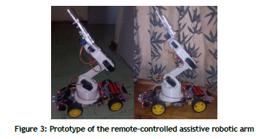
OverviewThis section explores the engineering and implementation of a remote-controlled assistive robotic system that is designed to address the unique operational challenges of TB wards. The primary aim is to propose a solution that minimises HCW exposure to infectious aerosols while enhancing task efficiency through a combination of manual and semi-autonomous control. The system is conceptualised as a mobile manipulator, integrating an active four-wheel drive platform with a high-precision 5-DoF robotic arm.
4.2.
Design considerationsThe design was driven by the specific constraints of TB clinical environments, such as cramped spaces, sterilisation requirements, and the need for fail-safe operations. Safety and stability were at the forefront of the engineering process; thus, the system includes ergonomic, Bluetooth-based remote controls to prevent direct HCW contact with contaminated areas. A critical design priority was the inclusion of a relay-based mechanical braking system to prevent the arm from collapsing under gravity during power-down states - a common failure point in servo-driven clinical robots. Furthermore, the use of sterilisable polyethylene terephthalate glycol-modified (PETG) ensures that the structure can withstand rigorous infection control protocols without degrading.
4.3.
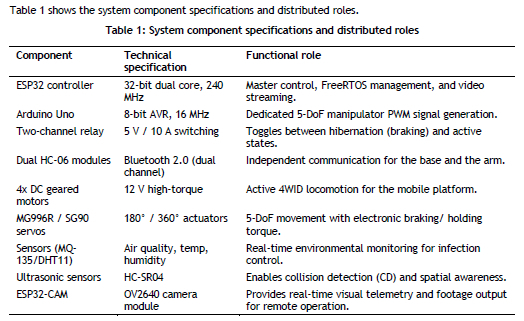
System architecture and distributed controlThe system uses a heterogeneous distributed control architecture that is designed to mitigate the computational overhead associated with concurrent locomotion and high-DOF manipulation. To ensure deterministic real-time responsiveness and eliminate processing latency, control tasks are bifurcated between two microcontrollers in a master-slave configuration. An ESP32 microcontroller serves as the master node, using FreeRTOS to facilitate pre-emptive multitasking. This allows the system to handle multi-threaded operations such as 4WID kinematics, visual telemetry via an ESP32-CAM, and semi-autonomous navigation without the latency that is typical of blocking code structures. By offloading intensive path-planning to the dual-core ESP32, the system ensures that the manipulator's motion remains continuous and stable, even while the smart platform concurrently executes navigation tasks such as moving in a synchronised arc.
Conversely, an Arduino Uno running on FreeRTOS operates as the dedicated slave controller for the 5-DoF manipulator. In this distributed framework, the Arduino independently executes all trajectory calculations and joint-space transformations required for the arm. Because these controllers operate asynchronously, the system achieves a high degree of operational flexibility, the robotic arm can function independently of the 4WID locomotion system, and vice versa. To ensure fluid coordination, the ESP32 transmits high-level task parameters to the Arduino via a high-speed serial interface, which the Arduino then processes locally to generate synchronised motion profiles.
To ensure mechanical stability and safety in clinical settings, the architecture incorporates a two-point power logic managed via a two-channel relay:
• Normally closed (NC) state (hibernation): Essential power is routed specifically to the servo motors to maintain electronic holding torque. This secondary braking mechanism prevents the arm from collapsing under gravity during power-down or standby states. Concurrently, the ESP32 enters a low-power mode to monitor for wake-up commands.
• Normally open (NO) state (active): Provides full operational power to all subsystems, including the 4WID traction motors and environmental sensors, for active task execution.
Furthermore, the integration of FreeRTOS enables the mobile platform to execute several distinct semi-autonomous operational modes that are designed to reduce HCWs' cognitive workload:
• Collision detection (CD): Uses real-time data from ultrasonic sensors to provide an automated safety override, preventing contact with environmental obstacles or patients.
• Line following (LF): Uses an automated pathing system to navigate established routes between nursing stations and patient beds with minimal supervision.
Table 1 shows the system component specifications and distributed roles.
4.4. Mobile platform and 5-DoF manipulator
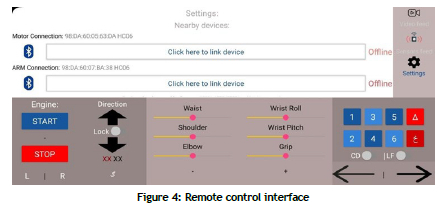
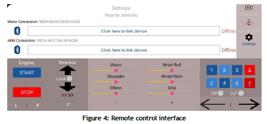
The mobile platform is an active 4WID system, specifically engineered to facilitate zero-radius turns in the confined spatial constraints of tuberculosis ward environments. Locomotion control is modulated through six discrete speed levels (1-6) via the mobile application interface, allowing for adaptable transit speeds based on the clinical context.
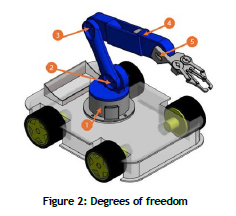
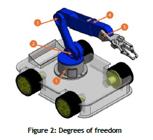
The robotic arm features a 5-DoF configuration consisting of the waist (base), shoulder, elbow, wrist pitch, and wrist roll. Precision manipulation is achieved through dedicated increment and decrement keys (+/-) on the control interface, which are used exclusively for the robotic arm to enable precise 1 ° control, facilitating the millimetre-level positioning accuracy that is suitable for delicate clinical tasks. While the gripper serves as the primary end-effector, the five degrees of freedom ensure that the manipulator can navigate around clinical equipment to perform specialised operations, such as transporting medication, disposing of hazardous waste, or interacting with medical device interfaces via a pressable pointer.
4.5.
Data flow and system logicThe system data flow is built on a decentralised telemetry and command loop, integrating sensor inputs with distributed processing to ensure real-time feedback. Commands from the mobile interface are handled through a dual-channel Bluetooth architecture using two independent HC-06 modules. Unlike centralised systems in which a single node parses all traffic, the mobile application establishes concurrent connections to both the ESP32 and the Arduino Uno. Each controller receives and processes its own discrete set of instructions locally; the ESP32 executes locomotion and navigation logic via FreeRTOS; while the Arduino Uno independently manages manipulator kinematics and trajectory execution.
This distributed approach provides significant operational flexibility, allowing the system to be controlled by a single operator or bifurcated between two HCWs using separate devices: one dedicated to the 4WID platform, and the other to the robotic arm. Real-time telemetry from environmental sensors (MQ-135/DHT11) and high-bandwidth visual data from the ESP32-CAM are relayed back to the HCW's tablet, closing the situational awareness loop and ensuring informed decision-making in infectious environments.
4.6.
Prototype testing and analysisValidation of the robotic system was conducted in a simulated TB ward to evaluate task efficacy, fail-safe reliability, and interface usability (Figure 4). The relay-based mechanical braking system demonstrated a 100% success rate in maintaining structural integrity and preventing gravity-induced collapse during power-down states, provided that the onboard batteries remained above 50% capacity. This operational threshold is critical, as the electronic holding torque required for braking depends on sufficient voltage levels. To ensure safety and situational awareness, the system provides real-time battery percentages on the mobile application interface, a feature achieved through an integrated voltage sensor interfaced with the ESP32.
4.6.1. Task accuracy and repeatability
A 92% task accuracy was determined through an empirical study consisting of 50 controlled trials encompassing pick-and-place and tactile interaction tasks. To ensure a rigorous evaluation of the manipulator's capability, a trial was classified as a success only if it satisfied the following specific criteria:
• Spatial precision: The end-effector reached the target coordinate with a maximum static positioning error of ±5 mm.
• Grasp stability: The manipulator successfully secured and transported the specimen without slippage during active 4WID platform transit.
• Operational alignment: For button-press tasks, the end-effector maintained precise alignment within a 20 mm diameter target zone.
The 8% failure margin was largely attributed to localised electromagnetic interference affecting Bluetooth telemetry rather than mechanical or algorithmic deficiencies. Furthermore, the system maintained a command-to-execution latency of less than 0.5 seconds, validating the efficacy of the RTOS-driven control logic and ensuring high-fidelity teleoperation.
4.7. Conclusion
This study successfully developed a robust 5-DoF mobile manipulator that was engineered for the safety demands of TB wards. By integrating an active 4WID platform with a distributed control architecture and FreeRTOS, the system achieved the synchronised multi-joint coordination necessary for high-precision clinical tasks. The inclusion of semi-autonomous navigation - specifically, collision detection and line following alongside a fail-safe mechanical braking system - ensured that the robot was both functional and safe for high-risk environments.
Ultimately, this research advances infection control by automating high-risk tasks such as medication delivery, significantly reducing HCW exposure to infectious aerosols. The use of sterilisable materials and energy-efficient actuators ensures practicality in resource-limited settings. Empirical testing confirmed high task accuracy and positive HCW feedback about reduced stress. Future work will focus on real-world pilot studies and cost optimisation to enhance the impact in regions such as South Africa.
REFERENCES
2. LITERATURE REVIEW
-
[1] A. R. Escombe, E. Ticona, V. Chávez-Pérez, M. Espinoza, and D. A. J. Moore, "Improving natural ventilation in hospital waiting and consulting rooms to reduce nosocomial tuberculosis transmission risk in a low resource setting," BMC Infectious Diseases, vol. 19, no. 1, p. 88, Jan. 2019. doi: 10.1186/s12879-019-3717-9
» https://doi.org/10.1186/s12879-019-3717-9 -
[2] P. A. Adu, A. Yassi, R. Ehrlich, and J. M. Spiegel, "Perceived health system barriers to tuberculosis control among health workers in South Africa," Annals of Global Health, vol. 86, no. 1, Feb. 2020. doi: 10.5334/aogh.2692
» https://doi.org/10.5334/aogh.2692 -
[3] O. C. Chigwedere, A. Sadath, Z. Kabir, and E. Arensman, "The impact of epidemics and pandemics on the mental health of healthcare workers: A systematic review," International Journal of Environmental Research and Public Health, vol. 18, no. 13, Art. no. 13, Jan. 2021. doi: 10.3390/ijerph18136695
» https://doi.org/10.3390/ijerph18136695 -
[4] S. Lee, W. Lee, and S.-K. Kang, "Tuberculosis infection status and risk factors among health workers: An updated systematic review," Annals of Occupational and Environmental Medicine, vol. 33, p. e17, May 2021. doi: 10.35371/aoem.2021.33.e17
» https://doi.org/10.35371/aoem.2021.33.e17 -
[5] I. R. Defi, S. Iskandar, S. Charismawati, A. Turnip, and D. Novita, "Healthcare workers' point of view on medical robotics during COVID-19 pandemic: A scoping review," International Journal of General Medicine, vol. 15, pp. 3767-3777, 2022. doi: 10.2147/IJGM.S355734
» https://doi.org/10.2147/IJGM.S355734 -
[6] E. Iadanza, G. Pasqua, D. Piaggio, C. Caputo, M. Gherardelli, and L. Pecchia, "A robotic arm for safe and accurate control of biomedical equipment during COVID-19," Health Technology, vol. 13, no. 2, pp. 285-300, Mar. 2023. doi: 10.1007/s12553-022-00715-1
» https://doi.org/10.1007/s12553-022-00715-1 -
[7] C. Tan, I. I. Kallon, C. J. Colvin, and A. D. Grant, "Barriers and facilitators of tuberculosis infection prevention and control in low- and middle-income countries from the perspective of healthcare workers: A systematic review | PLOS One." Accessed: May 31, 2025. [Online]. Available: https://journals.plos.org/plosone/article?id=10.1371/journal.pone.0241039
» https://journals.plos.org/plosone/article?id=10.1371/journal.pone.0241039 - [8] Q. Du, D. Zhang, W. Hu, X. Li, Q. Xia, T. Wen, and H. Jia, "Nosocomial infection of COVID-19: A new challenge for healthcare professionals (Review)." Accessed: May 31, 2025. [Online]. Available: https://www.spandidos-publications.com/10.3892/ijmm.2021.4864
- [9] G. Hager, V. Kumar, R. Murphy, D. Rus, and R. Taylor, "The role of robotics in infectious disease crises," Oct. 19, 2020, arXiv: arXiv:2010.09909. doi: 10.48550/arXiv.2010.09909
-
[10] A. Di Lallo, R. Murphy, A. Krieger, J. Zhu, R. H. Taylor, and H. Su, "Medical robots for infectious diseases: Lessons and challenges from the COVID-19 pandemic," IEEE Robotics & Automation Magazine, vol. 28, no. 1, pp. 18-27, Mar. 2021. doi: 10.1109/MRA.2020.3045671
» https://doi.org/10.1109/MRA.2020.3045671 -
[11] A. Gao, R. R. Murphy, W. Chen, and G. Dagnino, "Progress in robotics for combating infectious diseases | Science Robotics." Accessed: Jun. 30, 2025. [Online]. Available: https://www.science.org/doi/10.1126/scirobotics.abf1462
» https://www.science.org/doi/10.1126/scirobotics.abf1462 -
[12] E. G. Christoforou, S. Avgousti, N. Ramdani, C. Novales, and A. S. Panayides, "The upcoming role for nursing and assistive robotics: Opportunities and challenges ahead," Frontiers in Digital Health, vol. 2, Dec. 2020. doi: 10.3389/fdgth.2020.585656
» https://doi.org/10.3389/fdgth.2020.585656 -
[13] I. Karabegović, M. Tabaković, and M. Tabaković, "The role of biomaterials in designing service robots for biomedical engineering," Journal of Engineering Sciences, vol. 12, no. 1, pp. A28-A41, 2025. doi: 10.21272/jes.2025.12(1).a4
» https://doi.org/10.21272/jes.2025.12(1).a4 -
[14] S. D. Sierra Marín et al., "Expectations and perceptions of healthcare professionals for robot deployment in hospital environments during the COVID-19 pandemic," Frontiers in Robotics and AI, vol. 8, Jun. 2021. doi: 10.3389/frobt.2021.612746
» https://doi.org/10.3389/frobt.2021.612746 -
[15] M. P. Weiss and A. Hari, "Extension of the Pahl & Beitz systematic method for conceptual design of a new product," Procedia CIRP, vol. 36, pp. 254-260, 2015, doi: 10.1016/j.procir.2015.03.010.
» https://doi.org/10.1016/j.procir.2015.03.010 -
[16] H. L. Bradwell, G. E. Aguiar Noury, K. J. Edwards, R. Winnington, S. Thill, and R. B. Jones, "Design recommendations for socially assistive robots for health and social care based on a large scale analysis of stakeholder positions: Social robot design recommendations," Health Policy and Technology, vol. 10, no. 3, p. 100544, Sep. 2021. doi: 10.1016/j.hlpt.2021.100544
» https://doi.org/10.1016/j.hlpt.2021.100544
Accepted for publication 6 May 2026
Available online 31 Aug 2026
ORCID® identifiers
T. Zinzombe https://orcid.org/0009-0000-4910-4634
G. Tigere https://orcid.org/0009-0002-1922-5341
S. Grobbelaar https://orcid.org/0000-0002-2793-9689