Assessing the alignment of lean maintenance practices in a south african maritime valves and pumps workshop
Abstract
Lean maintenance practices have gained prominence for enhancing operational efficiency, reducing waste, and improving overall performance in maintenance, repair, and overhaul (MRO) environments. Lean principles have shown success in various industries, but their applicability and effectiveness in the unique context of maritime MRO workshops is still relatively unexplored. This research employs a mixed-method research approach, which entails qualitative and quantitative data-gathering through interviews, structured questionnaires, and observations. The assessment of a South African maritime valves and pumps MRO workshop revealed a predominant reliance on reactive maintenance, with no implementation of lean maintenance practices. This approach could lead to significant inefficiencies, including the increased downtime of valves and pumps, higher maintenance costs, and operational disruptions. To address these problems, it is recommended that comprehensive lean maintenance training and standardised maintenance processes be implemented, enhanced data use be invested in, and a culture of continuous improvement be fostered.
Abstract
Lenige instandhoudingspraktyke het prominensie gekry vir die verbetering van bedryfsdoeltreffendheid, die vermindering van vermorsing en die verbetering van algehele prestasie in onderhoud, herstel en opknapping (MRO) omgewings. Lenige-beginsels het sukses in verskeie industrieë getoon, maar die toepaslikheid en doeltreffendheid daarvan in die unieke konteks van maritieme MRO-werkswinkels is nog relatief onverken. Hierdie navorsing gebruik 'n gemengde-metode navorsingsbenadering, wat kwalitatiewe en kwantitatiewe data-insameling deur onderhoude, gestruktureerde vraelyste en waarnemings behels. Die beoordeling van 'n Suid-Afrikaanse maritieme kleppe en pompe MRO-werkswinkel het 'n oorheersende afhanklikheid van reaktiewe instandhouding aan die lig gebring, met geen implementering van skraal instandhoudingspraktyke nie. Hierdie benadering kan lei tot aansienlike ondoeltreffendheid, insluitend die verhoogde stilstandtyd van kleppe en pompe, hoër instandhoudingskoste en bedryfsontwrigtings. Om hierdie probleme aan te spreek, word aanbeveel dat omvattende skraal instandhoudingsopleiding en gestandaardiseerde instandhoudingsprosesse geïmplementeer word, verbeterde datagebruik belê word en 'n kultuur van voortdurende verbetering bevorder word.
1. INTRODUCTION
The maritime industry stands as a cornerstone of global trade and commerce, with ships and vessels serving as the lifeline of the international supply chain [1]. In this industry, the maintenance, repair, and overhaul (MRO) workshops that support the maritime sector play a pivotal role in ensuring the operational efficiency and safety of vessels [2]. In addition, the efficient and reliable operation of valves and pumps in MRO workshops is critical. Lean maintenance practices have gained significant recognition as a promising approach to enhancing the performance and sustainability of MRO operations [3]. However, the application of lean principles in the context of a South African maritime valves and pumps MRO workshop presents a distinct and complex set of difficulties and opportunities [3]. Therefore, this research focused on assessing the alignment of lean maintenance practices in the maritime valves and pumps MRO workshop, aiming to shed light on the extent to which these practices are implemented, and their impact on productivity, cost efficiency, and overall service quality. Furthermore, this study aimed to reveal valuable insights and practical recommendations and to make essential contributions to the optimisation of maintenance processes in the South African maritime industry.
Lean maintenance practices have gained significant attention in recent years as organisations strive to optimise their maintenance processes to enhance efficiency, reduce waste, and improve overall performance [3]. In the context of the maritime industry, particularly in MRO workshops that focus on valves and pumps, the alignment of lean principles becomes crucial in achieving operational excellence. This literature review aims to assess the alignment of lean maintenance practices in a South African maritime valves and pumps MRO workshop.
2.1. Lean maintenance practices
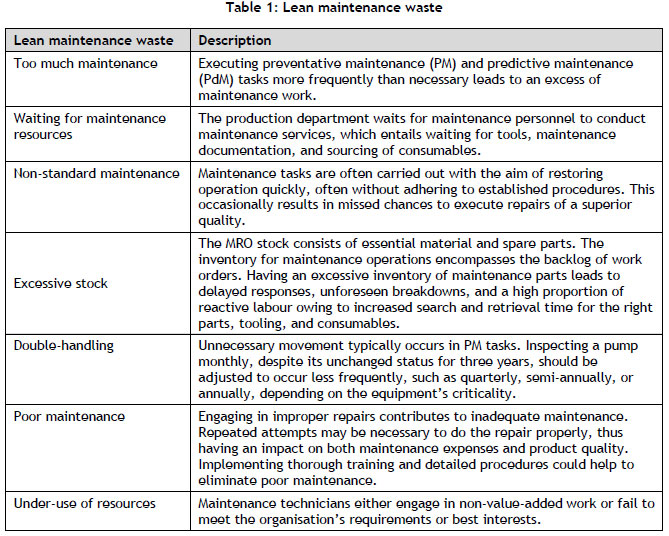
'Lean maintenance' is defined as a proactive maintenance approach that uses planned and scheduled maintenance tasks as part of total productive maintenance (TPM) practices [4]. This method employs maintenance strategies that are derived from the application of reliability-centred maintenance (RCM) decision-making principles, and is executed by self-directed action teams. Mostafa, Lee, Dumrak, Chileshe and Soltan [3] define lean maintenance as the integration of lean thinking with maintenance. Clarke, Mulryan and Liggan [5] define Lean maintenance as the provision of maintenance services to clients while minimising unnecessary waste. Gupta and Jain [6] state that there are two types of waste: obvious waste, and less obvious waste that results from variability in manufacturing or maintenance processes. In the context of maintenance practices, obvious waste is associated with the activities described in Table 1 [3].
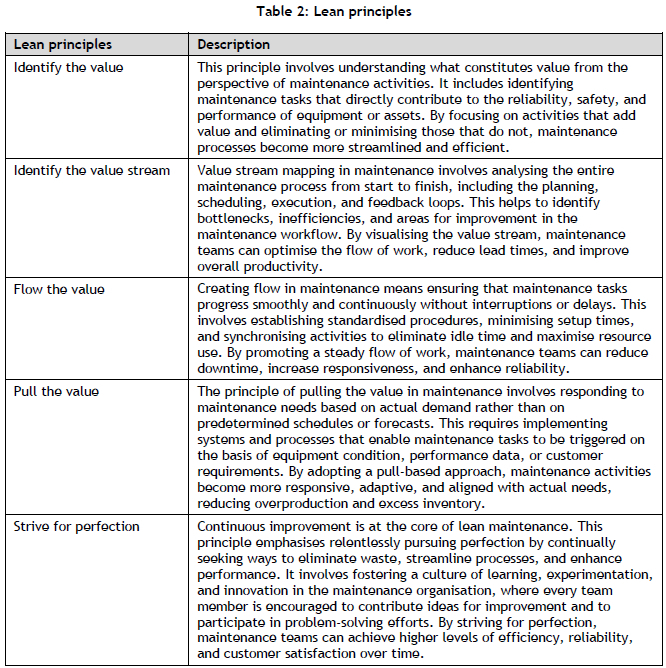
Lean maintenance emerged through the conceptual integration of five principles that form the foundation of any lean initiative [7]. The five lean principles are identifying the value, identifying the value stream, flowing the value, pulling the value, and striving for perfection. Mostafa et al. [3] define the five lean principles in the context of maintenance as shown in Table 2.
The adoption of lean principles in maintenance could result in optimised maintenance processes and cost reduction in preventative maintenance [8]. The use of lean tools such as failure mode and effect analysis (FMEA) helped a container handling industry to improve its maintenance process efficiently by identifying the root cause of tractors' engine problems. The use of the plan-do-check-act (PDCA) cycle helped the container handling industry in the United States to reduce the annual preventative maintenance cost for tractors by $14,842.58, which represented 73% of the cost reduction for each hour of operations [8]. Studies such as that of Sheng and Tofoya [9] revealed that the integration of lean into preventative maintenance helped manufacturing organisations to have improved equipment availability, product quality, and yield performance, and to identify the waste and to eliminate redundancy, which helped to reduce its maintenance costs. Similarly, Almomani and Almutairi [10] highlighted that implementing lean principles in maintenance management systems and operations would enhance the quality of maintenance, reduce mean time to repair (MTTR), increase mean time between failures (MTBF), and improve system availability and reliability, ultimately leading to a decrease in the number of failures and downtime experienced by maintained components.
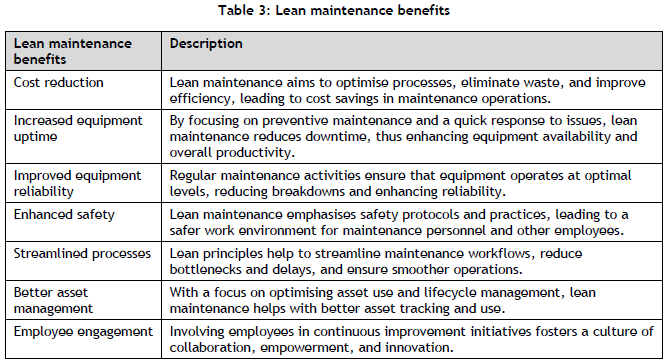
Dragone, Biotto and Serra [11] highlighted that the lean approach, when strategically applied, could enhance maintenance management by focusing on its principles rather than solely on techniques and tools. Therefore, in order to achieve lean maintenance effectively, key lean tools such as 5S, total productive maintenance (TPM), overall equipment effectiveness (OEE), Kaizen, Poka-Yoke, process activity mapping, Kanban, the computer-managed maintenance system (CMMS), the enterprise asset management (EAM) system, inventory management, visual management, and Takt time need to be used [3]. The likely benefits of implementing lean maintenance are shown in Table 3 [3].
2.2. Alignment of lean maintenance practices in MRO workshops
The lean manufacturing method was initially designed for repetitive job steps in a fixed production environment. However, aircraft maintenance, repair, and overhaul operate on a project-based principle, which is heavily reliant on the unique condition of each aircraft [12]. Consequently, the main aspect of the work is to address defects, which makes prediction unfeasible. However, Mostafa et al. [3] highlighted that, although lean principles were initially tailored to a fixed manufacturing or production environment, they could still be integrated with MRO operations. Mostafa et al. [3] also highlighted that there is not much in the literature that relates to the implementation of lean in MRO workshops. Therefore, it became necessary to carry out more research into the alignment of lean practices in MRO workshops. The Lean Aerospace Initiative's report highlighted significant enhancements in MRO services owing to the implementation of lean practices [13]:
• Setup time was reduced by 17%-85%.
• Lead time saw a 16%-50% reduction.
• Labour hours improved by 10%-71%.
• Costs were cut by 11 %-50%.
• P roductivity increased by 27%-100%
• Cycle time was reduced by 20%-97%.
• Factory floor space usage improved by 25%-81%.
• Travel distances for people or products were reduced by 42%-95%.
• Inventory or work-in-progress saw a 31%-98% improvement.
• Scrap, rework, defects, or inspection rates improved by 20%-80%.
2.3.
Valves and pumps maintenance in the maritime sectorDavidson, Cahill, Hinz, Kluza, Scianni and Georgiades [14] stated that valves and pumps form part of the internal seawater system of a ship or vessel, and are responsible for controlling fluid flow, maintaining safe operating conditions, and enabling the efficient operation of maritime vessels in various functions and applications. Seawater serves numerous essential functions that are vital for the effective operation of vessels, such as engine cooling, ballasting, firefighting, freshwater generation, air conditioning, and specialised operations tailored to the specific type of ship [15].
However, Davidson et al. [14] also stated that, because of the high exposure of seawater, the maintenance of valves and pumps becomes crucial for ensuring the reliability, safety, and efficiency of marine operations by reducing the significant acceleration of bio-fouling and corrosion on valves and pumps in order to avoid leaks and the reduced operational efficiency of valves and pumps. 'Bio-fouling' refers to the accumulation of organisms such as algae, barnacles, and molluscs on ships' internal seawater system, hull, and other structures of the vessel. The accumulation of these organisms can reduce the operation efficiency of the ship's crucial components [14]. 'Corrosion' refers to the gradual degradation of metal surfaces caused by exposure to seawater and atmospheric conditions [14]. The alignment of lean maintenance practices in the maritime valves and pumps MRO workshops would assist those workshops to adopt a proactive maintenance approach instead of a reactive one.
2.4.
Gaps and limitationsThere are several gaps and limitations in the literature regarding lean maintenance practices in the maritime industry, particularly for studies that focus on valves and pumps MRO workshops. First, there is little research that specifically addresses this topic, with much of the literature being concentrated on the manufacturing or general maintenance sectors and not being tailored to maritime contexts. Moreover, the unique challenges of the maritime industry, such as regulatory compliance, safety standards, remote locations, and the corrosive marine environment, are not adequately addressed. Second, there is a lack of case studies that are specific to maritime valves and pumps MRO workshops and that could provide practical insights and best practices. There is also a need for consensus on suitable metrics for measuring the effectiveness of lean practices in maritime MRO workshops. Furthermore, human factors and organisational culture are crucial aspects that are often overlooked in the literature, along with sustainability considerations, such as the environmental impact of lean maintenance practices in maritime settings.
3. METHODOLOGY
This section details the research design, approach, and techniques employed to assess the alignment of lean maintenance practices in a South African maritime valves and pumps workshop. The chosen methodology was pivotal in ensuring the reliability, validity, and generalisability of the findings.
3.1. Research design
To navigate the complexities of assessing the alignment of lean maintenance practices in a South African maritime valves and pumps workshop, a mixed method approach was adopted. This methodological choice was rooted in the nature of the research questions:
• To what extent are lean maintenance practices currently implemented in a South African maritime valves and pumps MRO workshop?
• What are the key obstacles or difficulties in implementing lean maintenance practices in the maritime valves and pumps workshop?
• What is the impact of the alignment of lean maintenance practices on the operational efficiency of maintenance operations in the MRO workshop?
3.2.
Data collection methodsThe subsections that follow describe the procedures for the data collection.
3.2.1. Quantitative data collection
Surveys: Structured questionnaires were distributed to artisans, supervisors, and managers in the workshop. The questionnaires covered aspects such as current maintenance practices, and awareness and implementation of lean maintenance, including its effectiveness and challenges.
3.2.2. Qualitative data collection
Observations: Direct observations of maintenance operations were conducted to understand the practical application of the maintenance procedures and lean methodologies on the workshop floor.
3.3.
SamplingThe sample included employees at various levels in the organisation to ensure diverse perspectives. Stratified random sampling was used for the survey to ensure representation across different roles.
3.4.
Data analysisDescriptive statistics was used to summarise the survey data, and a thematic analysis was used to analyse the observational notes in order to identify themes related to the adoption of and difficulties with lean maintenance practices.
3.5.
Validity and reliabilityThe data used in this research was gathered through both quantitative and qualitative approaches. In order to ensure the reliability and validity of the research, a triangulation approach was used. The data that was gathered showed consistency in the responses that were generated from the surveys and observations.
3.6.
Ethical considerationsInformed consent was obtained from all the participants, and clarity was provided about the principles of voluntary participation, freedom to withdraw at any stage of the research, the purpose of the research, and maintaining the confidentiality of the participants' information and responses.
4. RESULTS
This section sets the stage for a detailed exploration of the findings, highlighting the key aspects of lean maintenance practices that were assessed in the study.
4.1. Survey results
This section reports the results of the survey. A total targeted number of 30 employees participated in the survey. Those who participated were from the valve and pumps MRO workshop. The scores of the respondents for particular questions are shown in Figures 1 to 6.
4.1.1. Current maintenance practices
This section focuses on how maintenance was carried out in the valve and pump MRO workshop in order to assess its alignment with lean maintenance practices.
4.1.1.1 Evaluation of the type of maintenances practices employed in the valve and pump MRO workshop
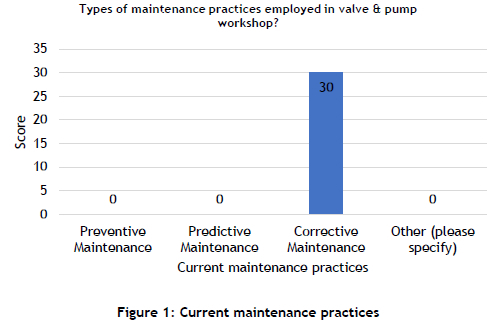
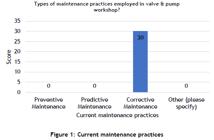
The respondents were asked to identify the types of maintenance practice employed in the valve and pump MRO workshop. The results are given in Figure 1.
4.1.1.2 Evaluation of the current maintenance structure
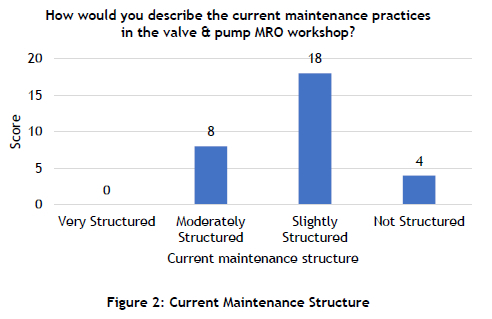
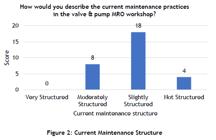
The respondents were asked to describe the current maintenance practices in the valve and pump MRO workshop. The results are shown in Figure 2.
4.1.1.3 Evaluation of the effectiveness of the current maintenance practices
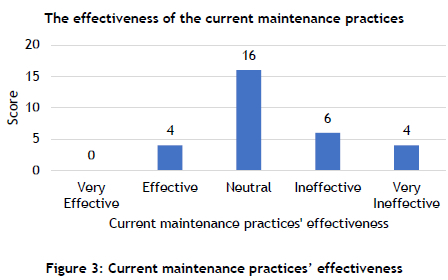
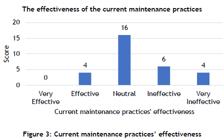
The respondents were asked to rate the effectiveness of the current maintenance practices of the valve and pump MRO workshop. The results are shown in Figure 3.
4.1.2. Awareness and implementation of lean maintenance
This section examines whether the respondents were familiar with the concept of lean maintenance, and whether it was implemented in their workshop.
4.1.2.1 Evaluation of familiarity with the concept of lean maintenance
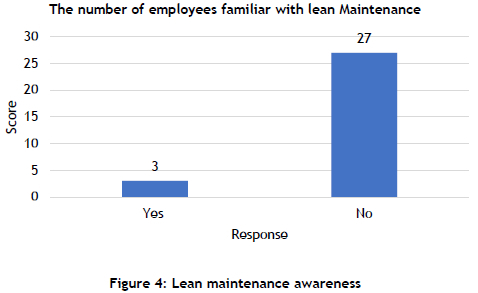
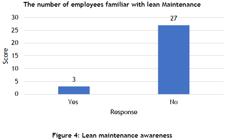
The respondents were asked whether they were familiar with the concept of lean maintenance. The results are shown in Figure 4.
4.1.2.2 Evaluation of how the employees became aware of lean maintenance
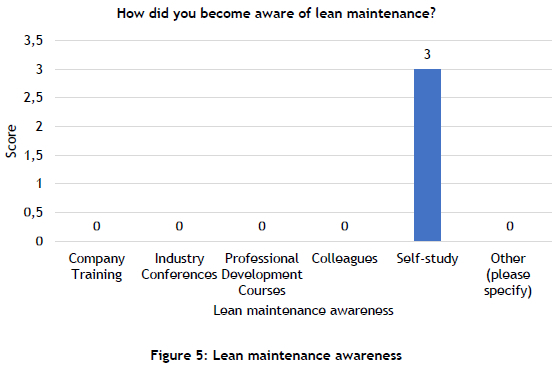
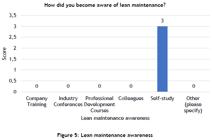
The respondents were asked how they had become aware of lean maintenance. The results are shown in Figure 5
4.1.2.3 Evaluation of whether lean maintenance practices had been implemented
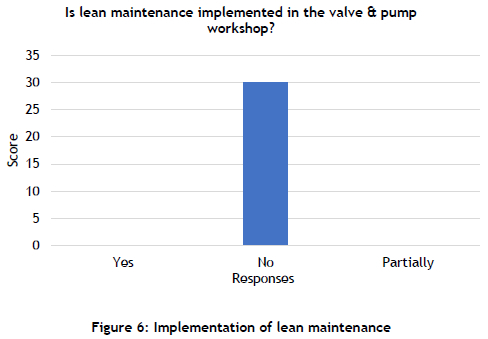
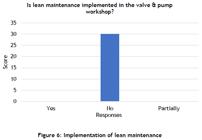
The respondents were asked whether the lean maintenance practices had been implemented in the valve and pumps MRO workshop. The results are shown in Figure 6
4.2. Direct observation
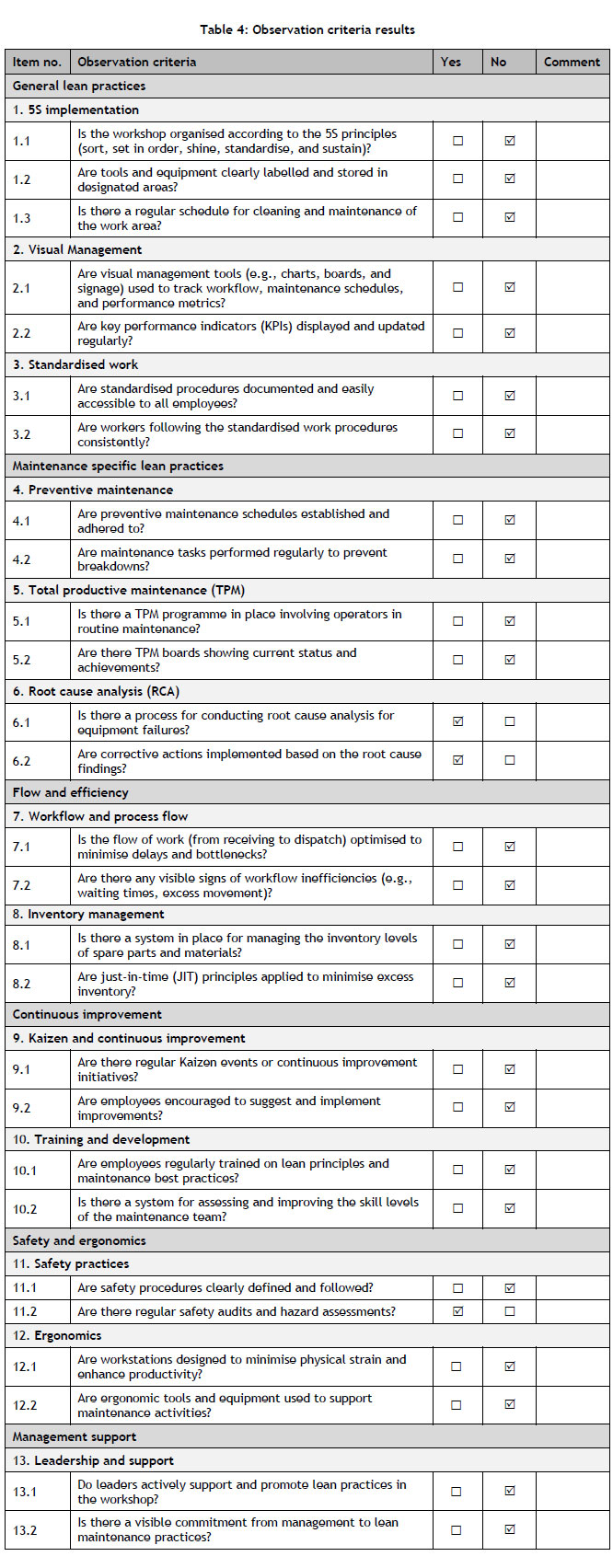
Observation was carried out in the valve and pump MRO workshop by the researcher in order to assess its alignment with lean maintenance practices. The results are shown in Table 4.
The direct observation covered several key areas of lean practices in a South African maritime valves and pumps MRO workshop as a unit, since the workstations were of similar design and capability. These were general lean practices such as 5S implementation, visual management, and standardised work. In addition, the criteria examined the workflow efficiency, inventory management, continuous improvement initiatives, employee training, safety practices, ergonomics, and management support.
The observation showed that the workshop adhered to lean practices such as RCA and safety practices. However, in its safety practice, the workshop had only implemented two of the safety practices, regular safety audits and hazard assessments. The rest of the lean practices, such as 5S, standardisation of work, Kaizen and continuous improvement, visual management, workflow efficiency, inventory management, employee training, ergonomics, and management support had not been implemented.
5. DISCUSSION
The primary objective of this research was to assess the alignment of lean maintenance practices in a South African maritime valves and pumps MRO workshop. Lean maintenance would aim to enhance efficiency, reduce waste, and improve the overall operational performance of the workshop.
However, our investigation revealed that the current maintenance strategy was primarily reactive, as shown in Figure 1, with no significant implementation of lean maintenance practices, as revealed by the analysis of the results in Figure 6.
5.1. Evaluation of current maintenance practices
The MRO workshop currently relies heavily on a reactive maintenance strategy, in which valves and pumps are maintained or repaired only after they fail. This approach is characterised by several key issues:
•
High downtime: Equipment failures often result in significant downtime, which disrupts operations and delays service delivery.•
Increased maintenance costs: The reactive approach leads to higher maintenance costs owing to emergency repairs and expedited parts procurement.•
Inefficiency: The lack of planned maintenance activities results in the inefficient use of resources and personnel.The results of the structured questionnaire revealed that the MRO workshop relied heavily on a reactive maintenance strategy that increased the downtime of valves and pumps, which therefore increased the downtime of ships or vessels. Sixty per cent of the respondents considered the reactive maintenance strategy of the workshop to be slightly structured; 27 per cent described it as moderately structured; and 13 per cent described it as not structured.
The respondents were also asked to rate the effectiveness of the reactive maintenance approach of the MRO workshop. Fifty-three per cent described the effectiveness of the current maintenance practice as neutral; 13 per cent described it as effective; and 23 per cent described the current maintenance as ineffective and 11% described it as very ineffective. The lack of a clear maintenance structure resulted in inefficiencies caused by poor planning of maintenance activities, leading to the inefficient use of resources and personnel.
5.2.
Alignment of lean principlesOur assessment (shown in Table 1 ), based on direct observation of a South African maritime valves and pumps MRO workshop, revealed that lean maintenance practices such as root-cause-analysis and safety practices were implemented in the workshop. However, in the safety practice the workshop had implemented only regular safety audits and hazard assessments. Key lean practices such as 5S (sort, set in order, shine, standardise, and sustain), value stream mapping (VSM), standardisation of work, Kaizen and continuous improvement, total productive maintenance (TPM), and visual management were either unknown or not practised.
•
5S implementation: There was no evidence of 5S practices in the workshop, resulting in a disorganised and cluttered work environment.•
VSM: The workshop lacked a systematic approach to analysing and improving its maintenance processes.The absence of some of the key lean practices in the MRO workshop could be attributed to factors such as a lack of awareness of and training in lean principles, and limited leadership and support.
5.3.
Identification of gapsThe primary gap identified was the lack of lean maintenance implementation, such as the following aspects:
•
Work organisation: The MRO workshop lacked a structured approach to organising tools, spares, and materials, leading to time wasted in searching for items.•
Lack of proactive maintenance: The reactive maintenance strategy on which the workshop relied heavily led to frequent disruptions and inefficiencies, highlighting the need for a shift towards proactive and preventive maintenance.•
Lack of standardisation: There were no standardised procedures for maintenance tasks, leading to inconsistent practices and variable outcomes.•
Continuous improvement: The absence of a culture of continuous improvement meant that lessons learnt from past failures were not systematically recorded or analysed in order to prevent future occurrences.6. RECOMMENDATIONS
6.1. Training and development
•
Lean maintenance training: Implement comprehensive training programmes on lean maintenance principles for all employees in the MRO workshop. This training should cover key lean tools and techniques such as 5S, TPM, VSM, and RCA.•
Continuous learning: Encourage a culture of continuous learning and improvement through regular workshops, seminars, and hands-on training sessions.6.2.
Process standardisation•
Standard operating procedures (SOPs): Develop and implement SOPs for all maintenance tasks to ensure consistency and quality in maintenance tasks.•
5S implementation: Introduce the 5S methodology in order to organise the workspace effectively.6.3.
Continuous improvement culture•
Kaizen events: Organise regular Kaizen events to encourage continuous improvement and employee involvement in problem-solving.•
Feedback loop: Establish a feedback loop through which employees could report issues and suggest improvements.6.4.
Data use•
Data management system: Develop a robust data management system to collect, analyse, and act on maintenance data.•
Decision-making: Use data analytics to drive decision-making and continuous improvement initiatives.7. CONCLUSION
This assessment of a South African maritime valves and pumps MRO workshop revealed a major reliance on reactive maintenance, with no implementation of lean maintenance practices. This approach would lead to significant inefficiencies, including the increased downtime of valves and pumps, higher maintenance costs, and operational disruptions. To address these problems, it is recommended that the workshop implement comprehensive lean maintenance training and standardised maintenance processes, invest in enhanced data use, and foster a culture of continuous improvement. The adoption of these recommendations would transform the workshop's maintenance strategy from being reactive to being proactive, improving its efficiency and enhancing its overall operational performance. Future research should focus on monitoring the impact of these implementations and exploring additional lean tools and techniques to sustain the continuous improvement efforts.
REFERENCES
2. LITERATURE REVIEW
- [1] N. Funke, M. Claassen, K. Nortje, and R. Meissner, "A research, innovation and knowledge management road map for the South African maritime sector: Charting a course to maritime excellence by 2030," Pretoria: Council for Scientific and Industrial Research, CSIR Report No: CSIR/NRE/WR/ER/ 2016/0044/A, 2016.
- [2] I. Lazakis, O. Turan, and S. Aksu, "Increasing ship operational reliability through the implementation of a holistic maintenance management strategy," Ships and Offshore Structures, vol. 5, no. 4, pp. 337-357, 2010.
- [3] S. Mostafa, S. H. Lee, J. Dumrak, N. Chileshe, and H. Soltan, "Lean thinking for a maintenance process," Production & Manufacturing Research, vol. 3, no. 1, pp. 236-272, 2015.
- [4] R. Smith, "What is lean maintenance? Elements that need to be in place for success," Maintenance Technology, vol. 17, no. 10, pp. 15-21, 2004.
- [5] G. Clarke, G. Mulryan, and P. Liggan, "Lean maintenance - A risk-based approach," Pharmaceutical Engineering, vol. 30, no. 5, pp. 1-6, 2010.
- [6] S. Gupta and S. K. Jain, "A literature review of lean manufacturing," International Journal of Management Science Engineering Management, vol. 8, no. 4, pp. 241-249, 2013.
-
[7] J. P. Womack and D. T. Jones, "Banish waste and create wealth in your corporation," 2003. [Online]. Available: http://www.kvimis.co.in/sites/kvimis.co.in/files/ebook_attachments/James [Accessed: March 8, 2024].
» http://www.kvimis.co.in/sites/kvimis.co.in/files/ebook_attachments/James - [8] A. A. Ebeid, I. A. El-Khouly, and A. E. El-Sayed, "Lean maintenance excellence in the container handling industry: A case study," in 2016 IEEE International Conference on Industrial Engineering and Engineering Management (IEEM), Bali, Indonesia, Dec. 2016, pp. 1646-1650.
- [9] T. L. Sheng and J. Tofoya, "The secret of manufacturing excellence: Lean maintenance," in 2010 International Symposium Semiconductor Manufacturing (ISSM), Oct. 2010, pp. 1-4.
- [10] H. Almomani and N. Almutairi, "Using lean principles in maintenance operations with application to water treatment plant," International Journal of Environmental Science, vol. 6, pp. 185-197, 2021.
- [11] I. S. Dragone, C. N. Biotto, and S. M. Serra, "Evaluation of lean principles in building maintenance management," in Proceedings of the 29th Annual Conference International Group Lean Construction (IGLC), Lima, Peru, July 2021, pp. 14-17.
- [12] A. Sánchez and F. Sunmola, "Factors influencing effectiveness of lean maintenance repair and overhaul in aviation," in 2017 International Conference on Industrial Engineering and Operations Management (IEOM), April 2017, pp. 855-864.
- [13] D.F. Mathaisel, "A lean architecture for transforming the aerospace maintenance, repair and overhaul (MRO) enterprise," International Journal of Productivity and Performance Management, vol. 54, no. 8, pp. 623-644, 2005.
- [14] I. Davidson, P. Cahill, A. Hinz, D. Kluza, C. Scianni, and E. Georgiades, "A review of biofouling of ships' internal seawater systems," Frontiers in Marine Science, vol. 8, 761531, 2021.
- [15] A.D. Coutts, K.M. Moore, and C.L. Hewitt, "Ships' sea-chests: An overlooked transfer mechanism for non-indigenous marine species?" Marine Pollution Bulletin, vol. 46, no. 11, pp. 1510-1513, 2003
ORCID® identifiers
K. Lewele: https://orcid.org/0009-0006-0602-4275
H. Steenkamp: https://orcid.org/0000-0002-6356-0633