Future mines' compressed air planning using digital twin simulations
Abstract
Most deep-level gold mines use compressed air services that directly influence production. However, compressed air planning is often overlooked, leading to unforeseen problems and production losses. Therefore, a need exists for a proactive compressed air planning strategy to illuminate and solve these problems before they occur. This would help to ensure that compressed air services meet the requirements of planned mining. This study developed a proactive planning methodology using digital twin simulations to identify and solve future problems in mines' compressed air systems. The methodology was applied to a case study mine, successfully solving a problem in which the compressed air system would have been unable to meet future pressure demands. The implemented solution led to a 32% pressure increase, demonstrating the potential of digital twin simulations in proactively planning and optimising mines' compressed air systems.
Abstract
Die meeste diepvlakgoudmyne gebruik saamgeperste lugdienste wat produksie direk beïnvloed. Die beplanning van saamgeperste lug word egter dikwels oor die hoof gesien, wat lei tot onvoorsiene probleme en produksieverliese. Daar bestaan daarom 'n behoefte aan 'n proaktiewe saamgeperste lugbeplanningstrategie om hierdie probleme te belig en op te los voordat dit voorkom om so te verseker dat saamgeperste lug verskaffing aan die vereistes vir beplande mynbou voldoen. Hierdie studie het 'n proaktiewe beplanningsmetodologie ontwikkel deur digitale tweeling-simulasies te gebruik om toekomstige probleme in myne se saamgeperste lugstelsels te identifiseer en op te los. Die metodologie is toegepas op 'n gevallestudiemyn, wat 'n probleem suksesvol opgelos het waarin die saamgeperste lugstelsel nie in toekomstige drukvereistes sou kon voldoen nie. Die geïmplementeerde oplossing het gelei tot 'n drukverhoging van 32%, wat die potensiaal van digitale tweeling-simulasies in die proaktiewe beplanning en optimalisering van myne se saamgeperste lugstelsels demonstreer.
1. INTRODUCTION
In deep-level gold mining, the strategic planning of compressed air systems is essential for operational efficiency and to minimise production losses. This article summarises a study on future mines' compressed air planning using digital twin simulations [1].
1.1. BACKGROUND
South African gold mines are among the deepest and most complex in the world . Despite global mining growth, local gold production is declining owing to rising operational costs and unique difficulties [2-4].
Compressed air systems are vital for operations such as drilling and loading, and directly influence production [5]. Compressed air offers benefits such as smooth power delivery, variable speed, torque control, and low heat build-up, making it a safe and sustainable energy source when properly managed [6]. However, these systems are among the most expensive and inefficient utilities, often accounting for up to 21% of a mine's total electricity demand [2, 7, 8]. Their inefficiency is result of their complex piping networks, which extend over several kilometres [3, 9]. Wastages such as leaks, open ends, and other losses contribute up to 70% of the total underground compressed air demand [10, 11].
Compressed air systems are complex, and need proper planning for continuous production and profitability. Current mine planning strategies focus mainly on ore extraction, neglecting proper planning for compressed air services [12, 13]. This inadequacy causes higher production costs and unforeseen pressure and flow problems, resulting in production losses.
1.2.
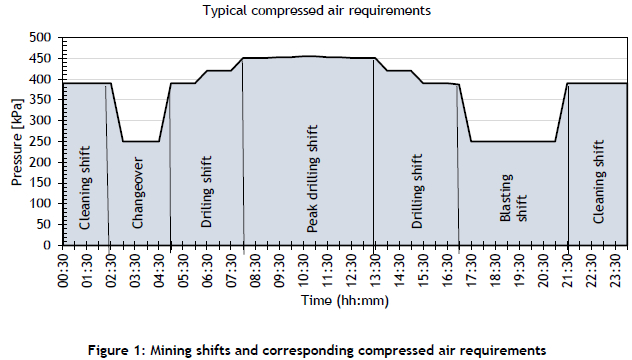
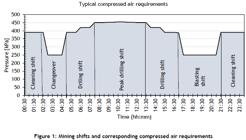
COMPRESSED AIR SYSTEMS IN DEEP-LEVEL MININGCompressed air systems are crucial in deep-level mining, and support three main shifts: drilling, blasting, and cleaning, each with specific air requirements [3]. The drilling shift, especially during peak periods, demands the highest compressed air flow and pressure for drills and equipment. Figure 1 shows a typical mine's compressed air demand schedule [12].
Compressed air systems comprise three main subsystems: the supply side, which includes compressors and air treatment equipment (dryers and filters); the reticulation system, which distributes air between the supply and demand sides; and the demand side, consisting of end-use equipment [2, 3, 12, 14, 15].
The reticulation network serves as the distribution system, transporting compressed air from the compressor house to end-users [16], and comprising a vast network of pipes that connect the supply and demand sides [3]. In deep-level mine compressed air systems, different types of pipes are used, depending on demand and location. Larger incoming pipelines are typically constructed from flanged pipe sections, providing more permanent fixtures [17]. Conversely, construction at developing ends and working areas is more dynamic, using quick clamp-on pipes. Various pipe sizes and couplings are available, being selected on the basis of specific applications [3, 18].
1.3. MINE PLANNING AND THE EFFECT OF COMPRESSED AIR ON PRODUCTION
Gold production is the primary determinant of a gold mine's profitability, directly correlating with its income, while production costs affect its profit [2]. Compressed air systems play a crucial role in drilling, a critical aspect of gold mining [3], yet they are among the most inefficient and energy-intensive systems in deep-level mines [2, 3, 17]. Inefficiencies have an impact on production by affecting service delivery in active mining areas, leading to costly production losses owing to inadequate compressed air supply pressure. These inefficiencies also increase energy consumption, thereby escalating production costs [19]. Typically, only 10% to 30% of the generated compressed air reaches the consumer [11, 20]. Poor service delivery has a direct impact on drilling rates, resulting in missed production targets and decreased production trends [3]. Insufficient compressed air pressure accounts for 4% of missed production shifts [21].
Deep-level mining in South Africa prioritises precious metals production, often allocating resources solely to meet production targets [22-26]. Similar to other industries, compressed air systems receive attention primarily when they fail to meet requirements, having a negative impact on production [22, 27]. Mine planning typically focuses on ore extraction, overlooking proper planning for compressed air services [17, 22]. Mines use standards and other guidelines for planning compressed air infrastructure [17, 28]. Most mines lack structured construction of compressed air systems, and often few to no people know the complete layout of the underground compressed air reticulation network [3, 9, 22, 29]. To extend the life-of-mine period, South African mines must delve deeper [30], requiring compressed air systems to supply more air over greater distances than initially planned [9, 22, 31, 32]. The mining environment is dynamic, with both service delivery and production areas constantly changing [11]. Deep-level gold mine compressed air systems are complex, and undergo frequent non-project-related changes that affect system performance [7, 15, 33]. Established standards and guidelines do not always account for the dynamic nature of compressed air systems, leading to inefficiencies [3, 11, 16].
Other industries have avoided production losses and system inefficiencies through proactive planning strategies and simulations [34]. Implementing similar strategies in mine compressed air systems could prevent unnecessary production losses. While South African mines have shown success in deep-level mining, there has been a lack of innovative thinking to develop new methods [11]. The mining sector's future depends on modernisation, as demonstrated by various studies on improving production strategies.
Vermeulen [34] investigated conventional systems for underground platinum mining, and addressed labour problems leading to production losses; this led to developing a new mine production planning system [34]. However, it did not examine the effects of compressed air system planning on production.
Valery, Jankovic and Sonmez [34] developed a methodology using process integration and optimisation to increase mine efficiency. While the study improved crushing and grinding operations, it did not consider the impact of compressed air pressure on drilling and production [35].
Van Zyl [10] analysed the impact of compressed air services on drilling performance and production. In this study, a practical holistic approach to analyse mine production outputs against pneumatic drilling performance was successfully developed. However, it did not provide a solution to the identified production losses [11].
Nell [2] addressed inefficiencies in compressed air reticulation networks and increased compressed air delivery pressures and production; but the study did not explore proactive planning strategies [3].
While substantial research has aimed to enhance mine production, there has been a dearth of emphasis on crafting a proactive planning strategy for mine compressed air systems to pre-empt production losses and tackle inefficiencies before they arise.
1.4. SIMULATION IN MINING
The concept of a digital twin is defined as consisting of a physical product, a virtual representation, and data connections linking both [36, 37]. Digital twin simulations offer an innovative solution for compressed air planning problems in deep-level mining. These simulations generate a virtual replica of the compressed air system, facilitating meticulous analysis and proactive identification of potential issues. Through simulating diverse scenarios and operational conditions, mines can devise strategies to mitigate inefficiencies and optimise system performance [48]. Simulation software, which is used in the mining sector for various issues, has shown significant potential in pinpointing problem areas in compressed air networks [38].
The mining industry grapples with outdated technology and equipment owing to expanding life-of-mine periods [22, 30]. To address these challenges, improvement strategies have been identified through the creation of digital twin models of various mine systems. Digital twin simulations have emerged as the most effective method for forecasting the impact of system changes [14, 39]. Simulation software has been used for various applications in mine compressed air systems, including assessing the viability of energy and cost-saving interventions and exploring optimisation strategies. Using simulations to determine the effectiveness of high-risk projects such as integration is encouraged, as seen in studies by Maré, Bredenkamp and Marais [23] and Van Niekerk, Kleingeld and Booysen [40]. Previous studies have proven that mine compressed air systems can be simulated accurately [41].
Upadhyay and Askari-Nasab [42] highlighted that simulation models are created to address specific issues, typically focusing on resolving current, isolated problems before being discarded . There's a notable absence of using simulations to devise approaches that address similar future problems [38]. Therefore, digital twin models need to be used to identify and address future problems in mining compressed air systems. A compressed air network simulation can be a powerful tool for planning compressed air system projects [43, 44]. Through digital twin simulations, various high-risk system alterations can be assessed without posing any physical risk to workers or to the system itself [45], thus aiding in the development of a more proactive planning strategy for mine compressed air systems.
2. DEVELOPMENT OF METHODOLOGY
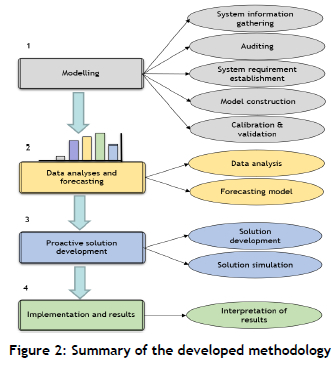
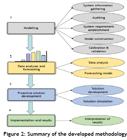
This section provides an overview of the methodology that was developed to assist deep-level gold mines in planning compressed air systems; for more information, please see the study by Burger [1]. The methodology was developed by using the literature, data, system information, and simulation software to create a digital twin model of the system. Figure 2 illustrates the methodology.
2.1. Modelling
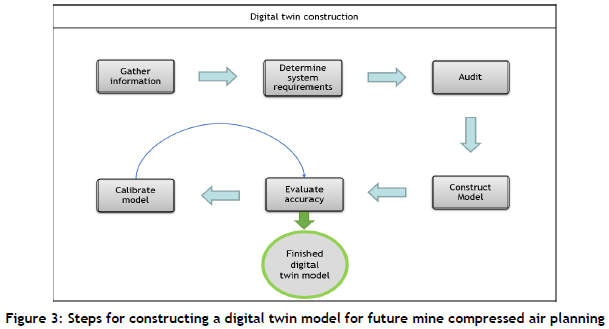
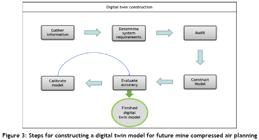
Several studies have outlined steps for developing digital twin simulation models that emphasise an iterative approach [19, 38, 46]. This study drew from previous research by Maré et al. and Pascoe et al. to establish steps for constructing a digital twin model for future mine compressed air planning [19, 46]. Figure 3 illustrates the process for constructing such a model for a deep-level gold mine compressed air system with future planning objectives.
The digital twin model should include the supply side, reticulation network, and demand side. The supply side includes compressors; the reticulation network comprises piping and valves; and the demand side features refuge bays and other users. The demand side should be represented by compressed air demand components that require the same demand flow and pressure represented by the compressed air users [47]. To simplify the modelling, the simulations in this study were constructed to simulate in a steady state under peak drilling shift conditions. This shift is the critical time frame of the system. In addition, the models extended only up to the cross-cut entrances of mining areas to reduce the costs and time for simulation construction without sacrificing accuracy [19, 46].
System information-gathering
Prior to constructing a simulation model, all necessary data must be collected [38]. This includes details on the supply and demand sides of the compressed air system, as well as information on the reticulation network used for distribution [3, 19, 38].
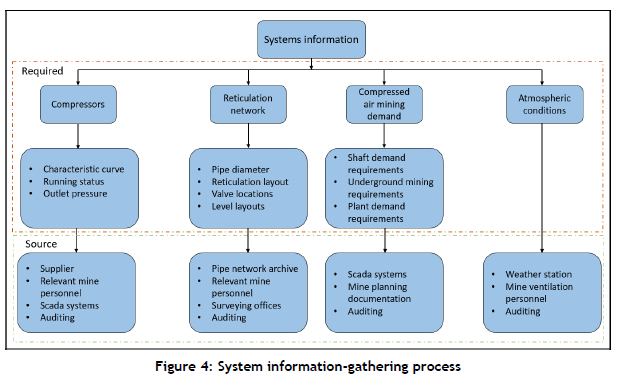
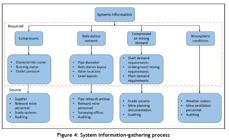
Using DXF level layouts with accurate geographical coordinates is essential for constructing the model, along with details of the compressed air system configuration and dynamic mining complex operations [23] On the supply side, gathering data on compressor types, performance, supply pressure, characteristic curves, efficiency, and other specs is crucial [39]. For the reticulation network, information on configuration, pipe dimensions, valve specifications, and other characteristics must be obtained [39]. Regarding the demand side, comprehensive data on all compressed air users, from surface workshops to underground operations, is necessary [9]. Audits will be required to gather additional information that is not readily available from mine personnel or other sources [45]. Figure 4 illustrates the data and information that is required, as well as possible sources from which the information could be obtained.
Establishing system requirements
Defining the specific system requirements is vital before simulating various planning scenarios [45]. This includes set points, system operating conditions, and compressed air requirements for continuous production [45]. These requirements serve as the foundation for compressed air system planning.
In deep-level gold mining, determining the required pressure at specific points in the system and for demand-side equipment is crucial [45]. Meeting the required pressure for drills is particularly critical, as it directly affects the drill penetration rate and production [3, 48]. Given the model's construction up to the cross-cut entrance, establishing the requirements at this point was essential.
To determine the requirements of the compressed air system at the cross-cut entrances, several key factors needed to be determined:
• What compressed air users are present in these sections?
• What are the requirements for these users?
• What is the standard layout of the compressed air system in these sections?
• What effect does the geography from the entrance to the stoping or development face have on the compressed air supply?
Research and gathering specifications documentation from equipment suppliers can establish the requirements of compressed air users in active mining areas. Completing a system audit will provide further relevant information.
The standard layout of the compressed air system in these sections can be obtained from the mine itself, as every mine has a standard for their infrastructure [22]. It is important to look at the manifold, valve positioning, and pipe sizing in these sections, as these may influence the compressed air supplied to the stoping and development faces. Assessing the effect of geography on compressed air supply involves considering two factors: the distance over which air needs to be distributed in these sections, and the minor head losses that are encountered over valves or in pipelines located in travel ways and raises.
In this study, a simplified simulation was used to establish the cross-cut entrance requirements for standard stoping and development ends. Information on the geography of these areas was gathered and used alongside other data to establish the cross-cut entrance requirements. Simulation software considers the previously mentioned factors, and has proven to be accurate in evaluating their effects [19, 38].
Auditing
This study required a comprehensive walk-through audit of the entire compressed air system - a process known to be difficult and time-consuming, yet crucial for constructing an effective digital twin model [22]. The audit comprises three parts: surface, shaft, and level audits. Conducting a walk-through audit involves inspecting and recording the compressed air system by visiting its subsections and walking along the pipelines [45].
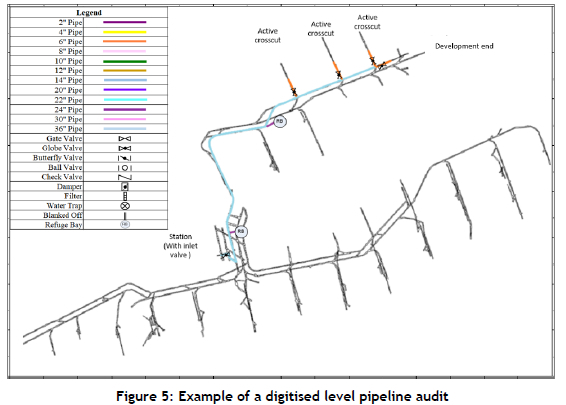
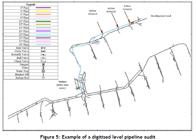
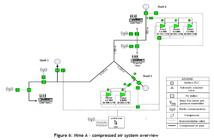
Auditing the entire compressed air system is crucial, particularly concerning the reticulation network, as mines may lack adequate information on pipeline sizing and network changes that might have occurred [7, 15, 33]. Special attention during the audit should focus on the level layout, pipeline configuration, pipe size, valve type and location, and any splits in the pipelines [45, 49]. Figure 5 shows an example of a level audit that has been digitised.
Model construction
The construction of the digital twin model begins with using the gathered system information, requirements, and audit findings. A baseline simulation of the current system is essential for estimating performance changes owing to production or infrastructure alterations [45]. This simulation validates the model's accuracy, and serves as the foundation for comparing various scenarios. The peak drilling shift was chosen as the baseline period for this study.
Several software packages can simulate mining systems and processes [41, 50]. However, only a few allow access to real-time system data and can simulate dynamic integrated systems [31, 51]. The simulation software for this study was chosen according to the requirements specified by Watkins for constructing simulations of deep-level mine compressed air systems [38]:
• The simulation software needs to be a transient simulation tool that can calculate the system's response to system infrastructure changes and mining demands.
• The simulation software needs to deliver various simulation outputs at a specified time step so that it can be compared with actual data.
• The simulation software needs to be suitable and easy to use for the application at hand.
• The simulation software must be accessible.
PTB, SolidWorks Flow Simulator, KYPipe Gas, and Flownex are potential simulation software packages for mining activities [52]. After comparison, PTB emerged as the most suitable for this study because of its alignment with all the specified requirements. The mine's three-year mining plan and the standard mining procedure for the compressed air infrastructure should be used to expand the digital twin model to include future mining areas.
Calibration and validation
The baseline simulation must undergo comparison with the current system using a control dataset, ensuring that all parameters are measured and verified against the digital twin's outputs. Verification and calibration are crucial for simulation accuracy [3, 45]. Calibration should adhere to component and system design specifications and requirements [38]. Mean absolute error (MAE) is the preferred method for validating simulations and for assessing accuracy by comparing major outputs such as system flow and pressure with actual system data [38, 52].
According to Maré et al. and other studies [19, 38, 45, 52], the model should undergo calibration until the simulation outputs are within a 5% error margin compared with the actual data. Simulation accuracy relies on the availability of data for precise comparisons and predictions; thus it is crucial to have sufficient accurate data during model calibration [53]. Inputting known data of the day's supply side, including the number of running compressors and their capacities, is essential. The three-year mining plan can determine active mining areas and their locations for the demand side of the model. Calibration and validation should be repeated until the desired model accuracy is achieved.
2.2. Data analyses and forecasting
The analysis was used to forecast the mine's future compressed air system requirements, using key performance indicators (KPIs) for effective performance measurement. KPIs - statistical values - are crucial for informed decision-making [54, 55]. The initial data analysis involves collecting and formulating data into KPIs.
Total production output is a standard KPI that mines use to determine productivity, and it is usually recorded as tonnes mined or hoisted [11]. The historical production of the mine in this study was evaluated by analysing the historical three-year mining plan. The historical data on tonnes of ore mined from each level and for the mine in total was captured and analysed. The compressed air used during the peak drilling shift is the peak production compressed air KPI [11]. During the peak drilling shift, the demand on the compressed air system is at its highest, as can be seen in Figure 1. The high compressed air consumption has a negative effect on the compressed air pressure because of friction losses in the reticulation network [11]. Thus the system is under the greatest stress to meet its requirements during this period. The compressed air consumed during the peak drilling shift is also the most closely related to shaft production [22, 24, 54, 56]. Therefore, the peak drilling shift requirements should be used for designing and planning the mine's compressed air system.
The data analysis should be completed by evaluating and comparing the historical production and compressed air use of the mine. The compressed air usage compared with the output production in the form of tonnes mined is an applicable KPI for identifying and evaluating system inefficiencies [11, 30]. These factors should be compared to establish the correlation between the compressed air flow requirements and production. The correlation can be determined by using a black box method, which is also known as a data-dependent model. The black box method uses statistical regression models and offers superior accuracy and ease of use [57, 58]. Any R^2 value greater than 0.5 is considered a strong correlation for compressed air models [58, 59]. The correlation between these factors can then be used to forecast the future requirements of the compressed air system. Simulation techniques can be used to quantify the relationship between system parameters [38]. The forecasting model is completed by using the digital twin model and the established correlation between the peak drilling shift compressed air flow and production.
The three-year mining plan should be used to establish the future production in each section of the mine and the mine in total. This data with the established correlation can then be used to estimate the future compressed air demand requirement for all underground mining activities during the peak drilling shift in the form of a total compressed air flow.
2.3. Proactive solution development
Digital twin simulations have been instrumental in proactive solution development, preventing disruptions and production delays in manufacturing industries [60]. Depending on the identified problem, a solution can be developed to solve it by upgrading or changing the system infrastructure. Leveraging existing mine infrastructure and making minimal adjustments to address inefficiencies can significantly reduce project implementation costs [3]. Solution development should proactively address identified problems to minimise their impact on mine production. This study implemented a proactive approach by scheduling solution implementation based on forecasting model results, aiming to mitigate the effects of the identified problems on the compressed air system and mine production.
The developed solution had to be simulated using the digital twin model, making relevant adjustments and updating the model according to the planned mining timeline. These simulations assessed both the system changes and the planned production effects. Proactive simulation-based procedures leveraged the speed of computer simulations compared with real-life production [61]. This allowed for a fast assessment of the solution's effectiveness. The simulation results could then be analysed to determine the solution's impact on the compressed air system performance.
3. METHODOLOGY IMPLEMENTATION AND RESULTS
The methodology was implemented at a deep-level gold mine in the North-West province of South Africa, referred to as 'Mine A' owing to a confidentiality agreement.
3.1. Case study background
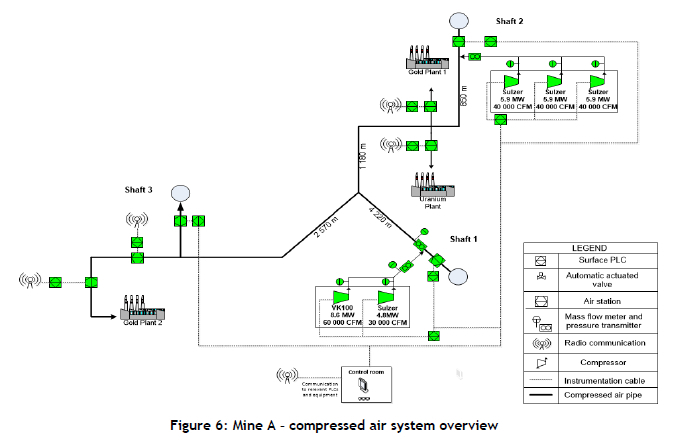
Mine A has a complex compressed air system that is expanded continuously as the mine goes deeper to increase its life-of-mine period. The system includes two compressor houses with five active compressors, totalling a capacity of 210,000 CFM. A standard piping reticulation system supplies compressed air to three shafts and three plants. Figure 4 illustrates the surface layout of Mine A's compressed air system.
3.2. Modelling
This section discusses the implementation of the methodology from Section 2.1 to construct a digital twin model of Mine A's compressed air system.
System information-gathering
All possible information was gathered for Mine A's compressed air system by following the system information-gathering process, and by researching the relevant literature.
All the necessary information for the supply side, including compressor specifications and characteristic curves, was collected. Information sources for the reticulation network were investigated, and discussions with mine personnel provided a basic understanding of the layout. However, owing to an incomplete knowledge of the entire network, audits were necessary to verify pipeline sizes and other details. Data for the demand side, including underground and surface compressed air users, was gathered from mine personnel and other sources. The three-year mining plan was used to determine the exact number of stoping and development ends that were active each month. Refuge bay locations were also obtained. This information was crucial for constructing Mine A's digital twin model.
The information-gathering process was one of the most difficult aspects of the implementation of the developed methodology. Given the old age and large size of the mining organisation, no single person knew the full details of the compressed air layout, and some data sheets for compressors and other equipment were not available. The auditing process and contacting the original suppliers helped to overcome these issues, but required a lot of effort and time.
System requirements established
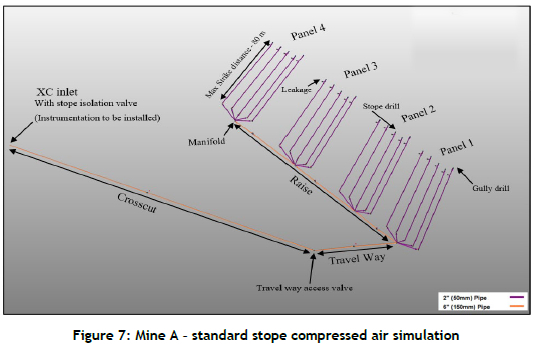
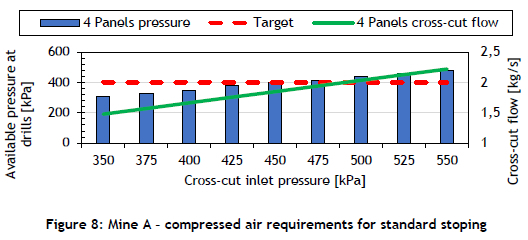
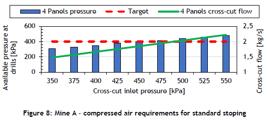
This section discusses the process followed to determine Mine A's system requirements, used as planning parameters for the compressed air system. The first step was to identify targeted pressure requirements at critical points. The minimum pressure for all equipment and plants was gathered, with the stoping and development faces needing at least 400 kPa for drills to operate effectively. During the peak drilling shift, the main compressed air users were the drills; thus 400 kPa at the stoping and development faces was used as the minimum requirement for the compressed air planning. The digital twin model was constructed up to the cross-cut entrances, and did not extend to the stoping and development faces. Thus the next step was to determine the compressed air requirements at the cross-cut entrance to deliver 400 kPa to the stoping and development faces. A simulation using Process ToolBox was built to determine these requirements. Figure 13 shows the completed standard stope compressed air simulation, constructed according to the standard sizing for these sections as provided by Mine A.
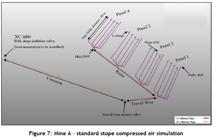
The number of active panels found in an active cross-cut for stoping was varied between one and four with different cross-cut inlet pressures. They were simulated to determine the pressure available at the drills. The results can be seen in Figure 6; from these results it was established that an inlet pressure of 450 kPa was required to provide the drills with 400 kPa for stoping. The same process was followed for the development ends. It was found that the required pressure at the cross-cut entrance for a development end was 425 kPa.
Auditing
Completing the audits helped to provide a good understanding of the system and the required information that could not be obtained from the information-gathering process. The surface compressed air system was audited by visiting the compressor houses and verifying previously gained compressor information. The compressed air reticulation network was followed to the shafts and plants on the surface and mapped. The proper arrangements were made, and shafts were examined for the reticulation network descending in these sections. Layouts of the underground levels with known information were drawn up, which made navigation during the level pipeline audits easier. The level pipeline audits were completed and the pipelines on each individual level were mapped using pen and paper. During the auditing process, refuge bays and other compressed air users on the demand side of the compressed air system were identified and their locations were pinpointed and recorded. The handwritten auditing documentation was digitised and stored.
Model construction
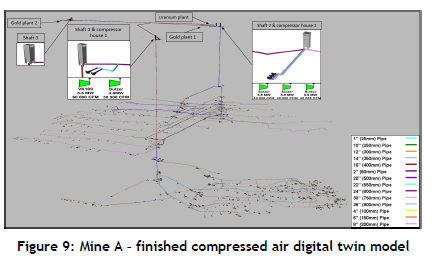
The previously gathered information from the compressed air audits and other sources was used to construct the base line digital twin model of the current compressed air system for Mine A. Figure 7 shows the finished compressed air digital twin model of Mine A's compressed air system. The three-year mining plan obtained from Mine A's planning department was used to expand the digital twin model to include future mining areas.
Calibration and validation
A day with adequate data on system conditions was chosen as a reference data set to determine the model's accuracy. The model was simulated and recalibrated until the error margins were sufficient. The results showed that the digital twin model accurately estimated the compressed air pressure with an MAE of 3%. The same process was followed for the compressed air flow, and was equal to 5%. This was within the specified 5% error margin required to validate the model.
3.3. Data analyses and forecasting
The data analysis was completed by first gathering the required information about the mine's production output and compressed air usage. The acquired data for Mine A was formulated into the required KPIs. The historical flows down the shafts during the peak drilling shift were obtained from the mine's Supervisory Control and Data Acquisition (SCADA) system. The data was formulated into a peak production compressed air KPI. Mine A's three-year mining plans provided information on the future and historical tonnes to be mined for the mine in total and for each level and cross-cut. The total historical tonnes mined was analysed and captured, and this data was used to formulate the total production output KPI.
As stated in Section 2.2, the compressed air usage to the output produced in the form of tonnes mined is an applicable KPI for identifying and evaluating system inefficiencies [10]. Thus the historical compressed air flow during the peak drilling shift and the total tonnes mined for Mine A were analysed and compared using a black box method to formulate this KPI. The regression analysis of the data revealed an R^2 value of 0.646, which is considered a strong linear correlation for compressed air models [58].
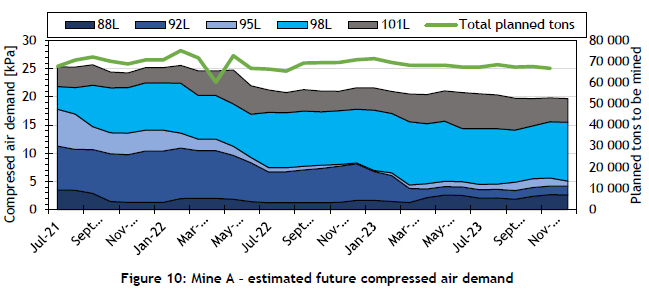
The forecasting model was completed using the developed digital twin model and the established correlation between compressed air flow and production. The three-year mining plan was used to establish future production in each section and for the mine in total. The established correlation and the data gained from the mine's three-year plan were used to estimate the future average compressed air flow requirements for all underground mining activities during the peak drilling shift. The flow during the peak drilling shift was further analysed to determine how much the maximum flows varied from the average flows during the peak drilling shift.
The analysis of the data showed that the maximum flow did not vary more than 15% from the average flow during the peak drilling shift. The analysis provided a good safety factor that was incorporated into the forecasting model. The developed model was used to estimate the future total compressed air demand requirements for underground mining according to the total planned tonnes in the three-year mining plan. The estimated upper flow limits were divided between the different production levels to estimate the future compressed air flow demand requirements for each level, as shown in Figure 8.
Figure 8 shows that the total required demand for compressed air remained reasonably constant and started to decrease slightly. At the same time, the compressed air demand for 98L drastically increased over the same period. This was an indicator that 98L was a potential problem area, as the originally installed infrastructure was not intended to supply such large compressed air demands. Using the digital twin model developed in Section 3.2.5 and simulating Mine A for each month of the three-year mining plan, it was identified that 98L was going to struggle with insufficient compressed air pressure for mining activities, as 98L East Haulage fell below the 450 kPa target from July 2021 onwards. The 98L Inlet pressure also fell below 450 kPa from October 2021 onwards.
3.4. Proactive solution development
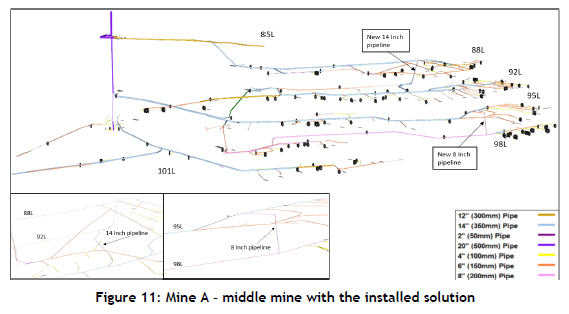
The results of the data analysis and the forecasting model clearly indicated that the compressed air reticulation network would experience problems with supplying adequate compressed air pressure to 98L for the necessary mining activities. 98L forms part of the middle mine of Mine A. Figure 9 shows a representation of the compressed air system of the middle mine. The shaft supplies compressed air to 85L and 95L; 85L supplies 88L; and 95L supplies 92L and 98L.
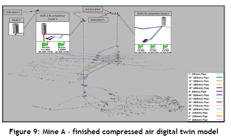
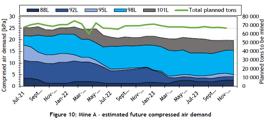
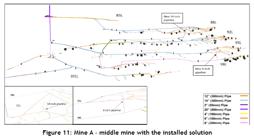
Figure 8 demonstrates that the compressed air demand for 98L would increase over time, while the demand for compressed air on 88L, 92L and 95L would decrease. The decrease in demand on 88L, 92L and 95L provided the opportunity for these levels to supply other sections of Mine A with the surplus compressed air their infrastructure could support. The pipeline supplying 98L from 95L was a 6" pipe, which was too small to supply the level with the required compressed air flow and pressure. Considering this, a solution was developed to create ring feeds between the levels of this section. This would help to distribute the surplus compressed air from the levels where the demand decreased to 98L where the demand increased.
The first step of the solution developed entailed installing an additional 8" pipeline between 95L and 98L, which would distribute the surplus compressed air from 95L to 98L. The second step of the solution, installing a 14" pipeline from 88L to 92L, would distribute the surplus air from 85L and 88L to provide for a portion of the compressed air demand on 92L. In turn, this would reduce the amount of compressed air that had to be supplied from 95L to 92L. It would further assist 95L by providing more compressed air at higher pressures to 98L. Figure 9 shows the compressed air system after implementing the proposed solution. The mine personnel established that the fastest time frame for the solution to be implemented was by 12 July 2022.
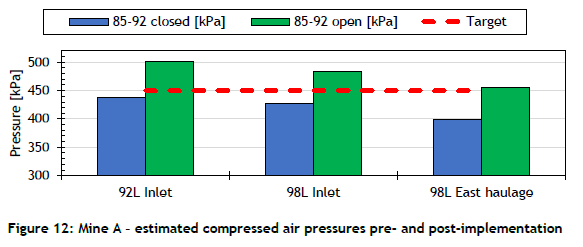
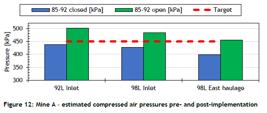
The developed solution was simulated as discussed in the methodology to determine the effect of these changes on the system. The simulations took into account both the changes to the system and the changes in production according to the three-year mining plan. Figure 12 shows the results obtained from the digital twin simulation for the completion of both steps of the solution. The results showed that the implementation of the solution would increase the pressure at the 98L Inlet and at the 98L East Haulage by 56 kPa. This would provide 98L with the required pressure to meet the target pressure of 450 kPa.
3.5. Results of implementation
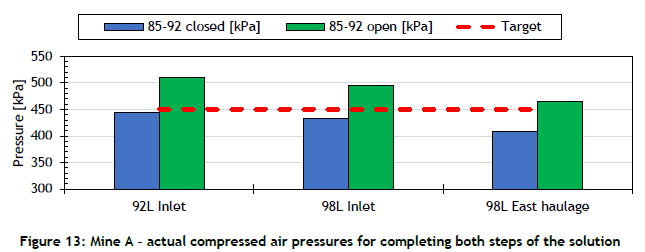
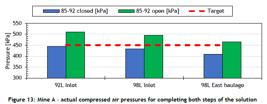
The second part of the solution was implemented on 12 July 2022. The data from the relevant pressure sensors was collected from the mine's SCADA system pre- and post-implementation and analysed and compared. The results, as presented in Figure 13 showed that the implementation of Step 2 of the solution increased the pressure at the 98L Inlet and at the 98L East Haulage by 58 kPa and 59 kPa, respectively. This ensured that 98L had sufficient compressed air pressure to meet the target pressure of 450 kPa.
Table 1 compares the results for the compressed air pressure on 98L pre-implementation and post-implementation, and the estimated pressure if there had been no intervention. The pressure at 98L Inlet is 21% higher and the pressure at 98L East Haulage is 32% higher than it would have been if no intervention had been done.
The implementation of the solution was successful, as it improved the compressed air pressure for 98L and ensured that all the levels had sufficient compressed air pressure for all mining activities. The simulation proved to be accurate, as the outcome predicted by the simulations was correct. It should be noted that the actual pressures for the implementation are slightly higher than the simulated pressures owing to the safety factor included in the simulation, which increased the size of the compressed air flow demands used in the simulation. As pressure is inversely proportional to flow, this made the simulated pressure a bit lower than the actual pressures.
4. CONCLUSION
Mine compressed air services suffer from poor future planning and outdated infrastructure, causing inefficiencies and production losses. Standards and guidelines used for planning do not account for the dynamic mining environment, where service delivery and production areas frequently change, leading to shifting system requirements. Simulation software in mining has effectively identified problem areas in compressed air networks, but has focused on solving current issues rather than on proactive planning. This study developed a methodology using digital twin simulations to identify and address future problems and inefficiencies in mine compressed air systems.
The methodology was tested and validated through a case study at Mine A, a deep-level gold mine in South Africa. A digital twin model of the mine's compressed air system was created and expanded to include future activities. A potential issue was identified in the main production level's compressed air system, which would have failed to meet the required pressure for stoping. The methodology was applied, resulting in a proactive solution. The simulation results indicated that the solution would enable the system to meet future requirements. The project was handed over to mine personnel for implementation, increasing the compressed air pressure at the problem level by 32% and preventing production losses.
This research demonstrated that the compressed air planning methodology effectively identified and resolved issues in mine compressed air systems. Implementing this methodology in other deep-level mines could reduce downtime and unscheduled maintenance, thereby increasing production and profitability.
REFERENCES
- [1] P. Burger, "Future mine compressed air planning using digital twin simulations," Master's dissertation , North-West University, South Africa, 2023.
- [2] J. A. du Preez, "Analysing the influence of compressed air pressure on gold production," Master's dissertation, North-West University, South Africa, 2020.
- [3] D. Nell, "Optimising production through improving the efficiency of mine compressed air networks with limited infrastructure," Doctoral dissertation, North-West University, South Africa, November 2017.
- [4] C. Scheepers, "Implementing energy efficiency measures on the compressed air network of old South African mines," Master's thesis, North West University, South Africa, 2011.
- [5] J. Jonker, "Automated mine compressed air control for sustainable savings," M.Eng. dissertation, North-West University, Potchefstroom, 2016.
- [6] U.S. Department of Energy, "Improving Compressed Air System Performance: A Sourcebook for Industry," 3rd ed., Advanced Manufacturing Office, pp. 16, 2017.
- [7] C. J. R. Kriel, J. Marais, and M. Kleingeld, ""Modernising underground compressed air DSM projects to reduce operating costs,"" in 2014 International Conference on the Eleventh industrial and Commercial Use of Energy, IEEE, 2014, pp. 1-6.
- [8] C. Cilliers, "Benchmarking electricity use of deep-level mines," PhD thesis, North-West University, South Africa, 2016.
- [9] J. H. Marais, "An integrated approach to optimise energy consumption of mine compressed air systems," PhD thesis, North-West University, South Africa, 2012.
-
[10] D. du Plooy, P. Maré, J. Marais, and M. J. Mathews, "Local benchmarking in mines to locate inefficient compressed air usage," Sustainable Production and Consumption, vol. 17, pp. 126-135, 2019. doi: 10.1016/j.spc.2018.09.010
» https://doi.org/10.1016/j.spc.2018.09.010 - [11] C. J. J. van Zyl, "Practical approach to analyse mine pneumatic drilling performance," Master's thesis, North-West University, South Africa, 2020.
- [12] S. Fouché, ""Improving efficiency of a mine compressed air system," Master's thesis, North West University, South Africa, 2017.
- [13] A. J. M. van Tonder, G. Bolt and J. F. van Rensburg, "Compressed air alternative solutions: Challenges encountered in deep level mining," 2012 Proceedings of the 9th Industrial and Commercial Use of Energy Conference, Cape Town, South Africa, 2012, pp. 1-8.
- [14] Marais, J.H., Kleingeld, M. and Van Rensburg, J.F., 2013, August. Simplification of mine compressed air systems. In 2013 Proceedings of the 10th Industrial and Commercial Use of Energy Conference (pp. 1-8). IEEE.
- [15] C. Oosthuizen, "A compressed air cost savings identification model for deep-level mines," Master's thesis, North-West University, South Africa, May 2019.
-
[16] A. T. Mckane, Improving compressed air system performance: A sourcebook for industry, US DOE, Lawrence Berkeley National Laboratory, LBNL Report #: LBNL-43888 Update, 2003. Retrieved from https://escholarship.org/uc/item/1627b9w
» https://escholarship.org/uc/item/1627b9w - [17] J. N. de la Vergne, Hard Rock Miner's Handbook, 5th ed., Stantec Consulting Ltd., Edmonton, Alberta, Canada: Stantec Consulting Ltd., 2008, pp. 178-186.
-
[18] "Pipe Couplings & Pipe Joining Product Category," *Victaulic*. https://www.victaulic.com/vtc_product_categories/pipe-joining-couplings/ (accessed 2022).
» https://www.victaulic.com/vtc_product_categories/pipe-joining-couplings/ - [19] P. Maré, J. I. G. Bredenkamp and J. H. Marais, "Evaluating compressed air operational improvements on a deep-level mine through simulations," 2017 International Conference on the Industrial and Commercial Use of Energy (ICUE), Cape Town, South Africa, 2017, pp. 1-8, doi: 10.23919/ICUE.2017.8068011
- [20] S. Mousavi, S. Kara, and B. Kornfeld, "Energy efficiency of compressed air systems," Procedia Cirp, vol. 15, pp. 313-318, 2014.
- [21] L. D. Meyer, "The development of an improved labour planning model for mines," Master's thesis, North-West University, South Africa, 2004.
- [22] L. Zietsman, "Novel solutions for compressed air demand management on deep-level mines," PhD thesis, North-West University, South Africa, 2020.
- [23] M. Aller, D. Stinson, and P. Edwards, "The financial impact of compressed air projects," in IEEE Cement Industry Technical Conference, 2006, Phoenix AZ, IEEE, April 2006, pp. 156-167.
- [24] S. Cloete, D. le Roux, and R. Bührmann, "Reducing compressed air wastage by installing new technology in underground mines," in 2013 Proceedings of the 10th Industrial and Commercial Use of Energy Conference, Cape Town, South Africa, IEEE, August 2013, pp. 1-6.
- [25] M. H. P. van Niekerk, S. van Heerden, and J. van Rensburg, "The implementation of a dynamic air compressor selector system in mines," in 2015 International Conference on the Industrial and Commercial Use of Energy (ICUE), IEEE, 2015, pp. 129-132.
- [26] E. Cagno and A. Trianni, "Evaluating the barriers to specific industrial energy efficiency measures: An exploratory study in small and medium-sized enterprises," Journal of Cleaner Production, vol. 82, pp. 70-83, 2014.
- [27] R. Saidur, N. A. Rahim, and M. Hasanuzzaman, "A review on compressed-air energy use and energy savings," Renewable and Sustainable Energy Reviews, vol. 14, no. 4, pp. 1135-1153, 2010.
-
[28] D. Cuello and G. Newcombe, "Key geotechnical knowledge and practical mine planning guidelines in deep, high-stress, hard rock conditions for block and panel cave mining," in Y. Potvin & J. Jakubec (eds), Caving 2018: Proceedings of the Fourth International Symposium on Block and Sublevel Caving, Australian Centre for Geomechanics, Perth, 2018, pp. 17-36, https://doi.org/10.36487/ACG_rep/1815_0.2_Cuello
» https://doi.org/10.36487/ACG_rep/1815_0.2_Cuello - [29] J. R. Neale and P. J. Kamp, "Compressed air system best practice programmes: What needs to change to secure long-term energy savings for New Zealand?" Energy Policy, vol. 37, no. 9, pp. 34003408, 2009.
- [30] P. Maré, J. Marais, and J. van Rensburg, "Improved implementation strategies to sustain energy saving measures on mine cooling systems," in 2015 International Conference on the Industrial and Commercial Use of Energy (ICUE), IEEE, 2015, pp. 102-109.
- [31] A. J. M. van Tonder, Automation of Compressor Networks Through a Dynamic Control System, Doctoral dissertation, Potchefstroom Campus, North-West University, South Africa, Nov. 2014, pp. 178-186.
- [32] W. Booysen, "Reducing energy consumption on RSA mines through optimised compressor control," Master's thesis, North-West University, South Africa, 2010.
- [33] L. N. Zietsman, J. H. Marais, and H. P. R. Joubert, "Identification Model for Cost-Effective Electricity Savings on a Deep-Level Mine Surface Refrigeration System," North-West University, Potchefstroom, South Africa, 2018, pp. 2-5.
- [34] A. Vermeulen, "Methods to optimise underground mine production," Master's thesis, Potchefstroom University for Christian Higher Education, 2002.
- [35] W. Valery, A. Jankovic, and B. Sonmez, "New methodology to improve productivity of mining operations," in XIV Balkan Mineral Processing Congress, Tuzla, Bosnia & Herzegovina , June 2011, pp. 557-565.
- [36] E. VanDerHorn and S. Mahadevan, "Digital twin: Generalization, characterization and implementation," Decision Support Systems, vol. 145, p. 113524, 2021.
- [37] M. Grieves, "Digital twin: Manufacturing excellence through virtual factory replication," White Paper, 2014, pp. 1-7 .
- [38] J. Watkins, "Trade-off between simulation accuracy and complexity for mine compressed air systems," Master's thesis, North-West University (South Africa), 2019.
- [39] J. F. van Rensburg, M. Geyser, M. Kleingeld, and E. Mathews, "Developing ESCo procedures for large telecommunication facilities using novel simulation techniques," Journal of Energy in Southern Africa, vol. 19, no. 1, pp. 43-54, 2008.
- [40] W. van Niekerk, M. Kleingeld, and W. Booysen, "The value of simulation models when implementing mine DSM projects," in 2013 Proceedings of the 10th Industrial and Commercial Use of Energy Conference, IEEE, 2013, pp. 1-4 .
- [41] J. Venter, "Development of a dynamic centrifugal compressor selector for large compressed air networks in the mining industry," Master's thesis, North-West University, South Africa, 2012.
- [42] S. P. Upadhyay and H. Askari-Nasab, "Simulation and optimization approach for uncertainty-based short-term planning in open pit mines," International Journal of Mining Science and Technology, vol. 28, no. 2, pp. 153-166, 2018.
- [43] A. Kluczek and P. Olszewski, "Energy audits in industrial processes," Journal of Cleaner Production, vol. 142, pp. 3437-3453, 2017.
- [44] K. Bunse, M. Vodicka, P. Schönsleben, M. Brülhart, and F. O. Ernst, "Integrating energy efficiency performance in production management: Gap analysis between industrial needs and scientific literature," Journal of Cleaner Production, vol. 19, no. 6-7, pp. 667-679, 2011.
- [45] F. Matthee, "Evaluating the feasibility of integrating mine compressed air systems for energy savings," Master's thesis, North-West University (South Africa), 2021.
- [46] B. Pascoe, H. J. Groenewald, and M. Kleingeld, "Improving mine compressed air network efficiency through demand and supply control," in 2017 International Conference on the Industrial and Commercial Use of Energy (ICUE), IEEE, 2017, pp. 2-4.
- [47] D. Arndt, Process toolbox user manual. 2017.
-
[48] S. B. Kivade, Ch. S. N. Murthy, and Harsha Vardhan, "Experimental Investigations on Penetration Rate of Percussive Drill," Procedia Earth and Planetary Science, vol. 11, pp. 89-99, 2015. doi:10.1016/j. proeps.2015.06.012.
» https://doi.org/10.1016/j. proeps.2015.06.012 - [49] P. Fraser, "The energy and water required to drill a hole," in Fourth International Platinum Conference. Platinum in Transition 'Boom or Bust', Sun City, South Africa, October 2010, pp. 11 -14.
- [50] Y. Alomair, I. Ahmad, and A. Alghamdi, "A review of evaluation methods and techniques for simulation packages," Procedia Computer Science, vol. 62, pp. 249-256, 2015.
- [51] G. E. du Plessis, D. C. Arndt, and E. H. Mathews, "The development and integrated simulation of a variable water flow energy saving strategy for deep-mine cooling systems," Sustainable Energy Technologies and Assessments, vol. 10, pp. 71-78, 2015.
-
[52] B. Friedenstein, C. Cilliers, and J. van Rensburg, "Simulating operational improvements on mine compressed air systems," South African Journal of Industrial Engineering, vol. 29, no. 3, 2018. doi: 10.7166/29-3-2049
» https://doi.org/10.7166/29-3-2049 - [53] B. Bartin, K. Ozbay, J. Gao, and A. Kurkcu, "Calibration and validation of large-scale traffic simulation networks: A case study," Procedia Computer Science, vol. 130, pp. 844-849, 2018.
- [54] F. Barnard and L. Grobler, "Baseline service level adjustment methodologies for energy efficiency projects on compressed air systems in the mining industry," in 2012 Proceedings of the 9th Industrial and Commercial Use of Energy Conference, IEEE, 2012, pp. 1-8.
- [55] R. D. Cook and S. Weisberg, Applied regression including computing and graphics. John Wiley & Sons, 2009.
- [56] J. Vermeulen, J. H. Marais, and W. Schoeman, "Simplified high-level investigation methodology for energy saving initiatives on deep-level mine compressed air systems," 2018 International Conference on the Industrial and Commercial Use of Energy (ICUE), Cape Town, South Africa, August 2018, pp. 1-8.
- [57] D. Jacobs, "Developing a digital twin for addressing complex mine ventilation problems," PhD thesis, North-West University, South Africa, June 2021.
- [58] I. Schuin, "Evaluating different statistical regression models for industrial energy measurement and verification," Master's thesis, North-West University, South Africa, 2020.
- [59] D. E. Hinkle, W. Wiersma, and S. G. Jurs, Applied statistics for the behavioral sciences. Houghton Mifflin, 2003.
-
[60] N. C. Schäfer, P. Burggräf, and T. Adlon, "Application of a Digital Twin for Proactive Production Planning," in SNAME Maritime Convention, 2022, vol. Day 2 Wed, September 28, 2022, D021S009R001, doi: 10.5957/smc-2022-058. [Online]. Available: https://doi.org/10.5957/SMC-2022-058
» https://doi.org/10.5957/SMC-2022-058 - [61] P. Vazan, J. Znamenak, and M. Juhas, "Proactive simulation in production line control," in 2018 IEEE 13th International Scientific and Technical Conference on Computer Sciences and Information Technologies (CSIT), vol. 1, IEEE, 2018, pp. 52-55.
ORCID® identifiers
P. Burger: https://orcid.org/0000-0002-5642-4561
J.C. Vosloo: https://orcid.org/0000-0003-1063-0252
J.H. van Laar: https://orcid.org/0000-0002-5642-4561